Introduction
Day-old chicks are the end product of the hatchery industry and provide the important starting point for broiler production. The major objective of hatcheries is to obtain a high hatchability of marketable chicks within a narrow spread of hatch. For broiler farmers, these chicks have to perform well, which translates as high viability, growth rate and breast meat yield and low feed conversion. A good-quality one day-old chick is a crucial link between the hatchery and the broiler farm (Decuypere et al., Reference DECUYPERE, TONA, BRUGGEMAN and BAMELIS2001; Decuypere and Bruggeman, Reference DECUYPERE and BRUGGEMAN2007).
Chicks do not emerge from their egg all at the same time - there is a hatching window ranging between 24-48 hours (h). In practice, all chicks stay in the incubator until almost all have hatched. This period, added to the time required for hatchery treatments and transport to the broiler farm, means that chicks may be deprived of feed and water for up to 48-72 h. In addition, the spread in hatch causes variability in the delay in time to feed access within one batch of chicks. This delay in feed access has repercussions on the development and growth of the chicks, with the magnitude of the effect of the delay in feed access depending on the hatching time within the hatching window.
This review is intended to give an overview concerning these problems. Firstly, the consequences of delay in feed access early post-hatch will be discussed. Secondly, the importance of the spread of the hatching period will be highlighted along with the consequences of any interaction between delay in feed access and spread of hatch. As one way to overcome negative effects caused by delay in feed access is to provide hatchlings with a pre-starter diet, the final section will discuss the effects of diet composition of pre-starter diets and an overview of already known results given.
Importance of early nutrition
In practice, both chicks and poults hatch over a period of 24-48 hours and are held in the incubator until a large percentage of the birds have hatched. Hatchery treatments and transport to the farm involve a further holding period of up to 72 hours. During this period, birds normally receive neither food nor water. Despite the contribution of residual yolk to the bird's energy balance, the newly hatched chicks have only a limited ability to assimilate food and water (Nitsan et al., Reference NITSAN, BEN-AVRAHAM, ZOREF and NIR1991). This results in the mobilisation of body reserves, mainly from subcutaneous fat and liver and potentially from muscles, to support metabolism and maturation of the thermoregulatory system, a process that manifests mainly during the first ten days of the postnatal life (Nichelmann and Tzschentke, Reference NICHELMANN and TZSCHENTKE2002).
The importance of early nutrition has already been extensively researched in recent years. The review by Uni and Ferket (Reference UNI and FERKET2004) gave an overview of the effect of a prolonged holding time after hatch on yolk utilisation, growth and gastro-intestinal development, muscle development and immunological development. However, the effect of delay in feed access and hormones and metabolites as well as on development of homeothermy has not been described in detail in literature yet. Results obtained in our laboratory have given an initial insight in the effect of early nutrition on hormone and metabolite levels and the development of homeothermy.
hormones and metabolites
Careghi et al. (Reference CAREGHI, TONA, ONAGBESAN, BUYSE, DECUYPERE and BRUGGEMAN2005) showed that chicks suffering from delay in feeding time have lower plasma T3 levels, suggesting an overall lower metabolic rate, which agrees with the results of Noy and Sklan (Reference NOY and SKLAN2001). Unpublished results obtained in our laboratory showed differential effects between fed and feed-delayed chicks on protein and lipid metabolism. Decreased levels of plasma uric acid and triglycerides after 36 – 48 h of starvation suggest a decrease in amino acid oxidation and hepatic lipogenesis, respectively. However, plasma levels of glucose, as a measure for carbohydrate metabolism, were not affected by feed deprivation. In addition, initial feeding of starved chicks resulted in heightened levels of plasma uric acid, triglycerides and glucose concentration, which dropped to normal levels thereafter, probably due to feedback mechanisms as described for 3 to 6 week old broiler chickens by Swennen et al. (Reference SWENNEN, JANSSENS, MILLET, VANSANT, DECUYPERE and BUYSE2005).
development of homeothermy
Decuypere and Kühn (Reference DECUYPERE and KÜHN1988) found that chicks fasted for 16 h before a short-term cold exposure had a greater decrease in body temperature than their fed counterparts, and this was maintained throughout the first week of life. In combination, they also found that these conditions resulted in a decreased serum T3 level and an increased serum T4 level, which was the reverse to that observed for chicks that were fed before cold exposure. This effect of feed restriction on the thyroid hormone levels was substantiated by King et al. (Reference KING, KING and ESHLEMAN1977), May (Reference MAY1978), Harvey and Klandorf (Reference HARVEY and KLANDORF1983), Klandorf and Harvey (Reference KLANDORF and HARVEY1985), Scanes and Griminger (Reference SCANES and GRIMINGER1990), Kühn et al. (Reference KÜHN, HERREMANS, DEWIL, VANDERPOOTEN, RUDAS, BARTHA, VERHEYEN, BERGHMAN and DECUYPERE1991), Darras et al. (Reference DARRAS, COKELAERE, DEWIL, ARNOUTS, DECUYPERE and KÜHN1995, Reference DARRAS, MOL, VAN DER GEYTEN and KÜHN1998) and Van der Geyten et al. (Reference VAN DER GEYTEN, VAN ROMPAEY, SANDERS, VISSER, KÜHN and DARRAS1999). According to the study of Van der Geyten et al. (Reference VAN DER GEYTEN, VAN ROMPAEY, SANDERS, VISSER, KÜHN and DARRAS1999), hepatic D3, an iodothyronine deiodinase that inactivates T3 or T4 by inner ring deiodination (St. Germain and Galton, Reference ST. GERMAIN and GALTON1997) appears to play a central role in the regulation of plasma T3 during fasting and re-feeding in the chicken. All these observations in combination with the knowledge that thyroid hormones have a crucial role in the thermoregulatory system (Debonne et al., Reference DEBONNE, BAARENDSE, VAN DEN BRAND, KEMP, BRUGGEMAN and DECUYPERE2008) leads to the hypothesis that a delay in feed access from the moment of hatch onwards impairs the thermoregulatory abilities of newly hatched chicks. This implies that if no feed can be provided after hatch for whatever reason, climatic conditions have to be adapted towards a higher environmental temperature to preserve the quality of the chick when placed on the farm.
Importance of time of hatch within a hatching window and spread of hatch between different hatching windows
Much research has already been conducted to elucidate the effects of early feeding. However, most investigators did not take into account the differences in biological age due to spread of hatch.
chronological and biological age
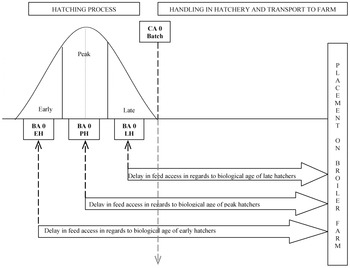
In general, the delay in time before chicks are fed for the first time is calculated by the time spent in the hatchery after hatch (for treatments such as sexing and vaccination), added to the transportation time to the broiler farm. In addition, the added ‘hatch window’ of 24 to 48 h (early versus late hatchers) must be taken into consideration (Decuypere et al., Reference DECUYPERE, TONA, BRUGGEMAN and BAMELIS2001) (Figure 1). Due to this spread in hatch, chicks not only differ in biological age, but also in quality (Bamelis et al., Reference BAMELIS, KEMPS, MERTENS, DE KETELAERE, DECUYPERE and DE BAERDEMAEKER2005; Tona et al., Reference TONA, BAMELIS, DE KETELAERE, BRUGGEMAN, MORAES, BUYSE, ONAGBESAN and DECUYPERE2003; Willemsen et al., Reference WILLEMSEN, EVERAERT, WITTERS, DE SMIT, DEBONNE, VERSCHUERE, GARAIN, BERCKMANS, DECUYPERE and BRUGGEMAN2008).
Schematic overview of the difference between biological and chronological age as the interaction with time of hatch within a hatching window is highlighted. Biological age is defined as the age in days in reference to the exact time of hatch while chronological age is defined as the age in days in reference to the end of hatch of the whole batch. Late hatchers have a smaller delay in feed access than peak hatchers which in turn have a smaller delay in feed access than early hatchers.
BA: Biological age; CA: Chronological age; EH: Early hatchers; PH: Peak hatchers; LH: Late hatchers.

A study by Careghi et al. (Reference CAREGHI, TONA, ONAGBESAN, BUYSE, DECUYPERE and BRUGGEMAN2005) underlined the importance of the difference between biological and chronological age of chicks. Biological age (BA) of chicks is defined as the age in days in reference to the exact time of hatch while chronological age (CA) is defined as the age in days in reference to the end of hatch of the whole batch. The relative growth (RG) of chicks from hatch to BA 2 d is twice as low for early hatchers as for late hatchers and stays higher for these late hatchers until BA 7 d when kept under conditions of immediate access to food. In contrast, no difference was found between late and early hatchers in RG at chronological age 7 d when feed was provided immediately (Careghi et al., Reference CAREGHI, TONA, ONAGBESAN, BUYSE, DECUYPERE and BRUGGEMAN2005). The egg weight at the start of incubation seems to have an effect on the time of hatch within the hatch window, as Careghi et al. (Reference CAREGHI, TONA, ONAGBESAN, BUYSE, DECUYPERE and BRUGGEMAN2005) found that early hatchers had a significantly lower starting egg weight as compared to late hatchers. In addition, a corresponding trend in higher hatching weight for the late hatchers was reported. An even more important observation made by these authors was the significant interaction between BA of chicks and delay in feeding time. At BA 4 d, the fasted chicks still had greater RG than the chicks that had been reared with feed. In addition, delayed feeding had a profoundly depressing effect on the growth to 7 d of late hatchers when CA was taken into account, a condition that was not apparent when BA was considered. An explanation in the differential growth rate to 7 d of age may be partly due to the differences in the levels of intestinal development and utilization of nutrients as described above. Other unknown intrinsic factors related to time of hatch may be involved in post-hatch growth potential of differently hatched groups.
spread of hatch
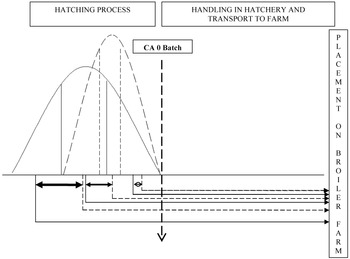
Delay in feed does not have the same effect on early and late hatchers, as late hatchers benefit more from early access to feed after hatch than early hatchers both when taken at biological or chronological similar ages after hatch (Careghi et al., Reference CAREGHI, TONA, ONAGBESAN, BUYSE, DECUYPERE and BRUGGEMAN2005). Therefore, it can be stated that the time of hatch within a hatching window is an important factor that aggravates the negative effect of delay in feed access (Careghi et al., Reference CAREGHI, TONA, ONAGBESAN, BUYSE, DECUYPERE and BRUGGEMAN2005). Moreover, the magnitude of the effect of delayed feeding is not only dependent on the hatching period within the hatching window, but also on the spread of hatch between batches (Decuypere and Bruggeman, Reference DECUYPERE and BRUGGEMAN2007) as demonstrated in Figure 2. The difference in the effect of delay in feed access between early and late hatchers, in practice conditions, becomes very obvious when the spread of hatch is smaller / larger. The duration of feed deprivation of late hatchers is little influenced by the spread of hatch, while in peak hatchers and early hatchers this severely decreases when the spread of hatch is smaller. In addition, the spread of the hatch is affected by incubation conditions as temperature, turning conditions or gaseous environment as well as by pre-incubation conditions as egg storage duration and the age of parent stock (Decuypere and Bruggeman, Reference DECUYPERE and BRUGGEMAN2007).
Effect of spread of hatch on the interaction between delay in feed access and time of hatch within the hatching window. The difference in duration of feed deprivation of late ( ), peak (
 ) and early (
 ) hatchers between batches with a small (
 ) or large (
 ) spread of hatch is shown. The duration of delay in feed access is very little influenced for late hatchers, while in peak and early hatchers it severely increases when spread of hatch is larger. CA: chronological age.

glucose, thyroid hormones and heat production
The spread of hatching time seems to affect the ability of newly-hatched chicks to use ingested glucose (unpublished results). Newly-hatched chicks have to make a transition from an endogenous lipid-rich yolk to carbohydrate-rich exogenous feed. As yolk lipids are depleted a few days after hatch, after which glucose becomes the primary energy source (Sklan, Reference SKLAN2003), chicks need to obtain a high capacity for degrading and ingesting carbohydrates soon after hatch. Late hatchers, when fed immediately after hatch, use glucose faster or possibly more efficiently than the early and peak hatchers (unpublished results). In combination with such digestive enzyme maturation (Moran, Reference MORAN1985), it provides them with the ability to use exogenous carbohydrates sooner than early hatchers. In addition, heat production, as a measurement for metabolic rate, was dependent on time of hatch. Heat production increases with age, although this increase appeared to be smaller for early hatchers (unpublished results). The combination of these two observations leads to the conclusion that the hatching time has an influence on the metabolic rate of the chicks during the first week of life. However, in a previous experiment (Careghi et al., Reference CAREGHI, TONA, ONAGBESAN, BUYSE, DECUYPERE and BRUGGEMAN2005) no differences in plasma T3 levels were found between early and late hatchers when feed was provided immediately after hatch. In contrast, when chicks were delayed in feed access, a clear effect on plasma T3 levels was observed. Chicks with a 48 h delay in feed access showed lower plasma T3 levels compared with chicks which had immediate access to feed. In addition, late hatchers exhibited lower plasma T3 levels during the fasting period than early hatchers. When chicks were fed, T3 levels increased significantly to normal basal values. Noy and Sklan (Reference NOY and SKLAN2001) reported the same observation.
new technologies
Because of the literature cited above, there is great interest in ways to aid chick nutrition before placement, as Careghi et al. (Reference CAREGHI, TONA, ONAGBESAN, BUYSE, DECUYPERE and BRUGGEMAN2005) suggested, by providing an energy source in the hatching basket and during transport. New technologies to overcome these problems are available. Some hatchery management experts have come up with an alternative housing system where these problems are addressed. In 2006, a new concept of early housing system in which pre-hatched eggs are brought in at day 18 of incubation in order to hatch under the novel regime, was introduced. When chicks emerge from their eggs they fall on a litter belt where food and water is immediately available and where they can stay from 7 to 10 d post-hatch before being transferred to the traditional broiler farm. This housing system serves both as a hatchery and a broiler housing system. According to Horrox (Reference HORROX2006), this type of housing system should result in chicks and poults equivalently one day ahead in development compared to standard industry practice. However, it requires heavy investment in new equipment and changes in logistics by hatcheries (de Oliveira, Reference DE OLIVEIRA2007).
Another possible solution is to provide hatchling supplements at the hatchery and/or at placement at the farm. Products such as Oasis (Novus International), Galito (Vitamex) and Gro-Gel (Dawe's Laboratories) are being used to promote early growth and liveability of poultry. The Oasis hatching supplement is a semi-solid hydrated nutritional supplement that contains 70% water, 10% protein, 20% carbohydrate and less than 1% fat (Batal and Parson, 2002). Benefits of post-hatch feeding supplement have been reported by Noy and Sklan (Reference NOY and SKLAN1999b) and Batal and Parsons (Reference BATAL and PARSONS2002). Although their results indicated that feeding Oasis (compared to fasting) had beneficial effects on growth performance, no significant differences were found between different forms of early nutrition (traditional solid feed, semi-solid feed (Oasis) or liquid nutrients). The beneficial effects of hatching supplements are explained by the fact that these chicks had immediate access to feed, whatever the form of the early nutrition. This leads to the hypothesis that it may not be the kind of feed itself, but more the stimulatory effect of whatever feed on GIT secretions, growth factors or neuronal factors that initiates the further development of the GIT and therefore gives advantage to chicks given early feed access.
Macronutrient composition of the pre-starter diet
The first week after hatch is an extremely important time for all young poultry. During the past 40 years, the market age of broiler chickens has been reduced by approximately one day each year. Nowadays, the first 7 d represent approximately 17% of the growing period in time and 5 - 10% in weight as a percentage of final body weight (Lilburn, Reference LILBURN1998; Havenstein et al., Reference HAVENSTEIN, FERKET and QURESHI2003). Moreover, the body weight at 7 d of age appears to be a good predictor for the body weight at slaughter age, with correlations ranging from 0.4 to 0.5, depending on breeder line and parent stock age (Willemsen et al., Reference WILLEMSEN, EVERAERT, WITTERS, DE SMIT, DEBONNE, VERSCHUERE, GARAIN, BERCKMANS, DECUYPERE and BRUGGEMAN2008).
the need for a pre-starter diet
Today's broiler feeding programs provide a starter feed from chick placement to 10 d of age. However, the chicks’ requirements change quickly during their first weeks of life, and this should be taken into account when composing starter diets (Swennen et al., Reference SWENNEN, EVERAERT, DEBONNE, VERBAEYS, CAREGHI, TONA, JANSSENS, DECUYPERE, BRUGGEMAN and BUYSE2009). After hatch, a major change occurs in the source of available nutrients for the neonatal chick; switching from endogenous lipid-rich yolk to exogenous carbohydrate and protein rich feed (Noy and Sklan, Reference NOY and SKLAN1999a). As already mentioned, the digestive tract has to undergo major morphological and physiological changes in the first week after hatch, to allow proper digestion and utilisation of ingested nutrients. The uptake of solid feed promotes these necessary changes in the morphology of the digestive tract and its secretions. It has already been proven, as described above, that a delay in first feeding, as occurs in practice, leads to a reduced performance of the chicks with respect to growth, immune system activation, digestive enzyme stimulation and organ development (Pinchasov and Noy, Reference PINCHASOV and NOY1993; Noy and Sklan, Reference NOY and SKLAN1999a; Dibner, Reference DIBNER1999; Gonzales et al., Reference GONZALES, KONDO, SALDANHA, LODDY, CAREGHI and DECUYPERE2003; Bigot et al., 2003). The first days post-hatch are therefore very critical to the development and survival of commercial chicks and poults. The first priority of an early nutrition program should thus be to better meet the specific needs of the newly hatched chicks with a pre-starter diet (Lilburn, Reference LILBURN1998). In addition, optimal nutrition in the first week should take into account the contribution of the yolk and the ability of the immature gut to effectively utilize exogenous feed (Swennen et al., Reference SWENNEN, EVERAERT, DEBONNE, VERBAEYS, CAREGHI, TONA, JANSSENS, DECUYPERE, BRUGGEMAN and BUYSE2009).
The ratio between macronutrients has a major influence on post-hatch performance and body composition of broiler chickens (Buyse et al., Reference BUYSE, DECUYPERE, BERGHMAN, KÜHN and VANDESANDE1992; Nieto et al., Reference NIETO, AGUILERA, FERNANDEZ-FIGARES and PRIETO1997; Smith and Pesti, Reference SMITH and PESTI1998; Bregendahl et al., Reference BREGENDAHL, SELL and ZIMMERMAN2002; Collin et al., Reference COLLIN, MALHEIROS, MORAES, VAN AS, DARRAS, TAOUIS, DECUYPERE and BUYSE2003; Swennen et al., Reference SWENNEN, DECUYPERE and BUYSE2007). Several studies in broilers have been performed with diets in which the iso-energetic substitution of one particular macronutrient was done only by one other macronutrient while keeping the third macronutrient at a constant level. For a review on this topic see Swennen et al. (Reference SWENNEN, DECUYPERE and BUYSE2007).
macronutrient composition of the pre-starter diet
In unpublished results obtained in our laboratory, it was shown that the macronutrient composition of the diet has a clear effect on the switch that newly hatched chicks make from utilisation of lipid rich yolk to the carbohydrates in the diet. Using the glucose oxidation breath test, it was shown that chicks fed a low protein diet appear to use more of the carbohydrates present in the formulation than chicks fed a diet with a low fat content, although the level energy was similar in both diets. It was clear that chicks fed the diet with lower protein level had a significantly higher heat production and respiratory coefficient during the first three days post-hatch. This observation was further supported by the higher levels of T3 present in the plasma. These observations lead to the conclusion that chicks fed a low protein diet have an excess intake of energy compared with intake of protein (unpublished results). Swennen et al. (Reference SWENNEN, EVERAERT, DEBONNE, VERBAEYS, CAREGHI, TONA, JANSSENS, DECUYPERE, BRUGGEMAN and BUYSE2009) investigated the influence of iso-energetic substitutions between the three macronutrients in pre-starter diets on performance and intermediary nutrient metabolism in broiler chickens. When fed a low protein pre-starter from hatch until d 5 post-hatch, chicks had a significantly lower body weight until d 28, compared to chicks fed an iso-energetic low carbohydrate or low fat pre-starter. At slaughter age this difference in body weight was still visible, although not statistically different. However, no influence of dietary composition of the pre-starter diet on feed intake was found. In contrast, Noy and Sklan (Reference NOY and SKLAN2002) reported an increased feed intake with a decreasing crude protein (CP) level but did not find an effect of pre-starter protein level on growth. These seemingly contradictory results are most likely explained by the fact that the dietary compositions in both studies are not comparable. Perhaps the increased feed intake compensated in the experiments of Noy and Sklan (Reference NOY and SKLAN2002) for the depressing effects of low CP on growth. In addition, Swennen et al. (Reference SWENNEN, EVERAERT, DEBONNE, VERBAEYS, CAREGHI, TONA, JANSSENS, DECUYPERE, BRUGGEMAN and BUYSE2009) found that plasma metabolite levels, like triglycerides, uric acid, glucose and free fatty acids, are influenced mostly by the low protein pre-starter diet. In another study performed by Everaert et al. (Reference EVERAERT, SWENNEN, METAYER-COUSTARD, WILLEMSEN, CAREGHI, BUYSE, BRUGGEMAN, DECUYPERE and TESSERAUD2010), the relative growth of chicks receiving a high protein diet during the first 5 d post-hatch was enhanced after the pre-starter diet treatment (from d 5 until d 7). While no differences in relative breast muscle weight were found, S6K1 and rpS6 (ribosomal protein S6 or the downstream target of S6K1) were activated by high protein levels in neonatal chicks, which lead to the conclusion that increasing protein above animal requirement enhanced the activation of components related to translation initiation in neonate chick muscle (Everaert et al., Reference EVERAERT, SWENNEN, METAYER-COUSTARD, WILLEMSEN, CAREGHI, BUYSE, BRUGGEMAN, DECUYPERE and TESSERAUD2010).
importance of protein level of pre-starter diet
Research on early nutrition indicated that proteins are the most important macronutrient present in the pre-starter diet. As Noy and Sklan (Reference NOY and SKLAN2002) concluded, once limiting amino acids and energy are provided at a sufficient level, the influence of dietary composition on immediate post-hatch growth becomes limited. However, as seen in the study by Swennen et al. (Reference SWENNEN, EVERAERT, DEBONNE, VERBAEYS, CAREGHI, TONA, JANSSENS, DECUYPERE, BRUGGEMAN and BUYSE2009), caution is necessary as it cannot be guaranteed that low protein diets deliver the necessary amount of nitrogen for the synthesis of non-essential amino acids, leading to a reduced protein synthesis (Sklan and Plavnik, Reference SKLAN and PLAVNIK2002). These results are similar to those obtained in older broiler chickens, where dietary protein content also had a larger impact on growth, energy and protein metabolism and on intermediary metabolites compared to the carbohydrate and fat fraction in iso-energetically formulated diets (reviewed by Swennen et al., Reference SWENNEN, DECUYPERE and BUYSE2007).
importance of the residual yolk
The importance of the residual yolk, already highlighted by Murakami et al. (Reference MURAKAMI, AKIBA and HORIGUCHI1992), was emphasised in the study of Swennen et al. (Reference SWENNEN, EVERAERT, DEBONNE, VERBAEYS, CAREGHI, TONA, JANSSENS, DECUYPERE, BRUGGEMAN and BUYSE2009) as the residual yolk appeared to be of high importance when chicks were fed diets with different macronutrient content. Chicks fed the low protein diet showed the highest utilisation of the yolk during the first two days, in spite of the fact that the low protein, low fat and low carbohydrate diets were iso-energetic. This observation confirms that of Wertelecki and Jamroz (Reference WERTELECKI and JAMROZ2005) i.e. a reduced protein level in the pre-starter diet stimulates the rate of re-absorption of the yolk sac contents. The increased re-absorption of the residual yolk in the low protein fed chicks suggests that the protein restriction in the pre-starter diet is more severe than the restriction in lipids or carbohydrates or that newly hatched chicks might be more sensitive to a shortage in protein than in lipids or carbohydrates. This may partly be explained by the fact that the efficiency of protein digestion is lower than that of lipids and carbohydrates in the first days after hatch (Noy and Sklan, Reference NOY and SKLAN1999c).
Interaction of early feeding and in ovo feeding
The pre-natal/perinatal period is a critical period in the development of the chick embryo because of its high caloric demand to fuel the hatching process and basal metabolism (Ferket and Uni, Reference FERKET and UNI2006). Maintaining sufficient glycogen reserves is of vital importance for surviving the demanding hatching process and for making the transition from endogenous to exogenous nutrition. As described earlier, delaying early feeding due to common hatchery practises will constrain the genetic potential for the future performance of broilers. These adverse effects can be neutralised or abolished by providing feed straight after the chick has hatched. However, under practical circumstances in the hatchery management, this is difficult to realise but alternatives are available such as a special housing system and supplementation with specialist feedstuffs. In ovo feeding (IOF), i.e. the injection of nutrients in the egg before or during incubation, forms another promising alternative. Many studies have been conducted concerning the development of techniques for in ovo feeding which have been patented (Uni and Ferket, US patent, 6.592.878). These researchers concluded that in ovo feeding must be applied while the embryo consumes the amniotic fluid, being around embryonic day (ED) 17 until ED 18 for chicken embryos, as the amniotic fluid is orally consumed by the embryos towards hatch and therefore nutrients are delivered to the embryonic intestine. It appears that both IOF and early feeding appeal to the same mechanisms in improving later performance. Stimulation of GIT development in ovo is initiated with intestinal presentation of amniotic contents while feed intake after hatching will cause a further stimulation. In addition, both IOF and early feeding after hatch improve body weight until at least 35 days post-hatch (Uni and Ferket, Reference UNI and FERKET2004; Uni et al., Reference UNI, FERKET, TAKO and KEDAR2005). Therefore, the question arises if there is a carry-over effect of IOF on the already beneficial effects of early feeding after hatch. An argument for this carry-over effect is based on muscle growth post-hatch. Satellite cell mitotic activity is the highest in the perinatal period and decreases with birds age (Velleman, Reference VELLEMAN2007). As mentioned earlier, delay in feed access decreases satellite cell mitotic activity when compared to their fed counterparts (Halevy et al., Reference HALEVY, GEYRA, BARAK, UNI and SKLAN2000; Mozdziak et al., 2002; Moore et al., Reference MOORE, FERKET and MOZDZIAK2005). Therefore, in ovo feeding may induce proliferation of myoblasts during embryonic development and could be responsible for a higher number of satellite cells in early post-hatch development.
Conclusions
In commonly-used poultry practice, hatched chicks have a delayed feed access for up to 72 h, due to the spread in hatching time in combination with other treatments, manipulations and transport to the broiler farm. It has already been extensively documented that such early feed deprivation has detrimental effects on the development and later performance of the chick. In addition, both the time of hatch within a hatching window and the spread of hatch are two important factors that can exacerbate the negative effect of delay in feed access. Several factors or techniques may help to alleviate these problems:
(1) In ovo feeding with adapted composition of nutrients to bridge the gap between hatch and first feeding
(2) Shortening the hatching window by specific conditions in the hatchery and/or even in the setter machine
(3) Shortening the time of first feeding by specific management measures e.g. new technologies for hatching as well as for early feeding, like oasis supplements
(4) Early nutrition programs or specific pre-starters as well as climatic conditions that better meet the needs of food deprived hatchlings
It remains a matter of debate whether in ovo or early feeding by itself is responsible and sufficient or if a specific composition of in ovo or early feed provided is necessary and the most important factor for the observed beneficial effects as mentioned in literature. Therefore, with this review the authors would like to stimulate future and further research regarding these topics.