Policymaking is a developmental process in which decisions made at a certain moment in time can influence political struggles years or even decades later. Recently, scholars have devoted increasing attention to these feedback effects, enhancing our understanding of the many ways in which “new policies create a new politics.”Footnote 1 Numerous studies have demonstrated how public policies generate self-reinforcing dynamics that promote continuation of the status quo and foreclose previously available policy alternatives. Even as the number of persuasive illustrations has grown, however, important questions about the frequency of policy feedback—and the conditions conducive to it—remain largely unanswered.Footnote 2 In the words of a recent study, “We know what feedback can do—but not as much about when feedback will or won't happen.”Footnote 3
Moreover, the feedback effects of public policies on elite decision makers, which were initially central to this literature, have largely been superseded by a concern with mass publics. This article seeks to revive and reorient the study of elite feedback effects. A more balanced view of how policies remake politics—one that accounts for their impact on government actors’ incentives and resources—is long overdue. American federalism provides a propitious context in which to examine this dimension of feedback, given the fluidity of intergovernmental relations in the United States.
Identifying the conditions that are most conducive to policy feedback requires the investigation of episodes where feedback did and did not occur.Footnote 4 This article examines the developmental trajectories of four federal-state policies: unemployment insurance (UI), the Sheppard-Towner Act, Medicaid, and general revenue sharing. The case studies emphasize the diverse ways in which state officials reacted to national initiatives and to subsequent attempts by the national government to alter or repeal them. In two cases—UI and Medicaid—state-level actors emerged as critical stakeholders and strongly resisted national reform efforts. In contrast, neither Sheppard-Towner nor general revenue sharing generated strong elite feedback.
The four cases illustrate how specific features of a program's design, the timing of its adoption, and interactions between the two can shape the extent to which a national initiative generates feedback among state government officials. Policy design can alter the resources and incentives of both the program's direct beneficiaries and the individuals who exercise governing authority over it. Certain financial and administrative provisions can encourage government elites to mobilize to preserve the status quo. Moreover, policy designs that affect powerful interest groups at the state level can bolster the intensity with which state officials lobby in Washington on the policy's behalf. Timing concerns the economic, political, and administrative environment in which a policy exists; a policy created at an inopportune moment may lack the potential to reproduce itself. The interaction of policy design and timing can help explain why similar policies adopted at different times, or distinct policies adopted around the same time, proceed along divergent developmental trajectories.
The remainder of the article proceeds as follows. We begin by reviewing the role of politicians and administrators in previous policy feedback research and then explain why American federalism provides a fruitful context in which to examine this form of feedback. We then turn to the four policies, outlining their origins and key features before tracing how state leaders reacted to both their initial creation and national efforts to modify them. The concluding discussion explains how the policies’ varied trajectories elucidate the impact of timing and policy design on elite policy feedback.
POLICY FEEDBACK AND GOVERNMENT ELITES
Politicians and administrators played a central role in early studies of policy feedback. In his seminal analysis of social politics in Britain and Sweden, Hugh Heclo offered a “political learning” perspectiveFootnote 5 in which elites “consciously build on, or react against, previous governmental efforts dealing with the same sorts of problems.”Footnote 6 Based on past experience and new information, officials decide whether to continue along the same policy path, make incremental changes, or move in a new direction.Footnote 7 Politicians and administrators who view a program as successful might encourage its expansion, as occurred with the incremental growth of Social Security during its first half-century.Footnote 8 Alternatively, perceived failures can lead lawmakers to discard policy initiatives,Footnote 9 as when Civil War pensions left behind a “permanent legacy of worry about open-ended public spending” and a determination to rely on contributory social insurance.Footnote 10
For several reasons, however, the past two decades witnessed a move away from the study of elite feedback. Empirically, arguments about political learning were broadly persuasive, but scholars found it difficult to “show that the policies have some significant independent impact on actors’ political behavior, rather than simply contributing to actors’ accounts of their actions.”Footnote 11 As Heclo acknowledged, policy learning is “easier to illustrate than to prove conclusively.”Footnote 12 From a conceptual standpoint, Paul Pierson argued that existing accounts offered insufficient clarity about the dynamics of learning, and that learning effects may better account for the development of alternatives than for agenda setting and the final choice of policies.Footnote 13 In a sharper critique, Peter A. Hall claimed that policy learning was “presented in only the sketchiest of terms” and that scholars had failed to explain where it fit into the policy process.Footnote 14
The empirical and conceptual challenges involved in the study of policy learning contributed to its gradual eclipse, as scholars turned to alternative feedback mechanisms and the impact of public policies on mass behavior. Paul Pierson's influential review essay—in which he highlighted the impact of incentives and resources and argued that feedback effects on mass publics had received insufficient attention—marked a clear turning point. The electorate became a major focus of policy feedback research, and the resulting literature on the ways in which “policy makes mass politics” is rich and informative.Footnote 15 Numerous studies illustrate how policies alter the political behavior of their target populations by providing politically relevant resources, affecting levels of political interest, and modifying their likelihood of political mobilization.Footnote 16
Recent advances in our understanding of policies’ effects on the incentives and resources of mass publics present an opportunity to revisit elite feedback effects. In contrast to earlier accounts’ emphasis on policy learning, we begin with the now-conventional conceptualization of feedback effects as self-reinforcing processes that make a policy's developmental trajectory difficult to reverse.Footnote 17 Pierson observed that “of all the dimensions of policy influence reviewed in this essay, those linking the resources and incentives generated by existing policies to the actions of government elites seem the least well established.”Footnote 18 Several studies have begun to fill this void by investigating state officials’ efforts to retain control over workers’ compensationFootnote 19 and early childhood education,Footnote 20 and to defend their financial stake in Medicaid.Footnote 21 However, each study focuses on a single policy, yielding findings that are neither generalizable nor predictive.
The study of mass feedback suggests that timing and policy design influence whether feedback effects materialize; we argue that a similar logic applies to government elites. Constituency mobilization encompasses not only a program's direct beneficiaries but also the public officials—politicians and bureaucrats—with jurisdiction over that program. Elite mobilization can lead to the “filling up” or “preemption” of a policy space as those who exercise authority over a program resist attempts to shift responsibility to other institutional venues.Footnote 22 Depending on the program's timing and policy design, elites’ institutional and electoral interests—discussed in greater detail in the next section—may or may not lead them to mobilize to preserve the status quo.
First, as Andrea Campbell explains, “feedbacks may not emerge because of poor timing; policy change may go with the political or economic stream or run against it.”Footnote 23 The “political stream” can promote or inhibit feedback effects through many channels. The general public's “policy mood” can affect programs’ appeal,Footnote 24 and policies that are inconsistent with prevailing ideological norms are unlikely to generate strong feedback among mass publics or the government elites who represent them. For instance, a liberal policy adopted on the cusp of a conservative era is unlikely to endure and flourish. Similarly, changing partisan alignments can undercut a policy's durability. Policies become vulnerable to modification or even elimination when the coalition responsible for their adoption loses power.Footnote 25
In the “economic stream,” the ups and downs of the economic cycle can influence a policy's ability to take root. New initiatives are especially likely to generate feedback effects when they create incentives that induce substantial investments.Footnote 26 These outlays influence actors’ future preferences. However, even supporters may not be able to make significant investments during an economic downturn. Thus policy consolidation is less likely if supportive actors face stringent economic constraints.
In addition to the political and economic streams, timing also includes the institutional and administrative context in which a policy evolves. Institutions are created, reformed, and eliminated at different times for different reasons, and this layering can create opportunities for entrepreneurs to exploit or erect barriers to potential reforms.Footnote 27 The contemporary era is characterized by both a dense infrastructure of governing commitments and the heightened resilience of the institutions defending them.Footnote 28 The transformation of political institutions influences the types of individuals who exercise governing authority and their expertise, both of which affect a policy's ability to reproduce itself. For our purposes, an especially important form of institutional resilience is the twentieth-century transformation of state governments, which expanded the responsibilities and resources of governors and state legislators and facilitated their collective action.Footnote 29
Second, the study of mass feedback suggests that several features of policy design are influential. Mass feedback effects tend to be more pronounced when beneficiaries receive larger, more visible, and more traceable benefits over an extended period.Footnote 30 Initiatives like Social Security and the G.I. Bill had a profound long-term impact because they distributed considerable material and nonmaterial support.Footnote 31 These insights apply equally well to intergovernmental grants, which vary in their financial generosity. Some grants require states to invest two dollars before receiving a dollar in matching funds, while others offer up to four dollars for each dollar of state spending; some grants are capped, while others are open-ended. Stronger financial incentives for investment increase the likelihood of feedback effects. In addition, policies that give states more administrative control have greater feedback potential, both because such flexibility enables states to maximize the amount of federal funding they receive and also because it heightens the states’ incentives to defend their “turf.” Another key component of program design is whether its authorization is temporary or permanent. Programs that require periodic renewal may be vulnerable to changing economic and political conditions, while those with permanent authorization may be more robust.Footnote 32
Policy design may also affect coalition formation, whereby public officials work in concert with other groups affected by the policy. The literature on institutional reform is instructive. Major changes to legislative institutions have been called “common carriers” that represent a “confluence of interests … whereby several groups support the change, but each group believes it will promote a different interest.”Footnote 33 Public policies appeal to different groups for different reasons. For instance, some conservatives favored the gradual expansion of Social Security benefits as a bulwark against union demands, and liberals preferred the same out of “equalitarian sympathies.”Footnote 34 Coalition building is not only an important precursor to policy adoption, but it can also be critical to policy consolidation. If a coalition comes together to push for a policy but subsequently disintegrates, the new program is unlikely to persist.Footnote 35 Moreover, it matters “not only whether the interests that originally prompted a reform will endure, but whether a reform sustains the coalitions that brought it about or causes new coalitions to emerge after enactment.”Footnote 36 Feedback effects are more likely when a new policy leads previously unaligned groups to coalesce into a unified force. Policies that combine financial incentives or resources for both private-sector actors and government elites, for example, might generate a powerful supporting coalition.
AMERICAN FEDERALISM AS A RESEARCH VENUE
In the highly decentralized American political system, numerous forms of elite feedback are plausible. This study focuses on federalism and state government officials’ reactions to national policy initiatives. The framers of the Constitution created what James Madison labeled a “compound republic” with shared policymaking authority across different levels of government.Footnote 37 The Constitution did not establish a sharp division of authority between the national government and the states.Footnote 38 Since “there are no immutable rules that spell out which institutions in society must be charged with making decisions,”Footnote 39 the distribution of policymaking responsibilities is constantly debated and renegotiated.
In this context, national initiatives that bestow administrative prerogatives or distribute funds can reshape state officials’ resources and incentives and promote their political mobilization. In addition to their personal ambitions to increase their own power, win reelection, or make sound public policy, state officials “also develop broader institutional interests stemming from their roles as temporary stewards of their respective institutions,” much as James Madison articulated in his discussion of ambition in Federalist 51.Footnote 40 Despite partisan, ideological, and regional differences among state officials, common institutional interests yield substantial areas of agreement on many important federal-state matters. These interests typically fall into two broad categories: fiscal—“how much federal money flows into state-governmental coffers, how it gets there, and how states are allowed to spend it”—and administrative—“state officials want flexibility to carry out federal programs in ways that accord with their own states’ circumstances.”Footnote 41 The creation of a new federal program with fiscal and administrative provisions directed at the states thus can spur state officials to try to retain or expand funding and flexibility, often by working through professional associations such as the National Governors Association, National Conference of State Legislatures, and National Association of Medicaid Directors.Footnote 42
The mobilization of state-level elites is analogous to the activation of private actors, but the geographic basis of representation in the United States provides a distinctive analytical advantage for the study of policy feedback. The Electoral College gives states a consequential role in presidential selection, and national legislators represent states or geographically defined districts, giving them an electoral incentive to be attentive to local needs and subnational officials. State officials are also responsible for the decennial drawing of House districts. In sum, the states play a central role in the selection and composition of the national government, providing what Herbert Wechsler famously described as the “political safeguards of federalism.”Footnote 43 These safeguards give national officials reason to respond to, or at least consider, the entreaties of state-level actors.
Public officials are not the only state-level actors whose potential influence is aided by the geographic basis of representation. National legislators must be attentive to the local constituencies they represent, including groups representing private interests. Federated membership associations with state and local chapters, such as business and medical associations, have long played a central role in American civic and political life.Footnote 44 State officials’ efforts to affect national policymaking are especially likely to succeed when they build formal coalitions with, or pursue the same objectives as, powerful state-level private interests.
Federalism is also a promising venue for the study of elite feedback effects due to the pressures of interstate competition for businesses and taxpayers. Since businesses are typically attracted to states that offer a low ratio of taxes paid to services received, state officials seek to enhance their economic position relative to their peers. For instance, states appear to be sensitive to the tax and redistributive policies of their neighbors.Footnote 45 These competitive pressures are magnified by the presence of institutional constraints like balanced budget rules, borrowing limits, and tax and expenditure limits in many states. In this competitive economic context, state officials have strong incentives to appeal to national lawmakers for the expansion of grants-in-aid and the alleviation of administrative and tax burdens.
In sum, the fluidity of intergovernmental relations, the geographic foundations of representation, and the intense interstate competition for businesses and taxpayers make elite feedback plausible in the context of American federalism. Strategic state officials have powerful incentives to defend their preferred jurisdictional arrangements in the national policy arena.
RESEARCH DESIGN AND CASE SELECTION
This study identifies the conditions under which national policies are likely to have feedback effects on state government elites by examining four programs: unemployment insurance (UI), the Sheppard-Towner Act, Medicaid, and general revenue sharing. The four case studies follow the same general structure. After describing the origins and central provisions of the relevant national initiative, we examine state reactions to the new program. In each case, after several years the national government attempted to diminish the states’ administrative role, reduce the financial resources available, or end the program. The states’ reaction to the proposed change is particularly important in assessing whether the policy generated elite feedback. Did state leaders mobilize to protect or enhance aspects of the initiative that they perceived as beneficial? Did they view one another—or the private-sector interests affected by the policy—as potential allies? Affirmative answers to these questions, particularly in cases where state officials had not lobbied actively for program adoption, offer evidence of feedback effects.
The mobilization of state officials can take several forms; the case studies presented here examine both the policy decisions that state officials make at home and their lobbying efforts in the nation's capital. National initiatives can offer state leaders incentives to establish or expand particular programs or to make administrative reforms, which in turn helps determine whether a policy will endure.Footnote 46 State leaders’ involvement in national politics is another form of mobilization. Like other stakeholders, state executive and legislative officials often testify at congressional hearings. The content of their testimony can illuminate their perceptions of what is in their interest and whether those perceptions have changed. Moreover, state officials sometimes appeal to their respective congressional delegations or negotiate with the White House when they want to affect national policymaking.
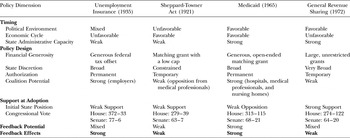
Importantly, our four cases vary along the two key theoretical dimensions of timing and policy design. These differences are summarized in Table 1.Footnote 47 In terms of timing, the four programs were adopted during four different decades of the twentieth century, each shaped by distinct economic and political environments. As for the administrative context, the original national policy occurred in the early twentieth century for two cases: UI (1935) and the Sheppard-Towner Act (1921). During this era, the “Rube Goldberg state” was constructed through intergovernmental grants and other instruments that facilitated or required the development of new state-level agencies and associations.Footnote 48 For Medicaid (1965) and general revenue sharing (1972), the original national policy was established at a time when state governments possessed stronger institutional and organizational capacities. This temporal variation helps account for the increased professionalism of state governments and the long-term expansion of the national government.
Case Studies

The programs also vary in terms of policy design. All four national initiatives distributed funds from the national government to the states. Yet the size of the transfers and the conditions attached to them vary in ways that might influence the mobilization of state policymakers and their allies. General revenue sharing consisted of a lump sum with virtually no conditions on its use, Sheppard-Towner involved capped matching grants, Medicaid offered more generous open-ended matching grants, and UI featured a federal tax offset provision that gave states a powerful incentive to establish their own programs. The national policies also offered state policymakers varying degrees of control over provisions like eligibility and benefit levels. Congress made the continuation of some programs conditional on periodic review, while others were granted permanent authorization. Finally, the policies had disparate effects on private-sector entities like businesses and health care providers, potentially affecting the political pressures state officials faced and their ability to build coalitions.
The preceding sections developed theoretical intuitions about why and how timing and policy design might prompt or discourage government elites to defend existing arrangements. The four policies’ variation along these two dimensions therefore permits preliminary speculation about their potential to generate feedback effects. While features of the political and economic environment in which UI was created seem inhospitable to strong feedback effects, its generous federal offset, permanent authorization, and strong coalition potential push in the opposite direction. Although the economic context of the Sheppard-Towner Act seems conducive to feedback, it was adopted in an unfavorable political and administrative context and includes several limiting design features. In terms of both timing and policy design, Medicaid possesses several attributes that seem likely to generate elite feedback. General revenue sharing, in contrast, offers a mixed set of features along both dimensions: Its favorable political and administrative environment and its large, unrestricted grants are counterbalanced by inhospitable economic conditions, its temporary authorization, and its weak coalition potential.
The multiple aspects of timing and policy design mean that the four cases examined here do not exhaust all possible permutations. As a result, they embody some of the trade-offs that are part and parcel of the case study approach. Like other recent studies of policy feedback effects,Footnote 49 they closely examine the hypothesized role of particular causal mechanisms in the context of individual policies and address causal complexity.Footnote 50 Furthermore, they illustrate how different combinations of causes, or distinct causal pathways, can produce the same outcome.Footnote 51 In short, the case studies advance a “defensible claim that the presence of a variable ‘favors’ an outcome.”Footnote 52 However, they neither conclusively demonstrate that a particular condition was necessary to the outcome nor uncover the frequency with which specific conditions and outcomes arise.Footnote 53 Despite these limitations, the case studies that follow provide fertile ground for the study of policy feedback and the conditions that promote or inhibit it.
THE SURPRISING PERSISTENCE OF UNEMPLOYMENT INSURANCE
The Social Security Act of 1935 created a federal-state program of unemployment insurance (UI) funded by employer payroll taxes and characterized by broad state discretion over benefits, eligibility, and financing. In the decades that followed, concerns about UI's inadequacies repeatedly led national lawmakers to attempt to replace it with a uniform system of unemployment insurance or, failing that, to establish more stringent national standards. Nonetheless, the original federal-state arrangement persists to this day with only minor modifications. Upon the program's creation, a powerful alliance of state officials and employer groups developed a vested interest in the status quo and successfully resisted periodic reform attempts. These strong feedback effects are especially noteworthy since state officials did not lobby energetically for UI's creation.
In 1934, President Franklin Roosevelt appointed a Committee on Economic Security to study (among other things) federal action to address the problem of the unemployed. Despite its preference for a wholly national system, the committee proposed a federal-state program for two reasons.Footnote 54 The first was concern that a national system would be rejected by a conservative Supreme Court.Footnote 55 A federal-state program was viewed as less vulnerable, since the Court had recently upheld intergovernmental grants for state-administered welfare programs.Footnote 56 The second was the committee's “grave doubt” that Congress would enact a uniform national system since “state jealousies and aspirations were involved.”Footnote 57 Southerners, who held key congressional committee chairmanships at the time, were eager to protect regional racial practices and low-cost labor policies.Footnote 58 Moreover, several states already had begun to develop their own UI plans, and the committee anticipated that Congress would defend the existing arrangements. Thus, the committee decided “reluctantly and with mental reservations, that for the present the wisest thing we could do was to recommend a federal-state system.”Footnote 59
Although the committee was attuned to the federalism-related implications of UI, state officials played a limited role in 1935 when Congress considered that component of the Economic Security Act. They represented a small proportion of the witnesses who appeared before the House Ways and Means Committee, and those who testified generally did not address UI. When the Acting State Commissioner of Social Welfare for New York State testified on behalf of the state's governor, for example, his testimony focused solely on sections dealing with dependent children and old age pensions.Footnote 60 In his firsthand account of the proceedings, Edwin Witte highlights supportive testimony from “labor union officials, industrialists, and prominent citizens” but does not mention state government leaders.Footnote 61
Under the new system, the national government's principal responsibility was to solve the states’ collective action problem by providing a strong incentive for the creation of UI programs.Footnote 62 In particular, national leadership would “make it easier for the States to act by removing those disadvantages in interstate competition which are always raised against purely State legislation that involves costs to industry.”Footnote 63 Dozens of states had considered legislation or established commissions in the early 1930s, but their efforts produced limited policy change. The Social Security Act included two financial provisions intended to galvanize state action. Along with a new federal payroll tax, the program established a tax offset provision that gave employers credit for the taxes they paid under state UI programs, so as to “remove the unfair competitive advantage” that employers in states without UI programs would otherwise enjoy.Footnote 64 Additional national responsibilities were to cover the program's administrative costs and safeguard its reserve funds. The states were given almost complete freedom over the amount and duration of benefits, waiting periods, eligibility requirements, disqualification provisions, and state tax rates.
National policymakers were keenly aware that competitive pressures might lead states to provide insufficient protection for workers. Observing that “state administration may develop marked inadequacies,” the committee noted that “should these fears expressed by the champions of a federally administered system prove true, it is always possible by subsequent legislation to establish such a system.” However, the committee also presciently cautioned that state-level “vested interests preventing modification or repeal” might emerge upon the program's creation.Footnote 65
Roosevelt signed the Social Security Act in 1935. Within two years, all forty-eight states, Alaska, Hawaii, and the District of Columbia had enacted UI laws. However, as progressives had feared, some state leaders preferred to keep worker benefits and tax rates low in order to attract migratory firms. Administration officials grew increasingly disillusioned with the federal-state UI system. In 1941 the Social Security Board argued that “a Federal system would obviate the marked disparities in the proportion of workers protected under State laws and the degree of protection afforded.”Footnote 66
Would-be reformers were emboldened by the removal of the principal obstacle to a national program—Supreme Court opposition—following a series of personnel changes and “about-face” decisions in the high Court in the late 1930s and early 1940s.Footnote 67 However, by this time a new obstacle had emerged: the interest of state officials in preserving the status quo. As early as 1939, one national official remarked that nationalization was unlikely because “the fifty-one unemployment compensation systems now have a vested interest in maintaining their present status.”Footnote 68
The sudden threat of nationalization at the onset of World War II led state officials to mobilize in earnest. After the Japanese attack on Pearl Harbor, President Roosevelt transferred all state-affiliated offices of the U.S. Employment Service from the states to the national government. State officials “bitterly denounced” the move and alleged that it was part of a broader strategy to “federalize” unemployment insurance.Footnote 69 They “successfully organized themselves to help defeat attempts to eliminate or to reduce their role in the employment service” and viewed “subsequent federal legislative proposals to broaden UI as efforts to assert greater federal control over the system.”Footnote 70 In 1942, for example, the administration proposed to temporarily supplement UI with a national war displacement benefits program. State officials, suspecting an attempt to nationalize the UI system, lobbied heavily against the proposal. The Roosevelt administration, backed by powerful labor organizations, was unable to overcome the opposition, and the measure died in committee.Footnote 71
State leaders’ opposition to early attempts at nationalization did not merely reflect the resistance of Southern conservatives who feared a more generous national program; northern states with relatively liberal provisions also eagerly defended their turf.Footnote 72 For instance, in 1941 the governors of the six New England states sent a telegram urging President Roosevelt not to approve proposals to nationalize UI.Footnote 73 And in 1945, Governor Edwin Martin of Pennsylvania, chairman of the National Governors’ Conference, testified that he spoke for all forty-eight governors when he said “the states are opposed to any bill or plan designed to federalize the administration of unemployment compensation.”Footnote 74 Regardless of political persuasion, “states generally resented and resisted federal efforts to control or dominate the program” during its early years.Footnote 75 Nor were state leaders simply responding to constituent demands. In a 1942 poll, 53 percent of respondents agreed that UI should be “mostly controlled by the federal government,” while only 20 percent felt that it should be “mostly controlled by each state government.”Footnote 76
In addition to protecting their turf, state leaders also acted under pressure from powerful state-level economic interests seeking to “prevent a nationalization of benefits that would hinder economic strategies based on low wages and stingy social provision.”Footnote 77 Employers recognized that the existing UI system worked in their favor, as the states competed with one another to provide an attractive business climate. Indeed, business groups succeeded in pushing states to lower the average state UI tax rate from 2.69 percent in 1938 to 1.01 percent in 1948, causing benefits to deteriorate sharply.Footnote 78 Equating nationalization with liberalization, employer groups urged sympathetic state officials to defend the status quo. As the UI system evolved, it became a “common carrier” that brought together a new coalition.
The combined opposition of state officials and business interests limited changes in the UI system in the ensuing decades.Footnote 79 Throughout the 1940s, administration officials attempted to establish a national program, but each time “state unemployment officials and business men leveled a heavy barrage of criticism.”Footnote 80 State elected officials, represented by groups like the Council of State Governments, joined the Chamber of Commerce and the Interstate Conference of Employment Security Agencies (ICESA) in lobbying against reform.Footnote 81 The ICESA—“an organization of state officials funded and partly staffed by the national government”—became “a strong force in resisting attempts to centralize and federalize Unemployment Insurance,”Footnote 82 epitomizing the mobilization of state-level actors. Under pressure from these powerful groups, UI reform stalled in Congress, even in the late 1940s and early 1950s when obstructionist Southern Democrats briefly lost control of the House Ways and Means and Senate Finance Committees.
Since a national system stood little chance of enactment, reformers switched tactics and began to promote new national standards. In 1950, President Truman proposed standards for the amount and duration of benefits, qualifying requirements, and disqualification provisions. However, under pressure from state officials and employer groups, the bill never made it out of committee.Footnote 83 Similar measures promoted by Presidents Kennedy, Johnson, and Nixon met a similar fate. One frustrated labor official called state officials “one of the toughest but quietest lobbies you are going to see anywhere.”Footnote 84 Throughout the 1950s and 1960s, the “fear of federalization was one important element in opposition to expansion of UI.”Footnote 85
Although the national government occasionally assumed a more prominent role in the UI system, the basic federal-state balance remains intact. Perhaps the single largest change occurred in 1970, when Congress mandated a permanent federal-state program of extended benefits for the long-term unemployed during periods of high unemployment and required states to cover a larger share of the workforce. In addition, Congress has acted eight times over the years to establish temporary programs of extended benefits—federally financed and governed by federal rules—during recessions.Footnote 86 Yet, as Margaret Weir has observed, these “piecemeal remedies” reflect a “reluctance to consider structural changes” in the federal-state system, despite widespread acknowledgment of its inadequacies, because “such modifications interfered with the states’ prerogatives established by the 1935 Social Security Act, which were strongly defended by business.”Footnote 87
Just as the states have resisted efforts to nationalize the UI system, so too have they rejected proposals for greater decentralization. For instance, in 1959 President Eisenhower invited a group of governors to the White House to discuss UI. In the wake of the 1958 recession, state reserves were depleted and Congress had enacted a temporary program of extended benefits that was about to expire. Eisenhower favored full state responsibility for UI and asked the governors to increase the amount and duration of state benefits to limit the need for further federal intervention.Footnote 88 In response, the governors issued a statement that endorsed the status quo. They asserted the states’ right to run UI programs “without imposition of Federal standards governing eligibility, duration or the amount of benefits” and advocated continuation of “federal advances to meet emergencies where the problems of unemployment are beyond the ability of the affected state governments.”Footnote 89
Despite decades of controversy and repeated attempts at reform, the UI system “has undergone less significant reform than any other American welfare policy.”Footnote 90 Just as Roosevelt's Committee on Economic Security predicted, vested interests—namely, a powerful coalition of state officials and business groups—quickly mobilized to protect state control over benefits, eligibility, and financing. As a result, “the inertial force of its beginnings has kept unemployment insurance primarily a state program.”Footnote 91
THE BRIEF LIFE OF THE SHEPPARD-TOWNER ACT
In November 1921, President Warren G. Harding signed the Promotion of the Welfare and Hygiene of Maternity and Infancy Act. Commonly known as the Sheppard-Towner Act after its two primary sponsors,Footnote 92 the law received strong bipartisan support. Its goal was to reduce infant and maternal mortality rates, and it provided states with matching funds to pursue activities serving mothers, expectant mothers, and very young children. State government support for Sheppard-Towner programs was broad but not deep, due to the small size of the available grants, the peripheral institutional position of the state agencies charged with their administration, and the opposition they generated from powerful state-level interests, most notably the medical profession. This limited elite feedback contributed to the law's demise when it came up for renewal in a more hostile political environment. Although its appropriations were extended for two years, this extension repealed the law on June 30, 1929.
The origins of Sheppard-Towner can be traced to intellectual and cultural shifts that began in the nineteenth century.Footnote 93 The establishment of the federal Children's Bureau in 1912 was especially important because the bureau received a directive to investigate and report on all matters affecting the lives of American children.Footnote 94 One of its earliest activities was the collection of data on infant and maternal mortality, and it found that rates in the United States were worse than those in many other countries. The bureau's 1917 annual report recommended that Congress provide “matching grants to the states so that they could set up infant and maternal health centers and expand visiting nurse services.”Footnote 95
Professional reformers, charity organizations, churches, and labor unions supported the grant-in-aid proposal, as did several leading national women's magazines.Footnote 96 Key state officials also favored the bill but did not lobby energetically on its behalf. When the editor of Good Housekeeping testified before Congress in May 1920, he provided “letters and telegrams that show that 33 of the Chief Executives of the States are in favor of maternal and infant welfare work at the public expense.”Footnote 97 The governors generally endorsed the principles motivating the bill, although some expressed reservations about its details. Furthermore, the governors themselves did not appear at this hearing, which featured witnesses affiliated with the Children's Bureau, the medical profession, and various women's organizations.
Indeed, the energetic efforts of women's groups were critical to the eventual adoption of the act. Established organizations like the General Federation of Women's Clubs, the National Consumers’ League, and the National Congress of Mothers were joined by newer groups like the National League of Women Voters. The Women's Joint Congressional Committee, a coalition of fourteen national interest groups, which was organized in 1920, “solidified women supporters and acted as the industrious and vociferous lobby on Capitol Hill.”Footnote 98 Their coordinated lobbying effort occurred amid the 1920 ratification of the Nineteenth Amendment granting women the right to vote, and the uncertain partisan implications of this change led many legislators “to register publicly their approval when the bill finally came up for a vote. Indeed, fear of being punished at the polls by American women, not conviction of the bill's necessity, seems to have motivated Congress to vote for it.”Footnote 99
The central feature of the Sheppard-Towner Act was its matching-grant program. State governments had to enact enabling legislation, develop a detailed implementation plan, and allocate funds to infant and maternity programs. They could only receive federal funds once they established state agencies that would coordinate their health programs with the Children's Bureau; the agencies had to be separate units whose “concern with children could not be diluted with any other responsibility.”Footnote 100 State plans had to be approved by a Federal Board of Maternity and Infant Hygiene that included the director of the Children's Bureau, the surgeon general, and the commissioner of education. Each participating state received a lump-sum $5,000 grant plus dollar-for-dollar matching funds of at least $5,000 up to a cap determined by the state's population.
Sheppard-Towner matching funds became available in 1922. Historians have described the act as “well received”Footnote 101 by state authorities and characterized state officials’ response as “generally quite positive.”Footnote 102 By 1923, forty states had accepted the funds.Footnote 103 However, resistance to Sheppard-Towner appeared in every region of the country. California, Illinois, and Vermont returned their unspent 1922 funds to the U.S. Treasury.Footnote 104 Protracted controversies over enabling legislation occurred in Connecticut, Kansas, Louisiana, Massachusetts, Rhode Island, and Washington. Opponents described Sheppard-Towner programs as a financial drain, an encroachment on states’ rights, and a step toward socialism.Footnote 105 Massachusetts, one of two states that chose not to participate in the program throughout its brief history,Footnote 106 launched an unsuccessful lawsuit in which it argued that the act violated the Tenth Amendment.
Specific provisions of the Sheppard-Towner Act limited its ability to generate elite feedback at the state level. Importantly, the financial resources provided to state governments were quite limited. The law made only $1,201,725 available to the states each year, representing less than 1 percent of all federal aid available to the states. This amount paled in comparison to other national programs requiring state matching funds. During the 1929 fiscal year, for example, $8,020,000 was available for cooperative vocational education and $76,197,294 was available for the national highway system. At its peak, the Sheppard-Towner Act provided less than one-fourth of the funds available for the eradication of pink bollworm.Footnote 107 In the words of historian J. Stanley Lemons, “In retrospect, this pioneering bill seems pitifully small.”Footnote 108
Other programmatic features of the Sheppard-Towner Act had a similar effect. One stipulation of the grant-in-aid was that the states could not provide cash benefits like maternal or infant stipends. This provision distinguishes Sheppard-Towner from programs like Social Security. Nor could states provide private physicians or other health care providers with direct payments. Patients were typically directed to medical professionals when a health problem was identified, yet the referrals did not prevent doctors from viewing Sheppard-Towner as competition, especially as their profession changed to emphasize the very public health activities the act funded.Footnote 109 The medical profession had been divided over the law's adoption, but over time it became more unified and mobilized in opposition to Sheppard-Towner. By demonstrating the value of and increasing the demand for prenatal, infant, and maternal care, the program gave physicians an incentive to push the government out of these areas. The policy thus “was in some respects the victim of its own success.”Footnote 110
Finally, the law only authorized funding for five years. This provision highlights the interaction of policy design and timing. It made the law especially vulnerable to short-term political shifts, such as changes in the distribution of power in Congress. As its initial five years of appropriations neared their conclusion, the effort to extend its life took place in a politically hostile environment. The mid-1920s were not a propitious political moment for public welfare innovations. President Calvin Coolidge endorsed more funds for Sheppard-Towner, “but only for an interim period during which he expected the states to prepare themselves for a full takeover of its programs.”Footnote 111 Congressional turnover was especially important. Forty-two of the Senators who had supported the Sheppard-Towner Act in 1921 were no longer in office by 1926, and three of the holdovers had changed their support to opposition.Footnote 112 In addition, “the politicians’ fear of wrathful women voting as a bloc against them had been quelled” by the time the renewal debate occurred.Footnote 113 The results of the 1922 and 1924 elections suggested that women, like men, voted along partisan lines. Elected officials had little reason to consider the electoral implications of a vote against renewal.
Thus renewal advocates operated in a less favorable political environment and had to contend with a more powerful and active opposition. Due to several of its programmatic features, the law lacked a “strong, easily identifiable, and mobilized constituency at the state level [or] the ability to supply discrete or tangible benefits to draw the support of other powerful, organized groups.”Footnote 114 To be sure, the directors of state Sheppard-Towner programs lobbied Congress in the mid-1920s. For example, Dr. Mary Riggs Noble, the Director of Administration of the Sheppard-Towner Act for the State of Pennsylvania, testified before the House Committee on Interstate and Foreign Commerce in January 1926, and other program administrators were present at the hearing.Footnote 115 This constituency had a vital stake in the law's renewal, yet they were neither allied with other influential groups nor independently powerful. As the vociferous opposition of the American Medical Association (AMA) made clear, the “disproportionately female professional employees of Sheppard-Towner programs [were] already marginal in their public health professions.”Footnote 116 The recent origins of the state agencies they headed were another disadvantage, as state directors’ influence was limited by “the far weaker and fragmented position child welfare departments held in state governments.”Footnote 117 When state Sheppard-Towner directors testified before Congress, they did not represent the broader medical profession or other key state officials.
Even the law's strongest supporters recognized its limited feedback effects. At a committee hearing in January 1926, the director of the Children's Bureau, Grace Abbott, suggested that state Sheppard-Towner programs were not well entrenched. She explained, “If we were to withdraw the Federal assistance at this moment, a great deal of the work would be undone, and the money that has already been expended would, to a very considerable extent, be lost, because much of the work has not yet been developed into permanent activity.”Footnote 118 She lobbied for a five-year extension of Sheppard-Towner appropriations, and eventually the House of Representatives endorsed a two-year extension.Footnote 119 Senate opponents, however, proposed a one-year extension, arguing that the “original purpose and intent of Congress to encourage the States to take up this important work is rapidly approaching fulfillment, if indeed that time has not already come.”Footnote 120 When Sheppard-Towner supporters refused to accept this amendment, a conservative filibuster blocked the bill for eight months. With appropriations on the verge of expiring, Sheppard-Towner advocates reluctantly agreed to a “compromise” that extended program appropriations for two more years but repealed the Sheppard-Towner Act on June 30, 1929. Advocates gained additional appropriations, but the cost of this victory was the termination of the program. Having failed to provide resources or alter incentives in ways that generated elite feedback, and having provoked the opposition of the increasingly powerful medical profession,Footnote 121 the brief life of the Sheppard-Towner Act came to an end.
THE REMARKABLE RESILIENCE OF MEDICAID
Today Medicaid is the largest health care program in the United States. It covers one in five Americans, comprises nearly half of all federal grants to state and local governments, and represents the most costly item in the typical state budget. When Medicaid was created in 1965, however, it was overshadowed by the simultaneous establishment of Medicare for the elderly. Medicaid's chief architect, the fiscally conservative House Ways and Means Chairman Wilbur Mills (D-AR), hoped this program for low-income Americans would remain small and unobtrusive; he later called it the most expensive mistake of his career.Footnote 122 The program's resilience in the face of repeated national attempts at retrenchment exemplifies elite feedback, illustrating the long-term impact of policy design and timing.
The proposal to create Medicaid was widely unpopular with state leaders and members of Congress alike. It was advanced by the AMA in a last-minute effort to scuttle Medicare, which physicians feared would be overly intrusive in health care markets. The AMA proposal—initially known as “Eldercare”—was an expansion of a state-administered, means-tested program financed through federal matching grants: Medical Assistance for the Aged, better known as the Kerr-Mills Program. During the debate over Medicare and Medicaid in 1964 and early 1965, no governor or state legislator testified before Congress on behalf of liberalizing Kerr-Mills. In fact, a series of governors bemoaned its shortcomings while endorsing the federal Medicare program as superior. John Reynolds, Democratic Governor of Wisconsin, argued that “the Kerr-Mills program cannot do the basic job of providing medical security, with dignity, to our older citizens” and that Medicare would “ease the financial impact of Kerr-Mills on our State budget.”Footnote 123 The leaders of several other states including Massachusetts, Minnesota, New Jersey, New York, Washington, and West Virginia echoed these sentiments. Nor did Medicaid elicit much congressional enthusiasm, as Democrats preferred Medicare, and Republicans sought to distance themselves from the increasingly unpopular AMA.Footnote 124 Nonetheless, Wilbur Mills unexpectedly included both programs in the Ways and Means Committee's bill in an effort both to address widely criticized deficiencies in the meager Kerr-Mills Program, which bore his name, and to forestall subsequent demands for liberalization of Medicare.Footnote 125 The Medicaid rider was added at the last minute and subject to little discussion, so few members of Congress knew much about it.Footnote 126 The Social Security Amendments of 1965 passed by a wide margin, reflecting the popularity of Medicare among the large Democratic majority.
Medicaid's policy design was deliberately expansive, reflecting years of limited state participation in Kerr-Mills and other federal-state welfare programs. Based on this experience, policymakers presumed that the states would be “slow and careful about taking up this option, would set eligibility standards and income and assets tests close to those for public assistance recipients, and would, therefore, limit both state and federal financial outlays.”Footnote 127 Wilbur Cohen, a Johnson Administration official who helped Mills draft the legislation, convinced Mills that Medicaid “would be operative only to the extent States undertake the financial responsibility to carry out the program” and that strong financial incentives and mandates were essential.Footnote 128
Medicaid included several carrots and sticks to encourage state participation. First, Medicaid offered unprecedentedly generous federal matching grants, ranging from a dollar-for-dollar match for the most affluent states to a four-to-one match for the poorest states. These grants were open-ended; the national government would provide matching funds no matter how much a state spent. Second, the new program allowed participating states to cover not only welfare recipients but also the “medically needy”—persons with high medical expenses relative to their incomes—the definition of which was left up to the states. Third, the program required participating states to cover five mandatory services: inpatient hospital care; outpatient hospital care; laboratory and x-ray tests; physician services; and skilled nursing home services. The last requirement was particularly consequential since Medicare and most private insurance do not cover long-term care. Fourth, participating states could elect to cover, and receive matching funds for, optional services including prescription drugs, dental care, and physical therapy. Finally, the law mandated that by 1975 all participating states provide “comprehensive care and services to substantially all individuals who meet the plan's eligibility standards.”
Despite their initial lack of support for Medicaid, many state leaders found these incentives irresistible, and designed much more generous plans than anyone had anticipated.Footnote 129 Republican Governor Nelson Rockefeller of New York developed the most ambitious state Medicaid plan in the nation, making 45 percent of the state's population eligible for coverage at a federal cost of $217 million—more than national lawmakers had estimated the program would cost for all fifty states combined.Footnote 130 Following New York's lead, numerous states “rudely jostled their way toward the [Medicaid] trough, to the increasing consternation of legislators and administrators in Washington.”Footnote 131 By 1972, forty-nine states were participating in the program, albeit to widely varying degrees.Footnote 132
Once Medicaid was in place, state leaders developed powerful incentives not only to take advantage of its generous financing, but also to fend off subsequent federal efforts at retrenchment. When Congress attempted to rein in federal Medicaid spending during the program's first few years, the governors mobilized to oppose the proposed changes. In the summer of 1966, Mills proposed a ceiling on federal Medicaid contributions to each state. However, Governor Rockefeller worked with Representative Eugene Keogh (D-NY), a senior member of Ways and Means, to preserve the program's open-ended grant. Keogh convinced his colleagues that the proposed change would squash the plans of several powerful states. As one committee member put it, “We're like the man who casually invited his country cousin to come have dinner someday and then has the guy arrive on his doorstep with his whole damn family. You'd like to slam the door in his face but how the hell can you do it?”Footnote 133
Recognizing that large, visible cuts in federal aid would elicit resistance from state leaders, Mills next proposed to redefine the “medically needy,” specifying that the federal government would not provide matching funds for able-bodied adults under sixty-five who were not on welfare. However, Governor Rockefeller again used his state's congressional delegation to block the bill, convincing Senator Jacob Javits (R-NY) to delay action in the Senate.Footnote 134 Mills ultimately worked out a compromise with the Johnson Administration, whereby the federal government would only help fund coverage for recipients with incomes under 133 percent of the state's standard to qualify for cash assistance. This change trimmed federal funding to states with expansive Medicaid plans but retained considerable state discretion over eligibility.
In 1968, the Senate took aim at Medicaid's generous open-ended grants. Its Finance Committee, under Chairman Russell Long (D-LA), passed a measure that would have dramatically reduced the federal matching rate for the medically needy. Several governors registered opposition. Massachusetts's Republican governor, John Volpe, sent a telegram to key members of Congress complaining that his state stood to lose $30 million per year if the measure passed and warning that the bill would deal a “telling blow” to states around the country.Footnote 135 Ultimately, Governor Rockefeller's influence with New York's congressional delegation led to a successful filibuster by Javits and Senator Charles Goodell (R-NY), and Long was forced to admit defeat.Footnote 136
One year later, President Richard Nixon sought to curb Medicaid's growth. Given that institutional care was the largest and fastest-growing component of Medicaid spending, Nixon proposed to reduce federal matching funds for nursing homes and mental institutions. His proposal was met with sternly worded disapproval from a bipartisan chorus of governors from all over the country, including Norbert Tiemann (R-NE), William Cahill (R-NJ), and Marvin Mandel (D-MD). Congressional support dwindled under pressure from state leaders, and the measure died. In sum, the early years of the Medicaid program provide a striking case of elite feedback. Although they had not supported its passage, state leaders emerged as a supportive constituency for Medicaid almost immediately, constraining national policymakers’ ability to cut federal funding.
The governors’ vigorous efforts to protect Medicaid from federal retrenchment were a product of not only the program's generous open-ended matching grants and administrative flexibility but also the timing of its adoption. Medicaid was established at a time when state governments were undergoing a dramatic transformation. Traditionally, state leaders had few formal powers, tiny staffs, and small budgets. However, rising demand for government services and the explosion of federal grants and mandates caused state leaders’ responsibilities and resources to expand greatly in the 1960s.Footnote 137 A series of reforms granted new administrative powers to the governors and ushered in a “new breed” of experienced, competent, ambitious politicians.Footnote 138 These governors tended to be socially liberal: thirty-three of the nation's governors were Democrats in 1965 and 1966, and even Republicans like Rockefeller were left-leaning by historical standards.
Collectively, the governors evolved from a disorganized, passive group of “political homebodies with few responsibilities or interests beyond the boundaries of their home states”Footnote 139 to “a tightly organized, hard-working group committed to a program of action.”Footnote 140 The Governors’ Conference, which had existed since 1908, opened a Washington office and effectively created a “full-time governors’ lobby” in the nation's capital in 1967.Footnote 141 The group changed its name to the National Governors Association to reflect its new status as a full-time lobbying organization.
The governors’ efforts to protect Medicaid over the past five decades also reflect pressure from the health care industry. Although groups representing health care providers initially resisted Medicaid's enactment, fearing government intrusion in private markets, they soon recognized the program's potential to help alleviate the cost of treating the uninsured.Footnote 142 Unlike Sheppard-Towner, Medicaid reimburses medical providers for health care services, creating strong incentives for industry leaders to seek its preservation and expansion. Since medical, hospital, and nursing home associations are organized on a state basis and tend to be more influential in state politics than in national politics,Footnote 143 they have repeatedly used state leaders as a conduit through which to influence national Medicaid policy, pushing the governors to lobby Congress to maintain or increase Medicaid funding and to loosen eligibility rules.Footnote 144
State officials’ ability to preserve Medicaid's basic structure in the face of repeated congressional efforts at retrenchment during the program's first several years established a persistent pattern. For instance, when the Ronald Reagan Administration proposed in 1981 to permanently cap the growth of federal Medicaid contributions at the inflation rate, extensive lobbying by governors of both parties led Congress to impose a small, temporary cut in the federal matching rate instead. Similarly, the resistance of many state leaders contributed to the demise of a proposal to convert Medicaid to a more restrictive block grant in the 1990s. Despite repeated federal attempts to cut funding, Medicaid's financing arrangement remains virtually unchanged. Its persistence is, in part, the enduring heritage of elite feedback.
THE RISE AND DEMISE OF GENERAL REVENUE SHARING
In 1972, Congress enacted a program of “general revenue sharing” with state and local governments. At the time, the $6.1 billion program was the largest federal grant-in-aid ever enacted.Footnote 145 With virtually no strings attached, general revenue sharing offered recipient governments an unprecedented degree of spending discretion. For these reasons, it should have been exceptionally popular with state leaders—and indeed, their vigorous lobbying was critical to its enactment. Yet the governors hardly put up a fight when Congress discontinued the state portion of general revenue sharing eight years later. Although some features of revenue sharing's design seemed conducive to elite feedback, the timing of its enactment—during a period of federal deficits, state surpluses, and intergovernmental tension over budget policy—helps explain state leaders’ failure to protect the program. Moreover, its diffuse benefits, and the resulting absence of pressure from state-level special interests, also contributed to the program's demise.
General revenue sharing first appeared on the national agenda in 1964 as a solution to two related budgetary problems. The first was “fiscal drag,” as an overflowing Treasury combined with high national unemployment threatened to depress aggregate demand. The second was “fiscal mismatch”: state and local governments’ revenues were lagging behind rapidly mounting service demands in education, health, sanitation, public safety, and other areas. In other words, “Where the high-priority public service needs were, the money was lacking; and where the money was ample, the high-priority needs were lacking.”Footnote 146
Revenue sharing was not enacted for another eight years, however. Instead, President Lyndon Johnson focused on categorical grant programs that helped alleviate the problems of fiscal drag and mismatch while also achieving his administration's policy goals. Johnson's successor, Richard Nixon, believed that this complex web of categorical grants hampered the autonomy and effectiveness of subnational governments. Nixon saw general revenue sharing as a superior alternative. By the time he took office, fiscal drag was no longer a problem, as the national surplus had been eaten up by the Great Society programs and the Vietnam War. Thus, “its original, primary objective shifted. No longer was the program intended to distribute surplus revenues, but instead, provide assistance to floundering states and localities, while avoiding the problems which had come to plague the growing array of categorical programs.”Footnote 147
State and local leaders—the principal beneficiaries of Nixon's proposal—enthusiastically supported revenue sharing. The National Governors Association (then known as the National Governors’ Conference) and National Conference of State Legislatures, along with the nation's mayors, county officials, and other associations representing state and local leaders, formed an alliance whose cohesion was cemented by their shared fiscal problems, which only intensified during the 1970–1971 recession. In “the most successful grass roots lobbying effort undertaken thus far by the groups collectively … delegations of mayors, governors, and county officials swarmed over Capitol Hill demanding congressional passage of this program.”Footnote 148 In testimony before the Senate Finance Committee, the National Governors’ Conference chairman and governor of Maryland, Marvin Mandel, noted that “revenue sharing is a top priority program for governors, mayors, and county officials throughout our Nation” and that state and local leaders had for years “labored long and hard” to secure its passage.Footnote 149
State and local officials faced an uphill battle, however, as committee leaders saw turning over large sums of money with virtually no strings attached as a threat to their authority and ability to claim credit for spending projects.Footnote 150 House Ways and Means Chairman Wilbur Mills (D-AR) was a particularly vocal critic of general revenue sharing and helped kill the measure in 1969, 1970, and 1971. However, Mills suddenly did an about-face in December 1971, when he announced that revenue sharing would be his top priority in the coming legislative session. His change of heart reportedly reflected his aspirations for the 1972 presidential nomination and his need to build support among state and local leaders.Footnote 151 Importantly, however, Mills only agreed to authorize the program for five years, not wanting to commit the national government to a permanent outlay without periodic review.
General revenue sharing passed by wide margins in both chambers of Congress. When asked why so many lawmakers voted for the bill, House Majority Whip Tip O'Neill replied, “Well, I guess we just gave in to all that pressure from the mayors and the governors.”Footnote 152 House members were especially vulnerable to pressure from state leaders at the time because reapportionment was under consideration in many state capitals.Footnote 153 The intergovernmental lobby—termed “the old general-revenue sharing steamroller” by one congressional aide—prevailed again in 1976, when Congress reauthorized the program for another three years.Footnote 154
Reauthorization notwithstanding, revenue sharing remained unpopular with many members of Congress. One representative complained of state and local officials who financed projects with revenue-sharing funds, “They don't even ask us to the ribbon-cutting ceremonies.”Footnote 155 The program also lacked presidential support once Democrat Jimmy Carter took office in 1977. When the legislation came up for reauthorization in 1980, Carter announced that he would not support its renewal for state governments. He asserted that the federal government needed to restrain spending to rein in the national deficit and an inflation rate approaching 14 percent. Moreover, he argued that most state governments no longer needed the funds, as they were experiencing rapid revenue growth and, in some cases, substantial budget surpluses.Footnote 156
In 1980, Congress voted to eliminate general revenue sharing for state governments in fiscal year 1981.Footnote 157 The legislation specified that the states could be included again in fiscal years 1982 and 1983, subject to future congressional approval, but with the proviso that for each revenue-sharing dollar a state received, it would have to give up a dollar in categorical aid so as to achieve budget neutrality. When the time came, however, Congress did not approve the return of revenue sharing for state governments.
Surprisingly, the governors hardly put up a fight over the program's demise. One observer marveled at “the meekness with which the nation's governors have taken the news,” labeling the official state response “almost inaudible.”Footnote 158 Indeed, some Democratic governors expressed acquiescence bordering on support for the elimination of revenue sharing. Speaking on behalf of the Democratic governors in the spring of 1980, Governor Bill Clinton of Arkansas testified, “Our position is that if it's gone, it's gone.”Footnote 159
The demise of revenue sharing can be largely attributed to timing. It was conceived in an environment of federal budget surpluses and concerns about “fiscal drag,” but the surpluses had evaporated by the time it was enacted eight years later. Throughout the 1970s, “the choir of deficit-reduction hawks was growing,” and by 1980 Washington was gripped by “near-hysteria over the deficit.”Footnote 160 Meanwhile, through a combination of state tax reforms and economic recovery, the problem of “fiscal mismatch” had gradually dissipated as well: “By being fiscally responsible, States had ironically put themselves in the position of losing support from a federal government that was becoming increasingly fiscally irresponsible.”Footnote 161
As the national budget situation deteriorated, the governors’ perceptions of the program shifted, as “what had been looked on in 1964 as an additional infusion of federal aid, and with good reason, suddenly began to appear more and more as a substitute for existing aid funds.”Footnote 162 Governor Jimmy Carter of Georgia explained, “Although the concept of revenue sharing was very good, I had great concern that there was no additional revenue to share. Despite [assurances] that existing funds would not be used to finance revenue sharing, I was fearful that this would be the case.”Footnote 163 Like many Democratic governors, Carter did not wish to trade categorical grants targeted to the poor for untargeted funds: “When these funds are taken away from the poor and put into general revenue sharing … even the most enlightened legislature is not going to take these funds and put them back exclusively into programs that benefit the poor.”Footnote 164
Such fears were confirmed almost immediately. Faced with a rapidly rising national deficit and inflation rate, President Nixon demanded cuts in categorical grant programs in the fiscal year 1973 budget and used his impoundment powers to slash spending when Congress failed to comply. The 1974 budget included more bad news for state and local leaders, with the elimination of more than a hundred categorical grant programs and with sweeping cuts in domestic social programs. State and local leaders, irked by the president's “bad faith,” withdrew their support from his federalism agenda, marking “an abrupt turnabout in the relations between the Nixon administration and the government interest groups.”Footnote 165
In addition to altering state officials’ perceptions of revenue sharing, the budget climate also reduced their incentives to protect the program against retrenchment. By 1980 most states were in “sound fiscal shape, at least in the aggregate, and this prosperity may have taken some of the fight out of them.”Footnote 166 State leaders also grew weary of the uncertainty around the program, as Congress and the president repeatedly threatened to eliminate or cut it. One state official explained, “Frankly, we've been whipsawed around this thing so much—one week we had it, the next week we didn't—after a while we realized we could do quite well without it.”Footnote 167 State leaders’ enthusiasm diminished despite solid public support for the program. In a May 1979 national survey, 51 percent of respondents declared themselves in favor of a program through which “state and local governments receive about $7 billion a year to use as they think best.”Footnote 168
Moreover, the rising national deficit contributed to a souring of federal-state relations, which greatly diminished the governors’ bargaining leverage in Washington. Shortly before revenue sharing came up for reauthorization, the leaders of thirty states angered Congress by calling for a constitutional amendment to balance the national budget. Congressional opponents berated state leaders for the “ultimate hypocrisy” of demanding a balanced budget—“but don't cut funds to the states.”Footnote 169 The ensuing deterioration of intergovernmental relations greatly diminished the chances of reauthorization. Governor Lee Dreyfus of Wisconsin, a Republican, warned his colleagues, “[We] have got to be prepared, at least those of us who have been arguing for a balanced federal budget, knowing what we don't want cut in the federal revenue sharing, to indicate where it is going to be cut in categorical aid. And if you aren't prepared for that, your Congressional Delegation is going to hit you back with it.”Footnote 170 Congressional opponents of revenue sharing thus used the governors’ demand for a balanced federal budget to bolster their argument that the program should be a substitute for, rather than a complement to, categorical grants.
In addition to timing, a key feature of policy design contributed to the demise of revenue sharing. The noncategorical nature of the grants resulted in the absence of strong interest-group pressure at the state level. When it came to cutting categorical grant programs in areas such as health care and housing, local beneficiaries—both suppliers and recipients—joined state and local leaders in fighting the proposed cuts. Revenue sharing, by contrast, did not enjoy similar support. Because the funds were not targeted to specific individuals or groups, the benefits were too diffuse to elicit protests from specialized interests when Congress threatened to end the program. As Governor Dreyfus explained, “Congress will cut where it gets the least screaming, and there are only 50 voices—the state governors—interested in preserving general revenue sharing.”Footnote 171 The lack of interest-group pressure also affected state leaders’ political calculus. From a policy standpoint, the governors enjoyed the flexibility offered by general revenue sharing; from a political standpoint, however, the absence of targeted benefits ultimately made the program expendable.
DISCUSSION
In some of the preceding case studies, national initiatives meaningfully altered state officials’ resources and incentives, leading to strong elite feedback. The creation of unemployment insurance (UI) in 1935 spurred state officials to defend what they perceived as their turf. The introduction of Medicaid in 1965 prompted state leaders to take advantage of the program's generous financial assistance and to protect it against retrenchment. In contrast, neither the passage of the Sheppard-Towner Act in 1921 nor the introduction of general revenue sharing in 1972 fundamentally altered the behavior of state policymakers over the long term. The divergent developmental trajectories of the four programs illustrate how timing, policy design, and the interaction between the two can affect the generation of elite feedback.
The long-term political impact of a policy initiative depends partly on the timing of its adoption.Footnote 172 Of the policy arenas examined here, perhaps the most compelling illustration of this premise is a juxtaposition of Sheppard-Towner and Medicaid. The two programs share some commonalities, providing health benefits through a matching-grant formula. Timing helps to account for their divergent trajectories. The Sheppard-Towner Act was enacted at the outset of a conservative period when expansions of government authority faced an uphill political battle, and the administrative capacities of state governments were not as well developed as they would be when Medicaid was created in 1965. Through the first half of the twentieth century, poorly funded state agencies typically attracted patronage appointees who lacked the expertise of their national counterparts, and “state legislatures were more likely to be controlled by politicians with little interest in policy innovation.”Footnote 173 By the mid-1960s, the “resurgence of the states” meant that state governments were institutionally stronger,Footnote 174 and a new generation of ambitious and policy-oriented governors had taken office.Footnote 175
The Medicaid and Sheppard-Towner case studies also illustrate the importance of policy design. Their distinct developmental paths suggest that the mere existence of fiscal assistance is not sufficient to generate policy feedback. Sheppard-Towner's matching grants were capped at such low rates that the average state was eligible for approximately $25,000 per year.Footnote 176 In contrast, Medicaid offered relatively generous terms, providing the least affluent states in the nation with four dollars in aid for each dollar spent. Critically, it imposed no cap on the total amount of federal aid. Moreover, whereas Medicaid established a permanent entitlement to health services, the Sheppard-Towner Act came up for reauthorization after five years.
The impact of policy design extends to issues of administrative authority, which had an especially profound effect on the evolution of UI. The creation of a state-administered UI program, and the threat of nationalization only a few years later, caused state administrators to mobilize to protect their jurisdiction. Forming the Interstate Conference of Employment Security Agencies to represent their interests, they made regular appearances on Capitol Hill to lobby against any policy changes they perceived as encroaching on their turf. This episode suggests that threats to authority and autonomy can prompt elite feedback.
Policy design is also important because it has implications for interest-group activity. National policies that target state-level interests can magnify elite feedback effects by stimulating state-level lobbying activity.Footnote 177 For instance, the fact that UI was financed by payroll taxes prompted employer groups to push state leaders to fend off attempts to nationalize and liberalize the program. And although many health care providers opposed Medicaid's enactment, they soon came to welcome the federal funding it provided and pressed for the expansion of covered services, eligibility, and provider payment rates—using state leaders as a conduit through which to influence federal policy. By contrast, the Sheppard-Towner Act, which did not reimburse physicians for the provision of medical services, fostered increasing hostility as the medical profession became more interested in public health issues and thus came to view the government as a competitor. Similarly, the untargeted nature of general revenue sharing meant that powerful state-level interests failed to come to its defense.
Finally, timing and policy design can interact in important ways. For example, the limited duration of the Sheppard-Towner matching grant meant that it came up for renewal amid the conservative ideological climate of the 1920s. Many of the legislators who had voted for the act in 1921 were no longer in office by the mid-1920s. Similarly, the demise of general revenue sharing was due in part to the interaction between the noncategorical nature of its grants—and the resulting absence of strong interest-group pressure at the state level—and the budgetary environment. In a context of national deficits and state surpluses, state officials came to view the program as politically expendable.
The interaction of timing and policy design can help explain how two policies adopted around the same time can generate feedback in one case but not the other. The creation of Medicaid prompted substantial state mobilization, but the introduction of general revenue sharing just a few years later did not. Although state officials had developed the institutional capacity to protect this new program, the shifting budgetary climate of the 1970s shaped their perception of the states’ collective stake in general revenue sharing in ways that reduced their incentives for mobilization. Isolating the reasons why policy initiatives generate, or fail to generate, feedback therefore requires attention to timing and policy design as well as the interaction between the two.
CONCLUSION
Political scientists have learned a great deal about the policymaking process by systematically examining what happens after the dramatic moment of program adoption, and the concept of policy feedback has contributed immensely to this scholarly progress. Recent research on feedback effects has emphasized the impact of public policies on the incentives and resources of mass publics. This article has sought to extend these important insights to a different set of actors—government elites—who once played a central role in studies of policy feedback but no longer feature as prominently. Offering a more balanced view of the ways in which policies remake politics, it focused on American federalism and illustrated how timing, policy design, and their interaction help explain why state officials mobilize to preserve some policies but not others.
Our analysis has interesting implications for more recent national policies, such as the Patient Protection and Affordable Care Act (ACA). The timing of the ACA's passage—during a period of intense partisan polarization, Republican dominance of state government, and recovery from the Great Recession—would seem to work against elite feedback. However, the act's strong financial incentives for state participation in the Medicaid expansion, combined with intense pressure from state-level interest groups representing insurers and hospitals that would benefit from the expansion, are increasingly leading Republican governors who initially opposed the policy to reverse course.Footnote 178 Although “the feedback production potential of the reform remains largely unrealized” thus far, these evolving dynamics suggest that “the ACA may yet reconfigure American politics in deeply transformational ways.”Footnote 179
Our analysis suggests several promising avenues for future research, some of which grow out of the specific institutional domain examined here. While the preceding case studies emphasized common tendencies among state officials, the study of American federalism offers a methodological advantage that we did not leverage—interstate variation in policy adoption and design. These differences are central to the scholarly literature on policy diffusion and can help illuminate why certain national initiatives gain more traction in some states than in others. In addition, state officials’ divergent responses may produce different feedback dynamics in their respective jurisdictions; this variation can be exploited in quantitative analyses of stakeholder mobilization.Footnote 180 Comparative analysis represents a second avenue for future research. The United States differs from other federal systems, and certain institutional features may affect the bargaining power of subnational actors, making elite feedback more or less likely.
The state officials emphasized in the preceding analysis represent a broader class of actors—elites—who merit a more prominent place in the study of feedback effects. With its focus on resources, incentives, timing, and policy design, this article has highlighted similarities between how public policies affect government elites and mass publics. Future research might examine how feedback effects potentially differ for public versus private actors, and how policy feedback effects at the elite and mass levels interact. Similarly, in each of the policy areas examined here, national initiatives delegated policymaking authority to the state level. Elite feedback also might occur with the delegation of authority to federal agencies or local government officials. Some types of elites may be more responsive than others to national initiatives, and this potential variation represents another fruitful avenue for future research. Finally, scholars also should investigate different forms of feedback. The case studies highlighted self-reinforcing feedback effects that foster programmatic stability, but certain policies introduced at certain moments in time might induce self-undermining feedback that diminishes rather than reinforces their long-term viability.Footnote 181
Although the scholarly literature on policy feedback effects began with the study of government elites, elected officials and administrators largely have been displaced by a focus on mass publics. As scholars move from the illustration of feedback effects to broader questions about their frequency and the conditions that are conducive to them, returning to the study of political elites has the potential to further our understanding of the many critical ways in which policies remake politics.