Introduction
In the past few decades, metal matrix composites have attracted the attentions of many researchers. Among the metal matrix composites, particle-reinforced aluminum matrix composites (PRMMCs) have a great application prospect in many fields, such as national defense, automobile, and aerospace, due to their high strength properties and light weight [Reference Miracle1]. However, traditional PRMMCs often need to compromise between strength and plasticity after adding reinforcements. To obtain excellent comprehensive mechanical properties, previous researches on the effects of particle content [Reference Bradbury, Gomon, Kollo, Kwon and Leparoux2, Reference Wang, Scudino, Stoica, Zhang and Eckert3, Reference Wang, Song, Sun, Xiao and He4, Reference Wang, Georgarakis, Nakayama, Li, Tsarkov, Xie, Dudina, Louzguine-Luzgin and Yavari5], shape [Reference Li and Ramesh6], size [Reference Suh, Joshi and Ramesh7], and distribution [Reference Kai, Li, Fan, Guo, Xiong, Zhang, Su, Lu, Moon and Zhang8] on the properties of the composites have been studied. Among these factors, particles size, especially for a nanoscale size [Reference Woo, Sneed, Peerally, Heer, Brewer, Hooper and Osswald9], plays an important role in the properties of composites. However, when the particles are nanoscale, they tend to agglomerate due to poor wettability and large surface-to-volume ratio in the matrix, which will lead to performance deterioration of the materials. Therefore, in situ formation of nanoparticles is a good way to solve this problem.
Since the discovery of carbon nanotube (CNT) in 1991 [Reference Iijima10], owing to its special mechanical properties [Reference Yu, Lourie, Dyer, Moloni, Kelly and Ruoff11], CNT has been considered as an ideal composite reinforcement [Reference Guo, Chen, Zhang, Cen, Wang, Song, Ni, Yi, Shen and Du12, Reference Guo, Song, Yi, Ni, Shen and Du13, Reference Kim, Eckert, Menzel, Gemming and Hong14]. As a one-dimensional nanofiber, the addition of CNTs can effectively improve the toughness of ceramic materials, which has been proved by numerous studies [Reference Yang, Deng and Hu15, Reference Ahmad, Unwin, Cao, Chen, Zhao, Kennedy and Zhu16, Reference Lee, Mo, Park and Hong17]. Adding CNTs and particles to metal matrix is expected to obtain excellent comprehensive mechanical properties in composites. Li et al. [Reference Li, Su, Zhu, Jin, Ouyang and Zhang18] synthesized in situ CNTs on SiC particles by using chemical vapor deposition method and then prepared SiCp and CNTs hybrid-reinforced 6061 aluminum matrix composites. The results show that when the SiC particle size is 7 μm, the strength and ductility of hybrid-reinforced composites are higher than those of single SiCp-reinforced composites. The properties of the hybrid-reinforced composites have been improved, but the preparation processes of the composites are complex. Moreover, the mechanical properties of the composites are not very good because of the poor interface bonding of SiCp to the Al matrix. Therefore, it is needed to find a simple method to prepare hybrid-reinforced Al matrix composites with good interfacial bonding. Ball milling technique has been found to be one of the most popular methods of manufacturing aluminum matrix composites due to its simplicity and flexibility [Reference Chen, Shen, Ye, Jia, Li, Umeda, Takahashi and Kondoh19, Reference Liu, Xu, Xiao, Xue, Wang and Ma20, Reference Saba, Sajjadi, Haddad-Sabzevar and Zhang21]. Some researchers have prepared CNT-reinforced Al matrix composites by using ball milling [Reference Zhang, Li, Pan, Pan, Zhou, Yang, Jia and Kondoh22, Reference Chen, Li, Imai, Jia, Umeda, Takahashi and Kondoh23, Reference Liu, Li, Yi, Prashanth, Chawake, Tao, You, Liu and Eckert24]. It was found that the damaged CNTs can react with Al matrix and in situ form aluminum carbide (Al4C3) nanorods in long-time ball milling (LTBM) [Reference Chen, Shen, Ye, Imai, Umeda, Takahashi and Kondoh25, Reference Liu, Li, Eckert, Prashanth, Renk, Teng, Liu, Bao, Tao, Shen and Yi26, Reference Najimi and Shahverdi27, Reference Kallip, Leparoux, AlOgab, Clerc, Deguilhem, Arroyo and Kwon28, Reference Xu, Tan, Xiong, Fan, Guo, Zhang, Su, Li and Zhang29]. Chen et al. [Reference Chen, Jia, Li, Imai, Takahashi and Kondoh30] prepared Al4C3-reinforced Al composites with CNTs and pure Al powder as raw materials, and the tensile strength of the composite reached 403 MPa, but the ductility of the composites decreased obviously.
Inspired by the above researches, a novel two-step ball milling method are designed to prepare in situ Al4C3 nanorods and CNTs hybrid-reinforced aluminum matrix composites. It is expected that the synergistic effect of Al4C3 and CNTs would enhance the strength of composites while maintaining good ductility. Two-step ball milling consists of an LTBM and a short-time ball milling (STBM). It is a strategy of task allocation: first, some CNTs, as C sources, and pure Al powder are mixed by long-time high-energy ball milling, which aims to facilitate the reaction between the CNTs and Al powder and generate in situ Al4C3 nanorods. Subsequently, a certain amount of CNTs is added to the above composite powders for STBM to get the composite powders with uniformly dispersed CNTs.
Results
Characteristics of raw materials and composite powders
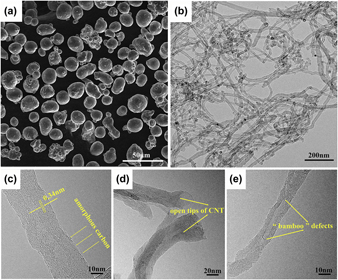
The morphology of the as-received Al powders and the CNTs is shown in Fig. 1. Figure 1(a) shows that the Al powders exhibit spherical shape with particle sizes about 25 µm. Figure 1(b) shows TEM image of MWCNTs. There exist some different types of defects in the as-received raw CNTs, such as amorphous carbons, open tips of CNTs, and “bamboo” defects [Figs. 1(c)–1(e)]. After applying high-energy ball milling, the CNTs will be damaged partially and generate more defects [Reference Zhou, Sasaki and Kawasaki31]. Amorphous carbons and open tips of CNTs can react easily with aluminum to generate Al4C3 during high-energy ball milling [Reference Zhou, Bang, Kurita, Miyazaki, Fan and Kawasaki32]. Bamboo-shaped CNTs exhibit high reactivity due to the high density of defects along the edge of the wall [Reference Saba, Sajjadi, Haddad-Sabzevar and Zhang21]. Just like the original defects existing on the raw CNTs, the new defects brought by ball milling can also easily react with Al matrix and generate Al4C3.
Scanning electron microscopy and TEM observations of the as-received starting materials: (a) pure Al powder, (b) raw MWCNTs, and (c–e) defects of CNTs.

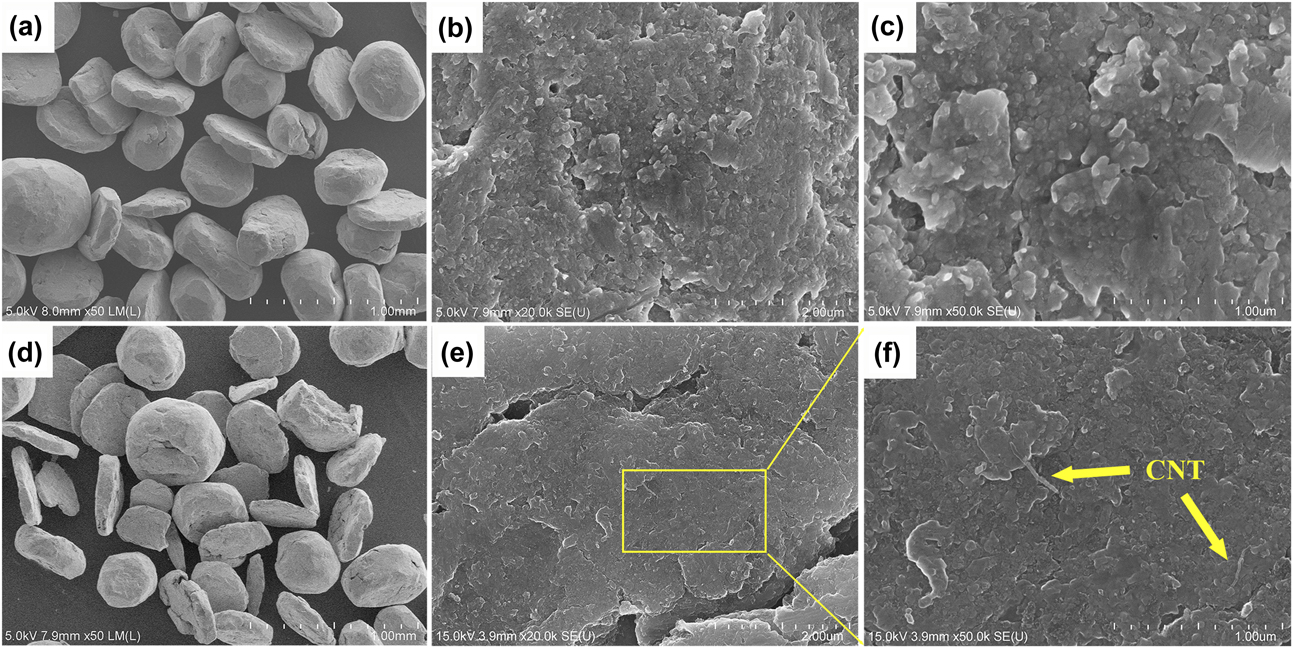
Figure 2 shows the morphology of the composite powders prepared by OSBM [Figs. 2(a)–2(c)] and two-step ball milling (TSBM) [Figs. 2(d)–2(f)]. After high-energy ball milling, the composite powders exhibit circular flake [Figs. 2(a) and 2(d)]. Such shape is more conducive to the attachment and dispersion of CNTs [Reference Jiang, Li, Fan, Cao and Zhang33]. Cold welding phenomenon of Al powders is observed in the OSBM composite powders, but nearly no CNTs can be seen at the surface of Al powders [Figs. 2(b) and 2(c)]. This is due to the structural damage of CNTs and the reaction of CNTs with aluminum during the long-time high-energy ball milling. It will be further demonstrated by Raman spectra and TEM images. Besides, some individual CNTs are attached to the surface of the composite powders prepared by TSBM, which indicates that CNTs exist in the composite powders prepared by TSBM process.
Scanning electron microscopy observations of the composite powders (a–c) prepared by OSBM and (d–f) prepared by TSBM. Figure (f) is an enlargement of the yellow box in Figure (e).

Phase composition of the composites
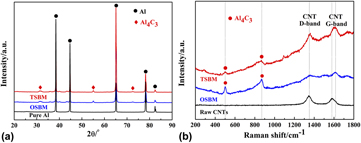
Figure 3 exhibit XRD patterns and Raman spectra of the composites. From the XRD pattern in Fig. 3(a), three peaks matched with Al4C3, including the main peak at 2θ is equal to 55° corresponding to the (112) plane of Al4C3, can be observed obviously in both OSBM and TSBM composites, which indicates that the Al4C3 phase is formed in both kinds of composites during the preparation. No other peaks except Al and Al4C3 can be found in the XRD patterns.
(a) XRD patterns of sintered composites and pure Al. (b) Raman spectra of sintered composites and raw CNTs.

Raman spectroscopic measurements were carried out to characterize carbon-related materials, such as Al4C3 bands near 490 and 855 cm−1 [Reference Sun, Cui, Gong, Chen, Shen and Wang34], CNT damage band (D-band) near 1350 cm−1, and CNT graphite band (G-band) near 1590 cm−1 [Reference Xu, Tan, Xiong, Fan, Guo, Zhang, Su, Li and Zhang29, Reference Steffens, Reznik, Kruzhanov and Dudzinski35]. It can be seen from Fig. 3(b), in OSBM composites, the D-band and G-band of CNTs almost disappeared. Meanwhile, two very obvious bands of Al4C3 appeared in the Raman spectra. This indicates that almost all the CNTs react with aluminum and form Al4C3 in the OSBM composites. A part of CNTs were remained in the TSBM composites, which revealed by the strong peaks corresponded to D-band and G-band of CNT. At the same time, the bands of Al4C3 also appeared in the composites. This indicated that in the TSBM composite, CNTs and Al4C3 are also included. The above results, combined with Al4C3 peaks in XRD pattern [Fig. 3(a)], confirm the transformation from raw CNT to Al4C3. Through the analysis by XRD and Raman, it is proved that the Al4C3 and CNTs hybrid-reinforced Al matrix composites can be successfully prepared via the TSBM process.
Microstructure of the composites
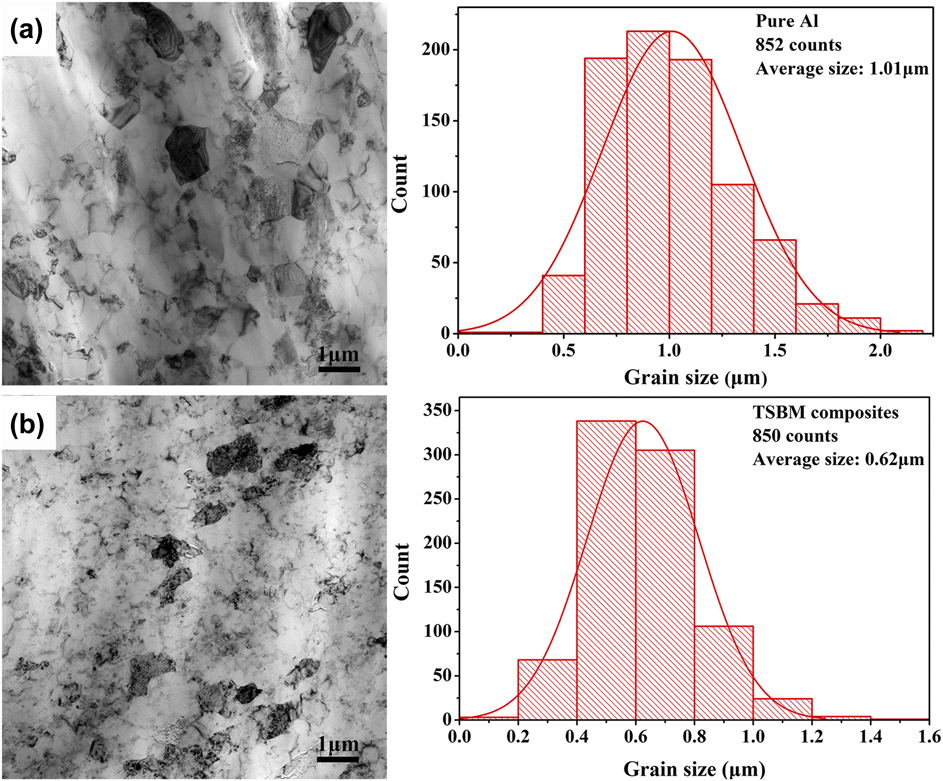
TEM observations of the microstructure of the pure Al and the TSBM composite are shown in Fig. 4. According to the statistical results [Figs. 4(a) and 4(b)], the average grain size of pure Al and the TSBM composites is just 1.01 and 0.62 μm, respectively. It is considered that the effective grain refinement in both materials is mainly due to the input of deformation energy during LTBM [Reference Xu, Tan, Xiong, Fan, Guo, Zhang, Su, Li and Zhang29]. Owing to the pinning effects of CNTs and Al4C3 on the grain boundaries during consolidation processes, the TSBM composite got finer grains compared with pure Al.
TEM observations of the microstructure and grain size statistical charts of (a) pure Al and (b) TSBM composites.

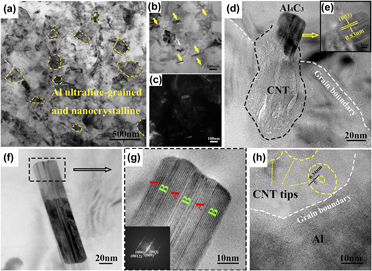
High-magnification and high-resolution TEM images of the TSBM composite are provided in Fig. 5. As shown in Fig. 5(a), there exists some ultrafine-grained and nanocrystalline materials in the TSBM composite. From the high-magnification images [Figs. 5(b) and 5(c)], many rod-like particles are dispersed in the Al matrix, as indicated by yellow arrows. These nanoparticles have a similar shape with the CNT segments and can be identified as single-crystal Al4C3 by the lattice spacing (0.83 nm) of (003) plane in the high-resolution TEM image [Fig. 5(e)]. Moreover, high-resolution TEM images in Figs. 5(f) and 5(g) show the presence of twin Al4C3 crystals. Furthermore, the Al4C3 is also confirmed by fast Fourier transform (FFT) pattern displayed by the inset in Fig. 5(g). Zhou et al. [Reference Zhou, Bang, Kurita, Miyazaki, Fan and Kawasaki32] primarily observed Al4C3 twinning in the CNT-reinforced Al composites heat treated at the temperature of 913 K. Steffens et al. [Reference Nam, Cha, Lim, Park, Han and Hong36] reported that the twinned Al4C3 was introduced by crystal deformation under compressive stress resulting from the difference in thermal expansion coefficient between Al4C3 and Al matrix during the cooling process of composites. In addition, some individual CNTs present in the TSBM composites, as shown in Fig. 5(h). These CNTs may cooperate with the in situ generated Al4C3 nanorods and later enhance the mechanical properties of the composites.
High-magnification and high-resolution TEM observations of the TSBM composite: (a) and (b) bright field image, (c) dark field image of (b), (d–g) micromorphology of Al4C3, and (h) individual CNTs distributed in Al matrix.

Mechanical properties of the composites
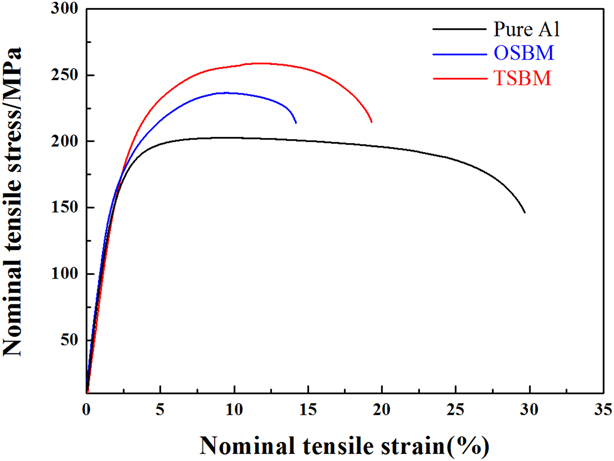
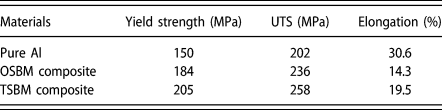
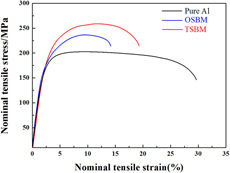
The tensile nominal stress–strain curves of the pure Al and the composites are shown in Fig. 6. Related results of 0.2% offset yield strength, ultimate tensile strength (UTS), and elongation at fracture are shown in Table I. For the pure Al sample, long-time high-energy ball milling resulted in an increase in strength. The UTS reached 202 MPa, which is two times more than the strength of industrial pure aluminum (80–100 MPa). This is mainly due to fine-grained strengthening brought by high-energy ball milling. It can be seen from the tensile stress–strain curve that the strength and ductility of the TSBM composite are improved in comparison with the OSBM composites. The UTS of TSBM composite reached 258 MPa, which is 27% higher than that of pure aluminum prepared in this work. The excellent comprehensive mechanical properties of TSBM composite are attributed to the hybrid enhancement effect of CNTs and Al4C3
Tensile nominal stress–strain curves of pure Al and composites.

Mechanical properties of pure Al and composites.

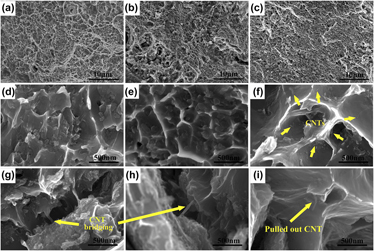
Figure 7 is the fracture morphology of the composite after tensile test. All specimens have dimples on the fracture surface [Figs. 7(a)–7(c)]. More cracks are seen on the fracture surface of OSBM composite [Fig. 7(b)], which may be due to the superfluous hard and brittle Al4C3 produced by long-time high-energy ball milling, high-temperature sintering, and hot extrusion. Figures 7(d)–7(f) are high-magnification images of fracture surface of pure Al, OSBM composite, and TSBM composite, respectively. In Figs. 7(d) and 7(e), no CNTs can be found on the fracture surfaces. However, as shown by yellow arrows in the enlarged fracture morphologies of TSBM composite [Figs. 7(f) and 7(i)], some CNTs pulled out from the Al matrix can be observed obviously, which indicates that some relatively integrated CNTs have been retained during the preparation of TSBM and these CNTs can improve the strength of the composite. In addition, some bridging CNTs can be clearly seen in the high-magnification images of TSBM composite fracture surfaces [Figs. 7(g) and 7(h)]. The CNT bridging can hinder the expansion of cracks and improve the toughness and ductility of composites, which explain the higher ductility of the TSBM composites than that of OSBM composite.
FESEM fracture morphologies of pure Al and composites: (a) and (d) pure Al, (b) and (e) OSBM composites, (c) and (f) TSBM composites, and (g–i) CNTs in the TSBM composite.

Discussion
Possible strengthening mechanisms operating in TSBM composites
The present results show that TSBM composite exhibits excellent comprehensive mechanical properties. Possible reinforcement mechanisms in TSBM composites include (i) fine-grained strengthening [Reference George, Kashyap, Rahul and Yamdagni37], (ii) dispersion strengthening by in situ Al4C3 nanorods [Reference Chen, Jia, Li, Imai, Takahashi and Kondoh30], (iii) load transfer from matrix to CNTs [Reference Li, Sun, Imai and Kondoh38], (iv) solid solution strengthening by carbon atoms from CNTs diffused into Al matrix [Reference Park, Keum and Lee39], and (v) thermal mismatch mechanism [Reference Yoo, Han and Kim40]. Due to the low solid solubility of carbon atoms in Al matrix, the solid solution strengthening of carbon atoms in composites can be neglected. The thermal mismatch often occurs in the process of quenching or rapid cooling [Reference Li, Sun, Imai and Kondoh38, Reference Chen, Tao, Yi, Liu, Li and Bao41]; however, the sample in this study is cooled slowly in the furnace, so the heat mismatch mechanism can be ignored. Therefore, only the remaining three strengthening mechanisms, i.e., fine-grained strengthening, dispersion strengthening by in situ Al4C3 nanorods, and load transfer, are the potential mechanisms for the strength improvement in the TSBM composite. The contribution of these mechanisms can be quantified in the following sections.
Strengthening by grain refinement
The statistical results in Fig. 4 show that the grain sizes of reference pure Al and TSBM composite are 1.01 and 0.62 μm, respectively. The strengthening effect of grain refinement can be explained by the Hall–Petch relationship, and the increase in strength can be calculated by the following equation [Reference Muñoz-Morris, Oca and Morris42]:
 $$\Delta {\sigma _{{\rm{GR}}}} = K\left( {D_{\rm{c}}^{ - 0.5} - D_{\rm{m}}^{ - 0.5}} \right)\quad ,$$
where ΔσGR is the strength increment brought by grain refinement, K = 0.04 MPa m0.5 for Al [Reference George, Kashyap, Rahul and Yamdagni37], D c is the average grain sizes of the TSBM composite, and D m is the average grain sizes of reference pure Al. After calculation, the value of ΔσGR is 10.9 MPa.
Strengthening by dispersed Al4C3 nanorods
For the OSBM composite, because of the long-time high-energy ball milling, the CNTs almost entirely reacted with the aluminum matrix and produced Al4C3, which can be proved by the FESEM images and Raman spectra. Therefore, the strength improvement (34 MPa) of OSBM composite is mainly due to fine-grained strengthening and dispersion strengthening of Al4C3. Because the grain size of the Al matrix is equivalent to the TSBM composite, the strength increment due to fine-grained strengthening is equivalent to 10.9 MPa. The remaining part (23.1 MPa) of the strength increment in the OSBM composites is mainly due to the dispersed strengthening of in situ Al4C3. As we know, the strengthening of in situ Al4C3 particles is mainly achieved by forming Orowan looping, and this increase in strength  $\left( {\Delta {\sigma _{{\rm{A}}{{\rm{l}}_4}{{\rm{C}}_3}}}} \right)$ can be calculated by the following equation [Reference Stoller and Zinkle43]:
 $$\Delta {\sigma _{{\rm{A}}{{\rm{l}}_4}{{\rm{C}}_3}}} = {{MGb} \over {2.36\pi }} \cdot \ln \left( {{\Phi \over {2b}}} \right) \cdot {1 \over {\lambda - \Phi }}\quad ,$$
where M = 3.06 for Al matrix, G is the shear modulus (taken as 25.4 GPa for Al [Reference Frost and Ashby44]), b is the Burgers vector (b = 0.286 nm for Al [Reference Bakshi and Agarwal45]), Φ is equivalent diameter of particles, and λ is distance between particles. It is assumed that Al4C3 particles distribute uniformly in the matrix [Reference Chen, Shen, Ye, Jia, Li, Umeda, Takahashi and Kondoh19, Reference Yoo, Han and Kim40]. It can be obtained by the following equation:
 $$\lambda = \Phi \cdot \root 3 \of {{\pi \over {6{V_{{\rm{A}}{{\rm{l}}_4}{{\rm{C}}_3}}}}}} \quad ,$$
where  ${V_{{\rm{A}}{{\rm{l}}_4}{{\rm{C}}_3}}}$ is the volume fraction of Al4C3 particles, which is equal to the volume fraction of CNTs for OSBM composite materials. The density of CNTs used in this work is about 2.1 g/cm3, so the
 ${V_{{\rm{A}}{{\rm{l}}_4}{{\rm{C}}_3}}}$ are about 2.56% and 3.82% when the CNT content is 2 wt% and 3 wt%, respectively. In general, strength enhancement in OSBM composite can be considered as the sum of all factors of strengthening (fine-grained strengthening and dispersion strengthening of in situ Al4C3). The average diameter of Al4C3 particles (Φ) and the distance between particles (λ) can be estimated from Eqs. (2) and (3) as 159 and 286.2 nm, respectively. This value agrees with the TEM image [Fig. 5(b)]. In the TSBM composite, it is assumed that all the CNTs (2 wt%) added in the first step reacted with Al matrix and formed Al4C3 nanorods. Because the formation condition of these Al4C3 is same as that of OSBM, their equivalent diameter (Φ) should be almost equal (159 nm). Therefore, the strength increment
 $\left( {\Delta {\sigma _{{\rm{A}}{{\rm{l}}_4}{{\rm{C}}_3}}}} \right)$ in the TSBM composite due to the dispersion strengthening of Al4C3 particles can be estimated as 15.8 MPa from Eqs. (2) and (3).
Load transfer from Al matrix to CNTs
The strengthening mechanism of composites containing fibrous reinforcements is usually explained by a shear lag model [Reference Xie, Li, Pan, Chang and Sun46]. In the shear lag model, the tensile strength of the composite is related to the length of the fiber reinforcement. The condition that the reinforcement can bear load effectively is that its length is larger than the critical length. The critical length is defined as follows [Eq. (4)] [Reference Chen, Shen, Ye, Jia, Li, Umeda, Takahashi and Kondoh19]:
 $${l_{\rm{c}}} = {{{\sigma _{{\rm{T}}{\rm{.CNT}}}}{D_{{\rm{CNT}}}}} \over {2{\tau _{\rm{M}}}}}\quad ,$$
where l c is the critical length of the reinforcement; σT.CNT is the tensile strength of the CNT, which is 3.6 GPa [Reference Deutschman, Michels and Wilson47]; and D CNT is the average diameter of the CNTs. τM is the ultimate shear strength (USS) of the matrix. USS value approximates to 0.65 times UTS [48]. Tensile strength of matrix in this study is 202 MPa. So, the calculated value for l c is 0.27 μm, which is much smaller than the average length (20 μm) of the CNTs used in this work. It is assumed that the CNTs (1.28 vol%) added in the second-step ball milling are uniformly dispersed in the aluminum matrix. The tensile strength improved by load transfer [ΔσT.C(L.T.)] can be calculated by Eq. (5) [Reference Zhang, Li, Pan, Pan, Zhou, Yang, Jia and Kondoh22].
 $$\eqalign{\Delta {\sigma _{{\rm{T}}{\rm{.C(L}}{\rm{.T}}{\rm{.)}}}} = \,\,{\sigma _{{\rm{T}}{\rm{.CNT}}}}{V_{{\rm{CNT}}}}\left( {1 - {{{l_{\rm{c}}}} \over {2{l_{{\rm{CNT}}}}}}} \right) \cr+ {\sigma _{{\rm{T}}{\rm{.M}}}}\left( {1 - {V_{{\rm{CNT}}}}} \right) - {\sigma _{{\rm{T}}{\rm{.M}}}}\quad ,$$
where V CNT is the volume fraction of CNTs, which is equal to the volume fraction of CNTs (1.28%) added in the second STBM process for TSBM composite. l CNT is the average length of CNTs (20 μm). σT.M is the tensile stress of Al matrix (202 MPa). After calculation, the value of ΔσT.C(L.T.) is 48.1 MPa.
In summary, these mechanisms occur simultaneously in TSBM composite, and the strength (σc) of the composites can be calculated by the following formula:
 $${\sigma _{\rm{c}}} = {\sigma _{\rm{M}}} + \Delta {\sigma _{{\rm{GR}}}} + \Delta {\sigma _{{\rm{A}}{{\rm{l}}_4}{{\rm{C}}_3}}} + \Delta {\sigma _{{\rm{T}}{\rm{.C(L}}{\rm{.T}}{\rm{.)}}}}\quad .$$
The calculated tensile strength of the TSBM composite is 276.8 MPa, which is higher than the experimental value of this composite (258 MPa). This result indicates that the above analysis about the strengthening mechanisms in TSBM composite is reasonable, and there exist fine-grained strengthening, dispersion strengthening by in situ Al4C3 nanorods, and load transfer from Al matrix to CNTs in this composite. On the basis of fine-grained strengthening, the synergistic effect of in situ Al4C3 nanorods and CNTs can further improve the strength of the composite while maintaining its good ductility. However, it is very difficult to completely uniformly disperse CNTs into Al matrix only by the 6-h second-step ball milling, and the CNTs aggregation could reduce the synergistic strengthening effect, so there occurs a difference of 7.3% between the experimental strength and the calculation value.
Conclusion
In situ Al4C3 nanorods and CNTs hybrid-reinforced Al matrix composites were successfully prepared by a novel TSBM process combined with sintering and hot extrusion. The TSBM composite got good comprehensive mechanical properties, and the UTS and elongation reached 258 MPa and 19.5%, respectively. Compared with OSBM composite, the strength and ductility of TSBM composite are improved simultaneously, which is mainly due to the hybrid-enhancing effect of Al4C3 and CNTs. The main strengthening mechanisms of the TSBM composite include fine-grained strengthening, dispersion strengthening of Al4C3, and load transfer of CNTs. The effect of hybrid reinforcement provides a new idea for preparing advanced metal matrix composites.
Experimental
Materials and methods
The diameter of the original multiwall carbon nanotubes (MWCNTs) is 20–30 nm and the length is 10–30 μm. The average particle size of aluminum powders (99.95% purity) is 25 μm. The process of preparing in situ Al4C3 nanorods and CNTs composite powders includes two-step high-energy ball milling. First, 0.6 g of CNTs and 29.1 g of Al powders were sealed in a cemented carbide jar together with GGr15 media balls (10 mm in diameter) under an argon gas atmosphere. The milling had been lasted for 24 h under the condition of 250 rpm (revolutions per minute) rotation speed and a ball-to-powder massive ratio of 10:1. Then, 0.3 g of CNT was added into the above composite powders under the same argon atmosphere, and the second-step high-energy ball milling had been carried out for 6 h under the same conditions used in the first step. For comparison purpose, 0.9 g CNTs and 29.1 g Al powders had been milled for 30 h by using one-step high-energy ball milling with the above ball milling parameters. Meanwhile, pure Al powder was also prepared by 30-h one-step ball milling (OSBM) under the same milling conditions.
Three kinds of powders mentioned above were cold pressed into φ28 mm cylinders at the pressure of about 187 MPa, and then the cylindrical billets had been sintered for 4 h at 600 °C in argon atmosphere. After that, the as-sintered billets were heated for 1 h at 773 K, then extruded into φ5 mm rods with the pressure of 737 MPa and the extrusion ratio of 36:1.
Characterization
The morphology of the powders and the tensile fracture surfaces of the as-prepared materials was examined by field emission scanning electron microscopy (FESEM; Nova Nano 450; FEI, Eindhoven, Netherlands). Structural defects in the CNTs and the phases of the materials were analyzed by Raman spectroscopy and X-ray diffraction (XRD). The morphology of in situ Al4C3 and interface of the composites was studied by transmission electron microscopy (TEM; FEI G2 F30 S-TWIN; FEI, Eindhoven, Netherlands). At a constant rate of 5 × 10⁻⁴ s−1, the tensile properties of the samples were tested by a universal testing machine (AG-X-100 kN; Shimadzu Corporation, Kyoto, Japan) at room temperature. The tensile samples are dog bone–shaped samples with a gauge length of 16.5 mm and a cross section of 2 mm (width) × 3 mm (thickness), and the average tensile property values for each material were obtained from at least three specimens.
Acknowledgment
The authors acknowledge supports from the Science Foundation of the Yunnan Provincial Science and Technology Department (Grant Nos. 2018FB085, 2014FC001, 2017HC033, and 2018ZE007) and the Science Foundation of Rare and Precious Metals Advanced Materials Collaborative Innovation Center of Yunnan Province (Grant No. KKPT201551005).