Introduction
This paper will deal with specific memories transformed into images. These memories are related to the event which happened at least once a year in New Kingdom Egypt (Panagiotopoulos Reference Panagiotopoulos2001, 269). This was the visit of foreign emissaries and it included the presentation of the objects they brought to the Egyptian king (Hallmann Reference Hallmann2006). The class (gift, tribute or tax) of the objects they brought was dependent on their country's status in relation to Egypt (Liverani Reference Liverani2001, 176). However, this difference is not clearly evidenced due to the effects of Egyptian decorum. Objects initially sent as gifts could be presented as tribute during the procession (Matić Reference Matić, Back Danielsson, Fahlander and Sjöstrand.2012; Singer Reference Singer2008, 17).
The event was organized in the palace and its audience was restricted to the high social elites, court society, royal family members and of course foreign emissaries (Spence Reference Spence and Spawforth.2007, 276, 280–81). It was emotionally charged for the Egyptian officials who organized it. This is stated in several Ramesside papyri (Papyrus Kohler, Papyrus Anastasi IIIA, Papyrus Anastasi IV-recto). They inform us that the officials should remember the day of the presentation of the jn.w [gift/tribute]. On this day an official has to pass beneath the ‘window of appearance’ of the king with other officials standing in two rows in front of the king. Foreign emissaries are said to have come from every foreign country. The texts also inform us that the official is frightened, stunned, and that his hand grows weak, not knowing if he will live or die, and that he turns to the gods for rescue (Gnirs Reference Gnirs, Gundlach and Taylor.2009, 28–9). Clearly, the outcome of the event was unpredictable, depending primarily on the king's and court's satisfaction with the received objects. The event was so important for the office of the people who organized it that they ordered it to be represented in their tombs. There are 46 tombs with so-called ‘tribute scenes’ in the New Kingdom (Hallmann Reference Hallmann2006). The term ‘tribute scenes’ is used to designate scenes found on the walls of private tombs and temple walls of the 18th dynasty in which foreigners are depicted in processions bringing objects, materials and people. As previously mentioned, not all of these foreigners brought tribute. Some of them brought gifts or tax; however, the term ‘tribute scenes’ will be used throughout the paper to designate all scenes, no matter the status of the foreigners.
Among the foreigners depicted in these scenes are those coming from the Aegean. If we did not have these representations, we could only speculate about whether representatives of the Aegean polities actually visited the Egyptian court. There are six Theban tombs with representations of Aegean and Syro-Aegean hybrid figures: Senenmut (TT 71), Intef (TT 155), Puimre (TT 39), Useramun (TT 131), Menkheperreseneb (TT 86) and Rekhmire (TT 100). They date from the reign of Hatshepsut to the early reign of Amenhotep II. Where accompanying text survives, these figures are identified as wr.w [princes], but we can understand them as emissaries (Matić Reference Matić, Back Danielsson, Fahlander and Sjöstrand.2012, 242). They come from Pḥw Sṯt [far north, Asia]—Puimre, jw nb n ḥrj-jb nw w3ḏ wr [every island in the middle of great green (sea)]—Useramun, and kftjw jww ḥrj-jb nw w3ḏ wr [Keftiu and/of the islands in the middle of great green (sea)]—Rekhmire (Matić Reference Matić2014, 277–84). The register with the depiction of the Aegeans in the tomb of Intef is badly preserved and is not of use for the discussions in this paper (Säve-Söderbergh Reference Säve-Söderbergh1957, pl. XIII).
The Aegeans, their dress and the objects they are depicted as bringing have received the attention of numerous scholars (Duhoux Reference Duhoux2003; Laboury Reference Laboury1990; Matić Reference Matić, Back Danielsson, Fahlander and Sjöstrand.2012; Reference Matić2014; Reference Matić2015; Matić & Franković Reference Matić and Franković2017; Panagiotopoulos Reference Panagiotopoulos2001; Thomas Reference Thomas and Driessen2016; Vercoutter Reference Vercoutter1956; Wachsmann Reference Wachsmann1987). There is disagreement on the degree to which these representations of the Aegeans can be used for historiography. Some scholars argued that certain figures and objects are less real than others and were therefore awarded an ahistorical status (e.g. Kitchen Reference Kitchen, Kousoulis and Magliveras.2007, 9). Their contribution to history has so far been undervalued in favour of those for which clear analogies can be found in the archaeological material from the Aegean (cf. Feldman Reference Feldman2006, 61). Indeed, looking for analogies in the archaeological material from the Aegean can be very productive. However, one should concentrate not only on analogies for single objects, but try to recognize analogous assemblages, too (Matić Reference Matić2015).
In this paper I will deal with precisely those objects which were considered to be less real, and argue that through studying them we can learn a lot about how memories of the processions and objects presented during them can be transformed through Egyptian decorum. First and foremost, I will discuss the previous ‘photographic’ approaches. Then I will discuss the objects in question through the lenses of creativity, transference and hybridism. After that I will provide my concluding thoughts about the transformation of memory and knowledge and the realization of the virtual experience.
‘Interrogating the real’
Some of the objects depicted as being brought by Aegean emissaries in ‘tribute scenes’ are quite often understood as less real than the others. Thus, the first issue which should be addressed is the reality behind the representations of precisely these ‘problematic’ objects. However, before I come to these objects, I would like to refer to the similar interpretative issue behind Aegean figures and Syro-Aegean hybrid figures depicted in Theban 18th dynasty tombs.
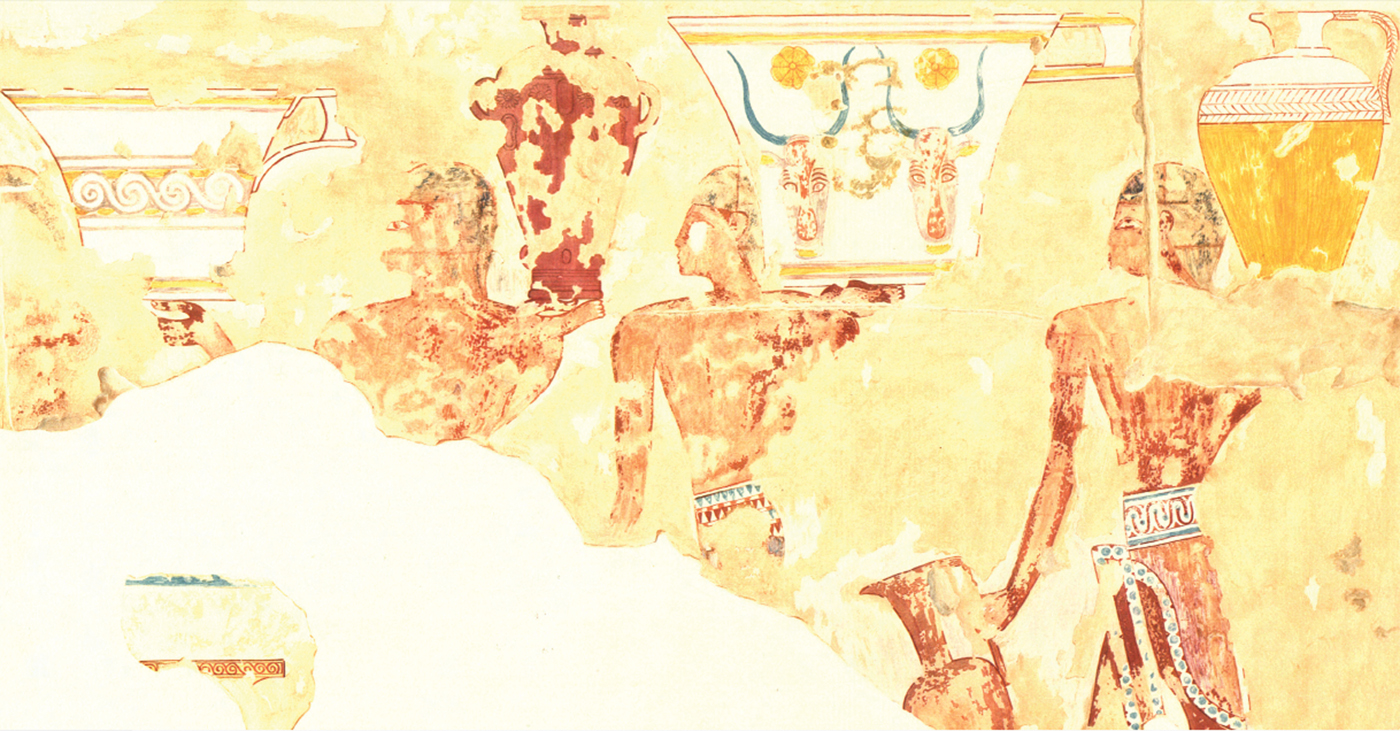
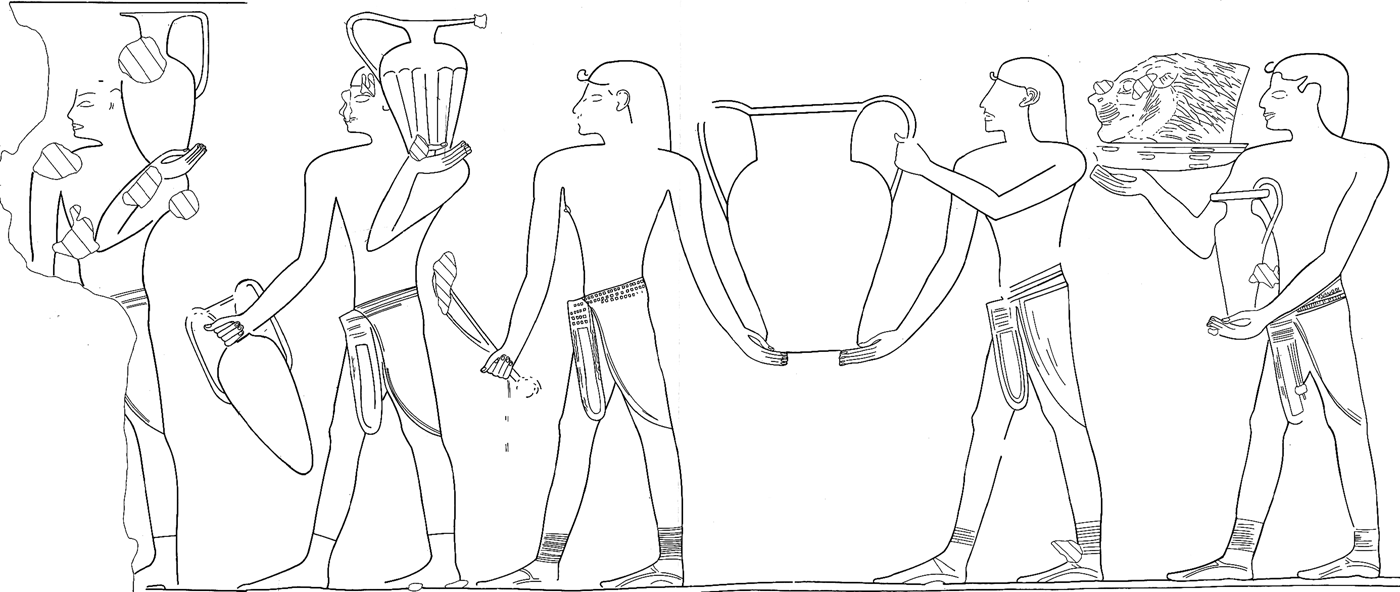
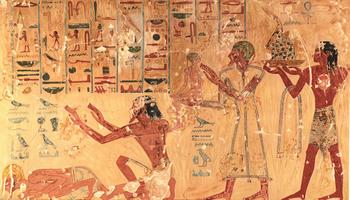
The first scholars to study the ‘tribute scenes’ approached them as photographs. They interpreted the Egyptian representations of foreigners as showing real physical characteristics. Thus, for example, narrow waists of Aegean figures in the tomb of Senenmut (Fig. 1) were understood as a specific trait of the ‘Myceanean race’ (Hall Reference Hall1903/1904). The Syrian-Aegean iconographic hybrid figures were, for want of a better term, referred to as ‘Syro-Keftians’ and located in Cilicia, although their existence there was, unsurprisingly, not archaeologically confirmed (Hall Reference Hall1928, 200–204). Such a ‘photographic’ understanding of the Egyptian imagery is encountered in the work of later scholars too. Some even argue that the hybrid figures maybe represent a mixture of the two or more populations which can be expected ‘in some of the cosmopolitan port towns of Syria-Palestine or the Nile Delta in the Late Bronze Age’ (Rehak Reference Rehak, Cline and Cline.1998, 47). The reality of the Syro-Aegean hybrid is defended even in some studies which show rigorous theoretical and methodological awareness when other materials are concerned (Feldman Reference Feldman2006, 61). Similarly, others also argued that these iconographic hybrid figures could derive from accurate observations of the crews of the trading vessels docked in the Egyptian ports. It was suggested that the men of the Uluburun ship might have resembled these hybrids (Darnell & Manassa Reference Darnell and Manassa2007, 202). Such interpretations are telling us that these authors understood iconographic hybridism as a method of representing cultural mixture and that they understand cultural mixture as merging of two or more cultures. This merging is interpreted as cosmopolitanism.
Aegean emissaries in the tomb of Senenmut (TT 71), reign of Hatshepsut, facsimile detail. (Davies Reference Davies1936, pl. XIV.)

However, there never existed ‘down to the waist Aegeans and up to the waist Syrians’, which does not mean that we should not take the hybrid figures into account at all (cf. Laboury Reference Laboury1990, 94). That these individuals actually did not look like this does not mean that the crews of the trading ships did not have identities which are beyond the dichotomies we establish when ethnicity is concerned (e.g. Aegean, Syrian, or any other). When Egyptian iconography is concerned, these hybrid figures have to be understood through principles of representation and decorum in which like is hybridized with like. Namely, during the New Kingdom both Aegeans and Syrians are associated with the north in Egyptian cultural geography (Quack Reference Quack1996, 77–9; Safronov Reference Safronov2017, 750–53) and therefore it should come as no surprise that figures from these regions can be hybridized (Matić Reference Matić2014, 282–7). The same goes for objects to which I now turn. I cannot agree with the opinion that the presence of hybrids in ‘tribute scenes’ demonstrates that accuracy was not considered essential (Roberts Reference Roberts, Knapp and van Dommelen2014, 356). The fact that we know of Aegean-Syrian and not of Aegean-Nubian or Syrian-Nubian hybrid figures indicates that there were strict rules about what can be iconographically mixed and in which context (Matić Reference Matić, Back Danielsson, Fahlander and Sjöstrand.2012; Reference Matić2014).
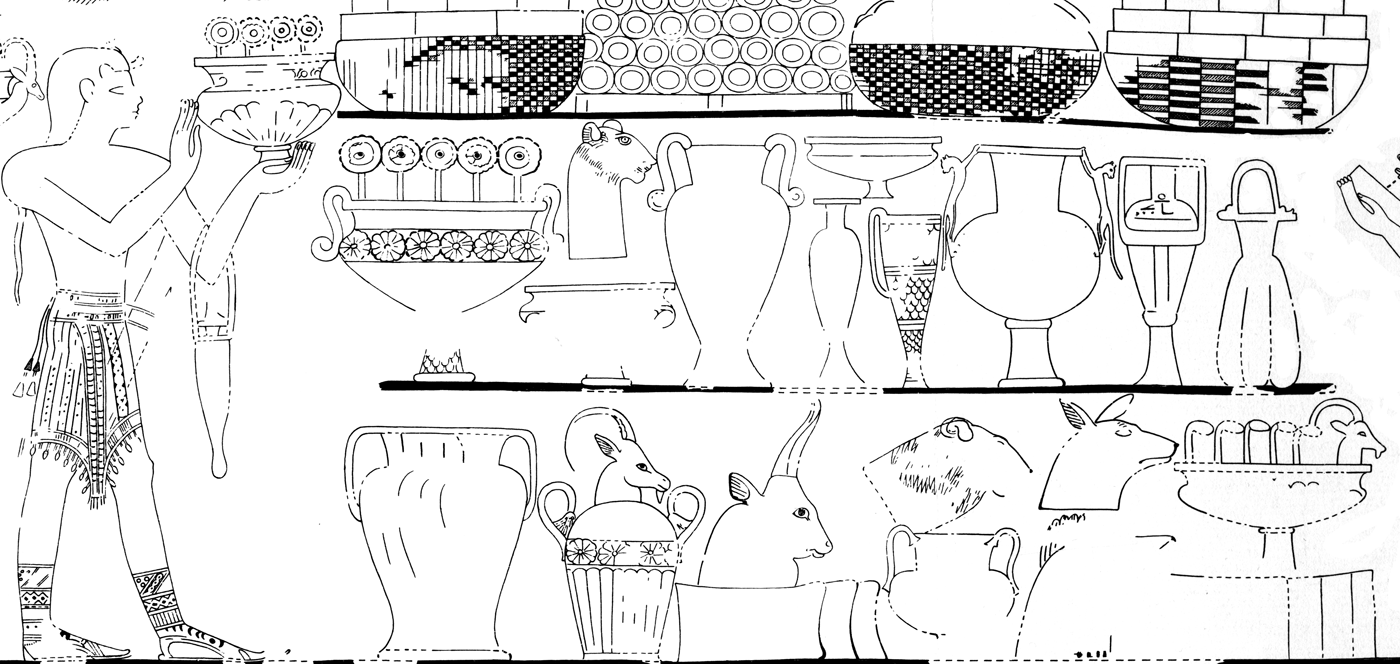
One of the examples of a ‘photographic’ understanding is the interpretation of the contents of the vessels based on their representations. Marinatos argued that some of the vessels brought by Aegeans contained herbs (discussion in Sakellaraki & Sakellarakis Reference Sakellaraki and Sakellarakis1984, 203). The reason why Marinatos argued that the vessels contained herbs is the depiction of some of the vessels with flowers vertically ascending above the rims (see Fig. 2). Examples can be found in the registers with Aegean and Syrian emissaries in the ‘tribute scenes’ from the tombs of Rekhmire (Davies Reference Davies1943, pl. XVIII) and Amenemhab (Davies Reference Davies1934, pl. XXV). Marinatos connected this to the Kftj.w [Crete] mentioned in Papyrus Ebers, of New Kingdom or possibly even Middle Kingdom date. Papyrus Ebers IX, 16–19 refers to a remedy for defecation (fgn) which will be like ‘beans’ of Keftiu (jwr.yt Kftj.w), indicating that the Egyptians had an equivalent (Strange Reference Strange1980, 93; Vercoutter Reference Vercoutter1956, 39). However, although Papyrus Ebers indicates that Egyptians knew of herbs from Keftiu, Marinatos misinterpreted the Egyptian imagery. According to the well-known Egyptian principles of representation, the plants depicted as though emerging from these vessels are actually representations of the interior decoration, or three-dimensional decoration placed on the edge or inside of the basin, or protomes on the rims (Brunner-Traut Reference Brunner-Traut and Helck1975; Schäfer Reference Schäfer and Baines1986, 97–8, 144). If we were to accept the interpretation of Marinatos, then we would have to argue that some of the metal vessels also contained frogs, birds, heads of pigmy ibexes, heads of bulls with sun discs between their horns, heads of horses and panthers, even heads of the Egyptian god Bes. This is because there are vessels with some of these creatures depicted on their rims. Such vessels are found in the tombs of Puimre, Useramun, Menkheperreseneb, Rekhmire, Amunedjeh (TT 84), Sobekhotep (TT 63) and Huy (TT 40) (Wachsmann Reference Wachsmann1987, 63–6, pl. I). It is impossible that these animals (frogs, birds, pigmy ibexes, bulls, horses, panthers) and a god (Bes) were the contents of these vessels. There is no difference in the colour of either plants or animals when compared to the vessels on which they are represented. Since the colour yellow stands for gold and white for silver (Wachsmann Reference Wachsmann1987, 56–9) and the plants and animals on these vessels are in one of these colours, they have to be interpreted accordingly. Clearly, when we look at these representations, we have to look at them from an Egyptian perspective, otherwise we will materialize something which was never there.
Aegean emissaries in the tomb of Rekhmire (TT 100), detail. (Redrawn after Davies Reference Davies1943, pl. XVIII.)

The issue of reality is also nicely illustrated by the relative size of the depicted objects. This is best shown in the tomb of Senenmut (Fig. 1), where Vapheio cups are depicted oversized and one pithoid amphora is depicted in reduced size (Davies Reference Davies1936, pl. XIV). There are several explanations offered for the oversized Vapheio cups. Hall (Reference Hall1909–10, 255) suggested that the artist made his picture from drawings of the original without realizing their actual size. This opinion was also expressed by Davis (Reference Davis1973). If this is true, then not only does this mean that the artist did not realize their real size, but never actually saw these objects himself(!). This implies the use of pattern books. Vercoutter (Reference Vercoutter1956, 190) argued that Senenmut wanted to place more emphasis on the objects than on the emissaries. According to Dorman (Reference Dorman1991, 33), the sense of the great size of the vessels is caused less by their enlargement and more by diminution of the figures who carry them. These interesting suggestions by Vercoutter and Dorman are both clearly based on the idea of Bedeutungsmaßstab—hierarchic scaling. However, hierarchic scaling is usually used for human figures and not objects. Its role was to differentiate the status of some figures from others. An additional problem is that the two Vapheio cups in the tomb of Senenmut are depicted in different sizes. Arguing on the same line that for some reason one cup was more important than the other is highly unlikely. Depicting these cups in scale would not allow the painter to depict all the details we see when the cups are depicted enlarged.
The reduced size pithoid amphora when compared to actual pithoid amphora is explained by Trude Dothan with the actual size of the metal prototype (as reported by Wachsmann Reference Wachsmann1987, 71). However, the pithoid amphora in question does not necessarily have to be a representation of a metal vessel. Red colour is also used for ceramic vessels in Egyptian paintings. If the painter depicted some objects in the ‘original size or scale’ he would have left too much unused space in the register and simultaneously caused a disorder in the composition. This empty space would then have to be filled with text. The texts accompanying the registers in ‘tribute scenes’ follow a more or less standardized pattern (Hallmann Reference Hallmann2006). Bearing this in mind, the empty space in the register would necessitate additional text which was most probably not at the painter's disposal.
Thus, we cannot simply conclude that the painter never saw the objects just because he depicted them differently to how we would expect them to be depicted. We can suppose that some of the visitors to the tombs indeed could have misunderstood the actual size of the objects they actually never saw in reality as they never attended the court ceremonies (cf. Matić Reference Matić, Back Danielsson, Fahlander and Sjöstrand.2012, 240–41). Clearly, not everyone in Egypt actually knew the principles of representation and composition and the different amount of background knowledge could have had a major influence on the way such images were understood.
Creativity
There are some objects depicted for which we do not have analogies in the Aegean Bronze Age archaeological material. For these objects we might surmise that they never existed. Unlike in the previously discussed examples, where some archaeologists materialized something which was never there by looking at and describing the depicted figures and objects with a modern gaze, the objects I will discuss now never existed, at least as three-dimensional objects. The question is whether they were understood by some tomb visitors as existing, namely by those who could not really tell the difference because they had not seen the originals in the first place, or lacked the background knowledge of the principles of representations and composition.
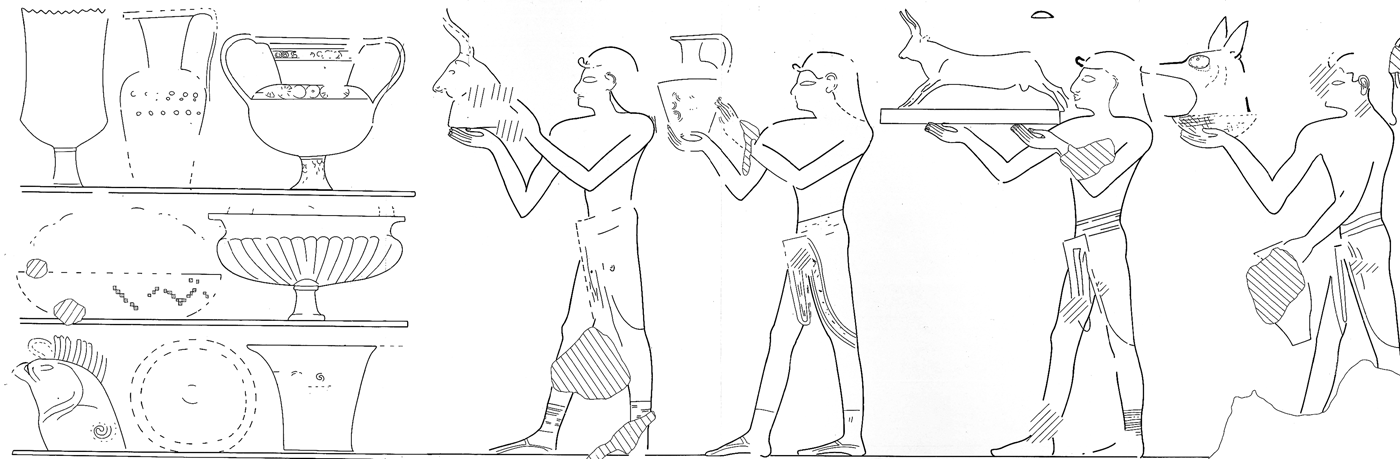
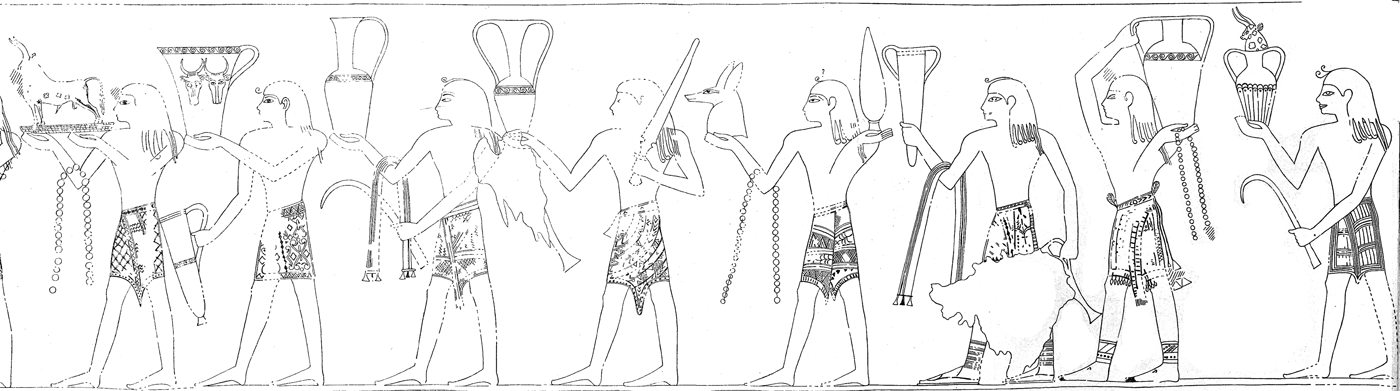
Some of them are rhyta in the form of a head of a jackal or a griffin. Jackal-headed rhyta are known from the tombs of Useramun (Fig. 3), Menkheperreseneb (Fig. 4) and Rekhmire (Fig. 2) (Wachsmann Reference Wachsmann1987, 58), and they are so far not known from either the Aegean or Egypt. The motif of the Egyptian jackal was transformed into a rhyton and it was suggested that these objects have a reality reference in jackal-headed masks from Egypt (Wachsmann Reference Wachsmann1987, 39). There are two known examples of Anubis (jackal-headed) masks from Egypt. Both are later than the depictions of jackal-headed rhyta in Theban tombs. One, made of wood, is in the Louvre, Paris (N4096) and is of 20th- or 21st-dynasty date, c. 1100–1000 bc. The other, of clay, is in Roemer and Pelizaeus museum in Hildesheim (inv. No. 1585) and is of Late Period date, c. seventh–fourth century bc (von Lieven Reference von Lieven, Berlejung and Filitz.2018, 70–71). Only the jackal-headed rhyta from the tombs of Useramun and Menkheperreseneb resemble these two masks so that one can follow the argument of Wachsmann. The jackal-headed rhyton from the tomb of Rekhmire looks different and was certainly not based on the Anubis masks.
Aegean emissaries in the tomb of Useramun (TT 131), reign of Thutmose III, detail. (Redrawn after Dziobek Reference Dziobek1994, Tf. 92.)

Aegean emissaries in the tomb of Menkheperreseneb (TT 86), detail. (Redrawn after Davies & Davies Reference Davies and Davies1933, pl. V.)

Griffin-headed rhyta are depicted in the tombs of Useramun (Fig. 3) and Rekhmire (Fig. 2) and they too have until now no Aegean parallels (Kantor Reference Kantor1947, 47; Koehl Reference Koehl2006, 247–8; Morgan Reference Morgan2010, 308; Wachsmann Reference Wachsmann1987, 59). This fact is entirely missed by those Egyptologists who did not venture outside their own field in interpreting these images. It was only remarked that the painters must not always have had the opportunity to see the objects they painted (e.g. Gerke Reference Gerke2014, 62–3). The depicted griffin-headed rhyta did not exist as three-dimensional objects in the first place, at least not as they were depicted in Egypt. It cannot be argued that such rhyta came from the Aegean to Egypt together with bull-headed and lion-headed rhyta (contra Judas Reference Judas, Pinarello, Yoo, Lundock and Walsh2015, 129). The rhyton depicted in the tomb of Useramun (Fig. 3) is falcon-headed, but it has a crest and spirals both protruding from the forehead and on the neck (Dziobek Reference Dziobek1994, Tf. 92). Thus, Aegean elements such as spirals are added to a visual prototype known from Egypt. The rhyton depicted in the tomb of Rekhmire is damaged, but has a crest, and Lyvia Morgan (Reference Morgan2010, 308) recognized spirals, although they are not preserved. This is certainly a probable educated guess based on the depiction of the rhyton from the tomb of Useramun and other examples of the Aegean rhyta. Morgan also argues that it has a straighter back and is therefore closer to the Aegean griffin (Reference Morgan2010, 308). The state of the griffin-headed rhyton from the tomb of Rekhmire (Fig. 2) does not allow much comparison (Davies Reference Davies1943, pl. XVIII), but indeed does not look much different to the one from the tomb of Useramun. It is located in the same place, among the piled objects in the third sub-register (Dziobek Reference Dziobek1994, Tf. 92). The griffin-headed rhyton is an innovation of the Egyptian artist. It was intentionally placed in the registers with the Aegean figures. In the tomb of Useramun, a falcon-faced head was changed into a griffin with the addition of the crest and spiral on the neck. In the tomb of Rekhmire, the head of an Aegean griffin was used as a prototype for the creative invention of an Aegean griffin-headed rhyton. Such Aegean griffins are known from the Tell el-Dabca ‘Minoan’ frescoes. They are, like the tombs in question, also Thutmoside, according to Manfred Bietak's most recent dating of the Tell el-Dabca (Reference Bietak, Bietak, Marinatos and Palivou2007, 39). According to Felix Höflmayer there is no evidence for such a late dating of the palaces. The stratum C/2-3 to which they are associated ended according to 14C dates sometime between 1650-1600 BC (Höflmayer Reference Höflmayer, Forstner-Müller and Moeller2018, 162–3). We can only speculate how the Egyptian painters came to the idea of creating an Aegean griffin-headed rhyton using the griffins from Tell el-Dabca as an inspiration.
Clearly, as indicated by the griffin-headed rhyta, some of the objects depicted as brought by the Aegean emissaries are not Aegean in origin, but they are still Aegean in appearance, or can be said to be Aegean-like. They were surely inspired by Aegean motifs and placed in the registers with the Aegean figures because they belong in that context. After all, creativity appears in existing surroundings and is as such contextually specific (Sofaer Reference Sofaer2015, 2). That we find a griffin-headed rhyton among the objects brought by emissaries from Syria, too, is not surprising, as this is an example of a transference based on decorum and cultural topography (Matić Reference Matić2014, 285–7). Interestingly, starting with the tomb of Useramun dated to the early reign of Thutmose III, where the griffin-headed rhyta first appear, painters started depicting the figures of Aegean emissaries with spirals (curls) on their foreheads (Figs. 3 & 5) and on the top of their heads in the later tombs (Figs. 4 & 2). They look as if they have spiral-shaped fringes and spiral crests like the Aegean-like griffin-headed rhyta and the Aegean griffin (Davies Reference Davies1943, pl. XVIII; Davies & Davies Reference Davies and Davies1933, pls. IV–V; Dziobek Reference Dziobek1994, Tfs. 92–93). Some authors interpret these curls as indication of curly hair (Anthony Reference Anthony2017, 27). This might well be true, but one wonders why the spiral-shaped fringes and spirals on the heads are not depicted on Aegeans in the tomb of Senenmut? Additionally, the position of these spirals is the same as on the heads of the griffins. It is questionable if this is really a mere coincidence. In the Aegean register in the tomb of Useramun, at least eight figures have spiral fringes. Among those from the tomb of Menkheperreseneb, there are at least seven figures depicted with these spirals as fringes and on the heads. In the tomb of Rekhmire there are at least eight. The spirals in question are identical to the ones we find on the heads of the griffins. It is as if Egyptian painters wanted to further pronounce their ‘Aegeanness’ by transferring an element of the griffin's body to the body of Aegean individuals. Nevertheless, I do not agree with the suggestion that the appearance of griffins with the Aegeans pronounced their liminal status for the Egyptians (Judas Reference Judas, Pinarello, Yoo, Lundock and Walsh2015). There is more than enough evidence to show that the Egyptians had continuous direct or indirect contacts with the Aegean since the Early Dynastic Period and Old Kingdom (Lange-Athinodorou Reference Lange-Athinodorou, Müller and Schiller.2018; Sowada Reference Sowada2009) and that these contacts intensified in the New Kingdom (Cline Reference Cline1994; Phillips Reference Phillips2010). Egypt is attested in personal names known from Linear B texts, such as a 3-ku-pi-ti-jo from KN Db 1105.B and mi-sa-ra-jo from KN F[2] 841.4 (Bennet Reference Bennet, Duhoux and Davies.2011, 157–8). Some even suggest there is evidence for an Egyptian embassy visiting the Mycenaean Pylos, based on one of the Pylos wall paintings (Blakolmer Reference Blakolmer, Alram-Stern and Nightingale2007, 45; Reference Blakolmer2012, 59–60). Thus, the 18th dynasty is exactly that time when, judging by the intensity of interrelations, the Aegeans would not be considered as a liminal Other. Further, the griffin-headed rhyta are also found in Syrian registers, yet Judas (Reference Judas, Pinarello, Yoo, Lundock and Walsh2015) did not argue for the liminal status of the Syrians.
Aegean emissaries in the tomb of Useramun (TT 131), reign of Thutmose III, detail. (Redrawn after Dziobek Reference Dziobek1994, Tf. 93.)

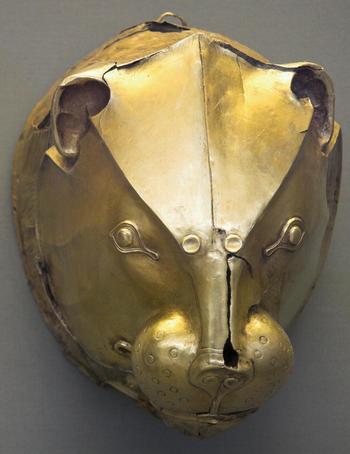
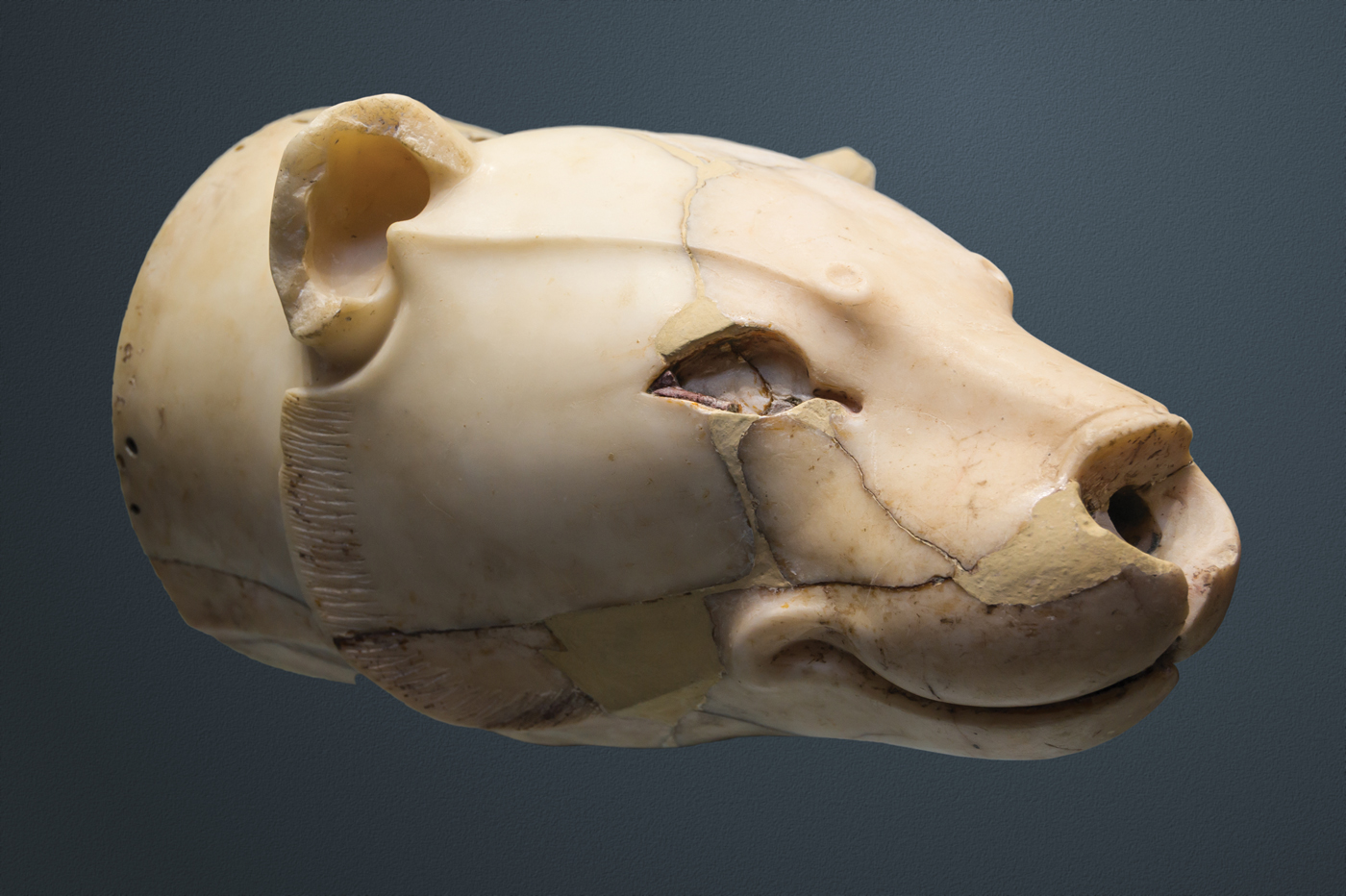
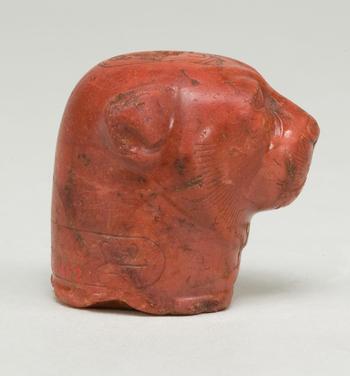
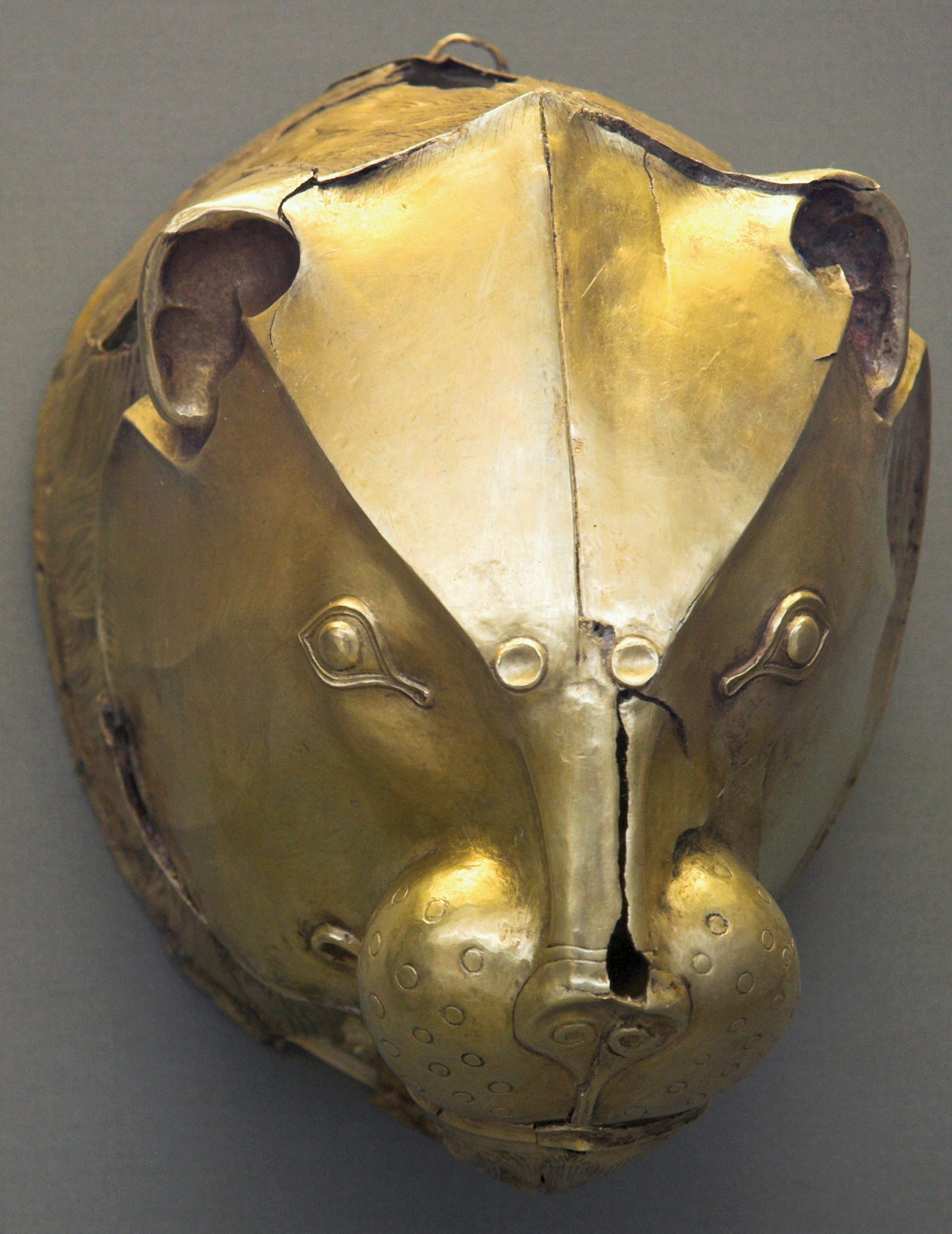
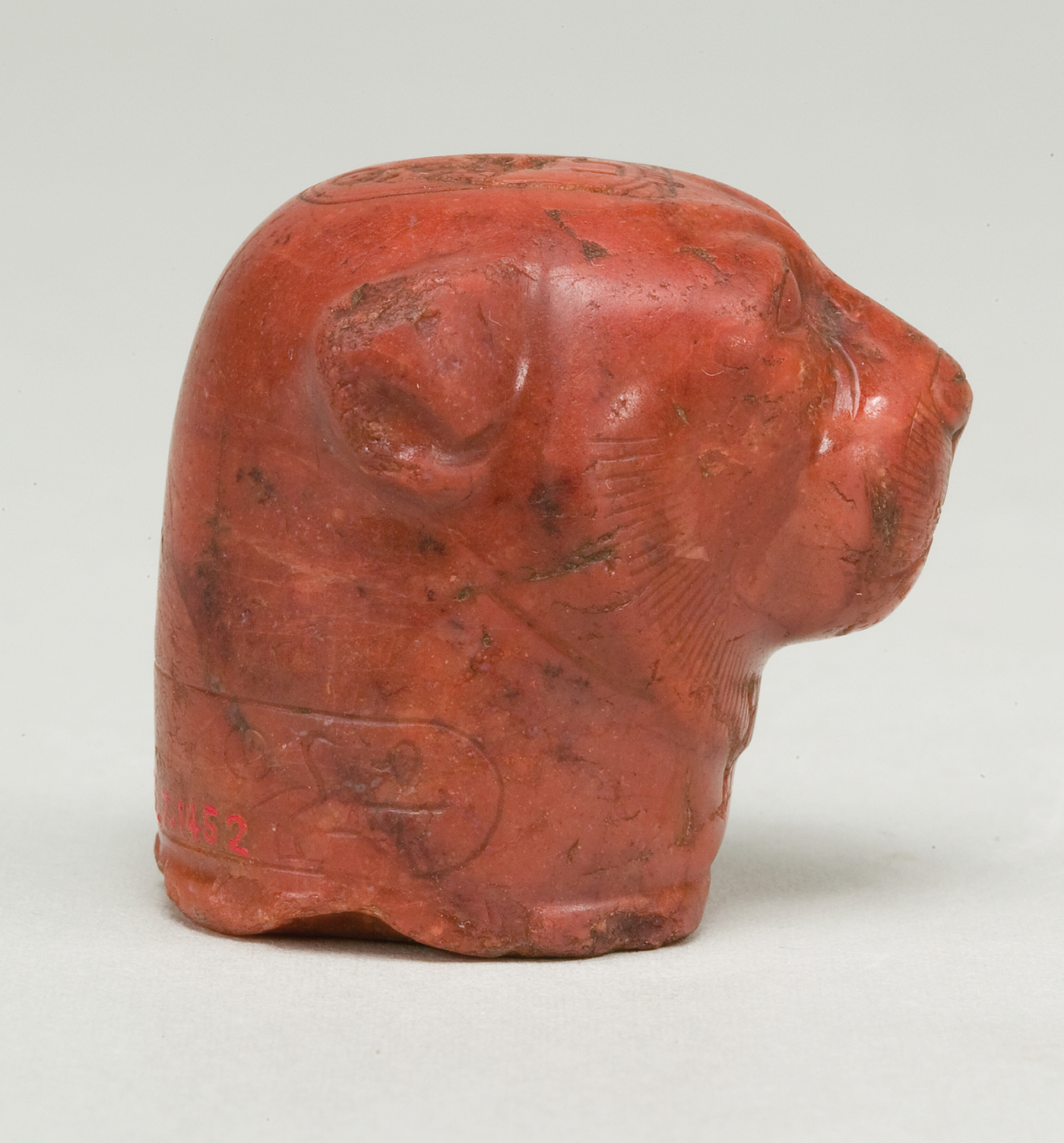
Some of the other objects depicted as being brought by the Aegean emissaries also suggest a peculiar creativity of the Egyptian painters. Thus, the lion-headed rhyta are sometimes depicted as we indeed find them in the Aegean (Figs. 6–7) as in the case of those from the tombs of Useramun (Fig. 5) and Rekhmire (Fig. 2) and sometimes as an Egyptian hieroglyphic sign F9  , as in the case of the one from the tomb of Rekhmire (Fig. 2) (Davies Reference Davies1943, pl. XVIII). This sign F9 depicts an upright head of a leopard and determines the words such as pḥty [strength] (Gardiner Reference Gardiner1969, 462). We are certainly not dealing with a head of a lioness (contra Anthony Reference Anthony2017, 75–6). There are also gaming pieces of the same shape from the joint reign of Hatshepsut and Thutmose III (Fig. 8), dating slightly earlier than the tomb of Rekhmire (Roehrig Reference Roehrig and Roehrig.2005, 188). Originally a head of a leopard was transformed into the hieroglyphic sign. In the tomb of Rekhmire the sign was enhanced in size and used to represent a vessel.
Golden lion-headed rhyton from grave IV, circle A at Mycenae. (Courtesy of wikimedia user Zde. https://commons.wikimedia.org/wiki/File:Gold_rhyton_in_the_shape_of_a_lion%27s_head_Mycenaean,_NAMA_273_080829.jpg)
Stone lion-headed rhyton from the palace of Knossos. (Courtesy of Wikimedia user Jebulon. https://commons.wikimedia.org/wiki/File:Lioness_head_rhyton_right_profile_archnmus_Heraklion.jpg)

Gaming piece in the shape of a panther's or lion's head (hieroglyph sign F9). (Courtesy of Wikimedia user Pharos. https://upload.wikimedia.org/wikipedia/commons/5/5c/Head_of_a_Leopard_with_the_Name_of_Hatshepsut_MET_26.7.1452_rp.jpg)
Transference
Transference is ‘a phenomenon in Egyptian art by which objects, figures or an entire part of a familiar stock scene has been transferred en masse to a rendition of a second stock scene to which it is not normally related’ (Wachsmann Reference Wachsmann1987, 12). The Aegean and Aegean-like objects are transferred into the registers with the Syrian figures in the tomb of Amenemhab (Davies Reference Davies1934, pl. XXV), or vice versa, as in the tomb of Rekhmire (Davies Reference Davies1943, pl. XVIII). One typical example of transference is the occurrence of ox-hide ingots with the Aegean figures in the tomb of Rekhmire (Fig. 2), although they are in all other cases brought by the Syrian figures. The conviction that these ingots have been brought by the Aegeans to Egypt was so strong that the ingots started to be erroneously referred to as Keftiubarren—Keftiu ingots (Buchholz Reference Buchholz1959). They are indeed associated with the Aegean figures and the land of Keftiu, but only in this single tomb! One should not exclude that Aegean emissaries could have brought ox-hide ingots as part of their jn.w [gift], but there is nothing to indicate that they were typical for the Aegean gift assemblage. On the contrary, the main elements of the Aegean gift assemblage are a Vapheio cup as a drinking vessel, a ewer as a serving vessel and a sword as a weapon (Fig. 1). This is demonstrated through the closest archaeological analogies for the Aegean objects of Late Minoan IB date depicted in the tomb of Senenmut, but found as an assemblage in several later Aegean burial contexts (Matić Reference Matić2015, 41–5). Sometimes only some of the elements are transferred, e.g. Minoan ‘S’ handles transferred to Egyptian shaped ḥs vases like in the tombs of Menkheperreseneb and Rekhmire (Laboury Reference Laboury1990, 107; Wachsmann Reference Wachsmann1987, 67–78).
This phenomenon of transference can be further noticed regarding the terms used to describe the origin of the figures. Namely, the term Keftiu is next to the term Menenus (Mnnws) used to describe the origin of the Syrian figures bringing, among other items, Aegean objects in the tombs of Amenemhab (Davies Reference Davies1934, pl. XXV). The figure of a Syrian depicted in proskynesis, but with the accompanying inscription wr n Kftjw [prince of Keftiu] from the tomb of Menkheperreseneb (Fig. 9), can be explained by the lack of the motif of an Aegean figure in proskynesis in the pattern book at his disposal (Matić Reference Matić2014, 284). The existence of pattern books has been suggested by several authors (summarized in Wachsmann Reference Wachsmann1987, 16–17). There are so far no known Aegean figures depicted in proskynesis. The only other supposedly Aegean figure in proskynesis is found in the tomb of Intef (Säve-Söderbergh Reference Säve-Söderbergh1957, pl. XIII). However, not only is the register so badly preserved that we cannot see much of Aegean elements in it, but also what we have preserved of the figure in proskynesis has parallels in the figure in proskynesis in the tomb of Menkheperreseneb. Both figures seem to wear the same type of kilt, which does not resemble the kilts worn by the Aegean figures in the tomb of Menkheperreseneb (for Aegean kilts, see most recently Matić & Franković Reference Matić and Franković2017). The badly preserved figure in proskynesis in the tomb of Intef also does not seem to have any traces of the long curly Aegean hair.
Aegean emissaries in the tomb of Menkheperreseneb (TT 86), facsimile detail. (Reworked after Davies Reference Davies1936, pl. XXI.)

A Syrian figure labelled as prince of Keftiu in the tomb of Menkheperreseneb should not be interpreted as a reflection of the political dependence of the Aegean to Egypt. But we are also certainly not dealing with an inaccurate labelling (contra Anthony Reference Anthony2017, 62). Proskynesis was a standard Near Eastern court procedure when approaching the king and is described in the numerous Amarna letters as prostration ‘seven and seven times’ (Moran Reference Moran1992, xxx). The lack of the motif is compensated by a Syrian figure in this posture and a transference of the text labelling him as coming from Keftiu. This is why we should not understand this as an indication of the location of Keftiu in Syria, as some have argued (Vandersleyen Reference Vandersleyen2003).
Two questions are crucial for discussion of the phenomenon of transference. The first concerns the possible reality behind transference and the second whether transference is meaningful or not. Wachsmann has already asked if, in certain cases, transference can be interpreted as reflection of reality (Reference Wachsmann1987, 12). We indeed know already from the Annals of Thutmose III that a silver vessel of Keftiu manufacture was given by a wr- [prince] of Tin3yw [Tinaju—mainland Greece?] to the Egyptian king (Helck Reference Helck1971, 306–7). A letter (KBo 2.11) from the later Hattuša (modern Boğazköy) archive indicates that the received gifts could have been sent to another party, as in the case of a rhyton of silver and one of gold sent by the Egyptian king to the king of Arzawa, which he then sent to the king of Hatti (Hoffner & Beckman Reference Hoffner and Beckman2009, 353). There are also cases of foreign objects which have been changed to suit local needs, such as the case of the stone bridge-spouted jar from Kato Zakro. Its original pair of cylindrical handles were removed from an Egyptian stone globular vase of brown porphyritic basalt; they were replaced with horizontal ones. An opening for the pouring hole was made and a spout of local grey-brown stone was added. Small rectangular holes were drilled on the spout in order to inlay white material which would imitate the texture of the original vessel (most recently discussed in Franković Reference Franković2018, 19–23). We can only assume that such transformed vessels could be further sent as gifts. The problem is therefore if it is correct to assume that transference in iconography can indicate reality. If we find an object usually associated with one region in the register with other figures, does this mean that this is a visual expression of circulating objects? Some have indeed interpreted transference in this manner, arguing that both Aegeans and Syrians brought, traded or made the same metal vessels (Walters Reference Walters, Kousoulis and Magliveras2007, 291). Although tempting, this suggestion is quite problematic from an iconographic point of view. We also find a griffin-headed rhyton carried by Syrian figure in the tomb of Sobekhotep. The vessel was clearly transferred from the Aegean register into a Syrian register, but as we know neither the Aegeans nor the Syrians could have brought it, as the vessel actually never existed!
The suggestion that the Egyptians were not capable of, or were indifferent to, differentiating between foreign artistic traditions cannot be accepted (contra Panagiotopoulos Reference Panagiotopoulos, Maran and Stockhammer2012, 56). We are well informed by later Amarna correspondence that Late Bronze Age rulers could differentiate very well between what they asked for and what they received. This is the case with King Tušratta of Mitanni, who complained to Queen Tiye, mother of Akhenaten that he still had not received the golden statues promised to him by Amenhotep III, Akhenaten's father (Amarna letter EA 26). Further he states that Akhenaten has sent wooden statues plated with gold (Moran Reference Moran1992, 85). There is no reason to doubt that the painters in their courts were equally well informed. Additionally, they were surely well informed about the production and style of objects coming outside their cultural spheres, and they could have made some of them themselves (Feldman Reference Feldman2006).
Hybridism
Although it seems that this is a recent problem, theoretical archaeologists have been struggling with the concept of ‘hybridity’ for over two decades, along with its postcolonial connotations (e.g. Fahlander Reference Fahlander, Cornell and Fahlander.2007; Stockhammer Reference Stockhammer and van Pelt.2013). The problem regarding this term and its understanding, appropriation and use in archaeology, and also regarding the study of the objects depicted as brought by foreigners in Theban tombs, is threefold:
1. The fact is that we can recognize a phenomenon fairly similar to the ‘third space of enunciation’ proposed by the postcolonial theorist Homi Bhabha when we read the written evidence on exchanged and presented objects. If we understand the ‘third space of enunciation’ as ‘a space where the negotiation of incommensurable differences creates a tension peculiar to borderline existences’ (Bhabha Reference Bhabha1994, 218), then we can possibly recognize it in the deliberate Egyptian misrepresentation of the objects sent as gifts by the foreign kings as tribute through placing them together with the same class of objects, but sent by the vassals. This happened with the chariots sent by Kadašman-Enlil to Amenhotep III (Amarna letter EA 1) and he complained about this because this act lowered his status (Moran Reference Moran1992, 2). By placing the chariots which were sent as a gift by the king of a state which is not under Egyptian control together with chariots sent as a tribute from countries which are under Egyptian control, Amenhotep III could have confused the attendees. Some could have had the idea that Kadašman-Enlil was a vassal of Amenhotep III. Similarly, when Kadašman-Enlil in Amarna letter EA 4 asks for a beautiful Egyptian woman to be sent to him in marriage, he adds: ‘Who will say: She is not the daughter of a king?’ (Moran Reference Moran1992, 9). Bearing in mind that the king of Egypt willingly took daughters of foreign kings in marriage, but refused to sent his own, Kadašman-Enlil's question can be read as an attempt at subversion. The beautiful woman from Egypt would mimic an Egyptian princess (Matić Reference Matić, Beck, Backes and Verbovsek2017, 100). As summarized by Fahlander, we should understand ‘third space’ not as a real space, although it can find itself there, but more as a social encounter structured by structural patterns, ideology and material setting with a potential for the non-expected and unpredictable, but also for tension and exercise of power. It is not restricted only to different individuals and groups, but also to materialities. Results of the social encounter are often unforeseen and beyond the expectations and intentions of the involved individuals. They can also go against their intentions (Fahlander Reference Fahlander, Cornell and Fahlander.2007, 15–16).
According to Bhabha, hybridity is strategic reversal of the process of domination through disavowal (Reference Bhabha1994, 112) and is ‘not a problem of genealogy or identity between two different cultures’ (Reference Bhabha1994, 114). This is exactly what Amenhotep III attempts with Babylonian chariots and what Kadašman-Enlil wants to do with an Egyptian woman. Both are reversing the status of the other. However, the very fact that, in the case of the foreigners’ processions in the New Kingdom Egyptian court, the discourse of the ‘dominating side’ (Egyptian) is arranging this ‘third space’ so that gifts can be mistaken for tribute and kings for vassals does not allow us to use the term hybrid, at least in the sense that Bhabha uses it (cf. Papa Reference Papa and van Pelt2013, 33).
2. According to Feldman (Reference Feldman2006), there is a class of Late Bronze Age objects which cannot be classified into specific production areas (workshops) or styles and therefore it can be said that they are exactly what some archaeologists tend to understand as ‘hybrid’. These objects can but do not necessarily have the potential for the expression of hybrid identity in a postcolonial sense. Furthermore, it was recently argued that which of these objects are considered hybrid has to be looked at more closely (Sinclair Reference Sinclair, Beck, Backes and Verbovsek.2017).
3. Some figures and objects depicted in the Egyptian tombs of high officials have elements that are usually found on other objects on these same tomb paintings. These objects are usually described as hybrid by those who dealt with these representations (Wachsmann Reference Wachsmann1987, 4–5). The term hybrid is used here only in the sense of a mixture of elements of different origin in producing something new but retraceable to its composite parts. The necessity to study hybridism closer in the representations of foreigners and objects they bring has already been stressed (Graff Reference Graff, Aruz, Benzel and Evans.2008). The problem emerges when some archaeologists recognize the ideas of Bhabha in such mixed forms (cf. Fahlander Reference Fahlander, Cornell and Fahlander.2007, 28). Such an understanding of postcolonial theory is rather naïve and superficial. Nowhere in his work does Bhabha refer to hybrid as being a mixture of the two where the origins of both can be retraced; rather the contrary. Indeed, he nowhere explicitly deals with material culture, and the only material culture-related example he gives is, in my opinion, the case of a ship being greeted on arrival with the Norwegian national anthem, despite the fact that it was running under the flag of another nation (Bahamian) and sailing with a non-Norwegian crew (Bhabha Reference Bhabha1994, 8). That is an excellent example of the unpredictable effects of third-space encounters.
Further, a prerequisite for the postcolonial theory of Bhabha is that hybridization and mocking mimicry are strategies of the subaltern and the colonized (Reference Bhabha1994). This nuance is lost in bumper-sticking Bhabha's name and work on forms of material culture which have a combination of elements. Theory does not function like a spice or a recipe. The subaltern do not need to combine more than two different cultural elements to produce the means to achieve their ends. That is why not every vessel or object we term hybrid, just because it has elements of more than two, must have had a role in deconstructing, questioning or misbalancing authorities or identities; not to mention that the conundrum is in the fusion of the archaeological term hybrid, which clearly means one thing, with the post-colonial term hybrid which clearly means the other. This has produced the effect that, wherever a hybrid object in archaeological terms was found, it was only a question of time until someone would refer to it as a hybrid by quoting Bhabha. Clearly this is wrong on many levels. That is why in this paper I refer to the hybrid figures and objects in Theban tombs not in the way Bhabha uses the term hybrid, but as objects consisting of elements which can be retraced to the objects from which they originally come. Maybe to some this might be disappointing, but there is nothing post-colonial about these hybrid forms, which does not mean their study is not fruitful.
As in the case of transference, the first problem we can open is the reality behind these hybrid representations. Clearly, as previously shown, the hybrid figures themselves are not historically reliable representations. But what about the objects? Do we know of such objects fusing different elements into something new, but retraceable to the old, existing in three-dimensional form? We cannot yet find analogies for the hybrid objects depicted in the Aegean registers.
However, not all possibility for a discussion on hybridity and ‘third space’ in post-colonial terms is lost. It was already suggested that the court processions could have functioned as a ‘third space’ of some sorts. There, although we have elements of confusion, misunderstanding, unpredictable and the unplanned, we also do not find a hybrid in Bhabha's sense, but a hybrid in the archaeological sense (chariots of vassals sent as tribute together with chariots sent as gifts). Indeed, if we would look for the hybrid in Bhabha's sense in the material form it could be right in front of our noses and we would still not see it. This is because, if understood as hybrid in the post-colonial sense, then everything can be a hybrid under the right subaltern circumstances. Archaeology cannot work with such a fluid concept (Stockhammer Reference Stockhammer and van Pelt.2013, 11–12). This does not mean that we are done either with post-colonial theory or with the work of Bhabha. If the third space is the encounter between individuals, groups, materialities, ideas and concepts which can produce new forms of knowledge, identity, ideas and forms beyond any expectations of the ones included in the encounter, then archaeology can and should explore this.
One of the examples of such a product of a ‘third space’ as an unpredictable and creative encounter between people and materialities is perhaps seen in the travertine pithos found by Georges Legrain in Karnak. Lilyquist (Reference Lilyquist and Ehrenberg.2002) studied the vessel in detail. It has no rim, neck or bottom of the base preserved. It was c. 78 cm high and 38 cm wide. A series of pendant petals or triangles in raised relief is on the base of the neck (seven are well preserved; there were maybe 21 altogether). Such pendants are found on chocolate-on-white pottery at the end of the MB II and during LB I in Palestine. Because of the shape of the pithos and the number of the handles, Lilyquist suggested that a Cretan object could have served as an inspiration for this Egyptian-made object. The inscription between two of the handles contains the titles and the name of Hatshepsut (Lilyquist Reference Lilyquist and Ehrenberg.2002, 120). The date of the pithos matches with the date of the tomb of Senenmut and its form is strongly reminiscent of the form of the pithoid amphora depicted among the Aegean objects in the tomb of Senenmut (Fig. 1). Since the tomb is located in Thebes, it is relatively close to the temple of Karnak where the pithos was found. The pithoid amphora, as depicted in the tomb of Senenmut, is itself a transformation of the originally Cretan vessel. Whether or not the prototype for the drawing in the tomb was a metal prototype of a pithoid amphora or a pithos, the drawing transformed it. The painter had to draw it upon its arrival in the court, and the court at the time was in Memphis, which was quite a distance away (c. 600 km) from the tomb of Senenmut in Thebes, where the painter painted further on the basis of his pattern drawings. This calls for caution in interpreting ‘tribute scenes’ as ‘one-on-one’ representations of reality. The painters did not necessarily always paint what they actually saw, but what they had at their disposal either in the pattern books or on the walls of already existing tombs. Thus, pattern books and the use of previously painted walls as sources can be seen as the origin of the phenomena of creativity, transference and hybridism in iconography. One interesting consideration would be that the pithos found in Karnak was not based on the three-dimensional prototype of Cretan origin, but on the Egyptian drawing of the vessel of the Cretan origin, either from the pattern book or from the tomb of Senenmut. This form was fused with elements of Syrian origin, producing something entirely new, first through transformation of a foreign object into an image following the rules of decorum and then through using this transformation (drawing) together with other cultural elements to transform it again and materialize it anew in three-dimensional form. But this remains a speculation.
Conclusion
The ‘interrogation of the real’ behind the Aegean emissaries and objects depicted as brought by them in ‘tribute scenes’ in Theban tombs of the 18th dynasty has much to teach us in our understanding of the historicity and reality behind these images.
I certainly agree with authors who stressed that these representations are representations of actual, real and historical court visits by the Aegean emissaries to the Egyptian court (Panagiotopoulos Reference Panagiotopoulos2001). The objects of Late Minoan IB date, depicted as brought by the Aegean emissaries in the ‘tribute scene’ from the tomb of Senenmut, even show that they form an assemblage found in the Aegean contexts of slightly later date where they are part of the expression of princely identity in death (Matić Reference Matić2015). Thus, we can assume that what these emissaries brought is an assemblage appropriate for a ruler, indicating that they and the one or ones who sent them recognized the Egyptian king as a peer. They sent him a gift worthy of a ruler in expectation of a return gift and establishment of social ties later attested in the Amarna letters as the ‘brotherhood of the great kings’.
However, as discussed above, these objects sent as gifts did not have to be represented as such at the Egyptian court in the foreigners’ processions. Indeed, the function of these processions was not to reflect the diplomatic and political reality of the Late Bronze Age, but the reality of Egyptian decorum instead. Already on this level we are dealing with a transformation of reality.
Further, this transformed reality of the courtly visit was depicted in the Theban tombs of the high officials of the 18th dynasty. The painters responsible for these representations used the drawings they made of these objects, further transforming them from three-dimensional things into two-dimensional images. They changed them in the process, and upon painting them on the walls of the tombs they changed them further, by enlarging them in order to achieve compositional unity, but also by adding elements to them which they originally did not have. These elements were not randomly selected, but are embedded in a sense of decorum. Transference and hybridism emerging from this process are based on the notion of cultural similarity observed through the lenses of cultural topography. Both the Aegean and Syria are in the north. Additionally, such a process was creative also with regard to the imagining and executing of imaginary objects which were supposed to look Aegean and were, as such, placed in the Aegean registers. Some objects are made ‘more Aegean’ and others are drawn as Aegean-like. Some elements originating from griffins, such as a spiral, were added to the depictions of Aegean figures in exactly the same place where we find them on the heads of the griffins. Objects originating in the Aegean were depicted in Egyptian manner, as in the case of lion-headed rhyta.
What really happened at the court when the foreign emissaries came remains in the memories of those who attended them and among them were the owners of the tombs with ‘tribute scenes’. These court events were of highly restricted access and not everyone could attend them and see the objects sent as gifts or tribute to the Egyptian king. Not everyone could have seen the people who brought them. However, the representations of these events were less restricted, since we find them in the accessible transverse halls of the tombs in question. Thus, the tombs were visited by those who did not attend the court events, and these visitors would encounter the foreign emissaries and the things they brought only through their representations. For them, the virtual representations functioned as real (cf. Matić Reference Matić, Back Danielsson, Fahlander and Sjöstrand.2012; Žižek Reference Žižek2002, 11). Some of the objects they could have seen there were proper simulacra (Baudrillard Reference Baudrillard and Glaser1994). They did not exist as three-dimensional objects, but only as two-dimensional representations of ideas about how an Aegean object could or should look. Some could serve as inspiration for the production of new three-dimensional objects. Thus, the virtual became the real; and what happened at the court and what the foreigners brought with them from their distant lands depends on whom we ask.