As in spoken languages, subject or actor arguments in signed languages may be expressed overtly by the use of noun phrases (NPs), by morphological means, or may not be expressed at all. Modeled on a previous study of American Sign Language (ASL) (Wulf, Dudis, Bayley, & Lucas, Reference Wulf, Dudis, Bayley and Lucas2002), we investigated the extent to which linguistic and social factors systematically condition variation in the overt expression of subjects in Australian Sign Language (Auslan) and New Zealand Sign Language (NZSL). This article reports the results of an empirical analysis of a corpus of 977 clauses in Auslan and 2145 clauses in NZSL drawn from spontaneous personal experience narratives. Our findings indicate that variation correlates with a similar set of linguistic factors as those reported in the previous study of ASL and reiterates the prominent role of discourse-level constraints previously described in spoken language studies. Some of the particular factors and their relative influence on variable subject presence differ somewhat between the two signed languages investigated here and the corresponding study of ASL.
The article is organized into four parts. First, we provide a brief review of previous work on the sociolinguistics of variable subject presence in spoken and signed languages and an explanation of relevant verb typology in signed languages. We then present the methodology used in our study, followed by a description of the results. Lastly, we discuss the implications of our findings for the understanding of variable subject expression in signed and spoken languages.
Variable subject expression in spoken languages
As Wulf et al. (Reference Wulf, Dudis, Bayley and Lucas2002) point out, sociolinguistic investigation into variable subject expression in signed languages follows a considerable tradition of research into null subject variation in spoken languages. Extensive work has been conducted on varieties of Spanish, for example, both in Spanish-speaking countries (e.g., (Cameron, Reference Cameron1992), and among Spanish-speaking communities in the United States (e.g., Bayley & Pease-Alvarez, Reference Bayley and Pease-Alvarez1997; Flores-Ferrán, Reference Flores-Ferrán2007; Travis, Reference Travis2007). Variable subject expression has also been investigated in Brazilian Portuguese (e.g., Paredes Silva, Reference Paredes Silva1993), Mandarin Chinese (Jia & Bayley, Reference Jia and Bayley2002), and Bislama (Meyerhoff, Reference Meyerhoff2000).
In contrast with languages such as English, variable subject expression is a striking characteristic of discourse in languages such as Spanish, Portuguese, and Mandarin. In Spanish, for example, the subject of an inflected verb can be either overtly realized in the clause as a noun or pronoun or absent and understood as a function of verbal inflections and contextual information. Travis (Reference Travis2007:5) provided the following example from Spanish. In (1a), the subject is expressed, introducing a referent for the first time by means of a pronoun, whereas the following clause (1b) lacks an overt subject.
(1)
a. Yo la pongo encima de la mesa?
Did I put it on top of the table?
b. ø se la pelo. . . .
[I] peeled it for her. . . .
The Spanish verbs poner ‘to put’ and pelar ‘to peel’ in (1a) and (1b) have endings in these examples that indicate that the subject is a first-person, singular argument. Thus, it appears that the verbal morphology motivates the omission of a subject NP. In a review of 30 years of research on variable subject presence in Spanish varieties, Flores-Ferrán (Reference Flores-Ferrán2007:625) commented that, although it is difficult to collate findings across differing language varieties, social contexts, and research methodologies, these studies overall point to the systematic effects of three main linguistic factors: first, person and number (first-person singular is most likely to be overt whereas plural verbs favor null subject); second, verb semantics (e.g., mental state verbs favor overt pronouns); third, “discourse connectedness” (i.e., the distance of a subject phrase from its antecedent increases the likelihood of its overt expression, and a switch in reference between adjacent phrases motivates overt subject expression.)
There is debate among scholars over the relative importance of these recurring linguistic factors in conditioning null subjects, especially the role of verb morphology. For example, in languages that lack verbal inflections, such as Chinese, null subject expression is still pervasive, and studies of other languages that do inflect for person find discourse-pragmatic factors to be salient (Cameron, Reference Cameron1992; Meyerhoff, Reference Meyerhoff2000). Several studies have examined the role of discourse-pragmatic constraints including topichood, contrast and emphasis, and stylistic factors reflecting careful versus informal speech have also been investigated as factors in subject pronoun use in certain Spanish varieties (Flores-Ferrán, Reference Flores-Ferrán2007).
Sorace, Serratrice, Filiaci, and Baldo (Reference Sorace, Serratrice, Filiaci and Baldo2009:461) discussed how native speakers' ability to tolerate the ambiguity of missing subject information in pro-drop languages depends on several aspects of linguistic competence, including knowledge of: (a) syntactic licensors, (b) the discourse conditions relevant to the use of expressed versus unexpressed subject NPs, and (c) interface processing principles to assess the discourse conditions and establish the correct pronoun-antecedent dependencies in real-time language use (i.e., keeping track of referents and knowing how to refer to them throughout a text). Empirical analysis of variable subject expression in signed language discourse contributes to understanding how such underlying linguistic competencies manifest in patterns of language use in a visual-gestural modality.
Verb typology in signed languages
To discuss variable subject expression in a signed language, it is necessary to first outline a typology of verb morphology in signed languages that potentially has a bearing on the expression of subject NPs. Verbs in signed languages have been classed into three main types that differ in respect to the morphosyntactic expression of arguments: (a) plain verbs, (b) agreement verbs, and (c) spatial verbs (Padden, Reference Padden1988).
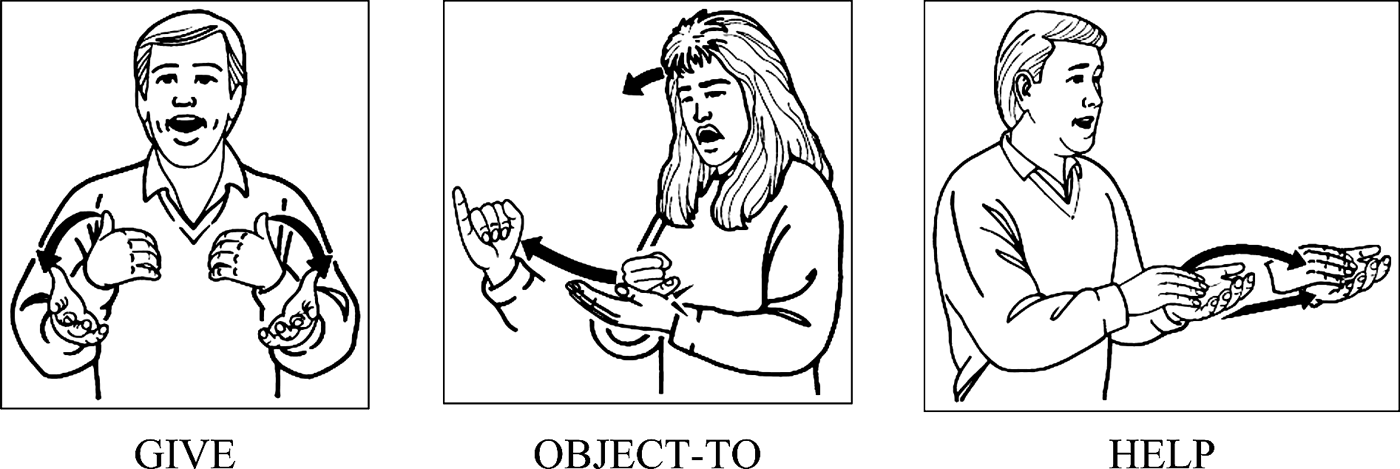
We will begin with an explanation of agreement verbs here. In signed languages such as Auslan and NZSL, agreement verbs include signs such as give, object-to, and help (Johnston & Schembri, Reference Johnston and Schembri2007). In their citation form, each of these three signs is produced with a movement away from the signer's body, as illustrated in Figure 1. This movement may be modified so that the signs are directed from and/or toward physically present referents in the space around the signer's body or locations associated with absent referents. The hands in the sign give, for example, can be moved from a location in front of the signer to the location of the addressee to mean ‘I give (something) to you’. Reversing the movement and orientation of the hands so that they move from addressee toward the signer can mean ‘you give (something) to me’.
Agreement verbs.
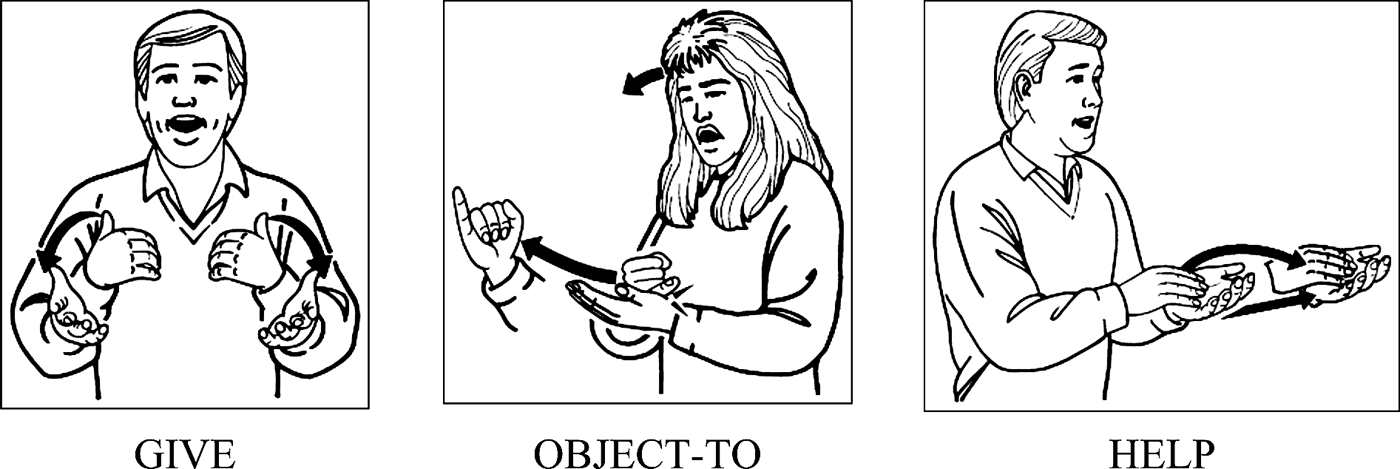
Note that we use the term agreement verb here to facilitate comparison with the existing signed language literature, but we agree with Liddell's (Reference Liddell, Emmorey and Lane2000) analysis of these verbs that rejected an agreement analysis of these constructions and analyzed them as a fusion of a lexical item (the handshape, orientation, and movement components of the sign) with a pointing gesture (the initial and final locations of the sign) (Johnston & Schembri, Reference Johnston and Schembri2007; Schembri, Reference Schembri2009).
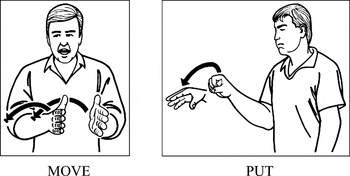
Spatial verbs such as move and put work in a similar way (see Figure 2), but in these cases, the use of space represents movement between physical locations and is not associated with animate arguments. In addition, there is a subset of spatial verbs (often referred to as classifier constructions) that include morphemic handshapes that represent classes of referent.
Spatial verbs.

Unlike agreement and spatial verbs, plain verbs are fixed in form. They cannot have their initial or final location modified to show associations between spatial locations and referents, nor are there alterations in the handshape signaling different classes of referent. As a result, the literature suggests that they tend to co-occur with explicit subject NPs (e.g., Lillo-Martin, Reference Lillo-Martin1986). For more detail on the subclasses of verbs in signed languages, see the work of Sandler and Lillo-Martin (Reference Sandler and Lillo-Martin2006) for a summary of mainstream analyses or Johnston and Schembri (Reference Johnston and Schembri2007) for alternative analyses applied to Auslan.
Research on variable subject expression in signed language
Variable subject presence has been described in signed languages mainly in terms of syntactic properties rather than from a variationist perspective (Aarons, Bahan, Kegl, & Neidle, Reference Aarons, Bahan, Kegl, Neidle, Ahlgren, Bergman and Brennan1994; Bahan, Reference Bahan1996; Lillo-Martin, Reference Lillo-Martin1986; Neidle, Kegl, McLaughlin, Bahan, & Lee, Reference Neidle, Kegl, McLaughlin, Bahan and Lee2000). It must be pointed out here that, despite the claims in the signed language literature, there is little agreement in linguistics generally on what constitutes a robust cross-linguistic definition of subjecthood. Haspelmath (Reference Haspelmath2007) suggested that many (perhaps all?) formal criteria used to identify “subjects” in typological studies are language-particular and hence not generally applicable. A number of typologists have proposed that some of the spoken languages described from a variationist perspective, for example, may in fact lack a grammatical category of subject (see, for example, the work on Mandarin by La Polla, Reference LaPolla1993). A similar claim has been made for Danish Sign Language (Engberg-Pedersen, Reference Engberg-Pedersen and Pajunen2002), whereas Meir, Padden, Aronoff, and Sandler (Reference Meir, Padden, Aronoff and Sandler2007) posited that the body of the signer can represent the properties of the subject with spatially inflected verbs. These observations may also apply to the signed languages discussed here (although see Padden, Reference Padden1988, for arguments in favor of a category of subject in ASL). For the purposes of this paper, however, we adopt the term subject in the sense of a semantic macro-role such as ‘actor’ (Van Valin & La Polla, Reference Van Valin and LaPolla1997). We use this terminology for consistency with the existing literature in both signed language linguistics and variationist sociolinguistics, but we do not wish to make a claim that either Auslan or NZSL has a category of grammatical subject in the strictest sense.
As we have seen in the discussion of verb typology, the visual-gestural modality in which signed languages are produced allows reference tracking to be encoded in a subset of verbs that employ directionality and spatial contrast. It is conventionally reported that signed language grammar allows (or even prefers) subject and object arguments to be unexpressed more often in clauses with agreement verbs modified in this way than in clauses with plain verbs (e.g., Lillo-Martin, Reference Lillo-Martin1986; Quadros & Lillo-Martin, Reference Quadros, Lillo-Martin and Brentari2010). Few sign language studies, however, report using naturalistic data to examine whether there is systematic interaction of morphosyntactic features of agreement verbs with the variable occurrence of subject NPs. There has thus far only been one investigation for ASL within a variationist framework that considers both linguistic environment and social factors, and this study focused on clauses with plain verbs only (Wulf et al., Reference Wulf, Dudis, Bayley and Lucas2002).
Using data from 19 narratives selected from a dataset collected as part of a large-scale sociolinguistics project on ASL, Wulf et al. (Reference Wulf, Dudis, Bayley and Lucas2002) investigated variable subject-pronoun presence in ASL. Their study focused only on the variable expression of animate subject NPs, rather than all types of subject constituents, and excluded clauses containing verbs that can be modified spatially for tracking reference to animate (i.e., agreement verbs) or locative arguments (i.e., spatial verbs). A primary finding was that animate subject NPs are more frequently null than present; in the ASL data, only 35% of subject NPs in plain verb clauses were expressed. The presence of a subject NP was conditioned by multiple linguistic constraints, including the following:
1. English influence was the strongest constraint on variation. Subjects were more likely to be expressed in an environment “characterized by obvious influence from English.”
2. Coreference: As in spoken-language studies (e.g., Cameron, Reference Cameron1992), subjects occurred more in switch reference environments than when the target clause was coreferential with the subject of the preceding verb. Narrative continuity of referents was found to be a key factor associated with absence of subject NPs.
3. Person/number: As in studies of spoken languages, first-person singular pronominal subjects were most likely to be present. Third-person singular pronouns were more likely to be null.
4. Constructed action and constructed dialogue: Overt subject pronouns were disfavored in clauses containing constructed action. In signed languages, the subject referent of a clause containing constructed action or constructed dialogue tends to be embodied by the signer's eye gaze direction, facial expression, body posture, and actions (Engberg-Pedersen Reference Engberg-Pedersen1993; Metzger Reference Metzger and Lucas1995).
Two social factors were also found to be significant in the ASL study: gender and age. Women favored expressed subject NPs, but men were more likely to use null subjects. Wulf et al. (Reference Wulf, Dudis, Bayley and Lucas2002) suggested that this result might reflect greater female attentiveness to clarity of form, and it conforms to a tendency in sociolinguistic variation for women to use prestige forms (e.g., Trudgill, 1974). In this case, overt subject NPs are more consistent with English syntax, which, as the written and dominant language of the surrounding majority, might be considered to have greater overt prestige in the American deaf community than ASL itself. In terms of age, no significant difference between younger (15 to 25 years) and middle (26 to 54 years) age groups was found; both favored null subjects. However the older group (55+ years) favored the presence of subject NPs.
The ASL study concludes that “null pronoun variation in ASL is systematic and subject to many of the same constraints observed in spoken languages. More detailed examination of the effects of the main constraints, however, is dependent on the examination of many more tokens than we have analysed here” (Wulf et al., Reference Wulf, Dudis, Bayley and Lucas2002:37). The ASL study comments on the importance of age as a social variable in sociolinguistic studies of the deaf community, given the impacts of historical language policies in deaf education in relation to signed language use and attitudes.
METHODOLOGY
Data and social characteristics of participants
Like the ASL study (Wulf et al., Reference Wulf, Dudis, Bayley and Lucas2002), the analyses of variable subject reported in this article form part of two larger projects investigating sociolinguistic variation in Auslan and in NZSL (Schembri & Johnston, Reference Schembri and Johnston2007; Schembri, McKee, McKee, Johnston, Goswell, & Pivac, Reference Schembri, McKee, McKee, Johnston, Goswell and Pivac2009). The projects were designed to replicate the ASL project, which was the first sign language study to apply quantitative methods to describing variation in a large, representative signed language dataset (Lucas, Bayley, & Valli, Reference Lucas, Bayley and Valli2001). Thus, we also purposefully selected a representative sample of participants across preselected social categories from the Australian and New Zealand deaf communities. These categories included sex, region, age group, social class (in Australia), and ethnicity (in New Zealand).
The Auslan and NZSL studies reported here were undertaken separately, at different times. The NZSL study largely replicated the methodology of the preceding Auslan study, with local definition of age groupings, and the omission of social factors that were less applicable to NZSL, or not found to be significant in the Auslan study. During 2003 and 2004, deaf fieldworkers collected data from 211 deaf signers in five cities in Australia: Adelaide, Brisbane, Melbourne, Perth, and Sydney. During 2005 and 2006, data was collected from 138 deaf signers in five sites across north, central, and south regions of New Zealand.
Sex
Sex (or gender) is a widely used social variable in sociolinguistic research (e.g., Cheshire, Reference Cheshire, Chambers, Trudgill and Schilling-Estes2002) and has been found to play a role in sociolinguistic variation in ASL and in Auslan (Lucas et al., Reference Lucas, Bayley and Valli2001; Schembri & Johnston, Reference Schembri and Johnston2007; Schembri et al., Reference Schembri, McKee, McKee, Johnston, Goswell and Pivac2009). We aimed to recruit a balance of men and women in each project, but we were more successful at attracting female participants. As a result, both the Australian and New Zealand data have slightly more deaf women than men (97 men and 108 women for Auslan; 60 men and 78 women for NZSL).
Age group
Age-related variation is well documented for both spoken languages (e.g., Bailey, Reference Bailey, Chambers, Trudgill and Schilling-Estes2002) and signed languages (e.g., Lucas et al., Reference Lucas, Bayley and Valli2001; Sutton-Spence, Woll, & Allsop, Reference Sutton-Spence, Woll and Allsop1990). Often, age-related variation at any point in time reflects a language change in progress (Labov, Reference Labov1994:86–94). Therefore, Australian participants were recruited in four different age groups: 15 to 30 years, 31 to 50 years, 51 to 70 years, and 71 years or older. Three age groups were used to select New Zealand participants: 15 to 39 years, 40 to 64 years, and 65 years and over. The specific age groupings in each country reflect changes in language policy in the education of deaf children during the twentieth century (similar changes have occurred in the United States, see Lucas et al., Reference Lucas, Bayley and Valli2001). Participants in the oldest age groups were mainly educated in residential schools for deaf children that emphasized the use of fingerspelling (in Australia) or spoken English (in New Zealand) in the classroom. Signed language tended to be used by children with each other in the dormitories and in the playground, however, and some instruction in some Australian schools would also have been by some means of signed communication (Johnston, Reference Johnston1989). Like the older group, Australian participants in the 51 to 70 years category would have been educated in centralized schools for deaf children, although many would have experienced the shift to oralism (i.e., educational approaches emphasized the exclusive use of speech and listening rather than signed communication) that occurred in a number of schools after the Second World War. Those in the 31 to 50 years category experienced greater use of assistive technology (e.g., hearing aids) and oralist teaching methods, the move toward the use of Australasian Signed English (a signed version of English, including a mixture of Auslan signs and contrived signs for grammatical markers, produced according to the rules of English syntax, see Johnston & Schembri, Reference Johnston and Schembri2007), the closure of centralized schools for deaf children and an increase in mainstreaming (i.e., integrating deaf children into schools with hearing children).
New Zealand participants over the age of 40 years were nearly all educated in residential schools for deaf children or specialized deaf education units attached to mainstream schools that used oralist teaching methods, but which also afforded mixed-age communities of signing peers outside of class. This generation's language use was also potentially influenced by their adult exposure to the Australasian Signed English of younger deaf people (after its introduction to schools in 1980) and to contact with signers from other countries through travel and immigration into the NZSL community.
Participants in the youngest group (15 to 30 years of age in Australia and 15 to 39 years in New Zealand) have seen some recognition of their national signed languages in educational policy and practice, but many would have been educated in mainstream settings by teachers using Australasian Signed English. Some of the youngest members of this group would have been educated in bilingual schools using Auslan or NZSL as the medium of instruction.
Ethnicity
Ethnicity is a social factor that has been shown to be relevant for sociolinguistic variation in ASL (Lucas et al., Reference Lucas, Bayley and Valli2001) and in sociolinguistic variation in spoken languages (e.g., Fought, Reference Fought, Chambers, Trudgill and Schilling-Estes2002; Holmes, Reference Holmes1997). A subgroup of indigenous participants was purposefully included in the New Zealand project, but not in the Auslan study, as the proportion of indigenous Australians in urban Australian deaf communities appears to be considerably lower than in New Zealand. The general Australian population is approximately 91% of European origin, with 7% of the population of Asian origin (mainly from East Asia and the Middle East), and another 2% of Aboriginal or Torres Strait Islander background. Other than the Anglo-Celtic majority, however, no single ethnic group is large, either in the general population or in the deaf community. Given this, and the fact that the education of deaf children has never been segregated on the basis of race (unlike the situation in the United States, see Lucas et al., Reference Lucas, Bayley and Valli2001) and there are no deaf clubs or associations based on ethnicity in Australia, there does not appear to be much evidence of systematic ethnic variation in the urban varieties of Auslan that were the focus of this study. Ethnicity was a variable included in the NZSL project, with the composition of the NZSL sample being 13% Māori (indigenous Polynesian) and 87% Pakeha (European origin) and others. Māori make up 15% of the overall New Zealand population (Statistics New Zealand, 2001). Historically, Māori and Pakeha deaf children have attended the same schools and their social networks are strongly interconnected, providing little empirical basis to expect linguistic variation. However, current interest in the construct of Māori deaf identity (Smiler, Reference Smiler2004) and its possible manifestation in language use (McKee, McKee, Smiler, & Pointon, Reference McKee, McKee, Smiler, Pointon and Quinto-Pozos2007), as well as the ASL findings on ethnic variation, prompted us to include this as a variable in the study.
Age of sign language acquisition
Members of deaf communities acquire signed language under diverse conditions in terms of age of exposure to language models, which contributes to variation in the grammatical characteristics in adult signing. Deaf signed language users in New Zealand and Australia conduct their lives in a language-contact situation and, thus, are bilingual to varying degrees in English (written and/or spoken). Native signers, who are born to deaf, signing parents and acquire signed language in the home, comprise only 5% to 10% of signing communities (Mitchell & Karchmer, Reference Mitchell and Karchmer2004). Most deaf individuals acquire signed language during early to middle childhood, typically (or traditionally) upon entry to a deaf educational setting where they are exposed to a group of signing peers. In some cases, due to deaf children's restricted access to English as a first language, Auslan or NZSL is acquired as a delayed first language (for an overview of research on age of acquisition effects on ASL grammatical competence, see Emmorey, Reference Emmorey2002).
For the purposes of investigating sociolinguistic variation in a signed language, it is necessary for the data to reflect the community of signers wider than the minority core of native signers, so we recruited both native and non-native signer participants. We opted, however, to include only those non-native signers who acquired fluency early enough to be considered near-native or fluent users of the language. Sorace et al. (Reference Sorace, Serratrice, Filiaci and Baldo2009) summarized research indicating that bilingual children who acquire a null subject language as a second language are significantly more likely to produce subject NPs in contexts in which native speaker monolinguals prefer a null subject. Similarly, the study of variable subject in ASL by Wulf et al. (Reference Wulf, Dudis, Bayley and Lucas2002) found English influence in a clause to be the strongest constraint on variable subject presence in ASL. Animate subject NPs were more likely to be present in a discourse environment characterized by features associated with English. This evidence suggests it is important, as far as possible, to separate and minimize the effects of language contact or bilingualism in signed language users when studying variation in this feature.
In the Auslan and NZSL projects, therefore, data was collected from individuals considered to be “lifelong” users of NZSL and Auslan, meaning that they had acquired signed language either natively or at an early stage of childhood. Over 95% of the Australian and 91% of the New Zealand participants reported that they had begun to sign by 7 years of age. In order to analyze native versus non-native status as a factor in variation, the Auslan project purposefully sampled a disproportionately high number of participants who had deaf parents as well as deaf people who had hearing parents. Due to the much smaller size of the NZSL deaf community and the small pool of native signers, it was not feasible to recruit a substantial sample of native signers, and native versus non-native status was not analyzed as a factor in the NZSL study. Only 6.5% of NZSL participants are native signers (which approximates their proportion in the language community), compared with 34% in the Australian study (a larger proportion than found in the community overall). We excluded nondeaf signers (despite the fact that those with deaf parents may also be native signers) and deaf people who had acquired Auslan or NZSL later in life, in order to minimize the possible effects of bilingualism on our data.
Data sample for variable subject analysis
Data used in the subject variation analyses were drawn from spontaneous narratives produced by a sample of the participants in each project, who were recorded in free conversation groups and in interviews with the deaf fieldworker. We use the term narrative to refer to short excerpts of continuous monologue that recounted an event, experience, or description. The Auslan sample consists of 20 narratives from the conversational data of 20 participants. The NZSL sample consists of 63 narratives from 33 participants: 33 narratives were drawn from conversations, and 30 from interviews. All but 3 of the NZSL participants contributed both an interview and a conversation sample to the dataset. By comparison, the original ASL study analyzed 19 narrative excerpts of 30 sec or more. The Auslan and NZSL narratives ranged from 35 sec to 2 min 42 sec.
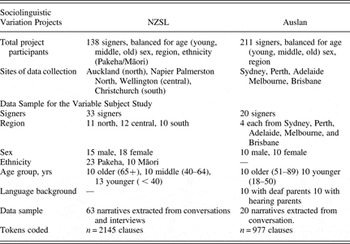
A summary of participants and data for the larger projects and the sample analyzed in this study are presented in Table 1.
Participants and data

Note: Dashes indicate data was not available.
Coding
Social factors were coded in the participant metadata associated with each data file. The Auslan study analyzed factors of gender, age (younger: 18 to 50 years; older: 51 to 89 years), and language background (deaf parents or hearing parents). The NZSL study analyzed factors of gender, age (younger: 18 to 39 years; middle: 40 to 64 years; older: 65+ years), region, and ethnicity.
Within the narrative segment selected from each participant's data (on average, about 1 min in length), every clause was identified and coded for the multiple factors listed later in this section. The NZSL data were transcribed, coded, and searched using ELAN software,Footnote 1 which allows users to transcribe and annotate multiple tiers of information that are temporally synchronized with the video player. Auslan tokens were glossed and coded, and this data was transferred to a FileMaker Pro database. Transcription (by glossing) in each study was done by research assistants who are native signers of Auslan and NZSL and experienced in signed-language glossing conventions. A protocol for coding the linguistic factors was agreed between the two research projects, and within each study, coding of tokens was cross-checked between the research assistant and principal investigator to ensure reliability of coding decisions. Cases of ambiguous or problematic tokens in the NZSL study (which followed the Auslan study) were discussed with the Australian lead researcher to increase consistency of coding between the two studies.
In the Auslan data, 977 of 978 clauses were coded, excluding one clear example of a clause that contained only an interjection, as these normally do not appear to take a subject argument. In the NZSL data, 2145 clauses were coded. Unlike the earlier ASL study, we did not select only clauses with plain verbs, nor only those with animate subjects. Instead, we analyzed all clauses of the predicate types: plain verb, agreement verb, spatial verb, as well as clauses that were apparently verbless (containing, for example, nominal and adjectival predicates). We coded for additional factors not investigated by the ASL researchers, including short-term structural priming—research on Bislama (Meyerhoff, Reference Meyerhoff2000) and Spanish (Travis, Reference Travis2007) indicated that null subjects tend to follow null subjects, and overt subjects follow overt subjects.
In summary, the linguistic factors we coded were:
1. Verb type: (a) plain, (b) agreement, (c) spatial, (d) other predicate structure.
2. Verb semantics (Auslan only): (a) motion verb, (b) psychological verb, (c) verb of saying, and (d) other.
3. Animacy (Auslan only): (a) animate subject, (b) inanimate subject.
4. Person and number of subject: first-person singular/plural, second-person singular/plural, third-person singular/plural.
5. Coreferent subject across clauses: (a) same subject referent as in previous clause, (b) different referent than in previous clause. The NZSL/Auslan study adopts Cameron's (1992) definition of coreference between subjects in the NPs of two adjacent clauses as being “same” and two NPs that have different referents as being “switch” reference. This definition is adopted for comparability with the ASL study design, although other studies define a wider scope for the reference-related environment (Flores-Ferrán, Reference Flores-Ferrán2002, for example).
6. Match of subject expression across coreferent clauses: (a) null coreferent subject NP in prior clause, or (b) expressed coreferent subject NP in prior clause.
7. Constructed action in a clause: (a) present, (b) not present.
8. English influence in clause (Auslan only), including fingerspelling (i.e., the use of the manual alphabet to spell out English words), clearly English syntax (e.g., use of English prepositions), English mouthings without an accompanying sign: (a) present, (b) not present.
9. Genre (NZSL only): (a) interview, (b) conversation.
To enable cross-linguistic comparison with results from a study of ASL (Wulf et al., Reference Wulf, Dudis, Bayley and Lucas2002), the data were analyzed using VARBRUL software. We used Goldvarb 2.1, developed by David Rand and David Sankoff (Reference Rand and Sankoff2004) at the University of Montréal.
RESULTS
Distribution of subject expression
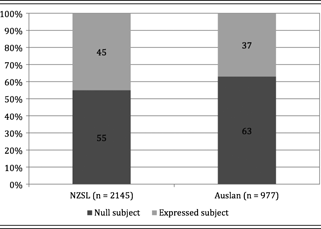
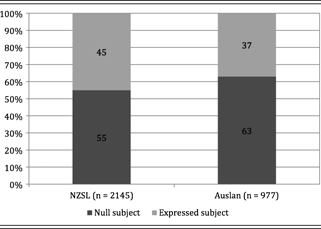
In both datasets, null subject NPs occurred more frequently than expressed subjects did (see Table 2). This tendency appears to be stronger in the Auslan data than in the NZSL data. The Auslan dataset consisted of 977 clauses; of these, 63% (n = 610) had a null subject. The NZSL data consisted of 2145 clauses; of these, 55% (n = 1183) had a null subject. Differences in distribution in Auslan and NZSL may be in part due to the different size of the datasets, or they may reflect differences in the language background of the participants (i.e., there were more native signers in the Auslan dataset).
Distribution of null and expressed subject
Significant factors
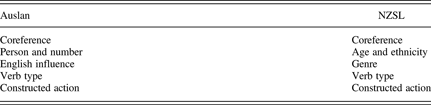
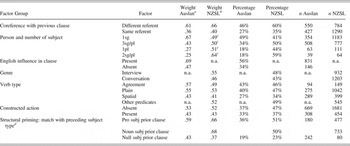
Two linguistic factors that were included only in the Auslan study—verb semantics and animacy of subject—did not reach significance in initial VARBRUL runs and, therefore, were not analyzed further. In the NZSL dataset, person and number was a nonsignificant factor, a rather surprising result given its importance in ASL and Auslan studies as well as numerous studies of spoken languages. No social factors in the Auslan data reached significance, and neither gender nor region were found to be significant in NZSL. All remaining factor groups were significant in both datasets. Table 3 summarizes significant factors in descending order of strength for Auslan and NZSL, respectively. (Further details are reported in Table 4.) Overall, factors constraining variable subject presence across the two languages and datasets are closely aligned.
Summary of significant constraints, Auslan and NZSL, in order of strength
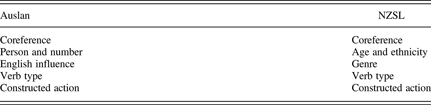
Note: Structural priming excluded as it was only investigated in a subset of the data.
Linguistic factors, Auslan and NZSL (application value = expressed subject NP

Notes: aAuslan: chi-square/cell = 1.0829; log likelihood –568.548. All factor groups significant at p<.05.
bNZSL: chi-square/cell = 1.1709; log likelihood –1370.109. All factor groups significant at p < .05.
cNot significant.
dNote that the structural priming factor weights come from a separate run without the coreference factor group included, due to interaction between the two factor groups in a combined run. The other factor groups included for Auslan and for NZSL were the same as in the main analyses, with identical results in terms of which factor groups proved significant.
Linguistic factors
Coreference
Our results show that continuity of subject reference between contiguous clauses has the strongest effect on the absence of expressed subject arguments in both NZSL and Auslan. Clauses that contain a change in subject referent favor expressed subject NPs (.61 in Auslan and .66 in NZSL), whereas continuity of reference between clauses disfavors the presence of subject NPs (.36 Auslan and .40 NZSL). Proximity of a referential antecedent within the discourse is similarly identified as a first-order constraint on variable subject expression in ASL (Lucas et al., Reference Lucas, Bayley and Valli2001) and is a prominent factor in Spanish (Cameron, Reference Cameron1992), Bislama (Meyerhoff, Reference Meyerhoff2000), and Brazilian Portuguese (Paredes Silva, Reference Paredes Silva1993).
Short-term structural priming
When the subjects of two contiguous clauses corefer, they are often expressed in similar form; this effect is known as short-term structural priming (Branigan, Reference Branigan2007; Travis, Reference Travis2007). Structural priming refers to the “unintentional and pragmatically unmotivated tendency to repeat the general syntactic pattern of an utterance” (Bock & Griffin, Reference Bock and Griffin2000:177). The subset of coreferential clauses in our data were coded for the form of the antecedent subject. Our results show that explicit subject NPs tend to immediately follow explicit subject NPs in coreferential clauses. Overall, we find that coreferential clauses tend to lead to unexpressed subjects when compared with clauses that involve switch reference, so it may be that this effect does not hold for longer stretches of discourse. This short-term structural priming effect was an important factor in the Auslan dataset (.59), and it was also strong in the NZSL data (.68 for full NP subjects in the preceding clause, and .66 for pronominal subjects).
Person and number
In the Auslan data, but not in NZSL, person and number of subject referent had a significant effect, as was also found in ASL (Wulf et al., Reference Wulf, Dudis, Bayley and Lucas2002). First-person plural and second person both strongly disfavor explicit subjects (at .27 and .25, respectively), although we note that this result is based on a very small proportion of the tokens: 862 of 964 subject tokens in Auslan were third-person singular/plural or first-person singular, with only 39 tokens of second-person singular/plural and 63 tokens of first-person plural subjects in the dataset. Third person accounts for the largest number of tokens and disfavors an explicit subject (.43). First-person singular subject was the second largest proportion of tokens and favors subject presence (.67), which is consistent with the ASL study.
Discourse style: English contact features and genre
In Auslan, the presence of English influence within a target sentence structure is associated with an explicit subject (.69) (see example (2), illustrating a loan translation from English, using the sign catch), whereas the absence of English features disfavors subject presence (.47). Because overt subject expression is more characteristic of English grammar than of Auslan and NZSL grammar, this finding suggests that higher use of explicit subject NPs may be an index of a contact language variety in Auslan.
(2) pro-1 catch b-u-s Ø go-home
‘I caught the bus and went home’
In the NZSL study, English influence was not coded as a factor. However, it has been claimed that English-influenced lexical and syntactic features are typical of more formal and explanatory registers in the related languages, British Sign Language (Sutton-Spence & Woll, Reference Sutton-Spence and & Woll1999) and Auslan (Johnston, Reference Johnston1989; Napier, Reference Napier and Lucas2006). Therefore, in the NZSL data, we analyzed the effect of discourse genre, predicting that interviews, as a potentially more formal genre, might yield more explicit subject NPs than conversational conditions. Results shows that genre does have a weak effect on variation. Subjects are slightly more likely to be explicit in interview conditions (.55), whereas the conversational context slightly disfavors the presence of an explicit subject NP (.46).
Verb type
Of the three verb types analyzed, spatial verbs occurred most frequently in the Auslan data, whereas plain verbs were the most common in NZSL. In both languages, spatial verbs are more likely to disfavor subject NP expression (.43 in Auslan, and .41 in NZSL). Example (3) from Auslan illustrates a spatial verb (go-to) occurring with a null third-person subject. This is followed by two more spatial verbs (stay and return) with a coreferential null subject (note that the subscript letters refer to locations: ‘c’ is the center of the signing space, and ‘r’ is a location on the right).
(3) woman c-go-to−r Ø stay−r Ø r-return−c
‘The woman went away, stayed a while and then came back’
In Auslan, plain verbs and agreement verbs both favor subject presence—an interesting result given that many agreement verbs can incorporate reference to a subject argument into the directionality of the verb sign, which is generally assumed to favor null subjects. Example (4) illustrates an agreement verb (help) occurring with an expressed subject (note that first- and third-person arguments represented by the initial and final locations of the verb are shown in subscript with the verb gloss).
(4) pro-11-help−3
‘I helped her’
By contrast, example (5) shows an instance of an agreement verb (give) occurring with a null subject (which is coreferential with the null subject of the preceding verb need).
(5) Ø need Ø 1-give−3
‘I need to give it to him’
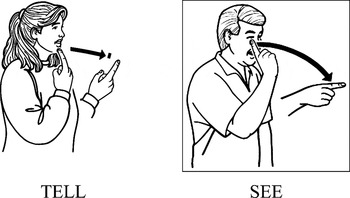
On closer inspection of the data, however, we realized that about two-thirds of the Auslan agreement verb tokens were single agreement verbs, such as tell and see (see Figure 3). These verbs can only be modified spatially to track referents associated with object arguments, as their initial location is a fixed place on the signer's body and cannot be moved to a location associated with another referent. In keeping with this limitation, these verbs exhibited more use of explicit subject NP expression than double agreement verbs, in which initial and final locations of the sign are moveable. This is illustrated in example (6) from NZSL, in which an overt third-person subject pronoun occurs with a partial agreement verb that starts at a fixed location on the chin.
Partial agreement verbs.

(6) pro-3 tell−3 husband
‘She told her husband’
In NZSL, plain verbs and other predicates slightly favor expressed subject NPs (.53 and .52, respectively), whereas agreement verbs have almost a neutral effect on subject presence (.49).
Constructed action
Constructed action allows for embodied and spatial (i.e., nonlexical) enacted representations of actor–undergoer roles. In a sequence of constructed action, the signer's body represents the first-person subject argument, and directionality of signs toward loci in the signing space may index other established referents, rendering lexical NPs less essential (Engberg-Pedersen, Reference Engberg-Pedersen1993; Metzger, Reference Metzger and Lucas1995). In example (7) from NZSL, a clause of constructed action (in which the signer simultaneously uses facial expression and body posture to represent himself as engaged in work while producing the manual signs) is bracketed between two plain verb phrases—the preceding one with a null subject and the following clause with an overt subject.
(7) ø go work [ø work ø do do] pro-1 busy
‘I went to work, and I'm working away. I was busy.’
Approximately two-thirds of tokens were in a clause without constructed action, and these clauses weakly favor subject expression (.53 in Auslan and .52 in NZSL). Results confirm expectations that the presence of constructed action disfavors overt subject NPs (.43 in Auslan and .43 in NZSL).
Results of VARBRUL analysis for all linguistic factor groups are summarized in Table 4.
Social factors
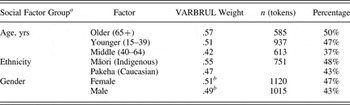
In the Auslan data, gender, age, and language background were included in the VARBRUL analysis. None were found to be significantly correlated with variable subject presence. In the NZSL study, gender, age, and ethnicity were included. Gender proved nonsignificant, whereas age and ethnicity reached significance levels (see Table 5). Results show that Māori signers are slightly more likely to use an explicit subject form than Pakeha signers are, and that middle-aged signers (40 to 64 years old) disfavor expressed subject NPs more than younger and older groups do. The probabilistic weightings for these factors are all close to the .50 (neutral) level, showing that social effects on variation are not particularly strong.
Social factors in NZSL

Notes: Application value = expressed subject NP.
aOther factor groups included: all linguistic factors listed in Table 4.
bNot significant.
DISCUSSION
Social factors play no or a relatively minor role in accounting for variable subject expression in Auslan and NZSL discourse, as has been claimed for spoken languages (e.g., Meyerhoff, Reference Meyerhoff2000) No social variables proved to be significant in the Auslan study. Gender was not significant in either language, in contrast to results in ASL (Lucas et al., Reference Lucas, Bayley and Valli2001). Our result is consistent with Flores-Ferrán's overview of Spanish research, in which, “to date, sociolinguistic analyses have not supported gender-based differences in the oral production of subject personal pronouns” (2007:643).
In NZSL, age and ethnicity were significant factors, with middle-aged (40 to 64 years) and Pakeha signers slightly more likely to drop subject NPs than other groups. It is possible that the patterns of NZSL usage in this age cohort reflect the facts that they nearly all attended residential schools and appear to have the most dense social networks in the New Zealand deaf community (cf., Milroy & Milroy, Reference Milroy, Milroy and Coulmas1997) and a relatively less variable style of NZSL usage than younger signers (who were educated in diverse mainstream settings with fewer other deaf students) and older deaf people do (who had less access to sign language due to strict oralism in deaf schools). Unfortunately, we did not include social network density as a factor in this study, nor do we have any objective measure of signed language fluency to test this possibility.
We found Māori signers were more likely to use explicit subject expression than Pakeha participants were. This is consistent with an earlier finding from the NZSL project that Māori signers favored the citation form of a phonological variant analyzed in NZSL (see Schembri et al., Reference Schembri, McKee, McKee, Johnston, Goswell and Pivac2009). Analysis of phonological variants in ASL also found that African American signers (especially those from a working class background) favored citation forms more than White signers (Lucas et al., Reference Lucas, Bayley and Valli2001), and this has been confirmed by current work being undertaken as part of a specific project investigating Black ASL (Lucas, McCaskill, Hill, & Bayley, Reference Lucas, McCaskill, Hill and Bayley2010). Thus, in ASL and NZSL, it appears that ethnic minority signers may be more conservative in their use of variable subject expression (i.e., their signed language production may be more influenced by surrounding spoken language norms). Alternatively, it is possible that Māori participants have had more variable childhood exposure to NZSL than the Pakeha group had, but support for such a claim would require more detailed ethnographic information about individual histories than we currently have available.
Turning to linguistic factors, evidence from Auslan, NZSL, and ASL is consistent with findings in spoken languages that continuity of subject reference between clauses has the strongest effect on null expression of subject (e.g., Meyerhoff, Reference Meyerhoff2000). Like the earlier ASL study (Wulf et al., Reference Wulf, Dudis, Bayley and Lucas2002), our results support the claim that unexpressed subjects are more powerfully motivated by the pragmatic recoverability of a missing, coreferential subject within the discourse context than by the specific syntactic or morphological properties of verbs.
Findings from the Auslan data about the effect of person and number align with studies of Spanish, Portuguese, and Mandarin which, overall, show that first-person–singular subjects are more likely to be expressed overtly than other subjects, and that singular subjects are more likely to be expressed overtly than plural subjects (Jia & Bayley, Reference Jia and Bayley2002). The preference for pronominal expression of first-person-singular subjects in Auslan is perhaps surprising in light of the salience of the body as an implicit first-person subject in the verb structures of many signed languages (as argued by Meir et al., Reference Meir, Padden, Aronoff and Sandler2007). However, this finding is consistent with spoken languages that make extensive use of null subjects (Flores-Ferrán, Reference Flores-Ferrán2007). The Auslan result that second-person subject strongly favors null subject may be partly the result of a disproportionately small number of tokens in this category (participants more frequently talked about themselves or third parties). However, this finding may also relate to the pragmatics of signed discourse, in which direct eye gaze toward an addressee concurrently with a verb can unambiguously index a second-person subject, making an expressed subject NP redundant. A similar consideration may underlie our finding that constructed action (involving the use of directed eye gaze, facial expression, and bodily orientation to enact shifted person reference during an utterance) favors null subjects, as is also true of the ASL results (Wulf et al., Reference Wulf, Dudis, Bayley and Lucas2002). Reconsidering the nature of spatial syntax in ASL from a cognitive linguistics perspective, Liddell and Metzger (Reference Liddell and Metzger1998) suggested that the grammatical roles of subject and object in constructed action predicates in ASL are pragmatically understood by the creation of blended mental spaces in the physical and conceptual discourse context, rather than by morphosyntactic means alone. Their focus on contextual and cognitive factors in the interpretation of person reference aligns in some respects with findings about the importance of discourse-pragmatic factors in enabling variable subject expression (e.g., Cameron, Reference Cameron1992).
The presence of English (or contact signing) features in a clause was found to increase the likelihood of explicit subject expression in Auslan. Comparisons of second-language speakers and native speakers of other pro-drop languages show differing patterns of overt and null subjects—non-nativeness being associated with increased overt subject use; pro-drop is also affected to varying degrees by language contact in bilinguals (Bayley & Pease-Alvarez, Reference Bayley and Pease-Alvarez1997; Sorace et al., Reference Sorace, Serratrice, Filiaci and Baldo2009). Although participants were all native or early learner users of Auslan and data collection conditions were planned to minimize conditions known to motivate code-switching, it is a fact that most signed-language users are functionally bilingual to various degrees, because they live in an English-dominant society, and also that they have acquired signed language to varying levels of “nativeness.” Research into ASL suggests that contact features of English syntax and lexicon occur commonly in signed-language discourse, even between deaf native signers (Lucas & Valli, Reference Lucas and Valli1992). Given these circumstances, it is not surprising that English influence within a clause is associated with use of overt subject NPs, which are more characteristic of English grammar than of Auslan grammar.
Our studies expanded on the preceding analysis of subject variation in ASL by analyzing the use of overt subjects with three categories of verbs, rather than just plain verbs. The aim of this design was to determine the extent to which existing models of verb types and their differing capacity to express semantic roles through spatial modifications actually account for the variable use of subject NPs in discourse. The finding in NZSL and Auslan that both agreement and plain verbs are more likely to occur with an overt subject might appear to challenge the conventional contrast made between these two kinds of verbs in terms of their capacity to use directionality for reference tracking, but more work needs to be carried out into this question. A recent study on Auslan, for example, shows that agreement verbs do not appear to be obligatorily modified spatially (de Beuzeville, Johnston, & Schembri, Reference de Beuzeville, Johnston and Schembri2009), and thus the interaction between variable subject presence and verb type might be more complex than the current literature on this topic suggests. We hope to investigate in the future whether actual modification, as opposed to potential modification (i.e., classification by verb type) of each verb token, plays an important role in variable subject expression.
Genre was found to have some effect in the NZSL study, with explicit subject expression occurring more often in the interview data than in conversational contexts. In fact, conditions for conversations and interviews were not markedly different: both involved only deaf interlocutors, were recorded in the same physical locations, and the participants were known to each other as members of a regional deaf community. Observation of the data did not suggest a difference in the degree of relaxed or careful language behavior in either situation. The main difference was that in the interview, control of topics was not spontaneous or equally distributed between interlocutors. Flores-Ferrán (Reference Flores-Ferrán2007:647) noted that “in conversational frames, question prompts may have an effect on the responses. If a question contains an expressed SPP, it is likely that the response may contain a repetition of the same form.” To the contrary, we found fewer expressed subject NPs in conversations, but we did not analyze question prompts in the dialogue. It seems likely that a higher level of shared experiential and discourse context is assumed or generated between genuine conversational interlocutors, requiring less explicit reference. In a signed language, conversational partners can jointly develop a set of shared conceptual and spatially located referents (i.e., mutually understood reference points in the discourse space that are indexed by eye gaze, placement, or movement of signs). Co-construction of shared points of reference in the discourse space might create pragmatic conditions that favor implicit rather than explicit subject reference.
CONCLUSIONS AND DIRECTIONS FOR FURTHER RESEARCH
In summary, this study suggests that variable subject expression in Auslan and NSZL is influenced by a similar range of linguistic factors as those observed for ASL and for spoken languages. As discussed, our results are consistent with the view that this variable feature of syntax in the signed languages studied to date is better accounted for as an effect of information structure in the discourse, specifically coreference of subjects, than of verb morphology (including sign language–specific structures such as verbs that make use of directionality) or social factors. Furthermore, our Auslan results illustrate more parallels with ASL and spoken languages, with both person and number and language contact also being significant factors. Importantly, our study appears to be the first to demonstrate short-term structural priming effects in naturalistic signed-language data (cf., Emmorey, Reference Emmorey2001).
A finer account of the effect of morphology on variable subject expression in signed languages might be gained by a further analysis that compares modified versus nonmodified tokens of agreement verbs, rather than by comparing tokens by categorical type as in this study, because it is known that the agreement potential of verbs is not consistently realized in actual usage (de Beuzeville, Johnston, & Schembri, Reference de Beuzeville, Johnston and Schembri2009). Localized ethnographic description of social network structure, as opposed to the ascriptive social categories used in these studies, may reveal more insight about the possible interaction of age and ethnicity indicated in the NZSL data. Considerable scope remains for analysis of syntactic variation in signed languages generally, especially in relation to other discourse genres and to investigate further the possible effects of long-term structural priming on subject expression.