Introduction
Major incidents (MIs) place great demands on the prehospital medical response in terms of leadership, communication, and distribution of resources and personnel. Reference Hugelius, Becker and Adolfsson1–Reference Tin, Hertelendy, Hart and Ciottone9 Global trends indicate increased frequencies of MIs such as mass-casualty incidents (MCIs) due to increased global terrorism, armed conflicts, urbanization, and natural disasters. Reference Lennquist5 Several scientific assessments have concluded that regular exercises and well-established medical contingency plans are of great importance for the medical response to an MI. Reference Hugelius, Becker and Adolfsson1,Reference Turner, Lockey and Rehn2,Reference Lennquist-Montán4,Reference Skryabina, Betts, Reedy, Riley and Amlôt7 In Sweden, the National Board of Health and Welfare (NBHW; Stockholm, Sweden) is responsible for health and medical care issues regarding regulations, guidelines, and educational requirements. 6,8 Twenty-one different regions are responsible for the prehospital care (including private companies commissioned by the regions) as well as for disaster preparedness and medical contingency. 8,10,11 Each region has a Regional Official in Standby (ROS; Swedish: TiB) on call with authority to initiate an MI response. This response entails the formation of a Regional Medical Command (RMC). 8 The prehospital on-site leadership consists of the Medical Incident Commander (MIC; Swedish: Sjukvårdsledare) with an organizational leadership role and the Medically Responsible Individual (MRI; Swedish: Medicinskt Ansvarig) who initiates triage and oversees medical interventions. Reference Lennquist-Montán4,10
Several recent MIs in Scandinavia have illustrated areas in need of improvement regarding organization, logistics, and communication. 12–14 To evaluate prehospital preparedness for MIs, several requirements must be met with regards to method. The legislation and guidelines with which each country and region operate under must be known. Hence, no general international tool can be used without local adaptation. However, many issues regarding organization and resources are comparable, and a similar way of repeated evaluation would therefore be of great use. Reference Gabbe, Veitch and Curtis15,Reference Haeberer, Tsolova and Riley16 The use of surveys, interviews, local visits, and retrospective reports has been previously employed in scientific literature to evaluate and guide planning for improvements of preparedness. Reference Haeberer, Tsolova and Riley16–Reference Kristiansen, Søreide and Ringdal19 Another method of evaluation is to perform surge capacity tests and reviewed exercises. Reference Blimark, Örtenwall, Lönroth, Mattsson, Boffard and Robinson20–Reference Ingrassia, Pigozzi, Bono, Ragazzoni and Della Corte22 The World Health Organization (WHO; Geneva, Switzerland) describes MI health care guidelines which can serve as a basis for evaluation and reporting. 23 Previous national investigations have demonstrated a need for continued disaster medical improvement work in Sweden, where basic knowledge of current conditions is vital. 8,12,13,Reference Blimark, Örtenwall, Lönroth, Mattsson, Boffard and Robinson20,24,Reference Lennquist and Hodgetts25 International studies and evaluations in the field of Disaster Medicine indicate that regular exercises and a well-developed emergency medical contingency plan are central to the health care system’s ability to handle an MI. Reference Hugelius, Becker and Adolfsson1–Reference Moran, Webb, Brohi, Smith and Willett3,Reference Skryabina, Betts, Reedy, Riley and Amlôt7 There is no established national method for repeated follow-up of the prehospital contingency work for MIs in Sweden.
The aim of the study was to assess qualifications and training requirements for central individual roles, to examine frequency and focus of training and simulation, as well as to examine current regional routines for MIs in Sweden. The aim was also to identify, to evaluate, and to investigate areas for improvement in prehospital health care preparedness for MIs in Sweden.
Methods
This was a descriptive comparative study of the Swedish regional prehospital preparedness. Data were collected through a web-based survey using a software program well-suited for the purpose offering adequate security. The survey was sent to Swedish prehospital operations managers in all 21 regions. The survey consisted of 64 questions with the following topics:
-
Background and information upon respondent;
-
Organization and leadership;
-
Communication;
-
Education, training, and simulation;
-
Contingency plans, use of triage systems, and action cards; and
-
Possible areas of improvement.
The survey consisted of questions with both multiple-choice as well as written answers. The questions were formulated based on national legislation, guidelines for regional preparedness, 6 the method described in the Swedish PS-model, 8,10 WHO guidelines, and assessments of previous MIs. 12–Reference Gabbe, Veitch and Curtis15,23 The survey was further assessed by a chief attending physician within the prehospital care organization of a metropolitan region, as well as a senior professor in Disaster Medicine with vast experience of conducting studies on the subject. A translated version of the survey is available in English along with the online publication of this study (Supplementary Material; online only).
The survey was open from September 3 through November 1, 2021. For descriptive data, median was calculated. Regarding answers to multiple-choice questions, the regional answers were compiled, and the percentage distribution was calculated and visualized in relevant graphs. To enable a statistical comparison between the participating regions, individuals with an assignment as operations managers or equivalent of each region’s prehospital organization were selected from the responses received. These are referred to in the study as Regional Management Individuals (RMIs).
Ethical Considerations
The study can be considered sensitive from a confidentiality and security point of view. The survey did not request information regarding direct numbers, resources, or places, but focused on organization and working methods. Study participants were not required to answer questions concerning classified information. The results were collected with a secure software for the purpose. In order not to reveal potential weaknesses in the working methods and contingency plans of individual regions, the names of the regions have been anonymized. When possible, the results were presented as a national overview. The survey does not reveal confidential information concerning Swedish disaster preparedness but aims to identify possible areas of improvement. The alternative of not conducting scientific research on the subject risks leading to areas for improvement remaining undiscovered until they arise during an MI and risk resulting in impaired patient care. The Swedish Ethical Review Authority (Uppsala, Sweden) has approved the study (Dnr 2021 — 02865).
Results
In total, representatives from 17 of 21 Swedish regions (80.9%) answered the survey. Altogether, a total of 37 survey responses from individuals with various roles within the prehospital sector were obtained. Responses were received from the Regional Operations Manager for Ambulance Health Care, Regional Emergency Response Coordinator, or Regional Ambulance Chief Physician from 15 of 21 regions (71%) and a total of 17 individuals. The result of the study thus illustrated procedures and regulations on the regional organization level.
Regional Management Individuals
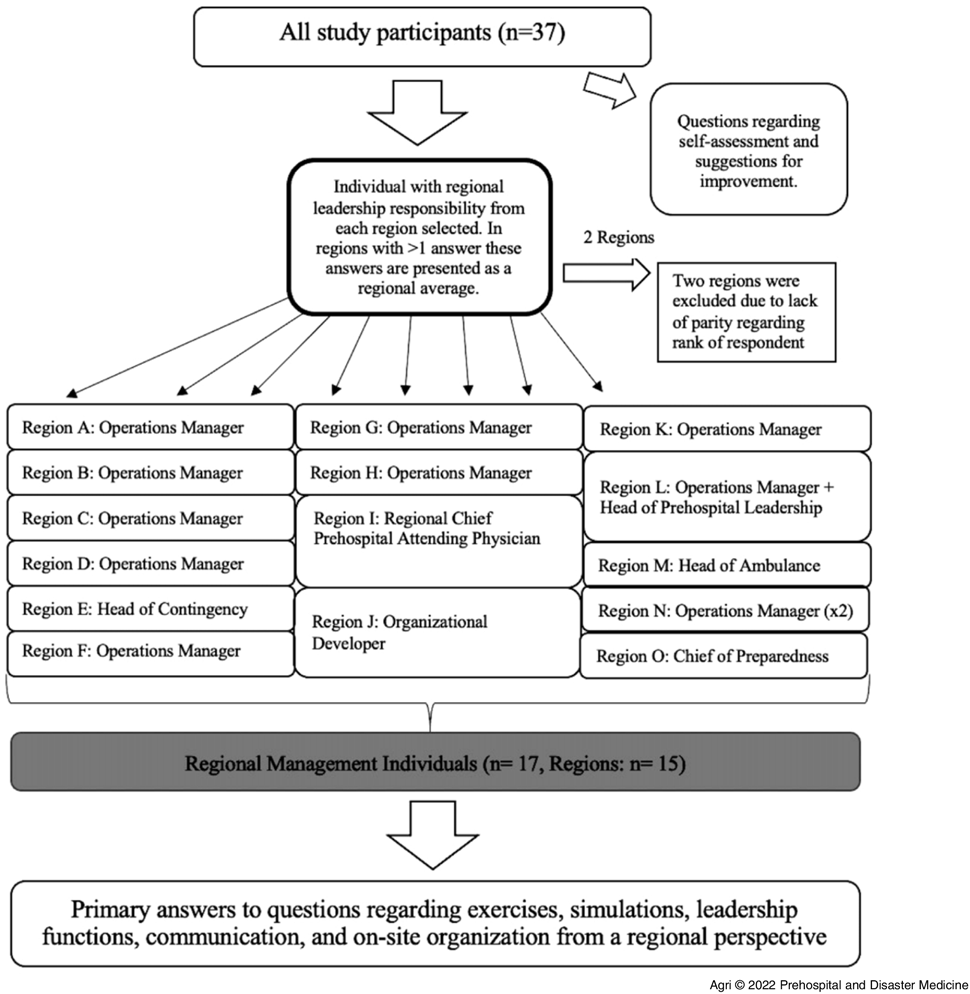
The professional roles that represent each region in the survey are presented in Figure 1. Secondary responses were in some regions obtained from another individual in the regional ambulance service or another specified organization in the emergency sector. The secondary source was then clearly stated and is hereinafter referred to as substitution response. Selected representatives of two regions are employed by a private ambulance provider: Region B, where the selected RMI is operations manager at the ambulance provider who has procured care assignments for the entire region; and Region I, where the RMI works regionally in a prehospital management unit together with all active ambulance providers in the region (Figure 1).
Presentation of the Selection of Regional Management Individuals (RMI).
Note: The names of the regions are replaced by an inconsistent letter variable for confidential purposes. Region A thus does not correspond to a later use of the letter A. Two regions were excluded from the selection of Regional Managers as no answers were received from individuals with a regional management responsibility. These regions were thus excluded from the selection of RMI. Region L and Region N were represented by two individuals where their answers were combined into one representative answer regarding regional procedure in the national comparison.

Differences in Leadership Functions
Fourteen of 15 RMIs stated that a nurse in the first ambulance that arrives at the scene of the accident will be Medically Responsible Individual (MRI; Swedish: Medicinskt Ansvarig). One RMI stated that a nurse in a so-called Reinforced Health Care Management Unit (RHCMU) becomes MRI. Regarding whom should hold the role of Medical Incident Commander (MIC; Swedish: Sjukvårdsledare), the following responses were given: second individual in first ambulance (n = 9 RMIs); nurse in first ambulance (n = 6 RMIs); and both previous (n = 2 RMIs). Of those respondents stating nurse in first ambulance, the following specifications were added: nurse in RHCMU (n = 2 RMIs); and in other designated management units (n = 2 RMIs). All RMIs stated that MIC makes organizational decisions at the scene of an incident and that the MRI makes medical strategic decisions.
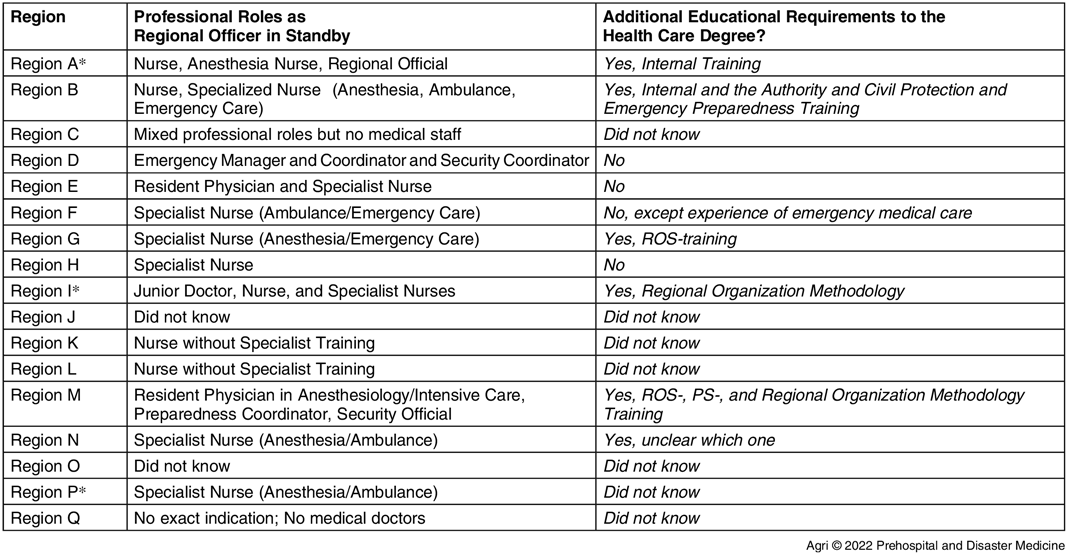
Concerning who is to cooperatively lead with on-site representatives from the police and rescue services, the following was stated: MIC (n = 14 RMIs) and RHCMU (n = 1 RMI). A majority (12/15 RMIs) stated that the ROS had a mandate to activate the RMC. The staffing of the role of ROS is displayed in Table 1.
Professions and Special Training for Regional Officers in Standby (ROS)

Note: Staffing of ROS in each region according to respondents. Two regions were represented by a substitution response (nurse specialized in prehospital care). One region is represented by a local unit manager as a substitution response (these three regions have been marked with an asterisk). Health care degree in this table compilation intended a nurse or a medical doctor degree.
Training and Simulations
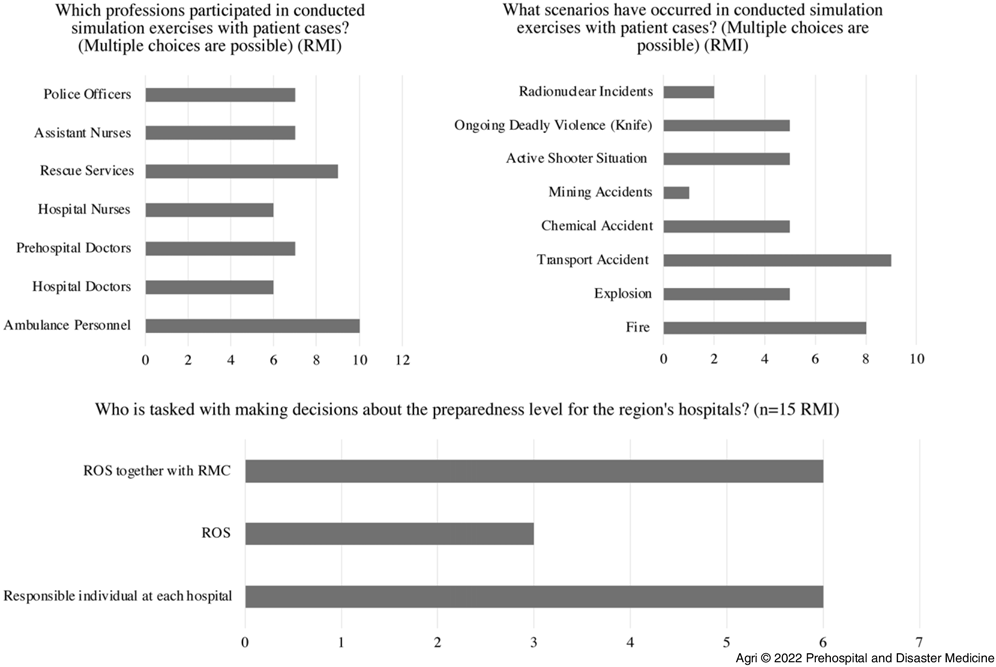
Regarding simulation exercises of an MI: two of 15 RMIs stated that no regional exercises were conducted; 12 RMIs conducted exercises with the participants and scenarios displayed in Figure 2 and occurred with the following frequency: three RMIs within the last six months, two RMIs within the last two years, four RMIs within the last three years, and four RMIs over three years. A substitution answer was obtained from a nurse in the prehospital management unit in one region.
Sub-Figure 2a: X-Value of the Bar Indicates how many RMI have Indicated that Each Occupational Group Usually Participates in Regional Exercises. Sub-Figure 2b: X-Value of the Bar Indicates how many RMI have Indicated that a Simulation Exercise with such a Scenario has been Carried Out. Sub-Figure 2c: Bar Chart Displaying the RMI Responses Regarding and the Activation of Hospital Alert and Preparedness Level.
Abbreviations: RMI, Regional Management Individual; ROS, Regional Officer in Standby; RMC, Regional Medical Command.

Regional management and collaboration exercises were performed in varying intervals: six RMIs stated over three years ago; four RMIs stated one-to-three years ago, and four RMIs stated within the last year. One RMI stated that such exercises were carried out at the sub-region level with separate frequencies. Regarding exercises where the RMC practices together with prehospital personnel, only four of 15 RMIs stated that this had been performed within the last five years.
Regional simulation exercises of an MI after a terror attack were performed with varying frequencies: no exercises within five years (n = 6 RMIs); one-to-two exercises within five years (n = 4 RMIs); five-to-six exercises within five years (n = 1 RMI); and the remaining participants stated that they did not know (n = 4 RMIs). Regarding the number of local exercises conducted within the region during the last five years: three RMIs stated none (these three RMIs had not carried out regional exercises either); one-to-two exercises (n = 3 RMIs); three-to-four exercises (n = 3 RMIs); five-to-six exercises (n = 1 RMI); and the rest did not indicate a specific number.
Organization and Communication
All 15 RMIs stated that there is an established system that should be used for primary triage in the event MCI, with 10 RMIs specifying the following: triage sieve (n = 5 RMIs) and other forms of physiological triage (n = 5 RMIs). A majority (12/15 RMIs) also stated that there was an established secondary triage system.
Answers regarding who is to decide whether health care can be provided at an injury site, the following responses were stipulated: joint decision between two or more on-site authorities (n = 10 RMIs); the health care alone (n = 4 RMIs); and “do not know” (n = 1 RMI). All study participants stated that the primary report from the scene of the incident should be submitted according to the METHANE structure. A majority (14/15 RMIs) stated that they used primary radio communication systems in the event of an MI. Regarding alternative communication in the event of transmission difficulties, a significant majority stated mobile phones. Regarding special exercises to improve communication in the event of an MI, six of 15 RMIs stated that no such training had been performed.
Medical Contingency Plan
Regarding guidelines for whether employees must read and be aware of the contingency plan, the following was stated: no guidelines exist (n = 6 RMIs); all prehospital employees should read at least the part regarding one’s potential role (n = 6 RMIs); contingency plan kept from employees due to confidentiality (n = 1 RMI); and only RMC required to read (n = 1 RMI). However, only two RMIs stated that they carry out follow-up controls through a joint annual review (n = 1 RMI) and an annual web-based test (n = 1 RMI).
The prehospital contingency plan for MCIs had been activated according to the following incidence according to RMIs: within two years (n = 3 RMIs); over two years (n = 2 RMIs); over five years (n = 5 RMIs); and never activated (n = 2 RMIs). Three RMIs stated that they did not know.
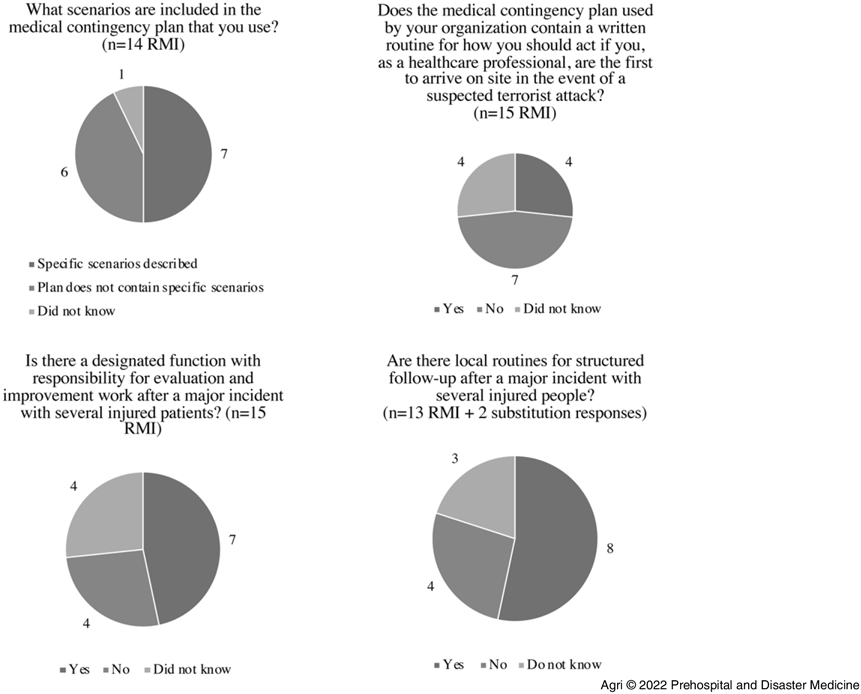
The answers regarding frequency of updating the contingency plan were as follows: updated annually (n = 3 RMIs); less than one year ago but not annually (n = 1 RMI); over one year (n = 2 RMIs); and over two years (n = 4 RMIs). Five RMIs stated that they did not know. The function responsible for updating of the regional contingency plans differed widely between regions: regional contingency department (n = 4 RMIs); chief prehospital physician (n = 2 RMIs); and a wide variety of other suggestions including regional safety manager, ROS unit, and emergency chief physician. Further responses regarding the content of the contingency plan are displayed in Figure 3.
Responses Regarding Contents of the Medical Contingency Plan and Follow-Up After a Major Incident Displaying the Distribution of RMI Responses.
Note: The substitution responses referenced in Figure 3d consisted of two nurses specialized in prehospital care.
Abbreviation: RMI, Regional Management Individual.

Participants Opinions
Questions concerning suggestions for improvements and opinions were answered by 16 of 37 participants, of which seven were RMIs. Recurring suggestions and requests were more and prioritized training, clearer leadership structure, only previously trained personnel in command functions, ambulance command center to be set up, and the reoccurring rehearsing and follow-up of contingency plans.
Discussion
Recent national assessments have stated that the medical disaster preparedness in Sweden needs improvement. 8,10,12,13,Reference Blimark, Örtenwall, Lönroth, Mattsson, Boffard and Robinson20,24,Reference Lennquist and Hodgetts25 This study aimed to examine the prehospital medical disaster preparedness regarding possible areas of improvement, differences between regions, and compliance with national guidelines using a national survey. The results displayed regional differences in methodology regarding staffing of central roles, contingency plan structure, and frequency of training. Several potential areas of improvement were identified.
According to the study findings, the role of MRI is routinely taken by a nurse in the first arriving ambulance and makes medical strategic decisions on site. These decisions may entail refraining from treatment or terminating hopeless health care measures. 10 Decisions of this nature are routinely made by medical doctors in a hospital setting. However, a conflict may arise between the need to quickly establish a prehospital management and high requirements of medical expertise. In regions where medical doctors can be on site quickly, it can be discussed whether they would be better suited to make such decisions. As an alternative, several regions use specially appointed management units prehospital, manned with specially trained nurses. Staffing of the prehospital management could be reviewed by national authorities as a possible way to facilitate an equal and optimal management structure in all regions.
All RMIs stated that there is an established triage system that should routinely be used for primary triage in the event of an MI. A majority stated varying forms of physiological triage with most RMIs presenting systems highly like one another. It can thus be argued that national guidelines should recommend a single common system to be used by all regions to avoid misunderstandings regarding triage in co-operative incidents. Globally, a wide variety of primary triage systems are used in MIs and there is no universal consensus. Reference Bazyar, Farrokhi and Khankeh26
The survey of the regional staffing of ROS displays great variation in occupational categories in service and that many regions seemed to lack specific training requirements. The results indicate that ROS has a central role with a mandate to activate RMC in the regions and that ROS can make decisions about the degree of preparedness at the hospitals in most of the regions. The regional discrepancies displayed in the results of this study could potentially affect the equivalence of MI interventions negatively. It can therefore be argued that standardized professional and training requirements should be established nationally for the role of ROS. The NBHW’s guidelines do not currently specify which professional roles should staff the service of ROS. 6 A national inquiry into the health care’s capacity to handle critical situations by the NBHW in 2018 displayed that most regions lacked specific written requirements for the role of ROS and that only one-half of the regions required any medical training. Instead, it was stated that candidates for the role were recruited from within the organization based on perceived leadership competencies, organizational knowledge, and experience. 8
In general, the results indicated that training and simulation exercises were rare, and the frequency of exercises is remarkably low for several key areas. A lack of preparation can create problems when starting up the effort in a disaster, criteria for emergency alarms, and use of established triage systems. An intervention in connection with a terrorist attack entails a risk for medical personnel working on the site and requires a well-functioning cooperation with the police and other authorities. To ensure that health care professionals are ready for such situations, it is appropriate to simulate such an event through structured joint exercises. Reference Lennquist-Montán4,Reference Skryabina, Betts, Reedy, Riley and Amlôt7,8 The fact that almost one-half of the regions stated that no regional simulation exercises of an MI after a terrorist attack have been carried out during the last five years should thus be a wakeup call for responsible managers and politicians. This is a clear area for improvement where, for example, national guidelines could be proposed to stipulate that all regions need to carry out simulation exercises with a specified frequency and that this is then followed up by national authorities.
A well-functioning communication is central to the medical response. Reference Hugelius, Becker and Adolfsson1,Reference Lennquist-Montán4,8 Many regions stated that they use mobile telephones as a secondary communication tool in the event of accessibility difficulties with the primary communication tool (ie, radio communication). During the terrorist attack in Stockholm, Sweden in 2017, the mobile network was strained by the public, which caused significant accessibility difficulties. 13 The primary communication tool experienced difficulties during the Sveg, Sweden bus accident during the same year. 12 Almost one-half of the regions stated that they did not perform exercises to improve communication in the event of an MI. Without functioning communication between the scene of incident and central leadership functions, both dependent on functional technique and a well-established communication structure, there is a risk that coordination and decision making of the effort will be made considerably more difficult. Reference Hugelius, Becker and Adolfsson1,Reference Lennquist-Montán4,8 This motivates a national inquiry into the systems of communication to be used during an MI to ensure that they are safe, reliable, and able to withstand eventual disturbances.
Action cards are designed so that individuals in critical roles have a clear picture of what is expected of them in an MI. It is therefore notable that some regions stated that they do not use action cards prehospitally for the leading roles on scene. As the results indicate that the crew members of the first ambulance are to assume these vital roles, ambulances in all regions should ideally contain accessible action cards providing a clear guidance for what the roles entail during this situation characterized by high levels of stress and uncertainty. Reference Hugelius, Becker and Adolfsson1
According to the study results, there were no guidelines for who should have read the contingency plan in one-half of the represented regions, and that when such guidelines exist, there is often no follow-up. This constitutes a significant area for improvement. A mandatory annual control test could potentially increase the motivation to read the contingency plan among prehospital care staff in preparation of an MI. The contingency plan should be adapted to the current health care structure. Reference Hugelius, Becker and Adolfsson1,8 Few stated that the contingency plan is updated annually, and there was also a great variation in answers to the question on responsibility for updating the contingency plan. This could risk creating a discrepancy between the region’s plans regarding formulation and structure, which can be problematic in joint efforts. A report from the Ministry of Social Affairs 27 (Stockholm, Sweden) from 2020 proposed the establishment of a national mass-injury plan which can then be used as a template to create adapted regional medical contingency plans. This would potentially improve the consistency and equivalence of regional plans and thus improve the discrepancies made visible by this study.
It is notable that several RMIs replied that the region does not have a designated individual responsible for evaluation and improvement work after an MCI. It is important to capture any shortcomings in the response as well as general reflections regarding the effort among the health care staff involved. The latter is also supported by the results of this study where care staff indicated that an improved follow-up is required after an MI. Previous assessments display that important conclusions can be drawn from a retrospective analysis of an MI. Reference Tin, Hertelendy, Hart and Ciottone9,12–14,Reference Turégano-Fuentes, Pérez-Díaz, Sanz-Sánchez and Ortiz Alonso17
Limitations
A limitation of the study is that respondents might have been less inclined to highlight weaknesses within the organization where they themselves hold a leadership role. The survey may lack validity outside of Sweden, although designed and based on a broad, all-cause approach. Local adjustments will have to be considered in order to use it in other countries. The study is further dependent on the respondents’ correct perception of the organization’s conditions and interpretation of questions. The individuals selected as representatives in the study are mainly individuals with a management assignment. The surveys responses are contingent on the perception of regional leadership, and questions regarding frequency of training and simulation could be supplemented by a corresponding study with a primary focus on ambulance personnel, as well as a study with specific focus on the role of ROS.
The study had a good response rate regarding national coverage; however, four regions did not participate in the study. A survey of similar content as the one used in this study could be implemented as a recurring quality assurance for early detection of improvement areas in the regions’ disaster preparedness work. The study participants were consistently positive about further research and development in the field of prehospital Disaster Medicine. Potential issues of confidentiality could be avoided if the survey is conducted by a national authority which then provides internal feedback to the regions. This would provide the ability to identify potential areas of improvement and the possibility to preemptively improve the regional health care ability to manage MIs.
Conclusion
The results of the study indicated several potential areas of improvement within prehospital Disaster Medicine preparedness for MIs in Sweden. The initial routines regarding alarm procedures and establishment of leadership roles were mainly in-line with national guidelines for the initial response and similar in all studied regions. Recurrence of training and simulation in essential areas was generally low. Qualification for the role of the ROS differed significantly between regions, both in terms of professional roles and educational requirements, which could potentially be resolved by establishing nationally standardized professional and training requirements for the role. In general, the requirements were low for the prehospital medical staff to have studied the contingency plan, and where such requirements existed, routines for follow-up were often lacking. It is possible to use a survey to examine parts of the regional prehospital preparedness work and organization for MIs.
Conflicts of interest
The authors declare none.
Supplementary Materials
To view supplementary material for this article, please visit https://doi.org/10.1017/S1049023X22002229