Introduction
Eucalyptus L'Her. is the largest genus in the family Myrtaceae with over 800 species almost entirely restricted to Australia. It is the dominant tree in many vegetation communities and a genus with high commercial value for timber and wood pulp, in addition to being of great ecological importance as a provider of habitat and food for many faunal species. A high degree of regional endemism is evident within the species (Brooker, Reference Brooker2000).
Global warming is predicted to impact heavily on many of these Eucalyptus species, with suggestions that more than 40% of the realized climatic niches of most species from across the country have ranges of less than 2°C mean annual temperature, including 25% with less than 1°C (Hughes et al., Reference Hughes, Cawsey and Westoby1996). Most studies have based their findings on modelling of past and projected species distributions (Dalmaris et al., Reference Dalmaris, Ramalho, Poot, Veneklaas and Byrne2015), or concentrated on the climate tolerances of mature plants (Butt et al., Reference Butt, Pollock and McAlpine2013), yet few have taken into account the disparity between the fundamental and realized niche characteristics of species tolerances (Booth, Reference Booth2016). Evidence exists to show that many Eucalyptus can grow successfully outside their natural distributions at warmer mean annual temperatures (Butt et al., 2013; Booth, Reference Booth2015; Booth et al., Reference Booth, Broadhurst, Pinkard, Prober, Dillon, Bush, Pinyopusarerk, Doran, Ivkovich and Young2015) and are highly plastic in traits related to maintaining fitness under novel conditions (Byrne et al., Reference Byrne, Prober, McLean, Steane, Stock, Potts and Vaillancourt2013; McLean et al., Reference McLean, Prober, Stock, Steane, Potts, Vaillancourt and Byrne2014). Adult plants may have the capacity to buffer extremes of climate through physiological resistance or phenotypic plasticity (for example, changes in water use efficiency and specific leaf area) (Nicotra et al., Reference Nicotra, Atkin, Bonser, Davidson, Finnegan, Mathesius, Poot, Purugganan, Richards, Valladares and van Kleunen2010; Drake et al., Reference Drake, Aspinwall, Pfautsch, Rymer, Reich, Smith, Crous, Tissue, Ghannoum and Tjoelker2014) but it is thought that long-lived tree species are unlikely to track rapidly changing environments effectively due to slow response times to changing climates (Pearson and Dawson Reference Pearson and Dawson2003; Butt et al., Reference Butt, Pollock and McAlpine2013). The reproductive stages of a plant's life cycle often represent a major bottleneck for species persistence, and tolerance in this early developmental stage is critical for survival, more so than at the adult stage (Watkinson, Reference Watkinson and Crawley1997; Lloret et al., Reference Lloret, Peñuelas and Estiarte2004). Studying germination is therefore essential for understanding plant distributions across multiple scales.
Germination is a physiological process that cannot occur outside the range of temperatures for normal metabolic function. Seeds of many plant species generally germinate over a range of temperatures and within this range there will be an optimal temperature (or temperatures), below and above which germination is delayed or depressed, but not prevented (Mott and Groves, Reference Mott, Groves, Pate and McComb1981). Understanding the ability of seeds to cope with changes to temperature signals involves research into seed sensitivity and tolerance to ‘novel’ conditions. Most Western Australian Eucalyptus species are thought to exhibit highly variable germination responses to environmental factors (Bell et al., Reference Bell, Plummer and Taylor1993; Bell et al., Reference Bell, Rokich, McChesney and Plummer1995). In the Mediterranean-type climate (i.e. winter wet, summer dry) zone of southern Western Australia species are usually considered to have low-temperature optima for germination that coincides with period of highest moisture availability; although resprouting species appear to be less sensitive to temperature conditions for germination than obligate seeders in the region (Bell et al., 1995). By comparison, species from south-eastern Australia are considered to be more influenced by habitat and geographical range, particularly at elevation (Battaglia, Reference Battaglia1993; Battaglia, Reference Battaglia1996; Mok et al., Reference Mok, Arndt and Nitschke2012).
Changes to climate have the capacity to introduce new threats and speed up existing declines (Watson, Reference Watson2016). In southern Western Australia, a changing climate is expected to impact heavily on the biota (Abbott and Le Maitre, Reference Abbott and Le Maitre2010). By 2070 the region may experience mean annual temperature increases of up to 3°C and rainfall declines of 20–30% (Bates et al., Reference Bates, Frederiksen and Wormworth2012). These warmer drier conditions will alter the environmental cues that seeds rely on for germination, probably causing shifts in timing of recruitment and its success (Walck et al., Reference Walck, Hidayati, Dixon, Thompson and Poschlod2011). Indeed, future climates may well exceed environmental tolerances of many species. These changes may have significant impacts on ecosystems in this already seasonally dry region, with cascading effects on species distributions, abundance, composition and health, including consequences for the persistence of dependent fauna.
The specific objectives of this study were (1) to identify the thermal thresholds for germination in a selection of common and threatened and geographically restricted (i.e. conservation-listed) Eucalyptus species from southern Western Australia; and (2) to use these data to model the impact of forecast higher regional temperatures on the timing and probability of germination. This combined approach seeks to offer vulnerability predictions for Eucalyptus species in the light of regional global warming scenarios.
Materials and methods
Study species
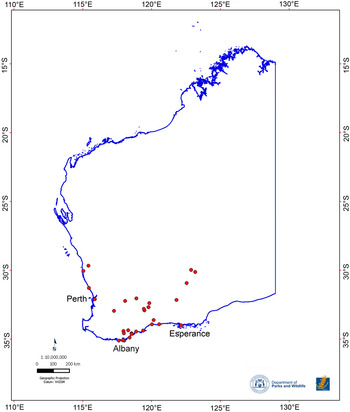
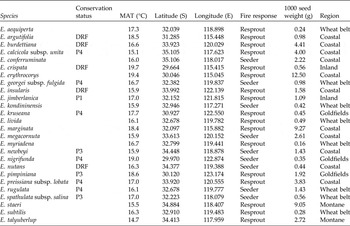
Twenty-six Eucalyptus species with varying life history characteristics and conservation status were selected for investigation (Fig. 1; Table 1). Seeds were collected from the wild across southern Western Australia over a period of 10 years from a broad range of individuals and subsequently stored under genebank conditions (cool and dry) until use. Eucalyptus seeds are generally held in the canopy in woody capsules. The seeds are mostly small and lack any feature that aids seed dispersal (Boland et al., Reference Boland, Brooker and Turnbull1980). Seed dormancy is not a common characteristic of Western Australian Eucalyptus species (Bell, Reference Bell1999), unlike some cool climate species from higher elevations in eastern Australia that may be dormant on dispersal and require cold chilling to overcome dormancy (Battaglia, Reference Battaglia1993; Battaglia, Reference Battaglia1997; Close and Wilson, Reference Close and Wilson2002; Mok et al., Reference Mok, Arndt and Nitschke2012). Seed release occurs when capsules dry and valves open and can be accelerated by drought or fire. Mature, viable Eucalyptus seeds from the region generally germinate freely once the requisite conditions of temperature, moisture and substrate combine to stimulate germination.
The location of 26 study species in the south west of Western Australia.

Eucalyptus species investigated in this study, their conservation status, fire response, seed weight and provenance

DRF denotes Declared Rare Flora gazetted under the Western Australian Wildlife Act 1950. Species listed as P1–P4 are data deficient and ranked in order of priority for survey and evaluation of conservation status so that consideration can be given to their declaration as threatened flora. MAT denotes mean annual temperature.
Environmental variables
The average monthly minimum and maximum temperatures for each seed source site were used as proxies for thermal tolerance and were obtained from WorldClim, a set of global climate layers with a spatial resolution of approximately 1 km2 (Hijmans et al., Reference Hijmans, Cameron, Parra, Jones and Jarvis2005). The data for ‘current’ conditions were derived from 1950–2000 averages. Future projections for the same climate variables were downloaded from the downscaled Hadley Centre Global Environment Model version 2 (HadGEM2-ES; http://www.metoffice.gov.uk/research/modelling-systems/unified-model/climate-models/hadgem2) using a high greenhouse gas emission scenario (Representative Concentration Pathway, RCP85) for 2070. The RCP85 scenario reflects high energy demand and greenhouse gas emission without climate change policies (Moss et al., Reference Moss, Edmonds, Hibbard, Manning, Rose, van Vuuren, Carter, Emori, Kainuma, Kram, Meehl, Mitchell, Nakicenovic, Riahi, Smith, Stouffer, Thomson, Weyant and Wilbanks2010). This scenario is extreme but reflects a likely climate outcome given the current level of mitigation activity. The HadGEM2-ES model (Jones et al., Reference Jones, Hughes, Bellouin, Hardiman, Jones, Knight, Liddicoat, O'Connor, Andres, Bell, Boo, Bozzo, Butchart, Cadule, Corbin, Doutriaux-Boucher, Friedlingstein, Gornall, Gray, Halloran, Hurtt, Ingram, Lamarque, Law, Meinshausen, Osprey, Palin, Parsons, Chini, Raddatz, Sanderson, Sellar, Schurer, Valdes, Wood, Woodward, Yoshioka and Zerroukat2011) includes dynamic vegetation, ocean biology and atmospheric chemistry, and has previously been used in simulating germination response in native species (Fernández-Pascual et al., Reference Fernández-Pascual, Seal and Pritchard2015; Cochrane, Reference Cochrane2016), including use in the Fifth Assessment Report of the Intergovernmental Panel on Climate Change (IPPC, 2013).
Experimental design
A bi-directional temperature gradient plate (TGP) (GRD1, Grant Instruments, Cambridge, UK) was used to deliver 196 different temperature combinations (constant and alternating) simultaneously. The TGP method was chosen in order to detect thresholds more accurately than step-wise temperatures delivered by incubators, characterizing a fuller spectrum of responses to future temperature scenarios. Seeds were sown in 30 mm plastic Petri dishes on 0.75% w/v water agar. Seed numbers per dish ranged from 14 to 20 depending on species, and each species was exposed to 49 temperature combinations with a 12-h photoperiod for 6 weeks (four species per run of the TGP). There was no capacity to replicate temperature conditions on the TGP but each species was represented by between ca 700–1000 seeds. Seed germination was checked three times weekly and germinated seeds showing a radicle at least double the length of the seed were removed. Percentage germination was calculated as the percentage of viable seeds that germinated within the incubation period. Seeds with a hard, white endosperm were considered potentially viable; empty seeds were removed from the original count. The experiments were carried out over a period of years from 2007 to 2016.
Data analysis
To define the response curves for each species and identify the optimal average and diurnally alternating temperature conditions for germination (percentage germination and mean time to germination), regression models were fitted to the empirical data from the TGP experiment as per Cochrane (Reference Cochrane2016). The proportion of seeds that germinated per dish and mean time to germination were the dependent variables in logistic and ordinary linear regression models, respectively. Each seed was treated as an independent unit in the logistic regression (i.e. it could either germinate or not). Percentage germination was calculated as the percentage of seeds that germinated within the incubation period and used in the ordinary linear regression models. Mean time to germination (MTG) was calculated for all temperatures (where germination occurred) using the equation: MTG = (n x d)/N, where n = number of seeds germinated between scoring intervals; d = the incubation period in days at that time point; and N = total number of seeds germinated. In addition, time to the onset (lag) of first germination (T 0) was also calculated. Simple linear regression was used to examine the relationship between the mean of the diurnal temperatures that provided most rapid and complete germination (defined as mean T opt) and T 0 and MTG. Simple linear regression was also used to investigate the relationship between the aforementioned germination parameters and latitude, and seed size.
Four alternative models were built to assess seed response to forecast warming for the region. The temperature values for each cell of the gradient plate (diurnal temperatures, average of day/ night temperatures, and amplitude of temperature range) were used as the independent variables to populate the models. Model 1 used the day and night temperatures within each cell as independent variables; model 2 used mean temperature in each cell as the independent variable; model 3 used the amplitude of temperature fluctuation in each cell; and model 4 used a combination of mean and amplitude of temperature. To allow for possible non-linear responses to temperature, the squares of temperature variables were included in each model. In all models a binary variable was included denoting the timing of light during the diurnal cycle (i.e. whether light coincided with the warm or cool part of the cycle) as one half of the cells on the temperature gradient plate had both day and night phases when temperature was higher (the latter being less meaningful, ecologically). Once the best-fitting of the four alternate models for germination was determined (based on the lowest deviance value), the optimal temperature conditions (day/night temperature cycle) for each species were estimated.
Finally, using the best-fitting models described above, the projected responses of each species under current and forecast monthly average minimum and maximum temperature conditions were estimated, thus providing a germination response for each month of the year. Statistical analysis was conducted in GenStat (16th edition, VSN International, Hemel Hempstead, UK); contour plots showing germination on the bi-directional temperature gradient plate were created using Origin 9.1 (OriginLab Corporation).
Results
Empirical data
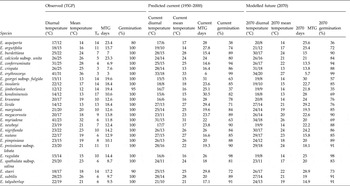
The germination temperature profiles for many species revealed surprising tolerance to high diurnal temperatures for germination (Supplementary Fig. 1). Final cumulative germination was high (80–100%) under optimum mean temperature (mean T opt) and ranged from 13 to 36°C (E. georgei and E. erythrocorys, respectively) (Table 2). This mean optimum temperature for germination was considered to be the mean of the diurnal temperatures under which highest germination occurred in the shortest possible time. The amplitude of the diurnal fluctuations ranged from 0°C (constant temperatures) to 23°C. Germination was retarded above and below the optimum temperatures but seeds could remain moist at sub- and supra-optimal temperatures for prolonged periods without losing viability.
Observed and modelled temperature conditions (diurnal and mean) and subsequent germination responses (percentage germination and mean time to germination, MTG) for 26 Eucalyptus species

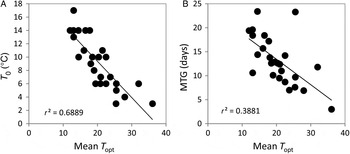
First germination (T 0) occurred between 3 and 17 days (E. erythrocorys and E. kondinensis, respectively). The mean time to maximum germination at the optimal temperature (MTG at T opt) ranged from 3 days (E. erythrocorys) to 23 days (E. aequiperta and E. calcicola subsp. unita). Seed size had no significant bearing on time to first germination, mean time to germination or temperature for optimum germination for the 26 study species (data not shown). There was, however, a strong negative relationship between mean T opt for commencement of germination (T 0) (P < 0.001; r 2 = 0.6889) (Fig. 2A). This germination lag time was greatest at lower temperatures with germination commencement more rapid at warmer mean temperatures. There was likewise a negative relationship between mean T opt and mean time to germination (MTG) (P < 0.001; r 2 = 0.3881), with time to complete germination more rapid at higher temperatures (Fig. 2B). There was no correlation between mean optimum temperature for germination and mean annual temperature or latitude of seed source sites (data not shown), suggesting a lack of adaptation to the local temperature environment for germination.
The relationship between mean optimum temperature for germination (mean T opt) and (A) onset of germination (T 0); and (B) mean time to germination (MTG).

Modelling of future climate response
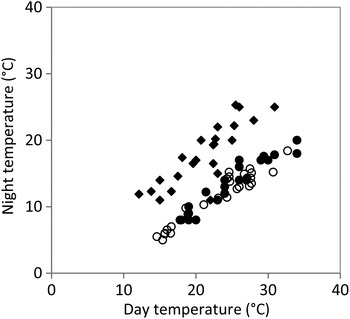
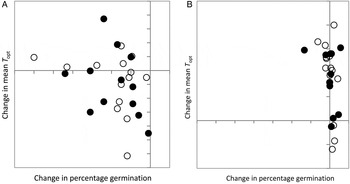
The strongest fit to the observed data for the majority of species integrated the mean and amplitude of temperature fluctuations (model 4), though model 1 (diurnal temperatures and their squares) was also a reasonable fit for many species. Models based on amplitude or average temperatures alone were not good predictors of seed response to higher temperature. Under current temperature conditions (1950–2000 averages) the best-fitting models predicted that optimum temperatures for most rapid and complete germination should occur between February and July depending on species, but in general, these models predicted that germination would be lower and slower than the observed data (Table 2). Under the high emission scenario for 2070 the models still predicted germination timing to be optimal between February and July, but a number of species would shift timing because of forecast temperature changes (see Supplementary Fig. 2). For E. erythrocorys optimum germination conditions were predicted to advance from February to March; E. subtilis and E. livida from March to April; E. marginata from April to May; E. spathulata from April to June; and E. newbeyi from June to July. In contrast, the models predict a reverse for E. pimpiniana with optimum germination timing retreating from April to March. Although temperatures are likely to be hotter in March compared with April, the forecast increase in summer rainfall in the locality of this species may indicate that soil will be sufficiently moist for germination to be successful during that time. Optimum germination timing for the remaining species is not predicted to shift. Mean times to germinate at T opt will be reduced by several days for many species. Optimum diurnal temperatures for maximum germination plotted for each of the 26 species illustrate the shift in the germination temperature niche from observed to predicted current to forecast 2070 temperature conditions (Fig. 3). Generally, the models suggest that warmer temperatures will benefit some species and not others and conservation species will not be disproportionally impacted (Fig. 4).
Relationship between TGP observed ( ), predicted current (1950–2000) (o) and 2070 modelled (●) diurnal temperatures for optimum germination. The observed data indicate a preference for germination under more-or-less constant temperatures, whereas optimum temperatures for germination predicted for current conditions (1950–2000) indicate species germinating better under slightly alternating temperature conditions with cooler nights. By 2070 conditions for optimal germination will shift again slightly to warmer day, and cooler night, temperatures overall but the coolest night temperatures will no longer exist.

Predicted change in mean optimum temperature (T opt) and percentage germination for 26 Eucalyptus species for 2070 with a high emission scenario (A) relative to observed TGP data; and (B) relative to predicted current (1950–2000) data. Common species (●); and conservation species (o). Note that the largest change in levels of germination across the 26 species occurs between observed and predicted current temperature conditions (A) and little change between predicted current and modelled 2070 percentage germination (B).

The pattern of germination response over the course of a yearly cycle of diurnal temperatures is similar for many of the species: reasonably high to high levels of germination both under current and future predictions coupled with little to no change in mean time to germination (Supplementary Fig. 2). Exceptions such as E. calcicola, E. livida, E. staeri, E. myriadena, E. nigrifunda and E. subtilis show a preference for warmer months for germination but will also increase germination under the 2070 scenario. The models predict that E. marginata germination levels will decline in the warmer summer months but increase over winter in the future. The species predicted to be most likely to decline with warmer temperatures is E. kondinensis, a common resprouting species from the western part of the region. The contour plot illustrating the observed TGP data combined with current and future germination response for each month of the year demonstrates a clear preference for the cool temperatures of autumn/winter for germination for this species (Supplementary Figs 1 and 2). Overall, another six species are predicted to suffer slight declines in level of germination (E. aequiperta, E. argutifolia, E. georgei, E. jimberlanica, E. kruseana and E. newbeyi), whilst seven species are predicted to have a slight increase in germination (E. calcicola, E. crispata, E. livida, E. nigrifunda, E. myriadena, E. spathulata and E. subtilis) (Table 2). The remaining species are predicted to maintain similar germination levels in the future.
Discussion
Temperature plays a major role in determining when and where a seed will germinate (Probert, Reference Probert and Fenner2000) and seasonal temperature changes are an important determinant of the season of seedling establishment (Bell, Reference Bell1999). Changes in the mean, as well as the frequency and severity of temperature extremes, can have a strong impact on the success of regeneration. This study used models to simulate a regeneration response by identifying major thermal constraints in germination in conjunction with ‘real’ data on germination thresholds for members of an important tree genus in southern Western Australia. In the main, the 26 Eucalyptus species investigated demonstrated wide thermal tolerances and very high temperature optima for germination, suggesting potential resilience to higher temperatures associated with anthropogenic climate change. Flexibility of temperature thresholds provides seed populations with a mechanism to adjust to forecast temperature increases. The models predicted that a number of species (E. georgei, E. aequiperta and E. jimberlanica) would suffer germination declines of 35% or more by 2070 relative to the observed data; however, the differences between the predicted current and future temperature conditions and the associated responses reveal only marginal germination declines. These anomalies are no doubt a result of the models used. The more worrying result is that predicted for E. kondinensis because of the large reduction in germination expected between predicted current and future conditions and the requirement for cooler conditions of autumn/winter for maximum germination.
Germination timing for some species shifted slightly when presented with warmer temperatures but most remained the same. Timing of germination is closely related to seedling survival and establishment, and flexibility in germination times may provide an opportunity for alleviation or exacerbation of climate change impacts on regeneration: pushing germination closer to spring and summer dry can increase mortality in autumn/winter regenerating species in seasonally dry ecosystems and in summer rainfall regions and at higher elevations warmer temperatures may push germination later into autumn and winter, increasing the risk of frost mortality (Mok et al., Reference Mok, Arndt and Nitschke2012; Rawal et al., Reference Rawal, Kasel, Keatley and Nitschke2015). The possible consequences of shifts in germination timing may be a contraction of niches for species intolerant of warmer conditions and expansions of niches for those resilient to change.
Temperature conditions for germination of Eucalyptus species from southern Australia has previously been reported to be mostly around 15–25°C (Boland et al., Reference Boland, Brooker and Turnbull1980). However, seed of some species has demonstrated tolerance to much higher temperatures. Eucalyptus tetragona, a species distributed predominantly south and east of Perth, Western Australia, has been observed to germinate at high levels between 10 and 35°C (Bellairs and Bell, Reference Bellairs and Bell1990); E. occidentalis has demonstrated high levels of germination at 30°C (Zohar et al., Reference Zohar, Waisel and Karschon1975) and E. globulus has exhibited fastest and most complete germination at 28°C, with germination only limited above 33°C (López et al., Reference López, Humara, Casares and Majada2000). Although seed might be able to germinate to high levels at high temperatures, speed of germination usually declines at temperatures above and below the optimum (Bellairs and Bell, Reference Bellairs and Bell1990; Battaglia, Reference Battaglia1993; López et al., Reference López, Humara, Casares and Majada2000). In this study the models predicted a slight increase in germination speed for most species at the optimum germination temperature as the region warms. Rapid germination may be beneficial for seedling establishment, providing competitive advantage in a seasonally dry and nutrient-poor environment.
Climate is often considered a primary constraint on species distributions at a regional scale (Pearson and Dawson, Reference Pearson and Dawson2003); however, this research has demonstrated that modelling climatic conditions within species geographic distributions has the potential to strongly underestimate the thermal tolerance of the germination niche. The overall pattern emerging from these results suggests broader temperature tolerance for most species than would be expected from distributions alone. This fact confounds the models somewhat and suggests that climatic distribution is a poor proxy for temperature tolerance during seed germination. In contrast, investigations in south east Australian Eucalyptus species suggested that the temperature germination niche tended to reflect the temperature niche within the temperature range in the habitat of species (Rawal et al., Reference Rawal, Kasel, Keatley and Nitschke2015). However, very little is known of field timing of germination in these particular Eucalyptus species, and temperatures in the upper soil stratum can be much higher than that recorded for air, and have been known to frequently exceed 60–70°C (Hnatiuk and Hopkins, Reference Hnatiuk and Hopkins1981). Under forecast warming scenarios, a 1°C increase in air temperature can result in an associated soil temperature increase of 1.5°C in some environments (Ooi et al., Reference Ooi, Auld and Denham2012). Nonetheless, it seems unlikely that forecast temperatures will exceed the current environmental tolerances of seed of the southern Western Australian Eucalyptus species investigated. The ability to germinate at high temperatures suggests that seed of some species (for example E. erythrocorys) might recruit at any time of the year following heavy rain; species germinating with lower thermal optima (for example E. kondinensis) are more likely to be restricted to germinate during winter.
Using a single environmental variable to understand a complex biological process is problematic for a broader understanding of species response to multiple interacting climatic factors. Water uptake is an essential initial step towards germination (Bewley and Black, Reference Bewley and Black1994) and cannot be discounted. A number of studies have considered the impact of moisture stress on germination in Eucalyptus species from south-eastern Australia (Edgar, Reference Edgar1977; Bachelard, Reference Bachelard1985; Battaglia, Reference Battaglia1993) with high sensitivity to moisture stress reported in Eucalyptus globulus (López et al., Reference López, Humara, Casares and Majada2000). Very little research has been conducted on moisture stress in species from south-western Australia, although germination in E. occidentalis was reported to be inhibited by low water potential (Zohar et al., Reference Zohar, Waisel and Karschon1975). An average decline in mean annual rainfall of ca 34% is expected across the 26 seed source sites by 2070 given a high greenhouse gas emission scenario. Summer rainfall can occur but it is erratic and usually associated with localized thunderstorm activity, or rain-bearing low pressure systems associated with tropical cyclones (Gentilli, Reference Gentilli1972). While heat stress can be alleviated by moisture, moisture stress is exacerbated by high temperatures through the process of evapotranspiration. Soil moisture reductions combined with rising temperatures can lead to greater seedling mortality over dry summer months, particularly in seasonal ecosystems. These climatic changes represent potential tipping points that may lead to large spatial shifts in species regeneration niches (Mok et al., Reference Mok, Arndt and Nitschke2012), with likely impacts on ecosystem composition and species abundance.
There was no evidence of local adaptation to thermal conditions and rare species were no less tolerant of higher temperatures than commonly occurring species. However, insufficient collections restricted the use of more robust statistical analyses, including answering questions related to phylogeny, biogeographic patterning and seed trait relationships and vulnerability. Eucalyptus is a large genus of more than 800 species and a more complete sampling of the genus would provide better predictive power. In addition, seed response to changing climates will vary across spatial and temporal scales (Cochrane et al., Reference Cochrane, Yates, Hoyle and Nicotra2015) and has been demonstrated for germination behaviour (Rawal et al., Reference Rawal, Kasel, Keatley and Nitschke2015) and growth (Drake et al., Reference Drake, Aspinwall, Pfautsch, Rymer, Reich, Smith, Crous, Tissue, Ghannoum and Tjoelker2014) in several Eucalyptus species. Sampling seed from across multiple populations will increase the robustness of our understanding of the variability within a species. Seed traits are important for predictive based plant ecology and are an integral part of a plant's life cycle, but in the end, laboratory results must be translated into field situations.
Implications
The capacity of long-lived tree species to respond to warming climates is regionally important, and of global concern, as trees dominate the carbon cycle. If capacity to germinate under high temperatures is a stable trait across many of the 800-plus known Eucalyptus species, then this tolerance may prove beneficial for the persistence of the genus as climates become more severe.
However, other ontogenetic stages of the life cycle may not demonstrate such wide thermal tolerances and successful germination does not necessarily guarantee successful establishment, with mortality during the first year of growth high (Rawal et al., Reference Rawal, Kasel, Keatley and Nitschke2015). Climate change can impact on rates of disturbance, tree mortality and life history processes that determine the ability of a species to recover from disturbance. Drought and temperature stress have been implicated in canopy tree mortality for many tree species worldwide (Allen et al., Reference Allen, Macalady, Chenchouni, Bachelet, McDowell, Vennetier, Kitzberger, Rigling, Breshears, Hogg, Gonzalez, Fensham, Zhang, Castro, Demidova, Lim, Allard, Running, Semerci and Cobb2010), an increase in wildfire risk (Millar et al., Reference Millar, Stephenson and Stephens2007), as well as significant climate-driven changes to seed production in the future (Etterson, Reference Etterson2004; Redmond et al., Reference Redmond, Forcella and Barger2012). The potential for reduced seed yield, coupled with possible declines in establishment levels as a result of delayed and shorter and drier wet seasons may still render populations of some species quite vulnerable despite the capacity to germinate under higher than forecast temperatures. Consequently, planning restoration and conservation projects in a changing climate without considering species capacity for regeneration may incur a high risk of failure. Investigations such as this one can provide managers with necessary information to identify species vulnerable at the germination stage and to adjust expectations for natural regeneration and targeted restoration by direct seeding. They can also be used to improve germination efficiency and seedling uniformity for nursery production, including support for translocation of conservation species in advance of shifting climates.
Supplementary material
To view supplementary material for this article, please visit https://doi.org/10.1017/S0960258517000010
Acknowledgements
I would like to acknowledge the contribution of Andrew Crawford, Todd Erickson and Sylvia Leighton for collection of seeds. I am grateful to Anne Monaghan for technical assistance in the laboratory.
Financial support
Support for the purchase of the temperature gradient plate came from a Natural Heritage. Trust grant from the Australian Government through the South Coast Natural Resource Management Inc. (Project 04SC1-13 h).
Conflicts of interest
None.