1 Introduction
Research on TH variation in different varieties of English has primarily focused on TH-fronting, defined here as the production of the voiceless dental fricative /θ/ as the voiceless labiodental fricative [f], which has been found to occur in varieties of New Zealand English, Scottish English and British English, amongst others (Wells Reference Wells1982; Kerswill Reference Kerswill, Britain and Cheshire2003; Wood Reference Wood2003; Clark & Trousdale Reference Clark and Trousdale2009; Schleef & Ramsammy Reference Schleef and Ramsammy2013; Stuart-Smith et al. Reference Stuart-Smith, Pryce, Timmins and Gunter2013). It is particularly pervasive in southern England and appears to be increasing in northern England as well as in Scotland (Kerswill Reference Kerswill, Britain and Cheshire2003), leading to a growing interest in understanding the social and linguistic factors that govern TH-fronting in these contexts. As such, there now exists a robust body of research (Kerswill Reference Kerswill, Britain and Cheshire2003; Wood Reference Wood2003; Clark & Trousdale Reference Clark and Trousdale2009; Schleef & Ramsammy Reference Schleef and Ramsammy2013; Stuart-Smith et al. Reference Stuart-Smith, Pryce, Timmins and Gunter2013) that has provided insight into how social factors such as gender and socioeconomic class as well as linguistic factors such as stress and lexical category constrain TH-fronting in varieties of English in both England and Scotland.
Research on TH variation in Hong Kong English (HKE) has also focused on TH-fronting, considered a unique feature of the English spoken in Hong Kong by native speakers of Cantonese (Bolton & Kwok Reference Bolton and Kwok1990; Stibbard Reference Stibbard2004; Deterding et al. Reference Deterding, Wong and Kirkpatrick2008; Setter et al. Reference Setter, Wong and Chan2010). This is unusual among the varieties of English that are emerging in Asia. While dental fricatives are rare cross-linguistically (Ladefoged & Maddieson Reference Ladefoged and Maddieson1996), and do not exist in either the phonetic or phonemic inventories of Asian languages that influence the English varieties emerging in Asia – such as Cantonese in Hong Kong; Mandarin Chinese, Tamil and Malay in Singapore; and Malay in Malaysia – speakers of English in these regions typically use either [t] or [s] in place of the voiceless dental fricative. While previous research (Bolton & Kwok Reference Bolton and Kwok1990; Stibbard Reference Stibbard2004; Deterding et al. Reference Deterding, Wong and Kirkpatrick2008; Setter et al. Reference Setter, Wong and Chan2010; Sewell & Chan Reference Sewell and Chan2010) has established that TH-fronting exists among speakers of HKE, there has not been a detailed investigation of the social and linguistic factors that govern TH-fronting in HKE. This is an important area of investigation as not only do the findings elucidate linguistic variation patterns in HKE, but also, by comparing the findings from HKE with previous research on TH-fronting in England and Scotland, insight can be gained into whether and how patterns of TH-fronting vary across different varieties of English. In addition, the current study examines the realization of TH as [s], which has not previously been documented as a variant of TH in HKE. The existence of [s] raises questions about why this variant of TH is emerging in HKE and whether the factors constraining realization of TH as [f] versus [s] are similar or different. This is the focus of the current study.
2 Literature review
The review of literature will first examine findings from research on TH variation across different varieties of English and particularly varieties of British and Scottish English, with a primary focus on TH-fronting as this phenomenon has been particularly well documented. Research on TH-fronting in HKE will then be examined. Although it is likely that TH-fronting is compelled by different linguistic and social phenomena in HKE, a comparison of findings across different varieties of English allows for conclusions to be drawn in terms of whether patterns for TH-fronting are variety-specific. The realization of TH as [s] will also be discussed, though as noted above, this has not previously been documented for HKE.
2.1 TH variation in England and Scotland
The voiceless interdental fricative TH has various realizations across different varieties of English, including [f], [s], [t] and [h]. Of these, the linguistic and social factors constraining the realization of TH as [f], or TH-fronting, have been particularly well documented. Realization of TH as [s] or [h] may also occur in some varieties of Scottish English, though typically in only a few words, while the realization of TH as [t] may occur for speakers of English from New York and as the dental stop [t̪] for some speakers of English from Ireland (Wells Reference Wells1982; Hickey Reference Hickey and Kortmann2004; Clark & Trousdale Reference Clark and Trousdale2009).
TH-fronting has been found to be constrained by both linguistic and social factors. In terms of linguistic constraints, it has been found to occur less frequently in words with /r/ after the TH in onset position such as three or through in some varieties of Scottish English (Clark & Trousdale Reference Clark and Trousdale2009) as the variant [s] may occur for some speakers in this linguistic environment. It is more likely to occur in syllable coda (e.g. the sounds after a vowel in a syllable such as in bathroom) than in syllable onset position (the sounds preceding a vowel in a syllable, such as something), and in word-final (e.g. as in bath) rather than word-initial position (e.g. as in things), particularly in some Scottish varieties of English, as [h], another TH variant, can occur syllable initially for some speakers (Clark & Trousdale Reference Clark and Trousdale2009; Schleef & Ramsammy Reference Schleef and Ramsammy2013). The prevalence of TH-fronting in different word/syllable positions may also be mediated by task type. Stuart-Smith et al. (Reference Stuart-Smith, Pryce, Timmins and Gunter2013) found that TH-fronting occurred more frequently in word-final than in word-initial and least in word-medial (e.g. in the middle of a word as in nothing) position in conversation data, whereas it occurred more frequently in word-medial than in both word-final and word-initial position in word-list data. It has also been found to differ in frequency across task types, with higher frequency in more controlled tasks such as a reading passage task than in conversational tasks (Schleef & Ramsammy Reference Schleef and Ramsammy2013; Stuart-Smith et al. Reference Stuart-Smith, Pryce, Timmins and Gunter2013). While this may be surprising, it is likely that differences in both word/syllable position as well as frequency are related to the words (and their frequency of occurrence) in the two tasks, rather than to the tasks themselves. Morphological complexity has also been found to be significant, with TH-fronting occurring more frequently in polymorphemic (multisyllabic as in something) than in monomorphemic words (one-syllable words such as bath) (Schleef & Ramsammy Reference Schleef and Ramsammy2013). Clark & Trousdale (Reference Clark and Trousdale2009) also found evidence of a priming effect on TH-fronting in Scottish English. They examined whether a preceding [f] in the same word would ‘prime a following word or segment by making it more quickly retrievable’ (Reference Clark and Trousdale2009: 51). They found that if a labiodental occurred in a preceding position in the word, the TH segment was more likely to be realized as a [f].
Some studies also suggest that TH-fronting may be lexically conditioned. In some varieties of Scottish English, it may appear less frequently in words such as thing, think, and derivatives of thing such as something and anything (Clark & Trousdale Reference Clark and Trousdale2009), in part due to the use of the [h] variant in these words for some speakers. This is confirmed by research by Schleef & Ramsammy (Reference Schleef and Ramsammy2013), who compared differences in TH-fronting in London and Edinburgh, with TH-fronting occurring frequently in words such as think, thing for participants from London. In contrast, participants from Edinburgh had less frequent use of TH-fronting in think, thing than participants from London, due to the prevalence of [h] in this position.
In terms of social factors, TH-fronting in England and Scotland occurs frequently among young, working-class males, indicating that age, gender and socioeconomic status all constrain TH-fronting (Kerswill Reference Kerswill, Britain and Cheshire2003; Stuart-Smith et al. Reference Stuart-Smith, Timmins and Tweedie2007; Clark & Trousdale Reference Clark and Trousdale2009; Schleef & Ramsammy Reference Schleef and Ramsammy2013). Peer groups/friendships have also been found to significantly affect TH-fronting (Stuart-Smith et al. Reference Stuart-Smith, Timmins and Tweedie2007; Clark & Trousdale Reference Clark and Trousdale2009). In fact, Stuart-Smith et al. (Reference Stuart-Smith, Timmins and Tweedie2007: 224) suggest that TH-fronting is emerging as a ‘youth norm. . . relatively independent of physical space. . . and which exist in a “cultural” or ideological space, towards which speakers may orientate’. Interestingly, recent matched guise research (Levon & Fox Reference Levon and Fox2014) on TH-fronting and ratings of professionalism found that TH-fronting appears to be losing its status as a feature of working-class speech in southern England as there were no differences in ratings of professionalism based on the percentage of TH-fronting among participants from southern England. As Levon & Fox (Reference Levon and Fox2014) argue, this suggests that TH-fronting may increasingly be viewed as a marker of an ‘urban’ or ‘street’ identity rather than socioeconomic status.
The diffusion of TH-fronting across the UK appears to be a relatively recent phenomenon. Some scholars (see Blevins Reference Blevins2004) argue that it is a diachronic sound change that originated from a ‘misperception’ effect between [θ] and [f]. This may explain why TH-fronting is more pervasive in word-final contexts as the difference in [θ] and [f] is less salient perceptually and articulatorily in word/syllable-final position. This merger then spreads from this environment to ‘other perceptually disadvantaged contexts before favourable ones’ (Schleef & Ramsammy Reference Schleef and Ramsammy2013: 45).
This misperception effect has been found to be a developmental process in the acquisition of TH in first language (L1) acquisition as well as a developmental stage in the production of English [θ] by French second language (L2) learners of English and the perception of [θ] as [f] by Hungarian L2 learners of English (Nemser Reference Nemser1971; Wenk Reference Wenk1979). This misperception most likely stems from the acoustic similarities of the two sounds as both have a low intensity (sound pressure), meaning that they are produced with weaker energy than other fricatives (Tabain Reference Tabain1998). Jongman et al. (Reference Jongman, Wayland and Wong2000) suggest that English [θ] and [f] are closer in many acoustic respects (spectral peaks, duration of fricative noise and noise amplitude) than are [θ] and [s], possibly leading to more misperceptions between [θ] and [f] than between [θ] and [s], particularly in the early stages of acquisition. It is also possible that TH-fronting is part of a developmental process in the acquisition of TH; in research on French L2 learners of English, Wenk (Reference Wenk1979) found that TH was realized as [f] in the early stages of acquisition, followed by [t] in the intermediate stage of acquisition, before [θ] was acquired in the advanced stage of acquisition.
2.2 TH variation in HKE
Hong Kong English (HKE) refers to the variety of English spoken by speakers of Cantonese in Hong Kong. English has served as an unofficial as well as official language in Hong Kong since 1841, when Hong Kong Island was ceded to Great Britain after the First Anglo-Chinese War. After the handover of Hong Kong to the People's Republic of China in 1997, English was retained as an official language. Cantonese, the most commonly used language of 93 per cent of the 7.3 million inhabitants of Hong Kong, is also an official language in Hong Kong. After the handover, Mandarin Chinese, the official language of China, was also given official language status in Hong Kong. Students are taught English from the age of 3, when they enroll in preschool. While English is taught in schools, there is a wide range of English proficiency levels in Hong Kong due to differences in how English instruction is implemented in local government schools. Some primary and secondary schools provide a Chinese Medium of Instruction (CMI), in which Chinese (usually Cantonese but increasingly Mandarin Chinese) is used to teach all subject matter and English is taught as a school subject. Other schools provide an English Medium of Instruction (EMI), in which English is used to teach most subject matter. While most primary schools are CMI, many secondary schools are EMI, as a high level of proficiency in English is required for admission to university in Hong Kong. Universities in Hong Kong use English as either the sole medium of instruction or as a mode of instruction along with Cantonese and/or Mandarin Chinese.
TH variation research on HKE has focused on TH-fronting, widely considered to be a distinguishing feature of HKE in contrast to other varieties of Asian English such as Singapore and Malaysian English. As noted previously, [s] has not been documented as a variant of TH in previous research on HKE. One of the earliest studies to examine TH-fronting in HKE was Bolton & Kwok (Reference Bolton and Kwok1990), who found that it existed in the spontaneous speech data of an educated tertiary student's English. Later research by Hung (Reference Hung2000) employed word lists to elicit a variety of features in HKE and found that one-half of the participants had TH-fronting, and that use of [f] vs [θ] in TH environments was categorical. In contrast, Stibbard (Reference Stibbard2004) found that use of [θ] or [f] was highly variable across his participants, though this could be due to use of conversation rather than more controlled word-list data, indicating that task type may also impact degree of TH-fronting in HKE, similarly to British and Scottish English.
Research by Deterding et al. (Reference Deterding, Wong and Kirkpatrick2008) found that realization of TH as [θ] or [f] was speaker-dependent, with some speakers having variable usage of [θ] or [f] whereas other speakers were categorical in using either sound. They also found that realization of TH as [θ] or [f] may be related to word position, with greater realization as [f] in final position; this is similar to findings on word/syllable position effects on TH-fronting in varieties of Scottish and British English (Schleef & Ramsammy Reference Schleef and Ramsammy2013). The researchers also examined TH-fronting across different lexical items and found that in initial position, it occurred more often on the word three than other lexical items. It also occurred frequently on the word think. There were no instances of TH-fronting in medial position. TH-fronting was most frequent overall in word-final position, in words such as youth and both. This indicates that both word position and lexical effects may impact TH-fronting in HKE; however, due to the limited number of tokens in that database, an expanded study is needed to confirm these findings.
As to why TH-fronting exists in HKE, it is most likely triggered by misperception effects between [θ] and both English and Cantonese [f] (/θ/ does not exist in Cantonese). In other words, TH-fronting in HKE may be motivated both by internal factors in English, similarly to other varieties of English, as well as by substratum influence from Cantonese. While both the voiceless and the voiced dental fricatives are rare cross-linguistically and difficult to acquire for both child L1 learners of English as well as L2 learners of English (Lombardi Reference Lombardi2003), the question is why [f] is in variance with TH rather than [s] or [t] for most speakers of HKE, as previous research has found. This is particularly interesting given that Cantonese also has [s] and [t], the sounds that are commonly used in variation or categorically for TH in other varieties of Asian English, including the English of Singapore, Malaysia, Taiwan and China (Deterding et al. Reference Deterding, Wong and Kirkpatrick2008). For example, [t] is a variant of TH in Singapore and Malaysian English, while [s] is a variant of TH in the English of Taiwan and China (Deterding et al. Reference Deterding, Wong and Kirkpatrick2008; Rau et al. Reference Rau, Chang and Tarone2009). As noted above, [s] and [t] (and [h]) are also variants of TH in some varieties of English. Chan (Reference Chan2001) and Deterding et al. (Reference Deterding, Wong and Kirkpatrick2008) argue that it may be due to the acoustic similarities of Cantonese [f] and English [θ], and perhaps a greater similarity between English [θ] and Cantonese [f] than between English [θ] and Cantonese [s]. As noted above, acoustic similarities between English [θ] and [f] in contrast to English [θ] and [s] have been suggested as the underlying cause of misperception effects that exist in both L1 and L2 acquisition (see, for example, Nemser Reference Nemser1971; Jongman et al. Reference Jongman, Wayland and Wong2000).
As yet, there are no studies that directly investigate misperception of [θ] and [f] in contrast to [θ] and [s] for Cantonese L1 speakers of English, though researchers have examined the misperception of English [θ] and [f]. Chan (Reference Chan2001) found that some of her Hong Kong participants could not perceive a distinction between [θ] and [f] and that these participants also had a higher rate of TH-fronting in production than those who had higher accuracy scores on the perception task, also indicating that perception and production of [θ] and [f] are related. Lau & Wong (Reference Lau and Wong2002) examined the perception of [θ] for year 1 secondary (S1) and year 6 (S6) secondary students in Hong Kong and found that S1 students had lower accuracy percentages for perception on a discrimination test than S6 students. This also provides some evidence to support the hypothesis that perception of TH as [f] rather than [θ] is a developmental process in HKE as the S1 students had a lower level of proficiency in English than the S6 students.
It is not clear whether TH-fronting is purely a linguistic phenomenon in HKE, or whether other factors impact TH-fronting in HKE. It is also not clear why [s] is emerging as a variant of TH in HKE and whether differences exist in the realization of TH as [f] or as [s]. The current study attempts to investigate these issues in more detail.
3 Research questions
The study examines the pervasiveness of TH variation for 44 speakers of HKE and whether there is a relationship between medium of instruction (MOI), gender and proficiency, and TH variation. Finally, the study examines which linguistic factors appear to constrain TH variation in HKE. The study thus seeks to answer the following research questions:
1. How pervasive is TH variation in HKE?
2. Which non-linguistic factors constrain TH variation in HKE?
3. Which linguistic factors constrain TH variation in HKE?
4. Do differences exist in terms of which factors constrain realization of TH as [s] or as [f] in HKE?
5. Are patterns in TH variation in HKE similar to or different from patterns found in other varieties of English?
4 Methodology
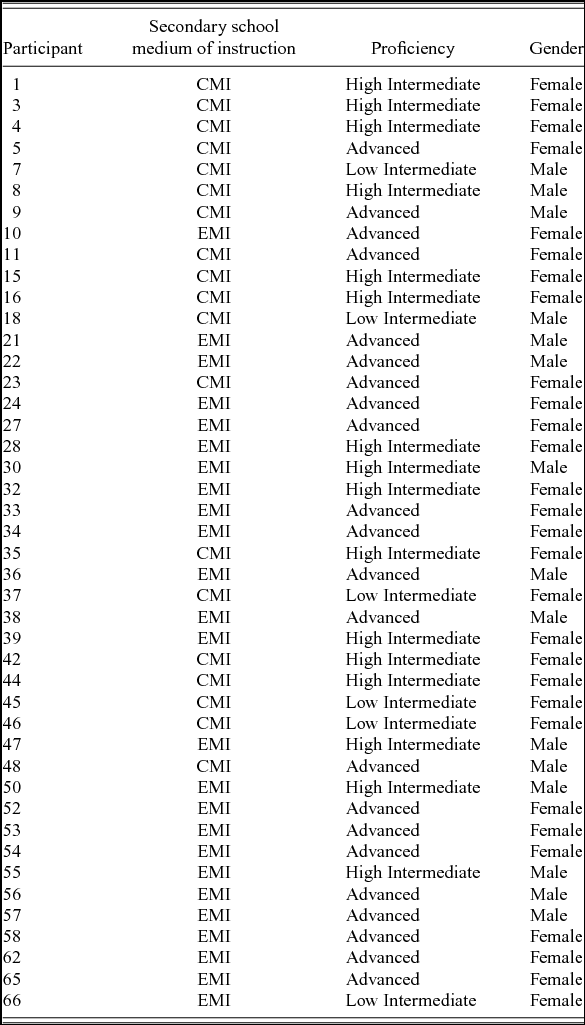
Data were collected from 44 Hong Kong Chinese students at a large university in Hong Kong. All participants spoke Cantonese as their first language and learned English from the age of 3. All were born and raised in Hong Kong. Twenty-nine (66 per cent) of the participants self-selected as female and 15 (34 per cent) as male on the background questionnaire the participants filled in when they enrolled in the study. All participants attended local Hong Kong government schools at both primary and secondary level: Nineteen (43 per cent) attended CMI schools at both primary and secondary level, while 25 (57 per cent) attended CMI schools at primary and EMI at secondary level. The participants’ levels of proficiency were determined by their scores on the Hong Kong Diploma of Secondary Education (HKDSE) or Hong Kong Advanced Level Examination (HKALE). All students who attend local government schools in Hong Kong are required to take the HKALE (prior to 2012) or the HKDSE for entrance to university. The participants’ scores on the spoken English portion of either the HKALE or the HKDSE were used to determine proficiency. Of the participants, 22 (50 per cent) were Advanced, 16 (36 per cent) were High Intermediate, and 6 (14 per cent) were determined to have Low Intermediate proficiency. Not surprisingly, there was a relationship between medium of instruction and proficiency in English: of the 19 CMI students, 5 (26 per cent) were Advanced, 9 (47 per cent) were High Intermediate and 5 (26 per cent) were Low Intermediate. In contrast, of the 25 EMI students, 17 (68 per cent) were Advanced, 7 (28 per cent) were High Intermediate, and only 1 (4 per cent) was Low Intermediate. These details can be found in table 1. Participant numbers refers to their Wave file numbers for the data recordings.
Details of the participants

Data were collected during one-on-one data collection sessions with the researcher in a soundproof recording studio. Data were recorded as 16-bit wave files on Marantz PMD-661 using a Shure microphone. During the data collection sessions, the researcher focused on eliciting spontaneous data. As such, the researcher asked each participant a range of questions designed not only to engage the participant in a real conversation but also to elicit a wide a range of lexical items. Questions included educational background, hobbies and travel. A total of thirty minutes of conversational data were collected from each participant; in addition, each participant was asked to read a brief word list and reading passage (see appendix) to elicit a wide range of lexical items. Words with TH were embedded in a larger word list. The word-list and reading passage data were combined as a preliminary analysis did not find differences in realization of TH between these two tasks. The word-list and reading data combined are referred to as the read data. The conversation data were first orthographically transcribed by a research assistant and checked for accuracy by the researcher. Once all data had been orthographically transcribed and checked, two trained research assistants transcribed all the data phonetically. Inter-rater reliability was calculated as 94 per cent for the orthographic transcriptions and 92 per cent for the phonetic transcriptions. If a disagreement arose, the researcher checked the transcriptions. In a few rare cases, data had to be eliminated as consensus could not be reached on the transcription. All TH tokens were also coded as belonging to the onset or coda of a syllable. Onset refers to syllable onset, either word-initially, as in the word thing, or word-medially, as in the word something, where the TH is the onset of the second syllable. Coda refers to syllable coda, either word-finally, as in bath, or word-medially, where the TH is the coda of the first syllable as in bathroom. When the TH was in medial position in the word, the Cambridge English Pronouncing Dictionary (Jones et al. Reference Jones, Roach, Setter and Esling2011) was consulted if questions arose about the status of the TH as the onset or coda of a given syllable. The word with was eliminated from the study as it was frequently realized with the voiced dental fricative [ð] or as [d] and not the voiceless TH.
5 Findings
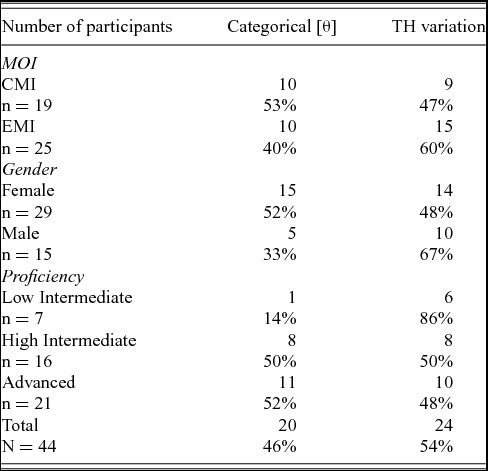
The study examined the pervasiveness of TH variation across the 44 participants. As table 2 demonstrates, of the 44 participants in the study, a slight majority (54 per cent) had some TH variation, while 46 per cent produced TH categorically as [θ] in both tasks.
Analysis of TH realization by MOI, gender and proficiency

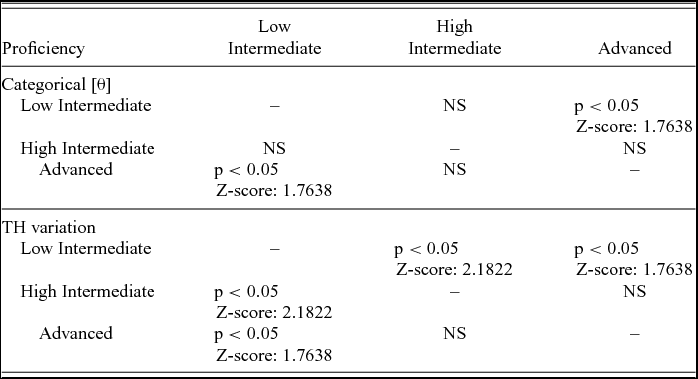
A series of Z-tests were conducted to determine whether there were differences in the existence of TH variation in the dataset based on gender, MOI or proficiency. There was a tendency for more males than females to have TH variation, though this was not significant. In addition, a greater percentage of EMI than CMI students had TH variation, though this was also not significant. Proficiency, however, was significant; the results of the statistical analyses for proficiency are shown in table 3.
Proficiency and TH variation

The statistical analysis showed that significantly more participants with Advanced proficiency had categorical [θ] in contrast to participants who had Low Intermediate proficiency. Significantly more Low Intermediate and High Intermediate proficiency participants had TH variation than participants who had Advanced proficiency. This suggests that TH variation is a developmental phenomenon.
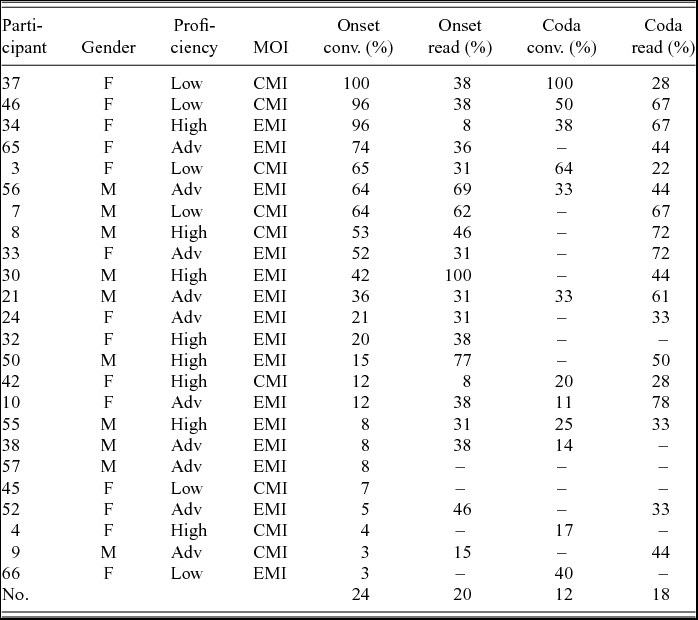
As noted above, 24 of the 44 participants had TH variation. A closer examination of the conversation versus read data was conducted for these 24 participants. Data were also analysed for differences in the syllable position of TH, to determine whether this had an impact on TH variation. For the 24 participants who had variable realizations of TH, there were different degrees of TH variation based on the task and syllable position. This is illustrated in table 4. Nine participants had TH variation in both syllable positions across both tasks. While two of the participants had TH variation only in onset position in the conversation data, none of the participants had TH variation only in coda position or only in the read data. As this demonstrates, TH variation in coda position may imply variation in onset position, but not vice versa. This requires further investigation. In addition, TH variation only occurred in more formal (read) tasks if participants also had it in more casual (conversation) speech.
Percentage of TH variation by participant, syllable position and task

As table 4 also demonstrates, most, though not all, participants who had TH variation in both syllable positions and/or task types also had higher TH variation percentages overall. In contrast, the participants who only had TH variation in onset position in the conversation data had low TH variation rates overall, between 3 and 8 per cent. There was also a wide range of percentages of TH variation, from 100 to 3 per cent, depending on the syllable position and task. Two of the three participants with the highest percentages of TH variation across both tasks and both syllable positions had Low Intermediate proficiency in English.
5.1 VARBRUL analysis of the data
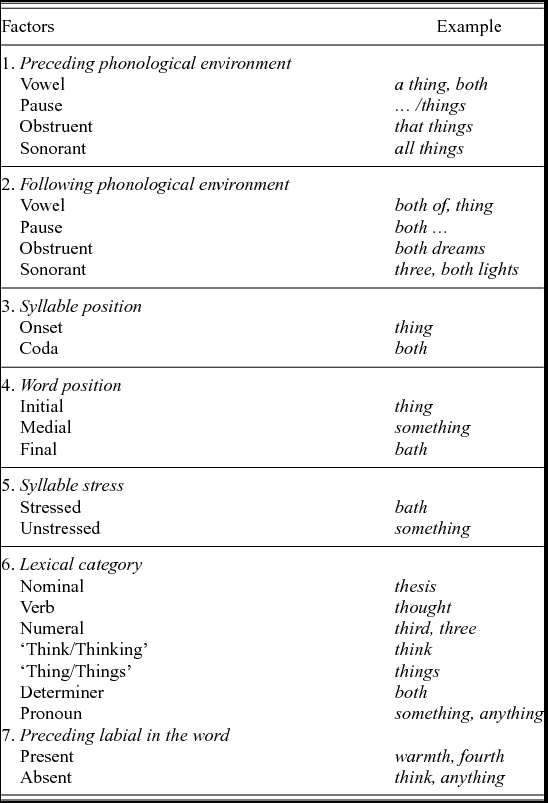
A VARBRUL analysis was conducted to examine which linguistic and non-linguistic factors constrained TH variation. Only data from the 24 participants who had TH variation were included in this analysis. All tokens with voiceless TH were coded as having one of three realizations: [θ], [f] or [s]. The realization of TH as [f] and [s] was coded separately to examine whether different constraints operated on the realization of TH as [f] vs [s]. The tokens were coded for several factors based on previous research as well as a preliminary analysis of the data. These factors are presented in table 5.
Linguistic factors in the VARBRUL analysis

The tokens were coded for both syllable position (onset vs coda) and word position (initial, medial and final), though some overlap between two factors was unavoidable (e.g. all initials were also onsets, and all finals were codas). Due to the large number of words that occurred only once or twice in the data set, frequency of lexical items was not investigated in the VARBRUL analysis. Instead, following previous research, the tokens were coded for lexical category such as ‘nominal’ and ‘verb’. Additionally, separate categories were created for the words think/thinking and thing/things because a preliminary analysis of the data established that these two words frequently underwent TH variation. A third category, ‘numeral’, was established to capture words such as third and fourth as a preliminary analysis had established that these types of words also underwent TH variation more frequently than other lexical items. Many of the words in the data set were pronouns (e.g. something, anything) or determiners (e.g. both) and therefore these two word categories were added into the analysis. Following Clark & Trousdale (Reference Clark and Trousdale2009), the current research examined whether the realization of TH as either [f] or [s] was more likely if there was a preceding labial (in this case [b], [m], [f], or [v]) in the same word.
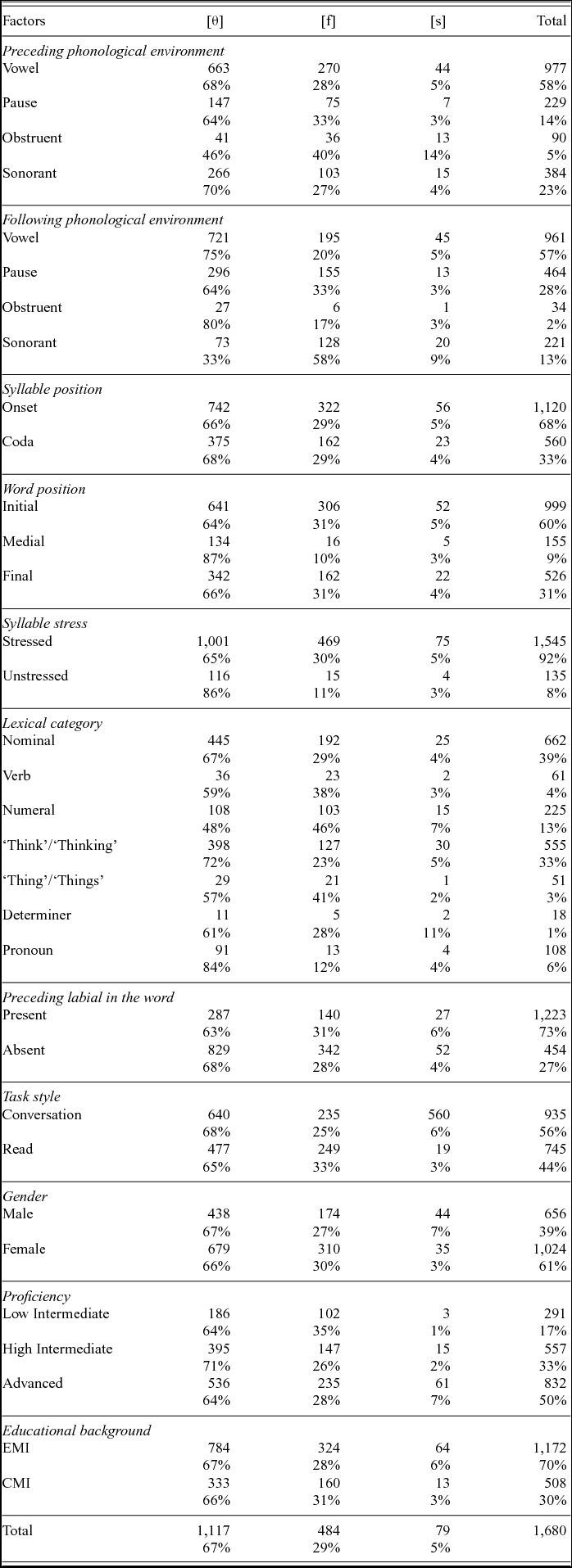
In addition, the tokens were also coded for four non-linguistic factors: task type (conversation versus read data), gender (female or male), proficiency (Low Intermediate, High Intermediate, Advanced) and MOI (EMI or CMI). Although only proficiency was found to significantly affect whether a participant had TH variation in contrast to categorical [θ] use, all four non-linguistic factors were included in the VARBRUL analyses to test whether they affected the likelihood of TH realization as [f] or [s] for those who had TH variation. Table 6 presents the percentage of TH realizations across the different factors. In this table, percentages should be read across a given row. For example, for the factor group ‘preceding phonological environment’, 68 per cent of realizations of TH as [θ], 28 per cent as [f] and 5 per cent as [s] had a preceding vowel. For the final column ‘Total’, the numbers demonstrate the total percentage of all tokens that corresponded to a given factor. Overall, 58 per cent of the TH tokens had a preceding vowel.
TH realization percentages across different factors

As table 6 demonstrates, there were a total of 1,680 tokens available for analysis from the 24 participants who had TH variation. Of these, 67 per cent were realized as [θ], 29 per cent as [f] and 5 per cent as [s].
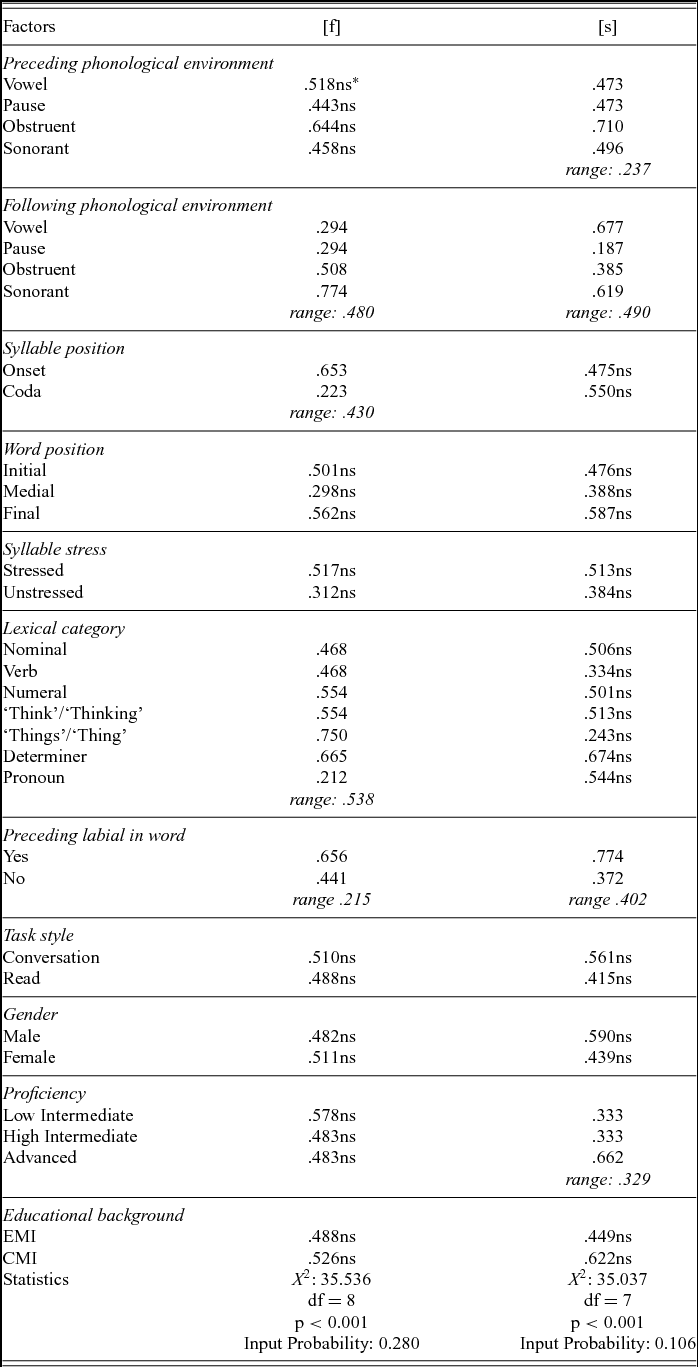
Several VARBRUL runs were conducted to find the best model fit for the data. The findings from each of the two VARBRUL analyses are presented in table 7. In each case, the realization of TH as [f] or as [s] was run against the realization of TH as [θ] (e.g. in the analysis of the realization of TH as [f], tokens with realization as [s] were ignored, whereas in the analysis of the realization of TH as [s], all tokens with [f] were ignored).
Results of VARBRUL analyses

*ns = not significant
As table 7 demonstrates, several factors were not significant for the realization of TH as either [f] or [s]: gender, task style, educational background, stress and word position. These factors will therefore not be discussed further in this section. Some differences were found in how different factors impacted TH realization as [f] or [s], demonstrating that TH realization as these two variants is constrained by different factors.
For realization as [f], four factor groups were found to be significant: lexical category, following linguistic environment, syllable position and preceding labial. Lexical category, with a range of .538, appears to have the strongest impact on the realization of TH as [f]. TH tokens in the words thing/things (.750) and determiners (.665) were more likely to be realized as [f] than think/thinking (.554), numerals (.554), nominals (.468) or verbs (.468). It was least likely to be realized as [f] in pronouns (.212). Following linguistic environment, with a range of .480, also had a strong effect on TH realization as [f]. Specifically, realization of TH as [f] was more likely to occur when the TH was followed by a sonorant (e.g. as in three or both leave) (.774). It was less likely to occur when followed by an obstruent (.508) and least likely with a following vowel or pause (.294). In terms of syllable position, TH in an onset (.653) was more likely to be realized as [f] than TH in a coda (.223). Finally, a preceding labial in the same word favoured TH realization as [f] (.656) over absence of a preceding labial (.441).
For realization of TH as [s], following linguistic environment had the strongest effect, with a range of .490, followed by preceding labial in the same word, proficiency and then preceding linguistic environment. Specifically, a following vowel (.677) and sonorant (.619) were more likely to result in realization of TH as [s] than a following obstruent (.385) or pause (.187). A preceding labial in the same word favoured TH realization as [s] (.774) over absence of a preceding labial (.372). Participants with Advanced proficiency (.662) had more realizations of TH as [s] than either Low or High Intermediate participants. A preceding obstruent promoted realization as [s] (.710) in contrast to a preceding sonorant (.496), pause (.473), or vowel (.473).
In sum, several findings emerged from the VARBRUL analyses, which will be explored more below in the discussion of the lexical analysis of the data. Firstly, linguistic environment, and particularly a following sonorant and/or a preceding labial, favoured the realization of TH as either [f] or [s]. These were the only two factors that significantly affected both realizations. Lexical category and syllable position only had a significant impact on realization of TH as [f], and preceding linguistic environment as well as proficiency only impacted realization as [s].
5.2 Lexical analysis of the data
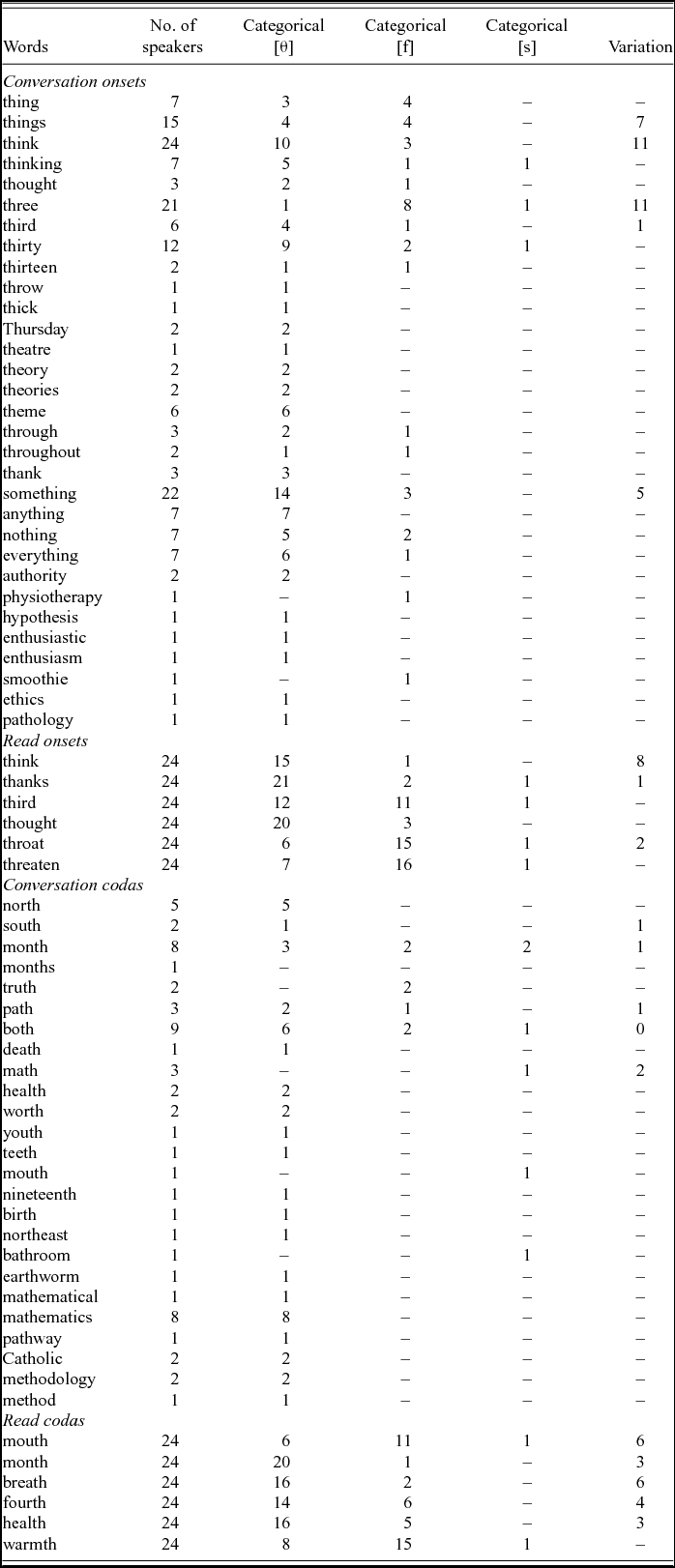
A lexical analysis of the data was conducted to provide further insight into the findings from the VARBRUL analysis. Table 8 presents the lexical items by the number of speakers who had each word in their data set (total N), and how many of these participants had categorical realization of the TH in each word as [θ], [f] or [s], or exhibited variation in their production. As with the VARBRUL analysis, only data from the 24 participants who had TH variation in their data set were included in the lexical analysis.
TH-realization across different lexical items

As table 8 demonstrates, a total of 68 different lexical items with TH were found in the data set, with 56 different lexical items in the conversation data and 12 in the read data. A closer examination of this data reveals that TH variation is largely lexically conditioned, with categorical or near-categorical TH variant usage for each speaker.
The lexical analysis provides further insight into the findings of the VARBRUL analyses. Firstly, the significant effect of a following sonorant is illustrated in the effect of a following /r/: for example, in the onset read data, the words with the most realization as [f] or [s] were threaten and throat, both of which have a following /r/ after the TH. Of the 24 participants, 15 pronounced the TH in throat categorically as [f], one as [s], and two had variation in their production. In terms of threaten, 16 pronounced the TH categorically as [f] and one as [s]. The onset conversation data further illustrate this pattern: while 21 of the 24 participants had three in their data set, only one participant categorically realized the TH in three as [θ], with eight pronouncing the TH categorically as [f], one categorically as [s], and 11 participants having variation in their production. The TH in the words through and throughout, while not appearing in many of the participants’ conversation data sets, was also categorically realized as [f] by some participants (one out of three for through and one out of two for throughout).
The lexical analysis also provides insight into the VARBRUL finding that a preceding labial has a priming effect on the realization of TH as [f] or [s]. It is likely that the higher rates of TH-fronting on the word something is the result of priming from the preceding labial as it occurred after a preceding [m]. While only one participant had the word smoothie in their data set, the TH was realized categorically as [f] by this participant, possibly also due to the preceding [m]. TH-fronting also occurred for the word physiotherapy, which has a preceding [f] in the word. The same pattern can be found when the TH was in syllable coda position: TH variation occurred most often in month, both, math. All three words also have a labial ([b] or [m]) in a preceding position in the word. The word both was also a determiner, a category the VARBRUL analysis found favoured TH-fronting. It is possible that it was the preceding labial and not the lexical category that had an effect on TH-fronting for this word. In fact, a closer examination of the words in this category in the VARBRUL analysis indicates that both was the only determiner in the data set. The word path, which also has a preceding labial in the same word, also had some TH variation: one participant out of the three who had this word in their data set had categorical [f] for the TH, while one participant had TH variation. Mouth only appeared in the conversation data for one participant, who categorically produced the TH as [s]. In the read data, TH variation was the most common in warmth and mouth. For both warmth and mouth, a preceding [m] in the word may have had fostered realization of the TH as [f] or [s].
As noted above, the VARBRUL analysis found that TH was more likely to be realized as [f] in numerals than in nominals, verbs and pronouns. The lexical analysis also demonstrates that numerals, and particularly third, thirty, thirteen, had some degree of TH realization as [f]. Interestingly, these numerals were all derivatives of three, a word with one of the highest rates of TH realization as [f] or [s]. The VARBRUL analysis also found that thing/things often had realization of the TH as [f], which the lexical analysis further demonstrates. For things, only four of 15 participants categorically realized it as [θ], while four categorically realized it as [f] and seven had variation in realization of the TH. For thing, of the seven participants who had this word in their data set, seven had categorical realization of the TH as [f]. In the VARBRUL analysis, the words think and thinking were grouped into one lexical item, which was found to favour realization as [f] more than nominals, verbs and pronouns. The lexical analysis indicates that realization of TH as [f] is favoured more in think than in thinking. Think appeared in all the 24 participants’ data sets and was realized categorically as [f] by three and in variation by 11 participants, with fewer than half of the participants (10 out of the 24 participants) producing it categorically as [θ]. In contrast, the TH in thinking was realized as [θ] by five out of the seven participants, with only one participant producing it categorically as [f] and one as [s]. It is not clear why the TH in thinking appears to undergo TH-fronting less than the TH in think. It is possible that syllable length is a factor; although this factor was not investigated in the VARBRUL analysis due to the low number of polysyllabic tokens in the data set, the lexical analysis does indicate that only a few polysyllabic words have realization of the TH as [s] or [f]. Interestingly, the TH in the word thought, the past tense form of think, had categorical realization as [f] by one of the three participants who had this word in their data set.
In sum, based on both the VARBRUL and the lexical analysis of the data, it appears that TH realization as [f] or [s] is more likely under the following conditions:
1. a following /r/: three, throat, threaten, throughout, through
2. a preceding labial consonant in the same word: something, warmth, mouth, both
3. numerals that are derivatives of three: thirty, third, thirteen
4. thing/think and their derivatives
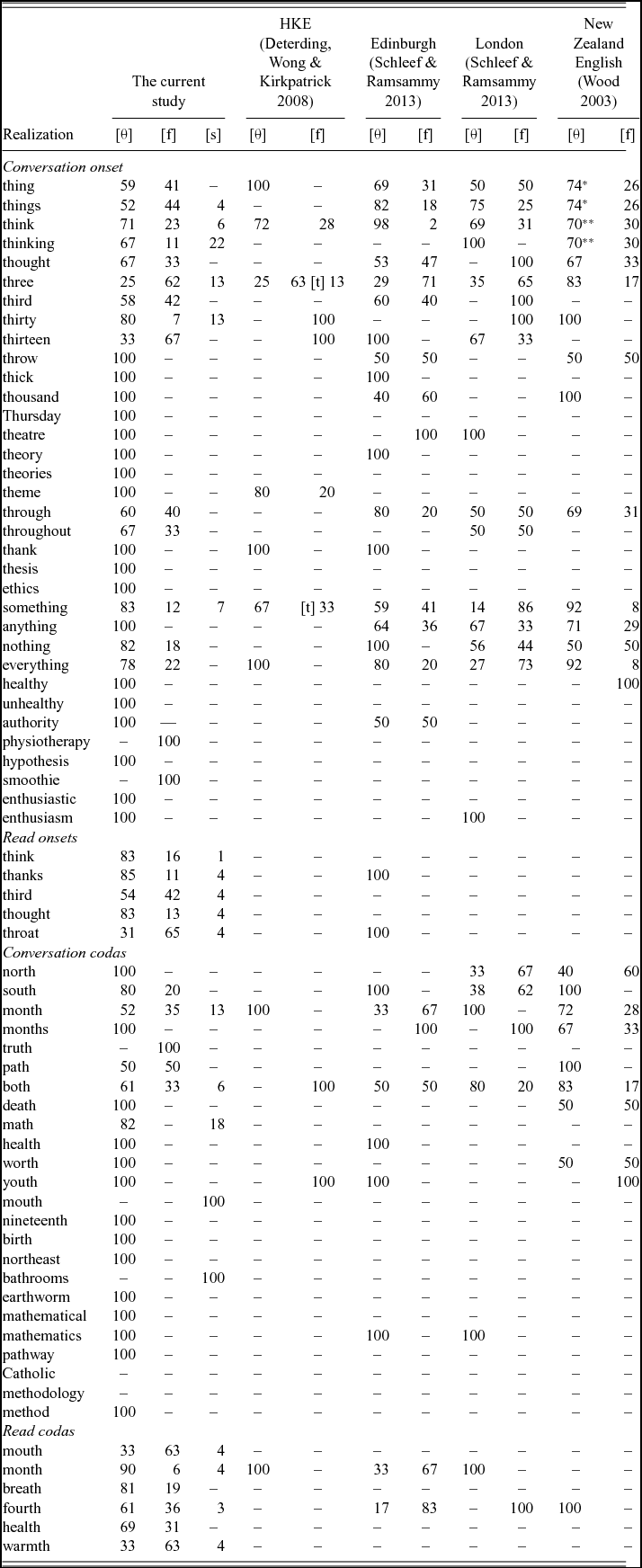
Table 9 compares the lexical patterns in the current data set with three previous studies of TH variation to determine whether there are differences or similarities in lexical patterns across varieties of English. Data from the current study are compared with data from previous research on HKE (Deterding et al. Reference Deterding, Wong and Kirkpatrick2008), as well as Edinburgh and London (Schleef & Ramsammy Reference Schleef and Ramsammy2013) and New Zealand (Wood Reference Wood2003). These are the only studies to date that have provided a lexical analysis of TH-fronting. For ease of comparison, the numbers in previous studies have been converted to percentages. Note, the realization of TH as [s] is only shown for the current study as previous research on HKE has not found this variant in their data; while it has been found as a variant in research on Scottish English, the numbers/percentage of realization of TH as [f] vs [s] have not been included in those studies.
A comparison of TH across studies (as percentages)

*combined tallies; **combined tallies
The cross-comparison of TH realization by studies confirms the patterns already noted above. Firstly, TH-fronting, as well as realization as [s], is prevalent in onset position with a following /r/ such as: three, through, throughout, throat, threaten. The word three has high rates of TH-fronting in the current data set as well as in both the London and Edinburgh data sets (Schleef & Ramsammy Reference Schleef and Ramsammy2013). It was also documented in earlier research on HKE (Deterding et al. Reference Deterding, Wong and Kirkpatrick2008). While Clark & Trousdale (Reference Clark and Trousdale2009) note that TH-fronting was disfavoured in this environment in their data from Scotland, they do state that words with a following /r/ often have realization of TH as [s] for the speakers in their study. This realization was also found in the current data set, though it was not as frequent as realization of TH as [f]. As TH-fronting appeared to be more frequent on words with a following /r/ in London, Edinburgh and New Zealand English, as well as in HKE, it appears that a following /r/ may be a phonological trigger for TH-fronting and/or [s] realization.
Secondly, in the current study, TH-fronting was prevalent in think/thinks as well as in thing/things; it also occurred in nothing, everything and something, though not in anything. As discussed above, TH-fronting is disfavoured in words with the thing or think lexemes for some speakers of Scottish English (Clark & Trousdale Reference Clark and Trousdale2009) as the TH may be realized as [h] in these words. The data from Edinburgh (Schleef & Ramsammy Reference Schleef and Ramsammy2013) confirm this: TH-fronting in think is rare though it does occur in thing/things/something/everything/anything. It is, however, much more pervasive in London (Schleef & Ramsammy Reference Schleef and Ramsammy2013), where the [h] variant does not exist for TH in these words. TH-fronting also occurs in these words in New Zealand English (Wood Reference Wood2003). This suggests that thing and think and words with these lexemes are frequently realized as another variant and not [θ] in some varieties of English. It is noteworthy that TH-fronting in words with the thing lexeme is most prevalent in London, particularly in something and everything, which are the words in which TH-fronting occurred in HKE. It may be that the preceding labial triggers TH-fronting in these words, in contrast to nothing, anything, and that this process gradually diffuses to other words with the thing lexeme where the TH is in word-medial position. Realization of the TH as [f] is also prevalent in the word thought in the current data set as well as the Edinburgh, London and New Zealand data sets, most likely because it is a past tense derivative of think.
In terms of the occurrences of TH-fronting in third, thirteen and thirty, this may not be surprising in HKE given that they are all derivatives of three, which has the highest percentage of TH-fronting and [s] realization in the current data set. It is quite interesting that while three is also typically fronted in London and Edinburgh, and to some extent in New Zealand English, TH-fronting is also prevalent in the derivatives of three (third, thirty, thirteen) in London, and not in Edinburgh or New Zealand, though it does happen to some extent in third in Edinburgh.
While TH-fronting was not as prevalent in syllable coda as syllable onset position in the current data set, it did occur in coda position in some words, particularly in both, which also had higher rates of TH-fronting for English in London, Edinburgh and New Zealand, as well as math. Similarly, the word month (and months in New Zealand English) also had TH-fronting in both HKE and New Zealand English, and some fronting in London and Edinburgh, though the overall number of tokens for these words in the London and Edinburgh data was small and therefore conclusions cannot be drawn without further study. It is also favoured in fourth in the Edinburgh and London (small sample) data sets as well as the current one. The current study also found a high rate of TH-fronting in mouth, and warmth in the read data set. It is possible that a preceding labial has a priming effect on the following TH realization in the same word, and that a similar process occurs in other varieties of English. As noted previously, Clark & Trousdale (Reference Clark and Trousdale2009) found that a preceding [f] had a priming effect in Scottish English. In HKE, it appears that a preceding labial may have a priming effect on the realization of TH, though this requires more research.
6 Discussion
The first two questions the study seeks to answer are how pervasive TH variation is in HKE and whether gender, proficiency and MOI constrain TH variation in HKE. In answer to the first question, a little over half (24 out of 44 participants, 54 per cent) had some TH variation in their data set, either realization of TH as [f] or [s] or both, which is similar to previous findings (Hung Reference Hung2000). The current study found there were significant differences in whether participants had TH variation or categorical use of [θ] based on proficiency in English, with participants with Advanced proficiency having more categorical use of [θ] than participants with Low Intermediate proficiency, and less TH variation than both Low and High Intermediate students. This suggests that TH variation in HKE is a developmental phenomenon, a stage in the acquisition of TH as [θ]. The finding from the VARBRUL analysis that realization of TH as [s] is more likely for participants at an Advanced level of proficiency than for those of Low or High Intermediate proficiency further suggests realization of TH as [f] may occur in the initial stages of acquisition of TH, followed by realization of TH as [s] at a later stage of acquisition for some learners of English in Hong Kong. Previous research (Lau & Wong Reference Lau and Wong2002) found that participants who had lower proficiency had greater difficulty discerning the difference between [θ] and [f] on perception tasks than secondary year 6 students. Taken together with the findings from the current study, this does suggest that TH-fronting is a developmental phenomenon in HKE. Research on both L1 and L2 acquisition of English (see, for example, Nemser Reference Nemser1971; Wenk Reference Wenk1979) has also found that [f] is a common realization of TH in early stages of acquisition. As discussed in the literature review, the realization of TH as [f] by both L1 and L2 learners of English in early stages of acquisition is probably due to misperception effects because English [θ] and [f] are acoustically very similar, both being produced with weaker energy than other fricatives (Tabain Reference Tabain1998). This acoustic similarity has also been proposed as the genesis of the emergence of TH-fronting in the UK (Blevins Reference Blevins2004), a diachronic sound change which is diffusing across England and Scotland, probably due to social (gender and socioeconomic class) factors.
Interestingly, no other non-linguistic factors, including gender, MOI and task, were found to affect TH variation in HKE. While more males had TH variation than females and, conversely, more females had categorical use of [θ] for TH in the current study, gender differences were not significant in the current study. Neither was MOI or task type. This suggests that TH variation in HKE is a linguistic phenomenon, most likely related to the acquisition of TH, and constrained by linguistic factors, including lexical category and linguistic environment.
As both the VARBRUL and the lexical analyses demonstrate, it appears that there is some degree of lexical conditioning, based on both linguistic context (following /r/, preceding labial) and lexical category (thing and think and their derivatives, and numerals). These patterns also appear in other data sets, including both London and Edinburgh English as well as New Zealand English (Woods Reference Wood2003; Clark & Trousdale Reference Clark and Trousdale2009; Schleef & Ramsammy Reference Schleef and Ramsammy2013), suggesting that similar linguistic constraints operate on TH variation across varieties of English although which realization TH takes may be variety-specific. For example, a following /r/ was found to favour realization of TH as [f] or [s] in HKE (and [t] for some speakers in HKE in Deterding et al. Reference Deterding, Wong and Kirkpatrick2008), as [f] or [s] for some speakers of Scottish English (Clark & Trousdale Reference Clark and Trousdale2009; Schleef & Ramsammy Reference Schleef and Ramsammy2013), and [f] in English in London and New Zealand (Wood Reference Wood2003; Schleef & Ramsammy Reference Schleef and Ramsammy2013). Similarly, thing and think and their derivatives were often realized as [f] in HKE as well as in London and New Zealand English (this study; Schleef and Ramsammy Reference Schleef and Ramsammy2013) and [h] in Scottish English in some cases (Clark & Trousdale Reference Clark and Trousdale2009; Schleef & Ramsammy Reference Schleef and Ramsammy2013). The current study also found that a preceding labial had a priming effect on the realization of TH as [f] and [s], an expansion of research on the priming effect of a preceding [f] on TH-fronting in Scottish English (Clark & Trousdale Reference Clark and Trousdale2009). Taken together, these findings suggest that patterns of TH variation in HKE are constrained by linguistic processes similar to those at work in other varieties of English. Unlike these other varieties of English, however, TH variation appears to be a developmental process in HKE and therefore is not influenced by non-linguistic constraints such as gender and task, as has been found for TH-fronting in the UK (Kerswill Reference Kerswill, Britain and Cheshire2003; Clark & Trousdale Reference Clark and Trousdale2009; Schleef & Ramsammy Reference Schleef and Ramsammy2013; Stuart-Smith et al. Reference Stuart-Smith, Pryce, Timmins and Gunter2013). It is also possible, as Deterding et al. (Reference Deterding, Wong and Kirkpatrick2008) note, that speakers of HKE follow some linguistic trends such as TH-fronting from Britain; this is not surprising given that Hong Kong was a British colony until 1997, and that British English still has prestige in Hong Kong.
Another finding from the current study is the emergence of [s] as a variant of TH. As the lexical and VARBRUL analyses show, few differences existed in the realization of TH as [f] versus [s]. As the VARBRUL analysis also found that realization of TH as [s] was more probable for Advanced than for Low or High Intermediate proficiency participants, it is likely that [f] and [s] are not in allophonic variation in HKE but rather emerge at different stages in the acquisition of TH. This of course raises the question of why [s] was found in the current data set when it had not been previously documented in research on HKE. It is unlikely that the current study had participants with a higher proficiency level (and thus at a later stage of TH acquisition) than previous research, given that participants in both the current and previous research have all been university students in Hong Kong. A more likely explanation for the emergence of [s] is the rising influence of Mandarin Chinese in Hong Kong. Since the handover of Hong Kong to Chinese rule in 1997, Mandarin Chinese has gained in importance in Hong Kong, in education and business. The Hong Kong Government also promotes the teaching of Mandarin Chinese in Hong Kong and many primary schools have been replacing Cantonese with Mandarin Chinese as the Chinese in CMI. In fact, a recent survey found that fewer than 40 per cent of primary schools in Hong Kong use Cantonese to teach Chinese (Cheng Reference Cheng2016). As noted previously, [s] is the common variant for TH for speakers of English from China and Taiwan (Rau et al. Reference Rau, Chang and Tarone2009). It is therefore possible that as speakers of English in Hong Kong gain higher levels of proficiency in Mandarin Chinese, features of Mandarin Chinese will emerge in HKE. This merits further investigation.
7 Conclusion
Rather than asking the question of why TH variation occurs in HKE, this article concludes by asking, why isn't it more prevalent in HKE? The percentages of TH variation in the current data set are low overall, particularly in comparison with other varieties of English (Schleef & Ramsammy Reference Schleef and Ramsammy2013). This is interesting since both language-internal as well as substratum influences from Cantonese and possibly Mandarin Chinese would appear to provide linguistic motivation for TH variation to occur in HKE. As noted above, it is also possible that HKE is influenced by different varieties of English with regards to TH-fronting. The answer most likely can be found in social forces propelling or inhibiting TH variation. In other varieties of English, particularly in the UK, TH variation, and particularly TH-fronting, appears to be becoming a marker of a social identification of ‘street’ or ‘urban’ amongst young people, primarily males, and as such is beginning to cross socioeconomic boundaries (Stuart-Smith et al. Reference Stuart-Smith, Timmins and Tweedie2007; Levon & Fox Reference Levon and Fox2014). This ‘youth code’ is probably why it is gaining in use in other varieties of English in the UK, including in northern England and Scotland.
While research (Hansen Edwards Reference Edwards and G2016) suggests that HKE is gaining some acceptance in Hong Kong, many speakers of English in Hong Kong may still prefer an exonormative accent such as General American or Standard Southern British English. As such, distinctive phonological features of HKE including realization of TH as [f] and [s] may be viewed as ‘errors’ rather than ‘innovations’ and as a marker of being ‘uneducated’, particularly for those for whom a General American or Standard Southern British English accent is preferable and has more prestige (Hansen Edwards Reference Edwards and G2016). While the current research examined how pervasive TH variation is in HKE and which linguistic (and non-linguistic) factors constrain the realization of TH in this variety of English, it is still not clear how language ideologies about English accents, and, particularly, distinctive features of HKE such as TH-fronting, impact use of these features. One finding of the current study is that TH variation appears to be a developmental phenomenon, since it was less likely to occur among students who had Advanced proficiency in English; it is possible that these Advanced learners sought opportunities to develop their English skills, including their English pronunciation, to appear more proficient in English and thus attain a higher score on the HKALE or HKDSE. This merits further research.
APPENDIX
The boy who cried wolf
There once was a poor shepherd boy who used to watch his flocks in the fields next to a dark forest near the foot of a mountain. One hot afternoon, he thought up a good plan to get some company for himself and also have a little fun. Raising his fist in the air, he ran down to the village shouting ‘Wolf, Wolf.’ As soon as they heard him, the villagers all rushed from their homes, full of concern for his safety, and two of his cousins even stayed with him for a short while. This gave the boy so much pleasure that a few days later he tried exactly the same trick again, and once more he was successful. However, not long after, a wolf that had just escaped from the zoo was looking for a change from its usual diet of chicken and duck. So, overcoming its fear of being shot, it actually did come out from the forest and began to threaten the sheep. Racing down to the village, the boy of course cried out even louder than before. Unfortunately, as all the villagers were convinced that he was trying to fool them a third time, they told him, ‘Go away and don't bother us again.’And so the wolf had a feast. (From Deterding Reference Deterding2006)
Accent inventory
When a student from another country comes to study in the United States, he has to find out for himself the answers to many questions . . . and he has many problems to think about. Where should he live? Would it be better if he looked for a private room off campus or if he stayed in a dormitory? Should he spend all of his time just studying? Shouldn't he try to take advantage of the many social and cultural activities which are offered? At first . . . it is not easy for him to be casual in dress, informal in manner, and confident in speech. Little by little he learns what kind of clothing is usually worn here to be casually dressed for classes. He also learns to choose the language and customs that are appropriate for informal situations. Finally he begins to feel sure of himself. But let me tell you, my friend, this long awaited feeling doesn't develop suddenly, does it? All of this takes will power.
Word list: (each word was read three times, in the carrier sentence ‘I say ______’)
think
thanks
third
thought
throat
threaten
mouth
month
breath
fourth
health
warmth