Introduction
Clinical ethics committees, with their typical threefold function of education, policy formation, and consultation, are present in nearly all U.S. hospitals today, and they are increasingly common in other healthcare settings such as long-term care and even home care.Footnote 1 Ethics committees are at least as prevalent in Canadian hospitals as they are in U.S. hospitals, and their presence is growing in Europe, much of Asia, and Central and South America.Footnote 2 Although ethics committees serve a variety of needs, their ultimate goal ought to be to promote ethical practices or, in other words, to engender the integration of ethics into the life of the medical center. Of the three primary functions of ethics committees, ethics consultation has historically been the most controversial and problematic, and consult services in many healthcare institutions have struggled to thrive.Footnote 3 A struggling or underutilized consult service will do little to promote the integration of ethics into clinical practice, but how can a struggling service be revitalized?
Herein, we aim to address this question by describing the evolution of our ethics consultation service at MetroHealth Medical Center, an urban public hospital, its struggle to thrive, and subsequent revitalization. While linking to broader discussions of ethics consultation in the literature, we highlight three key components of this revitalization: (1) the move from a full committee model to what we term an adaptive small-team model for consultation, (2) systematic education about the role of ethics consultation in clinical practice, and (3) the use of ethics consultation to inform other ethics initiatives such as education and policy formation or review. We offer this recounting of our own struggles and the lessons learned along the way in the hopes that it will be helpful to other consult services as they strive to engender ethics integration in their institutions.
Evolution of Ethics Consultation: The Struggle to Thrive
Having delivered approximately $200 million of unreimbursed care in 2006, MetroHealth Medical Center (hereafter “Metro” or “MetroHealth”), a 731-bed tertiary care hospital serving a largely indigent population in the city of Cleveland, is the county hospital of Cuyahoga County and one of the nation's leaders in the provision of healthcare to the poor and uninsured. With a stated mission to serve all residents of Cuyahoga County irrespective of ability to pay, Metro is the safety-net hospital for county residents.Footnote 4 As one of the region's last safety-net hospitals, it is de facto the hospital to which many indigent out-of-county residents turn for care.Footnote 5 Every institution has its own culture and, as hospitals go, Metro is a warm and welcoming place. Indeed, it recently made a local “99 Best Places to Work” list and boasts a very low nurse vacancy rate of 3%, less than half of the national average.Footnote 6 This does not mean that difficult ethical issues do not arise in patient care at Metro, nor does it mean that when they do arise they are easily addressed. On the contrary, the features that arguably create the need for ethics consultation in healthcare today—the complexity of medical decisionmaking, its value-laden nature, the rights of individuals to live by their values, and the broader pluralistic cultural context—are clearly present at Metro and, perhaps, even to a greater extent than in many institutions.Footnote 7 What is particularly important for our purposes, rather, is that even in this setting—a setting that one would expect to be especially conducive to a vibrant ethics consultation service—ethics consultation struggled to thrive.
Changes to the Consult Model
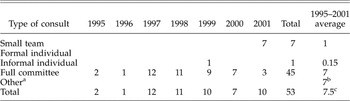
Prior to transforming its model of ethics consultation in 2001, the consult service averaged seven consults per year from 1995 to 2001 (first half).Footnote 8 The consult service during these years employed a full-committee model, convening the entire ethics committee to meet with the care team, patients, families, or surrogates. At this time, the full committee comprised 18 members with varying backgrounds including physicians from pediatric and obstetric medicine, geriatric medicine, neonatal medicine, psychiatry, critical care surgery/medicine, general medicine, pathology, physical medicine and rehabilitation, and nephrology and representatives from nursing administration, community, pastoral care, risk management, social work, and adolescent medicine.
As its proponents rightly emphasize, the full-committee model for ethics consultation has some important strengths over individual and team models.Footnote 9 It offers a much broader range of moral perspectives on the value-laden issues that come to consultation while also potentially drawing on the knowledge and skills of a wide variety of professional and disciplinary backgrounds. The latter helps to ensure that a full complement of potentially relevant knowledge and skill is available to the case,Footnote 10 whereas the former insulates against viewing one individual or a small team as substantive moral experts whose values should drive decisionmaking.Footnote 11 Similarly, it has also been said to be more democratic, especially when committee members vote on their recommendations.
Although we do not doubt that a full-committee model for ethics consultation can be effectively employed, our experience with it at Metro underscored some significant drawbacks that ultimately led us to move away from it. First, coordination among the full committee made timely response to a request for ethics consultation difficult, and this probably led to decreased utilization of the service. More importantly, the full-committee approach was sometimes intimidating for patients, families, and surrogates as well as for members of the care team. When patient, family, or surrogate involvement was required, for example, the full committee would convene along with members of the care team to discuss the case, and then the patient, family, or surrogate would be brought into the meeting room for discussion with the group. This rather formal and overtly juridical structure created an environment that risked already strained communication becoming adversarial. More than once patients, families, or surrogates referred to the ethics committee as the “tribunal,” wheras physicians would sometimes complain of “having an ethics committee called on me,”—hearkening back to the days when ethics consultation was seen as an outside intrusion (“ethics police”).Footnote 12 In our view, the full-committee model, however skillfully employed, is inherently susceptible to these perceptions because of its structure.
During the first half of 2001, the ethics committee, working with the Director of the newly established Clinical Ethics Program (which later became the Center for Biomedical Ethics, a joint effort of MetroHealth Medical Center and Case Western Reserve University), expanded its membership from 18 to 25 and revitalized its core functions, including ethics consultation. New members were added to the committee in order to ensure genuine system-wide representation and additional areas of expertise such as clinical ethics. Members added include representatives from emergency medicine, staff nursing, residency programs, palliative care, child life, and the Clinical Ethics Program. The committee itself decided to emphasize education as its primary function while simultaneously reorganizing its consult service. With the Clinical Ethics Program, the ethics committee embarked on a program of self-education, regular ethics education for major clinical areas, and an annual thematic educational effort (the latter has included end-of-life decisionmaking, dealing with the chronically nonadherent patient, medical futility, ethics and professionalism, and decisionmaking capacity). Changes to the consult service allowed for any of three models for consultation: consult by individual, small team, or full committee. Though the appropriate model would be determined by the team leaders on a case by case basis, it was agreed that the dominant model would be consultation by a small team comprised of ethics committee members.Footnote 13 These changes afforded the consult service a great deal of flexibility in meeting consultation requests.Footnote 14 For example, on the one hand, a request for a clarification of the institution's two types of DNR orders and their applicability to a specific clinical case (a not uncommon request) might be handled quickly and efficiently by an individual small team leader. On the other hand, input on the system's policy regarding nonemergent care for uninsured indigent out-of-county patients and appropriate response to a specific clinical case raising this issue might best be handled by the full ethics committeeFootnote 15 (an actual consult request that we discuss in more detail below) without the risk of creating an intimidating setting for patients or families or making health professionals feel that they are being policed.
For the first few years after the small-team model was adopted as the dominant mode for consultation, the core team consisted of an ethicist (co-chair, ethics committee), a physician (co-chair, ethics committee), and a nurse administrator (secretary, ethics committee). More recently, the team has consisted of an ethicist, a nurse administrator, and a social work manager and/or risk management/compliance officer. An important feature of the small-team model as it has been employed here is that other ethics committee members are invited to participate on an ad hoc basis depending on the needs of the case. This latter feature is significant because it allows for an added layer of flexibility in ensuring that an appropriate range of expertise is brought to bear in any given case. Ad hoc representatives of the ethics committee in consultation have included a wide range of professional backgrounds including pastoral care, legal, emergency medicine, child life, adolescent medicine, and long-term care. The small-team approach currently employed might aptly be termed an adaptive small-team model.
Changes to the Consult Process
Good process is essential for any effective ethics consult service. Indeed, the 1998 ASBH Report Core Competencies for Health Care Ethics Consultation highlights four key process questions that must be addressed: Who should have access to ethics consultation services? Should patients be notified if a consult is called? Should ethics consultations be documented? Must a consultation service have a mechanism for case review?Footnote 16 It is not possible, of course, to do justice to these and other process questions in the scope of this article, but we do want to give a brief overview of how we address access, notification, documentation, and case review while highlighting one important process change that seems to have helped to revitalize our service.
By policy, any patient, family member, surrogate, or member of the MetroHealth System staff may request an ethics consultation. The consult service is available for consultation on a 24-hour basis. During regular hours, calls go through the ethics committee secretary, who then gathers information, attempts to identify whether the request is appropriate for ethics consultation, and refers the request to at least one of the ethics committee consult team members.Footnote 17 After hours, the MetroHealth operator employs a call tree to contact a member of the ethics committee. In the event of an after-hours call, the first responder will play the role of the ethics committee secretary in gathering basic information about the request and then making a judgment as to appropriate next steps. The consult service does not presently utilize ethics pagers to facilitate consultation requests, and it is extremely rare that consults are requested outside of regular business hours.
To improve access to ethics consultation for patients, families, and surrogates, the ethics committee developed and disseminated an informational brochure that discusses the purpose of the ethics committee and the ethics consultation service. Patients receive a copy of the brochure upon admission, and brochures are available in outpatient settings throughout the system. Interestingly, in the 12 months following the dissemination of the brochures, ethics consultations were requested six times by in-patients or family members and twice by outpatients.
When patient or surrogate involvement in ethics consultation is required, they, along with the attending physician, are notified that an ethics consultation has been requested. There are, of course, consultation requests that do not demand patient involvement, such as a request for a policy clarification, and in these cases there is no requirement of notification.
Ethics consultations are normally documented in two places, the patient's chart and the ethics consultation record, which is maintained by the ethics committee in conjunction with the clinical ethics program. Ethics consultations that involve only policy clarification and similar matters are documented in the consultation record. Ethics consultations are discussed at the monthly meetings of the ethics committee. At present, this is the only forum for case review.
Concurrent with the reorganization of the ethics consultation service in favor of the adaptive small-team model (while also allowing for individual or full committee consultation at the discretion of team leaders), another process change was implemented that bears highlighting. When the adaptive small-team model is utilized, the first step after information gathering, preliminary identification of core ethical issues and selection of key ethics committee personnel for involvement in the case, is to arrange a meeting between the ethics consultation team and members of the care team. Such team meetings are routinely held prior to any meetings with patients, families, or surrogates. This step in the consult process affords both ethics consultation and care team members the opportunity to ensure that there is (1) good communication among team members and (2) agreement about the facts of the case (or identification of areas of confusion or disagreement). It also allows the group to attempt to identify salient ethical issues and consider the range of possible options and practical strategies for implementing those options in addressing the issues raised by the case.
There are two common, but noteworthy, unintended consequences that have resulted from the new ethics consult–care team leg of the consult process. First, the description of the case and identification of salient ethical issues that emerges in the team meeting is often markedly different from that offered by any specific individual prior to the team meeting. Second, such meetings often result in either (1) the dissolution of apparent ethical conflict or uncertainty as lines of communication are opened or (2) clarity on the part of care team members regarding the next steps they must take in order to address the ethical issues under discussion. Although we discuss ethics consultation and ethics integration in more detail below, the ethics consult–care team meeting in this way affirms the fact that the members of the care team are primarily responsible for dealing with the ethical issues they must confront on a daily basis—a crucial dimension of genuine integration of ethics into clinical practice.
Numbers and Types of Ethics Consults
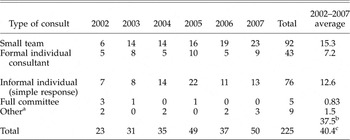
Since the changes to the ethics consultation service discussed above were implemented, the number and types of consults gradually increased from 7 in 1995–2001 (Table 1) to 23 in 2002 (the first full year during which the adaptive small-team model was employed; Table 2) to an average of 40 consults in subsequent years (Table 2). In the tables, we have distinguished “formal” from “informal” individual consults. As stated above, consults that utilize the single or individual consultant are done by one of the identified small-team leaders. Consults listed as “formal” are carried out by a single consultant but follow closely the process that is utilized for the small-team approach. This consult model is used in cases in which the circumstances preclude formation of a small team (e.g., time pressure) or, as only rarely happens, there is a direct request that an individual consultant model be employed. Alternately, the process utilized during “informal” individual consults is abbreviated because the question or concern can be addressed with a simplified process and response. The distinction between “formal” and “informal” is not intended to connote a difference in importance or relevance of an ethical question or concern, but rather merely a difference in the consult process.Footnote 18
Ethics Consults 1995–2001

a Consults originating from or focused on issues outside of the institution.
b 1995–2000, plus first six months of 2001.
c 1995–2001, plus last six months of 2001.
Ethics Consults 2002–2007
a Consults originating from or focused on issues outside of the institution.
b 2002–2007.
c 2003–2007.
As in many other hospitals, the highest percentage of consults at Metro come from our adult Intensive Care Units (ICUs), accounting for around one third of consult requests for the combined years 2002–2007.Footnote 19 Nearly all of these cases involved surrogate decisionmaking at the end of life, and a significant number dealt with withholding/withdrawing life-sustaining treatment. Due to Metro's status as a level 1 trauma center, we see a significant number of cases involving trauma victims, often relatively young adults, who are faced with decisions regarding aggressive care and rehabilitation on the one hand and withdrawal of life-sustaining treatment on the other. The Neonatal and Pediatric Intensive Care units accounted for around one fifth of consult requests over the same time period (2002–2007). Despite these areas of more heavy usage, the remainder of consults have come from a wide variety of clinical areas and departments, including, but not limited to, general medicine, general pediatrics, family medicine, labor and delivery, adolescent medicine, oncology, endocrinology, psychiatry, long-term care, and home health.
Ethics Consultation and Ethics Integration
As all who work in healthcare know, mission statements are often filled with vague generalities and are far removed from practice. When it comes to the special challenges faced by the ethics consult service at Metro, however, the mission really does matter. Though we do not provide a particularly large number of ethics consultations at Metro, the cases that do come to consultation tend to be extremely challenging, often raising multiple ethical issues that have no straightforward solution. Because of Metro's role as a safety-net hospital, many of the cases also involve indigent patients who are uninsured, thus pressing to the fore resource allocation questions that might otherwise remain in the background. This is evident in the cases we discuss below. More importantly, however, these cases illustrate how ethics consultation itself can play a role in engendering ethics integration in the life of the medical center provided that there is adequate education about its role and that consultation itself leads to and informs other ethics initiatives such as education and policy formation or review.
The Role of Ethics Consultation: “Don't Call ‘Ethics’ on Me”
As our consult service was transitioning from full committee to adaptive small-team model, “ethics” was invited to participate in a particularly difficult Neonatal Intensive Care Unit (NICU) case that functioned as a key learning experience for the committee and the consult team by underscoring the importance of education about the role of ethics consultation and of consultation itself informing other ethics initiatives. The case involved a full-term baby, Baby T, born with gastroschisis (bowels herniated outside the abdominal cavity) complicated by necrotizing enterocolitis that left only a small segment of healthy bowel. Though Baby T was otherwise healthy, she required total parenteral nutrition (TPN) due to her short bowel, and her only real chance for long-term survival was bowel transplant. Unfortunately for Baby T, no bowel came available and, after some months, Baby T developed liver failure secondary to her extended dependence on TPN, leaving her in need of both liver and bowel transplant. After consultation with her parents, Baby T was listed for double organ transplant. Baby T's condition waxed and waned, with no change in her long-term prognosis. At one point, a potential donor did come available, but this occurred at a time when Baby T was deemed to be too sick to survive transplant. After 15 months in the NICU and 9 months on the transplant list, a NICU nurse manager approached the NICU attending of the month about the need to have a multidisciplinary management discussion of Baby T's case. Several nurses were angry that Baby T was being “strung along” and doubted that Baby T's parents understood what transplant might mean for Baby T (40% chance of 3–5-year survival, with risk for multiple complications and extended hospitalization likely during that time). They were also concerned that, in their view, no alternative to transplant had ever been presented, including the alternative of providing only comfort care. Several members of the nursing staff complained that the care of Baby T was unethical and wanted to “call ethics” on the doctors. A nurse manager, at the urging of several nurses, convinced the NICU attending to invite a co-chair of the ethics committee to participate in a multidisciplinary case discussion concerning the plight of Baby T. Initially, the attending adamantly refused, defending his own “ethics” and stating that “outsiders” should not be involved, fearing that they would take control of the case. It was only after multiple requests by the nurse manager that the attending relented and agreed to have one representative of the ethics committee (a co-chair) present for the meeting on the condition that the representative's involvement be considered “participation in a management meeting” and not an “ethics consultation.”
The multidisciplinary management meeting for Baby T lasted nearly 2 hours, with the first half of the meeting devoted to discussion of Baby T's medical condition and a possible nontransplant experimental option for Baby T. When the meeting was opened for discussion, a heated exchange ensued regarding nursing concerns that Baby T's parents did not understand what transplant would mean for Baby T (likelihood of success, meaning of “success,” etc.) and that comfort care had never been presented as an option. In the course of the meeting, it became clear that there were deep underlying tensions between the nurses and physicians present and that these tensions reflected not just the case of Baby T but a more global dynamic of “us” versus “them” that had developed in the NICU. The ethics committee co-chair, as an “outsider” (also, a nonclinician), facilitated discussion between the two groups, eventually focusing the conversation on (1) the appropriate ethical standard for decisionmaking—“best interest” of Baby T, (2) the range of medically acceptable options in light of that standard—ranging from continued listing for transplant with “aggressive” care to comfort measures only, (3) the recommendation of the care team, and (4) who should be allowed to decide which option best meets that standard—ideally, Baby T's mother in shared decisionmaking with the care team.Footnote 20 In the discussion, broad agreement emerged on each of these points. Soon thereafter, Baby T's mother was again approached by the attending physician, a staff nurse, and social worker to discuss Baby T's options and she, with the support of the care team, opted for comfort care for Baby T.
The details of the resolution of the case of Baby T are less important for our purposes here than what it taught us about ethics consultation in our institution. First, in reflecting back on the case, it was clear that there was a great need for education about the role of ethics consultation. The attending initially took the involvement of ethics to be an indictment of his “ethics,” an intrusion from “outsiders,” and, ultimately, a threat to his role in decisionmaking. Nursing held largely the same view, and for this reason pushed for ethics involvement. The implicit view operative here was that of ethics consultation as a form of oversight or “moral policing,” that is, an ethics consultation should be called if someone is alleged to have done something unethical or morally improper. The attending physician's concern that “ethics” involvement not be considered an “ethics consultation” clearly underscored his mistaken view of the role of ethics consultation. As mentioned above, the idea that ethics consultation is a form of ethics oversight or “moral policing” was addressed as an early concern in the ethics consultation literature and has long been dismissed.Footnote 21 Despite this, our experience in the case of Baby T (and others) suggests that strong vestiges of this view remain, and there is evidence in the literature that our experience is far from unique.Footnote 22
Following the case of Baby T, we made a systematic effort to educate major clinical departments about the role of ethics consultation and its potential usefulness in addressing ethical conflict or uncertainty in particular cases. We also targeted specific service lines (nursing, nursing administration, and social work) through in-services designed to increase understanding of the role of ethics consultation while simultaneously raising its profile. Modeling a proper role for ethics consultation through the consult process itself, combined with this broad educational effort, coincided with a increased utilization of the ethics consult service shown in Table 1.
Thus, if ethics consultation is to be well utilized and promote genuine ethics integration, this view must be replaced by an understanding of the legitimate role of ethics consultation in contemporary healthcare. This role focuses on facilitating the resolution of ethical conflict or uncertainty, promoting shared decisionmaking, and affirming the authority of primary decisionmakers, rather than on the feared or mistakenly perceived role of taking over control of the case or supplanting primary decisionmakers.Footnote 23 Because of the mistaken “moral policing” view of the role of ethics initially held by some of those involved in the case, “ethics” involvement was nearly excluded.Footnote 24
Ethics Consultation: Informing Ethics Education and Policy
If ethics consultation is to promote genuine ethics integration, it must, in addition to facilitating the resolution of ethical conflict or uncertainty in the case at hand, inform subsequent educational or policy initiatives, and not just those focused on ethics consultation itself. The underlying “us versus them” dynamic, which became clear in discussion of Baby T's tragic situation, led to the establishment of monthly multidisciplinary rounds led by ethics and pastoral care for nursing, medicine, and others to discuss the ethical dimensions of particular cases or other ethical issues underlying NICU practice. It also led to a 6-week educational series (repeated twice since), sponsored by the ethics committee, on ethical issues in neonatal intensive care medicine. Other ethics consultation cases have had a similar impact on educational and even policy efforts, as the cases of Mr. H and Mrs. V illustrate.
Mr. H and Chronic Nonadherence
Mr. H is a 49 year old white male with lower limb paralysis due to a severe spinal fungal infection. He has a Peripherally Inserted Central Catheter (PICC) line for administration of the antibiotic amphotericin. Twice after visits from a friend, Mr. H was found slumped over in his bed. Mr. H was questioned and examined each time, but claimed to simply have been weak due to his progressive infection. A week later, Mr. H wheeled himself down the hall and told the administrative assistant that he was going to the gift shop. Eight hours later Mr. H was found passed out on a street corner near the hospital and was brought into the ED. Mr. H had overdosed on heroin which, he admitted, he had been administering through his PICC line. Mr. H said that he needed the heroin because he was in so much pain. Dr. X is angry with Mr. H and wants to remove his PICC line. Mr. H's only chance to overcome his life-threatening infection is to stay on amphotericin. An ethics consultation was requested.
Mr. H's case emerged during a series of consults involving patient nonadherence and possible drug-seeking behavior. The attending physician called the ethics committee secretary to discuss the case and request an ethics consultation. Ethics consult team leaders were then informed of the request and an ethics consult team–care team meeting was scheduled. Representatives from the care team included nursing, social work, and medicine, and the ethics consultation team consisted of the committee co-chairs, secretary, and a social work manager. In the course of the meeting, the attending physician expressed her exasperation at Mr. H's behavior and her unwillingness to be a party to his drug use. She said that if he were to continue misusing the PICC line, he would eventually develop a heart infection and die. On the other hand, administration of amphotericin through the PICC line was Mr. H's only realistic chance of overcoming his infection, which would itself be lethal if left untreated. In the course of the meeting, nursing revealed a previously unknown “fact” about Mr. H, that he claimed to have been a heroin user for around 25 years but had been free of heroin for a year prior to his hospitalization. He said, according to nursing, that he started doing heroin again while in the hospital because his pain was unbearable. His claim was met by considerable skepticism. However, the attending did acknowledge that, given Mr. H's drug history (which she previously had not known), his pain was probably not adequately managed.
As with the case of Baby T above, the case of Mr. H merits extended discussion that is well beyond the scope of this paper. For our purposes here, however, the case of Mr. H is less important for how it was resolved than for that to which it gave rise. Mr. H's case, and others like it, led to the establishment of a subcommittee of the ethics committee to develop guidelines for dealing with chronically nonadherent patients. Footnote 25 Those guidelines then formed the basis of a hospital-wide educational initiative (extending to major clinical departments and service lines) that was carried out the following year and that has been regularly revisited since. These guidelines have been used in numerous ethics consultations since they were developed. They recently stimulated targeted efforts to increase patient adherence in patients with a diagnosis of substance abuse or addiction.
Mrs. V and County Residence
Mrs. V is a 47 year-old female who comes to the ED for a “personal” problem. Upon examination she is discovered to have a vaginal fistula, and is referred (outpatient) to a surgeon for care. Upon seeing Mrs. V, the surgeon determines that Mrs. V does indeed need surgery, but not emergently. Mrs. V is an uninsured resident of a neighboring county. An ethics consultation was called.
The case of Mrs. V was referred for ethics consultation by central administration for input on the hospital's obligation to provide nonemergent care to out-of-county patients. Central administration (including the CEO) made it clear that it would honor the recommendation of the ethics committee but on the condition that the ethics committee address not only the case of Mrs. V but also develop policy guidelines for the ethical handling of such cases.
As mentioned above, Metro's mission is to care first and foremost for the residents of Cuyahoga County. One of the economic challenges faced by Metro, however, is how to handle out-of-county patients who seek nonemergent care. If Mrs. V had been a resident of Cuyahoga County, she would have been “rated” by the business office to determine her ability to pay for care. Metro utilizes a 6-point rating system, ranging from 1 (full pay) to 6 (free care). The rating system also allows the system to match particular patients with various charity care or other services for which they may be eligible. The dilemma with Mrs. V was her status as an indigent out-of-county resident seeking nonemergent care. The cost of that care (surgery) was estimated to be over $20,000—a resource that, if used, would simply not be available for county residents’ care needs.
In response to the request for consultation in the case of Mrs. V, the ethics committee did give specific input while also developing guidelines for care of out-of-county patients. These guidelines were subsequently incorporated into the relevant institutional policy. Again, for our purposes here, the critical point is that an issue that emerged in consultation later informed policy concerning that issue. If ethics consultation is to achieve genuine ethics integration, it must not be an end unto itself. Rather, it must inform other ethics efforts such as education and, as this case illustrates, policy formation.
Conclusion
As we conclude, we want to acknowledge the limitations of our efforts here. We have no illusions that any firm conclusions should be drawn on the basis of one ethics consultation service's struggle to thrive and its subsequent revitalization. Our aim rather has been to characterize the evolution of our consult service and lessons learned along the way, linking them to broader discussions of ethics consultation in the literature, toward the end of being helpful to others who, no doubt, face many of the same challenges we face. In moving from a full-committee model to what we term an adaptive small-team model (with the option of individual or full-committee consults as deemed appropriate), we saw the utilization of our ethics consultation service increase fourfold over a 3-year period, a usage rate maintained since. A key step in our adaptive small-team approach is the convening of an ethics consult–care team meeting. These meetings often result in either (1) the dissolution of apparent ethical conflict or uncertainty as lines of communication are opened or (2) clarity on the part of care team members regarding the next steps they must take in order to address the ethical issues under discussion. This latter feature is especially important for ethics integration, as it affirms the fact that it is the members of the care team who are primarily responsible for dealing with the ethical issues they face on a daily basis—a crucial dimension of genuine integration of ethics into clinical practice.
The change in model alone did not precipitate this increased utilization—far from it. The change in model was accompanied by educational outreach concerning the role of the ethics consultation service to dispel misunderstandings or confusion that might prevent clinicians from utilizing it. In addition, issues that arise in consultation, such as dealing with chronically noncompliant patients or delivering nonemergent care to indigent out-of-county patients, have informed ethics education and policy initiatives—also a critical link for genuine ethics integration in the medical center. Ultimately, it is our hope that this recounting of our own struggles and the lessons learned along the way as we worked to revitalize our consult service in some small way furthers the important dialogue in this area while also being helpful to other consult services as they strive to engender the integration of ethics into clinical practice in their institutions.