


One of the great, tragic consequences of civil war is the countless civilians who are forced to flee their homes in search of safety. The UNHCR estimates that an astounding 70.8 million people are displaced worldwide (UNHCR 2020). The repercussions of displacement for families and societies at war are far-reaching, including lasting psychological trauma (Thapa and Hauff Reference Thapa and Hauff2005) and staggering welfare losses for families (Ibáñez and Vélez Reference Ibáñez and Vélez2008). The resulting refugee flows also represent substantial political challenges for neighboring countries and international organizations, who can be destabilized in the event of a sudden humanitarian crisis (Salehyan and Gleditsch Reference Salehyan and Gleditsch2007). While many families flee to avoid being caught in the cross fire (Davenport, Moore, and Poe Reference Davenport, Moore and Poe2003), we also know that belligerents deliberately displace civilians as a tactic of war. What drives combatants to displace civilians, and under what conditions are they likely to do so?
A large body of research on the dynamics of civil war violence has produced accounts that center territorial conquest and the problem of identifying civilian loyalties as primary motivations. Belligerents force civilians to flee when converting them into collaborators is unlikely either because strong loyalties to the opposition make governance prohibitively difficult (Balcells and Steele Reference Balcells and Steele2016; Steele Reference Steele2011) or because steep informational asymmetries render the selective punishment of an opponent’s supporters impossible (Zhukov Reference Zhukov2015). These accounts are, almost uniformly, about how civilians map onto the war’s “master cleavage” (Kalyvas Reference Kalyvas2006), where the central mechanism is the distribution of civilian support to the warring sides in the conflict. People are forcibly displaced because belligerents want to wrest control of territory from their enemies and suspect that the locals are aiding them.
While territorial competition is useful for understanding wartime displacement and violence more generally, we also know that wartime violence is often distinctly more local in nature. Numerous accounts show local actors—sometimes powerful elites, sometimes ordinary citizens—taking advantage of war to maneuver against enemies, pursue private interests, accumulate resources, and achieve other goals that have little to do with the war’s master cleavage (Gutiérrez-Sanín and Vargas Reference Gutiérrez-Sanín and Vargas Reina2017; Kalyvas Reference Kalyvas2003; Wood Reference Wood2009). And yet, systematic evidence of how such opportunism shapes the violence we observe in war is relatively scarce. We also know much less about the conditions under which opportunism can generate displacement and violence.
Here, I intend to show that wartime displacement can also be distinctly opportunistic in nature, the result of local actors taking advantage of war to engage in private accumulation rather than a consequence of wartime territorial competition. To do so, I draw on literatures on opportunistic violence (Manekin Reference Manekin2013; Steele Reference Steele2017; Wood Reference Wood2009), political economy models of conflict (Dal Bó and Dal Bó Reference Dal Bó and Bó2011; Dube and Vargas Reference Dube and Vargas2013; Palacios Reference Palacios2012), and collusion between elites and armed actors during war (Gutiérrez-Sanín Reference Gutiérrez-Sanín2019; Vargas Reina Reference Vargas Reina2021). I corroborate an account of opportunistic displacement in which—against a backdrop of weak property rights and elite capture of the state (del Pilar Peña-Huertas et al. Reference del Pilar Peña-Huertas, Ruiz, Parada, Zuleta and Álvarez2017)—growing demand for land generates incentives for local elites to collude with armed actors in forcibly displacing peasants and capturing their land. Drawing on the literature, I further argue that the ability of elites and combatants to collude should depend in part on the nature and composition of the armed group in question. Specifically, factors that shape group composition—such as ideological commitments, a group’s base of support, and their general pattern of violence—should make collusion more or less likely (Gutiérrez-Sanín and Wood Reference Gutiérrez-Sanín and Wood2017; Weinstein Reference Weinstein2007).
I test the observable implications of this argument in the context of Colombia—a country that has been plagued by decades of rural conflict—between 1993 and 2005. Colombia represents an ideal context in which to test these dynamics, given both the extent of displacement during the conflict and the availability of fine-grained data on the conflict. I leverage the fact that beginning in the 1990s, the country saw the early expansion of African palm oil, a highly land-intensive crop, in parts of the countryside. As palm oil was transformed from an insignificant portion of the Colombian economy to one of its major exports, the growth of the industry generated intense pressure to accumulate land in these areas. In this paper, I delineate how the early period of expansion of this industry went hand in hand with predation of civilians through forced displacement.
I take a two-pronged empirical strategy, collecting panel data on the earliest presence and production of these crops across Colombian municipalities with an original survey of rural, conflict-afflicted households with a high incidence of displacement. The analysis of municipal data follows a difference-in-differences strategy, where I exploit the timing of palm-oil adoption at the municipal level to assess whether palm-growing municipalities experience disproportionate increases in displacement subsequent to adoption. The household survey provides access to household-level displacement experiences, including first-hand accounts of who the individual blames for the displacement and why they were displaced. Combined, the data allow me to test the implications of the argument at the level of both the municipality and the household, jointly strengthening the claim that palm-oil-induced displacement is deliberate and opportunistic.
I find that the timing of palm-oil adoption at the municipal level is associated with a substantial increase in the rate of displacement to the order of 23 more cases of displacement per thousand residents. The results are robust to a variety of additional tests. In line with the mechanism that collusion with armed groups facilitates opportunistic displacement, I also find that the effect of palm oil depends on the presence of paramilitary groups in the municipality, a group with known ties to rural elites (Ch et al. Reference Ch, Shapiro, Steele and Vargas2018; Gutiérrez-Sanín Reference Gutiérrez-Sanín2019). By contrast, the same pattern does not hold with left-wing guerrillas, who are unlikely to form similar ties. Finally, I turn to the long-term and ask whether these dynamics are correlated to contemporary land problems in postagreement Colombia. Using data from Arteaga et al. (Reference Arteaga, Osorio, Cuéllar, Ibáñez, Botero, Murcia, Neva and Rey2017) on the near-universe of restitution claims across the country, I find a robust correlation between the presence of palm-oil plantations and current restitution need to the tune of 12,000 more hectares of land under contention in palm-oil municipalities than comparable places (Arteaga et al. Reference Arteaga, Osorio, Cuéllar, Ibáñez, Botero, Murcia, Neva and Rey2017).
Results from the household survey produce complementary evidence to the municipal-level data while also providing insights on the nature of displacement. I find households that originally lived in palm-oil producing municipalities were more likely to be directly displaced by a group or entity than their counterparts and more likely to indicate they were displaced for their land by armed actors or elites. Moreover, those displaced from palm-oil regions tended to own or work on larger farms than those displaced from elsewhere, lending credence to the claim that displacement in palm-oil areas was motivated by land accumulation. Results from an endorsement experiment designed to elicit support for left-wing guerrillas find no consistent differences in support across palm-oil and non-palm-oil municipalities, providing some evidence against the claim that armed groups in palm-oil areas were simply displacing civilians they thought were affiliated with their left-wing guerrilla opponents. In all, the survey results suggest displacement dynamics were fundamentally different across palm- and non-palm-producing municipalities and corroborate an account of displacement as opportunistic and unrelated to identification problems.
The study has varied implications for research agendas in the study of violence. First, the results complicate the dominant narrative in political science as to why civilians are deliberately displaced. While scholars employing qualitative, ethnographic, and theoretical approaches have spent years analyzing wartime opportunism (Ballvé Reference Ballvé2012; Kalyvas Reference Kalyvas2003; Palacios Reference Palacios2012; Wood Reference Wood2009), quantitative approaches to these dynamics have been relatively scarce in the discipline (Manekin Reference Manekin2013). In particular, the results highlight the importance of exploring various ways that elites can become involved in armed conflicts (Acemoglu, Robinson, and Santos Reference Acemoglu, Robinson and Santos2013), and the influence this involvement has on the trajectory of war (Gutiérrez-Sanín and Vargas Reference Gutiérrez-Sanín and Vargas Reina2017; Stearns Reference Stearns2014). That elites seem more likely to collude with some combatants than others also indicates the value of generating new hypotheses bearing on a group’s pattern of violence (Gutiérrez-Sanín and Wood Reference Gutiérrez-Sanín and Wood2017). Second, the patterns that emerge in the paper bear striking resemblance to accounts of land-grabbing in nonconflict settings, where elite capture of the state has historically facilitated private accumulation through dispossession of peasant land (Hall Reference Hall2013; Wolford et al. Reference Wolford, Borras, Hall, Scoones and White2013). The similarity calls into question our ability to make sharp distinctions between times of peace and war in much of the developing world. It also underscores the folly of overlooking the “agrarian roots of violent conflicts” (Vargas Reina Reference Vargas Reina2021, 4), in which land disputes generate a variety of linkages between elites, peasants, armed actors, and the state (Albertus Reference Albertus2020; LeGrand Reference LeGrand1986).
Third, the results address the difficulty of postconflict transitions and in particular the challenge of making reparations to victims for wartime losses. Wartime reparations are rife with legal obstacles for victims and advocacy organizations, in part due to the difficulty of proving prior ownership and fear of violence upon return (McCallin Reference McCallin2012). The evidence presented here suggests opportunistic displacement can heighten these postconflict obstacles, reflected in the substantially higher demand for contemporary restitution in palm-oil areas. Cases where powerful actors have taken advantage of wartime to accumulate property and used the state to formalize possession (del Pilar Peña-Huertas et al. Reference del Pilar Peña-Huertas, Ruiz, Parada, Zuleta and Álvarez2017; Vargas Reina Reference Vargas Reina2021) could well prove especially difficult for victims to win given substantial disparities in access to legal and economic resources. Finally, the breadth and scope of evidence presented here also builds on and helps corroborate a large body of work by scholars of the Colombian conflict, investigative journalists, and activists who have documented the nexus between displacement and the palm-oil industry in the country (Grajales Reference Grajales2011; Gutiérrez-Sanín Reference Gutiérrez-Sanín2019; Hurtado, Pereira-Villa, and Villa Reference Hurtado, Pereira-Villa and Villa2017; Palacios Reference Palacios2012; Reyes Posada Reference Reyes Posada2009; Vargas and Uribe Reference Vargas and Uribe2017).
Why Armed Groups Displace Civilians
The causes and consequences of wartime displacement have received substantial consideration in the last two decades. Early scholarship adopted theory from the study of migration, thinking about the decision to flee as a function of push and pull factors such as economic costs, perceived risk, and social connections (Kunz Reference Kunz1973). A well-documented link between levels of violence in civil war and the rate of displacement suggests how, for most people, risk outweighs other potential considerations (Adhikari Reference Adhikari2013; Davenport, Moore, and Poe Reference Davenport, Moore and Poe2003). Scholars have taken a similar approach to considering how civilians choose whether or not to return to their place of origin, pointing to factors such as the strength of property rights and social networks as primary predictors of return (Arias et al. Reference Arias, Camacho, Ibáñez, Mejía and Rodríguez2014; Steele Reference Steele2009). Other work has debated whether refugee flows can spread instability to host states (Salehyan and Gleditsch Reference Salehyan and Gleditsch2007). These studies largely treat displacement as a “by-product” of civil war, in which people become refugees to avoid being caught in the cross fire of competing groups.
Yet we also know that both armed groups and states deliberately displace civilians, at the level of the individual as well as at the level of the community (Lichtenheld Reference Lichtenheld2020). In this vein, theories of strategic displacement emphasize that belligerents ultimately want to take and hold territory but face difficulty in identifying who civilians support. In contexts where locals have strong loyalties or emotional attachments to particular groups (Petersen Reference Petersen2001; Wood Reference Wood2003), armed groups may find it optimal to forcibly displace civilians even in locations where they are the most powerful actor, both to remove a potential “fifth column” and to cow those who remain into submission (Balcells and Steele Reference Balcells and Steele2016; Steele Reference Steele2011). For states acting as counterinsurgents, locations where they cannot identify and selectively punish insurgents or where rebels can effectively prevent civilians from cooperating with the state create incentives to forcibly displace or resettle populations (Zhukov Reference Zhukov2015).
While these accounts emphasize the objectives and behavior of combatants, it is also true that elites, civilians, and even belligerents themselves often take advantage of wartime to pursue private goals that are only tangential to the conflict (Roldán Reference Roldán2002). Black markets, for instance, infamously spring up around wartime rationing and shortages (Andreas Reference Andreas2011). There are also numerous examples of citizens (often falsely) denouncing neighbors to the state in order to take their property or settle old scores, both in Nazi Germany (Fitzpatrick and Gellately Reference Fitzpatrick and Gellately1997) and during the Rwandan Genocide (Des Forges Reference Des Forges1999). In Zimbabwe, Kriger also outlines how youth and women drew on guerrilla presence to assert greater independence from elders and men, respectively (Kriger Reference Kriger1988). Varied elites, such as cattle ranchers (Gutiérrez-Sanín and Vargas Reference Gutiérrez-Sanín and Vargas Reina2017) and mining companies (Berman et al. Reference Berman, Couttenier, Rohner and Thoenig2017), have also, at times, become deeply enmeshed in local conflicts. This is a primary thread in Kalyvas’s work: wartime violence is often an ambiguous blend of local, private motives and macro-level factors and this ambiguity in motive is “fundamental rather than incidental to civil wars, a matter of structure rather than noise” (Kalyvas Reference Kalyvas2003, 475).
Despite the varied ways in which noncombatants can take advantage of wartime, we have little systematic evidence on precisely how local actors deploy violence opportunistically during wartime, especially with respect to displacement. When, and how, might wartime displacement be driven by private motives? This article builds on the conflict literature by showing that wartime displacement can be driven not only by territorial conquest but also by local actors responding to economic incentives to accumulate land. In the process, the article also addresses a literature in the political economy of conflict that argues economic shocks can generate or exacerbate violence in civil-war settings (Azam and Hoeffler Reference Azam and Hoeffler2002; Bazzi and Blattman Reference Bazzi and Blattman2014; Dube and Vargas Reference Dube and Vargas2013). Yet while most of this work focuses on conflict onset or intensity, it ignores how such shocks can influence particular modalities of violence (Gutiérrez-Sanín and Wood Reference Gutiérrez-Sanín and Wood2017) or how local actors can also face incentives to engage in predation. I thus expand on this literature by considering how a particular set of economic conditions can generate incentives to displace civilians during wartime.
Opportunism and Wartime Displacement
Here, I draw on literatures in the study of opportunistic violence and the political economy of conflict to present an account in which growing demand for land creates incentives for elites and armed actors to collude in expropriating civilians of their land through displacement. Importantly, armed group composition should shape the viability of elite–combatant collusion, while weak property rights and elite capture of the state serve as important scope conditions for the argument.
The starting point for this account is a class of models in political economy that link economic shocks to conflict. In these models, economic shocks shape the opportunity cost that peasants face in deciding whether to work or fight (Grossman Reference Grossman1991). Positive economic shocks increase wages, which in turn raises the opportunity cost of fighting (Miguel, Satyanath, and Sergenti Reference Miguel, Satyanath and Sergenti2004). Conversely, negative shocks lower the opportunity cost of fighting, raising the probability of violence (Besley and Persson Reference Besley and Persson2011; Brückner and Ciccone Reference Brückner and Ciccone2010). A fundamental prediction of these models is that the effect of economic shocks on conflict will depend on the factor intensity of productive sectors and thus vary across industries. Positive shocks to labor-intensive industries (e.g., cane sugar, coffee) increase employment and wages and, in the process, reduce conflict. On the other hand, positive shocks to capital-intensive industries (e.g., petroleum, mining) can increase conflict by raising returns to predation, often called the “rapacity effect” (Dal Bó and Dal Bó Reference Dal Bó and Bó2011; Dube and Vargas Reference Dube and Vargas2013).
Empirically, I focus on rural areas in the developing world, settings where armed insurgencies often first take root (LeGrand Reference LeGrand1986). Agriculture is central to these economies and while agriculture is, on the whole, relatively labor intensive, there is substantial variation within agriculture in the land intensity of different industries. Industries that are highly land intensive (or inversely, low in labor intensity) require much larger tracts of land to offset high startup costs, long cultivation cycles, and other costs. For such industries to expand, firms must be able to acquire large quantities of land to begin or increase production. Unsurprisingly, growing demand for these industries often results in the rapid acquisition of land by firms and substantial increases in land use, as seen, for instance, with cattle-ranching in the Amazon (Walker, Moran, and Anselin Reference Walker, Moran and Anselin2000).
I expect that as with prior work showing a link between economic shocks to capital-intensive industries and predation, shocks to land-intensive agriculture should produce similar rapacity effects, with two important differences. First, while political economy models emphasize the peasant as the primary actor, whose choice between labor and combat determines the incidence of conflict, my account is more top-down in nature, where shocks in demand for land affect the decision making of economic elites and armed groups. While we know economic elites, firms, and other private actors continue to pursue their interests in wartime (Gutiérrez-Sanín and Vargas Reference Gutiérrez-Sanín and Vargas Reina2017), we infrequently theorize their involvement. Second, my expectation is not about the onset of war or broad incidence of conflict, as with much of this literature, but rather how shocks shape a specific form of violence (Bazzi and Blattman Reference Bazzi and Blattman2014). Shocks to land-intensive industries should increase the incidence of displacement, in particular, because forcing civilians to flee and then capturing the unoccupied land is a way of satisfying growing demand.
An important question is why elites and combatants would choose to displace civilians in response to demand shocks as opposed to other alternatives such as buying the land or hiring existing farmers to produce it themselves. This question is salient given that violence is costly and displacing civilians diminishes the labor pool available to produce the good in question. We also know that in some cases, combatants have co-opted or taxed existing production of valuable commodities without displacing the local population, such as with drug trafficking or mining (Sánchez De La Sierra Reference Sánchez De La Sierra2020). Understanding in what circumstances elites and combatants would choose to displace civilians rather than co-opt them is thus central to generating expectations about the effects of demand shocks to land.
Palacios (Reference Palacios2012) explores this question in a formal model, arguing that land intensity defines the trade-off economic actors face in the choice between displacing and co-opting existing production. The more land intensive an industry is (or, inversely, the less labor intensive it is) the smaller the cost of displacing and then replacing the existing labor force relative to the benefits accrued from expanding production. By contrast, for industries that are low in land intensity, the costs of replacing the existing workforce relative to the value of expanding production might be significant enough that economic actors and combatants are better off co-opting or hiring civilians to produce the commodity. This logic is borne out in anecdotal accounts that indicate displacement is relatively rare in illegal crops (e.g., coca), which must be grown in small plots to avoid detection (Palacios Reference Palacios2012). The argument also finds support in research showing that while combatants will fight to take over mines in response to shocks to the gold industry, they don’t tend to deliberately displace civilians in the process because illegal mining is also intense in labor (Idrobo, Mejía, and Tribin Reference Idrobo, Mejía and Tribin2014). The result is that the effect of economic shocks on displacement should depend on the factor intensities of the industry in question, with shocks to land-intensive industries being most likely to generate displacement.
In this account, economic actors, such as agricultural firms, are central in driving opportunistic displacement. Yet to forcibly displace civilians, which often takes place through public killings, massacres, or threats (Steele Reference Steele2009), economic actors often need to rely on hired muscle to credibly wield violence. In civil-war contexts, cooperation with armed groups can help elites overcome this obstacle, a dynamic that is well documented in the literature. In Colombia, for instance, elite-allied paramilitary groups have helped swing elections toward favorable candidates and suppressed opposition parties (Acemoglu, Robinson, and Santos Reference Acemoglu, Robinson and Santos2013; Fergusson et al. Reference Fergusson, Querubin, Ruiz and Vargas2019). In the Democratic Republic of Congo, researchers and journalists have similarly documented the cooperation of extractive industries with local militias to capture resources (Berman et al. Reference Berman, Couttenier, Rohner and Thoenig2017; Patel Reference Patel2016).
The likelihood that these elite–combatant relationships form is likely to depend, at least in part, on the nature of the armed group in question. Groups with ideological investments against elites or that are more reliant on peasants for support and recruitment may find these arrangements more costly either for material or ideological reasons (Gutiérrez-Sanín and Wood Reference Gutiérrez-Sanín and Wood2014; Weinstein Reference Weinstein2007). On the other hand, groups that depend less on locals or have other income sources may face lower costs to collaborating with elites. This conjecture follows a body of prior research showing that the latter type of armed group tends to abuse and prey on civilians at higher rates than the former (Weinstein Reference Weinstein2007) and that groups vary in the patterns of violence they deploy (Gutiérrez-Sanín and Wood Reference Gutiérrez-Sanín and Wood2017).
The extent to which the state plays a role in these processes can also vary. Weak property rights and tenure informality should generally facilitate dispossession—particularly in the long run, as victims without formal titles face barriers to reacquiring property (del Pilar Peña-Huertas et al. Reference del Pilar Peña-Huertas, Ruiz, Parada, Zuleta and Álvarez2017). And yet while tenure informality is often discussed in terms of “state absence” in the literature, the state is often not a passive victim in dispossession (Vargas Reina Reference Vargas Reina2021; Wolford et al. Reference Wolford, Borras, Hall, Scoones and White2013). Scholars have traced how the state’s legal and administrative institutions can also be actively weaponized by elites against peasants in a variety of ways (Mattingly Reference Mattingly2016; Vargas Reina Reference Vargas Reina2021). The extent to which elites are able to capture primary state institutions or form coalitions with state actors should also thus facilitate the process of opportunistic displacement, for instance, by allowing elites to formalize ownership of land captured from peasants (del Pilar Peña-Huertas et al. Reference del Pilar Peña-Huertas, Ruiz, Parada, Zuleta and Álvarez2017; Vargas Reina Reference Vargas Reina2021). Weak property rights and elite capture of the state should thus lower the cost of dispossession by making it less likely that victims are able to challenge elites in the future through legal channels.
Finally, the context of civil war itself is an important scope condition that also facilitates opportunistic displacement (Gutiérrez Sanín and Vargas Reina Reference Gutiérrez Sanín and Reina2016). Civil wars, and especially irregular wars where combatants do not distinguish themselves from civilians, are information-poor environments where uncertainty reigns as to which actors are responsible for what actions. In Colombia, for instance, a large proportion of wartime deaths are never attributed to a known perpetrator (Echandía and Salas Reference Echandía and Salas2008). This information problem is particularly steep for displacement, as Steele (Reference Steele2011) notes, “because displacement is frequently perceived to be a by-product of violence … armed groups, especially state armed forces, can deny responsibility more easily than when using lethal violence” (428). The result is that the “fog of war” might lower the potential costs of stealing land from peasants via forced displacement.
One caveat that is worth addressing is in what respect the process described here differs from the “ordinary” land-grabbing that takes place in much of the developing world, where elites take land from peasants through legal and extralegal means (Borras et al. Reference Borras, Hall, Scoones, White and Wolford2011; Wolford et al. Reference Wolford, Borras, Hall, Scoones and White2013). I would expect that, in lowering the costs of expropriation, the context of civil war is likely to substantially increase this kind of dispossession (del Pilar Peña-Huertas et al. Reference del Pilar Peña-Huertas, Ruiz, Parada, Zuleta and Álvarez2017). That said, in using data from a case study, this conjecture cannot be directly tested here. Instead, the main contention of this article is that the two processes follow a similar logic and that in fact what may look like displacement driven by territorial competition between armed groups is actually opportunistic land-grabbing.
In what follows, I test a variety of observable implications bearing on the previous argument. I do this both at the level of the municipality, where I look at trajectories of conflict-related displacement across municipalities, as well as at the household level, where I analyze patterns of displacement across families. At the municipal level, I expect that the growth of land-intensive industries should be associated with increasing displacement. This association should depend, at least in part, on the presence of armed groups that are likely to collude with economic actors. At the individual level, I expect that patterns of displacement should differ across individuals living in and outside of places with land-intensive industry such that the circumstances surrounding displacement in areas with land-intensive industry reflect a logic of opportunism.
Context: Palm Oil and Conflict in Rural Colombia
To explore how opportunism can motivate displacement, I take advantage of the early expansion of the African palm-oil industry in certain parts of Colombia during the armed conflict. The Colombian palm-oil industry is a valuable case to study. First, African palm is a remarkably land-intensive crop. Very high start-up costs in planting, production, and processing mean that huge tracts of palm must be planted to be profitable. In Indonesia (a top producer), a typical palm-oil plantation can fall in the range of 10,000 and 25,000 hectares (Maher Reference Maher2015; Mingorance, Minelli, and Le Du Reference Mingorance, Minelli and Le Du2004). Palm oil is particularly intensive in land relative to labor, requiring fractions of the person-days per hectare necessary to cultivate other crops such as bananas, rubber, or coca (Papenfus Reference Papenfus2000).
More importantly, the palm-oil industry in Colombia grew rapidly under the period of study. Small-scale production of palm oil dates back to the 1960s but was largely meant for local markets and only took place in a handful of municipalities. Beginning in the 1990s, however, palm oil cultivation began expanding dramatically, both in the amount being produced and number of municipalities participating in production. Today Colombia is the fourth largest source of palm oil in the world (Volckhausen Reference Volckhausen2018). The rise of the global industry over this period was driven in part by changing consumer preferences in commodity markets (Tullis Reference Tullis2019). The Colombian government’s use of tax subsidies and agricultural credits also spurred industry growth (Marin-Burgos Reference Marin-Burgos2014).
The civil war itself dates back to the 1960s, beginning as a low-intensity, left-wing insurgency against the state that quickly evolved in response to the growing drug trade and the emergence of new armed groups. Mass displacement has been one of the most significant consequences of the armed conflict, resulting in Colombia having one of the largest internally displaced populations in the world today (Ibáñez and Vélez Reference Ibáñez and Vélez2008). The period under study here (the 1990s and early 2000s), is a particularly violent one, with the main leftist group, the FARC, both growing in military power and facing territorial challenges from paramilitary groups. A primary quality of the conflict in light of the argument is that, broadly speaking, the left-wing guerrillas tended to recruit from the peasantry and raised revenue by extorting rural elites and small landholdersFootnote 1 through “war taxes” (Sánchez Reference Sánchez2006). By contrast, paramilitaries often held social and political ties to rural elites and were also often formed by small and medium landholders in response to predation from guerrilla organizations (Ávila and Romero Reference Ávila and Romero2011; Gutiérrez Sanín and Vargas Reina Reference Gutiérrez Sanín and Reina2016). These ties create overlapping interests between paramilitary groups and rural elites, which are important for understanding why (later in the results) the displacing effects of palm oil depend on paramilitary presence but not FARC presence.
Land inequality, land conflicts, and land insecurity are central to the Colombian armed conflict (LeGrand Reference LeGrand1986). Steep inequalities and problems originating from weak property rights have driven patterns of resettlement, land invasions, and conflicts throughout the country’s history (Kinosian Reference Kinosian2012), and there is evidence that displacement has exacerbated these problems (Ibáñez and Moya Reference Ibáñez and Moya2010). Scholars have also documented the methods by which elites, drug cartels, and armed actors (including the FARC) have taken land from civilians at different stages of the conflict (Reyes Posada Reference Reyes Posada2009).
With respect to the palm-oil industry, a number of ethnographic studies by Colombian scholars and investigative journalists have highlighted what the Center for Historical Memory (CMH) describes as a “curious relationship between displacement, land theft, and palm-oil plantations in at least 5 departments [of Colombia]” (Palacios Reference Palacios2012; Reyes Posada Reference Reyes Posada2009). One farmer in Santa Marta vividly described their displacement:
One day they (the paramilitaries) came to my place; they said—either you sell us your farm, or we’ll buy it from your widow. We took all our stuff and we left. They never paid for the land … my brother went back to our lands a few months ago, he told me the whole county is now planted with oil palm, hundreds of hectares. It is enclosed with fences and there is a “private property” notice. Quoted in Grajales (Reference Grajales2011)
An emblematic case of palm-oil-linked displacement comes from the Afro-Colombian communities of the Curvaradó and Jiguamiando river basins, where thousands of people were systematically displaced by paramilitary groups (in cooperation with military forces) through the use of assassinations and disappearances (Ballvé Reference Ballvé2013; Gutiérrez Sanín and Vargas Reina Reference Gutiérrez Sanín and Reina2016). Displaced land was later occupied and cultivated by palm-oil agricultural firms, some of which had direct ties to paramilitary leaders (Grajales Reference Grajales2011). In the aftermath, firms and individuals were able to leverage state connections to forge titles and other legal protections that would obstruct victims from making claims on their lost property (Gutiérrez Sanín and Vargas Reina Reference Gutiérrez Sanín and Reina2016). These events were subsequently investigated, resulting in the conviction of 30 businessmen and public servants involved in the process (Durán Nuñez Reference Durán Nuñez2015). What happened to these communities is by no means an isolated incident, nor is it solely linked to palm oil; scholars have documented similar dynamics with livestock farming in the village of La Pola or with lumber farming in the municipality of Plato (Gutiérrez Sanín and Vargas Reina Reference Gutiérrez Sanín and Reina2016).
This important work by scholars and journalists has produced closer inspection of the industry’s involvement in the conflict. However, there are few quantitative analyses of the influence of palm oil on displacement at the national level, and debate remains as to the direction of causality in these studies. In the following section, I first lay out data and results from the municipal-level analysis and then discuss data and results from the household-level analysis.
Empirical Strategy
Municipal Data and Analysis
Data on the main municipality-level outcome, forced displacement, comes from the Colombian Victim’s Unit, a state agency tasked with varied aspects of serving victims of the conflict. The Victim’s Unit tracks the number of people forcibly displaced at the municipality-year level, where forced displacement is defined as “people or groups who are forced to leave their home as a result of an armed conflict, generalized violence, or human rights violations.” Displacement estimates are based on state registers of internally displaced people.Footnote 2 To account for differences in baseline population across municipalities and over time, I divide displacement by municipal population and calculate the rate of displacement per thousand residents. I then use an inverse-sine transformation to account for the skewed nature of the distribution, though I note here that the main model is robust to instead taking the natural log or using raw displacement numbers and controlling for population in a count model.
To measure the effect of palm-oil industry expansion, I collect data from the National Federation of Palm-Oil Growers of Colombia (FEDEPALMA) on the presence of palm oil plantations at the municipal-year level. These data provide the year in which each municipality in Colombia built its first palm-oil plantation (if at all) and whether at least one plantation continues operating (FEDEPALMA 2019). This indicator variable takes the value of one in years in which a palm-oil plantation is active in a given municipality and zero otherwise. Because this variable does not provide information on the amount of planting taking place in a given year, I also collect data on the total amount of palm oil planted at the national level in each year of the sample (in hectares), from the same source. This variable allows me to measure the intensity of production taking place at different times in the country.
To estimate the effects of palm-oil expansion on displacement rates, I rely on varied strategies. The first is the model detailed in Equation 1, which follows the logic of a difference-in-difference in assessing whether the adoption of palm oil produces a disproportionate increase in displacements in places that ever produce palm oil compared with places that never produce it (Dube and Vargas Reference Dube and Vargas2013). Here, I regress the displacement rate in municipality i at time t against municipality fixed effects (αi), year fixed effects (ωi), and a treatment variable capturing whether municipality i at time t (
 $ {palmOil}_{it} $
) has started producing palm oil or not. The use of municipality fixed effects controls for time-invariant confounds linking the presence of palm oil and patterns of displacement, instead only leveraging within-municipality variation in palm-oil expansion. Year fixed effects account for common shocks in time-varying variables.
It is possible that the timing and location of palm-oil expansion is a function of the time-varying behavior of guerrilla groups or changes in the drug trade. These factors might, for instance, change the costs associated with planting. As a result, I also include two important time-varying controls (Xit): the number of left-wing guerrilla attacks and the presence of coca cultivations in municipality i at time t.
 $$ {dispRate}_{it}={\alpha}_i+{\omega}_t+{palmOil}_{it}\beta +{X}_{it}\phi +{\varepsilon}_{it}. $$
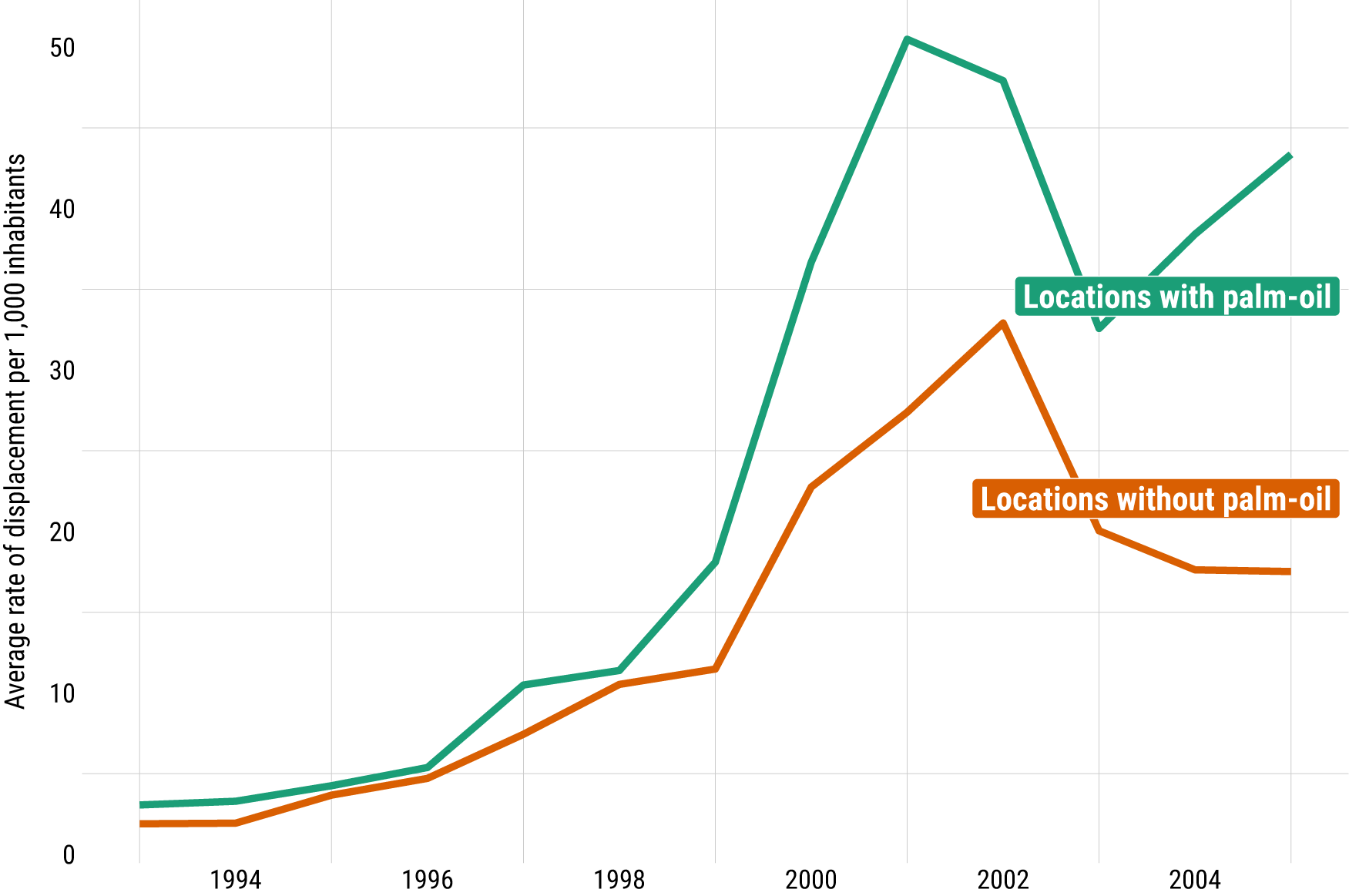
The resulting municipal-level panel data covers the years 1993–2005 and almost all 1,100 Colombian municipalities. Figure 1 below foreshadows some of the results of the analysis. For the earlier part of the 1990s, municipalities with and without palm oil have largely similar levels of displacement rates. As the palm-oil production frontier expands, however, a gulf emerges between the two in displacement rates, with palm-oil municipalities expelling huge numbers of civilians over this period.
Rate of Displacement (per 10,000 Residents) of Colombia Municipalities with and without Palm-Oil Cultivations
Note: The dashed line denotes the year in which the government begins palm-oil programs.

One testable element of the argument is that opportunistic displacement should depend, at least in part, on the presence of allied combatants on whom elites can rely as hired muscle. In empirical terms, this means that the effect of palm-oil expansion on displacement should depend on the presence of paramilitary groups (who often held ties to or were sometimes directly formed by elites [Ávila and Romero Reference Ávila and Romero2011]) but not necessarily the guerrilla organizations. I thus test for heterogeneous effects by interacting the palm-oil variable in Equation 1 above with indicators of paramilitary and guerrilla presence, respectively. Measuring armed-group presence (or territorial control) is exceedingly difficult when only violent behavior is observable in reports (Anders Reference Anders2020). As an imperfect substitute, I follow the literature and draw on measures of guerrilla and paramilitary presence at the municipal-level from CEDE. These measures are based on whether there are reports of the group in question (often reports about their use of violence) in the municipality, and I use them to construct indicators for whether each group has been present in the municipality over the study period.Footnote 3
Finally, in a separate analysis, I also consider the long-run consequences of opportunistic displacement by drawing on municipal data from Arteaga et al. (Reference Arteaga, Osorio, Cuéllar, Ibáñez, Botero, Murcia, Neva and Rey2017) on contemporary land restitution claims. Land restitution claims are the legal process through which displaced people seek out the return, or restitution, of land lost during the process of displacement. In Colombia, a staggering 7.3 million hectares of land face restitution claims (Arteaga et al. Reference Arteaga, Osorio, Cuéllar, Ibáñez, Botero, Murcia, Neva and Rey2017). The data I draw on include information on the magnitude of land-restitution claims (i.e., the amount of land, in hectares, in need of restitution) at the municipal level as of 2016, which I merge with other municipal variables, including the presence of palm-oil plantations.
Results
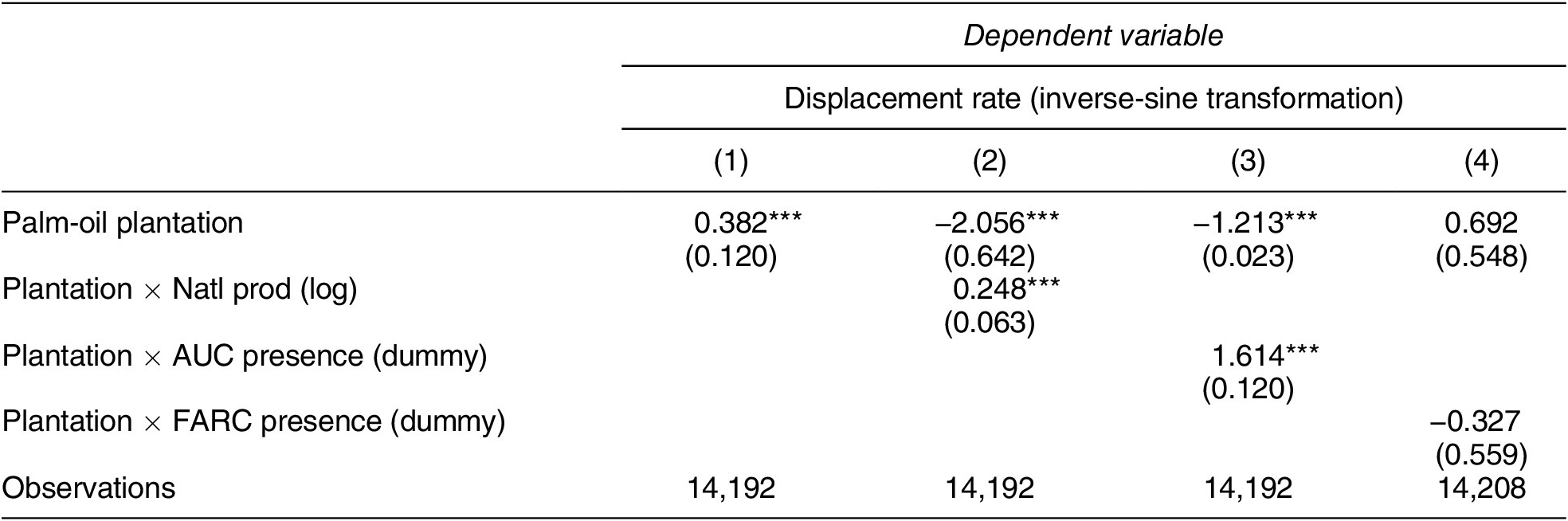
Table 1 presents results from the main analysis. Model 1 regresses the municipal displacement rate against the presence of palm-oil cultivations and shows that displacement rates are significantly higher during the period in which municipalities are growing palm oil than before the palm-growing period. In substantive terms, adopting palm oil produces an increase of roughly 23 more cases of displacement per thousand residents, a substantial increase relative to a national displacement rate of 14 per thousand.
Effect of Palm-Oil Growth on Displacement

Note: Models include municipal and year fixed effects and controls for time-varying presence of coca and FARC attacks. *p < 0.10, **p < 0.05, ***p < 0.01.
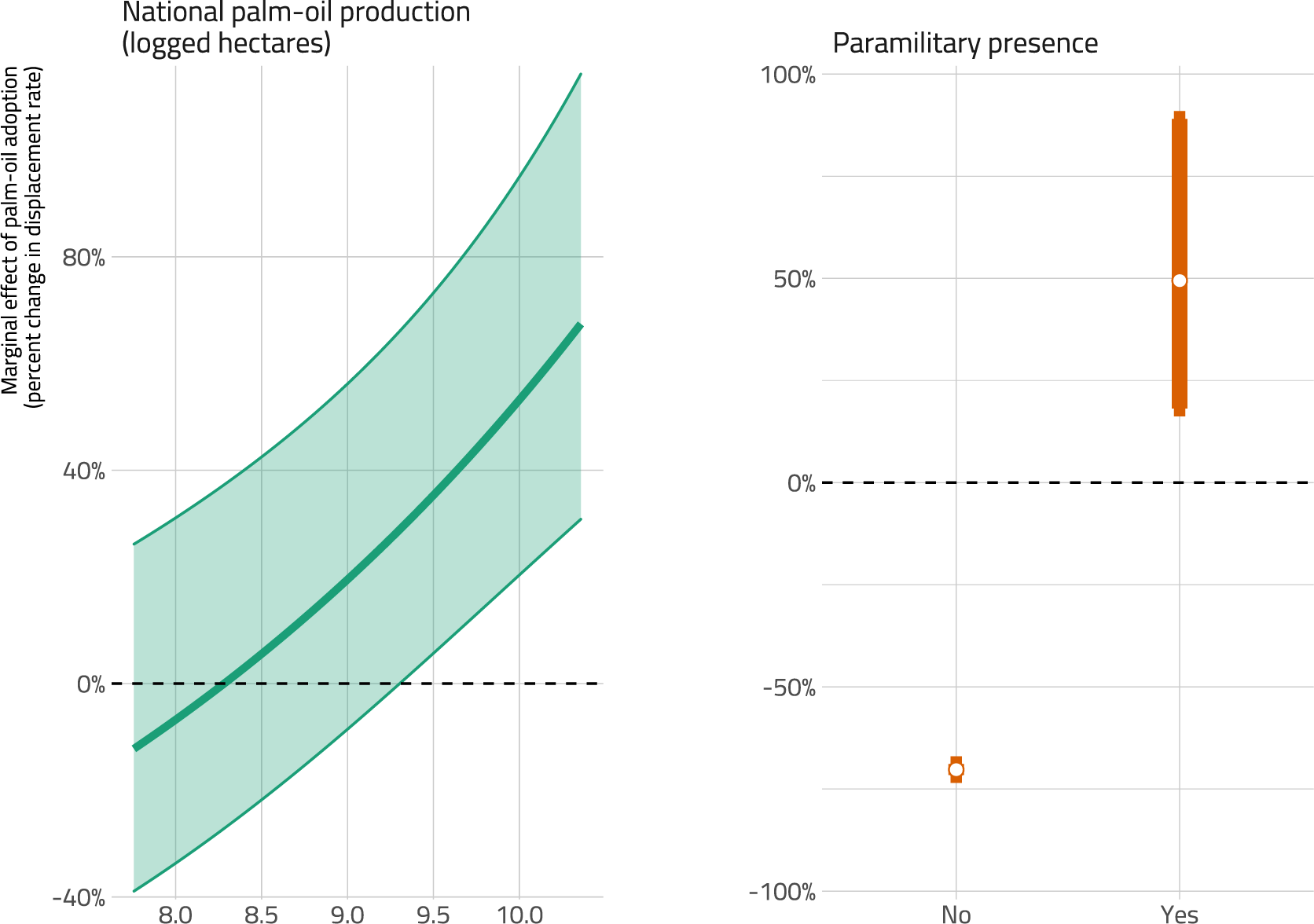
The results from Model 1 estimate the effects of adopting palm oil in general but tell us nothing about how the amount of planting corresponds to the amount of displacement. To get a sense of this, Model 2 interacts the palm treatment variable with the (logged) amount of palm planted each year and demonstrates that the effect of adopting palm oil on displacement is more intense in years when the palm-oil industry is experiencing high levels of growth (Figure 2 shows this relationship).
Effect of Palm-Oil Presence on Displacement Rate across National Palm-Oil Production Levels (Left) and Presence/Absence of Paramilitary Groups (Right)
Note: The confidence intervals for the effect of palm-oil adoption in municipalities without paramilitary presence are difficult to see because they are small relative to the confidence intervals for the same effect in municipalities with paramilitary presence.

Model 3 interacts the palm-oil treatment with whether a municipality has historically had paramilitary presence and tests whether, as expected in the theory, the effect of palm oil on displacement depends on the presence of armed groups with close relations to elites (i.e., paramilitaries). Figure 2 plots the effect of palm-oil cultivation on the displacement rate, depending on whether the municipality has paramilitary presence over the period in question. Interestingly, the effect of palm oil on displacement switches signs depending on the presence of paramilitary groups: palm oil is associated with a reduction in displacement in the absence of paramilitary groups but a significant increase in municipalities where paramilitaries have historical presence. The same pattern does not hold when we instead look at historical levels of left-wing guerrilla presence (Model 4), who are unlikely to collude with rural elites. These patterns mirror historical and ethnographic accounts of guerrilla and paramilitary relations with elites (Ávila and Romero Reference Ávila and Romero2011; Gutiérrez-Sanín and Vargas Reference Gutiérrez-Sanín and Vargas Reina2017) and point to the importance of accounting for group repertoires of violence in producing the kinds of arrangements necessary for opportunistic displacement (Gutiérrez-Sanín and Wood Reference Gutiérrez-Sanín and Wood2017).
I also perform a number of robustness tests that supplement the core result. First, the difference-in-difference analysis assumes that interventions are effectively random, conditional on time and group fixed effects. Although this assumption cannot be tested directly, I use two more modern causal inference approaches to estimate the effects of palm-oil adoption on displacement. Figures A.3 and A.4 visualize the results using the methodology described in Xu (Reference Xu2017) and Sun and Abraham (Reference Sun and Abraham2020), respectively. Overall, the results largely support parallel trends leading up to the adoption of palm oil, and the results from Sun and Abraham (Reference Sun and Abraham2020) suggest the effects of palm oil on displacement are concentrated in later periods. Second, as the theory pertains specifically to displacement, I also test whether palm-oil expansion predicts general guerrilla attacks against civilians—an outcome that should be unrelated to the explanatory variable—and find no evidence in this regard (Appendix Table A.2). The main result also holds if instead of relying on displacement rates I simply look at raw displacement counts by using a negative binomial generalized linear mixed-effects model (Appendix Table A.1) with an additional control for (logged) municipal population.
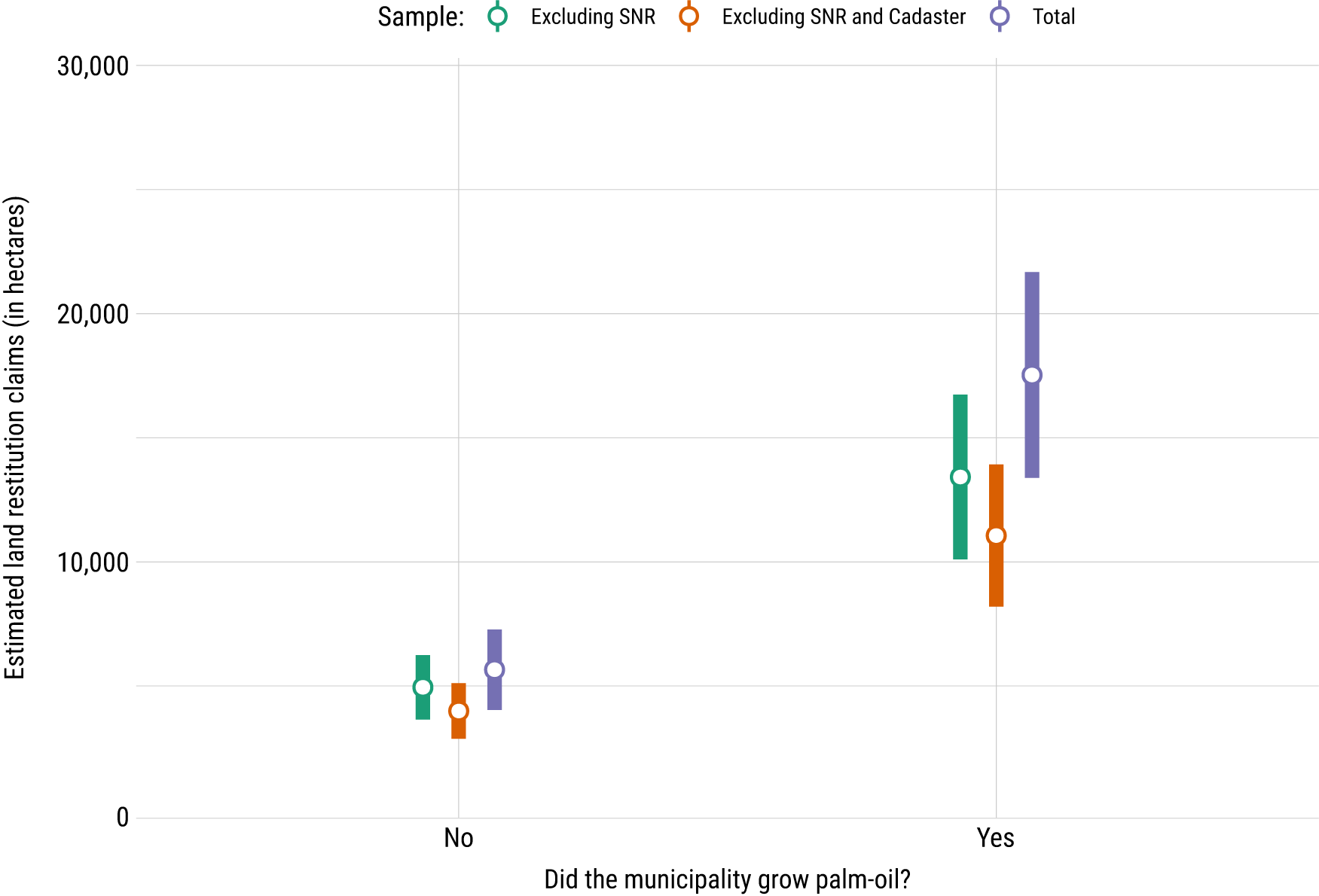
Finally, I also find that the presence of palm oil is correlated with present-day claims for land restitution by families displaced during the conflict. Controlling for potential confounds, municipalities that grew palm oil over the period of study have substantially higher restitution demand—approximately 12,000 more hectares of land with restitution claims—than other municipalities (Figure 3; Appendix table A.5 for full results). As a point of comparison, dispossession in Curvaradó and Jiguamiando—a particularly extreme case—involved an estimated 25,000 hectares of illegally acquired land by palm-oil companies (Montero Reference Montero2011). These results hold even while varying the underlying data source for land claimsFootnote 4, as seen in Table A.5. While these results cannot be interpreted causally, they suggest the potential for opportunistic displacement to have long-run consequences for countries recovering from war.
Predicted Amount of Contemporary Land-Restitution Need, Holding other Covariates at the Mean

The municipal-level results show that displacement increases following the arrival of palm oil to a municipality and some evidence that palm’s displacement effects are particularly strong during years of high production and in places where paramilitary groups have historically exerted influence. There is also a long-run association between the presence of palm oil in a municipality and current-day land-restitution need. While largely supporting the mechanisms described in the theory, the results also have a number of important limitations. First, the data on palm-oil plantations and displacement are aggregated at the yearly level and thus cannot cleanly distinguish the direction of the causal arrow. The presented patterns are conducive, for example, to a story in which palm-oil companies simply take over or purchase unoccupied land that had been (unknowingly) taken from a displaced person. The municipal data also cannot tell us the perpetrator of displacement, only that displacement took place, or whether the household fled in response to a direct threat or to avoid ongoing cross fire. I attempt to overcome some of these limitations in the next section, using household-level data, which give a more fine-grained picture of displacement dynamics.
Household Data and Analysis
Although the municipal analysis provides a general sense of trends, the household-level data provide a richer look at how the process of displacement affects households. The survey was fielded in March and June of 2017 as part of a performance evaluation of Colombia’s Land and Rural Development Program (LRDP), which was directed at improving the institutional capacity of the state to offer restitution to displaced victims and other land-related issues. The survey was fielded in person, using tablets, in municipalities with a history of high conflict exposure, and specifically oversampled households that had been victimized. The survey captured roughly 1,500 respondents across 50 municipalities and contains a high incidence of people who were displaced by the conflict (approximately 40% of the sample). As a result, the survey gives me access to a sample of respondents who are fairly homogeneous: most come from very poor, very rural municipalities across Colombia, and yet some were exposed to palm oil and others were not.Footnote 5
Here, I consider a number of outcomes that further outline mechanisms of opportunistic displacement. First is an item that asks respondents if they fled their home and, if so, why they chose to leave. I construct an indicator that codes respondents who said they were forced to leave their homes (by direct threats, experiences of violence, or other actions by armed actors), excluding those who left their home for other reasons (such that it was generally too dangerous to stay). This indicator allows me to look more narrowly at forced displacement than the municipal data allow, which doesn’t distinguish why people flee.
Second, I leverage an item that asks respondents who forced them to leave and construct an indicator for respondents forced to flee by either paramiltary groups or elites. Third, I use an item that asks respondents why they think they were forcibly displaced and create an indicator for those who responded that the actor in question “wanted their land.” Fourth, among those who indicate being displaced, I also look at an item that asks respondents to estimate the size of the land they lived or worked on. Although those dispossessed often have small landholdings, in absolute terms, it is possible that if displacement was motivated by land accumulation in palm-oil regions and a more heterogeneous set of concerns in nonpalm regions, then we might observe that people displaced from palm regions have had relatively larger landholdings, on average. Finally, a small subset of respondents (14%) indicate having initiated a legal challenge to recuperate their land and, if so, whether there was a current occupant on their land. If private actors are occupying displaced land in palm-oil regions, it is possible those displaced from palm-oil areas are more likely to currently face a challenger than those displaced from other areas.
I link respondent’s home municipality—and in the case of displaced respondents, their original municipality—with municipal-level data on the presence of palm oil. I use data on the presence of palm oil in the municipality as the key explanatory variable. This is an admittedly coarse measure of exposure to palm oil, as the presence of palm oil varies within municipalities. Further, I am not able to distinguish the precise moment in which the person was displaced and, therefore, simply test whether being from a municipality that has ever grown palm oil increases the propensity of certain displacement experiences. Of course, the causal interpretation of these estimates is limited, and the objective is simply to examine whether patterns in displacement experiences correspond with the paper’s account of displacement. Unless otherwise specified, I use logit models to regress displacement outcomes against the palm-oil indicator and a set of sociodemographic controls that should predict migratory decision making. Full model results are available in Appendix Table A.3.
Results
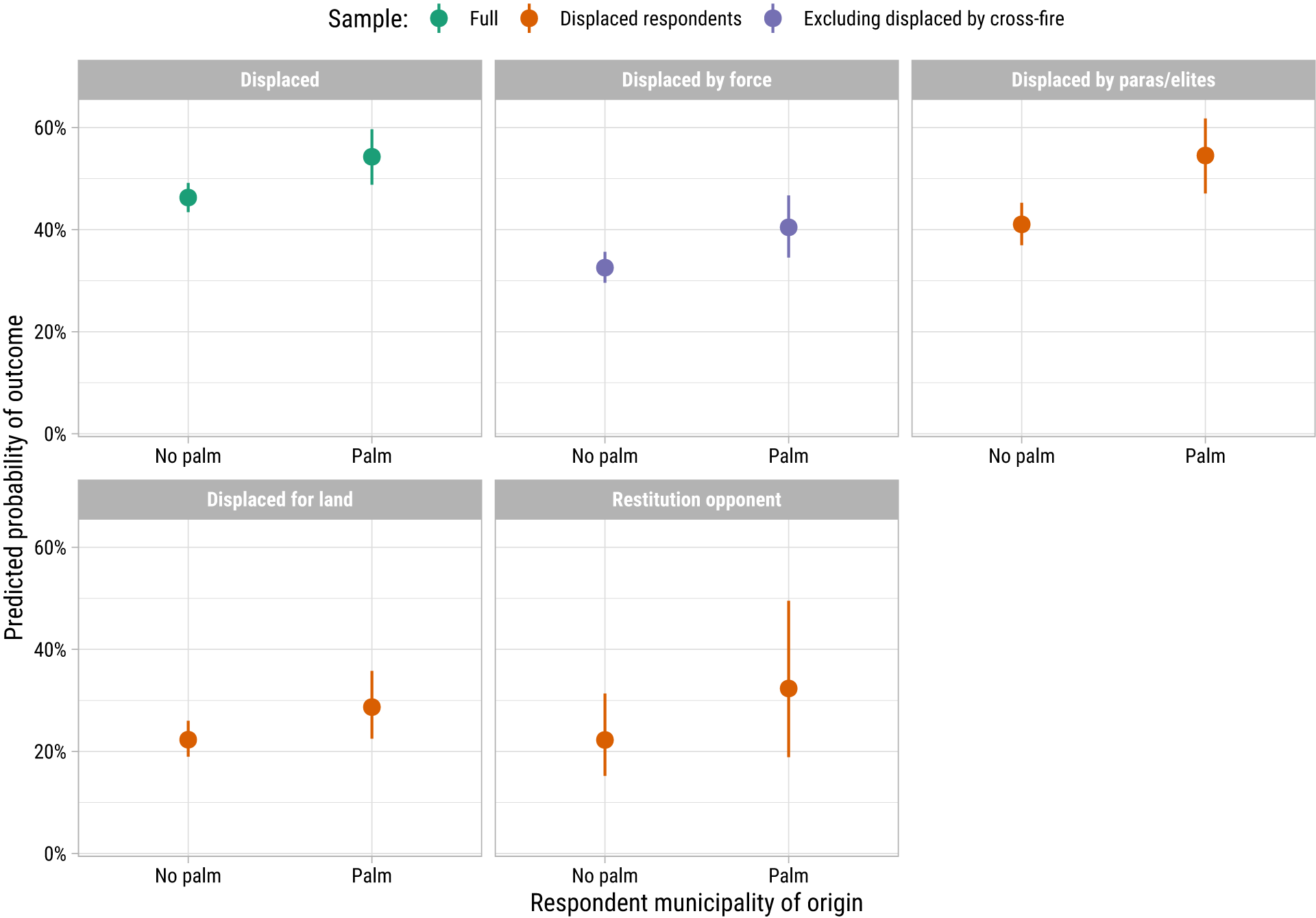
Figure 4 plots results from the household displacement models. The main explanatory variable here is whether the municipality grows palm oil. I find that, overall, respondents originating from palm-oil municipalities were more likely to have been displaced than their counterparts from other areas (Displaced). This holds if I instead define displacement as a respondent being directly forced out of their homes (Displaced by Force), excluding those who fled in response to general violence.Footnote 6 Among the displaced, those from palm regions were more likely to say either elites or paramilitaries forced them off their land than citizens displaced from other areas (Displaced by paras/elites) and similarly were more likely to indicate that the reason they were displaced was for their land (Displaced for land), though this result is only significant at p < 0.10. Finally, though people from palm regions were more likely to face an opponent in their restitution case (Restitution opponent; approximately 40% in palm-oil regions and 23% in other areas), standard errors are very large and the difference is not statistically significant.
Predicted Probabilities from Logit Models Using Household Survey Data
Note: Point estimates, 95% confidence intervals.

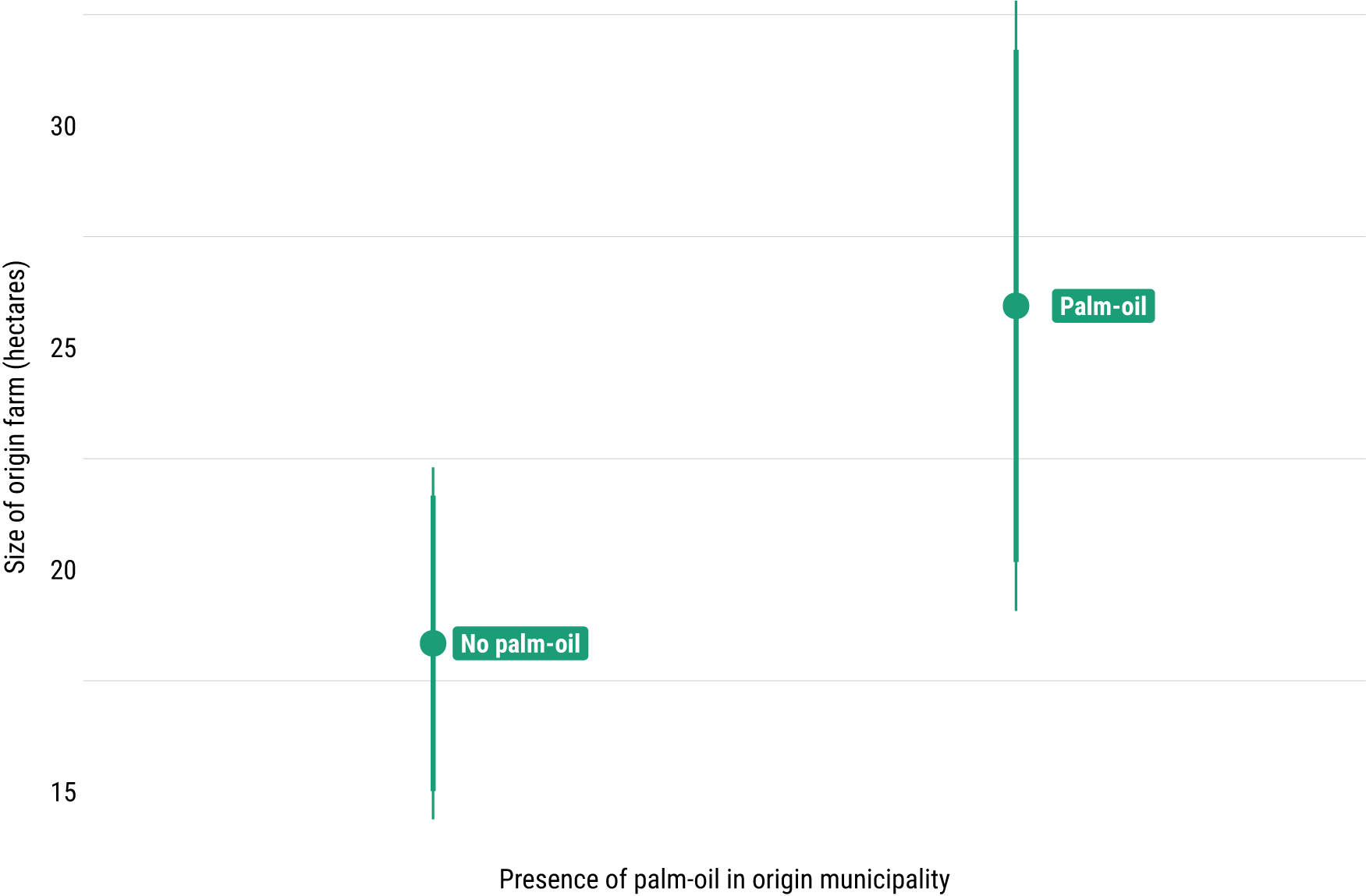
Next, I look at whether landholding patterns look different among those displaced within and outside of palm-oil municipalities. If displacement in palm-oil regions is driven by land needs but displacement in other areas is driven by other factors, it is possible that those displaced from palm areas might have lost more land to displacement.Footnote 7 Figure 5 provides mixed evidence of this: the average size of land owned or worked by displaced respondents is higher in palm-oil municipalities (p < 0.10). This pattern is suggestive of the claim that the expansion of palm oil led armed actors to target peasants for their land.Footnote 8
Estimated Amount of Land Owned or Worked Prior to Displacement across Palm-Oil- and Non-Palm-Oil-Growing Municipalities

I also use survey data to address a number of remaining concerns and potentially competing accounts. One concern is that rather than being motivated by land, paramilitary groups in palm-oil-growing regions were displacing citizens who were partisan to the FARC (Steele Reference Steele2009). To address this, I use an endorsement experiment meant to measure levels of support for the FARC discreetly (Bullock, Imai, and Shapiro Reference Bullock, Imai and Shapiro2011). Details of the endorsement experiment are available in the Appendix. I find no consistent evidence that people displaced from palm-oil regions tend to be more supportive of the FARC than people from other regions (Appendix Table A.6). While the experiment has clear limitationsFootnote 9, it presents evidence that is at least conducive to the notion that paramilitaries did not displace civilians in these settings out of ideological considerations.
A final concern is that the expansion of palm oil could be depressing local economies or generating economic grievances that in turn produce conflict and displacement. To assess this, I leverage survey data on rural wages from Dube and Vargas (Reference Dube and Vargas2013). These data capture hourly wages and demographic characteristics for over 25,000 rural households. I replicate the analysis from Equation 1, including a set of sociodemographic controls, and test whether wages fall disproportionately following the adoption of palm oil in palm-growing municipalities. Appendix Table A.4 shows no evidence of a decrease in wages following palm-oil adoption. Although limited in some respects,Footnote 10 a positive coefficient on palm-oil expansion suggests it is unlikely that palm oil would generate more of the kinds of violence that produces displacement via a poverty mechanism.
While not conclusive on their own, the survey results help flesh out the main findings from the municipal analysis. Household patterns are consistent with the municipal-level data in presenting a picture of displacement as a form of opportunistic land-grabbing, where elites and paramilitaries target peasants for their land and force them to leave in order to expand production.
Conclusion
Even when societies are able to bring conflicts to an end they face the insurmountable task of attempting to rebuild all that was lost during the war. Chief among these efforts is the process of resettlement and restitution for victims and refugees, who face daunting challenges in recovering their property and rebuilding their communities. Understanding the logic of displacement in civil wars is thus of crucial importance. To advance our understanding of this question, I test an account of displacement fundamentally motivated by opportunism rather than the strategic and territorial conquest logic that is so dominant in the literature. To test these claims, I explore the consequences of the growth of the Colombian palm-oil industry at the height of the country’s armed conflict. I combine novel, municipal-level panel data for agricultural production and conflict patterns with a survey of rural, conflict-afflicted households and present evidence that indicates that the growth of palm oil exacerbates conflict by incentivizing the forced displacement of civilians from their homes. The evidence suggests this dispossession is driven by linkages between elites and paramilitary groups, patterns that are not present with respect to the FARC. I also show a robust correlation between the presence of palm oil and a contemporary backlog of restitution claims, which highlights the long-term consequences of these dynamics.
In the process, the project points to a number of avenues for future research. Consistent with research that takes group composition seriously and argues that behavior should vary across different kinds of groups (Gutiérrez-Sanín and Wood Reference Gutiérrez-Sanín and Wood2017; Weinstein Reference Weinstein2007), the results caution against collapsing all civil-war actors into simple state–rebel binaries. One way of enriching this literature is to consider how armed-group relationships with elites (Gutiérrez-Sanín and Vargas Reference Gutiérrez-Sanín and Vargas Reina2017), state actors (Stearns Reference Stearns2014), and foreign companies (Berman et al. Reference Berman, Couttenier, Rohner and Thoenig2017) can shape a group’s pattern of violence. More generally, the study suggests that a single-minded focus on the behavior of armed actors misses how other actors, typically subsumed under the category of noncombatants, can behave strategically in war to pursue their interests.
Second, the patterns described here—of elites dispossessing peasants of their land—are not recent developments in Colombia’s history nor are they exclusive to Colombia. Rather, they have a long history in the country’s rural periphery, where cycles of displacement, dispossession, and resettlement characterized frontier expansion in the nineteenth and early twentieth century (LeGrand Reference LeGrand1986). Such dispossession is also similar to landgrabs by states, companies, and other actors in many parts of the developing world today (Borras et al. Reference Borras, Franco, Gómez, Kay and Spoor2012; Hall Reference Hall2013). While I argue that the context of armed conflict itself likely magnifies these dynamics, the results highlight the importance of contextualizing violence in broader historical conflicts over land and resources (Stearns Reference Stearns2014). More work explicitly analyzing the long-run consequences of these historical conflicts is thus necessary (Daly Reference Daly2012).
Third, the extent to which the patterns described here travel to other contexts also merits further investigation. While dispossession has been documented in a variety of countries characterized by persistent insecurity and weak property rights (Berman et al. Reference Berman, Couttenier, Rohner and Thoenig2017; Borras et al. Reference Borras, Franco, Gómez, Kay and Spoor2012), the relationship between land pressures and displacement has been less studied. The peculiarity of the ties between paramilitaries and elites in the Colombian context also raises questions about the exact nature and conditions under which elite–combatant collusion is likely. This question is particularly interesting in multiparty conflicts or in regions where multiple groups are contesting territory, as allegiances can form and break down over time (Christia Reference Christia2012).
Finally, the study also raises questions about the role of the state in opportunistic displacement and the implications of that role for the success of policy bearing on transitional justice, restitution, and reparations (McCallin Reference McCallin2012). While what happens to victims after displacement is largely absent from the empirics, other work has made clear that elites and other actors have used state institutions to legally codify accumulation through dispossession (del Pilar Peña-Huertas et al. Reference del Pilar Peña-Huertas, Ruiz, Parada, Zuleta and Álvarez2017; Vargas Reina Reference Vargas Reina2021). This pattern challenges depictions of the state as being largely weak or ineffectual in armed conflicts and suggests instead that the state can be leveraged to pursue wartime agendas, an area that merits further research (Acemoglu, Robinson, and Santos Reference Acemoglu, Robinson and Santos2013; Vargas Reina Reference Vargas Reina2021; Wolford et al. Reference Wolford, Borras, Hall, Scoones and White2013). Turning to postconflict policy, one concern raised by the study along these lines is that in cases of opportunistic displacement, it may be particularly difficult for victims to win legal battles against substantially better resourced and politically connected elites or private companies. In these cases, it seems vital that investment in judicial and investigative processes be made in order to assure fair outcomes for victims.
Supplementary Materials
To view supplementary material for this article, please visit http://doi.org/10.1017/S0003055421001003.
Data Availability Statement
Research documentation and data that support the findings of this study are openly available at the APSR Dataverse: https://doi.org/10.7910/DVN/DG2J0F.
Acknowledgments
For helpful comments, suggestions, and advice, I would like to especially thank Abbey Steele, Elisabeth Wood, Michael Weintraub, Javier Osorio, Jeremy Spater, Laia Balcells, Erik Wibbels, Ana Maria Montoya, and four anonymous reviewers. I would also like to thank participants and organizers at the Online Peace Science Colloquium, the Carolinas Conflict Consortium, and the UC Merced Political Science Speaker Series for helping to workshop the paper. Finally, I would like to thank Professor Ana Maria Ibañez at the Universidad de los Andes for making her data on the “Fondo de las tierras” available for this study.
Conflict of Interest
The author declares no ethical issues or conflicts of interest in this research.
Ethical Standards
The author declares that the human-subjects research in this article was reviewed and approved by Duke University IRB and certificate numbers are provided in the appendix. The author affirms that this article adheres to the APSA’s Principles and Guidance on Human Subject Research.




Comments
No Comments have been published for this article.