In 2006, Democrat Deval Patrick became the second elected African American governor since Reconstruction when he won the Massachusetts gubernatorial election over Republican Kerry Healey. Patrick was elected despite facing racially tinged campaign attacks that resembled the Willie Horton ads used by George Bush to paint former Massachusetts governor Michael Dukakis as soft on crime in the 1988 presidential election (Mendelberg Reference Mendelberg2001). One notable Healey ad began with a white woman walking alone in a dark parking garage and then cut to footage of Patrick describing a convicted rapist as “thoughtful” and “eloquent” (Cooper Reference Cooper2006). Patrick responded to this attack by pursuing a number of different strategies: offering a justification; touting his own tough-on-crime record; and arguing that Healey's attacks were an attempt to divert attention away from her own record. Patrick's polling lead shrank considerably after the racially tinged ads started airing. However, his rebuttals to Healey's attacks coincided with a rebound in his poll numbers.
Twelve years after Patrick's successful gubernatorial campaign, Andrew Gillum launched a bid to become Florida's first African American governor in 2018. His opponent, Republican Ron DeSantis, warned voters not to “monkey this up” by electing Gillum, who he repeatedly attacked as corrupt and soft on crime (Jacobs Reference Jacobs2018). President Trump acted as a DeSantis surrogate, once calling Gillum a “stone-cold thief” (Skoneki Reference Skoneki2018). While Deval Patrick shied away from addressing race in his response to the parking garage ad, Gillum denounced DeSantis' “monkey” comments in openly racial terms, saying that DeSantis and Trump “no longer do whistle calls. They're now using full bull horns” (Jacobs Reference Jacobs2018). Gillum went on to lose the election by four-tenths of a percentage point.
Gillum and Patrick represent different viewpoints in the debate over whether to directly confront racialized attacks in racial terms. Though different strategies have been used, little is known about whether rebuttals are effective at all, and if so, which ones and why. Filling this gap matters not only for understanding why candidates win or lose. It also clarifies whether political communication can play a role in reducing the significance of race as a consideration in candidate evaluation. Scholars of racial priming often paint a dim picture of the American public as being highly susceptible to manipulation by racial cues (Mendelberg Reference Mendelberg2001; Valentino et al. Reference Valentino, Hutchings and White2002). Concern regarding the susceptibility of the public to racial priming may be alleviated if white voters are receptive to rebuttals.
The standing prediction in the racial priming literature is that calling attention to the racial nature of an appeal—as Gillum did—is the most effective strategy. In this paper, I test this hypothesis for identical African American and white candidates and find mixed evidence: although it restores support for a white candidate, African American candidates do not enjoy the same benefit. I compare the effect of the racial rebuttal to the effect of a nonracial rebuttal strategy found to be effective by the literature on blame management strategies—a justification of the attacked action (McGraw Reference McGraw1991)—and find that the justification improves evaluations of both candidate types. I also test a third rebuttal that combines a nonracial justification of the attacked action with a racial denunciation and find that it has positive effects for candidates of either race. By demonstrating the effectiveness of justifications, I find that attacked candidates' electoral prospects are not irreparably damaged by negative racial attacks.
In addition to testing each rebuttal's effect on candidate evaluation, I also examine the role of racial attitudes in shaping candidate evaluation. Here, I find that both African American and white candidates are unable to change the minds of racially resentful white respondents when using the racial rebuttal. However, these same respondents evaluate the other two rebuttal types favorably regardless of the target's race. Taken as a whole, the results suggest that while race constrains African American candidates in important ways, they can nevertheless respond as effectively as white candidates to racial attacks by using the right rebuttal strategy.
Aside from its relevance to the racial priming literature, this study offers several other contributions to the study of public opinion and campaigns. First, unlike past studies on the effects of campaign messages (Johnston et al. Reference Johnston, Hagen and Jamieson2004; Gerber et al. Reference Gerber, Gimpel, Green and Shaw2011), I consider not only the effects of messages, but also how those effects change when pitted against a countermessage. This follows work by Chong and Druckman (Reference Chong and Druckman2007) and Sniderman and Theriault (Reference Sniderman, Theriault, Saris and Sniderman2004), who study elite communication in this more realistic iterative framework. Second, this study not only adopts but also advances Chong and Druckman's (Reference Chong and Druckman2007) counterframing paradigm by addressing how respondents evaluate counterframes that raise more than one consideration, which is commonly found in real campaigns but rarely tested in a controlled experimental setting (Chong and Druckman Reference Chong, Druckman, Bucy and Holbert2011). Third, although many scholars have examined the effects of negative campaigning (Ansolabehere and Iyengar Reference Ansolabehere and Iyengar1995; Geer Reference Geer2006), few have explored how the findings from that research are affected by a candidate's race (although see Krupnikov and Piston Reference Krupnikov and Piston2015). Finally, I compare identical messages offered by African American and white candidates, an approach that builds on rare studies of the effects of source cues (Kuklinski and Hurley Reference Kuklinski and Hurley1994; Nelson et al. Reference Nelson, Sanbonmatsu and McClerking2007). While informative, these studies do not consider how source cues operate in an iterative electoral context, as is done here.
1. Previous literature
Implicit racial appeals—ones that avoid direct reference to race, yet still communicate racial messages by alluding to racial stereotypes or using racial imagery—remain common in U.S. politics.Footnote 1 A systematic examination of campaign ads in U.S. House and Senate races conducted by McIlwain and Caliendo (Reference McIlwain and Caliendo2011) finds that racial stereotypes and imagery were common in attack advertising aimed at non-white candidates in the 1990s and 2000s. Research demonstrates that such cues lead to the activation of racial attitudes among white voters, making racial attitudes a central determinant of citizens' opposition to the representation of African Americans and their interests (Kinder and Sanders Reference Kinder and Sanders1996; Mendelberg Reference Mendelberg2001; Valentino et al. Reference Valentino, Hutchings and White2002; Hurwitz and Peffley Reference Hurwitz and Peffley2005; White Reference White2007; Tesler and Sears Reference Tesler and Sears2010; Kinder and Dale-Riddle Reference Kinder and Dale-Riddle2012; Tesler Reference Tesler2012).
Although many studies have documented the effects of implicit appeals, few have examined the effects of rebuttals to them. Early studies found that white Democrats in the 1970s and 1980s did not directly rebut implicit appeals made against them, instead choosing to ignore them or change the subject (Edsall and Edsall Reference Edsall and Edsall1991; Glaser Reference Glaser1996). Studies of African American candidates in the 1980s also found that explicit discussion of race, including directly challenging implicit appeals as racist, was not a popular strategy (see Perry Reference Perry1991 on “deracialization”).
The first test of the effect of rebuttals to implicit appeals was conducted by Mendelberg (Reference Mendelberg2001) using survey data from the 1988 presidential campaign. Using the date of interview from the 1988 American National Election Study (ANES) as a measure of exposure to the Horton ads, Mendelberg finds that racial attitudes had the smallest effect on candidate evaluations during the last phase of the campaign in which the Horton ads were explicitly called anti-black messages. Thus, Mendelberg argues that calling attention to the racial nature of the appeal is a successful rebuttal strategy. However, this finding is open to alternative explanations. For example, since message exposure is measured indirectly (using date of interview as a proxy), it is unclear whether the message itself or some other factor that occurred at the same time caused candidate evaluations to change. An experimental test is needed to determine the causal relationship between message and candidate evaluation. Also, Mendelberg's case study examined the response of a white presidential candidate's campaign. Black candidates' responses have never been tested.
2. Rebuttals to racial appeals
Research in political communication provides insight into how rebuttals might play an important role in combatting racial attacks. The pioneering work on “counterframing” by Chong and Druckman (Reference Chong and Druckman2007) and Sniderman and Theriault (Reference Sniderman, Theriault, Saris and Sniderman2004) critiques earlier work on framing, which showed that the way in which political arguments are “framed” can have dramatic effects on the types of considerations (such as group attachments, values, and interests) that citizens draw upon when making political evaluations (Kinder and Sanders Reference Kinder and Sanders1996; Nelson and Kinder Reference Nelson and Kinder1996; Nelson et al. Reference Nelson, Clawson and Oxley1997). Chong and Druckman (Reference Chong and Druckman2007) criticize the early framing research for ignoring the reality of democratic competition among elites. They argue that in the real world, opposing elites offer competing frames to the public in an effort to persuade citizens to evaluate a political matter using their preferred set of criteria.
In their experiments, they find that framing effects dissipate when pitted against a counterframe that emphasizes a different consideration, assuming that the counterframe is a compelling argument. This occurs because the counterframe promotes deliberate evaluation of the original frame. Though race and racial attacks are not discussed in their work, the relevance of their findings for this study's examination of rebuttals is clear: while racial attacks are a type of frame that is meant to activate racial considerations, rebuttals are a type of counterframe that can potentially raise an alternative set of considerations, thus changing how citizens evaluate candidates and the considerations they draw upon when doing so.
What remains unclear in the Chong and Druckman paradigm is what constitutes a compelling (or “strong”, in their terminology) frame. I advance their work by testing three counterframes to attacks that activate anti-black sentiment offered by identical black and white candidates. In the next section, I explain key features of each rebuttal and highlight other areas of political communication research that offer clues for how they might work. In the section after that, I consider how the race of the messenger may influence each rebuttal's effect.
3. Rebuttal strategies
The first strategy tested is the racial rebuttal. This was the one that Mendelberg (Reference Mendelberg2001) found effective—calling attention to the racial nature of the attack. Barack Obama used this strategy during the 2008 campaign in response to a John McCain ad that interspersed Obama images with irrelevant images of the blonde female celebrities Paris Hilton and Britney Spears. Obama replied to the ad by saying that it was an attempt to remind voters that he “doesn't look like all those other presidents on the dollar bills” (Mooney Reference Mooney2008).
The standing prediction in the racial priming literature is that calling attention to the racial nature of the appeal is the most effective rebuttal strategy. As mentioned earlier, Mendelberg (Reference Mendelberg2001) shows that racial attitudes had a significantly weaker effect on candidate evaluations during the last phase of the 1988 presidential campaign in which the Horton ads were explicitly called anti-black messages by leading Democrats, a charge that was widely disseminated by the media. The reason for this weakening racial effect, according to this account, is that the rebuttal “uncovered” the racial content of the Horton ad, which led whites to reject the message since it violated a widely held norm against openly racist derogation. The rebuttal should work even among racially resentful whites since supposedly even they, too, have internalized this norm. Thus, a message that would have worked as long it remained implicitly racial will no longer do so once it is uncovered as an explicitly negative reference to African Americans. From this perspective, racial works precisely because it is highlighting the racial character of the implicit message.
On the other hand, there are reasons to believe that racial may be ineffective or even counterproductive. One reason for skepticism comes from scholars in the “deracialization” tradition, who argue that African American candidates who avoid explicit discussion of race stand the greatest chance of success (Hamilton Reference Hamilton1977; Citrin et al. Reference Citrin, Green and Sears1990; Sonenshein Reference Sonenshein1990; Perry Reference Perry1991; Jeffries and Jones Reference Jeffries and Jones2006; Frederick and Jeffries Reference Frederick and Jeffries2009). A deracialized style is considered beneficial because it attempts to minimize the salience of racial considerations as much as possible. Thus, directly challenging an implicit appeal as racist makes little sense because it reinforces considerations that the candidate should be trying to suppress. From this perspective, racial will not work because either whites may not find charges of racism to be credible or the norm of racial equality no longer acts as a constraint on their response, a hypothesis that is supported by recent research (Valentino et al. Reference Valentino, Neuner and Vandenbroek2017).
Although racial has received the most attention in the racial priming literature, other rebuttal types are possible and suggest alternative mechanisms for explaining whether citizens revise their evaluations of public officials who are accused of wrongdoing. The second strategy tested in this experiment—justify—involves explaining the attacked action by tying together relevant facts into a reason-based narrative. For example, former Arkansas governor Mike Huckabee employed this strategy in 2009 when he was criticized for pardoning Maurice Clemmons, an Arkansas convict who murdered four Washington state police officers after Huckabee pardoned him. Huckabee justified the pardon by saying that he received a recommendation to pardon Clemmons from the trial judge in the case and the unanimous vote of the parole board (Sterling Reference Sterling2009).
Evidence consistent with the notion that justify can be persuasive is found in the political accounts literature begun by McGraw (Reference McGraw1991), who demonstrated the effective use of politicians' reason- and fact-based justifications for their controversial actions. According to McGraw (Reference McGraw1991), a justification does not deny responsibility for the action. Instead, “a justification focuses on the outcome and claims that contrary to accusations, the consequences are not so undesirable and therefore that less or no blame is warranted (1136).” Thus, a successful justification should lead to a two-step inferential process. First, if the citizen is satisfied with the justification, it should lead to positive reevaluations of the policy in light of the public official reframing its consequences in a more positive manner. Second, as a result of this reframing, the citizen may credit the public official for the policy action. While racial suggests that attacked public officials must “unmask” the racial intent of an attack, justify focuses on the role of relevant and credible information in counteracting an attack's harmful effects.
A third possible rebuttal strategy involves a more nuanced type of racial response—one that combines racial and compelling nonracial themes. In this study, this strategy is conceptualized as justify + racial, a hybrid response that combines a justification with a racial reference. One example of this response was Barack Obama's “A More Perfect Union” speech from March 2008 in which he addressed the controversial videos that emerged of his former pastor Jeremiah Wright denouncing the United States. In the speech, Obama tried to justify the origins of his relationship with Wright and how his former pastor, like many people, has strengths as well as shortcomings. Akin to racial, Obama acknowledged the existence of white racism in American society in a way that many observers considered unusual for a presidential candidate at the time (Kinder and Dale-Riddle Reference Kinder and Dale-Riddle2012, 45).
By disaggregating racial messages into subtypes based on their content, this study builds on the work of Stout (Reference Stout2015), who distinguishes between negative racial appeals—ones that “are generally devoid of substantive policy proposals and usually take the form of an attack on a political opponent, the media, or a supposed ally” (11–12)—and positive racial appeals—ones that “either advance black policy interests or highlight the candidate's connection to the black community without attacking outside political players or institutions” (8). For Stout (Reference Stout2015), tone is the key factor in determining whether whites accept racial rhetoric. He theorized that negative racial messages backfire among white voters because many view charges of racism as unnecessarily harsh. However, they may be open to racial messages that do not focus exclusively on charges of racism. Perhaps relevant and credible information may soften the tone of racial rebuttals, thereby making them more persuasive to white respondents.Footnote 2
In addition to providing a test of a more nuanced style of racial response, justify + racial also allows for a test of whether the effects of racial and justify are conditional on the other. In other words, it allows for an assessment of whether racial's effect is conditional on it being packaged with a compelling non-racial consideration such as justify, in line with Stout's (Reference Stout2015) finding that racial messages that focus only on highlighting racism are less effective than other types of racial messages. It also allows for a test of whether justify's effect is conditional on it being strictly non-racial.
4. Candidate race
In addition to the content of the rebuttals themselves, the race of the messenger is likely to influence how rebuttals are received (Kuklinski and Hurley Reference Kuklinski and Hurley1994). Tests of identical messages offered by African American and white politicians have found a number of instances in which messages offered by African American politicians are received less positively. For example, Nelson et al., (Reference Nelson, Sanbonmatsu and McClerking2007) found that African American elites' charges of racism are perceived as less credible than the same charges made by white elites. The implication of this finding for the current study is that since many observers may not view implicit appeals as being racial in nature, the effectiveness of the racial rebuttal hinges on whether the accusation of racial intent is perceived as credible. If African American claims of racism are perceived as less credible, then the racial rebuttal is also less likely to be effective when used by an African American candidate.
Other research suggests that the rhetorical penalty suffered by African American candidates extends beyond racial messages. Studies of negative advertising (Krupnikov and Piston Reference Krupnikov and Piston2015) and ambiguous rhetoric (Piston et al. Reference Piston, Krupnikov, Milita and Ryan2018) find that white candidates enjoy greater payoffs from using these nonracial communication strategies. Thus, we may observe racial differences in the effect of a nonracial rebuttal such as a justification.
Aside from rebuttals' main effects, another important outcome to examine is whether rebuttals can diminish the effects of racial attitudes on candidate judgments. Evidence consistent with the notion that rebuttals can deracialize is found in the literature on counterframing cited earlier (Sniderman and Theriault Reference Sniderman, Theriault, Saris and Sniderman2004; Chong and Druckman Reference Chong and Druckman2007). Applying their insight about counterframes raising alternative considerations to the current study, rebuttals that emphasize compelling nonracial considerations (such as a justification) may succeed in shifting focus away from the racial considerations that were primed by the attack.
Optimism regarding a rebuttal's potential to deracialize an attacked candidate is likely to apply more to white candidates than to African American candidates, however. Previous research on white candidates finds that the extent to which they are evaluated through a racial lens depends on the nature of the campaign communications environment (Kinder and Sanders Reference Kinder and Sanders1996; Mendelberg Reference Mendelberg2001; Valentino et al. Reference Valentino, Hutchings and White2002). Research on African American candidates, however, suggests that by virtue of their race alone, they make racial considerations “chronically accessible” in political decision-making (Tesler and Sears Reference Tesler and Sears2010). Hajnal (Reference Hajnal2007, 16), in a study of white attitudes toward African American mayoral candidates, finds that “black challengers can and usually do try to counter the uncertainty surrounding their candidacies by running “deracialized” or pro-white campaigns, but white voters tend to ignore these campaign statements, which they perceive as having little credibility.” Thus, rhetorical strategies aimed at shifting attention away from racial considerations (such as a nonracial justification) are unlikely to have their intended effect for an African American candidate.
5. Research design
To test the effects of rebuttals to implicit racial appeals, I conducted two internet survey experiments. The first experiment, conducted in March and July 2013, used a convenience sample of 265 white respondents from Amazon.com's Mechanical Turk (MTurk). While MTurk respondents are more diverse than student and convenience samples that are often used in political science experiments (Berinsky et al. Reference Berinsky, Huber and Lenz2012), they are not a nationally representative sample of American adults. To help compensate for this limitation, a second experiment was conducted in February 2014 using a sample of 380 white respondents provided by Survey Sampling International (SSI) that was drawn to match the U.S. white adult population on age, sex, and region. Results from the two experiments were substantively similar, so the two samples are combined in the following analyses.Footnote 3 Combining the samples yields a total of 645 white respondents.Footnote 4
The designs of the two experiments were identical. Both simulated an attack-rebuttal episode in a fictitious U.S. Senate campaign using a within-subjects design. Respondents were randomized into eight conditions: 1 (attack) × 4 (rebuttal types: racial, justify, justify + racial, or no rebuttal) × 2 (target race: black or white).
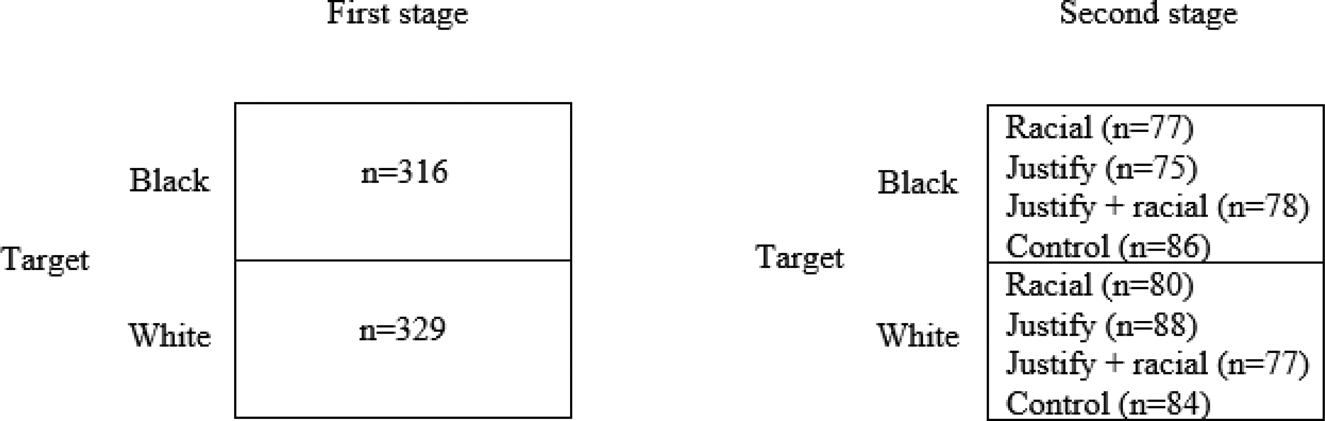
Figure 1 shows the basic design of the experiments. They proceeded in two stages. In the first stage, respondents read a fictitious news story about an attack ad in a U.S. Senate race. The story explains that the target of the ad was attacked by his opponent for pardoning a former U.S. Representative (the “criminal”) who was convicted of eight felonies, including assault of a police officer that left the officer hospitalized due to head injuries. After reading the news story, respondents provided feeling thermometer assessments (ranging from 0 = negative to 100 = positive) of the target and the attacker and answered a battery of demographic questions (but none about race so that responses to remaining questions are not primed by race). In the second stage, respondents were randomly assigned to one of the four rebuttal conditions (racial, justify, justify + racial, or control) and offered a second round of feeling thermometer evaluations for both candidates. To minimize the possibility of priming racial attitudes before reading the target's rebuttal, respondents answered the four-question racial resentment battery (Kinder and Sanders Reference Kinder and Sanders1996) after the second round of candidate evaluations.Footnote 5
Experimental design (Note: While the target's race is either black or white, the criminal's race is black in all conditions).

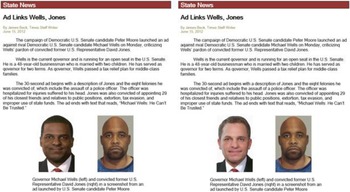
The pardon of a convicted ex-politician was selected as the theme of the ad described in the first stage news story because linking candidates to black criminality has been a theme in campaign ads such as the Willie Horton ad, the anti-Deval Patrick parking garage ad, and an ad from 2008 that tied Obama to Kwame Kilpatrick, the African American former mayor of Detroit who pleaded guilty to two counts of obstruction of justice and later resigned. The scenario examined in this study is intended to be similar to the Kilpatrick attack, as the ex-Representative's crimes are loosely modeled on Kilpatrick's. A side-by-side photo of the target and the criminal is embedded in the news article (see Figure 2). The target is shown wearing a suit while the criminal is shown in a mug shot. The race of the target was manipulated to be either white or black in order to test whether race affects rebuttal effectiveness. The criminal's race is black in all conditions.
Two versions of the attack news story, black target (left) and white target (right). The text of the news story is shown in Figure 1 of the Appendix.

The white and black versions of the target must be as close to identical as possible so that differences in ratings between them can be attributed to their skin color and not some other aspect of their appearance, such as their attractiveness. In order to do this, a morphing procedure used in earlier political science research was used (Bailenson et al. Reference Bailenson, Iyengar, Yee and Collins2008; Weaver Reference Weaver2012). This procedure yields a white face and a black face that are 60% identical, which controls for many extraneous (nonracial) sources of variation while still allowing realistic variation in skin tone and facial features.Footnote 6
In order to isolate the effect of race and neutralize interactions with party identification, I assign respondents to a primary contest between the target and attacker that matches the respondent's partisanship.Footnote 7 In other words, Democratic respondents are assigned to a Democratic primary; Republicans are assigned to a Republican primary; and Independent respondents are randomly assigned to either a Democratic or Republican primary.
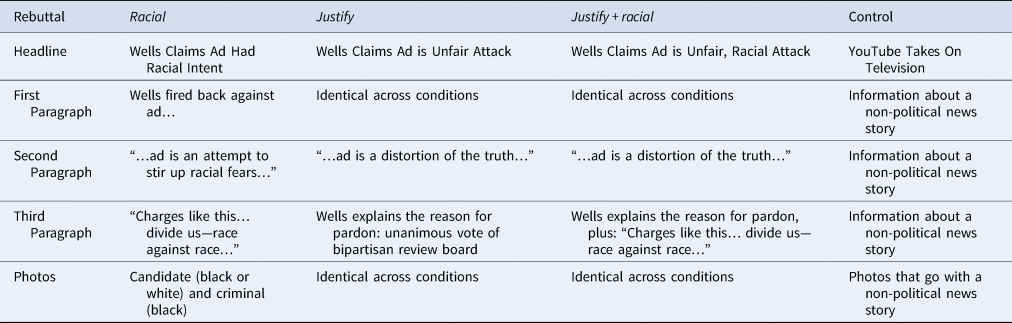
Turning to the second stage of the experiment, Table 1 highlights the key features of the four rebuttal conditions.Footnote 8 All conditions (except the control condition) contain the same first paragraph, explaining that a U.S. Senate candidate attacked his opponent for pardoning a convicted former U.S. Representative. The second and third paragraphs vary for each of the rebuttal conditions:
• In racial, the target says, “This ad is an attempt to stir up racial fears…Charges like this breed division in our country and our state. They divide us—race against race—so we blame each other instead of work together” (emphasis added). This statement is meant to resemble the one offered by then-Governor Bill Clinton's speech announcing his run for the presidency in 1991 when he said, “For twelve years, Republicans have tried to divide us—race against race—so we get mad at each other and not at them” (Mendelberg Reference Mendelberg2001, 104).
• The target in justify offers a justification for his action. He explains that the trial judge in the case recommended commuting the sentence and that the convicted Representative received a 5-0 vote recommending parole from the state's bipartisan parole board. He concludes by saying that he does not condone the Representative's actions but relied on the good judgment of the trial judge and parole board. This reasoning was similar to the real-life justification offered by Mike Huckabee described earlier.
• Justify + racial combines the justification offered in justify with racial's claim that charges like this divide us “race against race.”
• Finally, respondents read a non-political news article in the control condition that is similar in length and formatting to the other rebuttal conditions. After reading the article, respondents evaluate the target and the attacker they read about in the first stage news story. Thus, all respondents evaluate the fictional candidates twice. The control condition is needed in order to account for the possibility that the mere act of repeated measurement may influence treatment effects due to anchoring, learning, fatigue, or some other time-related phenomenon. In other words, if a change in candidate evaluations is observed in one of the rebuttal conditions but no change is observed in the control condition, we can be confident that the change in the rebuttal condition is not an artifact of repeated measurement.
Description of rebuttal stories

6. Results
Following studies in the counterframing and political accounts literatures, the analysis focuses on how rebuttals affect candidate evaluation. In addition to these main effects, I also address studies in the racial priming literature by examining the impact of racial resentment in shaping candidate evaluation. This allows for a test of whether rebuttals can help candidates deracialize.
The dependent variable used to test the main effect of a rebuttal is the change between the first round (post-attack) and second-round (post-rebuttal) of candidate feeling thermometer ratings. It is measured by (1) calculating the target-attacker feeling thermometer difference after the attack; (2) calculating the same difference after the rebuttal; and (3) calculating the difference between the second quantity and the first quantity and dividing by 100 to map on the −2 to 2 scale.Footnote 9 This score is the measure of the improvement in the evaluation of the target caused by the rebuttal with positive values indicating that the rebuttal helped the target, zero indicating that the rebuttal had no effect, and negative values indicating that the rebuttal backfired. The target-minus-attacker differences are used instead of simply looking at the target's ratings in order to account for the possibility that the attacker might suffer a penalty for issuing a negative attack (Lau and Rovner Reference Lau and Rovner2009).
Main effects are tested in three ways. First, is the effect positive and significantly different from the control group? Second, does the race of the target matter for the effect of a given rebuttal? After I conduct tests 1 and 2 for each rebuttal, I conduct test 3: which rebuttal is most effective for each target? These tests jointly cover all possible paired comparisons in a 4 × 2 design.
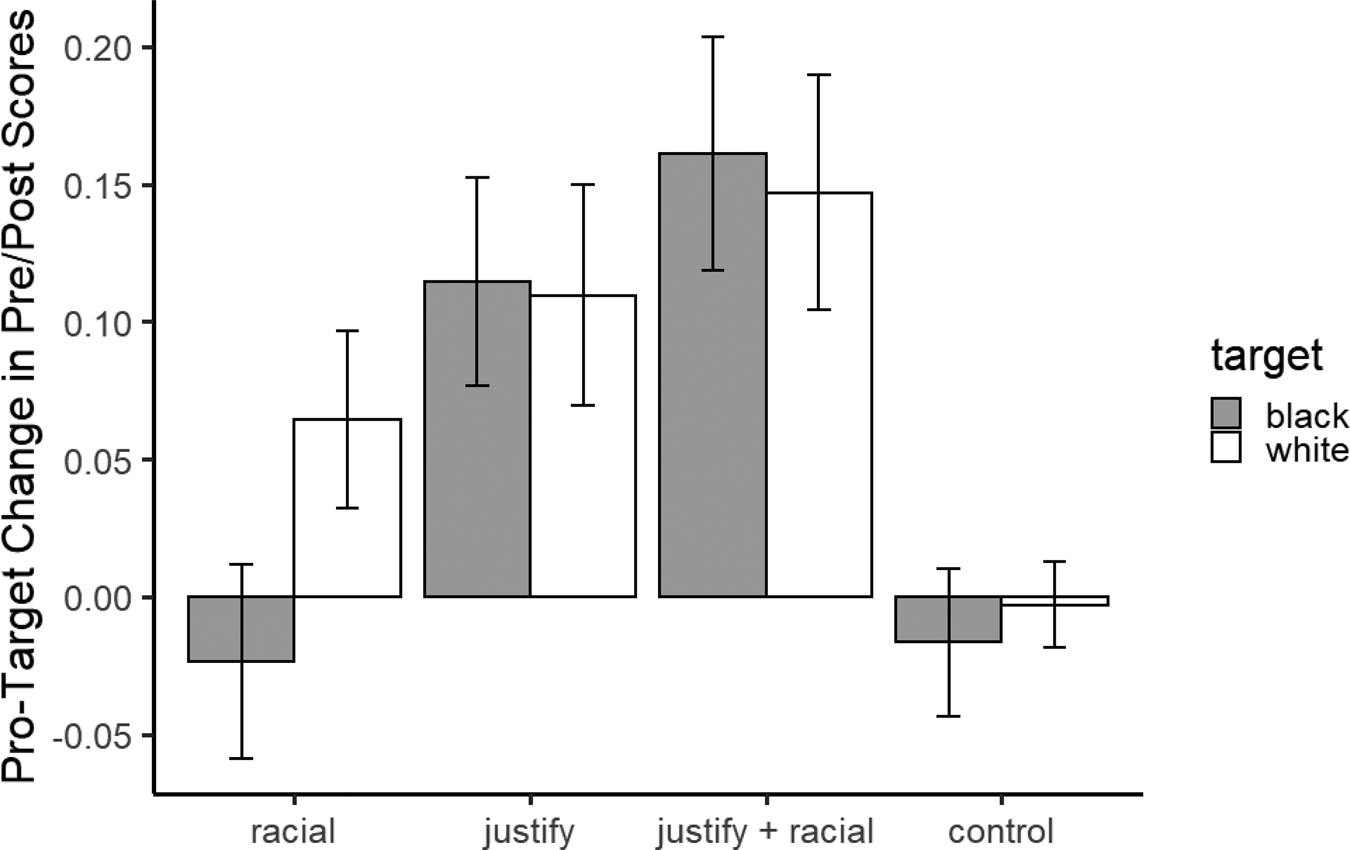
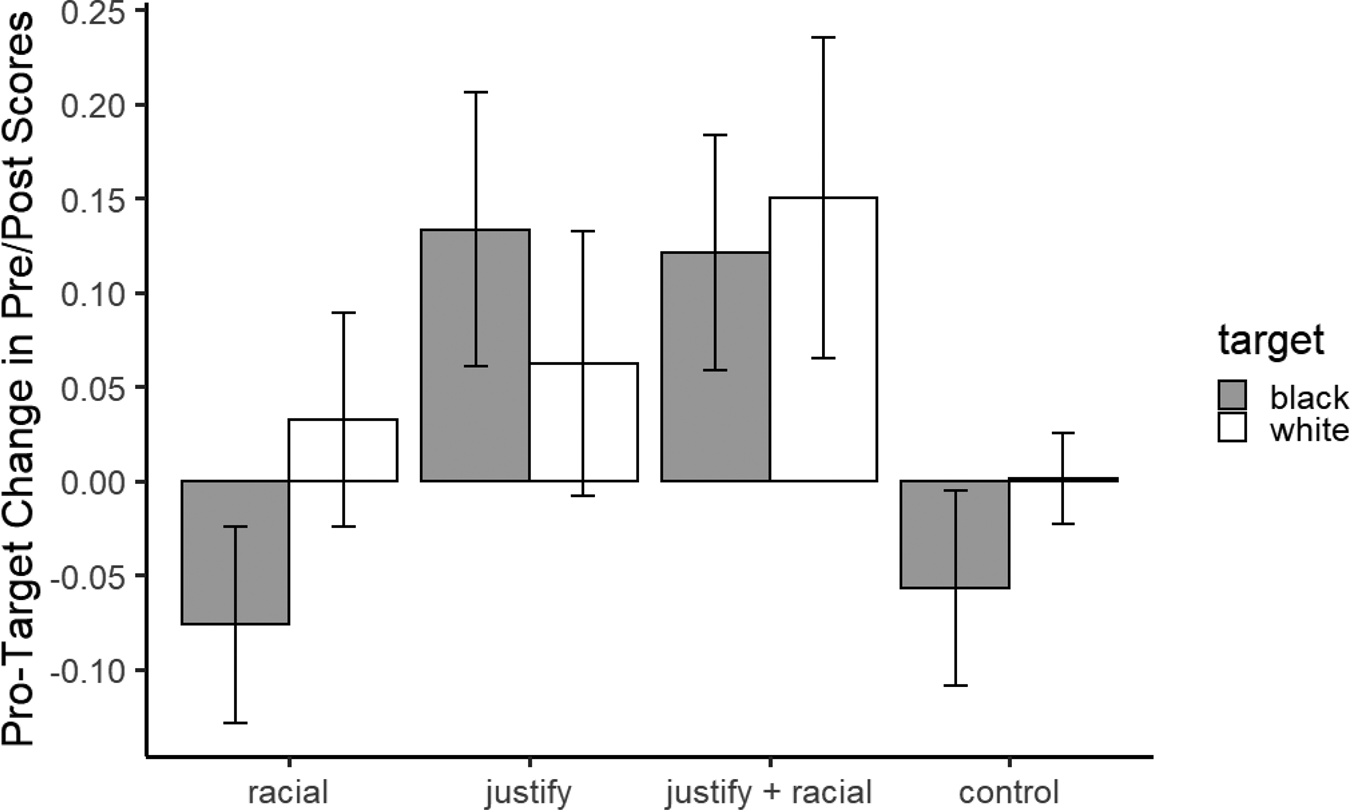
Figure 3 shows each rebuttal tested against a null hypothesis of no change relative to the control group (test 1) and all comparisons between pairs (tests 2 and 3). Each bar represents the rebuttal effect for each target-rebuttal pair with its 84% confidence interval, which is consistent with a two-tailed test of overlap at p = 0.05. In other words, values are significantly different where confidence intervals do not overlap. To aid in interpreting the magnitude of the rebuttal effects, the attack resulted in a target rating that was 0.14 lower than the attacker's rating on average.Footnote 10 Therefore, rebuttal effects can be interpreted as the amount of the 0.14 hit that the target gets back by using the rebuttal.
The impact of rebuttals on target-attacker evaluations. Positive values indicate that the rebuttal helped the target. Error bars represent 84% confidence intervals, which is consistent with a two-tailed test of overlap at p = 0.05. In other words, values are significantly different where error bars do not overlap. The “rebuttal effect” is the average change in target-attacker rating from post-attack to post-rebuttal for each rebuttal.

I start with racial. Looking at the average magnitudes compared to the control group (test 1), we see that it improves ratings of a white target by an average of 0.07 (p < 0.01), but the rebuttal's effect when used by a black target is statistically indistinguishable from zero (p = 0.82).Footnote 11 A direct test of the racial disadvantage hypothesis (test 2) indicates that support for the white target is 0.08 higher on average than for a black target using the same rebuttal (p = 0.01). Overall, the results provide mixed support for the racial priming literature's endorsement of racial. While it improves the evaluation of a white target, a black target does not enjoy the same benefit. This is consistent with previous research on the effects of racial rhetoric for black versus white elites (Nelson et al. Reference Nelson, Sanbonmatsu and McClerking2007).Footnote 12
Turning to justify, Figure 3 shows that this rebuttal improves evaluations of black and white targets alike (test 1). Justify improves evaluations by an estimated 0.13 for a black target and 0.11 for a white target compared to each target's appropriate control group (p < 0.01 for both tests). The difference in justify's effectiveness by candidate race is not statistically distinguishable from zero (test 2) (p = 0.90). In sum, justify is effective for a target of either race. This is also the case for justify + racial as it boosts evaluations of a black target by 0.18 and a white target by 0.15 compared to the relevant control group (test 1) (p < 0.01 for both tests). The difference between black and white targets is also statistically indistinguishable from zero (test 2) (p = 0.74) even though the rebuttal includes a mention of race.
Next, I turn to test 3: which rebuttal works best for each target? Starting with the black target, we learned from test 2 that justify and justify + racial were successful relative to the control while racial was not. Comparing justify to justify + racial, there is no statistically significant difference (p = 0.25), while both are more effective than racial (p < 0.01 for both tests). Based on test 3, it appears that the effective set of strategies for a black target are justify and justify + racial. At the same time, a black target should avoid racial, though it is worth noting that racial does not cause a backlash effect compared to the control group. The rebuttal simply leaves a black target no better or worse off than not responding at all.
For the white target, test 2 revealed that all three rebuttals were successful relative to the control group. Turning to test 3, justify + racial was more effective than racial (p = 0.03), but indistinguishable from justify (p = 0.22). Justify and racial were indistinguishable from each other (p = 0.22). Thus, as with the black target, the set of two strategies that cannot be dominated by any other are justify and justify + racial. The difference for a white target is that racial is also effective, though less so than justify + racial. Footnote 13
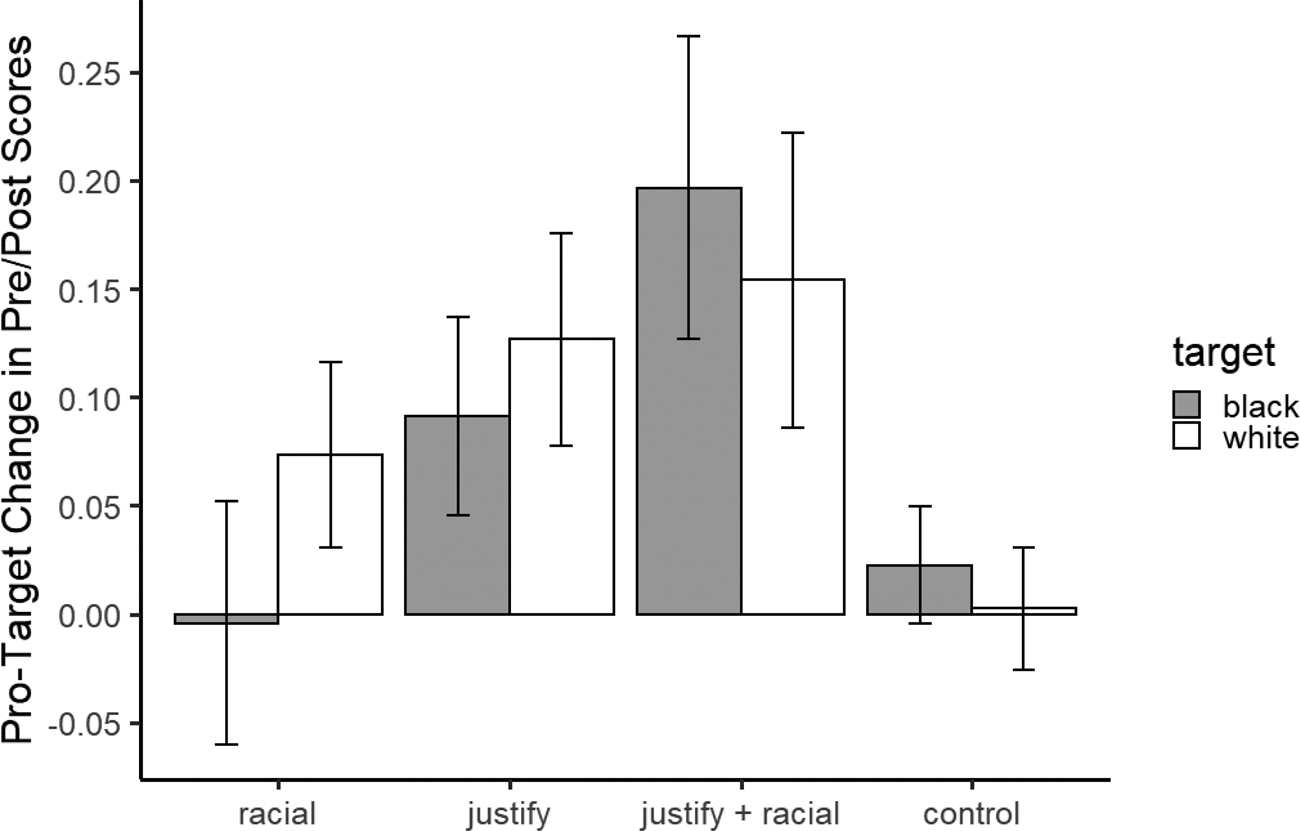
To better understand the main effects of each rebuttal, I examine whether rebuttal effects persist for respondents with high levels of racial resentment. The racially resentful provide a hard test for rebuttals. If rebuttals have a positive effect on the racially resentful, this would suggest that rebuttals can deactivate racial attitudes—a normatively attractive result given the inherently manipulative aspect of racial priming. Figure 4 shows the average rebuttal effect among high racial resentment respondents only (those in the top third of the sample, all of whom scored at or above 0.6875 on the 0–1 racial resentment scale (n = 245)).Footnote 14
Rebuttal effects among high racial resentment respondents only (top third of the sample, corresponding with racial resentment ⩾0.6875 on a 0–1 scale). Positive values indicate that the rebuttal helped the target. Error bars represent 84% confidence intervals, which is consistent with a two-tailed test of overlap at p = 0.05. In other words, values are significantly different where error bars do not overlap.

Starting with racial, we see a key difference from the overall findings. Compared to the control group, a white target using racial no longer enjoys statistically significant improvement in his evaluation (p = 0.48). As in the overall sample, a black target using racial is not significantly better off than the black target in the control group (p = 0.71). Comparing the white target to the black target directly, support for the white target is 0.11 higher on average, a marginally significant difference (p = 0.05). In sum, we see that racially resentful respondents do not respond positively to racial for a target of either race, but they especially do not like it when used by a black target.
Black targets, however, fare better among the racially resentful by using justify. A black target using justify enjoys 0.19 more support on average than a black target in the control group (p < 0.01). A white target using justify averaged 0.06 more support on average than a white target in the control group, but the difference is not statistically significant (p = 0.26). The comparison between black and white targets using justify yielded no significant difference (p = 0.33). Racially resentful respondents also appear to respond positively to justify + racial. Mirroring the overall results, justify + racial is more effective for both black and white targets compared to their respective control groups (black difference = 0.18, p < 0.01; white difference = 0.15, p = 0.02). The difference between black and white targets is not statistically significant (p = 0.70).
Overall, the results among the racially resentful are surprisingly similar to the results for the overall sample. The key difference is that racial no longer appears to benefit a white target. This suggests that a rebuttal that criticizes a racialized attack in explicitly racial terms does not necessarily lead racially resentful whites to reevaluate the racialized attack, contrary to Mendelberg's (Reference Mendelberg2001) theory of internalized racial norms. On the other hand, racially resentful whites appear to respond more positively to rebuttals that offer credible and relevant information even when that information is paired with explicitly racial criticism. Unlike racial, this holds for both black and white targets. In sum, results from this analysis suggest that information and tone are more important influences on candidate evaluation than highlighting norm violation among whites with high levels of racial resentment.
Finally, I examine rebuttal effects among the racially sympathetic, defined as respondents in the bottom third (RR ⩽ 0.5) of the racial resentment distribution (n = 273).Footnote 15 The results, presented in Figure 5, resemble the results for the overall sample shown in Figure 3.Footnote 16 The white target using racial enjoys a marginally significant effect of 0.07 relative to the white target in the control group (p = 0.06). In light of racial's lack of an effect for white targets among high racial resentment respondents, it appears that its effect among the overall sample is driven largely by racially sympathetic respondents. Meanwhile, justify and justify + racial are more effective for both black and white targets compared to their respective control group (p = 0.07 for black justify versus black control; p < 0.01 for all other comparisons). Overall, the analysis by racial resentment level suggests that while no racial resentment subgroup approves of a black target using racial, a white target offering the same rebuttal can mobilize support among the racially sympathetic. The other rebuttals work well across the racial resentment spectrum and without differences by target race.
Rebuttal effects among low racial resentment respondents only (bottom third of the sample, corresponding with racial resentment ⩽0.5 on a 0–1 scale). Positive values indicate that the rebuttal helped the target. Error bars represent 84% confidence intervals, which is consistent with a two-tailed test of overlap at p = 0.05. In other words, values are significantly different where error bars do not overlap.

7. Discussion
Despite numerous examples of racial attacks in recent campaigns, little is known about whether rebuttals are effective and, if so, which ones and why. In this paper, I define and systematically test three rebuttals used by African American and white candidates. Answering this question is important not only for understanding electoral outcomes but also for understanding the limits of racial campaigns and the public's capacity to respond to credible communication. I find that calling attention to the racial nature of the attack benefits a white candidate, but not an African American candidate, contrary to the standing prediction in the racial priming literature. However, two rebuttal types proved effective for white and African American candidates alike—(1) a non-racial justification of the attacked action and (2) a modified version of racial defense that includes a non-racial justification.
The key intellectual contribution of the current study pertains to how African American candidates experience and combat racial appeals, a departure from typical research on racial appeals, which focuses on the effects of racial appeals on white candidates (e.g., Mendelberg Reference Mendelberg2001). The findings have negative and positive implications for African American candidates facing racial appeals. On the negative side, there is clear evidence of continuing racial discrimination. The most obvious place to see this is in the responses to the racial rebuttal. In spite of this disadvantage, however, the findings also point to the more optimistic conclusion that African American candidates can still neutralize the damaging effects of a racial attack. The success of justifications is in line with studies that portray white voters, even racially resentful ones, as receptive to reasonable information (Hajnal Reference Hajnal2007; Goldman and Mutz Reference Goldman and Mutz2014). The success of the hybrid justify + racial also suggests that adopting a strictly deracialized style in the face of racial attacks may be unnecessary. To be sure, black targets who only highlight the racial nature of the attack fare poorly. But black targets can succeed with nuanced rebuttals that highlight compelling racial and non-racial themes. In short, the packaging of racial defense matters.
The results of this study also speak to an important theoretical question in the study of American racial politics. A key debate that has emerged during the Obama and Trump presidencies is whether the norm against explicit racial derogation still acts as a constraint on white Americans. Mendelberg (Reference Mendelberg2001) provided evidence that even whites with high levels of racial resentment reject explicitly racialized rhetoric, an argument that has been challenged by recent research suggesting that many whites no longer consider explicitly hostile racial rhetoric to be inappropriate (Hutchings et al. Reference Hutchings, Walton and Benjamin2010; Valentino et al. Reference Valentino, Neuner and Vandenbroek2017). The findings in this study support the view of the newer research. While racial improved evaluations of the white target among the overall sample, the analysis by racial resentment level shows that only the racially sympathetic respond positively. Racially resentful whites were not moved by a rebuttal that made visible a message that likely would have violated consensus norms in earlier decades.
One limitation of this study is that it focuses only on the opinions of white respondents. The response of African American voters would factor into any politician's thinking about the strategic use of rebuttals, and therefore, future research should take this into account. Another limitation is that the data was collected before Donald Trump became president, and so it is worth considering how these findings would hold up in the Trump era. Given recent findings that suggest white liberals have grown more racially sympathetic since the 2016 election (Pew 2017; Englehardt Reference Englehardt2019; Jardina Reference Jardina2019), it is possible that African American candidates charging racism may have a more receptive audience than the one found in this study. A third limitation is that other realistic rebuttal strategies were not tested. For example, a candidate can choose to ignore the attack and pivot to a topic more favorable to him such as policy positions or accomplishments. This is the strategy employed by Barack Obama for most of the 2008 presidential campaign. Obama usually avoided directly addressing racially tinged attacks or media speculation about the role of race in the campaign, instead choosing to focus on his economic message (Tesler and Sears Reference Tesler and Sears2010, 54–57). Future research should examine whether African American candidates can successfully fend off racial attacks by changing the subject in this manner.
It is likely that racial attacks like the ones Andrew Gillum faced in 2018 will remain a significant part of campaigns for the foreseeable future, so much work on rebuttals remains to be done. This study is a first step in addressing the important questions of which strategies work and for whom. Aside from these practical considerations, this study also has normative implications for the quality of public opinion in U.S. politics. Racial politics scholars often portray the American public as being easily manipulated by racial cues. This study builds on the existing literature by showing that implicit racial attacks do not necessarily determine the role of race in campaigns. Instead, African American and white candidates can counter the negative effects of these attacks depending on how they respond.
Supplementary material
The supplementary material for this article can be found at https://doi.org/10.1017/rep.2020.34
Acknowledgements
I thank Zack Chauvin for research assistance. For feedback and suggestions on previous versions, I thank Tali Mendelberg, Martin Gilens, Victoria Shineman, and the anonymous reviewers.