

Fieldwork in an austere environment offers anthropologists a dizzying series of paradoxical stimuli for mental and behavioral health: loneliness and connection, revelations among monotony, exhaustion with stimulation, and an affluence of meaning amid stark deprivation. The emotional experience of performing fieldwork has indeed been studied, mainly from within the field itself (Davies and Spencer Reference Davies and Spencer2010; Howell Reference Howell1988, Reference Howell1990), rarely by outsiders with a clinical perspective on resiliency and mental and behavioral health. Across the field of archaeology, some are beginning to normalize the conversation of mental health in the profession through surveys (Eifling and Klehm Reference Eifling and Klehm2020), blog posts (Ernst Reference Ernst2019; Fitzpatrick Reference Fitzpatrick2018; New Ethnographer 2019; Vieth Reference Vieth2018), online discussions (Rocks-Macqueen Reference Rocks-Macqueen2016); Twitter (Fitzpatrick Reference Fitzpatrick2019); podcasting (Women in Archaeology 2019), and conference sessions (Eifling and Klehm Reference Eifling and Klehm2019; Whitaker Reference Whitaker2018). Vieth (Reference Vieth2018) describes mental illness as an “invisible disability,” given the reluctance to disclose or discuss history or ongoing incidents. Systematic progress toward improving mental health in archaeological fieldwork is seen as part of creating a more compassionate, inclusive archaeology community more generally (see Emerson Reference Emerson2021; New Ethnographer 2019; Phillips et al. Reference Phillips, Gilchrist, Hewitt, Le Scouiller, Booy and Cook2007).The topic of mental health in the field season is increasingly familiar, yet it remains obscure due to the lack of systematic study.
This discussion applies several approaches in an attempt to build a patchwork understanding of how working in the field simultaneously restores and threatens the mental wellness of those who practice field archaeology in austere environments. First is a discussion of the baseline incidence of mental illness and behavioral disorders in the general population as well as among those in the archaeological research community. Next is an analysis of the experience of conducting archaeological field research, and the way that it may contribute to soothing, inducing, or exacerbating such disturbances. Up to this point, the discussion is applicable to field researchers, whether they are operating in familiar or far-flung settings. Proposed practices to be applied before, during, and after the field season come next, with a focus on teams that are operating remotely and that have the least access to their usual support structures. Last, there is a brief discussion of how withdrawal from communication technologies and social media may affect those in remote field-camp environments.
DEFINITIONS AND EPIDEMIOLOGY
The leading federal agency in the United States for defining and studying population mental health is the National Institute of Mental Health, which is nested within the National Institutes of Health. It periodically conducts the nationwide Survey on Drug Use and Health, which studies the civilian, noninstitutionalized population over 18 years old living in the United States. (Substance Abuse and Mental Health Services Administration [SAMHSA] 2018, 2019). The survey categorizes “any mental illness” (AMI) as a mental, behavioral, or emotional disorder resulting in a range from mild to severe impairment. The subset of “serious mental illness” (SMI) causes substantial interference with major life activities. The 2017 survey showed an overall AMI rate of 18.9%; a rate of 22.3% in females compared to 15.1% in males; and an overall decline of incidence with age with rates highest in those aged 18–25 years (25.8%), falling to 22.2% for those aged 26–49 years, and only 13.8% for those over 50 years of age. Respondents reporting white race had the highest incidence of AMI at 20.4%. Among the 18.9% of the population reporting AMI, only 42% reported having received mental health services in the previous year. Contrast this general rate with the SMI subset, it is apparent that the 4.5% of the U.S. population reporting SMI in the previous year were much more likely to receive services, with 66.7% having received care within the last year. Consequently, out of every hundred adult Americans, one can reasonably expect that 19 of them have had mental illness affect their daily function within the last year. Of those 19, five were severely limited by their symptoms. Of those five, three accessed services and two did not. Of the remaining 14 people with mild or moderate impairment, perhaps six of them received help, whereas the other eight did not.
The survey response rate in 2017 shows that 32.9% of people selected did not respond to the survey due to refusal to participate, persistent absence from home, or other physical or mental barriers. This third of the population may disproportionately suffer from mental illness, which raises the possibility of a general bias toward underreporting in these results. Consequently, if one were to draw a field team of 5–10 typical American members under 50 years old, there is a solid chance that it will contain at least one member who is experiencing, managing, recovering from, or about to have a mental or behavioral disturbance that limits daily function.
To inform a rational approach to field season preparation, it is important to note the types of conditions most often reported. Anxiety spectrum disorders were reported by 19.1% (22.3% of 18- to 29-year-olds), and major depression was reported by 7.0% (13.1% of 18- to 25-year-olds; SAMHSA 2018). Substance abuse disorder is the other leading category of concern with respondents 18–25 years old. Of these, 35.9% reported binge drinking alcohol, 6.2% abused prescription pain medications, and 24.0% reported using an illicit substance within the past month (SAMHSA 2019).
Narrowing the scope to those in the workforce and in academia, there are fewer studies, but these have been well summarized previously (Wong Reference Wong2018). One Belgian study found PhD students at higher risk than highly educated comparison groups for symptoms indicating a risk for depression (Levecque et al. Reference Levecque, Anseel, De Beuckelaer, Van der Heydenand and Gisle2017). A multinational study of master’s and doctoral students in various fields found depression and anxiety scores more severe than those in the general public (Evans et al. Reference Evans, Bira, Gastelum, Todd Weiss and Vanderford2018). Undergraduate and graduate student populations have also been studied (Eisenberg et al. Reference Eisenberg, Gollust, Golberstein and Hefner2007), revealing that young researchers share a period of life that stacks several factors against mental wellness: a peak age for substance abuse, a normal time for the first manifestations of disorders such as bipolar mood disorder or schizophrenia, and a vulnerable time for everyday stressors such as financial hardship. In addition, these students hold relatively low power in their professional research teams. The existing research suggests that developing a positive team culture with shared decision making among members of different rank may be helpful in a general research environment. The main takeaway is that the population of young professionals in field research faces a clear and present risk for mental health challenges. Thankfully, not all challenges are toxic, and not all field experiences are equal. Looking more closely, the interplay between the fieldwork environment and mental health is just as complex as one might imagine.
HOW FIELDWORK INFLUENCES MENTAL HEALTH
Archaeological field sites and field camps are unique entities in which pockets of backwater wilderness, farm fields, or construction sites can be coaxed to serve—perhaps in a single day—as one’s office, residence, long-distance travel destination, internet café, laboratory, yoga studio, cafeteria, childcare arena, collaboration space, and pub. When considering these myriad roles, the field site’s effect on mental health can be conceptually broken into the influence of the location and the activities done there. This section will discuss each one separately.
The Location
Any traveler is at risk for exposures to stress. Stripped of routine and familiarity, simple activities of daily living may each require a greater amount of puzzling, ultimately requiring more effort to communicate, eat and drink, move about, and meet one’s basic needs. Depending on the fieldwork location, archaeologists may also be at risk for a natural combination of stress reactions experienced by travelers, known as “culture shock”—a term coined in 1931 by anthropologist Ruth Benedict. Alas, natural and normal are not always aligned with safe and sound. Culture shock typically creates a smoldering level of stress that can diminish psychological resilience to other stressors, and it seems to accelerate burnout through a chronic low-level push toward a depressed and anxious mood. One study of British missionary personnel who had spent at least three months abroad found their daily function reduced most by malaria (87 cases per 1,000 person-years). Tied for second place were anxiety and diarrhea (63.5 cases), and depression was in fourth place (41 cases; Peppiatt and Byass Reference Peppiatt and Byass1991). Of that cohort, 4.6% were repatriated early due to medical conditions, 60% of which were psychiatric disorders. One other similar study of UN personnel on a 12-month deployment to Namibia found that of those sent home early, 59% were suffering from mental health disorders, including alcohol abuse (Steffen et al. Reference Steffen, Desaules, Nagel, Vuillet, Schubarth, Jeanmaire and Huber1992). The bottom line for the archaeology community to learn from the published experience of missionary and humanitarian communities is this: preparation for field research should include mitigation strategies to help deal with anxiety and depression in field settings (see also Klehm et al. Reference Klehm, Hildebrand and Meyers2021). Furthermore, preparations and insurance policies for acute care and evacuations need to explicitly provide access to rapid, culturally appropriate support for those with mental health and behavioral disturbances. The available research clearly shows that leaving mental health as an afterthought is, simply, an avoidable mistake.
For those researchers whose destination is a rural or unsettled area of land, the exposure to a foreign culture may be of less importance than the exposure to the wilderness itself. The definition of wilderness varies depending on the context of its application, but the most general concept of an uninhabited, inhospitable region with poor human control is a clear match for some archaeological field environments (see Peixotto et al. Reference Peixotto, Klehm and Eifling2021). Exposure to wilderness environments is a complex stimulus for mental health with both salubrious and detrimental effects.
Some romantic traditions of Western culture promote exposure to wild spaces as a way to commune with the divine. Depending on one’s mental frame, a walk in the woods that looks like a muddy slog between the trees can be experienced as a sublime weave through a web of unfathomable complexity. Such experiences are now studied in an effort to describe and utilize that transcendent moment as a way of stabilizing the mind. The still images of natural scenes are on the ceiling above your dentist chairs for a reason—their stress-relieving application is evidence based (Brown et al. Reference Brown, Barton and Gladwell2013). Taking that up one notch, one finds that the simulation of exploring a forest, through virtual reality technology, has been shown to improve affect and decrease stress even more effectively than still images (Valtchanov et al. Reference Valtchanov, Barton and Ellard2010). A few steps further and one reaches the challenge of residing in the wild—a stimulus long used to reveal the depth of one’s character. The Outward Bound School, founded in Scotland in 1941, uses exposure to the wilderness as a method for revealing and cultivating students’ capacity for self-reliance, connection, and compassion. Wilderness exposure therapy has used that same idea not only to build on existing wellness, but also to serve as a controversial method for rehabilitating youth suffering from a debilitating lack of trust, compassion, and self-efficacy (Russell et al. Reference Russell, Hendee, Phillips-Miller, McCool, Cole, Borrie and O'Loughlin2000).
Research suggests that wild places have the capacity to soothe and deepen one’s connection with the inner self as well as the universal. It only takes a quick check with one’s intuition or internet browser, however, to know that bad things happen in the middle of nowhere. Being cold, hot, wet, lonely, hungry, and exposed are common unpleasant experiences that erode one’s sense of safety and contribute to a general sense of stress (these features of daily life in the bush double as torture methods, depending on their intensity and duration). Add to the psychological strain the physical dangers of wild animals, cook stoves, weather patterns, poor sanitation, dehydration, heat exhaustion, excavation injuries, traveler’s diarrhea, and other ailments—all superimposed on the pressure to produce a valid dataset—and you have a perfect storm to erode the basic foundation of one’s mental health. This has been described well in the context of field archaeology (Fitzpatrick Reference Fitzpatrick2018).
The Work
Reframing the field camp as a place of employment, one may overlay the evolving literature on workplace mental health. Although the dig site bears little physical resemblance to a cubicle farm or a retail store, it will inevitably manifest some common elements of team dynamics, supervisory relationships, productivity pressures, and accountability.
The mental health impact of anthropology and archaeology fieldwork has been studied, albeit with significant limitations. Some studies suggest a direct therapeutic effect of archaeology fieldwork (Everill et al. Reference Everill, Bennett and Burnell2020; Sayer Reference Sayer2015), and one educational initiative in the United Kingdom built a system to track fieldwork’s contribution to students’ sense of mental flexibility, teamwork skills, organization, and mental stamina (Phillips et al. Reference Phillips, Gilchrist, Hewitt, Le Scouiller, Booy and Cook2007). The American Anthropological Association commissioned the most thorough wellness survey to date of anthropology field researchers. Nancy Howell, a demographer, conducted these surveys in 1986–1987 and published the results in a volume entitled Surviving Fieldwork (Howell Reference Howell1990) and in an associated summary article (Howell Reference Howell1988). The reported incidence of someone on the team experiencing mania was 7%, depression 28%, anxiety 31%, and culture shock 36%. Alcohol abuse was reported by 16% and other drug abuse by 11%. Although some of the perceptions that would lead to reporting mental illness in the 1980s may have changed, the underlying stimuli remain similar. Howell’s work includes the raw survey data and a rich discussion of memoirs and personal communications offering insight to how wellness is gained—and lost—in the field. A comparatively brief 2018 wellness survey of archaeologists and physical anthropologists (Eifling and Klehm Reference Eifling and Klehm2020) found that 17.9% of respondents reported experience with mental health problems in post-fieldwork contexts. Some of this strain appears to be related to instances of sexual harassment or assault within field research teams—a type of event that is uniquely toxic and increasingly acknowledged in the education literature (including Hays-Gilpin et al. [Reference Hays-Gilpin, Thies-Sauder, Jalbert, Heath-Stout, Thakar, Aitchison, Driver, Supernant and VanDerwarker2019] and Meyers et al. [Reference Meyers, Horton, Boudreaux, Carmody, Wright and Dekle2018]) and further discussed elsewhere in this issue (Peixotto et al. Reference Peixotto, Klehm and Eifling2021). Even if archaeologists experience or appear to experience relative wellness in the field, reintegration should be recognized as another time of heightened concern—not mistaken for an instantaneous return to normalcy.
EXISTING MODELS FOR PROMOTING ACCESSIBILITY AND INCLUSION
Although some mental health conditions may be induced entirely during the field season, many mental health conditions have the potential to be truly chronic, affecting the individual on a regular or cyclic basis throughout life. These may be an invisible disability over the long term. In either case, but especially for the sake of those with chronic disabilities, mental health conditions should be considered with the same seriousness as disabling physical conditions. Currently, the framework of accessibility and inclusiveness is the most widely accepted model for discussing the role of disability in the archaeology workplace.
A Brief History of Disability
The current model of inclusion and accessibility is the most recent product in a decades-long evolution in how disability itself is understood. The so-called “medical model” of disability dominated public discourse up through the 1960s, asserting that disabling conditions were present or not in each individual, and that each one represented a gap—or deficiency—in that individual’s ability to participate in society. In the United States, thinking evolved rapidly in the 1970s and 1980s to the “social model” of disability, under which disability is considered not as a physiological fact of life, but more as an often avoidable consequence of the implicit demands within the societal construct. The social model distinguishes between the individual’s traits as “impairments,” whereas the societal demands interfacing with that impairment can generate varying degrees of “disability.” For example, consider a librarian with impaired leg strength from spinal trauma, who uses a wheelchair for personal mobility. If living in a small town with a historic library that has stone steps and no access to bus routes, this person might face significant disabilities in commuting and working. This same person living in a town with accessibly built facilities and kneeling buses experiences a workday much more similar to others who can walk and climb stairs. Same impairments—reduced disability. The point of this framework is that many of the simple differences in people could be viewed as impairments, depending on the frame of reference, which are not inherently disabling. Instead, it is the design of environments and tasks that is inherently enabling or disabling for all of us. At first glance, this seems to transfer a towering responsibility onto the field director: to build a workplace that converts the fewest possible impairments into disabilities. On further examination, this responsibility of deliberate design doubles as a precious opportunity to optimize the safety, wellness, and productivity of the team.
Guidance from the U.S. Federal Government
The U.S. Centers for Disease Control and Prevention (CDC) publishes guidelines for identifying mental health conditions in the workplace, with a goal of helping employers furnish their workers with opportunities to identify and recover from mental states that degrade productivity (U.S. Centers for Disease Control and Prevention 2018). It is important to be aware that most of the federal guidance is still written in the parlance of the “medical model,” in which the term “disability” is used to refer directly to the individual’s trait. Some of the specific recommendations in CDC guidelines may be difficult to apply to the field camp setting, but the overall paradigm at play is easily adapted: people want to be well, and they want to be productive. Consequently, the enterprise serves its own interest as well as the well-being of its members by identifying and addressing symptoms of anxiety, depression, and substance abuse before they erode productivity. For those working in cultural resource management, U.S. government projects, or other traditional workplaces, the guidance from the CDC will be broadly applicable and will not run contrary to other applicable federal workplace law. Additionally, the Occupational Safety and Health Administration publishes guidelines on recommended practices for health and safety programs, in which workplace violence and medical emergencies are considered a “nonroutine event” worthy of a specific planning process and documentation (Occupational Safety and Health Administration [OSHA] 2016). The takeaway here is that for those workplaces maintaining compliance with federal guidelines, it is entirely appropriate to engage actively with mental health issues.
Guidance for Academic Environments
The Inclusive, Accessible, Archaeology project (Phillips et al. Reference Phillips, Gilchrist, Hewitt, Le Scouiller, Booy and Cook2007) offers a guideline for structuring learning environments in a way that maximizes inclusion and accessibility while minimizing the unnecessary transition of impairments to disabilities. This guidance provides a general framework, specific planning steps, and the testimonials of many disabled students that illustrate the effects of field directors’ varied prejudices and practices.
Inclusion as a Strategy to Enhance Safety
The cynical observer may consider the paradigm of inclusion as a way of satisfying the political appetites at the cutting edge of academic culture. I have argued publicly that a calculating pragmatist with an eye only to risk reduction would adopt practices to promote inclusion and accessibility in the field camp setting (Eifling Reference Eifling2019). Historical examples from the airline industry show fatal outcomes of cultures in which junior members are expected to show deference to their senior colleagues, as well as near miraculous outcomes of moments when power and decision making are shared equally among team members (Coyle Reference Coyle2018). Recent developments in the theoretical development of safety policy are well summarized by the work of Sidney Dekker, a safety scientist at the forefront of the Safety Differently movement (Dekker Reference Dekker2015). In short, a culture of safety in the workplace has classically been seen as an absence of mishaps or injuries—a state of safety termed “Safety 1” by safety scientist Erik Hollnagel (Reference Hollnagel2014). He also proposed a new paradigm called “Safety 2,” in which a culture of safety is defined not by an absence of mishaps but by the presence of positive capacities to regulate the risks inherent in a work activity. A culture of safety in the anthropology fieldwork environment would cultivate and value positive capacities that function to guard against the consequences of injury, evacuation, and degraded team performance. Inclusion should be considered among these positive capacities. Teammates who value one another’s wholeness will be more likely to support and enhance one another’s work. Teammates who feel comfortably seen will be more likely to demonstrate safe behaviors. Teammates who believe that their voices are heard and that their opinions are valued will be more likely to speak up in ways that support the wellness of all. In summary, the leading edge of safety science supports the notion that inclusivity bolsters safety. Outdoor education industry leaders such as the National Outdoors Leadership School have adopted these principles as baseline expectations within their programs.
DISCLOSURE AND PRIVACY IN THE UNITED STATES
Mental health conditions command a great deal of attention in the current climate at many academic institutions. As the epidemiology suggests, by the time one assembles a 12-person field research team, there is a great probability that at least one member has experienced anxiety, depression, or substance abuse within the last year—not to mention a 30-student field school. But how is the team leader to know?
Typically, voluntary disclosure by the individual is the only mechanism by which a team leader will become aware of a team member’s invisible disability or condition. The Americans with Disabilities Act (ADA) prohibits employers from asking about psychiatric disabilities in the hiring process, and even after hiring, an employee’s disclosure remains voluntary. If the employee asks for accommodations in the workplace, only then may the employer seek a minimum of detail sufficient to design and implement those accommodations. The Family Educational Rights and Privacy Act (FERPA) is intended to limit what educational records may be shared with others besides the student. Its effect in the university setting is more complex, causing apprehension among faculty and staff when gathering any extracurricular information about their students. Furthermore, the United States has the Health Insurance Portability and Accountability Act (HIPAA), which more gravely limits the sharing of health information. All field directors should be familiar with their organization’s policies that pertain to requesting, recording, or storing sensitive health information. Under FERPA, students’ health information that is housed in their university’s Student Health office typically become subject to disclosure in case of emergencies. Conversely, for students who get all their care outside the university—that is, from regular care providers in town or even from university hospitals—HIPAA serves as a firewall that may be opened by the student’s consent alone. A student may therefore consider health records in the Student Health profile as being stored in a “break in case of emergency” glass case. Those records outside the university health system are undiscoverable to the university research team, no matter the consequence. The student is, therefore, operating in a unique privacy environment in which privacy rights afforded to nonstudents may be abridged in certain circumstances.
Thinking about Voluntary Disclosure
Work environments can place varying degrees of importance on disclosure of medical and mental health conditions. At one end of the spectrum (minimal importance) would be a highly accessible workplace that intrinsically allows for equal participation among all workers—thereby rendering a broad spectrum of impairments insignificant—disclosure might be rare because few conditions would reduce an individual’s ability to work and contribute. At the other end of the spectrum (maximum importance) would be a military unit in which a thorough psychological and physical screening process is performed initially and then repeated at set intervals (annual screenings) and after trigger events (combat exposure), with the purpose of ensuring mission-ready status. To someone with a risk-reduction mindset, the latter scenario targeting maximum disclosure, discovery, and surveillance may sound like a dreamy information flow. To pursue 100% disclosure is to adopt an invasive and often prohibited methodology that will almost certainly not render its desired result. I suggest choosing a different path.
Researchers in the United Kingdom (Brohan et al. Reference Brohan, Henderson, Wheat, Malcolm, Clement, Barley, Slade and Thornicroft2012), the Netherlands (Brouwers et al. Reference Brouwers, Joosen, van Zelst and Van Weeghel2020), and the United States (von Schrader et al. Reference von Schrader, Malzer and Bruyère2014) have studied the reasons people choose to disclose or not disclose a mental health problem in the workplace. Nondisclosure is associated with fears of discrimination, rejection, gossip, and loss of credibility, as well as hopes of blending in—and a perception that the condition is not pertinent because it will be naturally accommodated by the existing features of the workplace. The choice to disclose is associated with previous positive experiences after disclosure, a wish to serve as a role model, a wish to be honest or authentic, a wish to avoid the work of concealment, and a wish to provide others with an explanation of behaviors they will undoubtedly witness in the workplace, such as tics or late wake-up times. Given the sensitive nature of the decision to disclose a physical or mental health condition, the person who receives a disclosure needs to be prepared to engage in a disclosure event with a mindset of inclusion, a framework for increasing accessibility, and a dedication to discretion. A “No Wrong Door” policy should be considered the standard in academic environments, which is inviting team members to speak with anyone else on the team, thereby avoiding the power imbalances that can serve to perpetuate or even trigger mental health symptoms (Phillips et al. Reference Phillips, Gilchrist, Hewitt, Le Scouiller, Booy and Cook2007).
Upon hearing a disclosure, a person may wonder, with a growing sense of fear, “Oh, my . . . did I just perform a rogue psychiatric or medical screening?” The answer is complicated but this discussion is intended to provide a more comfortable foundation for a listener who follows a few rules and acts in good faith. The task of mental health screening has become a hot issue, lying at the confluence of federal law, academic culture, and a generation of young adults who are more likely than ever to have mental health diagnoses and medications. There is a fine line between respecting the desire of individuals to not disclose mental health conditions and simultaneously trying to advocate for the wellness of the entire team while in the field. Although the disclosure of mental health issues may activate a higher level of anxiety during pretravel screening, a quick, candid conversation about it will cause the prudent layperson to respond in some familiar ways, much like after hearing about a moderate physical injury, someone might be inclined to say, “Sounds like that was hard, but it also sounds like it’s better now.” Or about a more recent or severe injury, someone might say, “I am no doctor, but you should really get that looked at.”
Cavalier action in this arena is clearly dangerous, and paralysis due to fear of a misstep is also inappropriate. The reality here is that the instincts of prudent laypeople are applied every day to the mental wellness of others. It is fair, and indeed expected, that field directors will use those instincts and any training they possess—because when they receive a disclosure, they must transition to being a responsible steward.
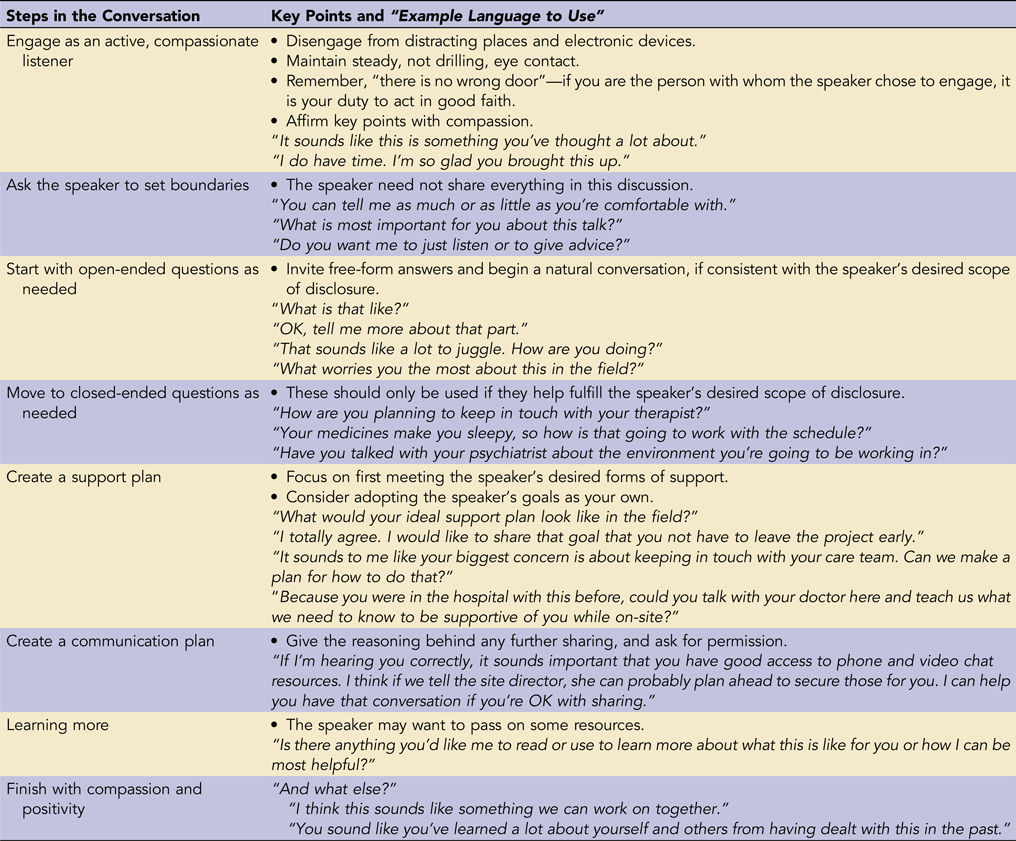
Because a disclosure of a mental health condition may be jarring or confusing for the listener, I offer a basic guide for listening to a disclosure conversation in Table 1. These steps are intended to help implement the how-to-disclose guidance published by the National Alliance on Mental Illness (NAMI 2020a) and to provide guideposts for conduct in these conversations. Throughout the conversation, it is important to remember that mental health conditions manifest along a spectrum of severity, ranging from subtle degradation in social bonds or productivity to self-neglect—or even self-harm. If the disclosure conversation reveals a history of self-neglect that may compromise that person’s safety, or any concern that the future field stressors may lead to self-harm, it is appropriate to encourage the individual to speak with their care team to establish a go/no-go recommendation and develop a support plan to be used during the field season. NAMI (2020b) recommends a plan structure called a Wellness Recovery Action Plan (WRAP). The components of the WRAP are quite extensive, but this can be a conversation starter for the teammate and care team. Together, the team member and care team can determine the components of the plan and then determine the best strategy for disclosing these details to the field team. Because the clinical care team may have no understanding of the field environment, it is important to offer a detailed description of the stressors and resources that will be present.
Guidance on Receiving a Voluntary Disclosure.

BEFORE THE FIELD SEASON
Prior to starting a field season, archaeology field directors suffer over checklists of necessary preparations. Mental health rarely ranks as a top priority among archaeology and biological anthropology field directors. Based on survey results, only 19 of 135 (14%) of respondents elected it as one of the primary concerns in the pre-fieldwork planning phase (Eifling and Klehm Reference Eifling and Klehm2020). Yet, as mentioned earlier, 17.8% of respondents mentioned that it is one of the hardest to resolve in post-fieldwork contexts. Should those checklists, then, include boxes for each team member’s mental health preparations? Perhaps, but it is worth discussing how the elements of wellness discussed as “mental health” lie conceptually within a broader consideration of “individual readiness.”
The paradigm of readiness is used throughout the U.S. Armed Forces. It is applied to large combat units (with elements to address the state of repair of their jets and tanks) all the way down to individual members (with questions about whether their Last Will and Testament is current, and whether they have packed all the required eyewear). Field researchers need to ask themselves similar questions. For the entire group, leaders will naturally be focused on whether funding, equipment, and partnerships are operational. It may feel less natural to be inquisitive about the group members’ preparations and any circumstances that will threaten an individual’s ability to contribute in the field. Moreover, it may be illegal to be inquisitive, depending on how one goes about it. To achieve individual readiness in the military setting is difficult, despite the group’s ability to inspect and demand it. To achieve it in a research setting is therefore daunting, given its manifest importance and persistent obscurity—from a mental health perspective, a person’s readiness for the field can be degraded by the presence of active stressors and by mental illness.
Preexisting stressors need to be discussed frankly by the team to consider their importance to the field team’s productivity. This should not, however, be a kind of simple checkbox analysis. Some stressors at home may be alleviated by the physical and mental separation generated by a field season, whereas other stressors may be aggravated by the same separation. For example, a team member’s recent breakup with a boyfriend may be rendered less haunting when distanced from associated places and activities. Meanwhile, a teammate’s productivity may be severely degraded if the individual is worried about a parent’s recent diagnosis with Parkinson’s disease. Understanding stressors requires that the team members have a baseline knowledge of one another, the choice to disclose stressors, and the faith that disclosing stressors will not hinder their professional contributions. In order to appraise the team’s active stressors fairly, the team must share a culture of trust and confidence. Furthermore, those involved need to understand that for some stressors, the natural coping response could render a reasonable person useless in the field. There should be no shame in postponing a field season if a team member’s child was just diagnosed with leukemia—but some might want the team to flex for a cat being diagnosed with cataracts. No two people react in just the same way, but surely everyone has stressors at any given time. Fortunately, it is not the team leaders’ responsibility to extinguish or place values on stressors. Instead, the leadership should foster a culture that encourages self-evaluation, respects disclosure, and facilitates thoughtful discussion of possible impacts on the team’s work. Team members should ideally have time to mitigate major life events prior to go/no-go decisions from the team.
First, leaders should set an explicit expectation of inclusivity and cultivate trust in the organization. They should provide an unvarnished understanding of the demands in their specific field research environment trusting that each individual will take steps to avoid becoming sick and injured in the field, and therefore make good choices about disclosure. Hopefully, a prior experience or field school will have given each teammate reasonable expectations about the hardships of the job. It is possible, however, that a person’s particularly positive prior field experience will fuel false assumptions about what is to come. Moreover, a gentle portrayal of the field season may make any condition seem irrelevant. After all, who needs a health screening for a walk in the park? Leaders should also consider recruiting people who will share a culture of inclusion and interdependence. Then, they should focus on eliminating stigma and the expectation of discrimination by sharing stories of the leadership needing help. This “breaking the halo” practice normalizes vulnerability, fosters interdependence, and invites mutual trust among the group.
Next, it is imperative to ensure that a support plan exists for each individual whose mental health conditions have been disclosed. The leader of a teammate with insulin-dependent diabetes would not expect that individual to receive a simple “all clear” letter from their physician indicating that no more attention needs to be paid to the condition. Instead, that leader would expect some easy and some hard days, each with its own management strategy, with an emphasis on safety. The same expectations should be applied to mental health conditions. An “all clear” is a pointless and perhaps harmful goal, and a management strategy should be designed for good and bad days, with an emphasis on safety. Some mental health conditions, just like some strictly physical ones, will not require such special planning.
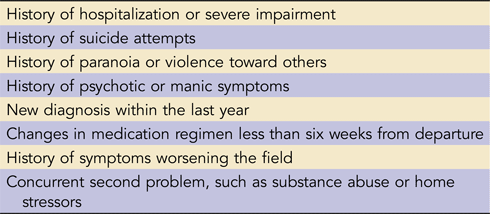
So, how is a field director to know whose condition may need closer attention for support plan development? Features that may suggest that an individual is at elevated risk of self-neglect or self-harm in the field are shown in Table 2 (Valk Reference Valk, Keystone, Kozarsky, Connor, Nothdurft, Mendelson and Leder2019). If a teammate discloses a mental health condition and goes on to describe any of these features, it is reasonable to encourage them to work with their care team to develop a support plan for use in the field. It is not the field director’s role to badger a teammate and run through a list of high-risk features, even if that person chooses not to discuss, confirm, or deny these features. A better leadership approach would be to say, “Please work with your care team to build a support plan we can use to help keep you well in the field and then help us learn about our role in that plan.” The leader can refer the teammate to the WRAP if the individual wants a conversation starter for the care team (Copeland Reference Copeland2012). Of course, the care team may also help guide the go/no-go decision point as well as design field management strategies. Most clinical personnel will be unfamiliar with fieldwork conditions and should therefore be briefed on the demands of the field site; the access to communication, medications, and care facilities; and other circumstances unique to the planned fieldwork environment.
High-Risk Features of Mental Health Conditions in the Setting of Travel for Fieldwork.

Source: Modified from Valk Reference Valk, Keystone, Kozarsky, Connor, Nothdurft, Mendelson and Leder2019.
Reasonable accommodations can be offered by the leadership, requested by the patient, or suggested by a care team member. Ideally, all three parties can be involved in this process and reach a mutually agreeable solution.
Finally, the leadership must be careful to establish the accommodations while sharing the minimum necessary detail with the rest of the team. Discretion on the part of the team leader is of great importance. Further sharing by the patient may be help the team understand, but it should not be coerced.
DURING A FIELD SEASON
In building reasonable accommodations for the field, some steps need to be considered prior to departure. Communication infrastructure is of critical importance and may require securing additional equipment, subscriptions, or funds. Teammates who typically have daily text or phone contact with support networks may depend on that greatly. Those who have weekly video chats with their therapists may be able to continue in the field. Others may need to return to town periodically or switch to satellite phone contact. Whether or not members of your team have a known history of mental health problems, every field leader should know the closest point of care that can provide a native-language, culturally appropriate mental health evaluation or hospitalization. Verification that any evacuation insurance or assets will cover the needs of an acute mental health or behavioral disturbance is also important. Pilots of small helicopters prefer voluntary passengers, so not all of them will carry individuals suffering from a psychiatric disturbance who are being required to leave against their will.
It is easy to imagine that those living in a field camp will have their wellness affected by the place and what goes on there. It can be harder to imagine, however, the concrete steps one can take to build a better work environment. Even excellent leaders will not have the power to design the perfect camp, but they can be intentional about designing the space, tasks, and schedule that everyone will share in an unfamiliar environment.
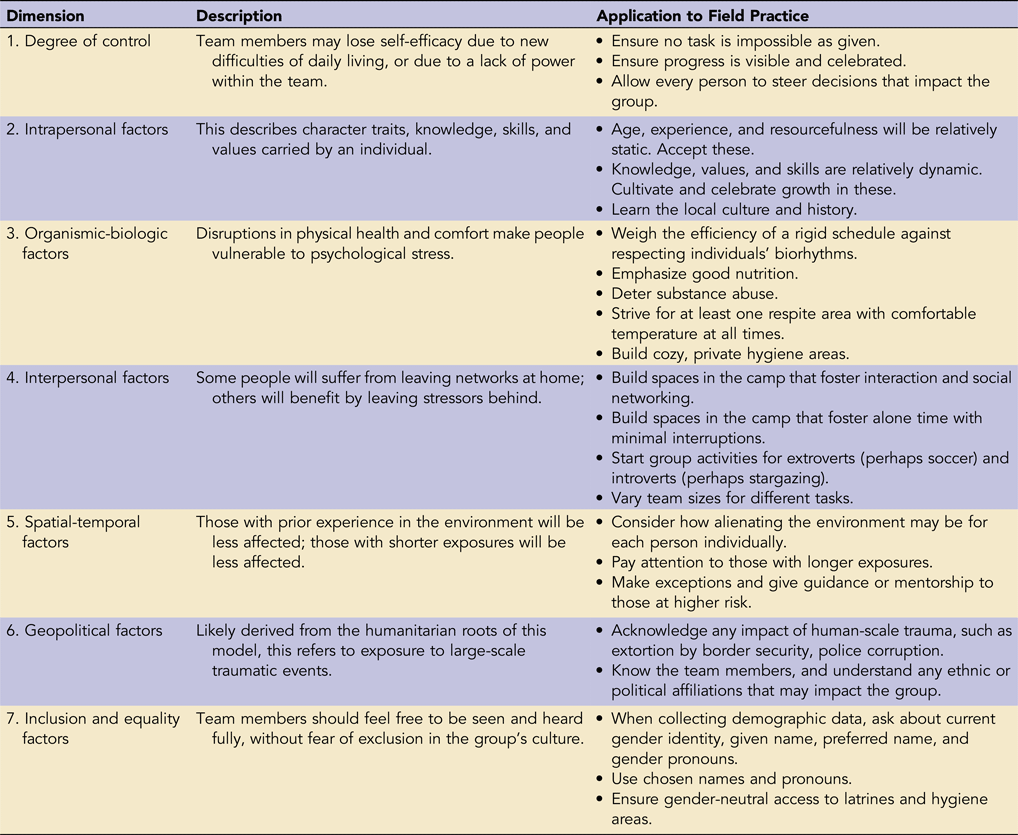
In studies of those traveling overseas for missionary and humanitarian work, the most common cause of early termination of fieldwork was found to be psychological stress. Benefiting from that knowledge, field team leaders may seek to soften culture shock as defined by Furham and Bochner (Reference Furnham and Bochner1986). The phenomenon of culture shock typically refers to a long process of injury and recovery, yet the risk factors for it can serve as guideposts in making a novel environment less alienating even in the short term. In this model, the traveler’s experience is considered in six different dimensions that cause stress. These are shown in Table 3. By understanding these sources of stress, the field leader may be able to adopt some simple do-no-harm practices that may reduce the burden of psychological strain in most participants. In addition to the six dimensions of culture shock, the table contains best practices identified for use in the business community (Thoroughgood Reference Thoroughgood, Sawyer and Webster2020) and legal and demographics research (GenIUSS Group 2014). Such good-faith stress-reduction efforts are aligned with the principle of accessibility, and they may limit the number of impairments resulting in disability in the workplace. Education about culture shock seems to have a protective effect, resolving symptoms and helping people return to normal function more quickly (Befus Reference Befus1988). Symptoms typically are most severe after a few months in the field. Therefore, people taking trips longer than a month should strongly consider pretravel education to improve the understanding of culture shock (Stewart and Leggat Reference Stewart and Leggat1998).
Do-No-Harm Strategies for Decreasing Psychological Stress in Fieldwork Settings.

Sources: Items 1–6 are modified from Furham and Bochner Reference Furnham and Bochner1986. Item 7 is modified from Thoroughgood Reference Thoroughgood, Sawyer and Webster2020.
The common theme among the dimensions in Table 3 is that the most important thing field directors can do is to know the people on their team. To clarify, responsible and thoughtful leadership does not require a set of disclosure checkboxes. Protecting the team’s wellness means actively learning how each person manifests their wholeness, their A game. It also means ensuring that someone notices when a teammate starts showing signs of strain in the field. Then comes the hard work. Directors should make it part of their job to think about each person every day, asking the question, “How is this person doing, and how do I know?” They should also see everyone on the team every day. This may inevitably be perceived as an act of surveillance, but it should be carried out in a caring spirit. A morning meeting after breakfast time is usually a good first choice. This daily ritual lends structure that is useful for organizing the day’s tasks and passing consistent information to the group. It also offers the group leadership an opportunity to watch for changes in teammates’ mood, tone, punctuality, appetite, and social relationships, along with other clues to stress that may have been revealed in a prior disclosure conversation. If the leader is unable to see each teammate due to timing or spatial separation, then someone else should be deputized to think about these individual wellness issues.
MENTAL HEALTH EVALUATION AND INTERVENTION BY THE LAYPERSON
If everything is going well, the archaeological field crew has grown in an atmosphere of trust and interdependence and in an environment that fosters productivity and resilience. The ideal outcome is that teammates will become attuned to one another’s wellness, be aware of changes, and intervene when they see that it is appropriate. Unfortunately, mental health disturbances can appear in subtle or convoluted ways (see Pollard Reference Pollard2009). It is easy to imagine what a teammate would look like with a dislocated finger. It is more difficult to imagine how that same teammate would manifest a slow erosion of a sense of self-efficacy that has resulted in genuine hopelessness. The observant layperson can readily perceive physical ailments in others—limps, rashes, fevers, bruises, and shortness of breath—which is why first aid courses are commonly offered in the community and millions of certifications are earned annually to care for cardiac arrests and injuries. Yet although observant laypeople are poised to observe signs of mental and behavioral ailments equally—such as insomnia, frequent hangovers, panic attacks, tearfulness, social isolation—far fewer resources exist to empower laypeople to use a framework to assess risk and intervene in another person’s mental or behavioral health. This disparity in training corresponds to a disparity in the willingness to do an assessment, make a plan, and intervene in mental health or behavioral disturbances.
Fortunately, there is one system that has key attributes perfectly suited to the needs of a research field camp. Designed for use by laypeople, it easy to learn and rapid to execute. It also offers a repeatable method of assessment, provides guidance on triage, lays out steps for performing basic interventions, and gives guidance on how to choose next steps forward. This system has been laid out in three different paradigms: Psychological First Aid, Mental Health First Aid, and Behavioral First Responder.
Field leaders or empathetic teammates can learn and employ this systematic framework for evaluation, intervention, and referral without fear of accidentally performing rogue psychotherapy—just as a typical first aid student need not fear accidentally performing an appendectomy. And just as surely as there will be a need for physical first aid at some point in a field season, there will also be stress reactions forming, evolving, and resolving.
Psychological First Aid (PFA) was devised in the 1950s in the United States by teams trying to design a response for the behavioral and mental health casualties of nuclear war. Planning how to manage the population-level mental fallout was an intriguing task, and it has continued to be in development in different communities ever since. The principles of PFA have evolved alongside the psychiatry and psychology literature, but the modern versions are more similar than they are different from the original. The basic premise is helping people cope with the acute stress caused by tragic or horrifying events—helping them move out of an acute emotional reaction phase and back to a clear-thinking, future-oriented condition. The process does not require the acquisition of intensive psychiatric knowledge. Instead, it involves an intentional adjustment of one’s usual ways of listening and interacting with someone in distress, and the intentional delivery of knowledge, empathy, and planning to someone in need. An approachable how-to reference for learning the history, empirical basis, and techniques of PFA is The Johns Hopkins Guide to Psychological First Aid (Everly and Lating Reference Everly and Lating2017). Unfortunately, experiential courses in PFA practice remain scarce.
Mental Health First Aid (MHFA) was devised in 2000 in Australia as a way of empowering laypeople to take confident, appropriate action when they sense that someone is developing or experiencing a mental illness, including substance abuse. Since then, it has spread to many different countries and is offered in many formats, ranging from 3-hour to 7-day courses, some about the general population, but others highly focused on the needs of youth, student, military veteran, police, senior citizen, and Canadian First Nations populations. Courses for MHFA have traditionally been offered in a classroom setting, but they are much more available through video teleconference due to accelerated adoption of distance-learning technologies during COVID-19. These courses can be accessed online through Mental Health First Aid (https://www.mentalhealthfirstaid.org/ for programs in the United States or Mental Health First Aid England (https://mhfaengland.org/) for programs in the United Kingdom. Because some MHFA courses are provided through government grants, this training is free in many circumstances.
In 2020, the National Outdoor Leadership School debuted its new classroom-based course for Behavioral First Responder certification. These courses are expected to be offered periodically in 2021, with distance learning options to be determined.
AFTER THE SEASON
Researchers returning from the field may be at risk for a series of adjustments as they reintegrate into their usual lives. Peace Corps volunteers and business travelers have been studied extensively, but research teams generally—and archaeologists specifically—have been studied more sparsely (but see Eifling and Klehm Reference Eifling and Klehm2020). The phenomenon of reverse culture shock is most prevalent in returning travelers who have been away for a long time—months or years. Consequently, they feel genuinely alienated by the changes they encounter when returning home.
Although it may seem counterintuitive, reverse culture shock can be just as disturbing to normal functioning as the phenomenon of culture shock typically experienced when leaving home (Hirshon et al. Reference Hirshon, Eng, Brunkow and Hartzell1997). Data from Howell’s survey work in the 1980s suggest that the returning anthropology researcher is also at risk of remembering the experience of fieldwork differently from the way it was experienced in real time (Howell Reference Howell1988, Reference Howell1990). It would seem that field researchers recall their field experiences fondly, even if they struggled in the moment. This pattern of recall may reflect a rosy bias nudging memory to confirm one’s professional identity. Conversely, it may accurately portray field researchers being their best selves when in the field. The incidence of mental and behavioral symptoms such as anxiety, depressed mood, and insomnia have not been studied using contemporaneous or prospective methods in the anthropology community. Therefore, it is possible that significant recall bias skews reporting that researchers are more blue and anxious when they return home compared to a period of relative wellness in the field. It is also clearly plausible that those dedicated to a career of discovery feel an acute loss when a flurry of exploration ends. Returning researchers may consequently feel a period of grief, but it should not interfere for long with their efforts to rejoin the fabric of their home communities.
Leaders of the field team should bear in mind any stress reactions they noticed during the field season and serve as gentle stewards encouraging follow-up after these members of the team return home. As team members reengage with home life, they will need to reengage with both old and new stressors, perhaps experiencing some amount of reverse culture shock, and perhaps grieving the end of the field season. It is important to normalize these reactions and ensure that those showing persistent or severe difficulty reintegrating into their lives have access to counseling support.
SOCIAL MEDIA AND COMMUNICATIONS
Although some of the best data on archaeology wellness have come from the 1980s, it is also important to consider the influence of powerful new technologies. Since the 2007 release of the iPhone, the sweeping adoption of smartphone technology has allowed a generation of psychologists and programmers to devise ever more powerful tools for controlling attention and behaviors, and to create some new connections while dissolving others. A fascinating body of psychology literature is investigating why, despite all the connectedness of our virtual spaces, Americans feel lonelier than they did in 2006. Now that over 80% of mobile phones in use are smartphones, they have become pervasive enough that random in-person encounters are reduced during the day for users and nonusers alike. Each user signs an individual agreement for the experience of using a smartphone, with their combined weight serving effectively as a societal consent to alter human behaviors and to have collective attention shifted away from the physical into the virtual. The effects of this are so broad and so new that they are poorly understood.
Even collecting data on technology deprivation has proven to be difficult because people do not want to consent to the experience of withdrawal. Yet compelling studies show our devices often serve as wedges instead of bridges. Adults having a conversation felt less satisfied by that conversation if a smartphone was merely present at the table (Przybylski and Weinstein Reference Przybylski and Weinstein2013) and perceived a loss of control in an endless hail of work-related e-mails (Alter Reference Alter2017). American adolescents showed rapid improvement in empathy and emotional recognition after just a week of camping together without smartphones (Uhls et al. Reference Uhls, Michikyan, Morris, Garcia, Small, Zgourou and Greenfield2014), and adults show improvement in well-being after reducing screen time and shifting to in-person interactions (Sherman et al. Reference Sherman, Michikyan and Greenfield2013; Tromholt Reference Tromholt2016). These relationships are complex, but the related literature is growing rapidly and may already be sufficient to support evidence-informed policies for smartphone use in field research and training environments. The data suggest that although the proposition of leaving the mobile network is anxiety provoking, the effects of withdrawal are indeed healthy, so there is no expectation of harm following limited access to social media. Those leading field training environments could make a choice to deliberately limit access to social media as an evidence-informed feature of the program, intended as a measure to support specific educational goals. For starters, a reduction in mobile device use may prevent the cognitive burden of frequent task-switching, thereby preventing blocks of time from being shattered into less useful “time confetti,” as described by psychologist Ashley Whillens (Nickisch and Whillens Reference Nickisch and Whillens2019). Furthermore, each field school should consider whether it is part of its mission to deliver for students a preview of the stressors of technology withdrawal and isolation, which may be inherent in some of their future projects. And finally, those in the field together depend on one another, and thoughtful interpersonal interaction with one’s teammates is the only way to monitor and support one another’s well-being. Time spent on devices costs time spent on teammates. Of course, any such policies should also respect a tool so compact that it can serve as a map, flashlight, beacon, and encyclopedia—and not wantonly dismiss a smartphone’s potentially lifesaving functions.
CONCLUSION
The archaeological field season is a complex stimulus to mental and behavioral health, and it conjures a complex response. The environment, the tasks, and the team all contribute to the overall effect. Best practices with our current state of the literature are largely derived from the travel medicine, humanitarian, and business spheres. Although some important topics, such as the impact of social media and technology on mental health, are being actively studied for broader reasons, the most important issues of understanding the field camp experience still need more careful study, with less reporting bias. Prospective data about the mental health and behavioral effects of the field research experience would be needed to define the hazards and healing opportunities. Ultimately, by minimizing the harms and magnifying the healing elements of field research as a discipline, it might be possible to build a healthier experience for those who love this unique work. The emphasis on a culture of inclusion and accessibility, the exposure and rejection of sexual assault, and the expectation of equal access all suggest that the field’s next generation of leaders will be equipped with rapidly expanding standards of decency. Until those ideals become the norms, it is incumbent upon practitioners of archaeology to support one another’s wholeness, and it is the duty of their physicians and other mental health providers to learn how to provide sound counsel for students, educators, and industry archaeologists.
Acknowledgments
No permits were required for this project. My gratitude remains boundless for the Corpsmen, Chaplains, and Medical Officers with whom I shared loss, hope, and replenishment while we supported the combat operations of 3d Battalion, 8th Marines from 2010 through 2013. Never again have I had a view so textured and true of so many other people. Those experiences still inform much of my approach to field care, and the opinions I offer here surely contain unnoticed echoes from that place and that work. I don't hope to militarize the research camp or its members; rather, I aspire to help its members profit from our experience.
Data Availability Statement
No original data were presented in this article.