INTRODUCTION
Varroa destructor Anderson & Trueman is an important threat for apiculture in most bee-keeping areas of the world and is indirectly responsible for huge losses of production in many bee-pollinated crops (Klein et al. Reference Klein, Vaissière, Cane, Steffan-Dewenter, Cunningham, Kremen and Tscharntke2007). Infested colonies collapse within 1 year if no effective acaricide treatment is carried out. Unfortunately, resistance towards many acaricide products has already been reported throughout Europe and the United States (Sammataro et al. Reference Sammataro, Untalan, Guerrero and Finley2005). This suggests a need to explore alternative control methods, based on a deeper understanding of the biology of the parasite and its host.
A crucial step in the life cycle of V. destructor is cell invasion, as this represents the beginning of the reproductive phase (Boot et al. Reference Boot, Beetsma and Calis1994; Dillier et al. Reference Dillier, Fluri and Imdorf2006). Mechanisms triggering cell invasion have been investigated; Beetsma et al. (Reference Beetsma, Boot and Calis1999) focused on the critical distance that allows the recognition of the brood by the mite; and Goetz and Koeniger (Reference Goetz and Koeniger1993) and Boot et al. (Reference Boot, Driessen, Calis and Beetsma1995) underlined the role of the distance between the larva and the cell rim.
Further studies investigated possible semiochemicals involved in the invasion process; several compounds released from the brood have been analysed and evaluated under laboratory conditions (see Milani, Reference Milani2002). Unfortunately, none of the identified chemicals appeared to be active under field conditions. More recently, Nazzi et al. (Reference Nazzi, Milani, Della Vedova and Nimis2001) studied the biological activity of bee larval food and identified a compound, 2-hydroxyhexanoic acid, that appeared to affect the process of cell invasion, both under laboratory and field conditions (Nazzi et al. Reference Nazzi, Milani and Della Vedova2004).
However, V. destructor reaches the brood cell by being carried there by a bee (Boot et al. Reference Boot, Beetsma and Calis1994). As nurse bees are mostly responsible for brood caring, whereas pollen bees do not normally come into contact with developing larvae, the choice of bee by the parasite can heavily influence its reproductive success (Calis et al. Reference Calis, Fries and Ryrie1999). Preference of varroa for honeybees of different ages has been investigated, showing that nurse bees are preferred over pollen foragers. Hoppe and Ritter (Reference Hoppe and Ritter1988) showed the strong repellent effect of the foragers' Nasonov pheromone on the varroa mite, which could be induced by glandular levels of pure pheromone compounds like geraniol. Kraus (Reference Kraus1993) supported the hypothesis of Hänel and Koeniger (Reference Hänel and Koeniger1986) concerning the influence of hormones of adult bees, such as juvenile hormone III, on the behaviour of the mite.
On the other hand, it has been noted that important differences exist among different developmental stages of the honeybee with respect to the quantity and quality of the cuticular hydrocarbons (Nation et al. Reference Nation, Sanford and Milne1992; Rickli et al. Reference Rickli, Diehl and Guerin1994; Martin et al. Reference Martin, Salvy, Provost, Bagnères, Roux, Crauser, Clement and Le Conte2001; Salvy et al. Reference Salvy, Martin, Bagnères, Provost, Roux, Le Conte and Clément2001; Aumeier et al. Reference Aumeier, Rosenkranz and Francke2002; Schmitt et al. Reference Schmitt, Herzner, Weckerle, Schreier and Strohm2007), and the influence of these on the varroa mite has already been recognized by different authors (Rickli et al. Reference Rickli, Diehl and Guerin1994; Donzé et al. Reference Donzé, Schnyder-Candrian, Bogdanov, Diehl, Guerin, Kilchenman and Monachon1998; Nazzi et al. Reference Nazzi, Milani and Della Vedova2002).
This study aims at further investigating the cuticular profile of nurse bees and pollen foragers and its possible role in the host-preference of V. destructor, with a view of identifying possible compounds that play an active part in host choice by the mite. Once identified, such compounds could represent novel tools in the development of alternative techniques for varroa control.
MATERIALS AND METHODS
Biological material
Honeybees and adult females of V. destructor were obtained from the experimental apiaries of Udine University (North-eastern Italy) where they were collected from May to September. Previous studies indicated that local colonies of A. mellifera L. used in all the experiments are hybrids between A. m. ligustica Spinola and A. m. carnica Pollman (Comparini and Biasiolo, Reference Comparini and Biasiolo1991; Nazzi, Reference Nazzi1992). The apiary was set up the year before the experiments and the colonies were maintained untreated for the duration of the experiments.
Adult honeybees were collected inside beehives for chemical analysis; honeybees observed leaning into brood cells were regarded as nurse bees whereas pollen foragers were distinguished by the presence of pollen loads. All nurse bees and pollen foragers were killed by freezing and stored at −20°C.
The mites were obtained from brood cells capped 0–15 h previously, according to Chiesa et al. (Reference Chiesa, Milani, D'Agaro and Cavalloro1989).
Extraction of honeybee cuticular hydrocarbons
Extracts for the gas chromatography-mass spectrometry (GC-MS) analysis were obtained by introducing a single bee into a conical glass vial with 1 ml of hexane and 100 ng of the internal standard 1-octadecene (Aldrich Chemicals). After 15 min the extract was transferred into a thin vial obtained by flame sealing of a Pasteur pipette. The extract was then reduced under nitrogen to 10 μl. One μl of the extract, corresponding to 0·1 bee equivalent, was injected in the GC-MS; 10 μl of the extract, corresponding to 1 bee equivalent, were used for the laboratory assays.
Laboratory assay
A modified version of the bioassay described by Kraus (Reference Kraus1993) was used in this study; 2 dead adult bees were placed at the two extremes of a small Petri dish (60 mm diameter), close to the wall of the container, one in front of the other. One adult female mite was placed in the centre of the Petri dish and its position was recorded every 10 min for 60 min. Three possible alternative positions were considered: mite on the treated bee, mite on the control bee, mite not on bees. For each Petri dish, a score was calculated summing the number of mites that were found on the bees during the six observations. This figure can vary between 0 and 6 and is representative of the time the varroa mite spent on the bees. The score can thus be considered as a measure of the preference of the mite for the stimulus under testing. Of course, this bioassay does not discriminate between cases where the stimulus acts from a distance or where contact must be made before an effect is noted. However, according to our observations, the latter case was very rare with the stimuli studied here. Every replication consisted of 10 Petri dishes and every assay was replicated 4 or 5 times. Experiments were carried out in a thermostatic cabinet, in darkness, at 35°C and 75% R.H. To check the position of the mites, the tray containing the Petri dishes was taken from the cabinet every 10 min and put back within 1 min. With this bioassay the preference of V. destructor for bees of different ages or bees treated with the following pure compounds was tested: 7-pentadecene (cis/trans mixture, 99% purity, called ‘C15:1’ in the rest of the article) (ChemSampCo Inc.), 9-nonadecene (cis/trans mixture, 99% purity, C19:1) (ChemSampCo Inc.), 8-heptadecene (cis/trans mixture: up to 15% trans and 1% heptadecane, 96% purity, C17:1) (Fluka Chemicals), 9-eneicosene (cis, 97% purity, C21:1) (Aldrich Chemicals), 9-tricosene (cis, 97% purity, C23:1) (Aldrich Chemicals). All chemicals were dissolved in hexane and tested at a dose of 100 ng/bee as this approaches the amount that is present on adult bees, as verified by GC-MS analysis. Extracts and pure compounds were spread all over the bee's body by means of a micropipette and the solvent was allowed to evaporate for about 10 min before starting the bioassay.
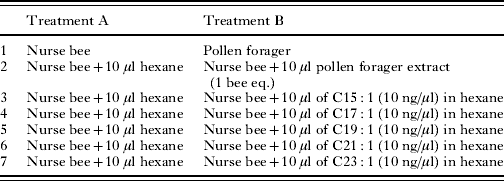
The experiments that were carried out are listed in Table 1.
Experiments carried out with the laboratory assay

Field assay
Combs containing brood cells about to be sealed were picked out and transferred to the laboratory, where groups of 5–10 cells containing 5th instar larvae (L5) were treated by injecting 100 ng of (Z)-8-heptadecene into the cell. As a control, an equal number of cells were treated with 100 ng of heptadecane (Sigma Chemical Co.) dissolved in 1 μl of acetone or with 1 μl of acetone alone; an equal number of cells was left untreated.
The distribution of treated and control groups on the combs was randomly selected, taking care to separate each group from the other by leaving at least 1 cell untreated. The position of the injected cells was recorded on a transparent plastic sheet. Combs were marked and re-allocated in the hives within 3 h.
The following day the marked combs were brought back to the laboratory. The treated and the control cells that had been capped were identified using the marked plastic sheet. Uncapped and emptied cells were noted, intact cells were opened and the number of infesting adult mites counted. Cells containing abnormal pupae or dead mites were not considered for the statistical analysis. The experiment was replicated 10 times; more than 1100 cells per treatment were treated.
GC-MS analysis
The compounds present in the cuticular extracts of nurse bees and pollen foragers were identified with a Varian 3400 gas chromatograph coupled to a Varian Saturn 2000 mass spectrometer. The column (CP-SIL 8, 30 m×0·25 mm ID, film thickness: 0·25 μm) was maintained at 40°C for 1 min then programmed to 320°C at 10°C/min. The carrier gas was helium (flow: 1 mL/min). Injection volume was 1 μl in splitless mode. MS ionization energy was set to 70 eV. Identification was based on the comparison of the mass spectra and the retention time with those of authentic standards.
Quantitative analysis of the identified compounds was carried with the method of the internal standard adding a known amount of 1-octadecene (grade 90%, Aldrich Chemicals) before the extraction. In total, 5 bees per developmental stage were analysed.
Statistical analysis
Laboratory assay
Data from all the replicates were organized in a matrix with as many rows as the number of mites used in the bioassay, and 2 columns containing the scores of the 2 stimuli to be compared. As the variables under study have an unknown distribution, the scores of different stimuli in a data set were compared by a sample randomization test (Sokal and Rohlf, Reference Sokal and Rohlf1995; Manly, Reference Manly1997). The randomization distribution was re-sampled 106 times with a computer program written for this purpose.
In the tables the average sum of the scores obtained in each replicate is given (this figure can vary between 0 and 60, when all mites tested were on the same treatment in all the observations) together with the standard error of the mean.
Field assay
The proportion of treated and control cells that were infested were compared using the Mantel-Haenszel method after testing the homogeneity in the odds ratio of the replicated 2×2 tables.
RESULTS
Laboratory assay
Nurse bee versus pollen forager
Five replicates, using a total of 50 mites, were carried out in the laboratory bioassay. The average score was 33·8±3·9 for nurse bees and 14·6±5·8 for pollen foragers (Fig. 1). The difference was highly significant (P<0·001).
Preference of the varroa mite for different bees in the laboratory bioassay.

Nurse bee versus nurse bee treated with pollen forager extract
Four replicates were carried out with a total of 40 mites. The average score for bees treated with 10 μl (1 bee eq.) of pollen foragers extract was 1·75±1·8 while the average score for nurse bees was 47·25±2·3 (Fig. 1). The difference was highly significant (P<0·001).
GC-MS analysis
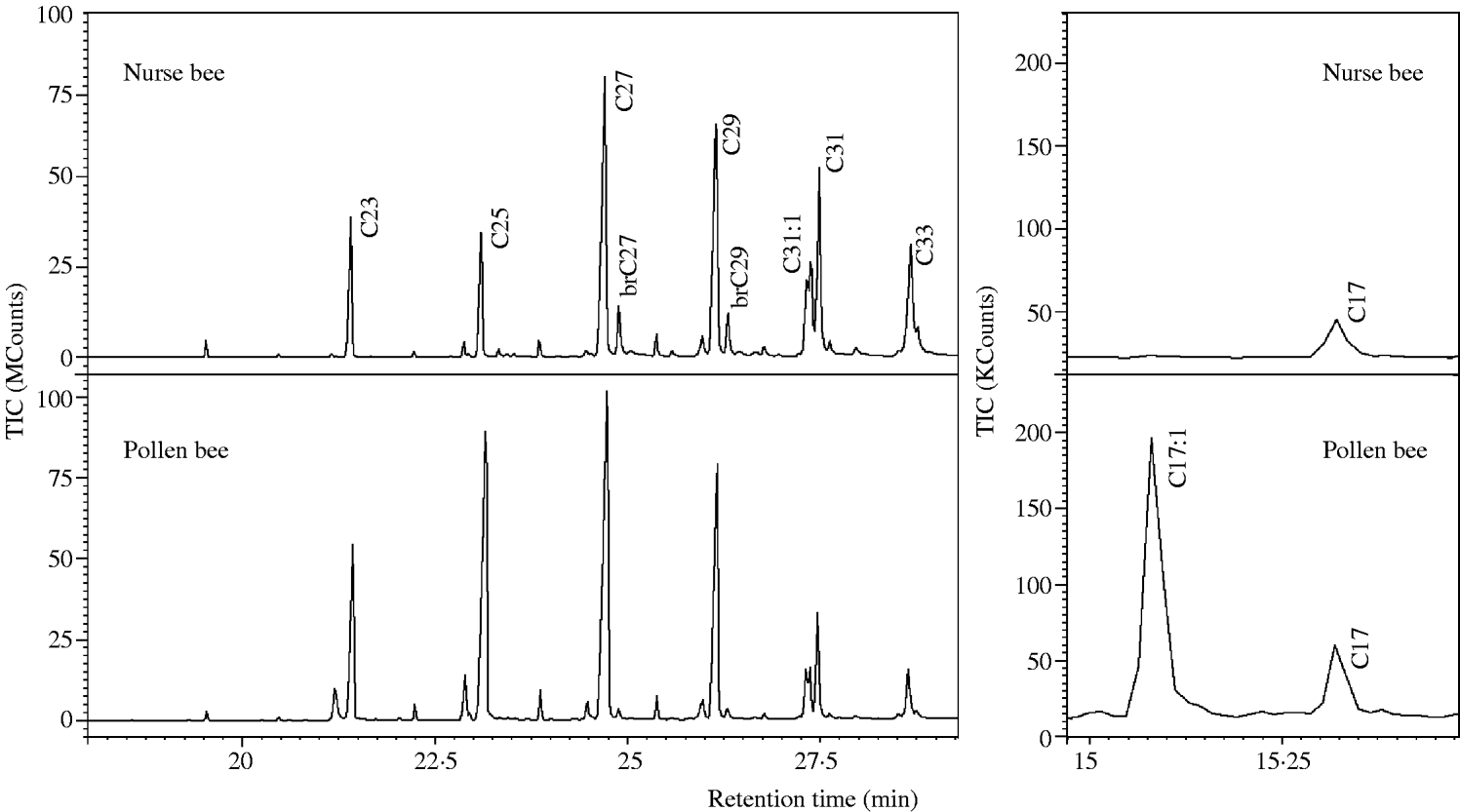
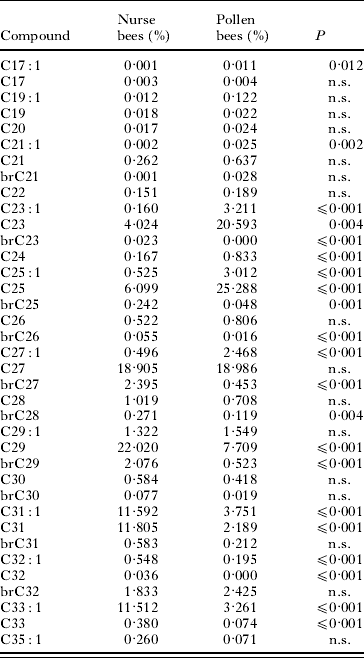
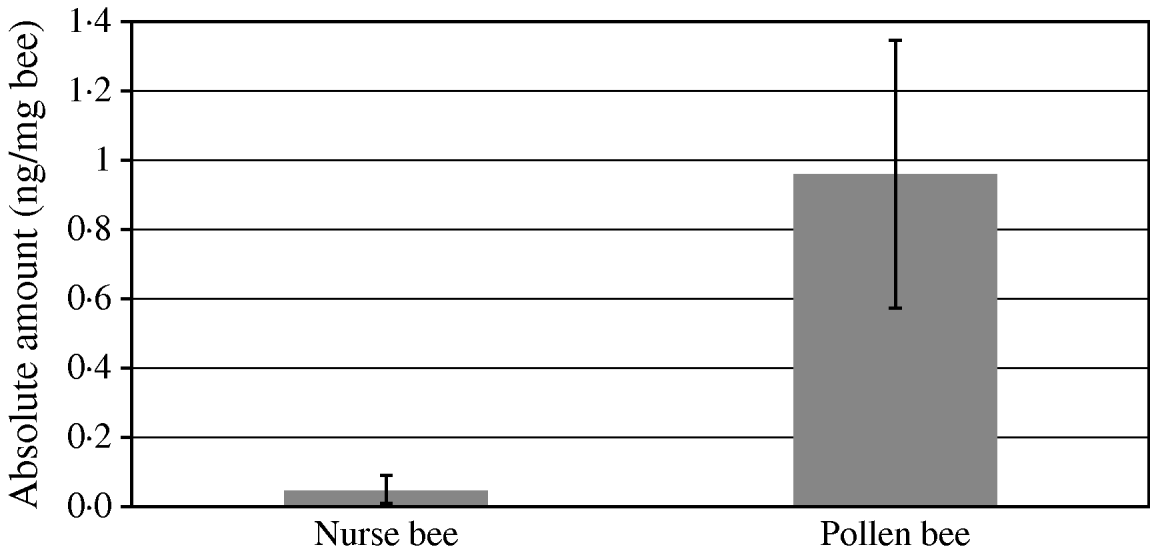
The GC-MS analysis of the extracts of nurse and pollen bees revealed the presence of several linear and branched saturated hydrocarbons with an odd number of carbon atoms ranging from 15 to 33 as well as the corresponding unsaturated linear hydrocarbons (Fig. 2 and Table 2). In general, it appeared that shorter straight-chain hydrocarbons are more abundant in pollen bees compared to nurse bees. In particular, among the most volatile compounds, a significant difference was found in the alkenes with 17–23 carbon atoms (Fig. 3). On the other hand, nurse bees tended to have larger quantities of longer chain hydrocarbons.
GC-MS analysis of a cuticular extract of a nurse bee (above) and a pollen forager (below); on the right, an enlargement of the first part of the GC trace.

Percentage composition of extractable surface hydrocarbons of nurse and pollen bees

Laboratory assays with pure compounds
Nurse bee versus nurse bee+10 μl C17:1
Four replicates were carried out with a total of 40 mites. The average score for nurse bees after the application of 100 ng of (Z)-8-heptadecene was 18±4·38 whereas an average score of 34·25±2·17 was observed for untreated nurse bees (Fig. 1). The difference was highly significant (P<0·005).
C17:1 in nurse and pollen bees as obtained from GC-MS quantitative analysis.

Other laboratory assays
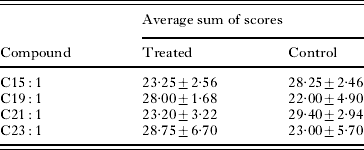
Four replicates, with 40 mites per replicate, were carried out with the following compounds: C15:1, C19:1, C21:1, C23:1. In all cases, no significant differences were found in the preference of the varroa mite for nurse bees treated with the stimuli and the solvent alone (control). The average scores for treated and untreated nurse bees are listed in Table 3.
Laboratory bioassay. Preference of the varroa mite for bees treated with 100 ng of selected pure compounds
(The average scores for treated nurse bees and bees that received the solvent alone (control) are given.)

Field assay
Infestation in cells treated with (Z)-8-heptadecene (0·243±0·05) was lower than in cells treated with the solvent alone (0·286±0·06), heptadecane (0·293±0·07) or control cells (0·291±0·06). The difference in the infestation between cells treated with C17:1 and the solvent alone approached significance (Mantel-Haenszel test, P=0·068).
DISCUSSION
The laboratory bioassay confirmed the preference of the varroa mite for nurse bees over pollen foragers; when nurse bees were treated with the cuticular extract from pollen foragers at the concentration of 1 bee equivalent, they became repellent to the mite. Indeed, it could be argued that mites simply do not like bees that have an extra load of hydrocarbons added to them. However, successive experiments in which the addition of pure hydrocarbons on bee cuticle did not affect mite behaviour suggest that this is not the case. Thus, the most likely hypothesis is that some of the compounds present on the foragers' cuticle may affect the behaviour of the parasite, having a potential role as semiochemicals as suggested by Schmitt et al. (Reference Schmitt, Herzner, Weckerle, Schreier and Strohm2007).
The GC-MS analyses confirmed that the main components of the bee cuticle are linear and branched alkanes (C17-C33) together with the corresponding alkenes. No important qualitative differences were found between the bee stages considered here. However, some quantitative differences between the cuticular profile of nurse and pollen bees were noted, with a higher amount of shorter chain-length hydrocarbons on the foragers' cuticle.
Several factors may be related to the above-mentioned differences. The thin layer of hydrocarbons on the surface of the insect cuticle represents the main mechanism reducing transpiration, a problem that in arthropods, due to their small size, is the main cause of water loss. The general pattern is that the presence of longer chain-length hydrocarbons is associated with warmer habitats; unsaturation and methylbranching have been associated with higher transpiration levels (Hadley and Schultz, Reference Hadley and Schultz1987). Pollen bees carry out their main activity outside the hive whereas nurse bees spend most of the time inside where both humidity and temperature are controlled. Thus pollen bees face environmental conditions that can dramatically differ from those experienced by nurse bees. Therefore differences in the hydrocarbon composition of the cuticle seem to be likely according to the task. In addition, the long chain-length cuticular lipids that confer waterproofing properties to the cuticle could be degraded by oxygen, heat and sunlight (Gibbs, Reference Gibbs1998) and pollen foragers are more exposed than nurse bees to all the external agents involved in the process of lipid degradation.
The laboratory bioassays showed that (Z)-8-heptadecene has a repellent effect on the varroa mite when applied at the concentration of 100 ng on the nurse bee surface with the other alkanes tested showing no biological activity. This suggests that the varroa mite can exploit the differences in the cuticular composition of its host for a fine selection of the most appropriate host stage to infest. In fact, the varroa mite is carried to the brood cells where reproduction takes place by a bee, so the choice of bees that are actively tending brood cells, such as nurse bees, is particular important for the mite. On the other hand, it has been shown that infested pollen bees are less likely to return to the hive than non-infested bees (Kralj and Fuchs, Reference Kralj and Fuchs2006), suggesting that it is safer for the mite not to stay on pollen bees. From this point of view the avoidance of pollen bees by means of recognition of chemical markers may have been selected through evolution.
Previous studies showed that h(Z)-8-heptadecene significantly affects the fertility and the fecundity of the mite inside sealed brood cells under lab conditions (Nazzi et al. Reference Nazzi, Milani and Della Vedova2002). It has also been demonstrated that 100 ng of (Z)-8-heptadecene applied under the capping of worker brood cells, under field conditions, causes a significant reduction in both the number of offspring and in the number of potentially mated daughters per female (Milani et al. Reference Milani, Della Vedova and Nazzi2004). The repellent effect of the alkene that has been demonstrated in this study suggests that the effect of the compound inside the cell may depend on a generic disturbance during the very strictly organized sequence of events leading to reproduction (Donzè et al. Reference Donzé, Schnyder-Candrian, Bogdanov, Diehl, Guerin, Kilchenman and Monachon1998) instead of a primer effect on oogenesis or oviposition. This evidence seems to confirm that (Z)-8-heptadecene has an important role in the biology of the varroa mite and could act as a semiochemical in the mechanism of host selection, which is a crucial step in the reproductive cycle of the parasite, as well as a factor of disturbance to the reproductive behaviour of the mite.
The results of the field experiment, in which brood cells treated with 100 ng of the compound were less infested than control cells, confirm the negative effect of the substance and suggest a possible use in the development of novel integrated techniques for varroa control.