

Introduction
In numerous OECD countries, including the Netherlands, policymakers have adopted behavioural welfare conditionality within social assistance policies as a response to more passive welfare policies. A central feature of these reforms has been the intensification of requirements for recipients to actively seek and apply for paid employment – an approach commonly referred to as workfare (Van Berkel et al., Reference Van Berkel, Caswell, Kupka and Larsen2017). These workfare strategies predominantly emphasize labour market outcomes and the principle of “making work pay,” often through the implementation of activation measures, compliance monitoring, and the imposition of sanctions for non-compliance (Dwyer et al., Reference Dwyer, Scullion, Jones, McNeill and Stewart2022). As an alternative to passive and workfare policies, social investment (SI) policy approaches have gained ground. SI policies aim to facilitate the strengthening of individual capabilities, equipping people for sustainable integration into the labour market through substantive support such as training and counselling (Hemerijck, Reference Hemerijck2017).
Cities increasingly seek space to implement SI policies within national institutional frameworks, thereby serving as frontrunners in social assistance policy innovation (Bokhorst et al., Reference Bokhorst, Bokhorst and Croon2025). In the Netherlands, in response to the most recent major workfarist policy reform in 2015 – the Participation Act – various Dutch cities initiated unique randomized and controlled social assistance experiments. These experiments were frequently characterized as “trust experiments” due to their emphasis on fostering trust and expanding opportunities for caseworkers to implement SI strategies (Groot et al., Reference Groot, Muffels and Verlaat2019; Roosma, Reference Roosma2022). Between 2018 and 2022, a group of around 800 social assistance recipients in a large Dutch city participated in a longitudinal experiment, testing the effectiveness of two alternative social policy approaches against the existing workfare “stick and carrot” approach in welfare-to-work counselling strategies (Muffels, Reference Muffels, Laenen, Meuleman, Otto, Roosma and Van Lancker2021). The first experimental condition was an SI approach, aimed at equipping individuals for the transition to (paid and unpaid) work with intensive and proactive support and coaching from a caseworker (Hemerijck, Reference Hemerijck2017); the second was a self-direction approach, designed to enhance self-determination and intrinsic motivation (Ryan and Deci, Reference Ryan and Deci2000) in making the transition to (paid and unpaid) work. The primary focus of the experiment was on labour market outcomes, while non-economic outcomes were secondary (Bos et al., Reference Bos, de Beer, Elshout, Portielje and van Berkel2023). The methods section and Appendix provide more details about the experiment.
Workfare policy orientations have frequently neglected the significance of recipients’ subjective well-being and trust, focusing instead on economic self-sufficiency as the primary metric of success. However, recent debates as well as scholarly contributions have pointed to the relevance of non-economic outcomes of social policy reforms (Lehmus-Sun, Reference Lehmus-Sun2023; Wagner et al., Reference Wagner, Pöyliö and Hemerijck2025). In this article, we empirically test whether SI policies foster citizen capacitation in ways that improve subjective well-being and generate micro-level policy feedback, reflected in trust in and satisfaction with welfare caseworkers.
The relationship between active labour market policies (ALMPs) and well-being of the unemployed is somewhat ambivalent. For instance, comparative research by Voßemer et al. (Reference Voßemer, Gebel, Täht, Unt, Högberg and Strandh2018) demonstrates that ALMPs exacerbate, rather than mitigate, the negative effects of unemployment on well-being. Lehmus-Sun (Reference Lehmus-Sun2023) also concludes that ALMP does not reduce the shock of (long-term) unemployment on well-being. Moreover, Voßemer et al. (Reference Voßemer, Gebel, Täht, Unt, Högberg and Strandh2018) find that generous unemployment benefits and “passive” income protection reduce the above-mentioned negative impacts on well-being. Other studies suggest that ALMPs effectively reduce the adverse consequences of unemployment for well-being (Carr and Chung, Reference Carr and Chung2014), and participants in ALMP programmes report higher levels of subjective well-being (Strandh, Reference Strandh2001).
These mixed empirical findings regarding the effects of ALMPs on well-being raise questions about the specific conditions under which SI might contribute to enhanced well-being, compared to passive or workfare approaches. An important aspect of ALMP is the dual nature of caseworker support, job search programmes, and work programmes; alongside supportive interventions, these policies often incorporate mechanisms of surveillance and stringent eligibility requirements (Van Berkel et al., Reference Van Berkel, Caswell, Kupka and Larsen2017; Senghaas et al., Reference Senghaas, Freier and Kupka2019; Gjersøe et al., Reference Gjersøe, Leseth and Vilhena2020; Dwyer et al., Reference Dwyer, Scullion, Jones, McNeill and Stewart2022; Eleveld, Reference Eleveld2024). The above-mentioned comparative studies (Carr and Chung, Reference Carr and Chung2014; Voßemer et al., Reference Voßemer, Gebel, Täht, Unt, Högberg and Strandh2018; Lehmus-Sun, Reference Lehmus-Sun2023) rely on aggregate national ALMP investment levels, making it difficult to isolate the effects of punitive versus supportive elements on well-being. Our controlled experimental design addresses this gap.
The effectiveness of social assistance services is dependent on the quality of relationships between recipients and frontline caseworkers (Senghaas et al., Reference Senghaas, Freier and Kupka2019; Gjersøe et al., Reference Gjersøe, Leseth and Vilhena2020). Trust and satisfaction with caseworkers are therefore crucial, as they facilitate open communication regarding the complex issues faced by recipients (Van Echtelt et al., Reference Van Echtelt, Dinmohamed, Eggink, Schyns and Kadrouch-Outmany2024; Vasiljević et al., Reference Vasiljević, Fiket, Đorđević and Štěpánková2025), and thereby improve caseworker-client co-operation (Senghaas et al., Reference Senghaas, Freier and Kupka2019).
However, existing studies regarding the (causal) relationship between social assistance policies and trust are limited in scope. Some scholars have explored the causal link between policy frameworks and trust in politicians and social trust, identifying significant associations (Kumlin and Rothstein, Reference Kumlin and Rothstein2005; Betkó et al., Reference Betkó, Spierings, Gesthuizen and Scheepers2022). Others have examined trust among different groups receiving welfare benefits, concluding that recipients of (selective) social assistance demonstrate lower levels of trust in social services (Hansen, Reference Hansen2025). And few qualitative studies demonstrate how conditional and obligations-oriented policy reforms (Van Echtelt et al., Reference Van Echtelt, Dinmohamed, Eggink, Schyns and Kadrouch-Outmany2024), fragmentation of services (Schneider et al., Reference Schneider, Theiss, Gędek and Zschache2025), and contradictory institutional embeddings (Theiss et al., Reference Theiss, Štěpánková and Šerek2025) complicate the formation of trust. While these studies all emphasize the challenges of building trust within workfare policy frameworks, they do not address whether and how alternative policies shape trust at the micro level between recipients and caseworkers.
In conclusion, despite growing attention to non-economic outcomes of social policy interventions, two gaps remain. First, empirical findings on activation and well-being are mixed, possibly because existing comparative research cannot disentangle supportive (SI) from punitive (workfare) elements of activation policies. Second, while generating trust functions as an SI strategy, little evidence exists on how alternative welfare designs shape trust in, and satisfaction with, caseworkers.
Therefore, our research question is: To what extent do social investment and self-direction policies, compared to workfare policies, enhance subjective well-being, trust in, and satisfaction with caseworkers among social assistance recipients?
Theorizing the relationships between social policies and non-economic returns
To understand how these policy approaches shape non-economic outcomes, we develop a theoretical framework disentangling the mechanisms through which workfare, SI, and self-direction are expected to generate different effects.
Social policy interventions and subjective well-being
Högberg et al. (Reference Högberg, Voßemer, Gebel and Strandh2019) argue – building on Fryer’s (Reference Fryer1986) agency restriction theory – that the impact of unemployment on subjective well-being stems not only from the absence of work as a regular activity or the lack of income as a stressor (Strandh, Reference Strandh2000), but also from the loss of “control, agency, and life-course predictability” (p. 270), implying a diminished capacity to exert control over one’s life and future. Building on this, Carter and Whitworth (Reference Carter and Whitworth2017) differentiate between process well-being – emerging from participation and experiences in activation schemes – and outcome well-being, which is a result of employment transitions facilitated by social policy interventions. In the latter, well-being improvement is driven by the intrinsic and latent value of paid work (Jahoda, Reference Jahoda1982). This study focuses specifically on the impact of policy interventions on process well-being.
Following Lehmus-Sun (Reference Lehmus-Sun2023), we distinguish between a hedonic view, focused on happiness and life satisfaction, and a eudaimonic perspective, centred on the development of capabilities, growth, and self-realization (Deci and Ryan, Reference Deci and Ryan2008). Social policy interventions – especially SI policies – are likely to have a stronger impact on subjective well-being conceptualized in eudaimonic terms than in hedonic terms (Lehmus-Sun, Reference Lehmus-Sun2023), which will therefore be the focus of our study.
We expect that the policy interventions within the experiment may influence eudaimonic process well-being in different ways. Fraser and Honneth (Reference Fraser and Honneth2003) emphasize the importance of social recognition in capacitation processes of citizens (see also Lamont, Reference Lamont2023). In the context of social assistance, interpersonal service provision by caseworkers can bolster feelings of recognition and inclusion, as recipients perceive their specific challenges to be acknowledged (Wagner et al., Reference Wagner, Pöyliö and Hemerijck2025; see also Van Echtelt et al., Reference Van Echtelt, Dinmohamed, Eggink, Schyns and Kadrouch-Outmany2024). Conversely, workfare-oriented policies often undermine this sense of recognition, relying heavily on recipients’ self-reliance rather than caseworker support (Wetenschappelijk Raad voor het Regeringsbeleid, 2017). Furthermore, these policies tend to erode recipients’ sense of agency through conditionalities, manifested in mandatory labour requirements, punitive sanctions, and pervasive surveillance mechanisms (Dwyer et al., Reference Dwyer, Scullion, Jones, McNeill and Stewart2020; Wickham et al., Reference Wickham, Bentley, Rose, Whitehead, Taylor-Robinson and Barr2020; Eleveld, Reference Eleveld2024).
Therefore, in the SI condition, increased contact with caseworkers may lead to greater recognition and improved levels of agency (Fryer, Reference Fryer1986; Fraser and Honneth, Reference Fraser and Honneth2003; Lamont, Reference Lamont2023). In the self-direction group, where clients receive less attention but more autonomy, we expect a positive effect on subjective well-being compared to the workfare group – though smaller than in the SI condition. Recipients may regain a sense of agency (Fryer, Reference Fryer1986) as they are granted more freedom to shape their own path towards employment, while the absence of a supportive and proactive intervention may still leave them struggling to fully achieve a sense of control or to feel acknowledged. These mechanisms highlight how supportive policy interventions are expected to affect recipients’ sense of recognition and agency, while punitive interventions undermine these.
We hypothesize that SI interventions improve subjective process well-being of participants compared to the workfare condition (H1a) and that the self-direction intervention also improves subjective process well-being relative to workfare, but to a lesser extent (H1b).
Social policy interventions and policy feedback: Trust in and satisfaction with the caseworker
Alongside these expected effects on subjective well-being, social policy interventions may also shape recipients’ experiences of the caseworker relationship, thereby influencing policy effectiveness. Temporarily suspending conditions of risk and uncertainty within social relationships is fundamental to the emergence of trust (Giddens, Reference Giddens1991). Direct “face-to-face” interactions with caseworkers serve as a mechanism for this suspension, as these encounters provide recipients with lived experiences that inform their expectations, thereby mitigating perceived risks and uncertainties (Giddens, Reference Giddens1991).
In the literature, three process and outcome-related factors in the formation of trust are identified (Mayer et al., Reference Mayer, Davis and David Schoorman1995; Norris, Reference Norris2022). First, recipients’ assessment of their caseworkers’ ability to provide effective support in establishing outcomes is important. Second, the perceived integrity of caseworkers and the extent to which they adhere to moral and ethical standards are essential. Third, recognition of recipients’ individual values and interests by caseworkers is crucial for establishing a trust-based relationship (see also Fraser and Honneth, Reference Fraser and Honneth2003).
In a comparable randomized experiment in the Netherlands, Betkó et al. (Reference Betkó, Spierings, Gesthuizen and Scheepers2022) demonstrated that self-direction and coaching (SI) within social assistance schemes significantly enhanced trust in (local) politicians, suggesting a causal relationship between the execution of social policy design by caseworkers and trust (see also Kumlin and Rothstein, Reference Kumlin and Rothstein2005). However, they do not disentangle how policy interventions shape trust at the micro level between recipients and frontline caseworkers, despite the central role of such trust in capacitating approaches.
Based on three dimensions of trust (Mayer et al., Reference Mayer, Davis and David Schoorman1995; Norris, Reference Norris2022), and the limited literature addressing causality (Kumlin and Rothstein, Reference Kumlin and Rothstein2005; Betkó et al., Reference Betkó, Spierings, Gesthuizen and Scheepers2022), we hypothesize that participants receiving self-direction and autonomy-based approaches will exhibit increased trust in their caseworker compared to the control group (H2a), and that the self-direction group will report significantly higher caseworker satisfaction compared to the control group, attributable to enhanced autonomy and reduced behavioural conditionality pressures (H3a).
Second, we hypothesize that participants in the SI group will report higher levels of trust in their caseworker, compared to the control group, due to enhanced perceptions of the caseworker’s ability to help (Norris, Reference Norris2022), and the demand-focused approach based on recipients’ needs (Groot et al., Reference Groot, Muffels and Verlaat2019) (H2b). Furthermore, participants assigned to this group are expected to evaluate their caseworker more positively compared to those in the control group, which could be caused by expanded opportunities for support and supervision (H3b).
Design, data and methods
Research context
To test our hypotheses, we draw on a longitudinal, randomized, and controlled experiment conducted in a municipality of a major Dutch city between 2018 and 2022, designed to evaluate the effects of various welfare-to-work counselling strategies under the Dutch means-tested social assistance regime.
In the Netherlands, social assistance guarantees citizens who have insufficient income to provide for themselves an income of 70% of the minimum wage. The study is situated within the national institutional context of the Participation Act (Participatiewet), which, since 2015, obliges all recipients to actively engage in paid employment or socially beneficial activities, under threat of high sanctions for non-compliance. Municipalities retain discretionary authority to adapt social assistance policies to local contexts, and therefore, implementation of sanctions has varied across municipalities; some have opted not to enforce them in full. Caseworkers in the Netherlands play a central role in implementation, as they are responsible for support and coaching on the one hand, and for monitoring compliance with conditionalities on the other.
The fact that the experiment was conducted within the social assistance scheme constitutes a least-likely case for detecting policy effects. Compared to recipients of unemployment insurance benefits (Werkloosheidswet), long-term social assistance recipients typically face more complex social and health-related challenges (De Klerk et al., Reference De Klerk, Eggink, Plaisier and Sadiraj2023). As a result, generating measurable effects through a relatively modest policy intervention is more difficult in this context. If alternative policy interventions yield effects under these conditions, such effects may plausibly be even stronger in settings where recipients are less disadvantaged and potentially more receptive to such interventions.
Research design
The experiment used in this study was open to all social assistance recipients, except for individuals classified as highly vulnerable – those experiencing complex mental health challenges or active addiction – who were excluded on ethical grounds. Approximately 40,000 recipients were invited to participate and received an invitation letter. Out of ~5,250 individuals who voluntarily enrolled, a stratified subsample of 816 participants was selected based on demographic and socioeconomic characteristics, including gender, age, migration background, household composition, residential district, and employment barriers.
After signing a letter of informed consent, participants were randomly assigned to one of three groups: (1) SI, in which participants received demand-focused and proactive guidance from caseworkers, who operated with reduced caseloads (with a maximum of 60 recipients, compared to 300 in the control condition) to enable personalized support; (2) Self-direction, in which participants were given autonomy to decide if, when, and how to engage with their caseworker (who also operated with a reduced caseload of 60 clients), within a non-coercive, low-contact framework; and (3) Workfare (control group), in which participants received standard counselling and support as defined by existing municipal protocols under the Participation Act, with guidance from a caseworker with a maximum caseload of ~300 recipients. Caseworkers in the self-direction and SI groups were not evaluated based on recipient outflow rates, which enabled them to provide broader support. More information about the goals, tasks, and job design of the caseworkers in the experimental arms can be found in Appendix A. Appendix A also provides further details regarding the differences in contact frequency and caseworker turnover across the three groups.
Possible effects of the experimental conditions might partly be attributed to these altered working conditions for caseworkers. However, this organizational context was a prerequisite for the effective delivery of the interventions and for adhering to the experimental arms’ underlying principles: (1) providing broader support across multiple life domains (such as well-being and social participation) rather than focusing solely on paid employment; (2) increasing recipients’ autonomy, thereby building mutual trust; and (3) prioritizing sustainable, qualitative transitions to the labour market over the “shortest route to work” approach.
The baseline demographic and socioeconomic characteristics of participants across the three experimental conditions measured after randomization are presented in Appendix D, indicating balanced randomization. Participants were interviewed at three distinct intervals over the course of the experiment, with gaps of 6–12 months between each wave. More information about the timeline of the experiment and the conditions under which interviews took place can be found in Appendix B. The experimental treatments were implemented after the first interview. Since the baseline interview took place after the initial encounter with the caseworker, it is possible that certain observed differences reflect the participants’ immediate reactions to this first interaction. Consequently, early scores for satisfaction and trust may be influenced by the participant’s perception of their experimental assignment, rather than serving as a purely pre-treatment indication.
All structured survey interviews were conducted face-to-face and, during COVID-19 restrictions, via telephone. Small financial incentives were provided to encourage participation and retention across waves. The COVID-19 pandemic introduced an exogenous shock during the study period, which influenced labour market opportunities and caseworker operations (Bos et al., Reference Bos, de Beer, Elshout, Portielje and van Berkel2023). The last wave of interviews was conducted during the COVID-19 pandemic. Contact between caseworkers and recipients was digital and/or by telephone during this period.
A comparison of characteristics between the experimental sample and the municipality’s total social assistance population reveals some differences. These differences and some further information about reasons why people declined participation can be found in Appendix C. If participants found employment and/or exited social assistance benefits, they remained in the study. The interview questions then focused on contact with their most recent caseworker. Participants left the experiment when they were no longer reachable for an interview, indicated to their caseworker that they no longer wished to participate, or when they moved to another municipality. Across the three conditions, dropout rates from baseline (T 0) to midline (T 1) ranged from 15.7% to 19.9%, while dropout rates from T 0 to T 2 increased, ranging from 26.8% to 28.7%, with an overall attrition of 18.3% at T 1 and 27.8% (see Appendix D). Attrition was not significantly correlated with the three conditions.
Operationalizations
The first dependent variable, subjective well-being, was measured using a 1–10 point self-report scale comprising multiple items related to the eudaimonic conceptualization of subjective well-being. For this study, three items were administered at each wave: “I am happy with who I am,” “I feel in control of my life,” and “I have good contact with others.” T 0 α c = 0.765, T 1 α c = 0.769, and T 2 α c = 0.756, indicating satisfactory reliability. A principal component analysis (PCA), with scores rescaled to a 1–10 scale, was conducted to construct a single well-being index for each wave. Our second dependent variable is trust in participants’ caseworkers, asking respondents to indicate their level of trust on a four-point scale, ranging from 4 (very much trust) to 1 (very little trust). The third dependent variable is participants’ satisfaction with their caseworker, which was measured on a 10-point scale – where 1 represents “very poor” and 10 represents “excellent” – using the question “What grade would you give your caseworker for their efforts and support?”
We include several covariates, adjusting for the influence of possible selective attrition during the experiment on our dependent variables, and to reduce standard errors. We use gender (reference is male), age in years and country of birth, being either in the Netherlands (1) or not (0), educational attainment in five categories, no education and primary school (1), lower level secondary school (2), higher level secondary school (3), lower tertiary education (4), and higher tertiary education (5). Additionally, we control for physical health, using the question, “Do you suffer from one or more long-term (chronic) illnesses, conditions, or disabilities?,” with answer options yes (1) or no (0), and satisfaction with income on a 10-point scale. We also include paid work, indicating whether or not the respondents were in paid (part-time or full-time) employment during the experiment. Hereby, we correct for possible effects of paid work as an outcome of caseworker support on “outcome” well-being (Carter & Whithworth, Reference Carter and Whitworth2017). Furthermore, we include covariates measuring respondents’ attitudes towards social assistance and the role of the municipality. Since randomization was based on objective characteristics, we control for these pre-existing attitudes as they may influence participants’ experiences with the experimental treatments. We selected statements that correspond with preferences towards each treatment. For the SI condition, the selected statement was: “I appreciate attention from the municipality” (attention). For self-direction, we used: “I believe that, while on social assistance, I should be free to do the things I find important” (autonomy). And for the workfare (control) condition, the statement was: “I think it is fair that I have obligations toward the municipality while receiving social assistance” (obligation). Respondents indicated their level of agreement on a five-point Likert scale, ranging from totally disagree to totally agree.
Results
In our results section, we first present the descriptive findings with mean scores in outcomes over the three waves. In a second step, we conduct explanatory analyses using repeated-measures linear mixed-effects analysis.
Descriptive findings
For each dependent variable, we first present the means across the three groups at three time points (T 0, T 1, and T 2) in a figure to visualize developments over time. At baseline (T 0), we additionally examine between-group differences to assess initial comparability.
Subjective well-being. First, we inspect the descriptive results for subjective well-being in Figure 1 and Appendix D. At the start of the experiment (T 0), some marginal but insignificant differences in subjective well-being were observed, where participants in the workfare group (7.5) showed somewhat lower levels of subjective well-being compared to the SI group (7.6) and the self-direction group (7.7). We see a small but significant decrease in subjective well-being within the self-direction group. Dropping from 7.7 at T 0 to 7.3 at T 1 and finally to 7.3 at T 2, resulting in a significant time effect. This suggests that within the self-direction group, the subjective well-being of participants was modestly but significantly reduced. For both the SI condition and the workfare condition, the change over the course of the experiment was both small and insignificant.
Subjective well-being.

Figure 1. Long description
The y-axis is labeled Mean score on well-being 95% C I, ranging from 0 to 10 with a break between 0 and 5.0. The x-axis is labeled Waves with three points: T sub 0, T sub 1, and T sub 2.
Three colored lines represent the experimental groups:
* Self-direction (green line): Starts at approximately 7.7 at T sub 0, drops to 7.3 at T sub 1, and remains stable at 7.3 at T sub 2.
* Social investment (blue line): Starts at approximately 7.6 at T sub 0, drops to 7.2 at T sub 1, and rises slightly to 7.35 at T sub 2.
* Workfare control (red line): Starts at approximately 7.5 at T sub 0, drops to 7.2 at T sub 1, and rises slightly to 7.3 at T sub 2.
Each data point includes vertical error bars representing the 95% confidence interval. On the far right, horizontal dotted lines indicate the overall mean (T sub 0, T sub 1, T sub 2) for each group: blue is highest, followed by green, then red.
Trust in the caseworker. Second, Figure 2 and Appendix D present the mean scores for trust in participants’ caseworkers across three waves, by experimental condition. Between-group comparisons revealed small but insignificant differences in trust at T 0: SI (3.23), self-direction (3.30), and workfare (3.19).
Trust in the caseworker.

Figure 2. Long description
The Y-axis is labeled Mean score on trust 95% C I, ranging from 2.80 to 3.40, with 0 at the bottom indicating Low trust and 4 at the top indicating High trust. The X-axis is labeled Waves with three points: T sub 0, T sub 1, and T sub 2.
Three colored lines represent the experimental groups:
* Social investment (blue line): Starts at approximately 3.23 at T sub 0, remains stable at T sub 1, and shows a slight increase to 3.26 at T sub 2. A horizontal dotted blue line indicates the mean (T sub 0, T sub 1, T sub 2) at approximately 3.24.
* Self-direction (green line): Starts highest at 3.30 at T sub 0, drops sharply to its lowest point of 3.03 at T sub 1, and recovers to 3.18 at T sub 2. A horizontal dotted green line indicates the mean (T sub 0, T sub 1, T sub 2) at approximately 3.16.
* Workfare (control) (red line): Starts at 3.19 at T sub 0, decreases to 3.04 at T sub 1, and continues to decline to 3.00 at T sub 2. A horizontal dotted red line indicates the mean (T sub 0, T sub 1, T sub 2) at approximately 3.06.
Each data point includes vertical error bars representing the 95% C I. The error bars are widest at T sub 2 for all groups.
Mean trust scores in the self-direction group declined significantly from 3.30 at T 0 to 3.03 at T 1, followed by a partial recovery to 3.20 at T 2. For SI, no significant change was observed between T 0 (3.23), T 1 (3.23), and T 2 (3.30). The within-group change for the workfare group was negative, with a small decrease from 3.19 at T 0, 3.04 at T 1, to 3.0 at T 2, but was insignificant.
Satisfaction with caseworker. Next, we present the mean satisfaction scores across three groups at three waves (see Appendix Table D and Figure 3 below). At the start of the experiment (T 0), a marginally significant difference was observed between the groups. Participants in the self-direction (7.9) and workfare (7.8) groups reported slightly higher satisfaction than those in the social investment group (7.5).
Satisfaction with caseworker.

Figure 3. Long description
The Y-axis represents Mean score on satisfaction (95 percent C I) ranging from 0 to 10, with a break between 0 and 5.0. The X-axis represents Waves at three points: T sub 0, T sub 1, and T sub 2.
* Self-direction (green line): Starts at approximately 7.9 at T sub 0, decreases slightly to 7.6 at T sub 1, and ends at 7.5 at T sub 2. A horizontal dotted green line indicates the mean (T sub 0, T sub 1, T sub 2) at 7.7.
* Workfare (control) (pink line): Starts at 7.8 at T sub 0, drops to 7.3 at T sub 1, and continues to decrease to 6.8 at T sub 2. A horizontal dotted pink line indicates the mean (T sub 0, T sub 1, T sub 2) at 7.3.
* Social investment (blue line): Starts at 7.5 at T sub 0, decreases slightly to 7.3 at T sub 1, then increases to 7.8 at T sub 2. A horizontal dotted blue line indicates the mean (T sub 0, T sub 1, T sub 2) at 7.6.
Vertical error bars representing 95 percent C I are present for every data point. The Social investment group is the only one showing an upward trend between T sub 1 and T sub 2.
The workfare group shows a statistically significant decrease in satisfaction, from a mean of 7.8 at T 0 and 7.3 at T 1, to a mean of 6.8 at T 2. The SI group shows a small but insignificant increase, from 7.5 to 7.3 and finally 7.8. In contrast, the self-direction group showed a small but statistically significant decline from 7.9 to 7.6 and finally 7.5.
Explanatory analysis
Next, we estimate a linear mixed-effects model to examine changes in the dependent variable over time and between groups. Here we compare the treatments to the control group (workfare). The model includes fixed effects for time, experimental condition, and their interaction, as well as a random intercept for participants to account for the repeated-measures structure of the data. For each dependent variable, three models were estimated: Model 1 included the main effects of time (wave) and intervention group (workfare, SI, and self-direction) as fixed effects, along with their interactions. Model 2 controls for age, gender, country of birth, education level, health, work status, and income satisfaction. In Model 3, we add different attitudes towards social assistance policies in general (attention, autonomy, and obligation).
Subjective well-being. First, we present the results of the impact of our experimental conditions on subjective well-being (Table 1). The wave dummy shows a small, significant decrease in subjective well-being over time, although in Model 3 the effect on T 2 is only weakly significant (p < .10). In addition, the self-direction group has a somewhat higher overall level of subjective well-being at T 0, especially when controlled for demographic factors and attitudes. The interaction effect shows that this slightly higher level of subjective well-being is significantly reduced during the experiment at T 2, when we consider both demographic composition and attitudes (β = −0.328, SE = 0.151, p < 0.05). For the SI condition, no significant effects were observed.
Effects of social policy interventions on subjective well-being (LMM models) a

Table 1. Long description
The table presents results for three Linear Mixed Models (Model 1, Model 2, and Model 3). Each model includes beta coefficients with standard errors in parentheses and p-values, alongside t-values with degrees of freedom in parentheses.
* Wave (reference T sub 0): T sub 1 shows a significant negative effect across all models (Model 1: beta = -0.27, Model 2: beta = -0.30, Model 3: beta = -0.25). T sub 2 also shows negative effects, though significance decreases in Model 3.
* Group (reference workfare): S I (Social Intervention) shows non-significant positive effects. Self-direction shows significant positive effects in Model 2 (beta = 0.30) and Model 3 (beta = 0.33).
* Wave times Group Interactions: Most interactions are non-significant, except for T sub 2 times Self-direction in Model 3, which is significant (beta = -0.33).
* Demographics: Age, Female gender, and Income show significant positive correlations with well-being. Health (reference Yes) shows the strongest positive significance across Model 2 (beta = 0.52) and Model 3 (beta = 0.46).
* Attitudes: Attention, Autonomy, and Obligation are included only in Model 3 and show non-significant effects.
* Model Statistics: The Intercept decreases from 7.46 in Model 1 to 5.68 in Model 3. R super 2 c (conditional) ranges from 0.63 to 0.66, while R super 2 d (marginal) ranges from 0.01 to 0.08. A I C values decrease from 6134.74 in Model 1 to 4001.33 in Model 3.
a Results of a linear mixed-effects model analysing changes in subjective well-being over time and across groups. The model includes fixed effects for time, group, and their interaction, and a random intercept for participants to account for repeated measures. The models are estimated using ML (lme4 package in R).
b Exact p-value is only reported if 0.05 ≤ p < 0.10.
c Conditional R2.
d Marginal R2.
~<0.10; *<0.05; **<0.01; ***<0.001.
For subjective well-being, we also find a marginally significant effect of the attention attitude, suggesting that placing greater importance on receiving extra attention and guidance could be associated with slightly higher levels of subjective well-being. In addition, lower levels of income satisfaction are also associated with lower levels of subjective well-being. Also notable are the effects of the demographic covariates. Physical health has a positive effect on subjective well-being, and age shows a positive association. Furthermore, women report higher levels of subjective well-being compared to men.
In conclusion, hypotheses 1a and 1b are both rejected; the self-direction approach and the SI approach did not significantly improve the subjective well-being of the participants in relation to the control condition. Alternatively, there is some tentative evidence that self-direction decreased subjective well-being at the last measurement (T 2). However, this effect should be interpreted with caution, given the number of effects estimated in Model 3.
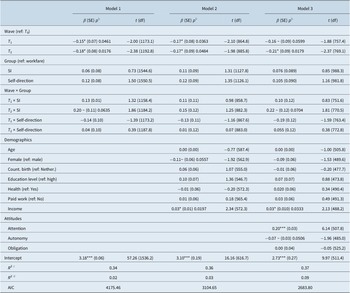
Trust in the caseworker. Trust in the caseworker decreased a bit over time compared to the situation at the start of the experiment, while it did not differ across conditions. Results presented in Table 2 show that all interaction effects are insignificant, but with one exception. We find a weak significant interaction effect of the SI approach at T 2, compared to the control condition: β = .195, SE = .105, p = <0.10.
Effects of social policy interventions on trust in caseworker (LMM models) a

Table 2. Long description
The table presents results for three Linear Mixed Models (Model 1, Model 2, and Model 3) with coefficients beta, standard errors S E, p-values, and t-statistics with degrees of freedom d f.
* Wave (reference T sub 0): T sub 1 shows a significant negative effect in Model 1 (beta = -0.15, p = 0.0461) and Model 2 (beta = -0.17, p = 0.0363). T sub 2 also shows significant negative effects across all models, with the strongest in Model 3 (beta = -0.21, p = 0.0179).
* Group (reference workfare): Neither S I nor Self-direction groups show statistically significant main effects compared to the reference.
* Wave times Group Interactions: The interaction T sub 2 times S I shows a marginal positive effect in Model 1 (beta = 0.20, p = 0.0635) and Model 3 (beta = 0.22, p = 0.0704).
* Demographics: Income has a small but significant positive effect across Model 2 (beta = 0.03, p = 0.0197) and Model 3 (beta = 0.03, p = 0.0333). Female gender shows a marginal negative effect in Model 2 (beta = -0.11, p = 0.0557).
* Attitudes: Attention has a highly significant positive effect in Model 3 (beta = 0.20, p < 0.001), while Autonomy has a marginal negative effect (beta = -0.07, p = 0.0506).
* Model Statistics: The intercept decreases from Model 1 (3.18) to Model 3 (2.73). R-squared marginal values (R super 2 d) increase from 0.02 in Model 1 to 0.09 in Model 3, while A I C decreases from 4175.46 to 2683.80, indicating improved model fit.
a Results of a linear mixed-effects model analysing changes in trust in caseworker over time and across groups. The model includes fixed effects for time, group and their interaction, and a random intercept for participants to account for repeated measures. The models are estimated using ML (lme4 package in R).
b Exact p-value is only reported if 0.05 ≤ p < 0.10.
c Conditional R2.
d Marginal R2.
~<0.10; *<0.05; **<0.01; ***<0.001.
After adding our demographic covariates in Model 2, the effect is reduced and becomes insignificant. Yet, remarkably, after including the items measuring attitudes towards social assistance policies in Model 3, the effect becomes marginally significant again (β = .224, SE = .124, p < 0.10).
Notably, the perception that receiving “attention” from the caseworker is important increases trust. In addition, we find a negative and weak significant effect for the autonomy attitude, suggesting that participants who value self-direction and autonomy could be slightly less trusting in their caseworker. Regarding the demographic covariates, we observe a consistent effect of self-rated income: participants who are more satisfied with their income are more likely to trust their caseworker.
In conclusion, our hypothesis 2a is rejected. Participants who received the self-direction approach were not significantly more trusting than participants in the control group (workfare). Partly in line with our expectation in 2b, we find a modest treatment effect on trust in the SI group. However, we note that the effect is small and marginally significant and appears only in Model 1 and 3.
Satisfaction with caseworker. Finally, we inspect the results for our third dependent variable – satisfaction with the caseworker (see Table 3). The wave dummies show a strong negative effect, indicating an overall decrease in caseworker satisfaction over the course of the experiment. The interaction effects show that this time effect is significantly stronger and positive for people in the SI group (β = −1.315, SE = .273, p < 0.001). The interaction effect is somewhat reduced, but remains strong and significant when we include the covariates. It suggests that in a context of declining satisfaction with the caseworker, the SI approach was able to maintain a relatively high level of caseworker satisfaction.
Effects of social policy interventions on satisfaction with caseworker (LMM models) a

Table 3. Long description
The table presents results from three Linear Mixed Models (L M M). The columns are divided into Model 1, Model 2, and Model 3, each providing beta coefficients with standard errors and p-values, alongside t-statistics with degrees of freedom.
* Wave (Reference T sub 0): T sub 1 shows a negative effect across all models, ranging from -0.52 in Model 1 to -0.44 in Model 3. T sub 2 shows a stronger negative effect, approximately -1.03 to -1.06 across all models.
* Group (Reference workfare): S I and Self-direction show no statistically significant main effects.
* Wave by Group Interaction: The interaction T sub 2 by S I is highly significant across all models (beta = 1.32 in Model 1, 1.28 in Model 2, and 1.14 in Model 3). The interaction T sub 2 by Self-direction is significant in Model 1 (beta = 0.57) but loses significance in Model 3.
* Demographics (introduced in Model 2): Income has a small positive significant effect (beta = 0.06, p = 0.024). Other factors like Age, Gender, and Education are non-significant.
* Attitudes (introduced in Model 3): Attention has a strong positive significant effect (beta = 0.49, p < 0.001), while Autonomy and Obligation are non-significant.
* Model Fit: R super 2 values range from 0.29 to 0.33. A I C decreases from 7123.72 in Model 1 to 4757.14 in Model 3, indicating improved model fit with additional variables.
a Results of a linear mixed-effects model analysing changes in satisfaction with caseworker over time and across groups. The model includes fixed effects for time, group, and their interaction, and a random intercept for participants to account for repeated measures. The models are estimated using ML (lme4 package in R).
b Exact p-value is only reported if 0.05 ≤ p < 0.10.
c Conditional R2.
d Marginal R2.
~<0.10; *<0.05; **<0.01; ***<0.001.
Regarding the self-direction condition, we find a small but significant negative effect (β = −0.567, SE = 0.271, p < 0.05), indicating a smaller decline in caseworker satisfaction compared to the workfare condition. However, after including the demographic variables, this effect becomes insignificant, suggesting it is driven by group composition. The effect remains insignificant after including our indicators for attitudes.
None of the demographic covariates were significant (although income satisfaction becomes marginally significant after attitudes are added). Once again, we find a positive effect of the “attention” attitude. Like the effect on trust in the caseworker, valuing attention is associated with higher caseworker satisfaction.
In conclusion, hypothesis 3b is supported: receiving an SI approach has a positive impact on caseworker satisfaction, in a context where overall satisfaction with caseworkers is declining. Hypothesis 3a, however, receives only minimal support. While there is initially a significant effect compared to the control condition, this effect disappears after controlling for demographic composition.
Discussion and conclusion
This study examines the causal effects of social policy interventions on non-economic outcomes, specifically subjective well-being and policy feedback (trust in and satisfaction with the caseworker). Employing a randomized and controlled experimental design enables the identification of causal relationships between supportive and punitive elements of social policy implementation and these non-economic outcomes. Thereby, this research contributes to the growing literature examining the relationship between social assistance policies and their broader societal impacts beyond economic measures (Voßemer et al., Reference Voßemer, Gebel, Täht, Unt, Högberg and Strandh2018; Betkó et al., Reference Betkó, Spierings, Gesthuizen and Scheepers2022; Dwyer et al., Reference Dwyer, Scullion, Jones, McNeill and Stewart2022; Lehmus-Sun, Reference Lehmus-Sun2023; Wagner et al., Reference Wagner, Pöyliö and Hemerijck2025). In addition to the extensive state-centred SI literature, this article provides deeper insight into how SI practices are implemented at the local level and their effects on non-economic outcomes (cf. Bokhorst et al., Reference Bokhorst, Bokhorst and Croon2025).
Caseworkers embody the abstract system of the government for recipients (Giddens, Reference Giddens1991), upon which recipients depend for their livelihood security and support in reintegration. Trust in caseworkers thus represents an important form of institutional trust and is a prerequisite for effective and adequate support to a vulnerable and often isolated group with limited personal resources (Van Echtelt et al., Reference Van Echtelt, Dinmohamed, Eggink, Schyns and Kadrouch-Outmany2024). One of our key findings is a positive and significant effect on caseworker satisfaction under the SI condition. The effects of the SI treatment on caseworker trust are marginally significant, providing weak empirical support for the hypothesized impact. This suggests that cultivating trust is a more complex undertaking than merely improving recipients’ satisfaction with the relationship with their caseworker (cf. Vasiljević et al., Reference Vasiljević, Fiket, Đorđević and Štěpánková2025). We observed a significant decline in satisfaction in the control group under the workfare condition, possibly driven by (a combination of) disappointment among participants experiencing an absence of change after enrolling in the experiment, and/or disappointment with guidance during a period of socioeconomic uncertainty (COVID-19). Given that the decline was already evident at the T 1 measurement – before the COVID-19 crisis – it is plausible that the former explanation carries more weight than the latter. These findings suggest that the execution of workfare policies tends to undermine policy satisfaction (cf. Van Echtelt et al., Reference Van Echtelt, Dinmohamed, Eggink, Schyns and Kadrouch-Outmany2024; Hansen, Reference Hansen2025; Theiss et al., Reference Theiss, Štěpánková and Šerek2025). However, contrary to theoretical expectations about the trust-enhancing potential of autonomy-based and unconditional approaches (Kumlin and Rothstein, Reference Kumlin and Rothstein2005; Groot et al., Reference Groot, Muffels and Verlaat2019; Muffels, Reference Muffels, Laenen, Meuleman, Otto, Roosma and Van Lancker2021; Betkó et al., Reference Betkó, Spierings, Gesthuizen and Scheepers2022), the data reveal no significant effects of a more unconditional, self-direction approach on trust or caseworker satisfaction.
Regarding well-being, we find no significant or substantive differences between the different groups. Although a significant negative effect was observed in the self-direction group during the final wave, this result only emerged in Model 3 after controlling for various covariates. Given the possible confounding influence of the COVID-19 crisis during the final wave and the large proportion of variance explained by sociodemographic factors, this treatment effect should be interpreted with caution. Also, in contrast to our expectations (Fryer, Reference Fryer1986; Strandh, Reference Strandh2000; Carr and Chung, Reference Carr and Chung2014), we do not find any positive, significant effects of our SI condition on recipients’ subjective well-being. Adding to the body of literature suggesting limited and mixed well-being effects of ALMP (Voßemer et al., Reference Voßemer, Gebel, Täht, Unt, Högberg and Strandh2018; Lehmus-Sun, Reference Lehmus-Sun2023), our findings indicate that a supportive SI or autonomous policy framework does not translate into improved recipient well-being. A plausible explanation for this lack of effect may lie in the characteristics of the study population: individuals on social assistance who often face multifaceted challenges, such as poor health, financial problems, and a lack of personal resources (De Klerk et al., Reference De Klerk, Eggink, Plaisier and Sadiraj2023). Enhancing eudaimonic process well-being (Carter and Whitworth, Reference Carter and Whitworth2017; Lehmus-Sun, Reference Lehmus-Sun2023) of a vulnerable group through caseworker interactions appears difficult to achieve. For this reason, long-term social assistance recipients might derive greater benefit from targeted, social work-oriented interventions to improve their well-being (Vellinga-Dings et al., Reference Vellinga-Dings, Steverink and Bilecen2025).
In sum, these findings reveal an asymmetry between policy feedback and well-being outcomes. While recipients value a more supportive relationship with their caseworker, which partially translates into increased trust, it remains insufficient to counteract the weight of structural barriers to well-being, such as chronic health issues and financial worries. This underscores the limitations of caseworker interventions for well-being improvement in social assistance (cf. Voßemer et al., Reference Voßemer, Gebel, Täht, Unt, Högberg and Strandh2018). These results contribute empirically to the mechanism proposed by Wagner et al. (Reference Wagner, Pöyliö and Hemerijck2025), in which SI interventions generate not only economic outcomes but also non-economic policy feedback.
This study, of course, also has its limitations. The strength of the experiment is simultaneously its weakness. First, the relatively small sample size, compared to larger comparative studies, restricts the chance of finding significant treatment effects. Second, despite running longer than comparable Dutch experiments, duration remained relatively short for achieving sustainable impact on complex processes like improving well-being or building trust. Future research would ideally involve longer-term experiments with more measurement points. Third, potential selection bias exists as participants self-selected initially. This self-selection may have excluded certain groups facing more severe challenges, language issues, or recipients who do not trust the government. In addition, the study may attract certain subgroups who are more likely to participate because they foresee positive outcomes. Consequently, we should be cautious in generalizing these findings to the entire population of social assistance recipients. Also, given the “least-likely case” selection of this study, it is plausible that other (short-term) welfare subpopulations with less complex issues could benefit more from supportive or autonomous policy frameworks in terms of trust and well-being. Fourth, COVID-19 significantly influenced both support provision and, possibly, our outcome measures during the study period. Since the entire T 2 measurement (November 2020–June 2021) coincided with the pandemic, all participants were equally affected at this wave, meaning COVID does not introduce differential bias between experimental conditions. However, the pandemic likely introduced noise into the outcome measures and treatment continuation (digital or telephonic contact instead of in-person meetings), working against finding significant effects. We, therefore, believe that these limitations result in a more conservative test of the mechanisms we hypothesized. Fifth, the initial measurement was conducted following the first meeting with a new caseworker. It is therefore possible that the baseline satisfaction and trust scores reflect the quality of this first interaction rather than a pre-experimental state. Finally, qualitative studies may offer complementary insights into how the mechanisms we theorized, but did not empirically test, play out in practice.
Overall, we believe that highlighting and examining non-economic outcomes of social policy interventions represents a valuable avenue for future research, one that acknowledges that the path to paid employment is challenging for many recipients. Along that journey, positive outcomes such as increased trust and policy satisfaction have intrinsic value.
Supplementary material
The supplementary material for this article can be found at http://doi.org/10.1017/ics.2026.10101.




 Open access

