Urea is a normal constituent of milk and it forms a major part (55%) of the non-protein nitrogen of milk (Ramakrishnaiah & Bhat, Reference Ramakrishnaiah and Bhat1986). Urea content of milk is affected by dietary factors, especially by the balance between the nitrogen fraction in the diet and the energy intake (Lefier, Reference Lefier1996; Holf et al. Reference Holf, Vervoorn, Lenaers and Tamminga1997). A high urea content in milk from unbalanced feeding of cows influences milk production and fertility (Butler et al. Reference Butler, Calaman and Beam1996; Larson et al. Reference Larson, Butler and Currie1997). Dietary crude protein content is positively correlated with milk urea nitrogen concentrations and the latter has been proposed as a management tool for assessing dietary protein feeding (Broderick & Clayton, Reference Broderick and Clayton1997; Godden et al. Reference Godden, Lissemore, Kelton, Leslie, Walton and Lumsden2001; Hojman et al. Reference Hojman, Gips and Ezra2005). Milk urea level is also linked to thermal stability of milk at higher temperature (Rajput et al. Reference Rajput, Bhavadasan, Singh and Ganguli1982, Reference Rajput, Bhavadasan and Ganguli1984). Because of clinical significance of blood urea level, a number of methods for urea estimation have been developed. The methods for estimation of urea in milk are largely derived from methods applicable to blood. These include reaction of urea with p-dimethyl aminobenzaldehyde (Bector et al. Reference Bector, Moti and Singhal1998) or diacetyl monoxime (Bhavadasan et al. Reference Bhavadasan, Rajput and Ganguli1982), measurement of change in pH (Luzzana & Giardino, Reference Luzzana and Giardino1999; International Dairy Federation, 2004) or measurement of carbon dioxide partial pressure (Jenkins et al. Reference Jenkins, Delwiche, Depeters and Bon Durant1999, Reference Jenkins, Delwiche, Depeters and Bon Durant2000) as a result of urea degradation by urease, coupled reaction using urease and glutamate dehydrogenase enzymes (Wolfschoon-Pombo et al. Reference Wolfschoon-Pombo, Klostermeyer, Buchberger and Graml1981; Kampl et al. Reference Kampl, Milas, Francetic and Srebocan1993), degradation of urea into ammonium ion and its measurement by ion selective electrode (Verma & Singh, Reference Verma and Singh2003) and characteristic absorption bands at 1690 cm−1 of amide bond of urea in infrared range (Hansen, Reference Hansen1998). The measurement of ammonium ion by ion selective electrode is prone to interference from other cations (Verma & Singh, Reference Verma and Singh2003). In the present communication, a method for estimation of urea in milk using ammonia sensitive electrode has been described.
Materials and Methods
Milk samples
Pooled or individual cow raw milk samples collected from the cattle yard of the Institute in amber coloured glass containers were brought immediately to the laboratory. The samples were skimmed by centrifugation (3500 g; 10 min.; 5°C) and unless otherwise indicated, the data presented in this article refers to skim milk.
Standard curve of ammonium chloride
Twenty five milliliters aqueous solutions of ammonium chloride (5×10⁻⁵ m to 10−1 m) were placed in 50 ml beaker. The ammonia electrode (Thermo Orion, USA, model: 95-12) connected to pH-meter, was allowed to dip in solution. Then, 0·5 ml high pH – ionic strength adjuster (Thermo Orion, USA) was added. High pH – ionic strength adjuster (ISA) contained sodium hydroxide, methanol and an indicator. The contents were stirred gently at a uniform rate on a magnetic stirrer. Electrode response in terms of mV was recorded when mV readings became stable (approximately 2 min). During measurement of electrode response, the temperature of all solutions was kept at 25°C. The logarithmic of ammonium chloride concentration was plotted against mV.
Standard curve for urea
Twenty five milliliters aqueous urea (Qualigens Fine Chemicals, India) solution (3–15 mm) were treated with 200 μl urease (EC. 3.5.1.5, Sigma Aldrich Chemicals Pvt. Ltd., USA) solution (10 mg/ml 0·05 m-Tris-HCl buffer, pH 7·0) for 15 min at 37°C. The solution was then incubated in a water-bath maintained at 25°C. When temperature of solution reached 25°C, ammonia electrode was added. Then 0·5 ml high pH-ISA was added and electrode response was recorded at 25°C when mV reading became stable. Standard curve of urea was prepared similarly to ammonium chloride standard curve.
Estimation of urea in milk
Twenty five milliliters skim milk was treated with 200 μl urease solution (10 mg/ml in 0·05 m-Tris-HCl buffer, pH 7·0) for 15 min at 37°C. Milk samples were then incubated in water-bath maintained at 25°C. Electrode response in mV was recorded at 25°C after addition of 0·5 ml high pH-ISA. Using standard curve for urea, mV signal was converted into urea concentration (C1).
The urea concentration equivalent to indigenous ammonia content in milk was estimated by treating 25 ml milk similarly as mentioned above except 200 μl Tris-HCl buffer (0·05 m, pH 7·0) was added instead of urease solution. Again using standard curve of urea, mV signal was converted into urea concentration (C2). Urea in milk was then calculated by subtracting C2 from C1.
Validation of method
Milk urea levels were raised by between 2 to 10 mm concentration by addition of calculated amounts of analytical grade urea. Urea levels were then measured as explained above. Recovery of added quantity of urea was calculated.
Urea levels in milk samples were measured by the above described method, diacetyl monoxime method (Bhavadasan et al. Reference Bhavadasan, Rajput and Ganguli1982) and an enzymatic method employing urease and glutamate dehydrogenase (kit from R-Biopharm, Germany). Paired t-test was used for comparison of results obtained by these three methods (Mendham et al. Reference Medndham, Denney, Barnes and Thomas2000).
Addition of preservatives
Two preservatives, Bronopol (2-bromo-2-nitropropane-1,3-diol) at 0·5 g/l and sodium azide at 0·5 and 2 g/l were added to the raw milk sample. Milk samples containing preservatives were stored up to 3 days at 4°C. Urea levels in unpreserved and preserved samples were determined.
Results
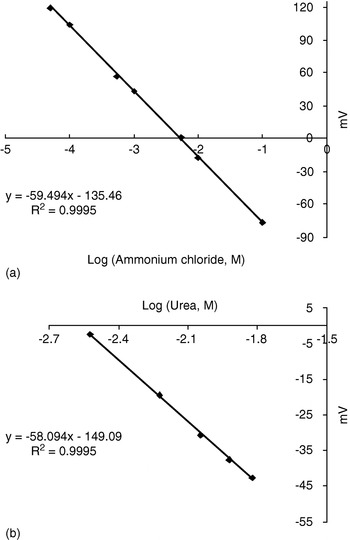
Ammonium ions exist in equilibrium with ammonia gas in aqueous solutions. The equilibrium is far more favoured towards ammonia at pH values greater than 11 (pK for NH3 ~9·0 at 25°C). For of this reason, ammonium chloride aqueous solution was made sufficiently alkaline to allow quantitative conversion of ammonium ion into ammonia to be finally measured by ammonia sensitive electrode. There was a linear inverse relationship between logarithmic ammonium chloride concentration and electrode response, mV (Fig. 1a). The linearity was noted at 10−1 to 5×10⁻⁵m-ammonium chloride. The calculated value of correlation coefficient, 0·9995, is indicative of a high degree of relationship between ammonium chloride concentration and electrode response.
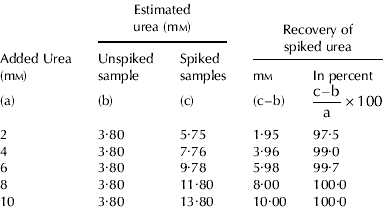
Relationship between ammonium ion concentration (a) or urea concentration (b) and electrode response, mV.

Quantitative conversion of urea into ammonium ion and ammonium ion to ammonia gas is the basis of estimation of urea by ammonia-sensitive-electrode. A linear inverse relationship between logarithmic of urea concentration and electrode response (mV) was noted (Fig. 1b). The correlation coefficient value, 0·9995, in the range of 3–15 mm-urea suggests that linear relationship exists between urea level and electrode response. Since milk urea level is in range of 3–8 mm (Kavitha et al. Reference Kavitha, Bector and Sharma2001a, Reference Kavitha, Bector and Sharmab), this method is applicable to milks. Even in milk samples adulterated with so called synthetic milk (Bansal & Bansal, Reference Bansal and Bansal1997; Paradkar et al. Reference Paradkar, Singhal and Kulkarni2000), abnormally higher levels of urea can be measured by this method.
Recovery
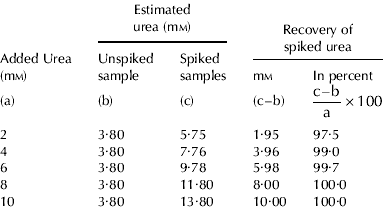
The method was validated by spiking milk samples with known concentrations of urea (2, 4, 6, 8, 10 mm). Estimated values of urea in unspiked sampled, spiked samples and recovery calculations are shown in Table 1. The recovery of added urea to milk was in the range of 97·5 to 100%. These results validate the method for its applicability to milk.
Estimated values of urea in milk spiked with different concentrations of urea and recovery of added urea
Repeatability
Milk and milk with added 2·49 or 4·98 mm-urea were used for repeatability. Each milk was analysed ten times. The mean (±se) urea level in these samples were 8·92±0·05, 11·40±0·06 and 13·84±0·07 mm, and the coefficients of variation were 1·77, 1·60 and 1·59%, respectively.
Accuracy
The accuracy of the ammonia electrode method was evaluated by comparison with two other methods working on different principles; enzymatic method and diacetyl monoxime method.
The mean value (±se) of urea estimations in 10 different milk samples by ammonia electrode method, enzymatic method and diacetyl monoxime method was 8·55±0·33, 8·51±0·31 and 8·83±0·33 mm, respectively. According to the t-test, the mean results from the ammonia electrode method and enzymatic method are not significantly different (P<0·05) from each other. However, the difference was significant (P<0·05) when ammonia electrode method was compared with diacetyl monoxime method. It has been observed that the estimated values of urea in milk by diacetyl monoxime method were about 3·5% higher compared with the other two methods.
Influence of preservative
When milk samples were preserved with sodium azide (0·5 and 2 g/l), no interference in estimation was observed. However, lower values (42 to 67% of initial level) of urea concentration in presence of Bronopol (0·5 g/l) were observed.
Urea levels in whole milk and skim milk
In four different milks, the levels of urea in whole and skim milks were measured. Mean urea levels in whole and corresponding skimmed milk were 4·86 and 5·06 mm, respectively, indicating that urea concentration in skimmed milk were about 4% higher than in whole milk.
Discussion
The addition of urease to milk catalyses the hydrolysis of milk urea to ammonium ion and carbon dioxide (Guilbault & Kauffmann, Reference Guilbault and Kauffmann1987). Ammonium ion is converted to ammonia by addition of high pH-ISA. The addition of high pH-ISA ensures the pH of the solution to be within 11 to 14 thus converting all the ammonium ions to ammonia. The ammonia electrode uses a hydrophobic gas-permeable membrane to separate the sample solution from the electrode internal solution. Dissolved ammonia in the sample solution diffuses through the membrane until the partial pressure of ammonia is the same on both sides of the membrane. In any given sample the partial pressure of ammonia will be proportional to its concentration. Ammonia in internal filling electrode solution becomes in equilibrium with ammonium ion and generates hydroxide ion.

The relationship between ammonia, ammonium ion and hydroxide ion is given by the following equation.
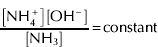
The internal filling solution contains ammonium chloride at a sufficiently high level so that the ammonium ion concentration can be fixed. Thus

The potential of the electrode sensing element with respect to the internal reference element is described by the Nernst equation:

where
E=measured electrode potential
E 0=reference potential
OH−=hydroxide concentration in solution
S=electrode slope
Partial pressure of gas is dependent on temperature and therefore, standard solutions, samples and electrode must be maintained at same temperatures during analysis.
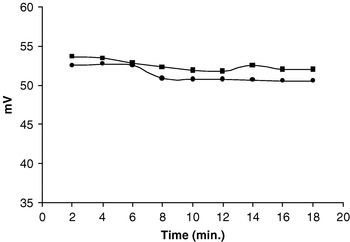
Ammonia is volatile and therefore for minimizing its escape from solution, temperature of urease treated milk (or standard urea solution) was lowered to 25°C. At this temperature as well as at 30°C, there was not significant drift in signal (Fig. 2). However, it is recommended to note response between 2 and 6 min. Electrode response to 1 mm and 10 mm ammonium chloride solutions between 23 to 27°C at 1°C interval were recorded. Electrode response was not affected by these minor changes in temperature of solution around 25°C.
Effect of lapsed period subsequent to pH-ISA addition to ammonium chloride solution (1 mm) on electrode response at 25°C (–•–) or 30°C (–■–).

The results obtained by this study reveal that the ammonia electrode can be employed for the estimation of urea content in milk samples. The method was observed to be in close agreement with the enzymatic method of urea estimation. The method has the advantage of rapidity and a large number of samples can be handled and results are available in short span of time. Sodium azide does not interfere in assay and the method can be applied in preserved milk samples. At times, small variations in standard curves of urea are observed and therefore, fresh standard curves needs to be prepared on each day of estimation.