


Introduction
The reality of inequitable access to speech pathologists for parents of children with speech, language and communication needs in rural and regional Australia is indisputable, contributing to significantly poorer long term outcomes – socially, academically and psychologically (Little & Grasselli, Reference Little and Grasselli2013; O'Callaghan, McAllister, & Wilson, Reference O'Callaghan, McAllister and Wilson2005; Verdon, Wilson, Smith-Tamaray, & McAllister, Reference Verdon, Wilson, Smith-Tamaray and McAllister2011; Victorian Council of Social Services, 2015). Only 4.5% of speech pathologists currently provide services to rural communities, whereas these communities constitute 30% of the total Australian population (Speech Pathology Australia, 2016). A recent Parliamentary Senate Report (Parliament of Australia, 2014) into gaps in accessing speech pathology services recommended increased consultation with health and education providers to ensure parents have access to information about the significance of speech and language disorders, along with information about the services they may need for their children.
Without this information, parents of young preschool-aged children may be unaware that their child may not be meeting developmental milestones, in terms of speech and language development and of the negative sequelae. Additionally, parents may have limited health literacy – defined as the ability to obtain, process and understand the necessary health information to make appropriate decisions (Australian Commission on Safety and Quality in Health Care, 2014). Health literacy also involves understanding the role that speech pathologists have in terms of supporting early speech and language skills, providing the foundation for literacy and the basis for learning at school (Bercow, Reference Bercow2008).
The relationship between parents and health professionals is fundamental to working effectively for a child. Bairati, Meyer, Gueye, Rouleau and Sylvestre (Reference Bairati, Meyer, Gueye, Rouleau and Sylvestre2011) purported that it is the responsibility of parents to seek out expertise relating to their child's perceived developmental needs. However, Arnold, Zeljo, Doctoroff and Ortiz (Reference Arnold, Zeljo, Doctoroff and Oritz2008) suggested that it is the responsibility of the service provider to make parents aware of this role. Each of these approaches can affect the parent-professional relationship, particularly when a parent has had no previous concerns about their child's developmental progress.
Additional difficulties and complexities arise for parents who may be economically or socially challenged, as they may be less aware of their child's speech or language concerns (Australian Early Developmental Index, 2009). Factors such as limited educational background may contribute to this lack of awareness, particularly in recognising early language concerns in their children. Bairati et al. (Reference Bairati, Meyer, Gueye, Rouleau and Sylvestre2011) commented that such families may be less likely to become involved in the educational activities of their child and early intervention services in general.
Studies by Hart and Risley (Reference Hart and Risley1995), Hoff (Reference Hoff2003), Locke, Ginsberg and Peers (Reference Locke, Ginsborg and Peers2002) and Weisleder and Fernald (Reference Weisleder and Fernald2013) all linked the potential for successful academic achievement in young children with high vocabulary and early speech and language competence. Their studies reported that preschool-aged children experiencing poor quantity and quality of direct language experiences in their home environment have a greater likelihood of having poor literacy outcomes at school, when compared to children entering school with higher vocabulary knowledge and having experienced more quality language and literacy opportunities.
Talking Matters Bendigo (TMB) was created in response to the need for improved (and informal) access to speech pathology services for preschool-aged children in the Bendigo region of Victoria. It was established through a partnership between the Department of Education and Training (DET), Bendigo Health (BH), La Trobe Rural Health School (LRHS), and the City of Greater Bendigo (CoGB). The first TMB clinic was conducted in October 2012, operating on a monthly basis as a drop-in clinic in local school libraries. Participating parents came to gain information about their child's speech and language or general development. TMB aimed to link families back to universal services such as maternal and child health services, childcare, kindergartens or playgroups.
What happens at Talking Matters Bendigo?
When the family arrives, they are greeted by staff from DET or CoGB who record demographic details and place families on a waiting list, in order of arrival. There is no appointment system in order to maintain the informal nature of the clinic. Parents have the option of returning later or they can wait in a central space at the clinic where children play together. TMB staff are available to engage parents in conversation about their child, to provide generic suggestions where appropriate, including attendance at playgroups, early parenting programmes, and/or linking back with universal services. There have been up to 12 families with siblings attending at the one time.
TMB sessions are not designed to be diagnostic. There are no standardised speech or language assessments conducted. Instead, the focus of the clinic is on developing parents’ skills in supporting and developing their child's oral language competence. Where the speech pathologist considers it to be necessary to elicit particular sounds or words from the child, this is done through book reading and using play. Once observations of the child are completed, a few simple recommendations are made such as linking the child back to universal services for further global development assessment as required, referral to another health professional, provision of simple ideas to encourage speech or language development at home and/or provision of a simple handout, similar to the Hanen programme, ‘It Takes Two to Talk’ (Pepper & Weitzman, Reference Pepper and Weitzman2004).
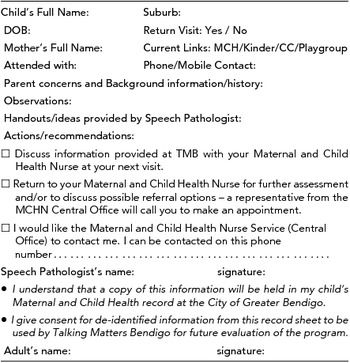
The TMB Summary Page
During the session, the speech pathologist records information on the TMB Summary Page (see Appendix 1) which is given to the parent. A digital copy of the TMB Summary Sheet is then added to the maternal and child health records for the child with the carer's consent, so that it becomes a part of the child's history. At the completion of the session, the parent is offered a feedback form to complete. This is anonymous and collected to inform improvements to the programme.
Monitoring
The TMB reference group comprises representatives from DET, BH, LRHS and CoGB and is responsible for monitoring the delivery of the clinics and overseeing any changes that are required. In 2014, the TMB reference group recommended that a research study to explore parental reactions to TMB was required. One of the reference group members approached a colleague at La Trobe University from Early Childhood and Special Education to develop a methodology with the following two aims:
-
1. To evaluate the parents’ perspectives of TMB and
-
2. To investigate whether TMB was successfully targeting a population of parents in rural Victoria (Bendigo) with preschool-aged children considered to be ‘developmentally vulnerable’ in terms of speech, language and communication needs.
Research Design
A qualitative (phenomenological) research design was used, which aimed to investigate participants’ lived experiences and how they interpreted those experiences (Perry, Morris, & Cotton, Reference Perry, Morris and Cotton2009). The research aims were investigated using an online survey (Appendix 2) and a semi-structured interview (Appendix 3) to collect data from a small sample of parents attending TMB.
Three La Trobe University Bachelor of Education/Honours students carried out this research supervised by La Trobe academics. Thematic analysis of interview data was conducted and themes identified. In order to increase objectivity and validity and to reduce the potential for researcher bias, inter-rater reliability checks through external scrutiny of the thematic analysis was examined by two external PhD students from La Trobe School of Education, Bendigo.
The Bendigo Health Human Research Ethics Committee approved this study (HREC) Reference Number: LNR/15/BHCG21.
Participants and Data Collection
All parents who had been seen by a speech pathologist at two separate TMB clinics, chosen randomly during 2015, were invited to participate by one of the three student researchers. After all information was provided to them concerning the aims of the study and the time commitment required, 10 parents were recruited to the study. Participants were interviewed at a TMB clinic by one of the three student researchers, immediately after seeing the speech pathologist, with most interviews taking approximately 15 or 20 minutes. An online survey was also completed by participants.
Participant demographic data was collected by the researchers (for example, home address, and the location of the TMB clinic they attended) and the referral source (for example, the maternal and child health nurse or the kindergarten teacher). This was done using an online survey because of its appropriateness, being both time and cost efficient in sourcing information from this population (Grimmer & Bialocerkowski, Reference Grimmer and Bialocerkowski2005). As data collection had to be finalised over a short period of time (6 months), the student researchers shared this task. The semi-structured interviews were chosen because they gave the participants ‘a unique voice’ and helped capture parents’ experiences and interpretations of these experiences (Perry et al., Reference Perry, Morris and Cotton2009). This was considered important by the by the TMB reference group.
Data Analysis
Data analysis was conducted by the students using a Microsoft EXCEL spreadsheet to develop descriptive statistics. The rationale for this choice was that the students had limited prior experience of more sophisticated statistical analytical methods. After keywords were identified from the interview data, coding was developed, queries were tested, and emerging themes showing connections were reported using both deductive and inductive reasoning. Deductive reasoning involved ‘confirming or falsifying predictive statements about the relationship between variables’ (Roulston, Reference Roulston2010, p.150).
In this study, codes were used to categorise the data and analyse the findings. This used an inductive reasoning process which occurs when ‘the researcher locates patterns and commonalities that contribute to the generation of theory’ (Roulston, Reference Roulston2010, p.150). This assisted in identifying themes, whilst also observing similarities and differences between individual responses. This was also compared to theoretical assertions such as those by Schwandt (Reference Schwandt2001).
Survey Monkey (2015) was used to expedite coding and cleaning of the survey data but was not used in the development of the survey items. All participants’ answers were summarised immediately after transcription. Grimmer and Bialocerkowski (Reference Grimmer and Bialocerkowski2005) stated that every survey question should address an essential aspect of the research aims as well as be simple in order to make it easy for the participant to answer questions. They claimed that surveys are an efficient way of collecting data in that they are inexpensive and provide high volume and time-efficient data collection. Survey questions were developed by the research team and trialled by the research students for clarity and authenticity. The wording of the survey questions were agreed upon only after the team was satisfied that both elements were demonstrated.
Collectively, the interviews and online survey provided detailed descriptive accounts of the background, expectations, knowledge and understanding of parents who attended TMB. They also enabled the examination of its accessibility, assistance with speech and language development at home and provided perspectives on collaborative partnerships between professionals and families in order to achieve optimal development for their children.
Results
Participants were eight mothers, one father and one foster parent. Of the cohort, 50% were male children and 50% were female children. Half of the children were under 3 years of age and the other half were between 3 and 5 years of age. Participants’ home locations were within the CoGB and within a 50 kilometre radius (for example, Eaglehawk, Maiden Gully, Golden Square, Ironbark, North Bendigo, Quarry Hill, Mount Camel, Goornong). Five participants reported that they were recommended to attend TMB by maternal and child health nurses, three by kindergarten staff, one by early intervention staff and one by playgroup staff. No participant had previously attended a TMB clinic. Seventy per cent of the participants had never seen a speech pathologist. Parents reported that five children attended kindergarten, two attended playgroup, one attended a Mother Goose programme and two did not attend any programme. Nine parents reported frequently reading books to their child at home and one reported daily book reading. All participants reported that TMB was comfortable, eight found it to be handy for school pick-ups and six parents reported that TMB was close enough to public transport.
All participants reported that they had no idea what to expect of a speech pathologist. They reported that there was adequate time to discuss their concerns with the speech pathologist, finding them to be friendly and to be good listeners. Most participants were reassured about their child's speech and language development. However, one parent was unconcerned stating: ‘As a Mum, I really didn't have any concerns because obviously you can understand what your child is saying. Um. . . it was just the kinder teacher who said maybe go. It's not bad. It's not a big problem’ (Karlie).
All participants reported understanding the information provided, although one participant reported: ‘[I] Still don't know what the problem is’ (Laurie). One participant valued the fact that TMB was free. Others stated that they felt positive about their child's future. One parent reported that she would ‘wait and see. . .time will tell. . .if it should sort itself out’ (Katherine).
Participants reported new confidence, improved awareness of the importance of their role in their child's speech and language development, and that they had new ideas to try at home. As Katherine commented: ‘Yes it has shown me that it is important. . . . that I may have skipped a bit and that I should be focusing on it’; whilst Laurie said: ‘It's confirming about what you think and then, even you might not pick up something so I think it's great to come along’.
Parents reported several advantages of accessing health professionals who work together in early child development stating:
Parents are empowered to carry out suggestions at home’ and ‘It provides an approachable professional. . . . it gives you greater awareness of early intervention (Margaret).
Resolving issues early is good’ and ‘Just to make sure and clarify. . . .I want to double check (Laurie)
Daunting to go from maternal and child health into a formal setting with a speech pathologist. . .this is just a little step (Bernadette)
Participants gave several reasons for attending TMB. One parent wanted comparisons with peers to know if they were ‘doing all right’ and realised that early help with speech and language development meant ‘[the child] is quicker to catch up’ (Kay). Bernadette concurred saying ‘too much to catch up on if we wait until school’, whilst Laurie said it ‘avoids social difficulties later in school’.
After being asked would parents recommend TMB to other parents, the participants reported: ‘It was a good starting point for tips and strategies’ (Bernadette); and ‘the clinic was a relaxed atmosphere and a natural environment’ and ‘I would definitely recommend it. . . easy to access. . . . schools provide easy access points. . .glad I came’. (Laurie)
Finally, some participants wanted TMB to be run on different days of the week and to provide morning tea!
Discussion
Parents living in regional, rural and remote areas face a variety of difficulties in accessing appropriate health professionals for their children particularly, speech pathologists (O’ Callaghan et al., Reference O'Callaghan, McAllister and Wilson2005). Furthermore, unidentified and non-supported speech and language difficulties in young children have been recognised as having associated links with long-term negative social, academic and psychological outcomes in later life (Snow, Reference Snow2009). There is now widespread agreement that engaging parents early is crucial in delivering home-based interventions to young children identified with speech and language development concerns (Law, Garrett, & Nye, Reference Law, Garrett and Nye2003; Law, Zeng, Lindsay, & Beecham, Reference Law, Zeng, Lindsay and Beecham2012; Lawler, Taylor, & Shields, Reference Lawler, Taylor and Shields2013; McAllister, McCormack, McLeod, & Harrison, Reference McAllister, McCormack, McLeod and Harrison2011; McCormack & Verdon, Reference McCormack and Verdon2015; McKean, et al., Reference McKean, Mensah, Eadie, Bavin, Bretheron, Cini and Reilly2015; Morgan, Farkas, Hillemeier, Hammer, & Maczuga, Reference Morgan, Farkas, Hillemeier, Hammer and Maczuga2015; Roberts & Kaiser, Reference Roberts and Kaiser2011).
This study found that seven out of ten participants were unaware of speech pathology in general. This finding provides some explanation as to why participants in this study were uncertain about answering some of interview questions regarding the role of a speech pathologist and their understanding about early speech and language development. Three main themes emerged from analysis of interview data. The first theme related to accessibility to TMB clinics in Bendigo. The second theme was about satisfaction with TMB clinic staff and finally the third theme was about satisfaction with information and resources from TMB speech pathologists. Overall, the interview questions elicited some diverse answers revealing some participant confusion about the outcomes of early speech and language support for their child. One question asked participants in what ways they thought information about speech and language strategies from the TMB clinic would be helpful to their child in the future. Participants’ responses varied from doubt about future outcomes to optimism about their child's future outcomes.
Parental health literacy may have been another factor that may have accounted for the uncertainty expressed about the role of speech pathologists. Parents’ understanding of the role of a health professional, such as a speech pathologist, requires some level of health literacy. In a recent national statement on health literacy, only 40% of adults in Australia are believed to have the necessary health literacy to meet the complex demands of everyday life (Parliament of Australia, 2014. p. 2). This suggests that vulnerable families may have greater difficulty acting upon professional information that they have gained during their consultations with professionals. Interview data results from this study indicated high participant satisfaction not only with TMB clinics but also with the quality of the speech pathologists’ knowledge and style of interaction with each parent and child. However, in most cases, this was a first time encounter with a speech pathologist, which indicated participants may have had little health literacy about the role of speech pathologists. Some participants thought that a speech pathologist would ‘test’ their child in a clinical manner, which indicates a lack of service knowledge. This has been mentioned as an associated disadvantage for rural parents by O'Callaghan et al. (Reference O'Callaghan, McAllister and Wilson2005).
It is worth noting that professional relationships between professionals and parents are an important factor in developing improved health literacy for vulnerable families and rural and remote families. Geller and Foley (Reference Geller and Foley2009) stated that there are features operating in professional relationships which relate not only to the quality of professional and parent relationship but also to the quality of parent–child relationships. They advocate that professionals need to consider the importance of the parent–child relationship as a primary means of transferring information and knowledge from parent to the child. They also caution that if this relationship is misjudged or not included adequately by the professional, it may result in a less than adequate outcome for the child.
Limitations
With a small sample size, results from this study cannot be generalised to all parents attending TMB. However, the data presents a cross-sectional snapshot of some parents’ views on TMB clinics and their speech pathologists’ role in engaging parent about speech, language and communication needs in young children. Furthermore, it is acknowledged that there could have been recall bias in some of the participants, in that they may have not remembered some background information or even of some of their experiences at the clinic.
Prompts were used throughout the interviews by the student researchers in order to try and overcome ‘off topic’ responses and to elicit more detailed and relevant answers to interview questions. In addition, it is worth considering that emotional reactions in some participants could have affected their responses. For example, some of the parents had just heard that their child did have significant speech and language concerns. Throughout the study, the researchers were conscious of the potential for emotional reactions from participants and approached each participant sensitively and in a welcoming, relaxed and friendly manner.
A further limitation may have been related to some of the methodology of this study. Scrutineers reported that using key phrases may have been preferable to analysing interview data with only keywords. This may have caused less ambiguity and limited the chance of loss of meaning during interview analysis and the coding process.
Conclusion
This study explored what regional Australian parents thought about their experience of attending TMB. All parents reported that their experience was satisfactory, in terms of accessibility, staff performance and information. Parents reported their experience was informative and useful in terms of information provided to them about their child. They stated that they would use the information and ideas gained from the clinic at home. Overall, there was evidence of a general lack of knowledge about the role of a speech pathologist.
This research suggests a positive outcome for parents who attended TMB and indicated that the clinics not only engaged parents and their children but also assisted in developing health literacy amongst the rural participants. Participants reported their visit to the TMB clinic had an immediate positive effect on their families, with regard to their concerns about their child's early speech and language development.
This study has limitations in sample size and generalisations from this participant group cannot be made, and there is a need for future research that includes longitudinal follow-up studies to establish the long-term effects of TMB clinics. This type of investigation would establish if TMB clinics can maintain a longer term effect on families and would be helpful in establishing if the TMB clinic improved outcomes for children who attended. It is worthwhile noting that an additional benefit gained from this study was that La Trobe Education student researchers gained an enhanced understanding of the complementary role of teachers and speech pathologists in early speech, language and literacy development.
More broadly, service delivery models that are more responsive to client preferences are likely to be well received, as this study demonstrated. Other regional or rural areas of Australia have shown interest in offering a similar type of service. As a result, TMB is likely to be widely applicable with additional modest financial support; and this should be explored in future research.
Appendix 1. Summary of Visit form
Talking Matters Bendigo – Summary of Visit
Appendix 2. Online Survey Questions
1. Are you male or female?
Male/Female
What is the family postcode?
2. What is your relationship to your child?
Mother/Father/Step-mother/Step-father/Grandmother/Grandfather/Aunt/Uncle/Guardian/Other
3. What is the age of your child?
0–2 years/ 3–5 years/ 5+ years
4. Are there any siblings?
Yes/No
If yes, how many siblings?
5. What are the siblings ages?
1/2/3/4/5/6/7/8/9/10/11/12/13/14/15/16/17+
6. Is this your first visit to a Speech Pathologist?
Yes/No
If no, where and when?
7. Have any siblings seen a Speech Pathologist?
Yes/No
8. Does your child attend any of the following?
Playgroup/Kinder/Preschool/Day-care/Creche
If no, why/why not?
9. How often do you read books to your child?
Never/Sometimes (<5 times per month)/ Always (4–5 nights per week)
If NEVER why/why not?
10. How was your experience with Talking Matters Bendigo?
Appendix 3: Audio Questions for Semi-structured Interview
Project Title
A process evaluation of Talking Matters Bendigo: From a parent's/carer's perspective.
-
1. What were your ideas about Speech Pathologists before today? What did you expect? Please describe your experience of speaking to the Speech Pathologist at TMB today. (Prompt: How did you feel about meeting a Speech Pathologist? (and/or) Was this a first for you?)
-
2. How did the Speech Pathologist (today) show that she understood what you were saying? (Prompt: In what ways were you able to contribute to the discussion?)
-
3. What were your concerns about your child's speech and language development before attending TMB today? In what ways did the Speech Pathologist address these concerns? (Prompt: Were your concerns confirmed? (and/ or) Were you reassured that your child is developing typically?)
-
4. In what ways did you understand what was said to you today in regards to your concerns about your child's speech and language? (Prompt: Did the Speech Pathologist address these concerns clearly in a way that you understood what was said?)
-
5. In what ways will you try out the ideas and suggestions given by the Speech Pathologist at home? (Prompt: Are the strategies you were given realistic in terms of the time you have and do you think the strategies would be difficult to implement?)
-
6. How has your understanding of your child's speech and language development (sounds and vocabulary) changed after attending the clinic today? (Prompt: Have you gained further understanding of the importance of talking and role modelling expressive language with your child?)
-
7. What do you think are the main advantages of accessing professionals for advice early in your child's life? (Prompt: How has access to professionals such as Maternal Child Health Nurse, Speech Pathologist (today) been helpful to you and your child?)
-
8. In what ways do you see or predict these strategies being helpful in the future with your child? (Prompt: Do you consider implementing these strategies and suggestions from the Speech Pathologist today will make a difference in your child's speech and language development in the next few months?)
-
9. What were your reasons for talking about your concerns about your child's speech and language at the Talking Matters Bendigo clinic now instead of waiting until your child starts school? (Prompt: Did you at any point consider waiting to see how things would turn out rather than coming today to the clinic?)
-
10. What would you recommend about Talking Matters Bendigo to other concerned parents?


