Throughout their academic life, students are frequently confronted with institutional and individual problems that may jeopardize their health and well-being. Recent studies on higher education (e.g., Ouweneel, Le Blanc, & Schaufeli, Reference Ouweneel, Le Blanc and Schaufeli2011) underline the importance of evaluating mental health in accordance with the characteristics of the academic context. They also recommend a holistic and multidimensional approach to mental health, as a way of understanding the coping processes which enable individuals to prevent mental health disorders and to attain well-being. In line with this perspective, the present study sets out to comprehend the predictive value of academic context characteristics on students’ well-being, with a view to better inform scholars and practitioners of higher education on possible mental health promotion approaches. Context characteristics should be understood as the meaning attributed by students to resources and demands of an emotional, cognitive and behavioral perspective of the academic context (Garello & Rinaudo, Reference Garello and Rinaudo2012). Mental health should be understood from a multidimensional perspective of positive personal well-being (subjective, psychological and social; Keyes, Reference Keyes2007).
Context characteristics and mental health
The relationship between context characteristics and mental health has been conceptualized and empirically studied in several fields of Psychology, however most of the relevant literature has tended to focus more on the context variables connected with workers’ mental health / well-being than with students’. For instance, within the scope of Occupational Health Psychology, a broad range of studies have emerged over the last ten years of research (e.g., Bakker & Demerouti, Reference Bakker and Demerouti2007; Bakker & Leiter, Reference Bakker, Leiter, Bakker and Leiter2010), underlining the importance of work contexts as sites characterized by challenge and/or constraint. In interaction with the individual characteristics of workers, these contexts may either promote or aggravate their mental health. Many of these studies support predictions drawn from a framework of models on the dynamic relationship between variables from an organizational context and workers’ well-being, such as the Demand-Control Model by Karasek (Karasek & Theorell, Reference Karasek and Theorell1990) and the Job Demands-Resources Model (JD-R) by Schaufeli and colleagues (Demerouti, Bakker, De Jonge, Janssen, & Schaufeli Reference Demerouti, Bakker, De Jonge, Janssen and Schaufeli2001). The model by Karasek and Theorell (Reference Karasek and Theorell1990) stresses the role of work demands, such as workload and time pressure, and of control, taken as the extent of participation in decision-making and the updating of personal skills, in the explanation of workers’ distress as well as of their motivation, learning and development. The JD-R model attributes occupational well-being, namely workers’ burnout and engagement, to two types of work context characteristics: perceived demands and resources (Bakker, Hakanen, Demerouti, & Xanthopoulou, Reference Bakker, Hakanen, Demerouti and Xanthopoulou2007). According to this model, demands may take on a physical, psychological, social and organizational nature (e.g., time pressure and workload) and are the main predictors of occupational ill-being and professional burnout, thus contributing to the explanation of workers’ mental health deterioration processes (Bakker & Demerouti, Reference Bakker and Demerouti2007; Schaufeli & Bakker, Reference Schaufeli and Bakker2004). Resources may also be varied (e.g., role clarity, working conditions and social support) and are good predictors of occupational well-being and work engagement, hence sustaining motivational processes (Schaufeli & Bakker, Reference Schaufeli and Bakker2004). Such relations between perceived work context variables and workers’ burnout / engagement are corroborated by a number of empirical studies (e.g., Bakker & Demerouti, Reference Bakker and Demerouti2007; Hakanen, Schaufeli, & Ahola, Reference Hakanen, Schaufeli and Ahola2008).
Within the scope of an academic setting, there is a scarcity of studies on the relationships between context variables and students’ well-being. Even so, some authors have turned to these models on workers’ well-being for some insights and have found that the published literature can also be useful in relation to students. For instance, Lorens, Bakker, Schaufeli, and Salanova (2006) found that the resources associated with the academic tasks, self-efficacy beliefs and well-being (academic engagement) of Spanish students had positive reciprocal relations across time. Lent et al. (Reference Lent, Singley, Sheu, Gainor, Brenner, Treistman and Ades2005) also argued that student’s well-being depends on how they perceive the context characteristics, given that significant relations were found between life satisfaction and perceived academic context resources. Furthermore, Salanova, Schaufeli, Martínez, and Bresó (Reference Salanova, Schaufeli, Martínez and Bresó2010), found that the perception of obstacles and facilitators was positively related to the perception of burnout as well as engagement. All in all, these results suggests the possibility that the factors that influence well-being in the organizational domain also intervene in the coping processes associated with the well-being of higher education students, and substantiate the importance of evaluating the latter in accordance with the perceived academic context characteristics.
Dimensions of Well-Being
The perspective adopted in the study of relations between context characteristics and well-being, for both workers and students, has tended, primarily, towards the professional/academic, and been operationalized by the use of burnout and engagement measures. Nevertheless, as pointed out by Van Horn, Taris, Schaufeli, and Schreurs, (2004, p. 372), well-being may be regarded as “a phenomenon that can be manifested in a number of different ways”, not only through negative or positive reactions towards work. In a study on the structure of the occupational well-being of Dutch teachers, these authors tested a multidimensional occupational model and verified that the professional, social and particularly the affective dimensions constituted their central dimensions.
Therefore, in the present study, we propose to explore the predictive value of academic context variables on the personal well-being of higher education students, through a holistic-based perspective of human functioning, namely by means of Keyes (Reference Keyes2007) three-dimensional model, which combines subjective, psychological and social well-being dimensions. Subjective well-being refers to the evaluation of life satisfaction and the presence of positive feelings; psychological well-being refers to the extent to which people perceive themselves as progressing in their personal lives, for instance in terms of self-acceptance, life objectives and inter-personal relations; social well-being refers to the extent to which individuals perceive their progression in social life, in the local community and in their relationship with society at large. The structure of this model has been confirmed in a number of studies both with adults aged between 25 and 74 (e.g., Gallagher, Lopez, & Preacher, Reference Gallagher, Lopez and Preacher2009) and with university students (e.g., Figueira, Marques Pinto, Lima, Matos, & Cherpe, 2014; Gallagher et al., Reference Gallagher, Lopez and Preacher2009; Robitschek & Keyes, Reference Robitschek and Keyes2009), thus, supporting the use of a single well-being measure, which operationalizes the three dimensions of well-being.
Considering personal well-being from this holistic perspective, integrating subjective well-being and positive psychological and social functioning (Keyes, Shmotkin, & Ryff, Reference Keyes, Shmotkin and Ryff2002), we suggest that there may be a prediction relationship between the perceived academic context variables and the dimensions of subjective well-being. We also expect to find some differentiated relations between the characteristics of the academic context and the specific dimensions of well-being which corroborate other complementary models that explain human functioning (Ryan & Deci, Reference Ryan and Deci2001). Indeed, on the one hand, the subjective well-being dimension, characterized as a state of positive sentiment towards life (Keyes & Waterman, Reference Keyes, Waterman, Bornstein, Davidson, Keyes and Moore2003), has proved to be particularly sensitive to individuals’ life circumstances and to the perception of peer support (Diener, Lucas, & Scollon, Reference Diener, Lucas and Scollon2006; Keyes et al., Reference Keyes, Shmotkin and Ryff2002; Keyes & Waterman, Reference Keyes, Waterman, Bornstein, Davidson, Keyes and Moore2003). On the other hand, the psychological well-being dimension, distinguished by a state of positive psychological functioning, has proven to be more sensitive to intra-individual variables, such as the perception of control and self-efficacy (Keyes & Waterman, Reference Keyes, Waterman, Bornstein, Davidson, Keyes and Moore2003; Ryff, Reference Ryff1989). In studies with higher education students, it has been used to assess the impact of students’ psychological functioning characteristics, namely perfectionism and academic task control (Chang, Reference Chang2006). The social well-being dimension, characterized as a state of positive social functioning, is considered sensitive to the possibility of participation and connection with community and social activities (Wann & Weaver, Reference Wann and Weaver2009). Overall, the three dimensions of well-being have proven to be sensitive to the quality of inter-personal relations (Keyes & Waterman, Reference Keyes, Waterman, Bornstein, Davidson, Keyes and Moore2003).
Closer examination of the relationship between the perception of context characteristics and students’ mental health has gained increasing importance over the last few years in many European higher education institutions, including those in Portugal, due to the structural changes imposed on higher education systems by the Bologna Process. Following the Bologna Declaration (The European Higher Education Area, 1999) a series of ministerial agreements, designed to ensure comparability in the standards and quality of higher education qualifications, were established between European countries. Accreditation became based on a credit system referred to as ECTS (European Credit Transfer System), which made the acquisition of level equivalences possible among the various European countries. In order to reform the education system in alignment with a modernized competency-based system, a total reorganization of curricula and teaching methods in every new cycle of study occurred throughout the first decade of the 21st century. Higher education courses in Portugal were restructured on the basis of three distinct educational levels, referred to as cycles: the first cycle is equivalent to an undergraduate degree, which formerly corresponded to 4/5 years of study and has since been reduced to 3 years: the second cycle is equivalent to a master’s degree, which formerly corresponded to 3/4 years of study and has since been shortened to 2 years; the third cycle corresponds to a doctoral degree (PhD), which formerly corresponded to 5/6 years of study and has since been reduced to 4 years. These changes have resulted in a time span reduction for equivalent academic qualifications, thus increasing students’ autonomous workload and decreasing the amount of time spent on the effective learning of similar curricular content. This, in turn, has served to condition students’ coping efforts and determine the potential risks / benefits for mental health and academic success (Almeida & Cruz, 2010). Nevertheless, to the best of our knowledge the evaluation of the impact of academic context variables on Portuguese students’ perception of well-being in the post-Bologna period is yet to be conducted.
Within this context, the present study aims to investigate the relationship between academic work characteristics in the post-Bologna period and students’ personal well-being (subjective, psychological and social) in a sample of students from the University of Lisbon, Portugal. In fact, it proposes a conceptual model, claiming the existence of prediction relations between academic context variables and students’ well-being, whereby these same variables influence well-being across time.
A longitudinal design was used in which all the measures were applied at two different points in time, separated by a period of eight months, equivalent to an academic year. The first point was at the beginning of the 1st Semester (T1), and the second at the end of the academic year (T2). According to several authors (Schaufeli & Bakker, Reference Schaufeli and Bakker2004), the context variables to be considered should be specific to the organizational site under study. Therefore, we used measures that had already been used by other researchers in studies with students from the University of Lisbon, which identified time pressure (perception of difficulties in managing time to accomplish academic tasks), role clarity (clear expectations about the roles as a student), working conditions (physical conditions and support equipment to the study) and peer social support (instrumental and emotional support from colleagues) as relevant context variables (Chambel & Curral, Reference Chambel and Curral2005).
While considering the empirical findings which define a negative impact of time pressure on well-being (Bakker & Demerouti, Reference Bakker and Demerouti2007; Schaufeli & Bakker, Reference Schaufeli and Bakker2004) and a positive impact of role clarity, working conditions and social support on the very same well-being across time (Hakanen, Schaufeli, & Ahola, Reference Hakanen, Schaufeli and Ahola2008; Schaufeli & Bakker, Reference Schaufeli and Bakker2004), we formulated a hypothesis, predicting a negative prediction of the former and a positive prediction of the latter on students’ well-being. Finally, despite the fact that the revised literature suggests specific relations between different context variables and the different dimensions of well-being (e.g., Chang, Reference Chang2006; Diener, Lucas, & Scollon, Reference Diener, Lucas and Scollon2006; Keyes et al., Reference Keyes, Shmotkin and Ryff2002; Keyes & Waterman, Reference Keyes, Waterman, Bornstein, Davidson, Keyes and Moore2003; Ryff, Reference Ryff1989; Wann & Weaver, Reference Wann and Weaver2009), given that there are very few empirical studies on such influence relations, we set out to analyze them in an exploratory manner in the present study.
Method
Participants
The longitudinal sample comprised a total of 128 students from two Faculties of the University of Lisbon (65.6% from the Faculty of Psychology and Institute of Education Sciences - FPES; 34.4% from the Faculty of Science - FC), and from four different courses (56.3% from Psychology, 8.6% from Education Sciences, 30.5% from Biology and 4.7% from Geology). Most participants were female (82%), in line with the population of Lisbon University; 45.3% were second year students, 19.5% third year students (64.8% from the first cycle) 20.3% fourth year students and 14.1% from the fifth year (34.4% from the second cycle). Pursuant to the Portuguese system, which permits progression from one semester to another without having necessarily passed or taken all the curricular units, this may have been the case for some of the participants, however this aspect was not evaluated. At T1 the mean age was 21years (SD = 4.00) and at T2 the mean age was 21.8 years (SD = 5.00).
Measures
Academic Context Characteristics
The academic context variables were measured on the basis of two Portuguese instruments, in a total of four sub-scales: Time Pressure (4 items, e.g., “I don’t have time to do all my work”, α of .88 at Time 1 and .91 at Time 2), Role Clarity (7 items, e.g., “I know how to acquire the knowledge required for each subject”, α of .87 at Time 1 and .92 at Time 2) Working Conditions (3 items, e.g., “There is enough space for students to work”, α of .72 at both times), sub-scales of the Description of Academic Work scale (Chambel & Curral, Reference Chambel and Curral2005), and the Peer Social Support sub-scale (5 items, e.g., “My peers take a personal interest in me.”, α of .71 at Time 1 and of .80 at Time 2) of the Social Support scale (Chambel & Curral, Reference Chambel and Curral2005). Answers were given for each item on a 5 point Likert scale (1 = I totally disagree; 5 = I totally agree), except in the case of peer social support in which the scale had 4 points (1 = I strongly disagree; 4 = I strongly agree).
Mental Health Continuum – Long Form (MHC-LF)
A MHC-LF version (Keyes, Reference Keyes2007) adapted to Portuguese university students (Figueira et al., Reference Figueira, Marques Pinto, Lima, Matos and Cherpe2014) was used to measure personal well-being in accordance with the model put forward by Keyes (Reference Keyes2007). It is a self-report scale, comprising 31 items distributed across the subjective, psychological and social well-being scales. The subjective well-being scale included 7 items related to the frequency of positive feelings (e.g., “Over the last thirty (30) days, how often have you felt… happy?”) which were answered on a 5 point Likert scale (1 = Always; 5 = Never) and one item related to the degree of satisfaction with life over the last few days, which was answered on an 11 point scale (0 = the worst life ever; 10 = the best life ever. This scale presented an α of .83 at Time 1 and of .84 at Time 2. The psychological well-being scale comprised 14 items (e.g., “Overall, I feel in control of the situation I am experiencing.”), and presented an α of .72 at Time 1 and of .76 at Time 2. Finally, the social well-being scale included 10 items (e.g., “I have something valuable to offer the world.”) and presented an α of .74 at Time 1 and of .70 at Time 2. The items of the last two scales were answered on a 7 point Likert scale (1 = I strongly agree; 7 = I strongly disagree).
Procedures
The study was approved by the Ethics Committee of the institution to which the authors were affiliated. At the beginning of the academic year, corresponding to the first point in time (T1), the teachers responsible for several groups of students were contacted and informed of the aims of the study and of its confidential nature, and permission was requested to enter the classes of the 2nd to 5th year of four different courses. The students were verbally informed of the study aims and those who provided their informed consent to participate replied voluntarily, in a classroom setting, to the questionnaire made up of several scales. Data confidentiality was assured and a secret individual code was chosen by participants to match their answers at T1 and T2. At Time 1, answers were received from 400 participants. At the end of the academic year (T2), the teachers who had collaborated at the first point in time authorized further contact with the students in their classes who were asked to fill in an identical questionnaire to the first. As data collection at T2 occurred in a different school semester and, consequently, not all of the students in the class were the same as those at T1, it was not possible to collect data from T1 participants who were not in the class at T2 for confidentiality purposes. Hence, only one hundred and twenty-eight students answered and completed the questionnaire correctly at both points in time, representing 32% of the initial answers.
Due to the dropout rate, comparative analyses between the group of individuals who participated only at T1 (N = 272 and the group that participated both at T1 and T2 (N = 128) were conducted on the variables of the model at T1. Correlations between the variables of the model were analyzed and, overall, significant correlations were found to present the same direction in both groups. The two groups were then compared in the variables of the model and the socio-demographic variables, and significant differences were found in the independent variable, time pressure, and in the three dependent variables (well-being dimensions). The students who only participated at T1 presented higher perception of time pressure [t(352) = 1.976; p < .05 (two tailed)], lower perception of subjective well-being [t(352) = –21.859; p < .001 (two tailed)] and higher perception of psychological and social well-being [t(352) =7.536; p < .001 (two tailed) and t(352) = 2.111; p < .001 (two tailed), respectively] than the students who participated at both points in time. All these differences were taken into consideration in the discussion of results. The socio-demographic characteristics were similar between the two groups and no significant differences were found.
Statistical Analysis
The hypotheses were tested by using a set of structural equation models with latent variables. First, we performed two, separate cross-sectional analyses at T1 and T2 in order to examine the relationship between the academic context characteristics and the three dimensions of well-being at T1 and T2. These preliminary analyses served to prompt our longitudinal analyses to verify if the cross-sectional pattern of results remained similar across time.
We then conducted a cross-lagged longitudinal analysis, aiming to verify the predictive value of the academic context variables on well-being across time. Thus, we evaluated the relationships between variables at both first and second points in time by exploring several competing models to assess which structural solution better suited our data. First, we began by testing a stability model (M1), which includes the auto-regressive effects between T1 and T2 for each latent variable, as well as the correlations of the T1 latent variables at T2. Immediately after, the model representing our hypothesis (M2) was tested, in which the direct prediction relations were added to M1. The reverse prediction model (M3), which includes the auto-regressive effects and correlations at T1 and T2, as specified in M1, was then tested, as were the reverse effects to those proposed in our model. In other words, these reverse effects are what seem to suggest that the personal well-being variables at T1 are what predict perception of the academic context characteristics at T2. Finally, the reciprocal prediction model (M4), which combines M1, M2 and M3, was tested.
The measurement models were specified by seven latent variables, each measured by three observable indicators obtained from the instrument described in the measures section above. The choice of three items for each latent variable was based on prior studies focusing on the validity of the measures described in the method section. Three items with the highest factor loadings in those studies were selected from each measure. Each variable was measured twice, covering a time lag of 8 months when testing the full structural models.
In order to statistically identify the models, the loading of one of the observed variables was constrained to 1.00 in its respective latent variable. All the other parameters were freely estimated by using the variance-covariance matrix of the indicators as input. In order to estimate the parameters, the maximum likelihood method was used. Normal distribution of the estimated residuals by the model for each variable was assured. A model was considered to fit the data when the Comparative Fit index (CFI) and the Incremental Index of Fit (IFI) were simultaneously above .90, the Root Mean Square Error of Approximation (RMSEA) was below .08 or when the SRMR was below .10 and the χ2/gl below 3.
Results
Preliminary analyses
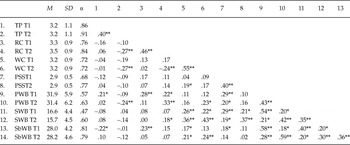
Descriptive Statistics: The descriptive statistics and correlation matrix between the latent variables may be observed in Table 1, along with the internal consistency coefficients of the measures. The comparison of average social well-being values revealed a significant difference between T1 and T2, lower in the latter [t(127) = 1.94, p < .05 (two tailed)], while the comparison of the average values of the remaining variables proved not to be significant (ts < 1.20, ns). The students were found to present higher values than the mid-point of the scale for all variables. The descriptive analysis also indicated that well-being values were high for both psychological well-being and subjective well-being, but low for social well-being. In general, the correlations pattern followed the expected direction. The test-retest correlations of the variables under study varied between .35 and .55, revealing some stability in the measures.
Descriptive Statistics, correlations and Alfa values (N = 128)

Note: T1 = Time 1; T2 = Time 2; TP = Time Pressure; RC = Role Clarity; WC = Working Conditions; PSS = Peer Social Support; PWB = Psychological Well-Being; SWB = Social Well-Being; SbWB = Subjective Well-Being; *p < .05; **p < .01.
Cross-sectional relations
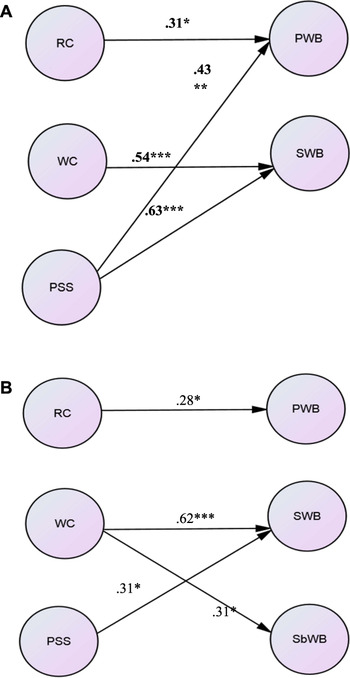
Table 2 presents the fit indexes of the models tested for T1 and T2 and Figure 1(a) and (b) present the models for T1 and T2, respectively. At T1 peer social support (PSS) emerged in association with social and psychological well-being; the working conditions variable (WC) was associated with social well-being and role clarity (RC) was associated with psychological well-being. When comparing the associations of different academic context variables with a same well-being dimension, the association between PSS and social well-being was found to be significantly stronger than the association between WC and social well-being (Z = 2.44; p < .001), and no significant differences were found in the association of PSS and RC resources with psychological well-being (Z = 1.83; p > .05). At T2, the WC variable was significantly associated with social and subjective well-being; PSS with just social well-being; RC with psychological well-being. When comparing the associations of different academic context variables with the same well-being dimension at T2 no significant differences were found in the association of PSS and WC resources with social well-being (Z = .023; p > .05).
Goodness-of-fit indices of the models tested in the cross-sectional analyses (N = 128)

Note: M1 and M2, codes of the models tested.
Standardised maximum likelihood coefficients of the cross-sectional model estimated in T1(a) and T2(b).
Note: PWB = Psychological Well-being; SWB = Social Well-being; SbWB = Subjective Well-being; RC = Role Clarity; WC = Work Conditions; PSS = Peers Social Support; *p < .05; **p < .01; ***p < .001

These results prove the existence of significant relations between all the academic context variables, with the exception of time pressure, and the well-being dimensions. The identified relations point to specific associations between the different academic context variables and the well-being dimensions. Furthermore, they indicate differences between T1 and T2. The finding that at T1 the PSS presented significant associations with well-being in all its dimensions and at T2 the WC also presented generalized associations is particularly noteworthy. RC was found only to present a significant relationship with psychological well-being, both at T1 and T2.
Main Analysis: Cross-lagged Relations
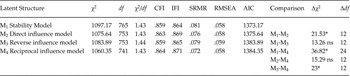
Models 1 and 4 were estimated with a view to testing the hypothesis that academic context variables predicts students’ well-being across time. The models were initially tested by taking into consideration the seven latent variables that were measured at two separate time points, and Table 3 presents the goodness-of-fit indexes of the tested models. One may observe that Model 2, which operationalizes our hypothesis that the context variables are what predict well-being, proved to best fit the data. Indeed, the fit of this model was considerably better than that of Model 1 (i.e., the stability model) and also of Model 3 (i.e., the reverse prediction model). Given that the Model 4 fit (i.e., the reciprocal relation model) is not considerably better than the Model 2 fit, the latter may be accepted as the most representative of the relations between T1 and T2 variables, since it is more parsimonious than Model 4. In fact, the AIC values are in keeping with such parsimoniousness and reinforce acceptance of Model 2. Nevertheless, although Model 2 is the model that best represents relations between the variables, both this model and the others were found to have only a reasonable fit to the data when taken in an absolute sense (e.g., the CFI varies between .864 and .859), although the RMSEA, the SRMR and the χ2 / df indicate a very good fit.
Goodness-of-fit indices of the models tested in the cross-lagged analyses (N = 128)

Note: *p < .05; **p < .01.
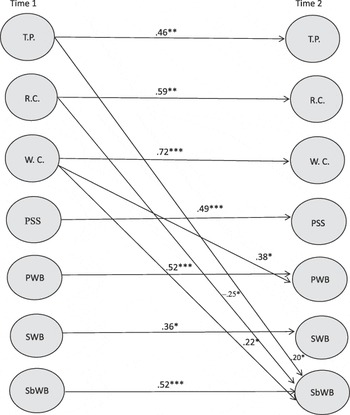
Figure 2 represents the significant effects observed in M2 (direct prediction). The estimated parameters indicate that the working conditions at T1 significantly predicted subjective and psychological well-being, to such an extent that the higher the perception of these conditions at T1, the more subjective and psychological well-being was reported by the students at T2. However, two unexpected effects were obtained, the first being that higher perception of time pressure at T1 predicted higher subjective well-being at T2, and the second that higher perception of role clarity at T1 predicted lower subjective well-being at T2. As for the other predictors, peer social support (PSS) did not relate significantly to any well-being dimension across time and none of the studied academic context variables proved to be a significant predictor of the social well-being dimension (SWB) across time.
Standardised maximum likelihood coefficients estimated in the direct influence model.
Note: TP = Time Pressure; RC = Role Clarity; WC = Work Conditions; PSS = Peers Social Support; PWB = Psychological Well-being; SbWB = Subjective Well-being; SWB = Social Well-being; *p < .05; **p < .01; ***p < .001

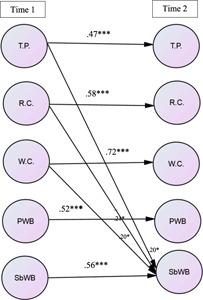
A supplementary analysis was then conducted in which a trimmed version of our proposed model, omitting the PSS and SWB variables (see Figure 3) was estimated. Goodness-of-fit indexes were very high for this model (χ2 = 520.20, p < .001; χ2 /df = 1.40; CFI = .915; IFI = .918; SRMR = .076; RMSEA = .056; AIC = 1375.64). Furthermore, two significant direct prediction relations and one marginally significant prediction were identified: time pressure at T1 significantly predicted subjective well-being at T2, confirming that the higher the level of time pressure perceived by students at the beginning of the academic year, the better their subjective well-being at the end of the academic year; role clarity at T1 significantly predicted subjective well-being at T2, also confirming that the more the students perceived role clarity at T1, the less they perceived subjective well-being at T2. Finally, the working conditions at T1 marginally predicted subjective well-being, in that the higher the perception of these conditions at T1, the more well-being at T2.
Standardised maximum likelihood coefficients estimated in the direct influence model without PSS and SWB.
Note: TP = Time Pressure; RC = Role Clarity; WC = Work Conditions; PWB = Psychological Well-being; SbWB = Subjective Well-being; *p < .05; **p < .01; ***p < .001

Discussion
This study aimed to investigate the relationships between academic work characteristics in the post-Bologna period and personal well-being (subjective, psychological and social) in a sample comprising Portuguese students, by means of a longitudinal study. Results further a broader understanding of the role played by the perceptions of time pressure, role clarity and working conditions on students’ well-being with relevant implications for scholars and practitioners of higher education.
When focusing on the analysis of each point in time, and taking the specificities of each into account, one may confirm that peer social support is positively related to most of the dimensions of personal well-being (Keyes & Waterman, Reference Keyes, Waterman, Bornstein, Davidson, Keyes and Moore2003), but only at the beginning of the academic year. These results may indicate that at this stage of the year the students show more availability and take better advantage of the interaction with peers, either because they have just returned from a long holiday period or due to the fact that they are not under any academic pressure (e.g., evaluations) at this point. Therefore, such findings reinforce the idea of the adaptive value of peer support, demonstrated in a number of studies on higher education processes (e.g., Sax, Bryant, & Gilmartin, 2002). The significant and positive associations between role clarity, taken as having a clear idea about what is expected in terms of academic work, and psychological well-being at both points in time, support the idea that the perception of control over tasks may be positively related to psychological well-being (Figueira & Marques Pinto, 2005; Keyes & Waterman, 2003; Ryff, Reference Ryff1989). As for the generalized association verified at the end of the school year (evaluation period), between the perception of working conditions and two of the dimensions of personal well-being, if the item content of this indicator is taken into consideration, it may be deduced that the perception of well-being is increased in the students who regard the physical space and the support equipment as being suitable for both academic and non-academic activities, and as having good conditions to study. This may mean that these conditions contribute to a perception of progression in their personal and social lives and a satisfactory evaluation of life during periods of academic assessment. The results shed light upon relevant clues for future studies, despite the fact that these data are merely exploratory, given that such associations were not confirmed in the longitudinal analysis, thus, pointing to the possibility of spurious relationships.
Cross-lagged results show that the perception of time pressure and role clarity significantly predicts subjective well-being, giving support to our prediction that the academic context variables influence personal well-being across time. These results underline the importance of evaluating student well-being in accordance with the characteristics of the context, and from a multidimensional perspective (Keyes, Reference Keyes2007).
On the other hand, the results of the cross-lagged analyses do not support our hypothesis regarding the negative predictive value of time pressure on students’ well-being, since the students who perceive more time pressure at the beginning of the year (T1) report higher subjective well-being at the end of the academic year (T2). When considering subjective well-being as an indicator of adaptation which reflects satisfaction and happiness, time pressure may be interpreted as a motivational factor for the students. Although time pressure is usually regarded as a demand in the literature (Bakker & Demerouti, Reference Bakker and Demerouti2007), this result stresses the importance of distinguishing the demands of a time pressure and excessive work nature from demands such as role ambiguity, with regard to their influence on well-being. The former, according to Demerouti and Bakker (Reference Demerouti and Bakker2011), may be more related to a motivational process, since they are perceived as being potentially rewarding in terms of the objectives to be attained (e.g., academic success). In other studies with different populations, similar results have been found, in that variables of this nature seem to contribute more consistently to a motivational process than to a health deterioration process (Boyd et al., Reference Boyd, Bakker, Pignata, Winefield, Gillespie and Stough2011).
The predicted positive effect of role clarity, working conditions and peer social support on students’ well-being across time has not been confirmed in our study either. On the contrary, the perception of role clarity at the beginning of the academic year significantly predicts a lower perception of subjective well-being at the end of the academic year. The content analysis of the items measuring role clarity suggest that the latter is related to students’ awareness of the complexity of academic tasks and the direction to follow, and such awareness may be reflected in an expression of less well-being. Thus, role clarity, which is frequently taken as a resource in light of previous studies (Bakker & Demerouti, Reference Bakker and Demerouti2007), seems to function more as a demand in the sample under study, since it predicts a reduction in students’ well-being, thus, contributing to the health deterioration process (Demerouti et al., Reference Demerouti, Bakker, De Jonge, Janssen and Schaufeli2001). The intervention of third variables in the relationship should be considered since greater role clarity may be associated with an attention focus on the accomplishment of academic tasks and an increase in students’ perception of stress and anxiety levels, thus reducing their subjective well-being. Along the same lines, in a prior study, higher education students were found to develop anxiety symptoms and maladaptive coping strategies in the face of threatening situations of loss of control, which interfered with their well-being (Figueira & Marques Pinto, 2005).
In short, the results raise issues in terms of theory, research and intervention regarding the status that variables such as time pressure and role clarity, habitually assumed as demands and resources, respectively (Bakker & Demerouti, Reference Bakker and Demerouti2007), may take on in the academic context, and at particular points of the academic year.
The fact that the effects across time are only confirmed for subjective well-being is noteworthy, since this indicates that students’ perception of well-being is essentially reflected in affective and emotional aspects, as suggested by other research studies (Van Horn et al., 2004).
This study has collected data on the prediction relations between various academic context variables and university students’ personal well-being with relevant implications for future research and intervention. Nevertheless a number of limitations should first be addressed.
Due to the longitudinal design of the study, a high percentage of participants dropped out between T1 and T2. Differences were found between the participants who responded at T1 and T2 and those who only responded at T1, for time pressure and for the well-being dimensions. Therefore, particular care should be taken in generalizing the results of this study, as we do not know whether the dropouts are a consequence of the resources and demands of the academic context or of other random processes related to the collection of data. It is also possible that they may have been influenced by fluctuations in the number of students per class over the year. In any case, the cross-lagged analyses carried out with the participants who answered the questionnaire at both points in time are robust in relation to the random effects, even though nothing is known about the impact of the resources and demands of the academic context on the well-being of those who dropped out at T2. The participants of our longitudinal sample, who took part in the study from the beginning to the end of the academic year, perceived less time pressure and more subjective well-being than those who dropped out. Since the results of the longitudinal analyses showed that perception of time pressure in an academic context predicts the subjective well-being of students, a replication study on a set of individuals with higher perception of time pressure and lower levels of subjective well-being would be extremely helpful.
The small sample of students within a single institution of higher education introduces the likelihood that at least some findings in the study do not apply to other contexts. Furthermore, the sample was restricted to students from the second to the fifth year, and presents an over-representation of Psychology students and female participants, although the latter imbalance is representative of the university population that was sampled. The longitudinal design implies a statistical control of these variables however, even so, the sample characteristics may be considered too specific to allow for a generalization of the results. These results lead us to reflect on the need to use more effective collection methods in future studies (Collins, Reference Collins2006).
The choice of the same academic context characteristics measures, previously used in studies with students from the same university (Chambel & Curral, Reference Chambel and Curral2005) is another limitation of this study. According to some authors’ recommendations to consider specific variables for each work context (Demerouti & Bakker, Reference Demerouti and Bakker2011), it would have been wiser to use preliminary qualitative procedures enabling access to participants’ perceptions of the specific characteristics of their academic context. A number of studies focusing on students’ coping processes highlight the potential relevance of other academic context variables that have not been addressed in the present study, such as the conflict between academic and non-academic activities and evaluation anxiety (Almeida, Soares, & Ferreira, Reference Almeida, Soares and Ferreira2001), not to mention the specificity of different school periods (e.g., Weare, Reference Weare, Aggleton, Dennison and Warwick2010).
The results of the present study stress the importance of considering distinct relations between the perceived academic context variables and well-being according to different time points in the academic year. In addition, there are also different associations of the context variables with different well-being dimensions, thus reinforcing the usefulness of a multidimensional approach to positive student mental health (Ouweneel et al., Reference Ouweneel, Le Blanc and Schaufeli2011) and bringing a variety of implications to research and intervention with higher education students. More specifically, the results of the cross-sectional analyses suggest that at the beginning of the academic year, peer support functions as a resource which is positively related to subjective well-being, suggesting a reinforcement on the part of academic institutions, of natural peer support in higher education psycho-pedagogical interventions, namely in student hosting programs (Saich, Reference Saich2008). These programs frequently include initiation ceremonies and mentoring projects which both count on the active participation of older students, regarded as the individuals who help the younger ones in their transition to a new context (Simão, Flores, Fernandes, & Figueira, Reference Simão, Flores, Fernandes and Figueira2008). On the other hand, at the end of the academic year, a noticeable generalized positive relationship between working conditions and well-being serves to underline the importance attributed to good working conditions and learning support equipment (e.g., study rooms, laboratories, library, online resources) for the students provided by the academic institutions, particularly during the final evaluation periods. Hence, the investment in such working conditions by the higher education institutions is a relevant measure with benefits to students’ mental health, namely during a phase when they are confronted with many challenges, some of which might contribute to a higher perception of stress and become an obstacle to their well-being (Figueira & Marques Pinto, 2005).
Regarding the results of the cross-lagged analyses, the fact that role clarity predicts a lower perception of subjective well-being at the end of the academic year alerts us to a sore need to study the role of students’ task awareness (understanding the types of performances they are expected to demonstrate and the study skills required to achieve those outcomes) in their well-being. The reform of the Portuguese higher education system, following the Bologna Declaration, to a modernized competency-based system, imposed new standards regarding learning outcomes that students should be able to demonstrate. Several studies have found a negative relationship between high performance demands on the part of the academic institution and satisfaction with life and/or positive mental health indexes (Chang, Reference Chang2006; Weare, Reference Weare, Aggleton, Dennison and Warwick2010).The conclusions of these studies point to the importance of balancing the efforts required of the students with the promotion of study skills and emotion-regulation coping skills that reduce the emotional impact of the tasks. Educational Psychologists and Counselors working in higher education institutions may play an important role in monitoring students struggling to meet the learning requirements and providing training skills programs and counseling interventions to support their coping efforts.
Overall, the results of the present study are coherent with the perspective defended by Hakanen et al. (Reference Hakanen, Schaufeli and Ahola2008) and Ouweneel et al. (Reference Ouweneel, Le Blanc and Schaufeli2011), who underline the role played by context variables on personal well-being and not solely on academic well-being. While concluding that these variables are differentially related to the various studied personal well-being dimensions, results also highlight the usefulness of a multidimensional approach to the study of personal well-being. Moreover, they encourage the accomplishment of studies that further a broader understanding of higher education students’ mental health and its predictors. In future studies on the relationship of students with the academic context, it is important to be aware of the specificity of the different academic year periods and the existence of third variables that may intervene in the relationship between context characteristics and well-being, namely variables of a more intra-individual nature, such as self-regulation strategies.