1. Introduction
There is no doubt that the world has changed a great deal over the past few decades. Technological progress, the development of the internet, and growing interdependence have complicated the relationships between nations. Especially, the interdependencies that include the mixed interactions among actors' cultures, economies, and military forces confuse the international scene.Footnote 1 As such, the international system reinforces the mechanism of peaceful settlement of actors' disputes through obligatory third-party intervention. In an interdependent system, violent conflict anywhere threatens the very stability of the system, and thus effective diplomatic processes are required to prevent the outbreak of widespread violence and chaos within the global system. Once a conflict arises, international negotiation is the primary method by which social actors settle their disputes.Footnote 2
There has been a surge of interest in analyzing the role of third party in international interactions. Countries can employ the assistance of some third party to help them resolve their conflicts. Third parties can play a variety of roles in an ongoing dispute (Young, Reference Young1967; Mitchell, Reference Mitchell, Mitchell and Webb1988). The third party actively participates in the settlement process, but only offers suggestions for a possible solution. Mediation basically is a variant of negotiation (Touval, Reference Touval1982). As pointed out by Princen (Reference Princen1992: 221): ‘much of what mediators do can be viewed as helping the parties overcome the difficulties of negotiating a voluntary agreement.’Footnote 3 However, sometimes third parties have variable motives for mediating a dispute. They probably become principals in a triangular bargaining process where they work toward an outcome favorable to their own national objectives, regardless of the grievances voiced by actors.Footnote 4 However, Werner (Reference Werner2000) also developed a modified model and suggested that the attacker's ability to choose the stakes of war can weaken the third-party defender's ability to deter an attack. Hopmann (1996: 12) further presented some criteria regarding who should be selected as a third party and five major kinds of roles that mediators can play in international negotiations. The focus on an obligatory role for a third party in dispute settlement enables an assessment on the basis of empirical observation of the degree to which states are willing to accept the international legal system or rule as the basis for their behavior (e.g., Huth and Russett Reference Huth and Russett1988; Bercovitch and Langley Reference Bercovitch and Langley1993; Raymond Reference Raymond1994; Dixon Reference Dixon1996; Smith Reference Smith1996; Bercovitch and Schneider Reference Bercovitch and Schneider2000; Jackson Reference Jackson2000). For example, Dixon (Reference Dixon1996) proposed seven forms of third-party techniques of conflict management in relation to the de-escalation of disputes and their peaceful settlement. Smith (Reference Smith1996) further referred to the idea of alliance reliability and concluded that nations with unreliable allies are more likely to surrender if attacked than are nations with reliable allies. Jackson (Reference Jackson2000) provided empirical evidence to examine some important factors that affect negotiation outcomes.Footnote 5 The acceptance of third-party dispute settlement procedures, and their application in practice, can serve as a more or less unbiased proxy for the extent to which states are prepared to subject themselves to the rule of international law.
Some substantial literatures examine the likelihood of third parties joining in wars (e.g., Altfield and Bueno de Mesquita Reference Altfield and deMesquita1979; Holsti et al. Reference Holsti, Hopmann and Sullivan1973; Sabrosky Reference Sabrosky and Singer1980; Singer and Small Reference Singer and Small1966a, Reference Singer and Smallb; Siverson and King Reference Siverson, King, Singer and Wallace1979, Reference Siverson and King1980; Smith Reference Smith1996). Altfield and Bueno de Mesquita (Reference Altfield and deMesquita1979) use an expected utility model to predict that intervention depends on the utility gained from one or the other party winning. If a third-party gains considerable utility from country i winning instead of country j, then intervention is more likely. Studies incorporating third parties model alliance formation as a function of potential wealth increases through gains from trade (e.g. Altfield Reference Altfield1984; Morrow Reference Morrow1991; Simon and Gartzke Reference Simon and Gartzke1996). Many alliances contain both large and small countries. Small countries have an incentive to join such an alliance due to the security a large country can offer. Large countries may not gain substantial security from allying with a small country, but may gain a market for the export of goods. These export markets provide large countries with gains from trade and increased wealth. Gowa (Reference Gowa1994) has shown that there is a high correlation between alliances and trade partners. In spite of numerous attempts by third parties to analyze international political interactions, these studies obviously neglect the role of economic interdependence in third-party relations.
Over the past decade, the link between bilateral trade and conflict/cooperation has played a central role in political economy literature. Does economic interdependence lead to peace or conflict between states? If countries’ economic ties were to be altered by certain factors, how would the international relations be affected? When a third-party enters an economic or political relationship characterized by interdependence, is it constrained in its conflict behavior or is it adding one more source of discord? Nonetheless, the virtues and vices of foreign trade in relation to international interactions have been debated.Footnote 6 Recently, various empirical studies have attempted to resolve these debates by analyzing the effects of trade flows on conflict. These studies, however, have largely ignored the trade and conflict interactions in which a third party is involved.Footnote 7 In this research we present some of the quantitative results with regard to international interactions pertaining to the links between trade, conflict, and third-party blocs.
One view that has gained considerable popularity is the liberal view that claims that trade reduces conflict between countries (e.g., Polachek Reference Polachek1978, Reference Polachek1980, Reference Polachek1997; Blainey Reference Blainey1988; Neff Reference Neff1990; Domke Reference Domke1988; Mansfield Reference Mansfield1994; Oneal et al. Reference Oneal, Oneal, Maoz and Russett1996; Reuveny and Kang Reference Reuveny and Kang1996; Russet et al. 1998; Dorussen Reference Dorussen1999; Oneal and Russett Reference Oneal and Russett1999; Polachek et al. Reference Polachek, Robst and Chang1999; Hegre Reference Hegre2000; Gartzke et al. Reference Gartzke, Li and Boehmer2001; Russett and Oneal Reference Russett and Oneal2001).Footnote 8 Recently, the trade–conflict literature has been extended to examine other questions. For example, as is well known, democracies fight each other less than non-democracies.Footnote 9 This topic can also be extended to discuss the third-party relationship. Dixon (Reference Dixon1993) indicated that democratically governed countries are more likely than others to resolve their disputes with the assistance of third parties. Raymond (Reference Raymond1994) provided evidence that the presence of joint democracy in war-prone dyads has a strong positive effect on the probability of referring interstate disputes to binding third-party settlement, even when controlling for alliance bonds and geographic proximity. A related trade–conflict model is the multi-country model of Dorussen (Reference Dorussen1999). He claimed that trade reduces the incentives for conflict, and this pacifying effect of trade would diminish rapidly with a larger number of countries. However, Hegre (Reference Hegre2002), according to both of his indicators, concludes that trade reduces conflict more the more states there are in the system, that is the effect of trade increases with a larger number of countries (Dorussen Reference Dorussen2002). Thereafter, Kang and Reuveny (Reference Kang and Reuveny2001) employ a multi-country, simultaneous framework, using the United States–Soviet Union–(West) Germany triangle as an example. Their empirical analysis demonstrates that trade and conflict are significantly inter-related, with positive reciprocity and inertia. Their purpose is mainly to emphasize that the dyadic flows in both trade and conflict strongly affect other dyads. A model of interacting trade and conflict would be better than two separate hypothetical models, one with trade alone and the other with conflict alone. However, they did not specify the actual mechanisms of interaction between trade and conflict among dyads. Few studies that examine the trade–conflict relationship also address international third-party interactions. Polachek et al. (Reference Polachek, Robst and Chang1999) had extended the trade–conflict model by incorporating foreign aid, tariff, contiguity, and country size, while treating terms of trade as given variables. Their brief results generally support the developed hypotheses, but many empirical questions were left unanswered. In their paper, only the relationship between the third party and the terms of trade is discussed.Footnote 10 This research will extend the trade–conflict model of Polachek (Reference Polachek1978) that treats trade as an independent variable, in order to focus on the third-party bloc conflict associated with trade. In addition to deriving the theoretical hypotheses, the empirical results will be investigated.
The paper is structured as follows. This section introduced some basic concepts and briefly reviewed the literature. Section 2 presents the basic trade–conflict model of Polachek (Reference Polachek1978) that is extended to derive third-party interactions. Section 3 discusses the sources of data. Section 4 provides methodology and empirical results and Section 5 concludes.
2. The theoretical model
A world system encompasses numerous countries, many trading with each other because the virtues of trade make each country better off economically. What results is a system of inter-country interdependencies, which if based on free market principles including free trade and the full mobility of resources, would result in maximal global output. Any country breaking off such a trade relation would decrease its own long-run economic well-being, as well as perhaps the well-being of its trading partners and of other countries (Anderton and Carter Reference Anderton and Carter2001). As such, reneging on a trade relationship is costly from a private as well as a global perspective.
The trade–conflict analytics
To see how these potential welfare losses lead to greater cooperation and less conflict, more structure needs to be introduced. First, an actor country's social welfare function is defined as W(C, Z). The variable C is total domestic consumption, which is defined as
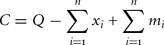
where Q is domestic production of a representative commodity, the xi are the exports of a representative commodity to country i, and the mi are the imports of a representative commodity from country i.Footnote 11 By including C, as defined, our approach is consistent with the economic theory paradigms that describe how countries maximize their collective well-being. Z = (z 1, z 2, . . ., zn) represents a militarized and political interstate conflict vector where each zi stands for conflict toward a particular country i. If zi is greater than zero, this implies that there is more conflict than cooperation, while zi that is less than zero implies that there is more cooperation than conflict. Realist theories that emphasize the importance of national security motive include the political relations variable Z (Keohane and Nye Reference Keohane and Nye1989). Typically

denotes increased welfare achieved through increased domestic consumption. Similarly

defines welfare associated with conflict. Wz can be positive if an actor gains satisfaction when behaving in a conflictual manner toward another country.
In the beginning, countries face a trade pattern based on expected or existing international relations (i.e., relations based on conflict or cooperation). There are a variety of methods through which conflict may influence trade, including tariffs, quotas, embargoes, or other trade prohibitions. For simplicity, we view conflict as making trade more costly by affecting import and export prices. That is, conflict is assumed to affect the terms of trade. If a target country responds to an actor's conflict by decreasing the price it will pay for the actor's exports, then conflict (on the part of an actor) raises the costs of trade. This implies decreased trade and a loss of the usual ‘gains from trade’. Similarly gains from trade are lost if a conflictual actor has to pay higher prices for imports from a target recipient of its conflict. This means that the export price pxi and the import price pmi are a function of conflict such that  ,
 and
 .Footnote 12 Thus, the implicit price of being hostile is the diminution of welfare associated with potential trade losses.
Under this trade–conflict relationship, the actor country will choose an optimal level of conflict toward the ith target country (zi) to maximize the social welfare function with positive but diminishing marginal utility of consumption and marginal utility of conflict; such that Wc > 0, Wcc < 0, Wz > 0, Wzz < 0, and  .Footnote 13 For simplicity we assume that the social welfare function is separable in C and Z (i.e., Wzc = 0), implying that the consumption of conflict and the consumption of other commodities are independent. Materialistic goals clearly imply that greater consumption yields higher welfare levels. The first derivative Wzi is the innate marginal benefit of additional conflict toward another country, namely the benefit (if it exists) of hatred.Footnote 14 The second partial derivative
 depicts how this hatred is affected by increased conflict toward a third party. For example,
 implies that actor conflict vented toward country j reinforces the benefits of an actor's conflict toward country i. Thus if rival target countries i and j are friends with each other but rivals of the actor, conflict with one reinforces conflict with another. This relationship is consistent with the maxim ‘a friend of a rival is a rival’. Alternatively, cooperation with one reinforces cooperation with another or ‘a friend of a friend is a friend’. On the other hand,
 implies the opposite, namely that increases in conflict with one country decreases the satisfaction of conflict with the other. This negative partial derivative is consistent with ‘a rival of a rival is a friend’. Alternatively, one can interpret this negative sign to imply that cooperation with another country (e.g. country 1) decreases the satisfaction of cooperation with a second country (country 2) or ‘a rival of a friend is a rival’.
Given this structure, the actor's domestic welfare is as high as possible when it chooses an optimal level of conflict Z to maximize W(C, Z) subject to the balance of payments constraint,  .Footnote 15 That is, if the actor only considers the purely direct effect of trade gains on conflict, it faces the following maximization problemFootnote 16

First-order conditions imply, for i = 1 to n

The FOCs simply state that, at the margin, an actor country chooses an amount of conflict with country i so as to equate the conflict's marginal costs  and marginal benefits
 .Footnote 17 For simplicity, we can assume that an actor interacts with only two possible targets. In this simple two-country case, the comparative statics shows (see Appendix)
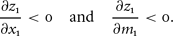
Thus the actor's conflict towards the target falls as exports from the actor to the target and/or imports from the target to the actor increase. This is the neoliberalists’ so-called result that trade reduces conflict.
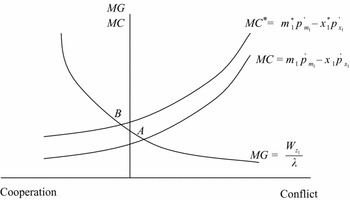
The above optimality conditions can be illustrated graphically for the first target in Figure 1. A similar depiction is given in Polachek (1978, 1980). The MC curve depicts the marginal cost of conflict. It is upward sloping since the second derivative of the balance of payments constraint is positive, which indicates that higher levels of conflict result in higher costs. The MG curve depicts the marginal welfare gains from conflict. The optimal amount of conflict toward the ith target country is where the MG and MC curves intersect at point A.
How increased trade decreases conflict.

One can apply Figure 1 to illustrate how trade affects conflict. Greater levels of trade imply either greater exports x 1, greater imports m 1 or both. Import and export values are contained in the marginal cost function. Since  is positive, greater import levels imply a larger m 1 and a higher MC curve. In turn, this higher MC curve implies less conflict and more cooperation since the MC* curve now intersects the MG curve further to the left at point B. Similarly, since
 is negative, greater x 1 values also imply a higher MC curve and hence lower levels of conflict. Next we consider how trade with one country may influence conflict with another country.
Third-party trade and international interactions
By expressing conflict vented toward the various countries separately (i.e., by considering W(·, Z(z 1,z 2, . . .,zn)), one can examine the effect of trade with one country on the conflict with another. As was stated earlier  and
 have political interpretations. From an actor country's vantage,
 implies that an actor's conflict vented toward country 1 reinforces the marginal benefits of an actor's conflict toward country 2. Thus if target countries 1 and 2 are friends, a conflict with one reinforces the conflict with the other. We claim that defining to occur when countries 1 and 2 are friends implies that increasing trade with country 1 decreases the conflict with country 2, i.e. trade decreases the conflict with friends of a trading partner. This relationship is consistent with the maxims ‘a friend of a rival is a rival’ or ‘a friend of a friend is a friend’. In other words, if the actor and target 1 become friendlier (increase trade), and countries 1 and 2 are friends, we predict that the actor and target 2 will become friendlier (conflict decreases). Furthermore, implies that conflict toward country 1 decreases the conflict's marginal benefit toward country 2, which suggests that countries 1 and 2 are rivals. We claim that an increase in trade between an actor and target 1 reduces conflict with target 1, thereby increasing the marginal benefits of conflict with country 2. This is consistent with ‘a rival of a friend is a rival’ or ‘a rival of a rival is a friend’, and one can show that increased trade with country 1 actually increases conflict with country 2.
The stated above can be explained by the following comparative statics (see Appendix)

Thus increasing exports to country 1 will decrease conflict with country 2  , if countries 1 and 2 are friends . Increasing exports to country 1 will increase conflict with country 2
 , if countries 1 and 2 are rivals . Similar relationships hold for imports. The above clearly states that (1) increasing trade with a third party will decrease conflict with a target, if the third party and the target are friends and (2) increasing trade with a third party will increase conflict with a target, if the third party and the target are rivals.
3. The data
Prior research typically uses war data such as the Militarized Interstate Dispute (MID) data set. The MID defines a militarized dispute as an international interaction involving threats, displays, or actual uses of military force; it must be explicit, overt, government sanctioned, and not accidental. Our primary source of data on conflict and cooperation is the Conflict and Peace Data Bank (COPDAB). The COPDAB is an extensive, longitudinal collection of more than 350,000 daily and yearly events reported by dyad.Footnote 18 Events are obtained as reported from 72 newspaper and journal resources. These events are coded on the 15-point scale representing different kinds of cooperation and conflict. We concentrate on annual measures of conflict and cooperation for each dyad in a 30-country sample, with data pooled for the years 1958–1967.Footnote 19 COPDAB is distinct from the MID data set in at least two ways. First, it contains information on both cooperative and conflictual events. Second, it contains data on both severe and mild forms of conflict and cooperation.
One problem with using this COPDAB data is that it is not up to date. However, although it is a flaw, the sample period is set in a time of antagonistic power blocs aligned with the United States and the Soviet Union. As such, it will provide an enhanced portrayal of friendly and rival relationships among countries and thus strengthen the reliability of the empirical tests. If we include or combine new data sets, the empirical tests will probably have worse results.Footnote 20 The other problem with this type of data is that certain countries are more newsworthy than other countries. If newspapers concentrate on certain countries, these countries will have more conflict and cooperation in our data. These types of selectivity issues are reduced by looking at relative conflict, i.e., the frequency of conflict minus the frequency of cooperation for a dyad. In this way, under or over reporting is reduced by concentrating not on the absolute frequency of reported events, but instead on the relative amount of conflict. We define net conflict (NETF) as the frequency of conflictual events (those in categories 9 to 15) minus the frequency of cooperative events (those in categories 1 to 7). A positive value implies a net conflict, while a negative value implies a net cooperation. Consistent with Azar (Reference Azar, Choucri and Robinson1978), on average, countries cooperate more than they conflict, with the average dyad having 1.62 conflictual events and 2.71 cooperative events each year. This measure is criticized since a dyad with a high degree of interaction (both high conflict and cooperation) might have the same net conflict as a dyad with no interaction. In both cases net conflict is zero despite differences in dyadic interaction.Footnote 21 As such, some argue that war data are more appropriate for examining international interactions. However, war data have a similar problem as dyads with a high degree of interaction, and appear the same as dyads that only conflict and do not cooperate.Footnote 22
Import and export data on a country directional basis in US dollars are compiled by Gillespie and Zinnes (n.d.). Sources for these data are found in the International Monetary Fund series of annual volumes under the heading ‘Direction of Trade’. Standardizied variables are included to hold other factors that may affect both trade and conflict constant. Banks’ (Reference Banks1973) Cross-National Times-Series Data Archive is used to select 13 country attributes over each of the years. These attributes are selected primarily because they have the least missing information. In addition, the data on defense expenditures (compiled mostly from the UN Statistical Yearbook by Gillespie and Zinnes) that are used to standardize for general levels of country militancy are included.
4. Methodology and empirical results
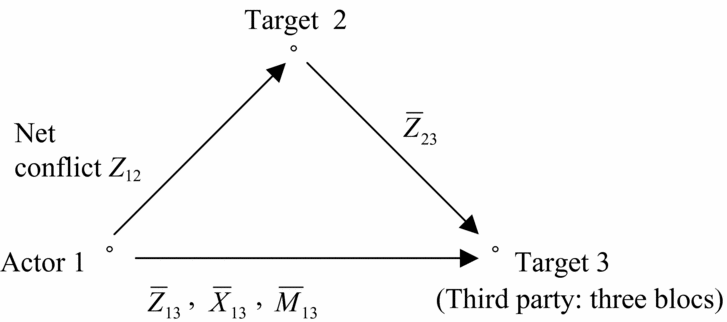
In order to keep the exposition as clear as possible, the theory section has used a single subscript to denote targets. The remainder of the paper uses two subscripts to denote the actor, the target and the third party. As illustrated in Figure 2, and discussed in the theoretical model section, an increase in trade between an actor and target 3 (assuming target 3 is the third-party bloc) will influence the conflict between the actor and target 2. Conflict will decrease if target 2 and target 3 are friends, while conflict will increase if target 2 and target 3 are rivals. A similar relationship is likely to hold if conflict changes between the actor and target 3. A change in conflict between the actor and target 3 will influence the conflict between the actor and target 2, depending on whether targets 2 and 3 are friends or rivals. In other words, the empirical work will test a broader interpretation of the hypothesis that considers conflict and trade as measures of whether the actor and target 3 are becoming more or less friendly.
Third-party interactions.
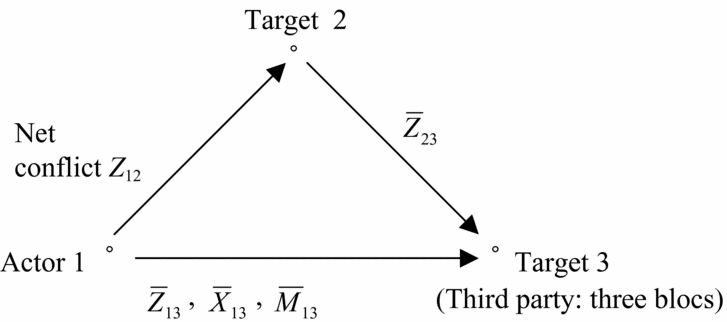
For analyzing the impact and role of the third-party blocs in international interactions, we develop a measure of average trade (X13, M13) and net conflict (Z13) between the actor and target 3 and a measure of whether targets 2 and 3 are friends or rivals (Z23) in each bloc (see Figure 2). If the target's average net conflict toward the third-party bloc is greater than zero (Z23 > 0), it is assumed the target and third-party bloc are rivals. If the average net conflict is less than zero (Z23 < 0), then the target and third-party bloc are friends.Footnote 23 We divide the sample into three different third-party blocs. The criteria for bloc classification are based on alignment and previous relationships, proximity, and political and economic factors.Footnote 24 For the purpose of this study, the alignment is classified by shared alignment (e.g. the parties belong to the same security arrangement, such as countries in NATO) and opposing alignment (e.g. the parties belong to opposing or antagonistic blocs, such as the USA and the Soviet Union). The previous relationships are divided into two categories: friendly and antagonistic.
Proximity is another important factor for classifying blocs. Since distance deters trade and trade reduces conflict, proximity will enhance cooperation.Footnote 25 As such, the parties in a bloc would be mostly geographically close. Lastly, democracy and non-democracy are regarded as the political factors and capitalism and communism as the economic factors. To sum up, states that share interests and socio-economic-political characteristics, an ongoing and friendly relationship, and geographical proximity are classified as part of the same bloc. As noted above, these three blocs are a Western bloc, a Middle Eastern bloc, and an Eastern bloc.
Western bloc: USA, Canada, UK, France, W. Germany, Italy, Greece, Israel;
Middle Eastern bloc: E. Germany, Cyprus, USSR, Morocco, Algeria, Tunisia, Libya, Sudan, Iran, Turkey, Iraq, Egypt, Syria, Lebanon, Jordan, Saudi Arabia, Kuwait;
Eastern bloc: China/PRC, Japan, India, Pakistan, Indonesia.Footnote 26
Basically, we claim that these three blocs as third parties will influence the actor's conflict toward the target differently because they have different political or economic characteristics.Footnote 27 However, the key point for such diversity is that we would like to look at the impact of third-party blocs on international interactions.
Each dyad has three observations, one for each third-party bloc. There are a total of 12,000 observations in the pooled sample. Ordinary least squares multivariate regressions are applied to test the hypotheses. First, the actor–third-party relationship based on conflict is examined and equation (8) is estimated.

where
Z 12 = the frequency of net conflict from the actor country toward the target country;
Trade 12 = exports from the actor country to the target country (X 12),
or imports of the actor country from the target country (M 12);
A 1 = a vector of actor country attributes;
A 2 = a vector of target country attributes;
Z13 = average frequency of net conflict initiated by the actor country toward the third party in each bloc;
Z23 = average frequency of net conflict initiated by the target country toward the third party in each bloc;
ϵ = a random error term normally distributed with mean zero.
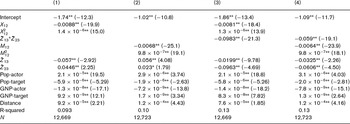
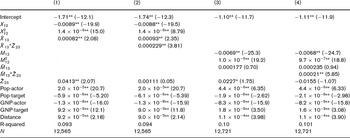
First, the coefficients of X 12 and M 12 in Table 1 are negative and match the neoliberalists’ view which claims trade promotes peace between countries.Footnote 28 The results in column (1) of Table 1 show that when controlling for exports, an increase in conflict from the actor toward other bloc countries (Z13) reduces actor–target conflict. Increases in conflict from the target toward other bloc countries (Z23) increase actor–target conflict. In column (2) we control for imports and find that actor–third party and target–third party conflict increase actor−target conflict. The above results provide some evidence that actor–target conflict depends on the actor's conflict toward other bloc countries and the target's conflict toward other bloc countries. We include an interaction between Z13 and Z23 to explicitly test the proposition. The interaction will show whether the change in actor–target conflict due to a change in the actor's conflict toward other bloc countries depends on the relationship between the target and other bloc countries. The results in columns (3) and (4) are statistically significant and somewhat consistent with the proposition. From column (3)

Footnote 29 From column (4)

Footnote 30 Thus an increase in conflict with target 3 has an impact on conflict with target 2, and the strength of this relationship depends on the relationship between the target and the third party when controlling for exports and imports.
The conflict relationship among actor, target and third parties with a pooled three blocs. Dependent variable: net conflict (Z12)

Note: T-statistics are in parentheses, *indicates significant at the 10% level, **significant at the 5% level.
In the theoretical section, we consider four different maxims based on whether countries 2 and 3 are friends or rivals. It is worthwhile discussing how consistent the results are with the theory. First, consider the case where we have an increase in Z13, implying that countries 1 and 3 are becoming less friendly or more conflictual. This will influence the conflict between countries 1 and 2 depending on the relationship between countries 2 and 3. If Z23 is positive, this implies that countries 2 and 3 are rivals and an increase in conflict between countries 1 and 3 will lead to a decrease in conflict between countries 1 and 2. This is consistent with the maxim ‘a rival of a rival is a friend’. If Z23 is negative, this implies that countries 2 and 3 are friends, but Z23 must be less than −2.02 when controlling for exports or −0.55 when controlling for imports, which results in an increase in conflict between countries 1 and 2. This is somewhat consistent with the maxim ‘a friend of a rival is a rival’.
Let us consider the case where Z13 is decreasing, implying that countries 1 and 3 are becoming friendlier. Again if Z23 is positive, this implies they are rivals and a decrease in conflict between countries 1 and 3 leads to an increase in conflict between countries 1 and 2. This is consistent with the maxim ‘a rival of a friend is a rival’. Lastly, Z23 being negative (again Z23 must be less than −2.02 or −0.55) leads to a decrease in conflict between countries 1 and 2. This is somewhat consistent with the maxim ‘a friend of a friend is a friend’.
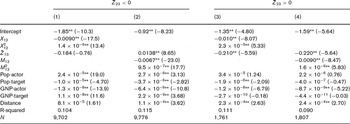
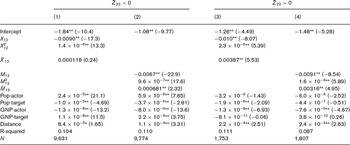
Separate regressions controlling for Z13 are estimated for observations where the target and third party are friends or rivals. As stated earlier, when the target and third party are friends (Z_23 < 0), we expect the coefficient of Z13 to be positive, and when the target and third party are rivals (Z23 > 0), we expect it to be negative. The empirical results are provided in Table 2. In column (1), the target and third party are friends and when controlling for exports, we find an insignificant relationship between actor–third-party conflict (Z13) and actor–target conflict (Z12). A positive and significant relationship is found in column (2) when controlling for imports and matches our prediction, because the actor will increase conflict toward the target as actor–third-party conflict increases when the target and third party are friends. Columns (3) and (4) look at cases where the target and third parties are rivals. Column (3) controls for the actor's exports and shows that an increase in actor–third-party conflict significantly reduces actor–target conflict. Column (4) presents similar results when controlling for the actor's imports. These results in both columns are consistent with the proposition.Footnote 31
The conflict relationship among actor, target and third parties with a pooled three blocs. Dependent variable: net conflict (Z12)

Note: T-statistics are in parentheses, *indicates significant at the 10% level, **significant at the 5% level.
The hypotheses are actually based on the relationship between the actor and target 3 being measured by trade, not conflict. Thus we again perform the above analysis using trade to measure the actor–third-party relationship (i.e. X13 and M13) and equation (9) is estimated.

where
Trade 13 = average exports from the actor country to the third party (X13), or average imports of the actor country from the third party (M13) in each bloc.
Table 3 includes interactions between actor–third-party exports/imports and target–third-party conflict. The positive and significant coefficients of X13 may indicate that the existence of alternative markets for the actor reduces the costs of a conflict with a given target. Column (2) includes an interaction between X13 and Z23, and the coefficient is significant.
The conflict relationship among actor, target and third parties with a pooled three blocs. Dependent variable: net conflict (Z12)

Note: T-statistics are in parentheses, *indicates significant at the 10% level, **significant at the 5% level.
From column (2)
![\begin{equation}
\frac{\partial Z_{12}}{\partial \bar{Z}_{13}} = {-} 0.00093 + 0.000229^*\quad
\bar{Z}_{23} < 0 \quad {\rm if}\, \bar{Z}_{23} < {- 4.06}
\]
\[
> 0 > {- 4.06}.
\end{equation}](https://static.cambridge.org/binary/version/id/urn:cambridge.org:id:binary:20151017041346240-0162:S1468109907002824_eqnU3.gif?pub-status=live)
For the entire sample, approximately 1,590 observations in relation to Z23 are less than −4.06 and 1,753 are greater than zero. If Z23 is positive, this implies that countries 2 and 3 are rivals, and an increase in exports to the third party leads to an increase in the actor's conflict toward target 2. If Z23 is negative and must be less than −4.06 in this case, this implies that countries 2 and 3 are friends, and an increase in exports to the third party leads to a decrease in the actor's conflict toward target 2. Countries 2 and 3 must be highly cooperative with each other, otherwise when increasing trade, actor country 1 will still on average increase conflict toward country 2. Thus for the vast majority of observations for which is it is implied that the target and third party are typically friends, an increase in exports to the third party leads to an increase in actor–target conflict. The coefficients of M13 in columns (3) and (4) are insignificant, and thus imports from third parties are not as important as exports in determining actor–target conflict. This result would imply that the impact of increasing trade with a third party on actor–target conflict merely depends on whether or not the third party and target are friends or rivals (Z23 < 0 or Z23 > 0).
As before, we run separate regressions for observations where the target and third party are friends or rivals. As the hypotheses stated, if the target and third party are friends (Z23 < 0), we would expect that the coefficients of X13 and M13 on actor–target conflict (Z12) will be negative, and if the target and third party are rivals (Z23>0), we would expect that they will be positive. The results are provided in Table 4. Column (1) looks at actor–third-party exports, but finds an insignificant relationship. This does not contradict the proposition. The results in column (2) are actually contrary to the hypothesis as an increase in imports from the third party to the actor increases conflict when the target is friendly with the third party. The results in columns (3) and (4) consider the cases where the target and third party are rivals. In these cases, the positive coefficients of X13 and M13 show that an increase in trade between the actor and other countries will increase actor–target conflict and support the proposition. Since in our sample the net conflict mean equals −1.09, the dyads tend to be more cooperative on average. As such, if the target and third-party bloc are rivals, the results are stronger and more consistent, which strengthens the propositions.Footnote 32
The conflict relationship among actor, target and third parties with a pooled three blocs. Dependent variable: net conflict (Z12)

Note: T-statistics are in parentheses, *indicates significant at the 10% level, **significant at the 5% level.
For analyzing the third-party bloc effects on international interactions, separate regressions are estimated for each bloc. All dyads are included in each regression with the third-party relationship being measured by conflict and trade with countries in the Western, Middle Eastern, and Eastern blocs.Footnote 33 First, we measure actor–third-party and target–third-party relationships based on conflict as in Table 1. In the Western bloc, the signs of the coefficients of Z13 and Z23 are the same, but the magnitude is smaller. The interaction between Z13 and Z23 again suggests that the actor–target conflict depends on the third-party bloc. As such, the effects on actor–target conflict on the Western bloc and all third-party blocs are very similar. With the Middle Eastern bloc as a third party, the effects on the actor–target conflict become quite different as the coefficients of Z13 and Z23 are all positive. With the Eastern bloc as a third party, the coefficients of Z13 and Z23 are not significant. This might be due to the fact that the Eastern bloc did not have a strong political or economic role in the world during the 1960s.
Second, we measure actor–third-party and target–third-party relationships based on trade as in Table 3. In the Western bloc, the coefficients of X13 and M13 are consistently positive and are very similar to Table 3. In addition, we only find the coefficients of X13 and X13* Z13 to be significant and positive as in Table 3. The results are
![\begin{equation}
\frac{\partial Z_{12}}{\partial \bar{Z}_{13}} = 0.00149 + 0.000315^* \quad
\bar{Z}_{23} < 0 \quad {\rm if}\ \bar{Z}_{23} < {- 4.73}
\]
\[
> 0 > {- 4.73}
\end{equation}](https://static.cambridge.org/binary/version/id/urn:cambridge.org:id:binary:20151017041346240-0162:S1468109907002824_eqnU4.gif?pub-status=live)
However, the difference is that the target and the Western bloc third-party countries must be very friendly (Z23< −4.73), otherwise increasing trade with the Western bloc would still cause an increase in net conflict between actor 1 and target 2. With the Middle Eastern bloc as a third party, these variables are not very significant, and with the Eastern bloc, they are even more insignificant. However, one interesting result is that the coefficient of M13 remains negative and significant and the coefficient of Z23 remains insignificant when the third party is the Eastern bloc. This shows that regardless what the relationship between the target and the Eastern bloc third party is, the actor will decrease conflict with the target when increasing trade with the Eastern bloc. Overall, these results evidently suggest that the Western bloc countries are very important in determining actor–target conflict/cooperation in a manner that is consistent with the proposition.
5. Conclusions and policy implications
Although in recent years, various efforts have been made to resolve longstanding debates regarding the effects of foreign trade on military disputes, the literature on the trade–conflict relationship has rarely addressed international third-party interactions. This article provides an progressive step in analyzing international interactions pertaining to the links between trade, conflict, and third-party blocs. In 1978, Solomon Polachek developed the trade–conflict model that claimed the increased trade between countries reduces conflict. The purpose of this paper is not only to illustrate the static nature of the underlying links between trade and conflict where third-party relationships are considered, but also to analyze the impact and role of the third-party blocs on international interactions. In so doing, we extend the basic trade–conflict model of Polachek (Reference Polachek1978) to analyze international interactions involving third-party blocs. An actor country maximizes its plausible social welfare function subject to a balance of payments constraint. We derive a theorem whereby, under reasonable assumptions, trade between the actor and a third party will affect conflicts between the actor and the target. A similar relationship is discussed and tested for conflicts, which may exist between the actor and the third-party blocs. The empirical tests provide support for the hypotheses derived from the model. The empirical results also show that the Western bloc countries play a central role in world politics and economic relations.
This research essentially highlights the importance of accounting for how the changes in trade or conflict between countries affect the international multilateral relationships. The policy implication here is straightforward. Encouraging free trade tends to decrease conflict and increase cooperation. The classical liberal thesis claiming trade promotes peace between states is based on two ideas: trade between two states increases the economic costs of waging war, and an inherent facet of increased trade is increased communication between states. The increased communication between states reduces the possibility of misunderstanding and fosters peaceful resolution of conflict (Hegre Reference Hegre2000: 5).
According to the theory of structural balance in international polities, changes in international relationships between two states affect a third nation. Heider (Reference Heider1946) and Cartwright and Harary (Reference Cartwright and Harary1956) formulated the postulates of this theory, which focused on the tendency toward balance in a triadic relationship. Imbalance is an important factor in attitude change. The imbalance can be resolved either by all nations becoming friends or by two deciding to like each other and to dislike the third member of the trio, who responds negatively to both.Footnote 34 With democracy being a worldwide trend, most contemporary leaders cling to this longstanding belief that expanding economic ties will increase the bonds of friendship and eliminate the thought of a resort to arms. If the trade gains increase countries’ welfare and serious conflict among countries disrupts trade, trade will promote peace and increased world trade will make the maxim ‘a friend of a friend is a friend’ a reality. As such, the international system will be structurally balanced.
Appendix: Procedures for comparative statics
In order to satisfy the second-order conditions for maximization, the Hessian matrix must be negative definite. In other words, the principal minors |H 1|, |H 2|, |H 3|, . . ., |H n| must alternate in sign
![\begin{equation}
| {H_1} | = | {W_{z_i z_i} + \lambda (x_i p''_{x_i} - m_i p''_{m_i})} | < 0,
\]
\[
| {H_2} | = \left| {\begin{array}{*{20}c}
{W_{z_i z_i} + \lambda (x_i p''_{x_i} - m_i p''_{m_i})} & {W_{z_i z_j}} \\
{W_{z_j z_i}} & {W_{z_j z_j} + \lambda (x_j p''_{x_j} - m_j p''_{m_j})} \\
\end{array}} \right|
\]
\[
= \left[ {W_{z_i z_i} + \lambda (x_i p''_{x_i} - m_i p''_{m_i})} \right]
\big[ {W_{z_j z_j} + \lambda (x_j p''_{x_j} - m_j p''_{m_j})} \big] - W_{z_i z_j}^2 > 0
\]
\[
|{H_3} |= 3 \times 3\,{\rm determinant}\,{\rm value} < 0, \ldots,\,{\rm etc}.
\end{equation}](https://static.cambridge.org/binary/version/id/urn:cambridge.org:id:binary-alt:20160710025132-88917-mediumThumb-S1468109907002824_eqnU5.jpg?pub-status=live)
For a simple two-country case, the solving procedures are
![\begin{equation}
\left[ {\begin{array}{*{20}c}
{W_{z_1 z_z} + \lambda (x_1 p''_{x_1} - m_1 p''_{m_1})} & {W_{z_1 z_2}} \\
{W_{z_1 z_2}} & {W_{z_2 z_2} + \lambda (x_2 p''_{x_2} - m_2 p''_{m_2}} \\
\end{array}} \right]\left[ {\begin{array}{*{20}c}
{\displaystyle\frac{{\partial z_1}}{{\partial x_1}}} \\
{\displaystyle\frac{{\partial z_2}}{{\partial x_1}}} \\
\end{array}} \right] = \left[ {\begin{array}{*{20}c}
{- \lambda p'_{x_1}} \\
0 \\
\end{array}} \right],
\]
\[
\frac{{\partial z_1}}{{\partial x_1}} = \frac{{- \lambda p'_{x_1} [W_{z_2 z_2} + \lambda (x_2 p''_{x_2} - m_2 p''_{m_2})]}}{{[W_{z_1 z_1} + \lambda (x_1 p''_{x_1} - m_1 p''_{m_1})][W_{z_2 z_2} + \lambda (x_2 p''_{x_2} - m_2 p''_{m_2} ] - W_{z_1 z_2}^2}} < 0,\,{\rm similarly}
\]
\[
\frac{{\partial z_1}}{{\partial m_1}} = \frac{{\lambda p'_{m_1} [W_{z_2 z_2} + \lambda (x_2 p''_{x_2} - m_2 p''_{m_2})]}}{{[W_{z_1 z_1} + \lambda (x_1 p''_{x_1} - m_1 p''_{m_1})][W_{z_2 z_2} + \lambda (x_2 p''_{x_2} - m_2 p''_{m_2} ] - W_{z_1 z_2}^2}} < 0,
\]
\[
\frac{{\partial z_2}}{{\partial x_1}} \,{=}\, \frac{{\lambda p'_{x_1} (W_{z_1 z_2})}}{{[W_{z_1 z_1} \,{+}\, \lambda (x_1 p''_{x_1} \,{-}\, m_1 p''_{m_1})][W_{z_2 z_2} \,{+}\, \lambda (x_2 p''_{x_2} \,{-}\, m_2 p''_{m_2} ] \,{-}\, W_{z_1 z_2}^2}}\begin{array}{*{20}c}
< \\
> \\
\end{array}0\, \ \ {\rm if}\,{\rm W}_{z_1 z_2} \begin{array}{*{20}c}
> \\
< \\
\end{array}0,
\end{equation}](https://static.cambridge.org/binary/version/id/urn:cambridge.org:id:binary-alt:20160710025132-36692-mediumThumb-S1468109907002824_eqnU6.jpg?pub-status=live)
and similarly