Introduction
Anaemia, characterised by reduced Hb levels, is a critical global health issue affecting over 1·8 billion people, including 571 million women(1,2) . Pregnant women are particularly susceptible due to physiological changes, with a global prevalence of 37 %, leading to increased risks of adverse maternal and neonatal outcomes(2–Reference Tian, Chen and Jiang5). Consequently, anaemia ranks as the third leading cause of disability worldwide(Reference Gardner, Kassebaum and McHugh6). Although the WHO aims to reduce anaemia in women of reproductive age by 50 % by 2025(7), many developing nations like Malawi lag behind this target, with a prevalence of 39·3 % and rising disability-adjusted life years(8,9) . Therefore, research is vital to combat this persistent burden in high-risk settings.
Household food insecurity has been hypothesised to adversely affect dietary intake, leading to nutritional deficiencies that can exacerbate the risk of anaemia(Reference Chaparro and Suchdev10). It occurs when there is a lack of access to safe, sufficient and nutritious food at the household level(Reference Tadesse Tantu, Demissie Gamebo and Kuma Sheno11). In 2019, the FAO estimated that 3 billion people worldwide could not access healthy diets due to food insecurity(12). In 2023, in Malawi, six million people’s livelihoods related to food security were stressed(13), and the issue continues to be pervasive in the country. Pregnant women are particularly vulnerable to the effects of household food insecurity due to their increased nutritional requirements. Previous research has demonstrated that food insecurity is associated with low dietary diversity (LDD) and could lead to inadequate intake of essential nutrients among women of reproductive age(Reference Moradi, Arghavani and Issah14). While the association between food insecurity and dietary diversity has been previously documented(Reference Moradi, Arghavani and Issah14), there is limited research on their collective association with anaemia, specifically among pregnant women.
Accordingly, this study is guided by a conceptual framework in which household food insecurity is hypothesised to adversely affect dietary intake, thereby increasing the risk of anaemia. Using a mixed-methods approach, the study investigates the relationships between household food insecurity, dietary intake and anaemia among pregnant women and health workers in Malawi.
Methods
Study design and participants
The research adopted a cross-sectional design leveraging data from pregnant women in Lilongwe. Lilongwe is one of the twenty-eight districts and the capital city of Malawi, located in the central region, with the highest and most culturally diverse proportion of the Malawian population among all districts, constituting 14·9 % of the total national population(15). Random samples of three government health facilities (Bwaila Hospital, Area 25 Health Center and Area 18 Health Center) and two Christian Health Association of Malawi (CHAM) facilities (Daeyang Luke Hospital and Likuni Mission Hospital) were selected in the city. The selection of both government and CHAM health facilities was to aid generalisation and accommodate a diversity of the city’s population from different socio-economic statuses and locations, as the selected health facilities were located in the South, West, Centre and North East of Lilongwe City, serving both members from urban and rural community settings. The sample size was calculated using the single-population proportion sample size formula, with anaemia prevalence in pregnant women in Lilongwe from a previous survey, at 37·5 %(Reference Cheng, Karra and Guo16), a standard normal distribution of 1·96 at a CI of 95 % and an absolute precision or margin of error of 5 %. A 10 % non-response rate was applied, and the final minimum sample size was 396:
 $N = {{{{({Z_{1 - \alpha /2}})}^2} \times P\left( {1 - P} \right)} \over {{d^2}}}$
Data for this study were collected from March to July 2024 through face-to-face interviews using the KoboToolbox web-based questionnaire by trained interviewers. Participants were included in the study if they were citizens of the Republic of Malawi, in their second trimester of pregnancy and consented to participate. Pregnant women in their second trimester were specifically selected because this period is characterised by increased susceptibility to anaemia, largely due to the most pronounced physiological decline in Hb levels occurring during this trimester(Reference Sun, Gu and Wu17) and, therefore, makes them an appropriate target group for possible interventions. They were excluded if they had medical records of leukaemia, haemorrhage, HIV positivity, malaria or sickle cell disease. After 688 pregnant women were approached to participate in the quantitative study, twenty-eight refused to consent, leading to 660 participants. Out of 660 participants who consented, forty-eight pregnant women were excluded due to underlying medical conditions such as HIV (n 33), sickle cell disease (n 1), malaria (n 11), haemorrhage (n 2) and leukaemia (n 1), resulting in a sample size of 612 women who were included in the final quantitative study analyses (online Supplementary Figure S1).
The study was conducted according to the Guidelines of the Declaration of Helsinki. Ethical approvals were obtained from Xiangya School of Public Health of Central South University in China (No. XYGW-2023-132), Lilongwe District Hospital Health Research Committee and CHAM in Malawi. Approval was also obtained from the Malawi National Health Sciences Research Committee (protocol number: #24/02/4371).
Measures
Dietary intake
The dietary variables included in this study were selected based on their relevance to the research objectives, established dietary guidelines and their applicability to the Malawian context. These included dietary patterns, dietary diversity and nutrient intake. A reproducible and validated Semi-Quantitative Food Frequency Questionnaire (SQ-FFQ) with a 30-d reference was used to collect participants’ dietary intake, adapted from a previous study(Reference Thakwalakwa, Flax and Phuka18). The SQ-FFQ provides a more reliable measure of habitual dietary intake over time, which is particularly relevant in pregnancy, where daily food choices may vary(Reference Willett, Lenart and Willett19). It included sixty-six food items commonly consumed in the Malawian setting. Frequency of dietary intake was aggregated into respective conversion factors (Never = 0; 1/month = 0·03; 2–3/month = 0·08; 1/week = 0·14; 2–4/week = 0·43; 5–6/week = 0·79; 1/d = 1; 2/d = 2; >2/d = 3), which were used to convert the reported dietary portion intake of the women into daily intake portions(Reference Pinto, Viegas and Martins20,Reference Sauvageot, Alkerwi and Albert21) .
Minimum Dietary Diversity for Women
The study used the Minimum Dietary Diversity for Women (MDD-W) guideline to assess the dietary diversity score (DDS) of pregnant women with the information obtained from the SQ-FFQ, as recommended by FAO(22). The DDS was scored on ten food groups (1. grains, white roots and tubers, and plantains, 2. eggs, 3. pulses, 4. dark green leafy vegetables, 5. nuts and seeds, 6. other vitamin A-rich fruits and vegetables, 7. dairy products, 8. other vegetables, 9. meat, poultry, and fish and 10. other fruits)(22). The SQ-FFQ data were harmonised by coding reported food items into ten FAO-defined food groups and scoring whether each group was consumed at least once during the reference period. This approach allowed the approximation of the dietary diversity in line with MDD-W guidelines, despite a potential overestimation of dietary diversity due to longer recall periods. A point was awarded for each food group if the woman had a minimum intake of 15 g of the food group, and the group was awarded a score of 0 if they did not reach a minimum intake of 15 g(22,Reference Islam, Jubayer and Nowar23) . The ten food groups resulted in a total DDS score of 10, and pregnant women who had scored at least 5 were regarded as having met the minimum DDS, and hence the dichotomous categories of DDS: LDD (<5 out of 10 food groups) and MDD-W (≥5 out of 10 food groups)(Reference Abou-Rizk, Jeremias and Cocuz24).
Nutrient intake
The pregnant women’s daily energy and nutrient intakes were calculated according to the portion of each food consumed in a day, using the Malawian Food Composition Table(25). Recommended nutrient intakes by joint FAO/WHO expert consultation were used as a reference in the current study’s nutrient intake analysis, as adapted from the ‘Malawi National Guidelines on Nutrition Care, Support, and Treatment for Adolescents and Adults’, leading to the cut-off points for adequate and inadequate nutrient intakes of pregnant women(26,27) .
Household food insecurity analysis
Household food insecurity was assessed using the Household Food Insecurity Access Scale (HFIAS)(Reference Maxwell, Vaitla and Coates28). The tool has nine questions on availability and access to food over the last month, including four different answers and scores (single answer choice for each question): an ‘often’ answer was allocated a score of 3; ‘sometimes’ was given 2; ‘rarely’ was given 1; and ‘never’ was allocated 0(Reference Kang, Hurley and Ruel-Bergeron29). The scores of household food insecurity were classified on a scale of 0 to 27. Food insecurity status was classified as food secure (0), mildly food insecure (1–2), moderately food insecure (3–10) and severely food insecure (>10).
Biochemical measurement
Hb concentrations and anaemia status classification were measured in g/dL using HemoCue® Hb201 point-of-care Hb analyser and analysed according to WHO recommendations(30). Anaemia was defined as Hb < 10·5 g/dL, in accordance with the WHO’s trimester-specific cut-offs for the second trimester. Specific classification for anaemia status was as follows: Hb ≥10·5 g/dL as non-anaemic; Hb level of 9·5–10·4 g/dL as mildly anaemic; Hb level of 7·09·4 g/dL as moderately anaemic; and Hb level of <7·0 g/dL as severely anaemic(30).
Qualitative study
Semi-structured interviews were conducted among pregnant women and key informants in the form of healthcare workers. The study adopted key areas of in-depth interviews from qualitative research on anaemia conducted in Ghana(Reference Awuah, Colecraft and Wilson31) and Pakistan(Reference Aziz Ali, Feroz and Abbasi32). Professionals with experience in qualitative interviews reviewed the semi-structured interview guides. Participants were purposively recruited using snowball sampling until the information was saturated. Twenty potential participants were approached, but three refused to participate (pregnant women (n 2), and health workers (n 1)), which, upon information saturation, resulted in seventeen participants being included in the final qualitative study analysis (online Supplementary Figure S2). Interviews were conducted via phone audio call and were audio-recorded after permissions were obtained.
Covariates
This study assessed and explored age, parity and history of miscarriage as covariates based on previous literature and theoretical conceptualisation(Reference Das, Bai and Chang33,Reference Futakawa, Matsumura and Tsuchida34) . Parity was investigated as any prior deliveries of an offspring after 24 weeks of gestation, and a history of miscarriage was regarded as a previous loss of pregnancy before the 20th week of gestation.
Statistical analysis
Cross-tabulations were employed to produce percentage relationships between household food insecurity, anaemia and maternal characteristics. Pearson’s χ 2 test was used to test the differences in anaemia status and household food insecurity status within categorical variable groups, and the independent t test for equality of means was used to test household food insecurity status and anaemia status differences for Hb. The Mann–Whitney U test was used to compare distributions of income, age and nutrient intakes within household food insecurity and anaemia groups. To address the multicollinearity of predictor variables in this study, collinearity diagnostics were run for the dietary variables (DDS and nutrient intake). Dismissal of potential multicollinearity among variables was based on a threshold of variance inflation factor of less than 5. Univariate and multivariate logistic regression models were used to determine the association between independent variables (residence, dietary intake and household food insecurity) and anaemia among pregnant women. Adjusted OR (a-OR) with a 95 % CI were used to report the associations. The final logistic regression model was adjusted for age, parity and miscarriage history. Significance was set at a P-value < 0·05. Data from this study were analysed using IBM SPSS Statistics, version 26. GraphPad Prism 10 was also used for logistic plot visualisation. Mediation analysis was conducted via the PROCESS macro version 4.2 extension of SPSS by Andrew F. Hayes to examine the mediating effect of dietary diversity in the relationship between household food insecurity and anaemia. Missing data were only observed in the variables of phone numbers and antenatal care registration numbers, which were not included in the final data analysis. All qualitative information was transcribed verbatim into Word document scripts, coded and analysed in NVivo 14, using thematic analysis(Reference Manda-Taylor, Kufankomwe and Chatha35). Two researchers were involved in the coding, and upon agreement, the themes of the study were adopted.
Results
Sociodemographic characteristics
A total of 612 pregnant women were included in the final analysis of the current study. The median (IQR) age of the participants was 24 (20, 29) years, ranging from 14 to 43 years, and most pregnant women (36·76 %) were between 20 and 24 years. Seventy-seven per cent (n 472) of pregnant women were from urban areas. Over half (52·94 %) of the pregnant women had no employment. The median household monthly income per capita was 25 000 (15 000, 50 000) MWK (Malawian Kwacha) (online Supplementary Table S1).
Anaemia status and maternal characteristics
The pregnant women had an average Hb of 11·60 ± 1·58 g/dL, with the normal group having a mean Hb of 12·20 ± 1·07 g/dL (P < 0·001). Anaemia prevalence in pregnant women was 21·24 % (n 130). Among the 130 anaemic pregnant women, 36·92 % were mildly anaemic, 57·69 % were moderately anaemic and 5·38 % were severely anaemic. Anaemia prevalence was highest in the youngest age group (<20 years) at 26·72 % (P = 0·023). Pregnant women living in rural areas had a significantly higher prevalence of anaemia compared with their urban counterparts (28·56 % v. 19·07 %, P = 0·016) (Table 1). Concerning occupation, farmers had the highest anaemia prevalence (45·95 %, P = 0·005) (online Supplementary Table S1).
Bivariate association between household food insecurity, anaemia status and maternal characteristics

Table 1. Long description
The table presents data on the bivariate association between household food insecurity, anaemia status, and maternal characteristics. It includes 612 entries and is divided into several columns and rows. The columns are labeled as follows: Variable, Total, Household food insecurity (Food secure and Food insecure), Anaemia status (No anaemia and Anaemic), and statistical values (χ²/t and P). The rows include Age (years), Residence, Hb (g/dL), IFA tablet intake, and Household food security status. Each row provides specific data points for the categories. For example, the Age row shows the median and interquartile range for different groups. The Residence row compares rural and urban areas. The Hb row provides mean and standard deviation values. The IFA tablet intake row shows the number and percentage of individuals who took or did not take IFA tablets. The Household food security status row categorizes individuals into food secure, mildly food insecure, moderately food insecure, and severely food insecure. The table also includes statistical values for each comparison.
IFA, iron-folic acid; t, t-statistic.
Household food insecurity
Only 30·07 % (n 184) of pregnant women’s households were food secure, while 11·11 % (n 68) were mildly food insecure, 43·30 % (n 265) were moderately food insecure and 15·52 % (n 95) were severely food insecure (Table 1), indicating a 69·93 % household food insecurity rate. Pregnant women with no employment had the highest food insecurity rate compared with those with at least some form of employment (74·07 %, P = 0·021). Pregnant women who belonged to the lowest tercile of household monthly income per capita (0–19 822·59 MWK) had the highest rate of household food insecurity (84·31 %, P < 0·001) (online Supplementary Table S1). Those from severely food-insecure households had the highest anaemia prevalence among the food-insecure households (30·53 %, P = 0·030) (Table 1).
Minimum Dietary Diversity for Women
The pregnant women had a mean DDS of 7·87 ± 1·35, and those from food-insecure households had a lower mean DDS (7·71 ± 1·35) compared with those from food-secure households (8·23 ± 1·29) (P < 0·001). Anaemic pregnant women had a lower mean DDS compared with those who did not have anaemia (7·54 ± 1·49 v. 7·95 ± 1·30, P = 0·002) (online Supplementary Table S1). Most pregnant women had gotten a DDS in plant-based food groups such as grains, white roots and tubers, plantains, dark green leafy vegetables, other vitamin A-rich fruits and vegetables, other vegetables and other fruits (Figure 1). Pregnant women who had attained an MDD-W had more intake of nutrients compared with those with low DD, such as Fe (45·01 (33·39, 56·92) v. 16·92 (13·70, 19·77) mg/d, P < 0·001), folate (219·31 (167·28, 272·32) v. 119·00 (79·25, 136·78) mcg/d, P < 0·001), vitamin C (199·61 (115·02, 338·28) v. 35·06 (16·56, 69·38) mg/d, P < 0·001) and vitamin B12 (4·06 (2·31, 4·76) v. 2·10 (2·01, 3·56) mcg/d, P = 0·003) (online Supplementary Figure S3). Those with low DD (<5) had higher household food insecurity compared with those who met the MDD-W (83·33 % v. 69·66 %, P = 0·307), as well as anaemia prevalence (58·33 % v. 20·50 %, P = 0·002) (online Supplementary Table S1).
Percentage distribution of women awarded a DDS for each food group. The percentage was calculated out of 612 women who had a minimum daily intake of 15 g from each food group. DDS, dietary diversity score.

Nutrient intake per day
Regarding the recommended nutrient intake, all pregnant women who had an inadequate daily intake had higher household food insecurity compared with those with adequate intake as noted for energy intake (75·72 % v. 60·26 %, P < 0·001), protein intake (75·64 % v. 64·00 %, P = 0·002) and fat intake (77·81 % v. 58·30 %, P < 0·001). The same trend was also true for anaemia prevalence as noted for energy (24·28 % v. 16·15 %, P = 0·017), Fe (32·26 % v. 19·27 %, P = 0·005) and vitamin C (28·14 % v. 18·65 %, P = 0·011) (Table 2).
Dietary nutrient adequacy, household food insecurity and anaemia status

Table 2. Long description
A table with 10 rows and 12 columns comparing dietary nutrient adequacy with household food insecurity and anaemia status. The columns are divided into four main categories: Total, Household food insecurity (Food secure and Food insecure), and Anaemia status (No anaemia and Anaemic). The rows represent different dietary nutrients: Energy (kcal/d), Protein (g/d), Fat (g/d), Iron (Fe) (mg/d), Vitamin A (mcg/d), Vitamin C (mg/d), Vitamin B12 (mcg/d), and Folate (mcg/d). Each nutrient category shows the number and percentage of individuals with adequate and inadequate intake. Notable trends include higher household food insecurity among those with inadequate nutrient intake and higher anaemia prevalence in the same group.
RNI, recommended nutrient intake; RAE, retinol activity equivalents.
Association between anaemia and maternal characteristics
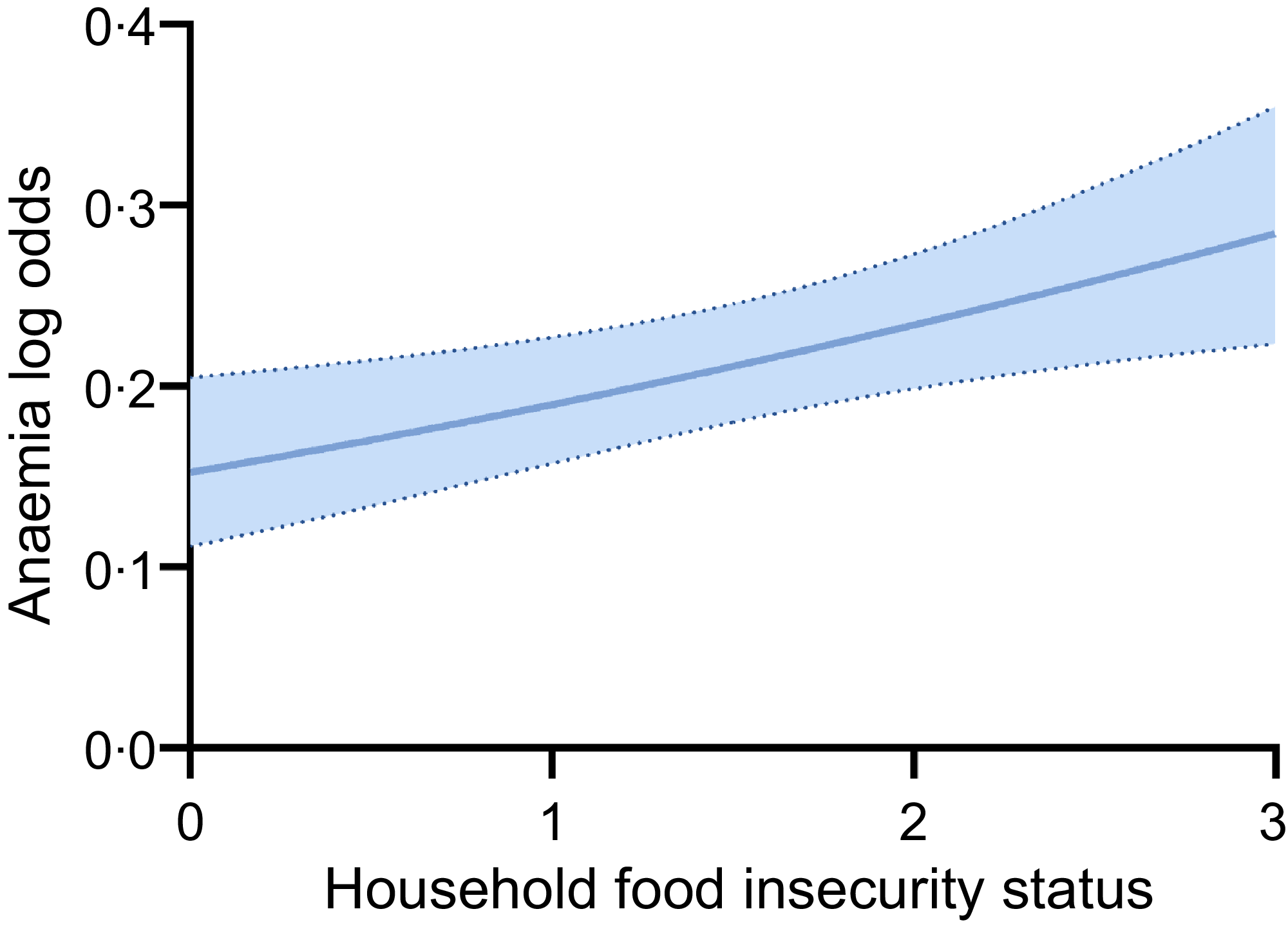
After adjusting the multivariate logistic regression model for age, parity and miscarriage history (Table 3), pregnant women from urban areas were 42 % less likely to have anaemia than their rural counterparts (a-OR: 0·58, 95 % CI 0·37, 0·90, P = 0·014). Additionally, the risk of having anaemia increased with an increase in household food insecurity (Figure 2), and pregnant women who resided in households that were severely food insecure were over two times more likely to have anaemia than those who were from food-secure households (a-OR: 2·58, 95 % CI 1·41, 4·71, P = 0·002). Pregnant women with an MDD-W had an 81 % reduced risk of having anaemia compared with those with LDD (a-OR: 0·19, 95 % CI 0·06, 0·61, P = 0·005). Pregnant women with inadequate energy, Fe and vitamin C intake were more likely to have anaemia compared with those with adequate intake (a-OR: 1·73, 95 % CI 1·13, 2·66, P = 0·012; a-OR: 1·98 95 % CI 1·21, 3·24, P = 0·007; and a-OR: 1·71 95 % CI 1·12, 2·59, P = 0·013, respectively). Half of the pregnant women did not take any iron-folic acid (IFA) tablets during the index pregnancy (Table 1). Multicollinearity diagnostics showed that the variance inflation factor for all variables included in the logistic regression analysis were less than 5. Model 2 calibration was assessed using the Hosmer–Lemeshow goodness-of-fit test. The test yielded χ 2 (8) = 6·83, P = 0·555, indicating no evidence of poor fit.
Univariate and multivariate logistic regression on the association between maternal characteristics and anaemia

Table 3. Long description
The table presents data on the association between maternal characteristics and anaemia, analyzed through univariate and multivariate logistic regression models. It includes columns for crude model, model 1, model 2, and VIF, with rows for different variables such as residence, energy adequacy, iron adequacy, vitamin C adequacy, dietary diversity score, and household food insecurity. Each row provides the c-OR, a-OR, 95% CI, and P-values for the crude model, model 1, and model 2, along with VIF values. The table shows how different factors influence the likelihood of anaemia in pregnant women, with notable trends including reduced risk in urban areas and increased risk with household food insecurity. The Hosmer-Lemeshow goodness-of-fit test results are also included to assess model calibration.
VIF, variance inflation factor; c-OR, crude OR; a-OR, adjusted OR; ref, reference category; DDS, dietary diversity score; LDD, low dietary diversity (<5 out of 10 food groups); MDD-W, Minimum Dietary Diversity for Women (≥5 out of 10 food groups); model 1, adjusted for age and parity; model 2, adjusted for age, parity and miscarriage history.
Logistic plot between household food insecurity and anaemia. Household food insecurity labels: 0 (food secure); 1 (mildly food insecure); 2 (moderately food insecure); 3 (severely food insecure). P < 0·05.

Mediation by dietary diversity in the association between household food insecurity and anaemia
A bootstrapping method was employed using the SPSS Process Macro to investigate whether DDS mediated the relationship between household food insecurity and anaemia among pregnant women. Initially, the model revealed that DDS was a significantly negative predictor of anaemia (β = −0·18, 95 % CI −0·32, −0·03; P = 0·017) – path b and that household food insecurity significantly and negatively predicted DDS (β = −0·06, 95 % CI −0·07, −0·04; P < 0·001) – path a. Additionally, household food insecurity rate was a significant direct predictor of anaemia (β = 0·05, 95 % CI 0·01, 0·08; P = 0·006) – path c’. The results of the indirect effect, based on 5000 bootstrap samples, indicated a significant indirect relationship between household food insecurity and anaemia mediated by DDS (β = 0·01, Boot 95 % CI 0·00, 0·02; P < 0·05) – path ab. The mediator, DDS, accounted for 17·86 % of the total magnitude of the mediation effect on anaemia (Figure 3).
Mediation of DDS on the effect of household food insecurity on anaemia. BootSE, bootstrap standard error; DDS, dietary diversity score; LLCI, lower limit confidence interval; Path a, effect of household food insecurity on DDS; Path b, effect of DDS on anaemia; Path ab, indirect effect of household food insecurity on anaemia; path c’, direct effect of household food insecurity on anaemia accounting for DDS; UPCI, upper limit confidence interval; Magnitude of mediation effect = [path ab/(path c’ effect + path ab effect)] × 100 %.

Figure 3. Long description
A flowchart illustrating the mediation of dietary diversity score (DDS) on the effect of household food insecurity on anemia. The diagram includes three main components: Household food insecurity, DDS, and Anemia. Household food insecurity is connected to DDS through Path a, with a beta value of -0.055, lower limit confidence interval (LLCI) of -0.075, upper limit confidence interval (ULCI) of -0.035, standard error (se) of 0.009, and P-value of 0.0001. DDS is connected to Anemia through Path b, with a beta value of 0.014, LLCI of 0.007, ULCI of 0.021, se of 0.004, and P-value of 0.0001. The direct effect of household food insecurity on anemia, accounting for DDS, is shown through Path c’, with a beta value of 0.046, LLCI of 0.013, ULCI of 0.078, se of 0.017, and P-value of 0.006. The indirect effect of household food insecurity on anemia through DDS is shown through Path ab, with a beta value of 0.010, BootLLCI of 0.001, BootULCI of 0.019, BootSE of 0.004, and P-value less than 0.05. The magnitude of the mediation effect is 17.86 percent.
Qualitative results
A total of seventeen people participated in the qualitative study: ten of them were pregnant women and seven were health workers. Among pregnant women, 80 % had achieved a secondary school level of education, and 60 % were involved in business as their occupation. Their ages ranged from 22 to 35 years. Of the health workers, 57·14 % were male. Their ages ranged from 32 to 50 years, and 70 % of them had a bachelor’s degree. The health workers’ designations included a community health nurse, disease control surveillance assistants, an environmental health officer, a laboratory technician and nursing officers. Their work experience ranged from 6 to 23 years.
The thematic analysis identified four overarching themes: Theme 1 (Awareness and knowledge of anaemia), Theme 2 (Awareness of prevention and control measures of anaemia), Theme 3 (Challenges in the fight against anaemia) and Theme 4 (Recommendations in the fight against anaemia) (Figure 4).
Themes identified during the qualitative interviews.

Most pregnant women defined anaemia as a ‘lack of blood in the body’. ‘I am not sure what anemia is, but I just heard from people in my community after someone had reportedly died because of anemia, and they said it is a form of serious cerebral malaria’ (Pregnant Woman 4).
Some other pregnant women reported not having heard much about what anaemia is, with a few referring to it as cerebral malaria. Both health workers and pregnant women concurred that the cause of anaemia was the lack of diversified food. Out of ten pregnant women, two perceived the condition as serious. Eight of the pregnant women underrated the seriousness of anaemia due to a lack of awareness and could not provide an appropriate diet plan for mitigating the condition. In addition, they considered local vegetables, such as amaranthus and hibiscus leaves, and fruits as the best foods for preventing and controlling anaemia.
Considering the anaemia-related services at health facilities, most pregnant women reported a distribution of free IFA tablets, which was echoed by all health workers. Hb testing was also mentioned, but it was not a reliable service, as pointed out by both sets of interviewees. Furthermore, most participants could not link the services they were provided, whether at the facility or community level, with the policies established by the government, and were not aware of the stakeholders’ responsibility for implementing anaemia-related programmes. In addition, most health workers only mentioned the distribution of IFA tablets and mosquito nets as government policies tailored against anaemia. Low uptake of IFA tablets was reported by both pregnant women and health workers as a common challenge faced in the fight against anaemia. The reasons for low uptake included side effects such as nausea and heart palpitations. ‘Some of us do not like taking these tablets. They make me feel sick and filthy. I feel nauseous whenever I take them. I have also heard that these tablets solidify your blood when you take them. Some of us think that these tablets might be produced by Satanists to make us barren’ (Pregnant Woman 2).
Cultural and religious beliefs, such as the tablets being an agenda of ‘Satanists’ to control the world population, were also reported as a barrier to IFA uptake. In response, participants pointed out that the government should increase education on anaemia, as most participants were not aware of the condition. ‘I think what the government can do is that at school, they need to specifically target the girl child. It will be easier if they start extensively teaching them from primary or secondary school. It is easier to understand information regarding anemia at the health facility when someone has prior education’ (Health Worker 5).
Discussion
Anaemia during pregnancy remains an issue of public health concern in many countries, including Malawi, and poor nutrition has persistently been rampant in such countries. This study comprehensively explored the association between household food insecurity, dietary patterns, anaemia and the knowledge and perceptions of anaemia among pregnant women seeking antenatal care services in health facilities in Lilongwe, Malawi, using a mixed-methods approach. According to WHO, the 21·24 % anaemia prevalence found in this study is still regarded as an issue of public health concern, calling for expedited interventions that aim to reduce the problem. The current study’s anaemia prevalence was lower than the national anaemia prevalence of 41 % in pregnant women(36), probably due to the exclusion of pregnant women with underlying medical conditions, which could have otherwise raised the prevalence(Reference Safiri, Kolahi and Noori37). In addition, since most pregnant women resided in the urban locations of the city with higher economic status, this could have potentially lowered the anaemia prevalence(Reference Safiri, Kolahi and Noori37). This may also have underestimated the burden of anaemia in rural areas, and hence, the sampling of rural health facilities needs to be expanded in the future. Age also exhibited significant disparities, as the youngest age group (<20 years) had the highest anaemia prevalence, highlighting the need for anaemia-related interventions to target younger pregnant women and those who reside in rural areas. Furthermore, the current study found a major lack of knowledge and awareness of anaemia among pregnant women, with most of them referring to anaemia as a ‘lack of blood in the body’, similar to a cross-sectional qualitative study conducted in Nepal(Reference Morrison, Giri and James38).
Household food insecurity was notably high, revealing the country’s persistent food insecurity. The current study found a significant association between household food insecurity and anaemia in pregnant women, concurring with studies conducted in other population groups(Reference Fischer, Shamah-Levy and Mundo-Rosas39,Reference Yang, Yuan and Yang40) , as it was associated with low purchasing power. Women in the lowest tercile of monthly income per capita and those with no employment had the highest household food insecurity rates. They could only rely on economically more available but nutrient-poor foods and had limited access to foods rich in Fe, folate and vitamin B12, hence a higher likelihood of anaemia(Reference Moradi, Arghavani and Issah41). With the preconception that the Malawian diet is predominantly plant-based(Reference Ramlal, Tembo and King42), participants from the qualitative study highlighted vegetables such as amaranthus (bonongwe) and hibiscus leaves (chidede) as a key preventive measure against anaemia, as they were perceived as being rich in Fe. However, this belief is not entirely substantiated, as these vegetables typically contain non-heme Fe, which is characterised by low bioavailability and poor absorption rates(43). Therefore, strategies such as biofortification and dietary diversification are necessary to supplement the traditional plant-based diets, as well as education on correcting the general misconceptions(Reference Abbaspour, Hurrell and Kelishadi44). This calls for the Ministry of Agriculture to facilitate livestock ownership and the establishment of home gardens through knowledge sharing on sustainable agriculture and subsidised farm inputs, enabling women to grow foods rich in micronutrients such as biofortified Fe beans, alongside common vegetables, and empowering them to have their livestock and byproducts such as eggs(Reference Haileselassie, Redae and Berhe45).
The Malawi Dietary Guideline recommends the daily consumption of six food groups, including vegetables, fruits, legumes and nuts, animal foods, staples and fats(Reference Katenga-Kaunda, Kamudoni and Holmboe-Ottesen46). However, the participants’ diets in the current study were mainly plant-based, with those who met the MDD-W having a reduced likelihood of having anaemia compared with those with LDD. Our study concurs with the ones conducted in China(Reference Cai, Li and Feng47), Ethiopia(Reference Zerfu, Baye and Faber48) and Ghana(Reference Ayensu, Annan and Lutterodt49), which also found that higher dietary diversity for women was significantly associated with reduced risk for anaemia. Pregnant women who had met an MDD-W had more intake of Fe, vitamin C, vitamin B12 and folate. As almost all participants were classified as folate-deficient, the discriminatory power of folate adequacy was limited in regression analyses. Nevertheless, the inclusion of folate in this study highlights its significance in pregnant women. Furthermore, the adjusted model of the current study revealed that pregnant women who did not meet the WHO-recommended daily intake of Fe and vitamin C were at a higher risk of anaemia than those who had adequate intake. Despite a weak association, a study conducted among women of reproductive age also found that the risk of anaemia was significantly increased by inadequate intake of such nutrients(Reference Swaminathan, Ghosh and Varghese50). The mediation analysis further revealed that LDD was a significant mediator through which household food insecurity increased the severity of anaemia, and hence, improving dietary diversity could reduce anaemia prevalence in pregnant women by up to 17·86 % linked to household food insecurity. As the current study indicates that approximately one-fifth of the relationship between household food insecurity and anaemia operates through dietary diversity, it underscores the role of dietary diversity as a plausible pathway linking food insecurity to anaemia risk. This finding points to dietary diversity as a potentially modifiable intermediary, one that could be targeted through nutrition-sensitive interventions aimed at improving dietary quality among food-insecure pregnant women. Our study uniquely pioneers the identification of the exact magnitude of the mediation effect of dietary diversity on the association between household food insecurity and anaemia, contributing valuable insights to existing literature. As such, the current study suggests the rigorous promotion of both dietary diversification and a balanced dietary intake to reduce the risk of anaemia.
IFA tablets have previously been proven to be effective in the reduction of anaemia(Reference Palika, Dasi and Ghosh51). In the current study, only half of the pregnant women took IFA tablets. Although some participants were generally aware that IFA tablets distributed at health facilities had something to do with anaemia reduction, they could not connect it to being a government-mandated policy and did not take the tablets. The implementation of the free IFA tablet distribution policy in Malawi dates back to the 20th century(Reference Young, Lupafya and Kapenda52). However, the current study revealed a gap in compliance with the tablets. The religious and cultural beliefs highlighted in this study are some social constructs that limit the effectiveness of antenatal supplementation programmes, even when supply and access are adequate. The low IFA uptake could perpetuate high anaemia prevalence and associated maternal and neonatal risks, undermining national nutrition and maternal health strategies. Addressing these barriers requires culturally sensitive health education, community engagement and integration of local belief systems into antenatal counselling to improve acceptance and sustained use of IFA supplements. The current study also revealed that despite the government’s mandate for routine health education at health facilities(Reference Lungu, Chodzaza and Kamanga53), the education sessions lacked detailed messages on anaemia, which could have also been behind the low uptake of the IFA tablets. To address these challenges, the study suggests comprehensive health education using a multi-sectoral approach to improve knowledge about anaemia. Programmes could include door-to-door visits and the involvement of community leaders to enhance receptiveness, as previously demonstrated(Reference Ko, Pumpaibool and Wynn54,Reference Thakur, Kumar, Prabhakar and Leal Filho55) . Young women in schools and the general community could also be targeted with anaemia-related messages by supplementing the education curriculum with detailed anaemia-related messages, including distributing brochures and fliers on anaemia. Health facilities could have posters on anaemia that are printed in the local language, such as Chichewa. The government could also include refresher training for health workers on anaemia to ensure that the health workers effectively deliver the services and detailed messages related to the condition. Implementing these strategies can help reduce the prevalence of anaemia among pregnant women and improve maternal and fetal health outcomes. Additionally, since some participants indicated that low uptake of IFA tablets was partly due to side effects such as nausea, we suggest an enhancement of the tablet processing technology that can improve the taste and smell of the tablets, as well as the manufacturing of high-quality protein and micronutrient powders made from locally available foods.
In addition, although routine Hb measurement has been one of the crucial components of the Essential Health Package in Malawi(Reference Medina Lara, Mundy and Kandulu56), the current study revealed that anaemia testing was irregular in most health facilities due to a lack of testing kits such as microcuvettes and HemoCue systems. Most pregnant women in the current study only had access to Hb measurement due to the supplementation of microcuvettes that the study offered. This, therefore, calls for immediate attention from the Malawi Ministry of Health and Population and international organisations such as the UNICEF, United States Agency for International Development (USAID) and the WHO to step in on the need.
These findings underscore the urgent need to strengthen implementation of Malawi’s National Multi-Sector Nutrition Policy and Strategic Plan, aligning maternal anaemia reduction efforts with national priorities for improving dietary diversity and micronutrient supplementation.
Strengths and limitations
This study is the first to assess the association between household food insecurity, dietary intake and anaemia among pregnant women in Malawi and their knowledge and perceptions towards anaemia. The study employed mediation analysis and a mixed-method approach to investigate the connectedness of household food insecurity, dietary diversity and anaemia among pregnant women, which has not yet been explored. However, a few limitations should be considered in interpreting the findings. First, this study employed a cross-sectional design, which raises the possibility of reverse causality in the relationship between household food insecurity, dietary intake and anaemia. Second, the use of a 1-month SQ-FFQ in collecting dietary information and HFIAS in assessing household food insecurity may have been subject to recall bias. Another limitation of the current study was that conducting interviews via audio phone calls may have limited the ability to assess body language, thereby limiting the observation of additional data during the qualitative interview process. The snowball sampling method may have introduced sampling bias in the qualitative phase of the study. Furthermore, despite adjusting for several covariates, potential residual confounding cannot be ruled out. Additionally, there might be a limited generalisability as the current findings are most directly generalisable to pregnant women in their second trimester, as this group was specifically selected due to the heightened susceptibility to anaemia associated with the physiological decline in Hb levels. Future studies could consider including pregnant women from all three trimesters.
Conclusion
This study aimed to explore the association between household food insecurity, dietary intake and anaemia in pregnant women in Lilongwe, Malawi. Over one-fifth of 612 pregnant women in their second trimester were anaemic, indicating a continued public health concern about the condition in Malawi. Anaemia risk is significantly increased with elevated levels of household food insecurity, LDD and inadequate nutrient intake, including energy, Fe and vitamin C, and a lack of knowledge and perception of anaemia. The current study indicates that approximately one-fifth of the relationship between household food insecurity and anaemia is mediated by dietary diversity, underscoring the role of dietary diversity as a significant and modifiable pathway linking food insecurity to anaemia risk. As such, integrating nutrition-sensitive interventions that prioritise dietary diversity into existing maternal health and food security programmes offers a promising and actionable strategy to reduce the burden of anaemia among pregnant women. There is, therefore, an urgent need for multi-sectoral collaboration, such as facilitation of home gardens and livestock ownership, which could improve dietary diversity, implementing comprehensive health education within school curricula, providing targeted training for healthcare staff and distributing anaemia-related fliers and brochures at the community level. These efforts could help improve dietary diversity and dispel cultural myths such as ‘IFA tablets cause infertility’. To reduce side effects, IFA tablet processing needs to be optimised with sustained-release technology. Further research should focus on developing and evaluating region-specific anaemia prevention programmes to combat anaemia more efficiently in African countries. Future studies may also consider combining additional Fe metabolism biomarkers, such as serum ferritin and transferrin saturation, to improve accuracy in determining anaemia and adopting a longitudinal study design to validate the conclusions.
Supplementary material
For supplementary material/s referred to in this article, please visit https://doi.org/10.1017/S0007114526108320
Data availability statement
Data described in the manuscript, code book and analytic code will be made available upon reasonable request pending approval from the authors.
Acknowledgements
The authors would like to thank the professors of the Xiangya School of Public Health, Central South University, in Changsha, Hunan Province, China (Qian Lin, Lina Yang), for their intellectual guidance, the research assistants in Malawi (Linda Chimbalanga, David Kanyerere, Thoko Nsema, Memory Nkhata, Chikaola Kelvin Sikanadze, Janet Tembo, Loveness Ngomale and Estery Kondowe) who collected data, and all the pregnant women who participated in this study.
William Munthali: Conceptualisation-Equal, Data curation-Equal, Formal analysis-Equal, Investigation-Equal, Methodology-Equal, Project administration-Equal, Software-Equal, Validation-Equal, Visualisation-Equal, Writing – original draft-Equal, Writing – review editing-Equal; Ying Zhang: Formal analysis-Equal, Project administration-Equal, Supervision-Equal, Writing – review editing-Equal; Qian Lin: Supervision-Equal; Lina Yang: Supervision-Equal, Writing – review editing-Equal.
This study did not receive any external funding.
The authors declare no conflicts of interest in the current study.