Introduction
The patent ductus arteriosus represents the most common cardiovascular pathology in neonates born prematurely, affecting over 50% of preterm infants with a gestational age of 28 weeks or less. Reference Hamrick and Hansmann1 The ductus arteriosus predominantly comprises smooth muscle cells, whose functional constriction postnatally initiates ductal closure, subsequently followed by anatomical remodelling into ligamentum arteriosum. Reference Gittenberger-de Groot, Moulaert, Harinck and Becker2,Reference Hamrick, Sallmon and Rose3 The closure of ductus arteriosus postnatally induced by an elevation in oxygen tension and vasoconstrictive agents such as endothelin-1, catecholamines, and contractile prostanoids, alongside a reduction in vasodilatory mediators including prostaglandins, nitric oxide, and adenosine. Additional factors influencing ductal closure encompass ion channels, calcium flux, morphological maturity, and genetic predisposition. Reference Hamrick, Sallmon and Rose3 Magnesium is pivotal in the regulation of vascular tone, functioning as a calcium channel blocker that inhibits calcium ion entry into smooth muscle cells, thereby inducing vasodilatation. Extracellular magnesium concentration modulates intracellular calcium mobilisation in both vascular smooth muscle and endothelial cells by preventing calcium influx and enhancing prostacyclin production. These mechanisms contribute to the delayed closure of the ductus arteriosus. Reference Katayama, Minami, Enomoto, Takano, Hayashi and Lee4 Antenatal exposure to magnesium sulphate (MgSO4) and the resultant higher serum magnesium levels in the fetus and neonate have been associated with increased patent ductus arteriosus incidence in some studies; however, the findings have been inconsistent.
This study aimed to evaluate the relationship between serum magnesium levels and the increased risk of symptomatic patent ductus arteriosus and other neonatal morbidities in premature infants.
Materials and methods
This retrospective single-centre cohort study was conducted through a review of medical records of patients admitted to a tertiary neonatal ICU between January 2015 and December 2018. The study included neonates born at or before 29 weeks of gestation. Exclusion criteria encompassed CHD, persistent pulmonary hypertension, and major congenital anomalies. The cohort was divided into two groups: those with symptomatic patent ductus arteriosus and those without. Serum magnesium levels, measured at 24 hours of life, were categorised into two groups: Group A (3 mg/dL) and Group B (< 3 mg/dL). The analysis encompassed various demographic factors including gender, gestational age, type of birth, birth weight, multiple pregnancies, medical treatments, and surgical interventions. Neonatal outcomes were also assessed, including respiratory distress syndrome, bronchopulmonary dysplasia, necrotising enterocolitis, intraventricular haemorrhage, retinopathy of prematurity, sespsis, length of hospital stay, and mortality.
In accordance with the institution’s parenteral nutrition policy, all preterm infants in the neonatal ICU initially received electrolyte-free parenteral nutrition, with the edition of electrolytes following the first 24 hours, based on serum electrolyte levels. Serum magnesium levels were determined using the Atellica CH analyser with the photometric method. Normal serum magnesium levels were defined as 1,6–2,3 mg/dL. Reference Gomella and Cunningham5
According to the institution’s protocol, echocardiographic evaluations were performed by a trained paediatric cardiologist using a VIVID IQ machine with 12S probe within the first 4 days of life for all preterm neonates, with earlier assesments conducted if signs of systemic hypoperfusion or pulmonary overcirculation were present. Symptomatic patent ductus arteriosus was defined as a ductal diameter ≥ 1.5 mm, LA/Ao ratio ≥ 1.5 with systemic and pulmonary findings. For neonates with symptomatic patent ductus arteriosus, treatment with ibuprofen or paracetamol was administered, with additional courses provided if necessary. Ductal ligation was performed for cases of persistent symptomatic patent ductus arteriosus despite medical treatment. Follow-up echocardiographic evaluations were conducted 24–48 hours post-treatment or ductal ligation using a VIVID IQ machine with 12S probe and adhering to standardised protocols executed by trained paediatric cardiologists.
Statistical analysis
Statistical analyses were conducted using IBM SPSS statistical software for Windows, Version 21.0 (Chicago, IL, USA). When evaluating the study values, descriptive statistical methods (i.e., mean, standard deviation, median, frequency, percentage, minimum, and maximum) were used. The normal distribution of the quantitative data was tested by a Shapiro– Wilk test and graphical analyses. Student’s t test was used for comparisons of normally distributed quantitative variables between two groups, and a Mann–Whitney U test was used for comparisons of non-normally distributed quantitative variables between two groups. Pearson’s chi-squared test and the Fisher–Freeman–Halton test were used for a comparison of the qualitative data. The association between Mg, Ca, and patent ductus arteriosus was evaluated by correlation and regression analysis. Statistical significance was accepted as p < 0.05.
Results
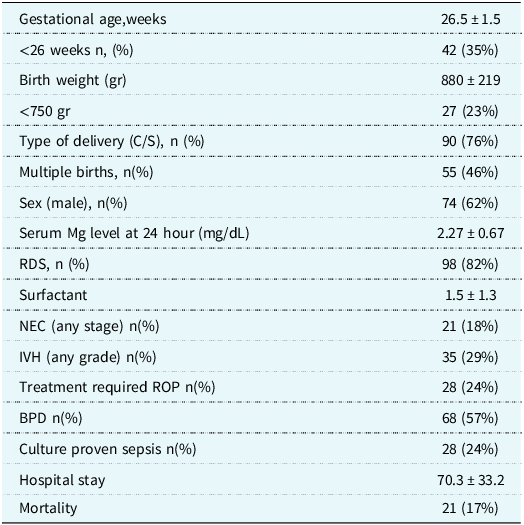
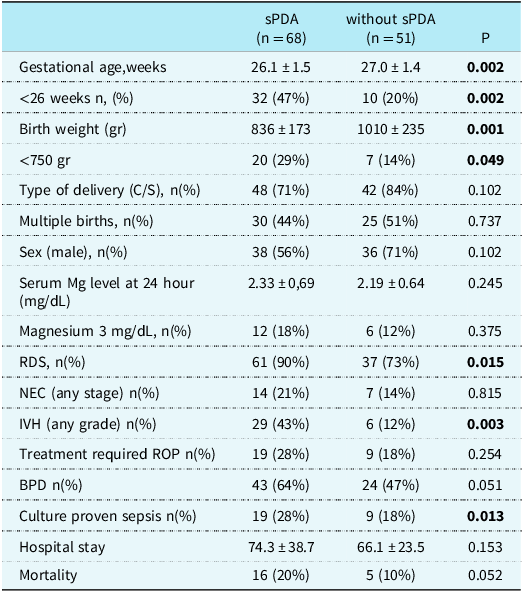
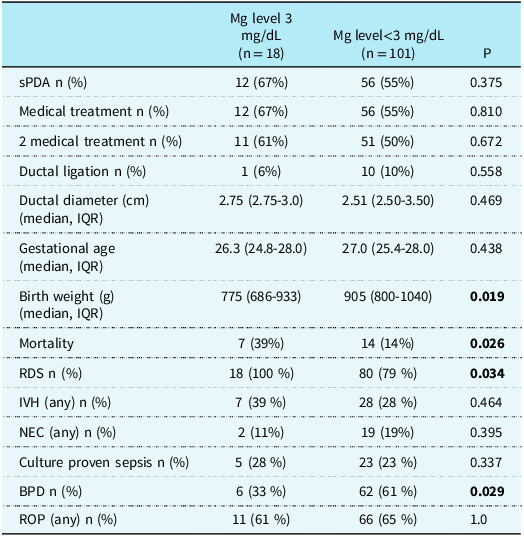
A total of 119 infants with a gestational age of ≤ 29 weeks were included in the study, with 74 of the neonates (62%) being male. Ninety neonates (76%) were born by C-section. The mean birth weight was 880 ± 219 g, and the mean gestational age was 26.5 ± 1.5 weeks. Among the participants, 68 infants were diagnosed with symptomatic patent ductus arteriosus. The baseline characteristics of the study participants are presented in Table 1. The baseline characteristics and neonatal outcomes with symptomatic patent ductus arteriosus and without symptomatic patent ductus arteriosus are presented in Table 2. Gestational age and birth weight were significantly lower among symptomatic patent ductus arteriosus neonates (p < 0.05). No significant difference was observed between these two groups. Respiratory distress syndrome, intraventricular haemorrhage, and early onset neonatal sepsis were significantly higher in the symptomatic patent ductus arteriosus group. We also evaluated the association between magnesium levels and symptomatic patent ductus arteriosus, the results were demonstrated in Table 2; contrary to expectations, there was no significant difference between serum magnesium level and symptomatic patent ductus arteriosus. Also, no significant difference was observed between serum magnesium level and ductal diameter, requirement of medical and surgical treatment of symptomatic patent ductus arteriosus (Table 3). There was a reverse relationship between serum magnesium level and gestational age and birth weight; in other words, the serum magnesium level was higher among neonates with lower gestational age and birth weight. It was observed that as serum magnesium level increased, mortality increased, but when regression analysis was performed among factors affecting mortality such as birth weight, gestational age, respiratory distress syndrome, bronchopulmonary dysplasia, sepsis, symptomatic patent ductus arteriosus, and high serum magnesium level, it was seen that only gestational age increased mortality (OR:1.44 95% CI (0.94–2.22) p = 0.04).
Baseline characteristics of all neonates in the study

C/S = caesarean section; RDS = respiratory distress syndrome; NEC = necrotising enterocolitis; IVH = Intraventricular haemorrhage; ROP = Retinopathy of prematurity; BP = Bronchopulmonary dysplasia.
Baseline characteristics and neonatal outcomes with and without symptomatic PDA

sPDA = symptomatic patent ductus arteriosus; RDS = respiratory distress syndrome; NEC = necrotising enterocolitis; IVH = Intraventricular haemorrhage; ROP = Retinopathy of prematurity; BPD = Bronchopulmonary dysplasia.
The association between neonatal outcomes and serum magnesium level

SPDA = symptomatic patent ductus arteriosus; RDS = respiratory distress syndrome; NEC = necrotising enterocolitis; IVH = Intraventricular haemorrhage; ROP = Retinopathy of prematurity; BPD = Bronchopulmonary dysplasia.
In comparing neonatal outcomes between Group A and Group B, it was observed that the incidence of respiratory distress syndrome was significantly higher in neonates with serum magnesium levels exceeding 3 mg/dL, while the incidence of bronchopulmonary dysplasia was significantly lower in the same group (p < 0.05). These findings are detailed in Table 3. Furthermore, when gestational age, symptomatic patent ductus arteriosus, respiratory distress syndrome, and sepsis were considered potential risk factors for the development of bronchopulmonary dysplasia, multivariate analysis revealed that elevated serum magnesium levels significantly decreased the incidence of bronchopulmonary dysplasia (OR: 0.167, 95% CI: 0.051–0.543, p = 0.003)
Discussion
Contrary to our hypothesis that elevated serum magnesium levels might increase the risk of symptomatic patent ductus arteriosus and subsequently the need for medical and surgical treatment, given magnesium’s role as a calcium channel blocker, our study found no significant association. Previous research has consistently reported a higher prevalence of symptomatic patent ductus arteriosus in neonates with earlier gestational ages and lower birth weights, as well as a greater incidence of respiratory distress syndrome, intraventricular haemorrhage and sepsis in this population. Although a trend towards increased mortality with higher serum magnesium levels was noted, this association was attenuated and rendered nonsignificant when adjusted for confounding variables in the regression analysis. Interestingly, the incidence of RDS was significantly higher in premature neonates with serum magnesium levels exceeding 3 mg/dL. Conversely, the incidence of bronchopulmonary dysplasia was significantly lower in the same group. Even after adjusting for confounders, such as gestational age, symptomatic patent ductus arteriosus, respiratory distress syndrome, and sepsis, bronchopulmonary dysplasia remained significantly lower in premature infants with serum magnesium levels above 3 mg/dL.
In an in vivo study, Toyoshima et al. demonstrated that MgSO4 administration in rat neonates resulted in delayed ductal closure and reduced duct-constricting effect of indomethasin. Reference Toyoshima, Momma and Nakanishi6 Additionally, elevated serum magnesium concentrations have been observed in term and preterm neonates whose mothers received MgSO4. Reference Dangman and Rosen7,Reference Rantonen, Kaapa and Jalonen8 Antenatal MgSO4 treatment in extremely low birth weight newborns was shown to reduce the response to prophylactic patent ductus arteriosus treatment with indomethacin but had no significant effect on the medical treatment of . Reference Katayama, Minami, Enomoto, Takano, Hayashi and Lee4 This might be related to the fact that the half-life of magnesium is approximately 48 hours, and the serum level decreases to normal values within a few days. However, our study did not identify a significant relationship between serum magnesium level at 24 hours of life and the incidence of symptomatic patent ductus arteriosus or the necessity for medical or surgical intervention.
Del Moral et al. reported antenatal MgSO4 exposure in extremely low birth weight infants was associated with a higher risk of patent ductus arteriosus particularly in more mature infants (26 weeks), though the requirement for surgical ligation did not differ significantly between MgSO4 exposed and control groups. This observation is consistent with other studies suggesting that developmental variations in voltage-gated calcium channels might affect magnesium-induced vascular response. Reference del moral, Gonzalez-Quintero, Claure, Vanbuskirk and Bancalari9 Consistent with the results of the mentioned study, a rabbit lung study demonstrated that there is a developmental change in voltage-gated calcium channels, which can cause differences in the response of magnesium-induced vascular relaxation at different stages of development. In other words, the dilator effect of magnesium may increase in more mature infants. Reference Tolsa, Gao and Raj10 Half of our study group consisted of newborns were below 26 weeks of gestation, and in our study, we did not find the difference between high serum magnesium levels and symptomatic patent ductus arteriosus and the need for treatment.
Supporting our findings, De Jesus et al. and Alanso et al did not report an increase in the prevalence of patent ductus arteriosus associated with antenatal MgSO4 treatment. Reference De Jesus, Sood and Shankaran11,Reference García Alonso, Pumarada Prieto and González Colmenero12 In the mentioned study, the mean magnesium level on the first day of life in newborns who received antenatal MgSO4 treatment was 2.68 ± 0.10 mg/dL, slightly higher than our results (2.33 ± 0.69 mg/dL). Reference García Alonso, Pumarada Prieto and González Colmenero12 However, their study did not stratify patent ductus arteriosus incidence by serum magnesium levels, while our stratification (Mg level 3 mg/dL and Mg level < 3 mg/dL) also yielded no significant association.
In the study conducted by Stigson, the serum Mg level was significantly higher among infants at the same mean gestational age (< 29 weeks) who had patent ductus arteriosus compared to the group without patent ductus arteriosus. The mean serum magnesium level of neonates with patent ductus arteriosus was 2.38 mg/dL (0.98 mmol/L), corroborating our findings. Reference Stigson and Kjellmer13 Another study assessing preterm neonates exposed to antenatal magnesium for neuroprotection found no significant difference in patent ductus arteriosus incidence when stratified by serum magnesium levels aligning with our results. Reference Basu, Chickajajur, Lopez, Bhutada, Pagala and Rastogi14
Furthermore, Qasim et al. concluded that antenatal MgSO4 treatment did not corrolate with an increased incidence of patent ductus arteriosus, suggesting that magnesium does not interfere with the calcium channels essential for ductal constriction. Reference Qasim, Jain and Aly15
Magnesium sulphate influences the formation of arachidonic acid metabolites, which play a critical role in mediating acute lung injury. Acute lung injury is often exacerbated by high oxygen exposure due to the production of oxygen-free radicals. These radicals, along with leukotrienes, cytokines, and prostanoids, can damage the vascular endothelium of the lungs, increase capillary permeability, and lead to pulmonary congestion, oedema, and leukocyte infiltration. In animal studies, rats exposed to acute oxygen toxicity showed reduced lung injury with high-dose magnesium treatment. Reference Flink, Dedhia, Dinsmore, Doshi, Banks and Hshieh16 Conversely, hypomagnesemia increased susceptibility to hyperoxic lung injury, while hypermagnesemia appeared to mitigate it. Reference Dedhia and Banks17 Human studies have yielded inconsistent results. Basu et al. reported no significant difference in the incidence of bronchopulmonary dysplasia between groups treated with antenatal magnesium sulphate and those not treated. Reference Basu, Chickajajur, Lopez, Bhutada, Pagala and Rastogi14 Edwards et al. found a higher prevalence of bronchopulmonary dysplasia in the high cord blood magnesium group; however, this association was not significant after adjusting for covariates, suggesting a link between gestational age and birth weight. Reference Edwards, Edwards, Swamy and Grotegut18 In contrast, Alonso et al. reported a significantly lower incidence of moderate to severe bronchopulmonary dysplasia among neonates treated with prenatal magnesium sulphate. Reference Alonso, Prieto and Colmenero19 Consistent with these findings, our study observed a significantly lower incidence of bronchopulmonary dysplasia among neonates with higher serum magnesium levels.
Our institution routinely administers antenatal MgSO4 for neuroprotection to pregnant women at risk of preterm delivery before 32 weeks of gestation. Nonetheless, some patients may not receive MgSO4 due to time constraints between hospital admission and delivery, and the treatment status of patients referred from external centres is not always documented. The retrospective design of our study limits our ability to ascertain the precise dosing and duration of antenatal MgSO4 administration. Additionally, our diagnosis of symptomatic patent ductus arteriosus was based solely on a ductal diameter of ≥ 1.5 mm, LA/Ao ratio ≥ 1.5 and clinical findings, without incorporating current ultrasonographic criteria demonstrating systemic steal and pulmonary overload for hemodynamic significance.
Our study did not identify a definitive link between serum magnesium levels and the occurrence of symptomatic patent ductus arteriosus or the necessity for medical and surgical treatment in preterm infants born before 29 weeks of gestation. Notably, we observed a lower incidence of bronchopulmonary dysplasia among neonates with elevated serum magnesium levels. Thus, while antenatal MgSO4 treatment, typically administered for maternal and fetal–neonatal neuroprotection, may not significantly influence the development or management of symptomatic patent ductus arteriosus, it might offer protective benefits against moderate to severe bronchopulmonary dysplasia. Further prospective studies are needed to clarify these associations and better understand the potential therapeutic roles of magnesium in neonatal care.
Financial support
This research did not receive any specific grant from funding agencies in the public, commercial, or not-for-profit sectors.
Competing interests
The authors stated that there are no conflicts of interest regarding the publication of this article.
Ethical standard
The study was undertaken in compliance with the guidelines of the Declaration of Helsinki. The study was approved by the local ethics committee of Acibadem University (No: ATADEK 2018–13/2).