Introduction
Traumatic brain injury (TBI) is a common and significant cause of disability (Langlois et al. Reference Langlois, Rutland-Brown and Thomas2006). Individuals with TBI have elevated risk for anxiety and depressive disorders following injury (Hibbard et al. Reference Hibbard, Uysal, Kelpler, Bogdany and Silver1998; Bombardier et al. Reference Bombardier, Fann, Temkin, Esselman, Barber and Dikmen2010; Gould et al. Reference Gould, Ponsford, Johnston and Schönberger2011a ). Reported prevalence ranges between 10% and 70% for anxiety and 18.5% and 61% for depression (Rao & Lyketsos, Reference Rao and Lyketsos2002; Kim et al. Reference Kim, Lauterbach, Reeve, Arciniegas, Coburn, Mendez, Rummans and Coffey2007), with these disorders co-occurring in approximately 75% of cases (Jorge et al. Reference Jorge, Robinson, Moser, Tateno, Crespo-Facorro and Arndt2004; Whelan-Goodinson et al. Reference Whelan-Goodinson, Ponsford, Johnston and Grant2009; Gould et al. Reference Gould, Ponsford, Johnston and Schönberger2011a ). Post-TBI anxiety and depression are associated with poorer functional outcomes (Pagulayan et al. Reference Pagulayan, Hoffman, Temkin, Machamer and Dikmen2008; Whelan-Goodinson et al. Reference Whelan-Goodinson, Ponsford and Schönberger2008; Schönberger et al. Reference Schönberger, Ponsford, Gould and Johnston2011; Gould et al. Reference Gould, Ponsford, Johnston and Schönberger2011b ).
Despite their high prevalence and negative impact, there has been relatively little investigation of treatments for anxiety and depressive disorders after TBI. Evidence shows that the effectiveness of pharmacological therapy is limited and concerns have been raised regarding vulnerability of individuals with TBI to side-effects (Warden et al. Reference Warden, Gordon, McAllister, Silver, Barth, Bruns, Drake, Gentry, Jagoda, Katz, Kraus, Labbate, Ryan, Sparling, Walters, Whyte, Zapata and Zitnay2006; Fann et al. Reference Fann, Hart and Schome2009). Developing non-pharmacological treatments is essential. The psychological therapy of choice for anxiety and depression in the general population is cognitive behavioral therapy (CBT) (Butler et al. Reference Butler, Chapman, Forman and Beck2006). CBT teaches behavioral skills including graded exposure, activity scheduling, relaxation and social skills, and cognitive skills such as challenging unhelpful thoughts (Beck, Reference Beck1995). However, individuals with moderate to severe TBI commonly have impaired attention, memory, executive function, and self-awareness that may affect their ability to benefit from psychological therapy as applied to the general population.
Most studies examining the use of CBT to treat anxiety and depression in individuals with TBI are limited in their study design (Tiersky et al. Reference Tiersky, Anselmi, Johnston, Kurtyka, Roosen, Schwartz and Deluca2005; Soo & Tate, Reference Soo and Tate2007; Waldron et al. Reference Waldron, Casserly and O'Sullivan2013). The few studies with good design show promising results in alleviating anxiety. Evaluating a five-session CBT program for acute stress disorder following mild TBI, Bryant et al. (Reference Bryant, Moulds, Guthrie and Nixon2003) reported a lower percentage of cases receiving CBT (n = 12) showing clinically significant post-traumatic stress disorder at therapy completion and 6-month follow-up than those receiving treatment as usual (n = 12). In a waitlist-controlled trial of CBT in 12 individuals with social anxiety (nine with TBI), Hodgson et al. (Reference Hodgson, McDonald, Tate and Gertler2005) reported a significant reduction in depression and anxiety on the Hospital Anxiety and Depression Scale (HADS), though not social phobia at post-treatment and 1-month follow-up. Tiersky et al. (Reference Tiersky, Anselmi, Johnston, Kurtyka, Roosen, Schwartz and Deluca2005) found that CBT combined with neurorehabilitation reduced anxiety on the Symptom Checklist – 90R in 20 individuals with mild-moderate TBI. However, as Soo & Tate (Reference Soo and Tate2007) noted, these trials have been small in number and sample size and heterogeneous in methodology. While Bedard et al. (Reference Bedard, Felteau, Marshall, Cullen, Gibbons, Dubois, Maxwell, Mazmanian, Weaver, Rees, Gainer, Klein and Moustgaard2014) demonstrated efficacy of mindfulness-based cognitive therapy for depression in individuals with TBI, other well-designed studies targeting depression post-TBI have been less promising. Fann et al. (Reference Fann, Bombardier, Vannoy, Dyer, Ludman, Dikmen, Marshall, Barber and Temkin2014) conducted a randomized controlled trial with 100 participants with TBI and major depressive disorder (MDD) (31% severe TBI), delivering 12 weekly CBT sessions with emphasis on behavioral activation, either in person (n = 18) or via telephone (n = 40). There were no significant effects relative to a usual care control group on the 17-item Hamilton Depression Rating Scale (HAMD-17). Treatment delivery across two modalities is a significant study limitation. Ashman et al. (Reference Ashman, Cantor, Tasaosides, Spielman and Gordon2014) reported no significant reduction in depression on the Beck Depression Inventory II (BDI-II) immediately following 16 sessions of CBT relative to supportive counseling. One reason these studies have not found significant effects may be that they failed to address anxiety, which is often co-morbid with depression (Gould et al. Reference Gould, Ponsford, Johnston and Schönberger2011a ). It is essential that trials are developed that address both anxiety and depression following TBI.
Given the presence of cognitive impairments, particularly following moderate to severe TBI, it is important to adapt therapy to maximize benefit. We previously developed and tested the feasibility of a manualized Adapted CBT (aCBT) program with post-TBI anxiety (Hsieh et al. Reference Hsieh, Ponsford, Wong and McKay2012a , Reference Hsieh, Ponsford, Wong, Schönberger, McKay and Haines b , Reference Hsieh, Ponsford, Wong, Schönberger, Taffe and McKay d ). This incorporated repetition and prompting, a manual containing handouts and visual prompts, simplified self-monitoring record sheets, management strategies for executive difficulties and a focus on concrete behavioral strategies. Booster sessions also represent an important component of therapy to consolidate gains for individuals with executive and memory difficulties. These were not included in the above-mentioned studies employing CBT following TBI.
Given that CBT requires active client involvement (Cuijpers et al. Reference Cuijpers, van Straten, Andersson and van Oppen2008), client motivation is extremely important. Individuals with TBI with limited self-awareness and cognitive function may be difficult to engage in therapy. Brief preparatory motivational interventions may enhance readiness to change, psychological preparedness, treatment engagement and response in this population (Van den Broek, Reference Van den Broek2005; Arkowitz et al. Reference Arkowitz, Westra, Miller and Rollnick2008; Medley & Powell, Reference Medley and Powell2010). Motivational interviewing (MI) is a well-validated therapeutic approach aiming to address ambivalence related to attempts to change behavior. Watkins et al. (Reference Watkins, Auton, Deans, Dickinson, Jack, Lightbody, Sutton, van den Broek and Leathley2007) showed that a brief MI intervention in an acute stroke setting had a positive effect on mood. We have previously successfully examined the use of preparatory MI among other clients with complex presentations (Baker et al. Reference Baker, Lee, Claire, Lewin, Grant, Pohlman, Saunders, Kay-Lambkin, Constable and Carr2005). Following successful use of MI as a prelude to CBT in anxiety treatment studies (Westra & Dozois, Reference Westra and Dozois2006), we developed a three-session preparatory program to precede nine sessions of CBT and trialed it with success in a client with severe TBI treated for anxiety 4 months post-injury (Hsieh et al. Reference Hsieh, Ponsford, Wong, Schönberger, McKay and Haines2012 b) The MI sessions focused on helping the client establish realistic treatment goals and supporting their self-efficacy for coping with anxiety. Strategies accommodated the client's cognitive limitations, including use of personally meaningful metaphors and role-plays.
The overall aim of this study was to examine the efficacy of CBT in treating anxiety and depression following TBI. We investigated the efficacy of three treatment conditions, the first two incorporating aCBT: MI followed by CBT (MI + CBT), non-directive counseling followed by CBT (NDC + CBT), and waitlist control (WC) in reducing self-reported anxiety and depression symptom severity in individuals with mild to severe TBI. Our primary hypothesis was that participants receiving aCBT (NDC + CBT and MI + CBT, i.e. aCBT groups) would show greater reduction in HADS-Anxiety and Depression, Anxiety and Stress Scale (DASS)-Depression symptoms than participants in the WC group over a 30-week period including intervention and follow-up. Additionally, we hypothesized that participants in the aCBT groups would exhibit greater functional gains on the secondary measure, the Sydney Psychosocial Reintegration Scale, 2nd edn (SPRS-2) compared with WC over 30 weeks. Our secondary hypothesis was that the addition of MI would increase motivation for treatment and improve outcomes of CBT, so that participants receiving MI + CBT would show a greater reduction in anxiety and depression symptoms and improvement in psychosocial function over the 30 weeks than those receiving NDC + CBT.
Method
Participants
Patients with TBI and anxiety/depression were recruited between May 2008 and June 2013. Staff at local rehabilitation facilities were informed about the study including inclusion/exclusion criteria, and they referred eligible patients. Inclusion criteria were (1) mild to severe TBI, (2) age ⩾18 years; (3) adequate English and cognitive ability to complete questionnaires and therapy tasks; (4) symptoms consistent with one or more depressive and/or anxiety disorder or subsyndromal anxiety and/or depressive disorder with clinical levels of impairment as indicated by Structured Clinical Interview for DSM-IV (SCID-I; First et al. Reference First, Spitzer, Gibbon and Williams2007). Exclusion criteria were: (1) active suicidality, (2) psychosis and, (3) residing >150 km away. Participants were not compensated for participation.
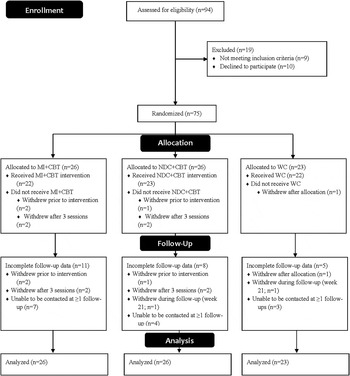
Study recruitment and retention is set out in Fig. 1. Of the 94 individuals referred to the study, 75 (20 females) were randomized, 26 to MI + CBT, 26 to NDC + CBT and 23 to WC.
Flow of participants through each stage of the randomized controlled trial. MI, Motivational interviewing; CBT, cognitive behavioral therapy; NDC, non-directive counseling; WC, waitlist control.

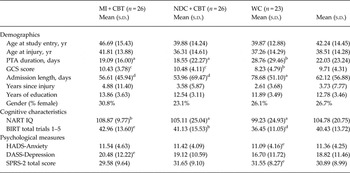
Mean time post-injury was 3.73 years, with 16% <1 year post-injury, 52% 1–2 years post-injury, and 32% >3 years post-injury (range 3–57 years) of whom six were >10 years post-injury (one WC, two CBT, three MI + CBT). The predominant cause of injury was motor-vehicle accident (42.7%), followed by pedestrian (18.7%), falls (12%), motorbike (10.7%) and cycling (9.3%) accidents, work-related injuries (2.7%) or other causes (4.0%). Glasgow Coma Scale (GCS) scores were available for 63 participants, with 46.1% classified as mild (scoring 13–15), 15.9% as moderate (score 9–12), and 38.1% as severe (score 3–8). Post-traumatic amnesia (PTA) duration was available for 65 participants, with 6.2% classified as mild (PTA < 24 h), 30.8% as moderate (1–7 days, or <1 day with abnormal CT), 36.9% as severe (1–4 weeks) and 26.2% as very severe (>4 weeks). Group demographic, cognitive and psychological characteristics at baseline are provided in Table 1 and diagnostic details in Supplementary Table S1. There were no significant group differences on these measures.
Demographic, cognitive and psychological characteristics by treatment condition at baseline

MI, Motivational interviewing; CBT, cognitive behavioral therapy; NDC, non-directive counseling; WC, waitlist control; PTA, post-traumatic amnesia; GCS, Glasgow Coma Scale; NART IQ, National Adult Reading Test Intelligence Quotient; BIRT, Brain Injury Rehabilitation Trust Memory and Information Processing battery; HADS, Hospital Anxiety and Depression Scale; DASS, Depression, Anxiety and Stress Scale; SPRS-2, Sydney Psychosocial Reintegration Scale, 2nd edn.
a Missing data from four participants.
b Missing data from two participants.
c Missing data from five participants.
d Missing data from three participants.
e Missing data from one participant.
The majority of participants had an anxiety disorder co-morbid with a depressive disorder (60%); 21.20% had a depressive disorder only, 13.5% an anxiety disorder only, 13.5% presented with a subclinical depressive or anxiety disorder, and 1.9% had other disorders (n = 1, co-morbid anxiety, depression and alcohol dependence). Most frequent anxiety disorders were generalized anxiety disorder (GAD; 17.3%) and post-traumatic stress disorder (17.3%) and most frequent depressive disorder was major depressive disorder (56%). There were no significant group differences in diagnoses. Of the sample, 42.7% were taking psychotropic medication at study entry, 42.3% in the MI + CBT group, 38.5% in NDC + CBT group and 47.8% in WC group.
Procedures
This study was approved by university and hospital ethics committees and participants provided informed written consent.
Randomization and concealment
Following recruitment and baseline assessment, participants were randomized into treatment groups stratified by gender and referral source. Block randomization was applied with three participants in each block to ensure group balance. A researcher independent of the study used an online random number sequence generator and transcribed allocation sequences onto cards. Staff conducting follow-up assessments were masked to group membership and independent of treatment delivery.
Treatment groups and interventions
Participants were randomized into one of three groups: (1) MI + CBT, receiving MI for 3 weeks followed by CBT for 9 weeks, and three booster sessions of CBT between 21 and 30 weeks post-recruitment; (2) NDC + CBT, receiving non-directive counseling for 3 weeks, CBT for 9 weeks and three booster sessions of CBT between 21 and 30 weeks; and, (3) WC with invitation to receive MI + CBT at 30 weeks post-recruitment.
Participants allocated to MI + CBT or NDC + CBT were assigned a treating therapist, who had doctoral qualifications in clinical psychology or neuropsychology and completed advanced training in MI and CBT. Treatment sessions were audio-recorded, with consent, and used to evaluate treatment adherence. Therapists met monthly with supervisors, and received group and individual clinical supervision.
Motivational interviewing
MI sessions were guided by Westra & Dozois (Reference Westra and Dozois2003) using a study specific manual detailed elsewhere (Hsieh et al. Reference Hsieh, Ponsford, Wong, Schönberger, McKay and Haines2012c ). Sessions were designed to facilitate treatment engagement and expectancy using core strategies and principles of MI. Therapy aimed to explore and resolve ambivalence about change and prepare for change by supporting self-efficacy.
Non-directive counseling
NDC sessions controlled for the effect of therapeutic attention in the MI + CBT group. Sessions were intentionally client-directed and therapists used non-strategic reflective listening to establish and maintain rapport.
Cognitive behavioral therapy
CBT was provided consistent with the original formulation of CBT (Beck et al. Reference Beck, Rush, Shaw and Emery1979; Beck, Reference Beck1995), following a manual adapted within this formula (Hsieh et al. Reference Hsieh, Ponsford, Wong, Schönberger, McKay and Haines2012b , Reference Hsieh, Ponsford, Wong, Schönberger, Taffe and McKay d ). This focused on core CBT components, including psychoeducation, modification of unhelpful thinking styles, graded exposure (where appropriate), behavioral activation, problem solving, relaxation and relapse prevention. CBT sessions were structured in line with Beck (Reference Beck1995), including: collaborative agenda setting, mood check (using subjective units of distress), scheduling, update and review of between-session tasks, and eliciting feedback. CBT was modified for TBI by making cognitive strategies more concrete (e.g. using coping statements for commonly encountered problems rather than requiring participants to self-generate situation-specific helpful thoughts), incorporating external aids (handouts and summaries) for learning and memory problems, providing support for planning homework and therapy tasks to compensate for executive difficulties, and implementing strategies and behavioral experiments in vivo where possible. CBT was also tailored to the clinical diagnosis and presenting symptoms, for example, providing education for specific clinical disorders (e.g. depression, GAD, etc.), and prioritizing CBT components based on evidence-based interventions for specific disorders (e.g. Beck et al. Reference Beck, Rush, Shaw and Emery1979; Dugas & Robichaud, Reference Dugas and Robichaud2005). All participants received a handbook to organize treatment materials, and prompts and reminders to encourage completion of between-session tasks.
Waitlist control
Waitlist participants received no additional intervention during the waitlist period and were discouraged from having other psychological therapy. All participants were permitted to continue any rehabilitative or medical treatment and/or psychotropic medication on stable dosage being received at study entry, which were monitored and recorded at each assessment. WC participants were offered MI + CBT following 30-week follow-up.
Treatment adherence
A random sample of 10% of session recordings (40 CBT, 16 MI) was rated using session-specific (e.g. MI or CBT) monitoring forms adapted for the study (Carroll et al. Reference Carroll, Ball, Nich, Martino, Frankforter, Farentinos, Lynn, Mikulich-Gilbertson, Morgenstern, Obert, Polcin, Snead and Woody2006; O'Donnell et al. Reference O'Donnell, Lau, Tipping, Holmes, Ellen, Judson, Varker, Elliot, Bryant, Creamer and Forbes2012). Assessors were independent of the study and had expertise in MI and CBT. For MI sessions, the assessor rated therapist adherence to key tasks/skills (1 = not present, 7 = high occurrence) and competency in delivery of key tasks/skills (1 = very poor, 7 = high excellent). On the CBT monitoring form the assessor determined three ratings (0 = unacceptable to 7 = excellent) for each session based on (1) adherence to a CBT approach, and (2) adherence to and (3) competency in delivery of the specific treatment module being delivered.
For MI sessions, average rating scores for therapist adherence were: mean = 5.57, s.d. = 1.03, range = 3.91–6.80; and competence: mean = 5.16, s.d. = 1.10, range = 3.50–6.40. For aCBT, average overall session adherence ratings were: mean = 5.71, s.d. = 1.02, range = 2–7; treatment module specific adherence: mean = 5.79, s.d. = 0.81, range = 3–7 and competency: mean = 5.74, s.d. = 0.82, range = 3–7.
Measures
Screening measures
The SCID-I (First et al. Reference First, Spitzer, Gibbon and Williams2007), the gold standard of clinical diagnosis, was administered to determine psychiatric diagnosis at baseline. Neuropsychological screening measures administered to ensure groups were matched for IQ and memory impairment included the National Adult Reading Test (NART; Nelson & Willison, Reference Nelson and Willison1991), a premorbid IQ test, and the List Learning subtest from the Brain Injury Rehabilitation Trust Memory and Information Processing Battery (BIRT; Coughlin et al. Reference Coughlin, Oddy and Crawford2007), a verbal memory task. To measure self-efficacy and motivation to change, participants completed the Anxiety Change Expectancy Scale (ACES; Westra et al. Reference Westra, Dozois and Marcus2007) pre-treatment, prior to CBT (after MI or NDC) and post-CBT (week 12). The ACES comprises 20 items examining self-efficacy and motivation to change depression and anxiety symptoms. A higher score indicates higher efficacy expectancy for change.
Outcome measures
Primary outcome
The HADS-Anxiety and the DASS-Depression scales were used to assess anxiety and depression symptoms, respectively, at baseline and 3, 12, 21 and 30 weeks post-baseline, because they have been shown to be most sensitive to anxiety and depression symptoms in individuals with TBI (Schönberger & Ponsford, Reference Schönberger and Ponsford2010; Dahm et al. Reference Dahm, Wong and Ponsford2013; Wong et al. Reference Wong, Dahm and Ponsford2013). Comparing the sensitivity and specificity of HADS and DASS in individuals with TBI, Dahm et al. (Reference Dahm, Wong and Ponsford2013) obtained higher sensitivity (78%) and specificity (81%) of HADS-Anxiety than for DASS-Anxiety (sensitivity 69%, specificity 76%); but higher sensitivity (91%) and specificity (84%) for DASS-Depression than for HADS-Depression (sensitivity 85%, specificity 80%). HADS-Anxiety scale benefited from items reflecting tension and worry symptoms measured separately on the DASS stress scale, whereas the DASS-Depression scale benefited from items reflecting devaluation of life, self-deprecation, and hopelessness not present on the HADS-Depression scale. HADS-Anxiety requires participants to rate on a four-point scale their experience of 14 symptoms over the past week. A score >7 on each scale indicates clinically significant anxiety, with scores 8–11 indicating mild, 12–15 moderate and >15 severe anxiety. The DASS-Depression scale requires participants to rate on 14 items how they have felt over the past week using a four-point scale. A score >9 for DASS-Depression indicates clinical significance, with scores 10–13 indicating mild, 14–20 moderate, 20–27 severe and >27 very severe depressive symptoms. Response to therapy was judged to occur if the participant moved to a lower symptom severity category.
Secondary outcome
The SPRS-2, Form B – Self (Tate et al. Reference Tate, Hodgkinson, Veerbangsa and Maggiotto1999) was administered at baseline and at 21 and 30 weeks post-baseline. The SPRS-2 requires participants to rate their current level in work skills, leisure, organization, relationships, communication, social skills, personal habits, community travel and accommodation on a six-point scale, where higher scores indicate better psychosocial functioning.
Power calculation
The previous study by Hodgson et al. (Reference Hodgson, McDonald, Tate and Gertler2005) obtained a large effect of CBT on HADS-Anxiety. In this study we took a conservative approach, anticipating a moderate effect size. With alpha set at 0.025, f = 0.2, a sample of 25 per group (total sample size of 75) was estimated to give power >0.99 to detect a moderate effect size [power computations performed with G*Power 3.0.10 (gpower.software.informer.com)].
Data analysis
Following Consolidated Standards of Reporting Trials (CONSORT; Schulz et al. Reference Schulz, Altman and Moher2010), outcome analyses were performed on the intent to treat sample, including all participants randomized. Analyses were conducted using SPSS v. 20 (SPSS Inc., USA) and Stata Statistical Software v. 12.1 (StataCorp., USA). Descriptive statistics were used to summarize data, and demographic, clinical, and psychological measures were compared across groups using one-way ANOVAs, χ2 analyses, and effect sizes (Hedges’ g). Random-effects regressions were used to compare the trajectory of anxiety and depression symptoms and psychosocial function over time between groups (for aCBT groups separately and combined), controlling for baseline scores. Correlations were computed between baseline depression/anxiety scores and response to treatment.
Ethical standards
The authors assert that all procedures contributing to this work comply with the ethical standards of the relevant national and institutional committees on human experimentation and with the Helsinki Declaration of 1975, as revised in 2008.
Results
Treatment integrity monitoring
All participants receiving aCBT completed the designated number of sessions, which included the core components of CBT. While several participants in the WC group had consulted a social worker none reported receiving psychological therapy prior to being offered it at 30 weeks.
Treatment response
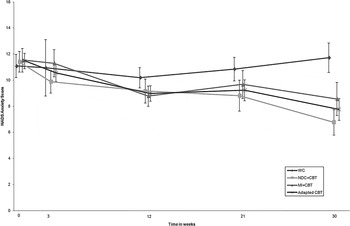
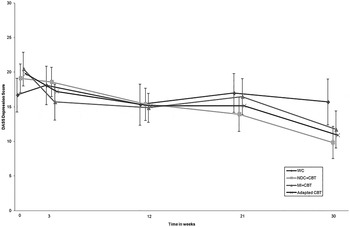
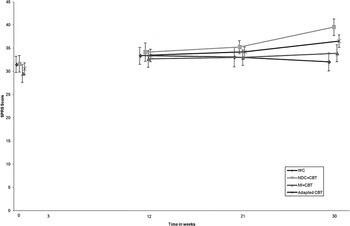
Figs 2–4 show the mean primary and secondary outcome scores over time. Across all groups there was improvement in anxiety, depression and psychosocial functioning over time. Effect sizes indicate the amount of change from baseline for each treatment group (see Supplementary Table S2). When compared with baseline scores, the aCBT groups showed small to moderate reduction in HADS-Anxiety (g range = 0.2–0.47), DASS-Depression (g range = 0.22–0.4), and gains in psychosocial function post-treatment (g range = 0.31–0.43), but by 30-weeks showed large reduction in anxiety (g = 0.84) and depression (g = 0.82) and moderate improvement in function on the SPRS-2 (g = 0.68).
Mean HADS-Anxiety scores (±s.e.) for each group at each time-point. Adapted CBT = data from the NDC + CBT and MI + CBT groups combined.

Mean DASS-Depression scores (±s.e.) for each group at each time-point. Adapted CBT = data from the NDC + CBT and MI + CBT groups combined.

Mean SPRS-2 scores (±s.e.) for each group at each time-point assessed. Adapted CBT = data from the NDC + CBT and MI + CBT groups combined.

Treatment effects on primary outcome measures of anxiety and depression
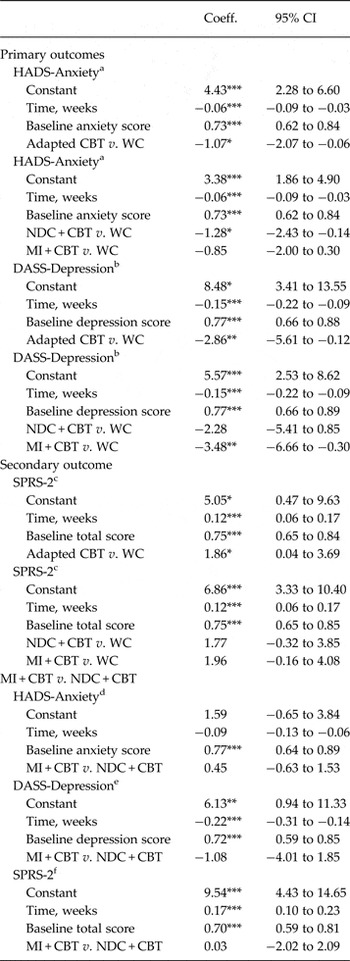
Table 2 shows the results of the random-effects regressions. There were significant reductions in both anxiety and depression symptoms over the 30 weeks of the study across all groups. In addition, when controlling for baseline scores on each measure, there were significant differences between the symptom trajectory of the aCBT groups and the WC group on HADS-Anxiety. Analyses examining change over time with aCBT groups separately showed that the NDC + CBT, but not the MI + CBT group, showed a significantly greater reduction in HADS-Anxiety over 30 weeks, relative to WC. There were significant differences in change over time between aCBT groups and WC on DASS-Depression. The MI + CBT group showed a significant reduction in DASS-Depression over time relative to the WC group, while the NDC + CBT group did not.
Random-effects regressions of HADS-Anxiety, DASS-Depression, and SPRS controlling for baseline scores on each measure

HADS, Hospital Anxiety and Depression Scale; DASS, Depression, Anxiety and Stress Scale; SPRS-2, Sydney Psychosocial Reintegration Scale, 2nd edn; CI, confidence interval; CBT, cognitive behavioral therapy; WC, waitlist control; NDC, non-directive counseling; MI, motivational interviewing;
***p < 0.001; **p < 0.005; *p < 0.05; Adapted CBT = MI + CBT and NDC + CBT groups combined.
a Based on 317 observations on 74 participants.
b Based on 315 observations on 74 participants.
c Based on 240 observations on 74 participants.
d Based on 220 observations on 52 participants.
e Based on 215 observations on 51 participants.
f Based on 167 observations on 52 participants.
Supplementary Figs S1–S3 show results for HADS-Depression and DASS-Anxiety and Stress scales. By week 30, participants in both treatment groups showed large reduction in HADS-Depression and DASS-Anxiety, and moderate to large reduction in DASS-Stress, not evident in the WC group. Regression analyses revealed significant symptom reduction over time but group differences were not significant.
Responders v. non-responders
Of the aCBT groups, 55.2% had moved to a lower HADS-Anxiety symptom severity category by 30 weeks compared to 33% in WC, with 50% scoring in the normal range, compared to 13.3% of the WC group. On the DASS-Depression scale 65.5% of the aCBT groups had moved to a lower symptom severity category by 30 weeks, v. 20% of the WC group, and 48.3% scored in the normal range, compared to 40% of the WC group. Higher anxiety and depression scores were significantly associated with greater response to treatment (r = 0.37, p < 0.05 and r = 0.34, p < 0.05, respectively).
Effects of treatment on secondary outcome measure of psychosocial functioning
Table 2 also presents results of the random-effects regressions for the secondary outcome measure, the SPRS-2. Over 30 weeks the aCBT groups showed significantly greater gains in psychosocial functioning on the SPRS-2 than the WC group.
Effect of MI: comparison of MI + CBT group with NDC + CBT group
The random-effects regressions comparing the MI + CBT and NDC + CBT groups on all outcome measures, controlling for baseline scores, are also presented in Table 2. Overall, HADS-Anxiety and DASS-Depression levels decreased significantly over time. However, there were no significant differences between the groups in terms of change over 30 weeks on HADS-Anxiety or DASS-Depression scores. Psychosocial functioning also improved significantly in both groups over time but there were no significant group differences between the trajectory of MI + CBT and NDC + CBT groups over the 30 weeks. Random-effects regression of ACES scores revealed significant improvement in self-efficacy and motivation for change across all groups over time, but no significant group differences (see Supplementary Table 2). Effect sizes showed negligible increases in the WC control group (g = 0.08), very small change for the NDC + CBT group (g = −0.14) and moderate increases for the MI + CBT group (g = −0.59) at week 3 (post-MI/NDC), but large changes in both NDC = CBT (g = −0.95) and MI + CBT (g = −0.98) groups at week 12 (post-intervention) along with a moderate change in the WC group (g = −0.51).
Discussion
This study examined the efficacy of aCBT with and without MI in reducing anxiety and depression symptoms following TBI. The primary study hypothesis was supported. Using intention-to-treat analyses, the aCBT groups showed a significantly greater reduction in HADS-Anxiety scores 30 weeks after recruitment, after controlling for baseline levels of anxiety. Further, at 30 weeks more than half of participants in the aCBT groups had moved to a lower symptom severity category on the HADS-Anxiety, with 50% scoring within the normal range, compared to 33% and 13% of participants in WC, respectively. There was also a significant reduction in DASS-Depression scores in the aCBT groups at 30 weeks, with 65% of participants in the aCBT groups moving to a lower DASS-Depression severity category, compared to 20% in WC. Participants with higher depression and anxiety showed greater response to treatment.
The aCBT groups showed only small to moderate symptom reduction on completion of the 9 weeks of CBT, changes that may not be considered clinically significant, but these gains increased from moderate to large by 30-week follow-up, following receipt of three CBT booster sessions. Provision of booster sessions appeared to be important to attain benefit from CBT in this sample of individuals with TBI and associated cognitive impairment. It may be that booster sessions are required at regular intervals to achieve lasting gains. There was also a significantly greater increase in psychosocial function on the SPRS-2 in the aCBT groups at 30 weeks, suggesting that improvements in mood in response to therapy were associated with broader gains in psychosocial function in the domains of daily functioning, work, leisure and relationships. This association may be bidirectional, as CBT techniques such as behavioral activation and problem solving may be focused on work or social activities, with improved function having a positive impact on mood.
The finding of a reduction in HADS-Anxiety is consistent with findings from two previous studies demonstrating reduced anxiety in response to CBT intervention in samples with less severe TBI (Bryant et al. Reference Bryant, Moulds, Guthrie and Nixon2003; Hodgson et al. Reference Hodgson, McDonald, Tate and Gertler2005). The present study has shown that aCBT can also achieve significant reduction in anxiety in individuals with predominantly severe TBI. Two recent studies evaluating efficacy of CBT for depression did not find a significant reduction in depression symptoms on their primary outcome measures, the first on the HAMD-17 at 16 weeks post-recruitment (Fann et al. Reference Fann, Bombardier, Vannoy, Dyer, Ludman, Dikmen, Marshall, Barber and Temkin2014) and the second on the BDI-II (Ashman et al. Reference Ashman, Cantor, Tasaosides, Spielman and Gordon2014), although Fann et al. did find a significant effect among CBT completers on the patient-reported SCL-20, and twice as many in the active treatment group reached remission in the Ashman et al. study. In the former study by Fann et al. all participants had MDD and 40% of controls had also received either counseling or pharmacotherapy and in the latter study by Ashman et al. participants were an average of 10 years post-injury and included 40% mild TBI and the control group received supportive psychotherapy, factors which may have lessened group differences. However, these studies did not address anxiety, had much shorter follow-up periods and did not include booster sessions. Findings from the present study, the first to address both anxiety and depression using aCBT and first to include booster sessions in psychological therapy following TBI, suggest that positive effects of psychological intervention for people with moderate to severe TBI may emerge only gradually over extended periods. They may require more than 9 weeks’ intervention to consolidate gain to achieve symptom reduction. It would appear that depression symptoms may take longer to abate than anxiety symptoms in these individuals and that higher levels of anxiety and depression are associated with greater treatment response.
The secondary hypothesis that preceding CBT with three sessions of MI would enhance anxiety and depression symptom reduction was not supported. As recommended by Westra & Dozois (Reference Westra and Dozois2006) a comparison pre-treatment (NDC) was included to control for the effect of therapeutic attention. The group receiving MI + CBT did not show a significantly greater reduction in either anxiety or depression symptoms over time relative to the NDC + CBT group. Nor did they show a significantly greater increase in self-efficacy and motivation to change on ACES.
The present study does have some limitations. A WC condition was used, in which participants were discouraged from receiving psychological treatment, as opposed to an active care control condition, which may have strengthened the findings. For ethical reasons, the WC group was offered intervention at 30 weeks. This precluded comparative follow-up beyond this time-point. Participants’ use of other rehabilitative therapies was not fully documented. The cell sizes were relatively modest and larger studies are required to explore further the impact of MI in this population. Although not differing significantly across groups, participants varied in severity and nature of anxiety and depressive diagnoses, injury severity and time since injury, and cognitive function. Examining the impact of this variance will be the subject of another paper.
While other studies have demonstrated the efficacy of CBT in the treatment of depression in individuals with TBI (Bedard et al. Reference Bedard, Felteau, Marshall, Cullen, Gibbons, Dubois, Maxwell, Mazmanian, Weaver, Rees, Gainer, Klein and Moustgaard2014), our study represents the first attempt to address both anxiety and depression symptoms in individuals with mild-severe TBI using a CBT protocol adapted for cognitive impairments. It has shown that anxiety symptoms may be more responsive to CBT intervention, but a reduction in symptoms of both anxiety and depression may be achieved over an extended period, with inclusion of booster sessions to achieve therapeutic gains. Importantly, results suggested that symptom improvements generalized to psychosocial functioning. Given anxiety and depression are common co-morbidities with TBI, this study offers an encouraging direction for rehabilitation clinicians.
Supplementary material
For supplementary material accompanying this paper visit http://dx.doi.org/10.1017/S0033291715002640.
Acknowledgements
This study was funded by NHMRC grant No 606432. The authors thank Ming-Yun Hsieh for work in developing and piloting the manualized intervention.
Declaration of Interest
None.