I. INTRODUCTION
Considerable attention has been paid to porous metal materials due to their high specific strength and energy absorption and potential in several applications.Reference Yi, Peng, Liu, Lai and Ni1–Reference Zhang, Scarpa, Ma, Hong and Mahadik3 Compressive properties are important characteristics of porous materials. Generally, the compressive properties of porous materials depend on the cell wall material and structure.Reference Liu, Yu, Zhu, Wei, Luo and Liu4–Reference Qiao, Xi, Tang, Wang and Zhu7 However, low compressive strength is one of the major disadvantages of porous metals.Reference Wu, Zhou, Yao and Xiao5 Lighter, stiffer, and tougher structural components are in high demand as novel materials, and composites are suitable for many structural applications.Reference Jhaver and Tippur8 The secondary phase, which is dispersed into the primary phase, has demonstrated limited effectiveness. An interpenetrating phase composite (IPC) has a unique structure with a completely interconnected matrix and reinforcement phaseReference Qiao, Fan, Yu and Guo9,Reference Wegner and Gibson10 and can overcome the limitations of other materials.Reference Jhaver and Tippur8 This composite is uniquely different from traditional composites composed of a discrete inclusion phase (fibers, whiskers, or particles) embedded into a continuous matrix phaseReference Cheng, Kim, Reddy and Abu Al-Rub11,Reference Wegner and Gibson12 and may possess advantageous properties associated with the interpenetrating microstructure.Reference Kishimoto, Wang, Tanaka and Kagawa13,Reference Periasamy, Jhaver and Tippur14
Based on porous metal materials, several composites have been developed with improved mechanical properties.Reference Cree and Pugh15 IPCs can combine porous metal materials of different material classes (polymer, ceramic, metal, etc.) to achieve various property combinations.Reference Reinfried, Stephani, Luthardt, Adler, John and Krombholz16 Reinfried et al.Reference Reinfried, Stephani, Luthardt, Adler, John and Krombholz16 outlined two types of IPC processing based on open-cell steel foams interpenetrated with polystyrene foam or a direct-foamed-SiC ceramic and found that the associated mechanical properties were enhanced. Mg-based metallic glassReference Sun, Zhang, Wang, Fu, Hu, Wen and Hodgson17 and stainless-steel/bronzeReference Wegner and Gibson18 IPCs were produced and exhibited improved mechanical properties after infiltration. Notably, the presence of SiC particles in Zn22Al/10 vol% SiCp composite foams can alter the deformation mechanism of ZA22 foamsReference Yu, Liu, Luo and Liu19 so that the mechanical behavior of IPCs is based on the components. Wegner et al.Reference Wegner and Gibson10 found that resin did not possess a superior property that contributed to the effectiveness of the composite. As polymer composites are widely used in different fields,Reference Meneghetti and Qutubuddin20,Reference Rout and Satapathy21 it is necessary to find an economic method to produce IPCs. Recently, metal foam–polymer IPCs have received considerable attention.Reference Jhaver and Tippur8,Reference Kishimoto and Shinya22,Reference Liu and Gong23 One phase can offer high toughness and thermal conductivity, and the other phase enhances the stiffness and dielectric properties to form a synergistic structure.Reference Periasamy, Jhaver and Tippur14 However, it is not a simple process, and manufacturing metal foam is expensive. Moreover, the 3D microstructure is difficult to control and characterize during the IPC production process.Reference Zhou, Yao, Duan and Qin24 However, previous studies rarely involved sintered metal fiber preform-resin IPCs. Unsaturated polyester resin is widely used due to its low viscosity, good processing capability, and outstanding physical behavior.Reference Hsieh, Tsai and Chang25
In our previous study, a new metal–resin IPC was fabricated, and the tensile properties were improved by infiltrating resin into the porous short-fiber preforms.Reference Zhou, Yao, Duan and Qin24 In this work, short 304 stainless steel fibers were fabricated by cutting ropes into segments. Then, a variety of preforms with different fiber fractions and diameters were produced by compaction and sintering. A novel 304 stainless steel fiber/resin IPC was produced by infiltrating a type of unsaturated polyester resin into the preforms under vacuum conditions. The anisotropic microstructure, compressive behavior, and energy absorption were investigated. Additionally, the axial cross section of the IPC after compression was observed using scanning electron microscopy (SEM).
II. MATERIALS AND METHODS
A. Manufacturing process of the metal–resin IPCs
As in our previous work,Reference Zhou, Yao, Duan and Qin24 the manufacturing procedure for the resin–metal IPCs can be generalized as two stages: porous preform formation and vacuum infiltration.
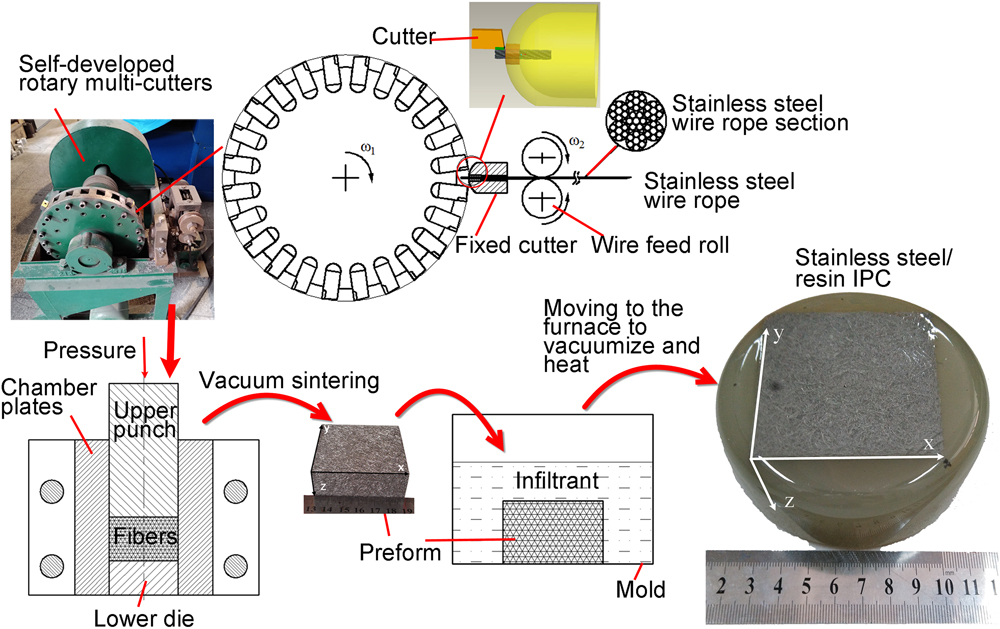
The processing procedure of the porous preforms was divided into three steps: fiber fabrication, mold pressing, and vacuum sintering. Short 304 stainless steel fibers with diameters of 90 or 160 μm were fabricated by cutting stainless steel wires into segments with lengths of 10–15 mm, as described in Ref. Reference Wu, Zhou, Yao and Xiao5. Then, the short fibers were randomly put into a mold, followed by compaction and vacuum sintering at 1330 °C for 90 min. After completing the sintering process, the preforms were naturally cooled to room temperature in the furnace. The processing details were described in our previous work.Reference Wu, Zhou, Yao and Xiao5 The quality-volume methodReference Wu, Zhou, Yao and Xiao5 was used to calculate the average porosity P, and the fiber volume fraction in the IPC was 1 − P.
The vacuum infiltration process was implemented in a WHS-20 vacuum furnace (Zhongshan Kaixuan Vacuum Technology and Engineering Co. Ltd., Zhongshan, China) at room temperature. The infiltrant consisted of 600 g of unsaturated polyester resin (LH-6993), 5 g of methyl ethyl ketone peroxide (LH-508), and 5 g of promoters (LH-817) from Guangzhou Liheng Mekpo Technology Co. Ltd., Guangzhou, China. The unsaturated polyester resin was placed in a mold. Then, methyl ethyl ketone peroxide was added, and the mixture was sufficiently stirred. Next, promoters were added and stirred until the mixture was uniform. In the next step, the preforms were added to the uniform mixture, and the mold was moved into the furnace to vacuumize for 2 h (when infiltration was complete). After the infiltration process ended, the temperature was increased to 98 °C and maintained for 2 h. Finally, the IPC samples were naturally cooled to room temperature in the vacuum furnace. A schematic diagram of the manufacturing process and the IPC sample are shown in Fig. 1.
Schematic diagram of the manufacturing process and the macroscopic appearance of the metal/resin IPC.

B. Microstructure and compressive characterization of the IPCs
Because the microstructure and tensile behavior of the metal/resin IPCs exhibit anisotropy,Reference Zhou, Yao, Duan and Qin24 the compressive behavior will also be anisotropic. The microscopic structures of the IPCs were observed with a SEM (S-3700N, Hitachi Ltd., Tokyo, Japan). Specimens made from the different directions of the stainless steel/resin IPCs were machined using the conventional methods for compressive tests. The geometry of the specimens used in the compression tests was cuboid in shape with dimensions of 10 mm × 10 mm × 10 mm. All compressive tests were conducted on an electronic universal mechanical testing machine (AG-100NX, Shimadzu, Kyoto, Japan) at a constant crosshead speed of 1 mm/min. All tests were conducted at room temperature (approximately 25 °C) and for five specimens of each IPC group. The axial cross sections of the deformed specimens were imaged with a SEM (S-3700N, Hitachi Ltd., Tokyo, Japan).
III. RESULTS AND DISCUSSION
A. Microstructural characterization of the stainless steel/resin IPCs
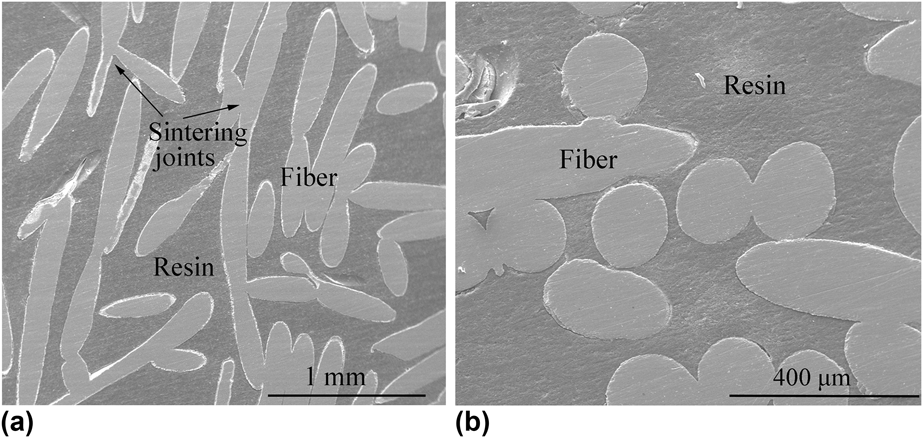
As reported previously,Reference Wu, Zhou, Yao and Xiao5,Reference Zhou, Yao, Duan and Qin24 the preform had a spatial composite intertexture structure from the surface to the center and stainless steel fibers were randomly distributed. It was not difficult to form the preform with a specific 3D structure, and interconnected open pores were distributed in the structure. Therefore, it is possible to completely infiltrate the preform with infiltrant and form the interpenetrating structure. The microstructures of the metal/resin IPC with a 32.11 vol% fiber fraction and 160 μm fiber diameter in the in-plane (x–y plane) and through-thickness (x–z plane) directions are clearly shown in Figs. 2(a) and 2(b), respectively. The gray phase is resin and the lighter phase represents 304 stainless steel fibers. No evident voids can be observed in the resin and interface, and the metal–resin interface is crisp and continuous, suggesting good bonding after infiltration.Reference Jhaver and Tippur8,Reference Zhou, Yao, Duan and Qin24 During the heating and isothermal holding process, the unsaturated polyester resin consolidates due to free radical copolymerization. Figure 2 reveals that the microstructure of the IPC exhibits anisotropy in two directions, i.e., most fibers distributed in the IPC are parallel to the pressure face, namely, the x–y plane. The pore structures display anisotropy for the different fiber forms and interconnections in the two directions.Reference Wu, Zhou, Yao and Xiao5 Additionally, many sintering joints can be observed and are the result of material migration between the fiber and fiber bundle interconnection points. The fibers are not distributed uniformly after randomly placing the fibers into the mold, and different compaction force extensions are exhibited.
SEM micrographs of the IPC with a 32.11 vol% fiber fraction and 160 μm fiber diameter in the (a) in-plane (x–y plane) and (b) through-thickness (x–z plane) directions.

B. Compressive behavior
After the IPC specimens were manufactured, static compressive tests were conducted to investigate their compressive behavior.
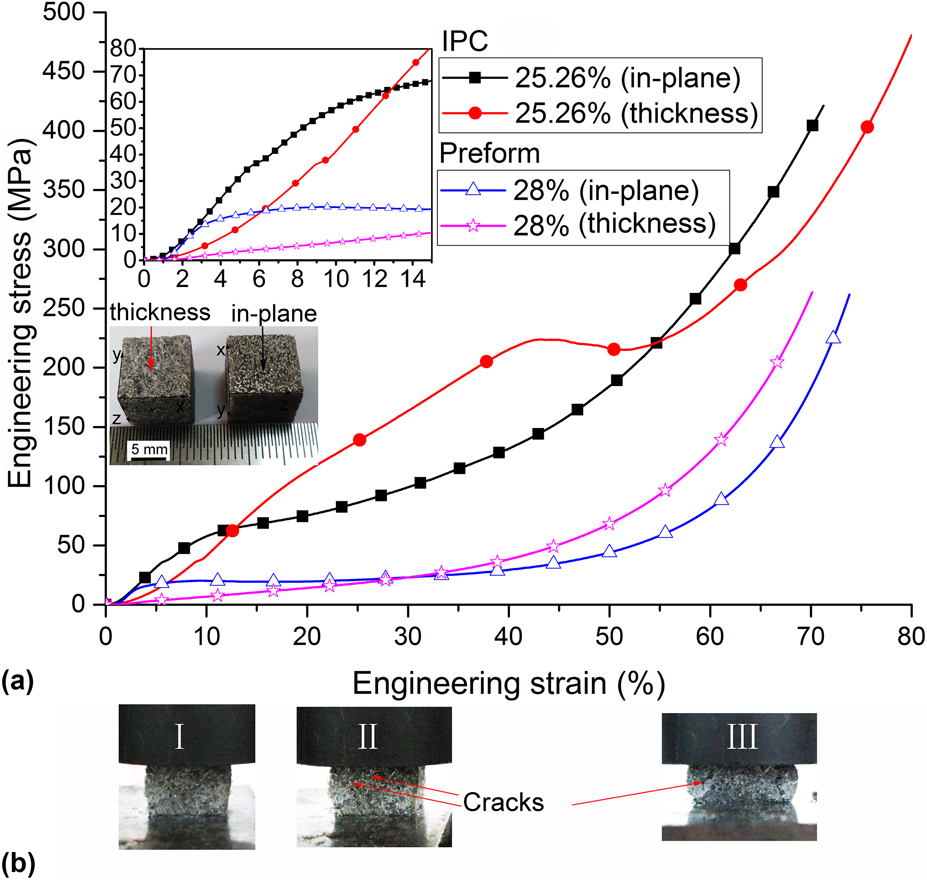
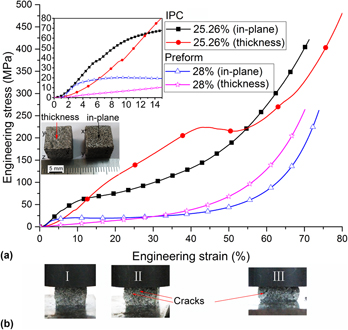
Figure 3(a) shows the measured static compressive stress–strain curves of the IPC with a 25.26 vol% fiber fraction and 160 μm fiber diameter and the preform with a 90 μm fiber diameter and 28 vol% fiber fraction in different directions. The in-plane direction in Fig. 3(a) refers to the compressive loading direction (the x-direction or y-direction), which is parallel to the x–y surface. The through-thickness direction refers to the compressive loading direction parallel to the z-direction. It is obvious that the compressive properties of the IPCs are anisotropic. The compression processes of the specimens in the in-plane direction exhibit distinct elastic–plastic behavior (three deformation stages),Reference Wu, Zhou, Yao and Xiao5,Reference Qiao, Xi, Tang, Wang and Zhu7,Reference Jhaver and Tippur8 i.e., an elastic stage, a quasiplatform stage that occurs after yielding, and a final densification stage, in which the stress drastically increases. To understand the IPC failure, the progression of deformation during loading was measured, and three different stages in the quasistatic deformation process of the IPC with a 25.26 vol% fiber fraction in the in-plane direction are shown in Fig. 3(b). The compressive process initially exhibits short-term elastic deformation and quickly enters yielding, followed by quasiplatform plastic deformation. In this process, few cracks appear, as shown in stage I in Fig. 3(b). Nonlinear stress–strain behavior during the elastic stage (strain of less than 10%) can be observed and agrees with the results of other studies.Reference Daehn, Starck, Xu, Elfishawy, Ringnalda and Fraser26–Reference Zhou, Yao, Duan and Qin28 This behavior is caused by the elastic deformation of the stainless steel preform accompanied by the plastic deformation of the resin. Compared with the tension tests of the IPCs in our previous work,Reference Zhou, Yao, Duan and Qin24 moderate to high yield stress and strain values are observed during the process of compression. These effects are attributed to residual stresses, i.e., the matrix is prestrained under tension after manufacturing.Reference Scherm, Völkl, Neubrand, Bosbach and Glatzel27 The second stage can be defined as the pseudo-platform stage, which is different from the sustained plateau region of the metal–polymer IPC described in Refs. Reference Jhaver and Tippur8 and Reference Liu and Gong23. Beacuse the resin in the preform is a brittle material, the skeleton of the IPC includes small spaces that can be condensed; therefore, the platform behavior becomes unclear compared with that of the porous preform. Due to the interfacial cleavage or skeleton of the aluminum foam being destroyed, a sustained plateau region where yielding occurs can be found in the IPC.Reference Liu and Gong23 The pseudo-platform stage is an additional evidence of good bonding. With deformation processing, macrocracks appear in the resin and at the interface [clearly shown in stage II in Fig. 3(b)]. As plastic deformation continues, the compressive redistribution at the interface becomes more serious and results in the appearance of cracks. With increasing stress, cracks propagate in the resin and along the interface, but the fiber skeletons do not collapse because of their high ductility, resulting in energy absorption. With further deformation, compression enters the densification stage. During this compression process, cracks continue to propagate in the resin and at the interface until the resin collapses and debonding occurs, as shown in stage III in Fig. 3(b). Anisotropic compression curves are depicted in Fig. 3(a). Compared with the in-plane direction, the IPCs have higher pseudo-platform stress and strain but lower elastic modulus in the through-thickness direction (184.36 MPa at a 50% strain in the in-plane direction and 223.90 MPa at a 43.14% strain in the through-thickness direction). In the through-thickness direction, the compressive stress–strain curve of the IPC exhibits no obvious quasiplatform stage and yielding, and the densification stresses do not increase dramatically compared with those of the IPC in the in-plane direction with increasing strain. However, the stress slightly decreases with increasing strain when it reaches the maximum before the densification stage. In the preform, the compressive process also exhibits anisotropy. As observed for many other porous materials, the compressive process of the preform in the in-plane direction exhibits three obvious stages.Reference Qiao, Xi, Tang, Wang and Zhu7,Reference Jhaver and Tippur8 Namely, the preform experiences short-term elastic deformation and then enters a quasiplatform stage, where the stress increases slightly with increasing strain before the densification stage in the through-thickness direction. From our previous research,Reference Wu, Zhou, Yao and Xiao5 although the samples are both comparatively flattened after compression, a macroscopic crack does not appear in the failed preform due to the high ductility of the stainless steel fibers. Therefore, as noted above, the compressive properties of the preform after infiltration are improved: 44.04 MPa in the in-plane direction and 68.22 MPa in the through-thickness direction for a preform with a 28 vol% fiber fraction and 90 μm fiber diameter,Reference Wu, Zhou, Yao and Xiao5 and 184.93 MPa in the in-plane direction and 226.93 MPa in the through-thickness direction for an IPC with a 25.26 vol% fiber fraction and 160 μm fiber diameter. Additionally, the compressive behavior is altered, which is consistent with the results of previous studies.Reference Jhaver and Tippur8,Reference Gómez de Salazar, Barrena, Morales, Matesanz and Merino29
(a) Uniaxial compressive stress–strain curves of the IPC with a 160 μm fiber diameter and 25.26 vol% fiber fraction, and the preform with a 90 μm fiber diameter and 28 vol% fiber fraction in the in-plane and through-thickness directions (the inset graph represents the higher magnification curves with a 0–15% strain, and the inset sample loading photos represent the IPC compression in the through-thickness and in-plane directions, respectively). (b) Three different stages in the quasistatic deformation process of the IPC with a 25.26 vol% fiber fraction in the in-plane direction.

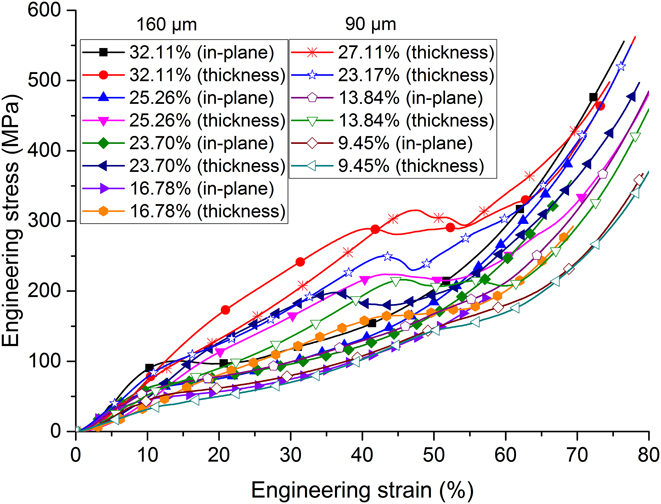
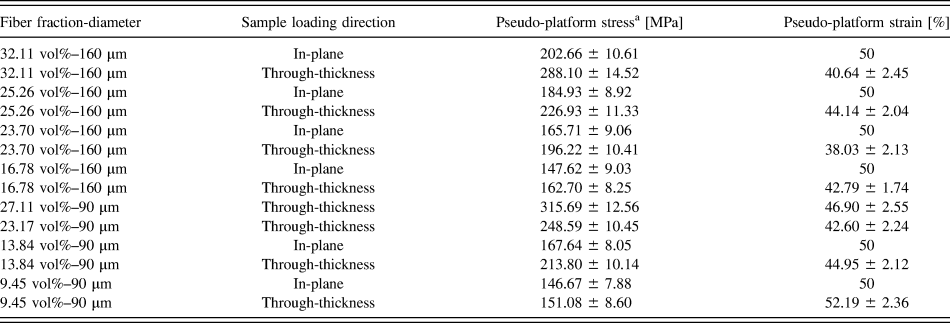
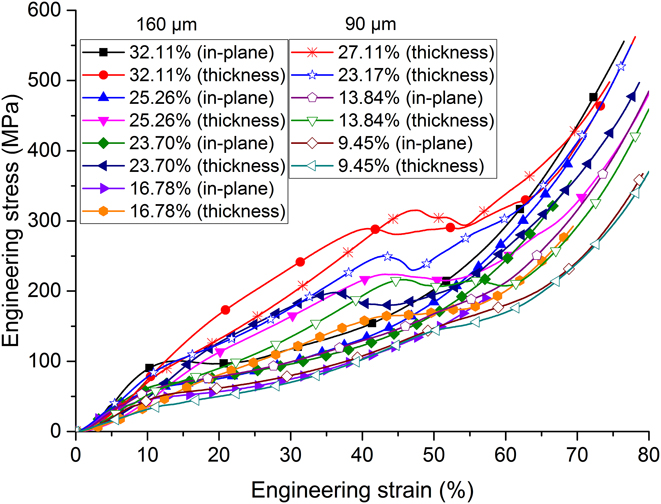
The contrasting compressive stress–strain curves of the IPCs with different fiber fractions and diameters are shown in Fig. 4. To evaluate the mechanical properties of the metal/resin IPCs, the pseudo-platform stress can be defined as the stress when the strain reaches 50% in the in-plane direction for a comparison of the compressive properties of the preforms in Ref. Reference Wu, Zhou, Yao and Xiao5. The pseudo-platform stress is defined as the peak stress before the densification stage in the through-thickness direction. Because the IPCs do not exhibit a distinct yield point and nonlinear stress–strain behavior is displayed in the elastic stage, it is difficult to obtain the yield strength. The compressive properties are summarized in Table I. In both directions, the elastic modulus and pseudo-platform stress values increase with increasing fiber fractions, which is consistent with the conclusions of other studies.Reference Wegner and Gibson10,Reference Liu and Gong23 However, the elongation at a pseudo-platform stress does not exhibit a significant difference, with no monotonic increase or decrease with increasing fiber fractions, i.e., the elongation ranges from 38.03 to 44.14% for the IPCs with a 160 μm fiber diameter and fiber fractions from 16.78 to 32.11 vol%. This result differs from the conclusion of Ref. Reference Wegner and Gibson10, which reported that a higher metal fraction improved the ductility of the composite. This result may be due to different connections in the microstructure. The pseudo-platform stress of the IPCs in the through-thickness direction is higher, and the elongation at the pseudo-platform stress is larger than that of the IPCs in the in-plane direction. As mentioned above, similar to the anisotropy of the IPC with a 25.26 vol% fiber fraction, the IPCs with different fiber fractions and diameters also exhibit anisotropic properties, and their differences become smaller as the fiber fraction decreases. The anisotropic compressive behavior of the IPCs is not significant when the fiber fraction is less than 9.45 vol% for similar compression curves. For the IPCs with a 160 μm fiber diameter, the pseudo-platform stress increases from 147.62 to 202.66 MPa in the in-plane direction and increases from 162.70 to 288.10 MPa in the through-thickness direction for fiber fractions ranging from 16.78 to 32.11 vol%. This result occurs because the mechanical properties of the composites increase as the fractions of harder phases increase.Reference Wegner and Gibson10 Our previous studies revealed that finer fibers can significantly improve the tensile strength and elongation at the maximum stress of metal/resin IPCsReference Zhou, Yao, Duan and Qin24 and the compressive strength of stainless steel fiber/ZA8 zinc alloy IPCs.Reference Zhou, Yao, Duan and Qin28 Figure 3(a) shows that finer fibers can also improve the compressive properties of the metal/resin IPCs. Specifically, for the IPCs in the in-plane direction, the pseudo-platform stress is 167.64 MPa for a 13.84 vol% fiber fraction and a 90 μm fiber diameter, and this value is 147.62 MPa for a 16.78 vol% fiber fraction and a 160 μm fiber diameter. An improvement is also observed in the through-thickness direction, as the pseudo-platform stress is 213.80 MPa and 162.70 MPa for the IPCs with 90 μm and 160 μm fiber diameters, respectively. Therefore, it is obvious that finer fibers can significantly improve the composite strength and three-dimensional structure per unit volume participating in the compressive process.
Contrasting compressive stress–strain curves of the IPCs with different fiber fractions and diameters in both directions.
Summary of the compressive properties for the metal/resin IPCs with different sample loading directions, fiber fractions, and diameters.

a The pseudo-platform stress of the IPC can be defined as the stress when the strain reaches 50% in the in-plane direction and the peak stress before the densification stage in the through-thickness direction.
C. Energy absorption efficiency of the IPCs
To investigate the energy absorption characteristics of the IPCs during the compressive process, the energy absorption efficiency can be calculated using the following formulaReference Tan, Liu, Du, Wu and He30:
 $$E\left( \varepsilon \right) = {\left( {\sigma \varepsilon } \right)^{ - 1}}\int_0^\varepsilon {\sigma {\rm{d}}\varepsilon } \quad ,$$
where E denotes the energy absorption efficiency of the metal/resin IPC, σ is the stress, and ε is the strain.
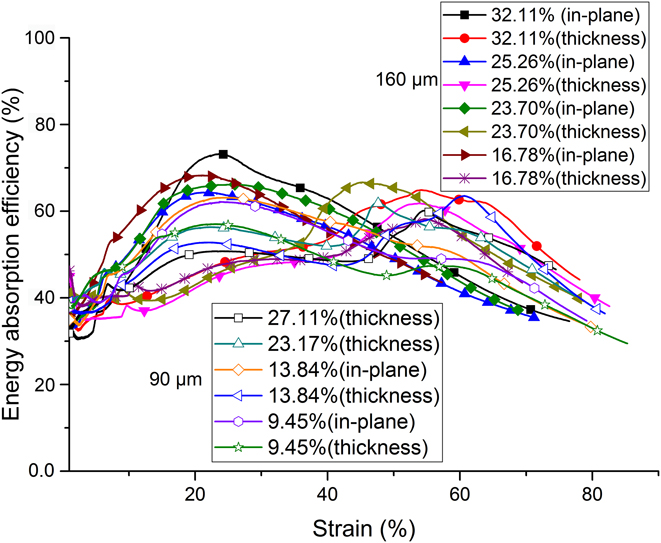
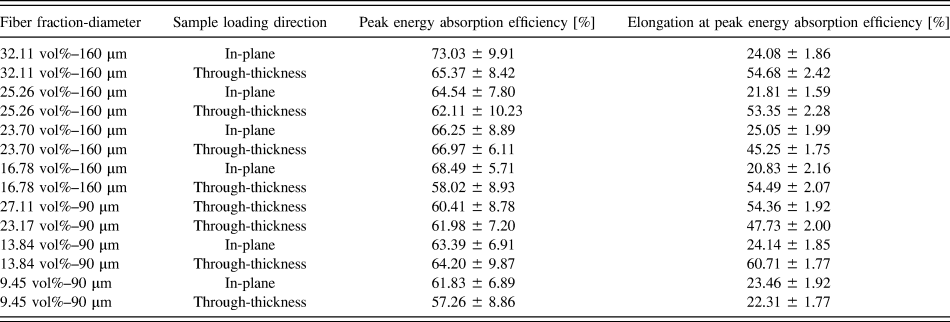
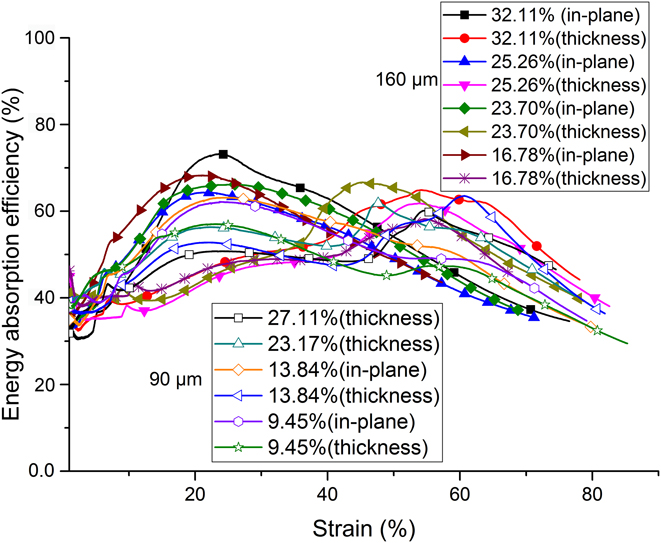
The energy absorption efficiency implies an absorption property. Generally, a higher value of E indicates better performance of the materials.Reference Tan, Liu, Du, Wu and He30 Figure 5 shows the energy absorption efficiency of the IPCs in the in-plane and through-thickness directions for various fiber fractions. The values are calculated from the compressive stress–strain curves based on Eq. (1). All the energy absorption efficiency curves have peak values, and these values are summarized in Table II. Clearly, all the energy absorption efficiency curves first increase to reach peak values and then decrease. Unlike the effect on the compressive strength, the fiber diameter does not have an obvious effect on the energy absorption properties. Notably, the peak energy absorption efficiency is reached when the strain is approximately 21–25% for all the IPCs in the in-plane direction, while the IPCs in the through-thickness direction reach peak values after a 45% strain, except for the IPC with a 9.45 vol% fiber fraction (at approximately 23% strain). The peak energy absorption efficiency of the IPCs in the in-plane direction is significantly higher than that in the through-thickness direction when the fiber fraction is higher than 32.11 vol% or lower than 16.78 vol%. Additionally, the anisotropy of the IPCs decreases at fiber fractions lower than 16.78 vol%. The peak energy absorption efficiencies of the IPCs with 32.11 vol% and 16.78 vol% fiber fractions increase by 7.66% and 10.47% from the through-thickness direction to the in-plane direction, respectively. For the IPC with a 9.45 vol% fiber fraction, the increase in the peak energy absorption efficiency is 4.57%. For the IPCs with fiber fractions between 16.78 and 32.11 vol%, the difference in the peak energy absorption efficiency is less than 2.5%. Overall, the porous preforms absorb energy, the infiltrant has the capacity for energy absorption, and energy can be absorbed when the resin collapses. For the IPCs with a 160 μm fiber diameter in the in-plane direction with decreasing fiber fractions ranging from 25.26 to 16.78 vol%, the energy absorption efficiency slightly increases from 64.54 to 68.49%, while for the IPCs with finer fibers, the variations in values are not obvious. The energy absorption efficiency slightly decreases as the fiber fraction increases in a certain range rather than monotonically increasing or decreasing. The IPC with a 32.11 vol% fiber fraction and 160 μm fiber diameter exhibits the maximum peak energy absorption efficiency of the samples, and the IPC with a 9.45 vol% fiber fraction and 90 μm fiber diameter displays the minimum value, i.e., 73.03% and 57.26% for the IPCs with 32.11 vol% and 9.45 vol% fiber fractions, respectively. The peak values of the energy absorption efficiency are approximately 0.85 in the in-plane direction and 0.49 in the through-thickness direction for the preform with a 28 vol% fiber fraction.Reference Wu, Zhou, Yao and Xiao5 By comparison with our results, the energy absorption decrease for the IPCs in the in-plane direction and increase for the IPCs in the through-thickness direction after resin infiltration into the preforms, which differs from the conclusion of Ref. Reference Liu and Gong23. The energy absorption capacities of porous materials are mainly due to the yielding, buckling, and fracture behavior of the cells and the friction between the ligaments when they contact each other.Reference Liua, Yua, Zhu, Wei, Luo and Liu31 The absorbed energy of the composite strongly depends on the proportion of the polymer, interfacial strength, etc. As mentioned above, the IPCs have a higher compressive strength than the preforms, but the ligaments are not completely deformed, and the friction between ligaments decreases during compression due to resin filling in the pores of the preforms. However, the friction between the fragmented resin will dissipate considerable energy. Therefore, the IPCs exhibit complex energy absorption capacities resulting from several complicated factors. In conclusion, after infiltration, the energy absorption behavior of metallic preforms can be favorably modified.Reference Liu and Gong23 Additionally, the anisotropy of energy absorption is not so great but the decrease in energy absorption is acceptable. The interpenetrating structure of these materials enables them to undergo considerable deformations during compression, which allows them to absorb considerable amounts of energy. The strength of these novel IPCs is considerably higher than that of the widely used aluminum foam and foam–polymer composites.Reference Stöbener and Rausch32 In the future, the IPCs can potentially be used under conditions of high specific strength and energy absorption and in applications that require water-resistant properties, such as in the automotive and packaging industries.
Energy absorption efficiency of the IPCs in the in-plane and the through-thickness directions with various fiber fractions.
Summary of the peak energy absorption efficiency for the IPCs with different sample loading directions, fiber fractions, and diameters.

D. Compressive fractographic examinations
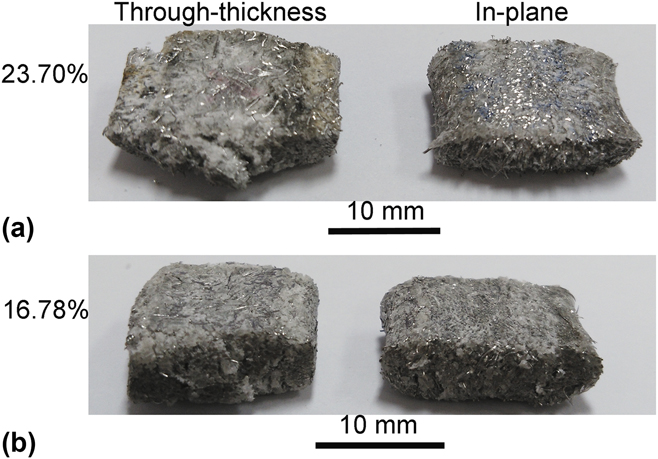
The macroscopic failure images of the IPCs with a 160 μm fiber diameter and 23.70 vol% and 16.78 vol% fiber fractions in the in-plane and through-thickness directions are shown in Figs. 6(a) and 6(b), respectively. The large difference in the macrosurface of the IPCs in different directions after compression is noticeable. The samples in the in-plane direction exhibit typical waist-shaped structures, while drum-shaped structures appear in the through-thickness directions, which are also observed during the compression of the preforms.Reference Wu, Zhou, Yao and Xiao5 The difference in appearance decreases with decreasing fiber fraction. During the compression process, the fibers become closer and the resin collapses and extends, which constantly promote the densification process. Notably, the failed samples are not compressed to a collapsed state, but macroscopic cracks appear on the side surface. The nondirectional cracks demonstrate that there is a complex deformation mechanism, which is characterized by a mixture of brittle and plastic fractures. Additionally, many exposed fibers that can be seen from the side surfaces become coarser due to fiber debonding during compression. This result was also observed during the compression process of the metal–metal IPC.Reference Zhou, Yao, Duan and Qin28
Macroscopic failure images of the IPCs with a 160 μm fiber diameter and different fiber fractions after compression: (a) 23.70 vol% and (b) 16.78 vol% fiber fractions.

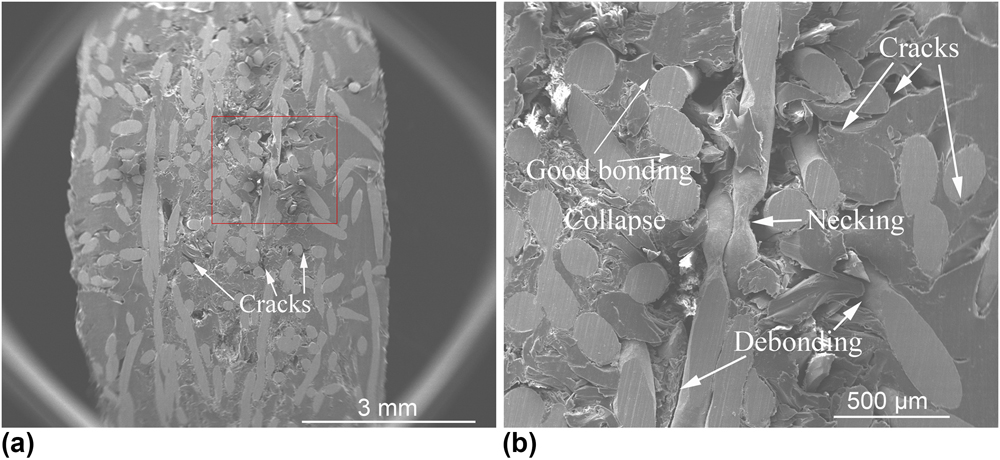
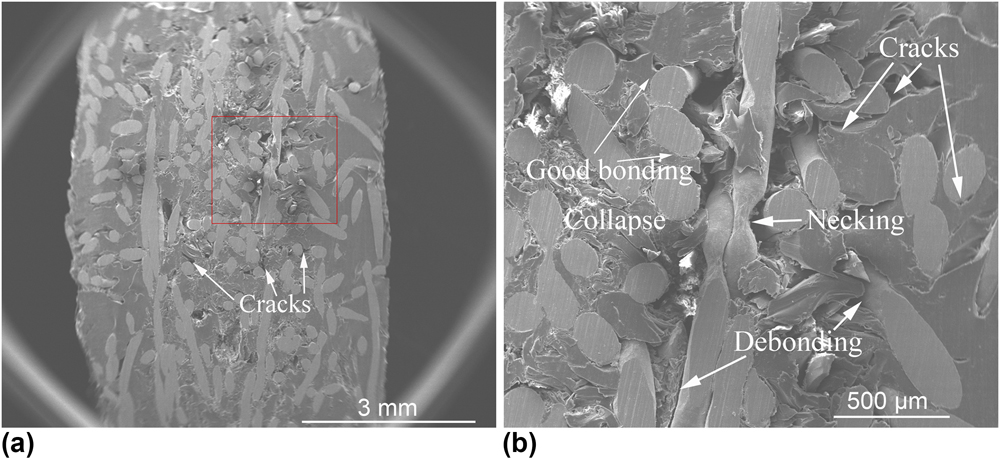
The microstructure of the axial cross section (the compressive loading direction is along the horizontal axis of the sample) of the IPC with a 32.11 vol% fiber fraction and 160 μm fiber diameter in the through-thickness direction is shown in Fig. 7. Figure 7(a) shows that many cracks appear around the fibers but do not completely propagate at the interface, indicating good bonding between the fiber and resin. Because of the large mismatch in the thermal expansion coefficients between the fibers and the resin, stress concentration is generated at the interface, although the infiltration process is conducted under vacuum conditions, which facilitates crack formation.Reference Scherm, Völkl, Neubrand, Bosbach and Glatzel27 As the compression load increases, the stress exceeds the strengths of the interface and resin, leading to the formation of cracks.Reference Zhou, Yao, Duan and Qin24 Additionally, some microcracks can form due to solidification shrinkage, which is also observed in other IPCs.Reference Cree and Pugh15 Additionally, the results show that cracks and resin collapse are mainly generated in the middle of the sample perpendicular to the compression load. Figure 7(b) clearly shows that many cracks arise, and the resin between the fibers collapses because resin is the softer phase and plastic deformation occurs first.Reference Zhou, Yao, Duan and Qin24 Even after severe deformation, some resins debond from the fibers, but the cracks do not completely propagate around the fibers, indicating a high bond strength. Additionally, the fiber network effectively transmits the stresses in the matrix.Reference Gómez de Salazar, Barrena, Morales, Matesanz and Merino29 The IPC mainly exhibits three types of failure: resin collapse, fiber necking, and debonding.
Microstructure of the axial cross section of the IPC with a 32.11 vol% fiber fraction and 160 μm fiber diameter in the through-thickness direction after compression: (a) lower magnification and (b) higher magnification.
IV. CONCLUSIONS
(1) Novel metal/resin IPCs were produced by spontaneously infiltrating unsaturated polyester resin into 304 stainless fiber preforms under vacuum conditions. The metal/resin IPCs exhibit anisotropic structures and most fibers are parallel to the x–y plane direction.
(2) The anisotropic compressive behavior of the IPCs was investigated, and the difference was not obvious when the fiber fraction was less than 9.45 vol%. The compression processes of the specimens in the in-plane direction exhibit distinct elastic–plastic behavior, i.e., an elastic stage, a quasiplatform stage, and a final densification stage, but no obvious quasiplatform stage appears in the compressive curves of the IPCs in the through-thickness direction. The IPCs exhibit nonlinear elastic behavior. Compared with the in-plane direction, the IPCs have a higher pseudo-platform stress but lower elastic modulus in the through-thickness direction. The IPCs exhibit an improvement in the compression strength but a slight decrease in the energy absorption capacity in comparison to the preforms. As the fiber fraction increases, the elastic modulus and pseudo-platform stress of the IPCs increase without a significant increase in the elongation at the pseudo-platform stress, and the peak energy absorption efficiency of the IPCs slightly decreases in a certain range rather than monotonically increasing or decreasing. The peak energy absorption efficiency of the IPCs in the in-plane direction is significantly higher than that in the through-thickness direction when the fiber fraction is higher than 32.11 vol% or lower than 16.78 vol%; otherwise, the difference is not significant. Finer fibers can significantly improve the compressive strength but have a limited effect on the energy absorption efficiency.
(3) Large macrosurface differences are exhibited for the IPCs in different directions after compression and the anisotropy decreases with decreasing fiber fraction. Cracks and resin collapse are mainly generated in the middle of the samples perpendicular to the compression load. Resin collapse, fiber necking, and debonding are the main fracture characteristics of the IPCs. The IPCs have high strength-to-weight ratios, and other mechanical properties will be investigated in the future to evaluate the associated comprehensive properties. The IPCs might be suitable for use in lightweight applications under conditions where high specific strength, energy absorption, and water resistance properties are needed.
ACKNOWLEDGMENTS
The project was financially supported by the Science and Technology Program of Guangzhou, China (No. 201604016015) and the Special Project of National Development and Reform Commission (ChinaGrid 2011636). Bibo Yao gratefully acknowledges the support from the Chinese Scholarship Council (CSC) and the Doctorate Dissertation Innovation Funds supported by the South China University of Technology.