





Introduction
Potato (Solanum tuberosum L.) is the most economically important vegetable crop grown in Canada with farm cash receipts of Can$1.9 billion in 2023 (Agriculture and Agri-Food Canada 2025). The Atlantic Canadian provinces of Prince Edward Island (PE) and New Brunswick (NB) accounted for 35% of Canada’s seeded potato acreage in 2023, with potatoes contributing over 42% of total farm cash receipts in Prince Edward Island and 18% in New Brunswick (Agriculture and Agri-Food Canada 2025). Potatoes are intensively managed and require expensive inputs to sustain production and yields. Potato producers in Prince Edward Island attributed 26% of their input costs to fertilizer and chemical crop protectants, both of which have increased in cost by 6% and 20%, respectively, from 2014 to 2019 (PEI Potato Board 2019). Potato crops are slow to establish, often requiring greater than 14 d to emerge, and are poor competitors with weeds, which if left uncontrolled can result in 12% to 61% yield loss through reductions in tuber number and quality (Ganie et al. Reference Ganie, Soltani, McKenzie-Gopsill, Felix, Hutchinson, Dille and Sikkema2023). Producers in Atlantic Canada have few in-season broadleaf herbicide options and often rely on a single application of a preemergent photosystem II (PSII)-inhibiting herbicide such as metribuzin (a Group 5 triazinone) or linuron (a Group 5 substituted urea) to provide season-long weed control. These herbicides are applied to more than 75% of potato acreage in the Atlantic region (L MacKinnon, personal communication, 2019). In recent years, Atlantic producers have reported reduced efficacy of these herbicides, and resistance has been confirmed in the region (McKenzie-Gopsill et al. Reference McKenzie-Gopsill, Graham, Laforest, Ibarra, Hann and Wagg2020). As such, research into alternative management approaches in potato that reduce weed pressure are required.
Common lambsquarters (Chenopodium album L.) is a summer annual broadleaf weed with a continuous emergence pattern that allows it to compete for resources with spring-planted crops for the duration of the growing season (Bassett and Crompton Reference Bassett and Crompton1978; Brown et al. Reference Brown, Gallandt, DiTommaso, Salon, Smith, Ryan and Cordeau2022; McKenzie-Gopsill Reference McKenzie-Gopsill2024). Chenopodium album is considered one of the most economically significant weeds in potato production systems and can reduce potato yield by up to 85% if left unmanaged (Eberlein et al. Reference Eberlein, Patterson, Guttieri and Stark1997; Parks et al. Reference Parks, Curran, Roth, Hartwig and Calvin1996). It sets seed in late summer and early fall and can produce an average of 72,000 seeds per plant (Stevens Reference Stevens1932). The small black seeds have little endosperm and can persist in the soil seedbank for more than 20 yr (Lewis Reference Lewis1973; Stevens Reference Stevens1932). More than 50% of C. album populations in Atlantic Canada are resistant to PSII-inhibiting herbicides and are increasingly difficult to control in potato with existing management tactics (McKenzie-Gopsill et al. Reference McKenzie-Gopsill, Graham, Laforest, Ibarra, Hann and Wagg2020).
Cover crops are crops grown in between periods of regular cash-crop production with the goal of enhancing, sustaining, or recovering agroecosystem services, including weed suppression. In Atlantic Canada, potatoes are generally grown in 2-yr cereal/legume–potato or 3-yr cereal/legume–forage–potato rotation. The incorporation of summer annual cover crops in place of cereals or legume in the year before potato has increased over the past several years as a tactic to improve soil health; reduce nutrient leaching and soil erosion; and break pest cycles for insect, disease, and weed management. Cover crops can suppress weeds through active in-season competition, preventing weed establishment; cover crop species vary in their ability to suppress weeds. For example, buckwheat’s (Fagopyrum esculentum Moench) aggressive spring growth, rapid canopy coverage, and allelopathic effects have been found to hinder weed establishment (Falquet et al. Reference Falquet, Gfeller, Pourcelot, Tschuy and Wirth2015; McKenzie-Gopsill et al. Reference McKenzie-Gopsill, Mills, MacDonald and Wyland2022; Worthing et al. Reference Worthing, Mills and McKenzie-Gopsill2024). Brassica species, including brown mustard [Brassica juncea (L.) Czern.], and tillage radish (Raphanus sativus L.), can similarly develop a dense canopy that limits weed seedling growth (Lawley et al. Reference Lawley, Teasdale and Weil2012). In addition, following termination and or incorporation, cover crop residues can continue to suppress weeds through the release of allelopathic compounds and changes to nutrient availability and release, which can reduce the requirement for herbicides (Owen et al. Reference Owen, Beckie, Leeson, Norsworthy and Steckel2014; McKenzie-Gopsill and Farooque Reference McKenzie-Gopsill and Farooque2023; McKenzie-Gopsill et al. Reference McKenzie-Gopsill, Nyiraneza and Fillmore2024). For example, Pittman et al. (Reference Pittman, Barney and Flessner2020) found that cover crops with high biomass and high C:N ratio provided a lasting mulch for light interference and subsequently increased the level and duration of weed suppressive effects and have been correlated to increased crop yield in the subsequent year. Similarly, Gannett et al. (Reference Gannett, Butler-Jones, DiTommaso, Sparks and Kao-Kniffin2024) found that residues with high C:N suppressed redroot pigweed (Amaranthus retroflexus L.) emergence due to changes in nitrogen availability facilitated by enhanced microbial activity. To date, however, there exists limited information on how cover crops grown the year before potato can contribute to weed suppression in rotation.
Selecting the appropriate cover crop termination method is critical for residue breakdown and maximizing a species’ weed suppressive potential (Wortman et al. Reference Wortman, Francis, Bernards, Blankenship and Lindquist2013). Cover crops can be terminated chemically, through use of herbicides, or mechanically, through use of plowing, rolling, mowing, disking, or roller-crimping. Depending on the desired outcome and specific weed species, termination timing, method, and soil disturbance can influence the weed suppressive ability of the cover crop, mostly due to changes in soil ground cover (Mirsky et al. Reference Mirsky, Gallandt, Mortensen, Curran and Shumway2010; Morse Reference Morse1999; Wortman et al. Reference Wortman, Francis, Bernards, Blankenship and Lindquist2013). Incorporating cover crop residues following mechanical termination can bury weed seeds and block light to inhibit weed emergence in the subsequent crop (Lehman and Blum Reference Lehman and Blum1997; Shaner and Beckie Reference Shaner and Beckie2014). Similarly, Schmidt et al. (Reference Schmidt, Stephan and Finckh2019) found that over a 2-yr crop rotation cycle, incorporating cover crop mulch via chisel plowing before potatoes reduced C. album seedbank density by 15% in the top 15 cm of soil when compared with conventional moldboard plowing. Schmidt et al. (Reference Schmidt, Stephan and Finckh2019) also found that the application of a dead cover crop mulch applied shortly after potato emergence in combination with chisel plowing provided nearly 100% soil cover from May until June, thus hindering C. album emergence. Furthermore, mechanical termination methods that incorporate cover crop residue such as disking or plowing can improve soil seedbed uniformity, thus facilitating easier tuber seeding and increased potato marketable yield (Mehring et al. Reference Mehring, Stenger and Hetterman-Valenti2016). Use of nonselective chemical herbicide can effectively terminate the crop while also providing broad-spectrum weed control and not disturbing the soil or surface residues (Whalen et al. Reference Whalen, Bish, Young, Conley, Reynolds, Norsworthy and Bradley2019). Mowing and roller-crimping can also provide effective cover crop termination that limits soil disturbance and maximizes surface residue, yet their efficacy varies across species and timing with direct effects on subsequent weed suppression (Teasdale and Rosecrane Reference Teasdale and Rosecrane2003). As such, termination methods that maximize surface residue and minimize soil disturbance have the greatest potential for inhibiting weed emergence (Teasdale et al. Reference Teasdale, Brandsaeter, Calegari, Skora Neto, Blackshaw, Upadhyaya, Upadhyaya and Blackshaw2007).
The objective of the present study was to evaluate several cover crops and termination methods to suppress C. album populations before potatoes. We hypothesized that (1) cover crops with higher stand densities will compete with weeds and decrease C. album establishment and contributions toward the weed seedbank, (2) cover crops terminated with methods that retain soil ground cover will decrease the germinable fraction of the C. album seedbank by providing a mulch effect, yet (3) cover crops terminated via soil incorporation will increase potato yield and quality due to improved seedbed and soil tilth.
Materials and Methods
Experimental Design
A multiyear field experiment was established at the Harrington Research Farm (46.3436°N, 63.1697°W) in Harrington, PE, Canada, and the Fredericton Research Farm (45.9229°N, 66.6082°W) in Fredericton, NB, Canada, in 2018, 2019, and 2020. Local site restrictions prevented access to the Fredericton research site in 2020 and resulted in reduced site-years from this location. Soil at Harrington, is characterized as a fine sandy loam (Ferro-Humic Podzol, OM 3%, pH 6.2) and at Fredericton, as a coarse sandy loam (Gleyed Humo-Ferric Podzol, OM 3%, pH 6.2). The experiment was established as a randomized split-plot design with latinization and three replications (n = 27). Cover crop species was the whole-plot factor and termination method the split-plot factor. Brown mustard, buckwheat, timothy (Phleum pratense L.), and a mixture consisting of annual ryegrass [Lolium perenne L. ssp. multiflorum (Lam.) Husnot], hairy vetch (Vicia villosa Roth), and crimson clover (Trifolium incarnatum L.) were selected as cover crops to evaluate the effects of cover crop species with varying growth habits, growth rates, and their ability to suppress weeds. To reduce the effect of confounding treatments with field variability, termination methods were latinized such that each termination method occurred only once per row and once per column across the experiment.
In the cover crop phase, fields were moldboard plowed, spring-tooth harrowed twice, rolled, and fertilizer broadcast according to provincial recommendations. Cover crops were seeded with a small plot seeder (Plotseed XL, Wintersteiger AG Ried im Innkreis, Austria) on June 6, 2018, and June 18, 2019, in Fredericton, and June 12, 2018, and June 26, 2019, in Harrington. Seeding rates for brown mustard, buckwheat, and timothy were 11.2 kg ha−1, 44.8 kg ha−1, and 5.6 kg ha−1, respectively. The seeding rate of the cover crop mixture was 3.0 kg ha−1, 36.0 kg ha−1, and 12.0 kg ha−1, for annual ryegrass, hairy vetch, and crimson clover, respectively. Seeding rates were chosen based on local recommendations (McKenzie-Gopsill et al. Reference McKenzie-Gopsill, Mills, MacDonald and Wyland2022). Cover crops were sown in 6 by 12 m plots. The early-flowering species, buckwheat and brown mustard, were flail mowed at flowering in mid-August and replanted within 7 d as is common in the region to prevent seed set and subsequent volunteers (McKenzie-Gopsill et al. Reference McKenzie-Gopsill, Mills, MacDonald and Wyland2022).
Treatment Application
To evaluate the effects of different termination methods on C. album seedbank persistence and potato quality, cover crops were terminated with one of four methods in mid-September: (1) mowing, (2) roller-crimping, (3) disking, or (4) glyphosate. Mowing was conducted using a Woods PRD6000 rear-mounted 1.83 m flail mower (Woods Equipment, Oregon, IL, USA) to mow cover crops to an approximate height of 5 cm. Roller crimping was conducted with a roller-crimper (I & J Manufacturing 10.5’, Gordonville, PA, USA) filled with approximately 400 L of water for a total weight of 1,195 kg. Cover crops were rolled twice, bi-directionally. Disking was done to an approximate depth of 10 cm with a 1.83-m Land Pride DH1572 disk harrow (Land Pride, Salina, KS, USA). Glyphosate (Roundup WeatherMax®, Monsanto, Winnipeg, Canada, 540 g ae L−1) was applied at a rate of 1,258.2 g ae ha−1 using a CO2-pressurized research plot sprayer in 2018 and a CO2-pressurized backpack sprayer in 2019. Both sprayers were calibrated to deliver 200 L ha−1 at 210 kPa with TP 8002VS nozzles (TeeJet® Technologies, Springfield, MA, USA). Mechanical termination methods were applied at a travel speed of approximately 5 km h−1. Plots were then left to overwinter.
In Year 2, potato plots consisting of four potato rows were sown into cover crop plots from Year 1. Fields were chisel plowed to a depth of 5 cm and spring-tooth harrowed to incorporate cover crop residues. At planting, rows were formed and fertility banded according to local recommendations to provide 185, 200, and 135 kg ha−1 of nitrogen, phosphorus, and potassium, respectively (Burton et al. Reference Burton, Nyiraneza, MacDonald and Stiles2018). Untreated Elite 1 potato sets (‘Russet Burbank’) were hand planted at 38-cm spacing with 91 cm between rows. Rows were closed mechanically, and imidacloprid (Admire 240, Bayer Crop Science, Calgary, Canada, 240 g ai L−1) was applied in-furrow at a rate of 312 g ai ha−1 to provide broad-spectrum insect control. Potatoes were planted on June 1, 2019, in Fredericton and May 28, 2019, and June 6, 2020, in Harrington. Potatoes were hilled at ground-crack, approximately 4 wk after planting. Additional pest management for insects and diseases was conducted as required in accordance with provincial recommendations. At maturity, potatoes were top killed with diquat (Reglone, Syngenta Canada, Guelph, ON, Canada, diquat ion 240 g ai L−1) at a rate of 300 g ai ha−1 in 200 L of water on September 20, 2019, and August 27, 2020, at Harrington, and on September 17, 2019, at Fredericton. Potato plots were harvested at physiological maturity on October 11, 2019, and October 7, 2020, in Harrington, and on October 9, 2019, in Fredericton.
Data Collection
To determine early-season cover crop and C. album density, cover crop and C. album counts were made in three randomly placed 0.5 by 0.5 m quadrats per plot at 4 wk after planting. Cover crop establishment was then calculated based on seeding rates, seed germination tests, and cover crop 1,000-seed weight.
To evaluate the effect of cover crop and termination method on the germinable fraction of the C. album seedbank, composite rhizosphere soil cores (0 to 15 cm) consisting of three 8-cm-diameter samples were collected twice, before cover crop termination and at potato hilling, and stored at 4 C until processing (Gross Reference Gross1990). Samples were thoroughly mixed and sieved through a 4,000-µm sieve to remove large debris and concentrated using an elutriation system (Gillison’s Variety Fabrication, Benzonia, MI, USA) affixed with an 840-µm mesh screen at the top of each chamber (Gross Reference Gross1990; Smucker et al. Reference Smucker, McBurney and Srivastava1982; Ter Heerdt et al. Reference Ter Heerdt, Verweij, Bekker and Bakker1996). Samples were run for approximately 4 min, and the contents within the cylinders and mesh screens were then washed into a 250-µm mesh sieve. Samples were spread into trays containing moistened sterilized sand. Trays were placed in a greenhouse with a 16/8-h light/dark photoperiod and 22/16 C day/night temperature cycle. High-pressure sodium lights provided supplemental lighting when natural light conditions fell below a photosynthetic photon flux density of 2,000 µmol m−2 s−1. A watering spike placed in each tray supplied 150 ml of water d−1. Trays were monitored regularly for seedling emergence. Germinated seedlings were identified, tallied, and removed until germination ceased (Ter Heerdt et al. Reference Ter Heerdt, Verweij, Bekker and Bakker1996).
To evaluate the effects of cover crop termination method on soil C:N, a subsample was taken from all soil samples. Soil samples were analyzed for percent carbon and nitrogen content using high-temperature combustion with the Vario MAX Cube Organic Elemental Analyzer (Elementar Americas, Ronkonkoma, NY, USA).
To evaluate carryover weed suppressive effects of cover crops in potato, C. album density was determined at 4 and 8 wk after hilling (WAH) within one 0.5 by 0.5 m quadrat randomly placed within each plot centered over a potato row. Potatoes were mechanically harvested at physiological maturity to determine carryover effects of cover crops and termination method on yield. Potatoes were graded in accordance with the CFIA potato grading scale (CFIA 2023) using an optical grader (Celox-P-UHD, New Tec, Odense, Denmark) and sorted into cull or marketable potatoes. Small (<3.8 cm), large (>8.9 cm), misshapen, and sunburned potatoes were removed and counted as culls. The sum of medium (3.8 to 5 cm) and Canada #1 (5 to 8.9 cm) class sizes were calculated as marketable yield.
Statistical Analysis
All statistical analyses was performed in the R software environment (RStudio v. 4.3.2; R Core Team 2023) with a Type I error rate of α = 0.05. Generalized linear mixed-effects models were used to evaluate cover crop establishment, C. album density in the cover crop year, and C. album seedbank density, with a Poisson distribution and a log link function with the R package lme4 (Bates et al. Reference Bates, Maechler, Bolker, Walker, Christensen, Singmann, Dai, Scheipl, Grothendieck, Green, Fox, Bauer, Krivitsky, Tanaka, Jagan and Boylan2025). Cover crop (whole-plot factor) and termination method (split-plot factor), location, and their interaction were treated as fixed effects; and location, year nested within location, replication nested within location by year, and cover crop nested within replication were treated as random effects. To account for initial differences in seedbank density, the seedbank density before cover crop termination was included in the seedbank model as a covariate. Soil C, soil N, soil C:N, and potato cull and marketable yield were modeled with the same fixed and random effects structure as previously described, but with a gaussian distribution and an identity link function. Generalized linear mixed-effects models with repeated measures were used to analyze C. album density, with cover crop (whole-plot factor) and termination method (split-plot factor), location, time, and their interaction treated as fixed effects, and location, year nested within location, replication nested within location by year and cover crop nested within replication as random effects with a uniform covariance structure on time, using the R package lme4. In all cases, model assumptions were evaluated by visual inspection of residual plots. For all modeled parameters, least-square means and standard error of the mean were generated, and mean separation was conducted with a Tukey’s honest significant difference (HSD) test and a Type I error rate of α = 0.05. Linear regression and Pearson’s correlation coefficients were used to investigate relationships between cover crop density and C. album density in the cover crop phase and for soil C:N and C. album density in the potato phase using the base functions in R.
Results and Discussion
Cover Crop Phase
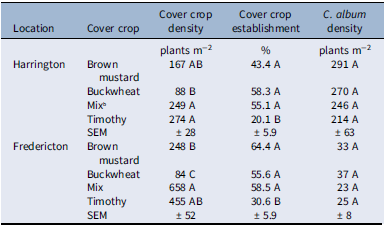
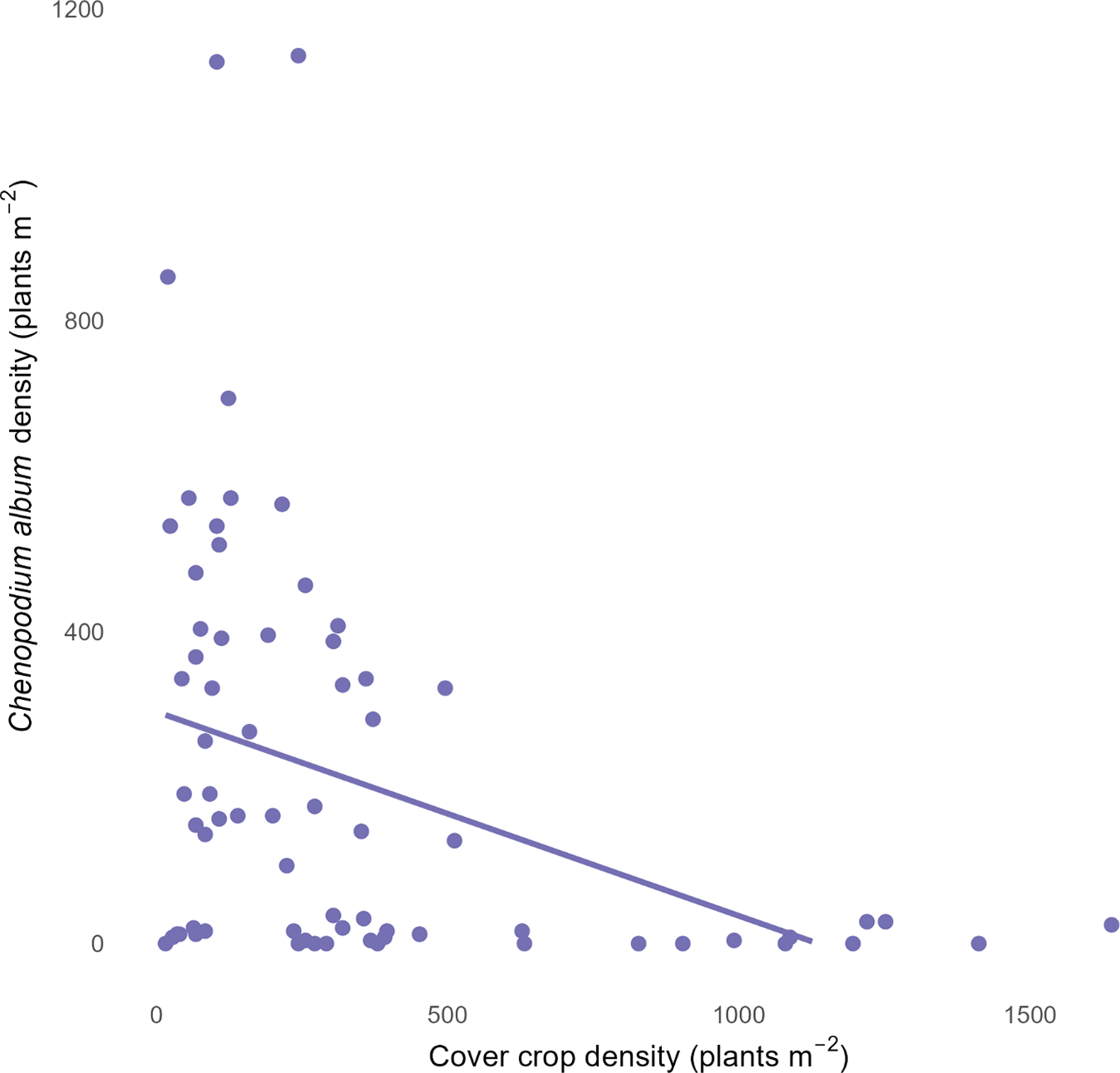
Cover crop density varied by location (F(1, 116) = 340.75, P < 0.001), cover crop (F(3, 15) = 23.52, P < 0.001), and their interaction (F(3, 116) = 77.86, P < 0.001). Total average cover crop density was 42% greater in Fredericton than in Harrington. At both locations, cover crop density was reflective of seeding rates, with the mixture and timothy having the highest density and buckwheat the lowest (Table 1). Cover crop establishment varied by location (F(1, 122) = 5.28, P = 0.023), cover crop (F(3, 122) = 20.03, P < 0.001), but not their interaction (F(3, 122) = 2.43, P = 0.069). Establishment at both locations was similar for brown mustard, buckwheat, and the mix, and it was between 82% and 190% greater than timothy (Table 1). Chenopodium album density differed by location (F(1, 114) = 2,432.21, P < 0.001) and the interaction between cover crop and location (F(3, 114) = 2.94, P = 0.036), yet not by cover crop (F(3, 15) = 0.54, P = 0.664). Overall, C. album density was 159% greater in Harrington than Fredericton (Table 1). Furthermore, C. album density displayed a negative relationship with cover crop density and declined as cover crop density increased (ρ = −0.29, P < 0.001, R2 = 0.09) (Figure 1). Combined, these results demonstrate that cover crop density and establishment were greater in Fredericton and may be a result of lower starting seedbank density and subsequent weed pressure compared with Harrington. Weed seedbank size is known to affect the success of weed management tactics (Dieleman et al. Reference Dieleman, Mortensen and Martin1999). For example, a high starting seedbank density has been shown to buffer against mechanical and chemical weed control throughout a crop rotation and to maintain a high density of emerged weed populations following treatment (Buhler et al. Reference Buhler, Hartzler and Forcella1997; Dieleman et al. Reference Dieleman, Mortensen and Martin1999). In contrast, correctly timed tillage and mowing to manage seed production followed by planting a cover crop to limit subsequent emergence can result in greater than 80% decline in viable seed numbers of foxtail (Setaria spp.) and C. album regardless of starting seedbank density (Mirsky et al. Reference Mirsky, Gallandt, Mortensen, Curran and Shumway2010). The lack of mowing in the timothy and mixture in our study likely allowed emerged weeds to set seed. Further, while tillage and reseeding was done midseason with brown mustard and buckwheat, the continuous emergence pattern of C. album in the Atlantic Canadian region (McKenzie-Gopsill Reference McKenzie-Gopsill2024) allowed C. album to evade control and contribute seed to the seedbank. This emphasizes the need to manage cover crops based on local weed populations and their phenology to realize the weed suppressive effects of cover crops.
Cover crop density (plants m−2), establishment (%), and Chenopodium album density (plants m−2) at 4 wk after cover crop planting in Harrington, PE, and Fredericton, NB, Canada, in 2018 and 2019 a

Table 1. Long description
The table presents data on cover crop density, establishment, and Chenopodium album density for two locations, Harrington and Fredericton. It has five columns: Location, Cover crop, Cover crop density, Cover crop establishment, and C. album density. The table includes data for four different cover crops: Brown mustard, Buckwheat, Mix, and Timothy. Each row provides specific values for cover crop density in plants per square meter, cover crop establishment in percent, and C. album density in plants per square meter. The table also includes standard error of the mean (SEM) values for each cover crop. Notable trends include variations in cover crop density and establishment between the two locations and among different cover crops.
a Data are least-square means and the standard error of the mean (SEM). Means followed by different letters are significantly different with a Type I error rate of α = 0.05 according to a Tukey’s honest significant difference (HSD) test within each location.
b Mix contains annual ryegrass, crimson clover, and hairy vetch.
Relationship between cover crop density (plants m−2) and Chenopodium album density (plants m−2) at 4 wk after planting in the cover crop phase at Harrington, PE, and Fredericton, NB, Canada, in 2018 and 2019 (y = –0.26x + 297.70).

Potato Phase
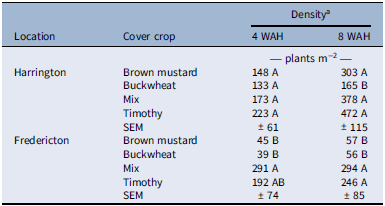
In the potato phase of the rotation, C. album density differed by the interaction between cover crop, location, and sampling time (F(9, 217) = 4.50, P = <0.001), but not termination method (F(3, 217) = 0.16, P = 0.922). Overall, C. album density remained higher at Harrington than Fredericton (Table 2) and can be again attributed to initial differences in seedbank density. A similar effect has been observed with multiple herbicide–resistant waterhemp [Amaranthus tuberculatus (Moq.) Sauer], where poor weed control in one year decreased weed control efficacy in the subsequent year’s soybean [Glycine max (L.) Merr.] (Yadav et al. Reference Yadav, Jha, Hartzler and Liebman2023). Forcella et al. (Reference Forcella, Eradat-Oskoui and Wagner1993) demonstrated that high seedbank loads of >1,000 seeds m−2 would produce populations so great that mechanical means of seedbed preparation were not sufficient to control seedlings, and chemical herbicide intervention was required to prevent crop yield losses. Further, high initial seedbank density increases the volume of residual herbicide active ingredient required to maintain control during the season, with an upper limit often observed where further increases in herbicide rate have minimal impact on emerged weed populations (Taylor and Hartzler Reference Taylor and Hartzler2000). As such, the high initial seedbank density at Harrington likely contributed to the minimal impact of cover crop and termination treatments on emerged C. album populations.
Chenopodium album density (plants m−2) in potato plots following cover crops in Harrington, PE, and Fredericton, NB, Canada, at 4 and 8 wk after hilling (WAH) in 2019 and 2020.

Table 2. Long description
The table presents Chenopodium album density in plants per square meter in potato plots following different cover crops at two locations, Harrington and Fredericton, and two sampling times, 4 weeks after hilling (WAH) and 8 WAH. The table has 10 rows and 4 columns. The columns are labeled Location, Cover crop, and Density at 4 WAH and 8 WAH. The row labels include the locations Harrington and Fredericton, and the cover crops Brown mustard, Buckwheat, Mix, and Timothy. The density values are provided for each cover crop at both sampling times. Notable trends include higher densities at Harrington compared to Fredericton and variations in density based on the cover crop and sampling time. The standard error of the mean (SEM) is also provided for each measurement.
a Data are least-square means and the standard error of the mean (SEM). Means followed by different letters are significantly different with a Type I error rate of α = 0.05 according to a Tukey’s honest significant difference (HSD) test within each location.
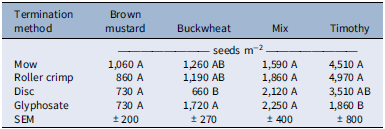
Chenopodium album seedbank density was affected by cover crop type (F(3, 71) = 210.19, P < 0.001) and the interaction between cover crop type and termination method (F(9, 71) = 19.40, P < 0.001; Table 3). Buckwheat terminated with disking resulted in 64% fewer C. album seedlings emerging from the seedbank compared with glyphosate (Table 3). Further, C. album density was 46% to 65% lower following buckwheat than all other cover crops in Harrington at 8 WAH (Table 2) and 77% to 81% lower following brown mustard and buckwheat in Fredericton at 8 WAH (Table 2). While seeds of other weed species, including corn spurry (Spergula arvensis L.) and green foxtail [Setaria viridis (L.) P. Beauv.], were present in samples (data not shown), they represented <50% of the total seedbank, which was primarily C. album. Combined, the reduction in C. album seedbank density observed in the potato phase at both locations suggests that brown mustard and buckwheat may have had residual weed suppressive effects after incorporation (Table 2). Buckwheat and brown mustard are known to have carryover and allelopathic effects on various weed species (Björkman et al. Reference Björkman, Lowry, Shail, Brainard, Anderson and Masiunas2015; Campiglia et al. Reference Campiglia, Paolini, Colla and Mancinelli2009; Iqbal et al. Reference Iqbal, Hiradate, Noda, Isojima and Fuji2003; McKenzie-Gopsill and Farooque Reference McKenzie-Gopsill and Farooque2023; Xuan and Tsuzuki Reference Xuan and Tsuzuki2004), which can be affected by degree of soil incorporation (Björkman and Shail Reference Björkman and Shail2013; Dyck et al. Reference Dyck, Liebman and Eric1995). Brassica crops contain glucosinolates that can form volatile compounds known as isothiocyanates, which have been shown to inhibit the germination and growth of many weeds, including C. album (Brown and Morra Reference Brown and Morra1997; Haramoto and Gallandt Reference Haramoto and Gallandt2004; Teasdale and Taylorson Reference Teasdale and Taylorson1986). The use of Brassicaceae seed meals with biologically active isothiocyanates has also been shown to reduce C. album biomass by greater than 87% (Rice et al. Reference Rice, Johnson-Maynard, Thill and Morra2007). Similarly, buckwheat produces exudates, and decaying residues and shoot extracts have shown growth-inhibiting effects on various weeds (Iqbal et al. Reference Iqbal, Hiradate, Noda, Isojima and Fuji2003; Kumar et al. Reference Kumar, Brainard and Bellinder2009b; McKenzie-Gopsill and Farooque Reference McKenzie-Gopsill and Farooque2023). Together, our results support the use of buckwheat and brown mustard as a tool for C. album seedbank management in potato rotations due to their direct weed suppression during growth as well as subsequent inhibitory effects on its seedbank.
The readily germinable Chenopodium album seedbank density (seeds m−2) in the rhizosphere (0–15 cm) at Harrington, PE, Canada, in potato plots following different cover crops terminated by various mechanisms a

Table 3. Long description
A table comparing the readily germinable Chenopodium album seedbank density in the rhizosphere under different cover crops and termination methods. The table has four rows and five columns. The columns are labeled as Termination method, Brown mustard, Buckwheat, Mix, and Timothy. The row labels are Mow, Roller crimp, Disc, Glyphosate, and SEM. Each cell contains the seedbank density values in seeds per square meter. Notable trends include varying seedbank densities across different cover crops and termination methods, with specific values provided for each combination.
a Data were pooled across years and represent the least-square and standard error of the mean (SEM). Means not connected by the same letter within a column are significantly different with a Type I error rate of α = 0.05 according to a Tukey’s honest significant difference (HSD) test within each cover crop type.
Impact of Cover Crops on Soil Seedbank and C:N
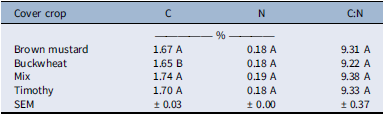
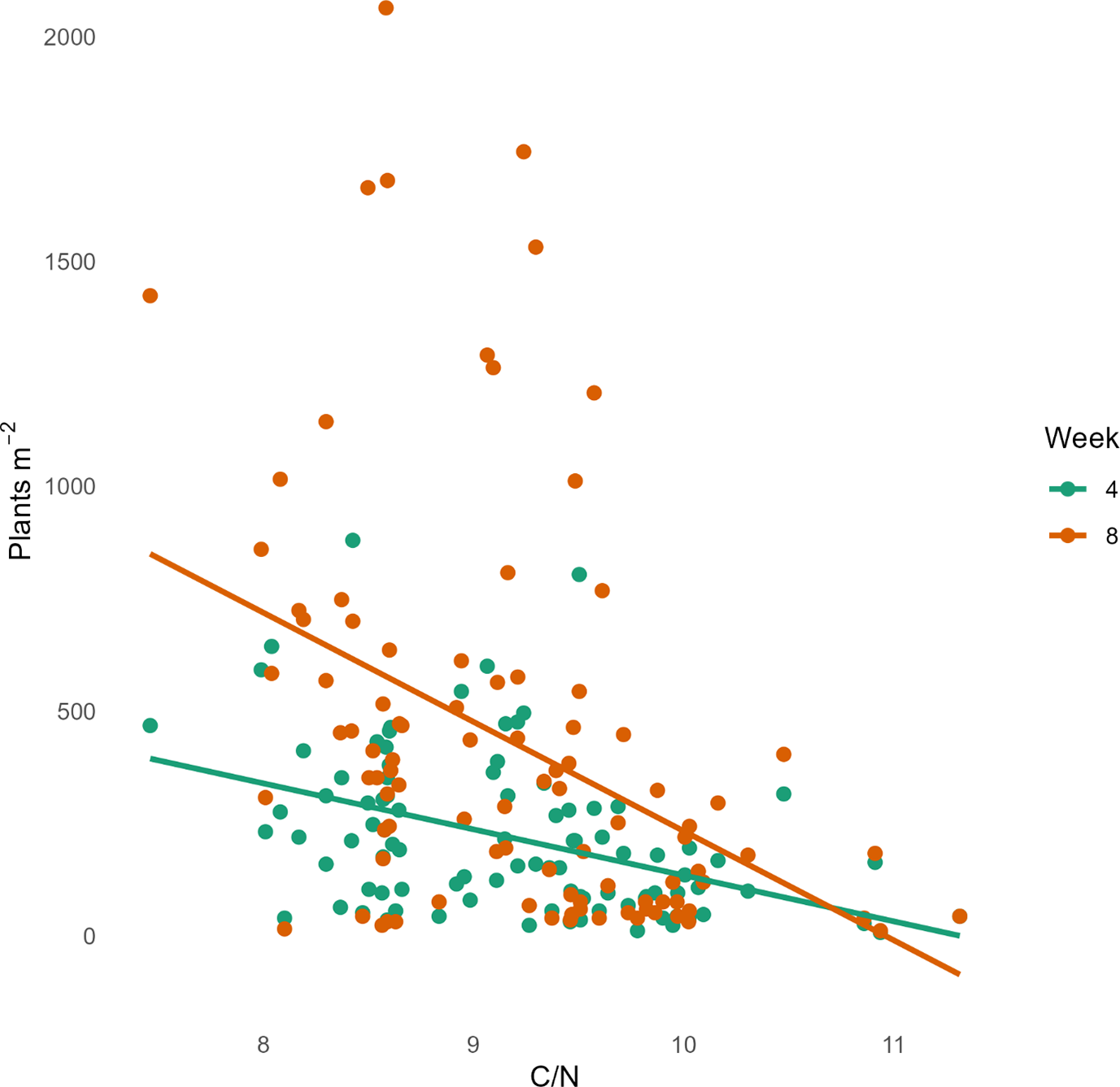
Soil carbon was affected by cover crop (F(3, 72) = 5.74, P = 0.001), but was not impacted by termination method (F(3, 6) = 0.11, P = 0.953) or their interaction (F(9, 72) = 0.19, P = 0.995) (Table 4). In the potato phase, soil carbon following buckwheat was 4% to 6% lower than following the other cover crops. By comparison, neither soil nitrogen nor C:N was affected by cover crop (F(3, 72) = 2.34, P = 0.081; F(3, 72) = 1.41, P = 0.246), termination method (F(3, 6) = 0.51, P = 0.693; F(3, 6) = 0.33, P = 0.801), or their interaction (F(9, 72) = 0.75, P = 0.665; F(9, 72) = 0.68, P = 0.721) (Table 4). Despite cover crop species having negligible impact on soil C:N, a relationship was found between C. album emergence in the potato phase and soil C:N. Chenopodium album density in the potato phase declined with increasing soil C:N at 4 WAH (ρ = −0.42, P < 0.001; R2 = 0.18), and this trend continued to 8 WAH (ρ = −0.40, P < 0.001; R2 = 0.16; Figure 2). Our results demonstrate soils with increased C:N had lower C. album germination, which may be due to the lower nitrogen availability reducing germination. Chenopodium album is a nitrophilous species, and increased availability of nitrogen has been shown to break its dormancy and stimulate seed germination (Fawcett and Slife Reference Fawcett and Slife1978; Williams and Harper Reference Williams and Harper1965). Similar to our findings, Kumar et al. (Reference Kumar, Brainard and Bellinder2009a) observed buckwheat and brown mustard to have relatively low C:N levels in their biomass, supporting rapid residue decomposition rates and N release to stimulate seed germination. McKenzie-Gopsill and Farooque (Reference McKenzie-Gopsill and Farooque2023) found that cover crop residues with high C:N values can suppress weed emergence following incorporation, possibly due to nutrient tie-up and release of allelopathic compounds. Pittman et al. (Reference Pittman, Barney and Flessner2020) and Gannett et al. (Reference Gannett, Butler-Jones, DiTommaso, Sparks and Kao-Kniffin2024) showed that the use of high-biomass mulches with high C:N could inhibit germination of the closely related A. retroflexus and suggest this as another tool for producers to support sustainable weed management. Further, McKenzie-Gopsill et al. (Reference McKenzie-Gopsill, Nyiraneza, Arseneault, Lynch and Fraser2025) found that seed of weedy species, including C. album, was entirely absent from the seedbank in soil with high biological activity and high C:N values across more than 50 agricultural sites in the province of Prince Edward Island. Together, our results support the use of high-biomass cover crops that could influence N release through changes in C:N and provide inhibition of nitrophilous species such as C. album in potato production.
Percent carbon (C), nitrogen (N), and the carbon-to-nitrogen ratio (C:N) of soils collected at hilling in the potato phase at Harrington, PE, Canada, in 2019 and 2020 following various cover crops a

Table 4. Long description
The table presents data on soil carbon (C), nitrogen (N), and the carbon-to-nitrogen ratio (C:N) following different cover crops. It has five rows and four columns. The columns are labeled ‘Cover crop’, ‘C’, ‘N’, and ‘C:N’. The row labels are ‘Brown mustard’, ‘Buckwheat’, ‘Mix’, ‘Timothy’, and ‘SEM’. The values for each cover crop are as follows: Brown mustard: C 1.67 percent, N 0.18 percent, C:N 9.31; Buckwheat: C 1.65 percent, N 0.18 percent, C:N 9.22; Mix: C 1.74 percent, N 0.19 percent, C:N 9.38; Timothy: C 1.70 percent, N 0.18 percent, C:N 9.33; SEM: C ± 0.03 percent, N ± 0.00 percent, C:N ± 0.37. The table shows the impact of different cover crops on soil carbon, nitrogen, and the carbon-to-nitrogen ratio.
a Values are least-square means ± the standard error of the mean (SEM).
Means not connected by the same letter within a column are significantly different with a Type I error rate of α = 0.05 according to a Tukey’s honest significant difference (HSD) test.
Relationship between the soil C:N and Chenopodium album density (plants m−2) at 4 (y = –102.29x + 1157.86) and 8 (y = –242.85x + 2661.89) wk after hilling (WAH) in the potato phase at Harrington, PE, Canada, in 2019 and 2020.

Impact of Cover Crops and Termination Method on Potato Yield
Potato marketable yield was affected by location (F(1, 2) = 42.08, P = 0.023), termination method (F(3, 105) = 5.23, P = 0.002), cover crop (F(3, 105) = 4.18, P = 0.008), and the interactions of location and termination method (F(3, 105) = 5.01, P = 0.003) and termination and cover crop (F(9, 105) = 2.07, P = 0.039). Marketable potato yield was consistently higher in Fredericton (14,599 ± 2490 kg ha−1) than in Harrington (6401 ± 1820 kg ha−1) (Figure 3A). Further, marketable potato yield at Fredericton increased by 29% and 31% when following cover crops that were terminated via disking or glyphosate, respectively, whereas no effect was observed in Harrington (Figure 3A). This provides partial support for our third hypothesis, that cover crop termination method would influence potato yield and quality. Mehring et al. (Reference Mehring, Stenger and Hetterman-Valenti2016) found potato marketable yield was highest following cover crops terminated by rototilling, a high soil-disturbance method. Termination of cover crops by disking or rototilling improves seedbed conditions for potato planting and establishment and increases available nutrients from decaying cover crop residues (Wortman et al. Reference Wortman, Francis, Bernards, Blankenship and Lindquist2013). Glyphosate is a systemic herbicide and is regularly used for cover crop termination, as it can provide further control of weeds along with crop desiccation (Kumar et al. Reference Kumar, Singh, Flessner, Haymaker, Reiter and Mirsky2023). By comparison, terminating cover crops by mowing or roller-crimping does not incorporate residues into the soil immediately after termination and had less impact on potato yield. Therefore, termination by glyphosate or disking may improve seedbed conditions and nutrient availability for potato establishment in the subsequent cropping year, contributing to increased marketable yields.
Yield of (A) marketable and (B) cull potato tubers (kg ha−1) following termination of cover crops in the year prior in Fredericton, NB, and Harrington, PE, Canada, averaged over 2019 and 2020. Bars with different letters indicate the least-square means are significantly different across treatments and locations within marketable or cull yield with a Type I error rate of α = 0.05 according to a Tukey’s honest significant difference (HSD) test.

Figure 3. Long description
Panel A: A box-and-whisker plot showing the yield of marketable potato tubers in tons per hectare (T ha^-1) across different treatments in Fredericton, NB, and Harrington, PE, Canada. The horizontal axis lists treatments: Disc_Fredericton, Disc_Harrington, Glyphosate_Fredericton, Glyphosate_Harrington, Mow_Fredericton, Mow_Harrington, Roller-crimper_Fredericton, and Roller-crimper_Harrington. The vertical axis ranges from 0 to 2.5 T ha^-1. Each box plot shows the distribution of yields, with different letters indicating significant differences in least-square means across treatments and locations. Panel B: A box-and-whisker plot showing the yield of cull potato tubers in tons per hectare (T ha^-1) across the same treatments and locations. The horizontal axis lists the same treatments, and the vertical axis ranges from 0 to 25 T ha^-1. Each box plot shows the distribution of yields, with different letters indicating significant differences in least-square means across treatments and locations.
Marketable potato yield was greater following buckwheat and brown mustard, which may in part be due to the decreased C. album density observed following these species early in the season (Table 2; Figure 3A). The added pest suppressive benefits of these cover crops may also have contributed to these observed increases in potato yields. For example, Mehring et al. (Reference Mehring, Stenger and Hetterman-Valenti2016) found potatoes grown under irrigation had 93% weed control following a spring-seeded rye (Secale cereale L.) /canola (Brassica napus L.) cover crop at 14 d after planting and attributed this to their allelopathic effects. Further, other Brassica spp. have been shown to suppress potato pests and provide increases in yield following incorporation (Davis et al. Reference Davis, Huisman, Westermann, Hafez, Everson, Sorensen and Schneider1996). This includes suppression of pests such as click beetle (Elateridae spp.) larvae (wireworm) and diseases, including verticillium wilt (Verticillium dahliae Kleb.), as well as parasitic nematodes (Davis et al. Reference Davis, Huisman, Westermann, Hafez, Everson, Sorensen and Schneider1996; Ploeg Reference Ploeg, Ciancio and Mukerji2008). Jiang et al. (Reference Jiang, Nyiraneza, Noronha, Mills, Murnaghan, Kostic and Wyand2022) found 16% greater marketable potato yield when grown in rotation with buckwheat compared with rotations that included barley (Hordeum vulgare L.) and red clover (Trifolium pratense L.) and attributed this to in-season nitrogen mineralization in the subsequent potato crop year. Furthermore, brown mustard has been found to increase soil pH and availability of phosphorus and potassium (Khan et al. Reference Khan, Farooque, Brown, Zaman, Acharya, Abbas and McKenzie-Gopsill2021), which are often yield limiting in the acidic low-nutrient soils of Atlantic Canada.
Cull yield varied by location (F(1, 2) = 161.01, P = 0.006), termination method (F(3, 105) = 5.76, P = 0.001), and the interaction of termination method and location (F(3, 105) = 6.94, P < 0.001). Cull yield was similar across termination methods in Harrington and averaged 430 ± 30 T ha−1 (Figure 3B). In contrast, cull yield in Fredericton was 52% and 88% higher following disking and rolling, respectively, than when following cover crops terminated by mowing (Figure 3B). This increase in cull yield was primarily from increased sunburn damage and tuber greening at Fredericton (80 ± 40 T ha−1) versus Harrington (30 ± 40 T ha−1) (data not shown). Increased cultivation is usually used to reduce tuber greening by limiting light exposure during the season and ensuring adequate soil covers the developing tubers (Bellinder et al. Reference Bellinder, Wallace and Wilkins1996). It is possible that poor termination efficacy by disking or rolling contributed to poor soil tilth that limited the ability to cover potato tubers during the growing season. These results suggest that cover crop termination method can impact cull yield in the subsequent year and that methods that improve soil tilth can contribute to reduced tuber defects, including sunburn.
Overall, our results highlight the importance of the starting seedbank density when planning a cover crop and termination strategy for weed suppression in potato production. We found that cover crops and termination methods had a greater impact on C. album seedbank load in Fredericton over Harrington, where initial seedbank density was lower. However, our results support the use of cover crops with rapid establishment and allelopathic effects in potato rotations to suppress C. album, aid in the long-term exhaustion of the C. album seedbank, and improve marketable potato yield to support sustainable potato production. Further, our results highlight the relationship between cover crop residue C:N for suppressing nitrophilous species such as C. album. Future research should focus on understanding how termination method influences residue breakdown of cover crops and its contribution to long-term weed suppression in a potato rotation. In light of increasing herbicide-resistance challenges in the region (Heap Reference Heap2025; McKenzie-Gopsill et al. Reference McKenzie-Gopsill, Graham, Laforest, Ibarra, Hann and Wagg2020), this study contributes to the development of weed seedbank management tactics for C. album and a pathway toward more resilient potato production.
Acknowledgments
The authors wish to thank the Harrington and Fredericton farm crews, Sheldon Hann, and Ashley Nicolle MacDonald for assistance.
Funding statement
Funding for this research was supported by Agriculture and Agri-Food Canada project J-003715 to AM-G.
Competing interests
The authors declare no conflicts of interest.


 Open access

