Medical short-stay units (SSUs) have gained popularity for their potential to reduce length of stay and hospital costs for patients requiring brief hospitalization. Reference Ross, Hockenberry and Mutter1 Infections are among the leading diagnoses for patients admitted to SSUs. Reference Yong, Li and Roberts2 The SSU model of care, which includes rapid patient turnover and frequent provider handoffs, may present unique challenges to appropriate antibiotic prescribing, particularly at discharge. Although transitions of care from hospitals and emergency departments are known common times of antibiotic overuse, Reference Yogo, Haas and Knepper3 discharge prescribing from SSUs has not been studied. Thus, we characterized antibiotic overuse at discharge from 2 SSUs in a tertiary-care hospital.
Methods
Setting and population
This cross-sectional study included patients hospitalized in either of 2 medical SSUs with a total of 40 beds at a single academic medical center. These units are staffed by advanced practice providers and physicians who work 8-hour shifts, with 3 provider handoffs daily.
Eligible adults were those discharged with an oral antibiotic prescription from either SSU between May 2018 and September 2019. Patients were identified based on discharge diagnosis codes for common infections (Appendix online) or abnormal urine cultures to identify urinary tract infections (UTIs). Potentially eligible patients were randomized and evaluated manually for exclusions until our 100-patient target was reached (Supplementary Fig. 1 online). Patients were excluded if discharge antibiotics were for chronic suppression or for infections without clear institutional guidelines, or if they were severely immunosuppressed or failed to clinically improve within 72 hours of appropriate treatment (Appendix online). Two reviewers performed manual chart review on all eligible patients to obtain patient characteristics, microbiology findings, and antibiotic therapy.
Definition and assessment of antibiotic overuse after discharge
The primary outcome was the percentage of patients with antibiotic overuse at discharge. Antibiotic overuse was defined based on previously published methods Reference Vaughn, Gandhi and Chopra4 and included unnecessary use, excess duration, and guideline discordant selection (Appendix online). Unnecessary antibiotic use refers to antibiotics prescribed for noninfectious conditions or nonbacterial infections and was only assessed for patients diagnosed with pneumonia or UTI. Excess duration refers to antibiotic prescriptions >1 day beyond the recommended duration. Guideline discordant selection includes suboptimal and inappropriate antibiotic use. Suboptimal use refers to antibiotics that, although potentially effective, were inconsistent with institutional guidelines without documentation of rationale to avoid preferred agents (eg, use of fluoroquinolones when safer alternatives were available). Inappropriate antibiotic selection includes antibiotics prescribed that did not cover the isolated or probable infectious organism(s). Discharge antibiotic regimens could be classified as overuse in 1 or multiple categories.
Institutional guidelines (Supplementary Fig. 2 online) were considered the gold standard in assessing antibiotic overuse. When evidence for appropriate treatment was conflicting (or guidelines were unclear), treatment was considered appropriate. Antibiotic overuse was assessed independently by 2 reviewers via chart review. Differences in assessment were resolved by a third reviewer. For cases identified as overuse, the chart was reviewed for documentation of factors influencing prescribing, including consultant recommendation, prescribing errors, failure to account for adequate source control, and premature classification of patients being “slow to respond” to initial antibiotics (Appendix online).
Data analysis
Descriptive statistics were calculated for all variables. Factors associated with overuse were assessed using χ2, Fisher exact, or 2-sided t tests. A sensitivity analysis was conducted where patients with an ID consultant were considered to have appropriate antibiotic therapy. A P value < .05 was significant. Analyses were conducted using SAS version 9.4 software (SAS Institute, Cary, NC).
Results
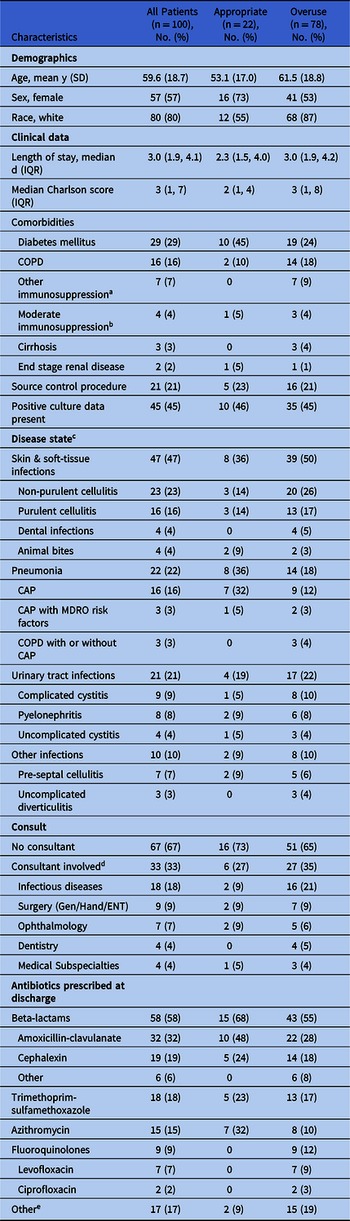
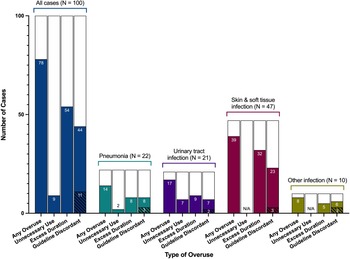
Of 100 patients discharged from SSUs with antibiotics, 47 had a skin and soft-tissue infection (SSTI), 22 had pneumonia, 21 had a UTI, and 10 had “other” infections (Table 1). Overall, 78 cases (78%) involved overuse, including 39 (83%) of 47 of those treated for SSTI, (17 (81%) of 21 treated for UTI, and 14 (64%) of 22 treated for pneumonia (Fig. 1). Also, 28 cases (28%) had multiple types of overuse. The most common types of overuse were excess duration (54 of 100, 54%) and guideline discordant selection (44 of 100, 44%). The median excess duration was 3.5 days (IQR, 3.0–6.0) overall and 4.0 days (IQR, 3.0–6.0) for SSTIs. Examples of factors influencing overuse included consultant recommendations, miscalculation of duration, and the need for source control procedure (Supplementary Table 1 online). On bivariable analyses, consultant involvement and infectious disease (ID) consultant involvement specifically, as well as a diagnosis of SSTI, were associated with excess duration; a diagnosis of pneumonia was associated with appropriate duration (Supplementary Table 2 online).
Characteristics of Included Patients Discharged on Antibiotics from Medical Short Stay Units

Note. SD, standard deviation; IQR, interquartile range; COPD, chronic obstructive pulmonary disease; CAP, community-acquired pneumonia; MDRO, multidrug-resistant organism; Gen, general surgery; hand, hand surgery; ENT, ear, nose, and throat surgery.
a Other immunosuppression included immunosuppression not meeting definition for severe (excluded) or moderate immunosuppression (below).
b Moderate immunosuppression defined as: Human immunodeficiency virus infection with CD4 count above 0.200 × 10⁹ cells/L, chemotherapy within 30 days, treatment for leukemia or lymphoma within 6 months, long-term steroid use (≥10 mg of prednisone per day or equivalent), use of a biologic agent (eg, a tumor necrosis factor inhibitor), or presence of a congenital or acquired immunodeficiency (eg, asplenia, nephrotic syndrome, or renal transplant >1 year prior).
c Disease state refers to the diagnosis per inpatient provider for which antibiotics were prescribed. Notably, per reviewer assessment, there were 2 cases of viral pneumonia, both diagnosed as CAP, and 7 cases of asymptomatic bacteriuria: 4 cases of complicated cystitis, 2 cases of uncomplicated cystitis and 1 case of pyelonephritis.
d Subtypes do not sum to “yes” value as some cases involved more than one consultant service.
e Includes linezolid, metronidazole, doxycycline, clindamycin, fosfomycin, and nitrofurantoin.
Types of antibiotic overuse, overall and by disease state (N = 100 cases). Colored portions of each bar represent the number of cases for that type of antibiotic overuse. Cases could be classified with 1 or multiple overuse types. Unnecessary use refers to antibiotics prescribed for noninfectious or nonbacterial conditions and was only assessed for pneumonia and urinary tract infections. Shaded portion of guideline discordant bars represents subset of cases classified as inappropriate use, defined as an antibiotic regimen that would not effectively treat the diagnosed infection.

When all 18 patients with an ID consultation were considered to have appropriate antibiotic therapy, 62 (62%) of 100 patients had antibiotic overuse, including (25 of 47, 53%) of patients with SSTI.
Discussion
In this cross-sectional study of 100 patients discharged from medical SSUs with antibiotics for common infections, 78% of all discharge regimens involved overuse. The largest contributors to overuse were excess duration and management of SSTIs. Notable factors influencing overuse included type of infection and involvement of consultant services. To our knowledge, this is the first study to characterize antibiotic overuse at discharge from medical SSUs.
SSTIs were the most common infection treated in our study. Previously, excess antibiotic duration and antibiotic overuse has been well described in SSTIs, Reference Sullivan and de Barra5 though unique factors in SSUs may lead to even higher rates of overuse. For example, 18 cases of excess duration had miscalculated durations (Supplementary Table 1 online); such medication errors may be related to frequent provider handoffs and discontinuity of care. We also identified 8 cases of patients being prematurely (within 48 hours of appropriate treatment) labeled as “slow to respond,” possibly reflecting the pressure to discharge SSU patients quickly. Finally, the advanced practice provider (APP) model in these SSUs may influence antibiotic overuse and represent a target for education and stewardship interventions. Reference Sanchez, Hersh, Shapiro, Cawley and Hicks6
The role and impact of ID consultation on antibiotic overuse in this setting is unclear and requires further dedicated study. Although many studies have suggested a benefit of ID consultation on reducing antibiotic overuse, Reference Bork, Claeys and Heil7 other studies have questioned these benefits in the absence of additional dedicated antimicrobial stewardship interventions. Reference Standiford, Chan and Tripoli8,Reference Arensman, Dela-Pena and Miller9 Additionally, the APP model may contribute to higher consultant involvement. Reference Kuo, Goodwin, Chen, Lwin, Baillargeon and Raji10 Even when accounting for documented clinical severity and time to improvement, ID consultation was associated with antibiotic durations in excess of local stewardship guidelines, particularly in SSTIs. It is likely that an optimal approach to antibiotic treatment in the SSU will require consultant buy-in to assist antibiotic stewardship efforts.
Our study has several limitations. It was a small, single-center observational study dependent on retrospective chart review. Our analysis could not account for undocumented clinical details and did not assess differences in magnitude or type of antibiotic overuse. The study strengths include comprehensive chart review performed in duplicate, detailed review for potential contributing factors, and inclusion of a “high-performing hospital” in other stewardship metrics which suggests the magnitude of overuse may be even higher in SSUs elsewhere. Further study is necessary to determine whether antibiotic overuse in SSUs influences patient outcomes.
In summary, antibiotic overuse at discharge from medical SSUs is high. Similar to other settings, duration of therapy and management of SSTIs are important stewardship targets, though SSUs may present unique challenges. Notably, antibiotic overuse in SSUs was common despite successful stewardship interventions on acute care services, which are staffed by the same hospitalist physicians, suggesting dedicated interventions are needed to improve prescribing in SSUs.
Supplementary material
To view supplementary material for this article, please visit https://doi.org/10.1017/ice.2021.346
Acknowledgments
Financial support
Dr. Vaughn is supported by a career development award from the Agency for Healthcare Research and Quality (1-K08-HS26530-01). The content is solely the responsibility of the authors and does not necessarily represent the official views of the Agency for Healthcare Research and Quality.
Conflicts of interest
All authors report no conflicts of interest relevant to this article.