Introduction
Cigarette smoking remains the leading preventable cause of cardiovascular disease (CVD) in the industrialised world. In most developing countries there is an increased uptake of smoking (McNeil et al., Reference McNeil, Piccenna and Ioannides-Demos2010). Cessation rates remain suboptimal despite advances in pharmacologic and non-pharmacologic approaches.
Interest in the behaviour change required for smoking cessation has led to further exploration of the role of the teachable moment, defined by McBride and colleagues as a naturally occurring health event that motivates individuals to spontaneously adopt risk-reducing health behaviours (McBride et al., Reference McBride, Emmons and Lipkus2003). McBride et al. hypothesised that the ability of a cueing event to represent a teachable moment was determined by the extent to which the event firstly, increased perception of risk and negative outcome expectancies related to smoking; secondly, prompted strong affective or emotional responses; and thirdly, redefined self-concept or a social role. Furthermore, they proposed that these cognitive responses precede motivation, skills acquisition, and self-efficacy that modify the likelihood of behaviour change (McBride et al., Reference McBride, Emmons and Lipkus2003). While a variety of health events can be teachable moments, including disease diagnosis, pregnancy, and clinical visits, hospitalisation has been identified as an important teachable moment, including for quitting smoking (McBride et al., Reference McBride, Emmons and Lipkus2003; Landa et al., Reference Lando, Hennrikus, McCarty and Vessey2003). Hospital-based cessation interventions have been found to be effective, with success seen in patients who have suffered a myocardial infarction (MI) (Lando et al., Reference Lando2006; Taylor et al., Reference Taylor, Houston-Miller, Killen and DeBusk1990) including a reported quit rate from Smith et al of 57% at 12 months (Smith et al., Reference Smith, Reilly, Houston-Miller, DeBusk and Taylor2002).
We have proposed extending the idea of the teachable moment to a simulated one whereby a subject with no prior CVD views him or herself depicted in a personalised video as if he/she is a smoker who subsequently suffers a heart attack and potentially dies leaving loved ones to cope on their own (May et al., Reference May, Tofler, Bartrop, Heinrich, Baird, Jozefiak and de Burgh2010). In an initial evaluation of this simulated teachable moment approach of smoking subjects viewing images of themselves and their family in the personalised video, 8 of the 13 smokers (54%) were abstinent at 3 months, and this rate was sustained at 12 months (May et al., Reference May, Tofler, Bartrop, Heinrich, Baird, Jozefiak and de Burgh2010).
Despite the supportive evidence, further insights are needed into the conceptualising of the teachable moment, including the modifiers of its efficacy (Lawson & Flocke, Reference Lawson and Flocke2009). To investigate the components of the teachable moment that facilitate smoking cessation, we prospectively evaluated the determinants of quitting among smoking patients admitted for an acute coronary syndrome, including the impact of the final diagnosis (heart attack or angina), and the motivating features of the hospitalisation for quitting identified by the subject. We also separately determined predictors of short term (1 month) and long term (12 month) abstinence.
Methods
The study protocol was approved by the Human Research Ethics Committee of the Northern Sydney Area Health Service and conformed to the principles outlined in the Declaration of Helsinki (Puri et al., Reference Puri, Suresh, Gogtay and Thatte2009). Consecutive patients admitted to the cardiac and cardiothoracic surgery units of Royal North Shore and North Shore Private Hospitals, Sydney, in 2009‒2010, were surveyed by nurses from the North Shore Cardiovascular Education Centre, while in hospital. Patients who were smokers on admission were enrolled, signed informed consent, and completed a questionnaire by interview in-hospital. All eligible subjects agreed to participate. Follow up occurred at one month and at 12 months following discharge, by telephone survey. Abstinence was defined as non-smoking for at least 14 days prior to contact, as reported by the participant (Aziz et al., Reference Aziz, Skapinakis, Rahman, Rao, Ashrafian, Panessar and Athanasiou2009). There was no formal in-hospital referral for smoking cessation, however subjects were informed about the link between smoking and heart attack, and informed about Quitline (a telephone-based programme) and encouraged to discuss quitting with their doctor. These recommendations were reinforced for those who attended cardiac rehabilitation.
Questionnaires
At baseline, the cardiac diagnosis and any in-hospital intervention were recorded, together with the highest level of education achieved, whether the participant was living with a smoker or non-smoker, and responses to items in the Heaviness of Smoking Index (Heatherton et al., Reference Heatherton, Kozlowski, Frecker, Rickert and Robinson1989). Level of intention, motivation and confidence for quitting reported by the participants was recorded using a 7-point Likert scale. The subjects were also asked to rate motivators for quitting during the in-hospital interview on a 7-point Likert scale ranging from ‘not at all important’ to ‘very important’. Smoking status was evaluated by telephone follow-up at one and 12 month follow-up. If the participants had initially quit but relapsed, the reasons for the relapse were noted.
Statistical Analysis
Baseline data are presented using percentages or mean values and standard deviations. Differences between groups were analysed using Student's t-test for interval data, and chi-square test (X2) for categorical data. The relationship between baseline characteristics and quitting smoking at 1 and 12 months was determined using logistic regression analyses. Firstly, univariate linear regression analyses were performed. Variables significantly associated with quitting were then included in a backward stepwise (Wald) multivariate logistic regression model until only those variables with p <0.05 remained in the model. Data were analysed using SPSS version 21 for Windows.
Results
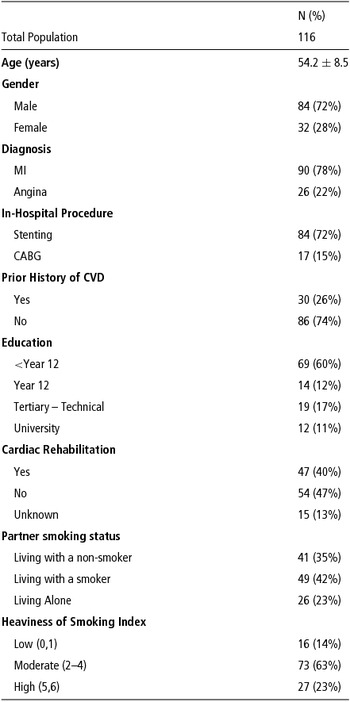
Study Population (Table 1)
One hundred and twenty-one individuals who were smokers immediately prior to hospitalisation were enrolled while in hospital. One was excluded from analysis because he was found to be smoking cannabis, not tobacco, and one died prior to the one-month follow-up. Three subjects had non-ischaemic diagnoses: pericarditis, myopericarditis, and alcoholic cardiomyopathy, and were excluded from the analysis. The remaining 116 who were seen at one month consisted of 84 men and 32 women. The average age was 54.2 ± 8.5 years. The final diagnosis was MI in 90 subjects and angina in 26. In-hospital procedures were stenting in 84 and coronary artery bypass surgery (CABG) in 17. Prior history of CVD included MI in 18, stent in 11 and CABG in four. Forty-seven subjects attended a cardiac rehabilitation program. At 12 months, we evaluated 113 subjects (82 men and 31 women), after we were unable to contact three participants.
Clinical characteristics

Predictors of Quitting (Table 2)
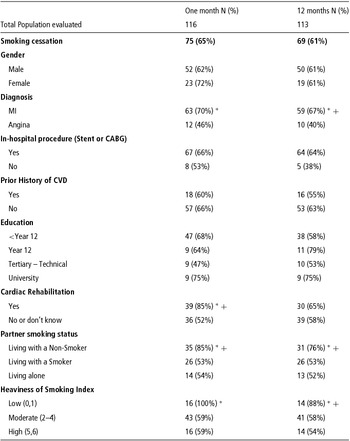
The self-reported quit rate at one month was 65% (75/116), and at 12 months was 61% (69/113). The determinants of quitting are shown in Table 2. There were no significant differences in quitting based on age or gender.
Clinical predictors of quitting smoking post hospitalisation for acute coronary syndrome

* = Univariate predictor; + = Multivariate predictor, p<0.05
Age was not a significant predictor. The average ages of those who quit were 54.2 and 54.2 years at 1 and 12 months, and the non-quitters were 54.2 and 53.8 years, respectively.
Diagnosis
There was a greater likelihood that the subject would not smoke if the diagnosis was MI rather than angina. This difference was significant in both univariate and multivariate analyses at 12 months, and as a univariate predictor at 1 month. Although subjects who had an in-hospital procedure (stent or bypass surgery) did not have a higher quit rate than those who did not have a procedure, those who had bypass surgery had a greater 1 month quit rate than those who had stenting alone [16/17 (94%) versus 51/84 (61%), p<0.05]. However, this difference in quit rate between those who had bypass or stenting was not seen at 12 months [10/17 (59%) versus 54/83 (65%)].
Prior history of CVD
There was no significant difference in likelihood of quitting if the subjects had a history of prior CVD.
Level of education
There were no significant differences in quit rate based on education, although the small number with university education had the highest quit rate, which was maintained at 12 months.
Cardiac rehabilitation attendance
Individuals were more likely to quit smoking at 1 month if they were among the 40% who attended a cardiac rehabilitation programme. However the higher quit rate was not maintained at 12 months. The patients who attended cardiac rehabilitation did not have a higher in-hospital level of intention, motivation or confidence in quitting than did non-attenders. The importance of smoking as a cardiac risk factor was mentioned during classes, but there was no formal mechanism for smoking cessation.
Partner smoking status
Subjects were more likely to be abstinent at both the 1 and 12 month follow-up, if they had a non-smoking partner versus if they had either a smoking partner or were living alone. This difference was significant in the multivariate models at both 1 and 12 months.
Heaviness of smoking index
A low index was associated with a greater likelihood of abstinence at both 1 and 12 months, including as a multivariate predictor at 12 months.
Smoking aids to quitting
Fifty-eight of the 75 (77%) who successfully quit at 1 month stated that they quit unaided, whereas only 17 (23%) used aids.
In-hospital attitudes to smoking cessation (Table 3)
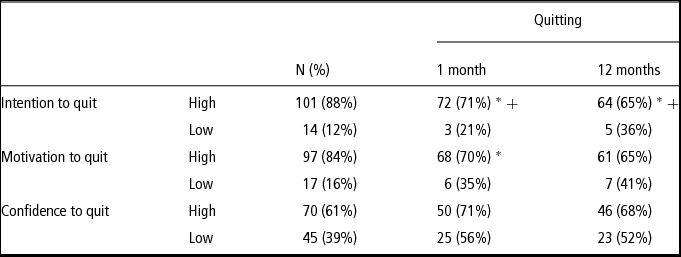
Most participants, while in hospital, expressed a high level of intention (88%) and motivation (84%) to quit smoking, whereas only 61% were very confident of quitting. A high level of intention to quit was significantly associated with increased quit rates at one and 12 months in the multivariate model, while a high level of motivation was only a univariate predictor of quitting at 1 month, and a high level of confidence did not significantly predict quitting.
In-hospital attitudes to quitting as predictors of quitting smoking post acute coronary syndrome
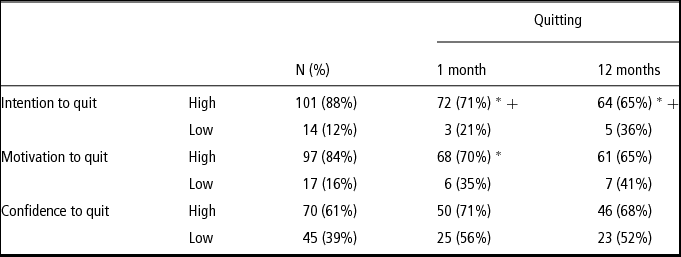
* = Univariate predictor of quitting; + = Multivariate predictor, p<0.05
N (number) and % of subjects who noted attitude as having a strong impact
(6,7 on 7 point Likert Scale). Low = 1–5
Motivators for quitting (Table 4)
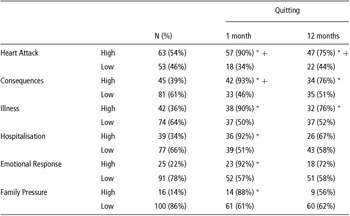
The most common motivators rated highly (6/7 on a 7-point Likert scale) by the participants for quitting while in hospital were having a heart attack (n = 63); the consequences of the hospital diagnosis (n = 45); the illness (n = 42); the hospitalisation (n = 39); the emotional response (n = 25); and family pressure (n = 16). At 1 month, high levels of all of these motivators were univariate predictors of abstinence, with the heart attack and consequences being significant multivariate predictors. However at 12 months, only the heart attack, its consequences and the illness were univariate predictors of abstinence, with the heart attack remaining as the sole predictor in the multivariate model.
In-hospital motivators as predictors of quitting smoking post acute coronary syndrome

* = Univariate predictor of quitting; + = Multivariate predictor, p<0.05
N (number) and % of subjects who noted the motivator as having a strong impact
(6,7 on 7 point Likert Scale). Low = 1–5 or did not complete.
Causes of relapse
The causes of relapse identified by participants who had initially quit but relapsed were stress (n = 14), environment (n = 10) and craving (n = 10).
Discussion
Hospitalisation with an acute coronary syndrome is a powerful stimulus for smoking cessation, with a 65% quit rate at 1 month that is maintained at 61% at 12 months. The majority of those who quit did so without medication or other aids. The high quit rates exceed those achieved with pharmacologic therapy, and support the powerful effect of the teachable moment in smoking cessation. While these findings are consistent with those previously reported (Smith et al., Reference Smith, Reilly, Houston-Miller, DeBusk and Taylor2002) our novel findings are that quitting and long-term abstinence were more likely if the diagnosis was a confirmed heart attack rather than merely angina. In addition, the subjects themselves identified the heart attack and the consequences of that diagnosis as important psychological motivators to quit whose impact persisted at 12 months. In contrast, the hospitalisation, emotional response and family pressure were the only significant predictors of quitting in the short term.
Lando showed that there was a greater likelihood that the hospitalised smoker would stop if a strong relationship was established between the disease and smoking (Lando et al., Reference Lando, Hennrikus, McCarty and Vessey2003). Other clinical scenarios have provided the opportunity for medical and nursing staff to opportunistically intervene with smoking cessation interventions. In many cases, these interventions have been particularly effective when the patient relates their diagnosis to their smoking behaviour (Lando et al., Reference Lando, Hennrikus, McCarty and Vessey2003; Lando, Reference Lando2006; Taylor et al., Reference Taylor, Houston-Miller, Killen and DeBusk1990; Smith et al., Reference Smith, Reilly, Houston-Miller, DeBusk and Taylor2002). Being mindful of the consequences of smoking increases the levels of intention and motivation to quit smoking. In our study, most patients reported high levels of intention and motivation to quit while in hospital, reinforcing the value of using the hospitalisation with acute coronary syndrome as a teachable moment. Sixty-one per cent were confident of quitting, but interestingly, level of confidence was not a significant predictor of quitting. Self-efficacy has been described as a determinant of smoking cessation outcome (Gwaltney et al., Reference Gwaltney, Metrik, Kahler and Shiffman2009; Marlatt & Donovan., Reference Marlatt and Donovan2005).
Although whether or not the participants had a cardiac procedure while in hospital had no overall impact on quitting, the subjects who had bypass surgery had a higher quit rate at 1 month than those who had coronary artery stenting. This finding might be influenced in part by the longer in-hospital stay for the surgical patients, since we found no difference in abstinence at 12 months. In contrast to our results, Crouse and Hagaman found that a higher quit rate was maintained at 1 year for patient following bypass surgery (55%) compared with angioplasty (25%) (Crouse & Hagaman, Reference Crouse and Hagaman1991). Shi and Warner reported that major non-cardiac surgery increased quit rates among smokers (Shi & Warner, Reference Shi and Warner2010)
While the focus of the present study was on the teachable moment of the heart attack, which was a significant multivariate predictor of abstinence at 12 months, we confirmed prior findings that smokers who had a non-smoking partner were more likely to quit and maintain abstinence long term than those who either had a partner who smoked or did not have a partner. This finding reinforces the importance of the home environment as a modifier of behavior (McBride et al., Reference McBride, Curry, Grothaus, Nelson, Lando and Pirie1998; Rohrbaugh et al., Reference Rohrbaugh, Shoham and Dempsey2009; Homish & Leonard., Reference Homish and Leonard2005). In our study, attending cardiac rehabilitation was also associated with a higher earlier likelihood of quitting, although this difference was not significant at 12 months. While the early influence of cardiac rehabilitation may be contributed to by patient education and group motivators, we cannot exclude that those who decided to attend cardiac rehabilitation were more predisposed to quit than those who did not attend rehabilitation. Addressing the causes of relapse among these patients after they complete their rehabilitation programmes should be considered. Education level has previously been found to correlate with smoking quit attempts and long term abstinence (Gilman et al., Reference Gilman, Martin, Abrams, Kawachi, Kubzansky, Loucks, Rende, Rudd and Buka2008) however education attainment was not a significant predictor in our study, where we saw good quit rates including among those who did not complete high school. The level of nicotine dependence has also been inversely related to the likelihood of quitting in hospitalised patients (Ong et al., Reference Ong, Cheong, Prabhakaran and Earnest2005). We found that low levels of nicotine dependence predicted both initial quitting and continued abstinence whereas Cosci reported a significant prediction at 12 and 26 weeks but not at 52 weeks (Cosci et al., Reference Cosci, Corlando, Fornai, Pistelli, Paoletti and Carrozzi2009).
The findings from this study, which support the importance of the heart attack and its consequences as components of the teachable moment, reinforce the value of incorporating these aspects in further study of the simulated teachable moment. Our initial evaluation of a personalised video that simulated the individual having a heart attack due to smoking with potential adverse consequences used these components, and resulted in comments such as ‘the video made me aware of the important things’ and ‘it felt very real’ and ‘that's me, that's me’ (May et al., Reference May, Tofler, Bartrop, Heinrich, Baird, Jozefiak and de Burgh2010).
Limitations
Smoking status was by self-report, which may underestimate smoking prevalence compared with cotinine levels (Gorber et al., Reference Gorber, Schofield-Hurwitz, Hardt, Levasseur and Tremblay2009). We cannot exclude the possibility that some clinicians imparted a stronger message regarding the need for smoking cessation than others. Information on previous quit attempts was not obtained, nor was there information on depression, which is quite common in cardiac patients, and may affect quitting success (Berlin & Covey, Reference Berlin and Covey2006). Furthermore, we cannot exclude the possibility that the relationship between living alone and lower likelihood to quit may have been contributed to by a greater level of depression among subjects living alone (Frasure-Smith et al., Reference Frasure-Smith, Lesperance and Talajic1995).
Conclusion
Hospitalisation with an acute coronary syndrome represents a strong teachable moment to stop smoking which was well maintained up to 12 months. The quit rate was greater when the more significant diagnosis of heart attack was made compared with that of angina, and most subjects quit without additional medication or aids. The presence of the heart attack and its potential consequences were the most commonly identified and sustained motivators for quitting. The study findings support the further investigation, characterisation and utilisation of the teachable moment in smoking cessation.
Acknowledgements
None
Financial Support
Funding support was provided by Heart Research Australia.
Conflict of Interest
A patent has been awarded for behaviour change through the simulated personalised teachable moment (Northern Sydney Central Coast Area Health Network and G. Tofler, NSW, Australia).
Ethical Standards
The authors assert that all procedures contributing to this work comply with the ethical standards of the relevant national and international committees on human experimentation and with the Helsinki Declaration, 2008.