Introduction
Animal droppings are known to be the primary source of nutrition for scarab beetles (Vinod and Sabu, Reference Vinod and Sabu2007). Through the utilization of dung, these beetles, directly or indirectly, facilitate important ecological functions: nutrient recycling, improving soil structure and water retention capacity, aiding in seed dispersal and controlling some vertebrate pests and parasites (Landin, Reference Landin1961; Richardson and Richardson, Reference Richardson and Richardson2000; Beaune et al., Reference Beaune, Bollache, Bretagnolle and Fruth2012). Previous studies on aspects of dung beetle ecology have demonstrated that individual dung beetle species exhibit preferences for particular habitats and dung types (Hanski and Cambefort, Reference Hanski and Cambefort1991; Halffter et al., Reference Halffter, Favila and Halffter1992; Martín-Piera and Lobo, Reference Martín-Piera and Lobo1996; Al-Houty and Al-Musalam, Reference Al-Houty and Al-Musalam1997; Medina et al., Reference Medina, Escobar and Kattan2002; Bogoni and Hernández, Reference Bogoni and Hernández2014). Many of these studies were carried out in man-modified landscapes, and were confined to using a limited range of habitats with a particular dung type, or vice versa. No single study has examined preferences of dung beetles in a wild and protected landscape encompassing a wide range of habitats that is home to a diverse array of free moving large mammal species. The tropical island of Sri Lanka supports an estimated 103 species of dung beetles (Kudavidanage and Lekamge, Reference Kudavidanage, Lekamge, Weerakoon and Wijesundara2012), and there are several protected areas within the country with the aforesaid features of habitat and animal diversity. We carried out the present study to investigate how preferences of dung beetles for habitat and dung types plays out in a protected area in a tropical environment with a mosaic of distinct habitat types and a diversity of large mammal species; and in so doing to test the hypothesis that, in these circumstances, habitat and food selectivity among the species of dung beetles would facilitate coexistence. Our study was restricted to the true dung beetles, i.e. those in the subfamily Scarabaeinae since they feed exclusively on dung (Arrow, Reference Arrow1931) and hence would be an ideal group to study dung preferences.
Materials and methods
Study site
The study was carried out in the Wasgomuwa National Park (7° 43′ 0″ N, 80° 56′ 0″ E), covering an area of 33,649 ha. It spreads across two administrative districts, Matale and Polonnaruwa, and is bordered by three rivers: Kalu Ganga, Amban Ganga and Mahaweli Ganga. This protected area falls within the ecoregion Dry Monsoon Forest, in the dry zone of Sri Lanka, where the annual rainfall is between 1,250 and 1,900 mm, and which is marked by a protracted dry period of several months prior to the rainy season from October to January. The mean temperature is 32°C throughout the year. Over much of the area the vegetation is closed canopy monsoon forest. However, mainly due to anthropological disturbances in the past, there are many areas with low, scrub vegetation, as well as areas with only a grass cover. Alongside the many watercourses flowing across the park there is a dense riverine vegetation cover, as well as sandy banks. Animal life in the park includes several species of large mammals selected for the present study. This National Park, therefore, presented an ideal location for studying the food and habitat preferences among dung beetle species that feed on animal droppings.
Selected habitat and dung types
Five distinct habitat types were selected: (1) Closed canopy forest with trees reaching a height of 30 m and with sub-canopy layers of smaller trees and shrubs; (2) Riverine: narrow strips of thick vegetation along river banks, with some tall trees of up to 30 m, characterized by loose, moist soil and a relatively thick litter cover; (3) Bank: wet sandy soil with no vegetation or with small grassy patches; (4) Scrub: thorny scrub vegetation with trees usually below 3 m, and (5) Grass: largely open areas dominated by grass and containing scattered trees. To investigate dung preference, we selected five large-mammal dung types: (1) leopard, (2) cervid (deer and sambur), (3) elephant, (4) bear, and (5) buffalo.
To ensure that dung was fresh, we collected all dung samples, with the exception of that of the buffalo and bear, from the National Zoological Gardens, Dehiwala, Sri Lanka, on the day prior to laying out the traps. Fresh buffalo and bear dung were collected from the study area because buffaloes were not held in captivity and bear in captivity were fed on a diet that differed from that in the wild. In both instances, the dung was thoroughly inspected before use to ensure the absence of beetles.
Experimental design
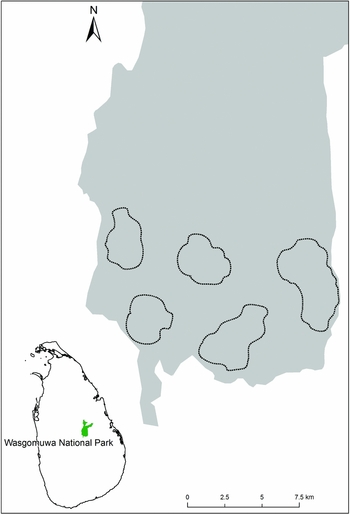
Five areas were selected for sampling, spread across the southern section of the park (Fig. 1) and separated from each other by at least 25 km. In each area, five habitat patches, i.e. forest, riverine, bank, scrub, and grass, each separated by a distance of at least 2 km, were randomly selected. Within each habitat patch, with the exception of four instances where the trap spacing was down to 10 m (due to the small extent of these patches), we maintained a trap spacing of between 40–50 m (in accordance with Larsen and Forsyth, Reference Larsen and Forsyth2005; Vinod and Sabu, Reference Vinod and Sabu2007; Sabu et al., Reference Sabu, Vinod, Latha, Nithya and Boby2011; Noriega, Reference Noriega2012) to prevent direct influence of the odour of one dung type acting upon another.
Map showing the five sampling areas within the southern part of the Wasgomuwa National Park. The location of the park is shown on the sketch of Sri Lanka.

Transparent plastic cups of 200 ml were compacted with the selected dung. The cups, buried to the rim at soil level, and left well camouflaged (Laub et al., Reference Laub, Youngman, Love and Mize2009), were used as pitfall traps. This non-destructive sampling method was used because killing within the protected area was forbidden. Five traps, each baited with one of the five different dung types, were placed within each selected habitat patch. This design allowed for 125 pitfall traps, i.e. a particular habitat/dung type would have a total of 25 traps. Trapping was conducted from April to September 2012, during the dry season. Traps were kept open for 24 hr, collected into sealed bags by instantly covering the trap and retaining beetles within the trap and any immediately outside. This procedure was consistent across all habitats and dung types. The sealed bags were then transported to the field laboratory for sorting. Identification of the beetles was based on Arrow (Reference Arrow1931). Beetles were sacrificed only in the few cases where field identification was not possible.
Data analysis
The Shannon–Wiener diversity index (H’= −∑ (P i * lnP i )), where P is the proportional abundance of each of the dung beetle species (Zar, Reference Zar1984), was calculated for each habitat and dung type. The Levins measure of niche breadth (B = 1/∑P i 2) and the standardized niche breadth index (BA = (B − 1)/(n − 1)) (as used by Manly et al., Reference Manly, Mcdonald and Thomas1993 and Mueller and Altenberg, Reference Mueller and Altenberg1985), where P is the proportion of individuals using resource i, and n is the total number of resources considered, were used to compare resource selection by the dung beetle species. In this index, on a scale of zero to one, a value close to zero would indicate a high degree of specialization while a value close to 1.0 would indicate generalization in terms of resource use. Here, we utilize these indices to compare specialization of the dung beetle species that recorded over five individuals in the present study. At the community level, niche overlap of the species assemblages in the different habitat or dung types was examined using the Proportional Overlap (C) as given by Colwell and Futuyma (Reference Colwell and Futuyma1971), where C ih (proportional overlap between the two resources i and h) is calculated using C ih = 1–1/2 ∑ |p ij − p hj |. Here, p ij is the proportion of individuals of species j using resource i and p hj is the proportion of j for the resource h. A niche overlap value of zero indicates no overlap whilst a maximum of one indicates that resources share the same community. Also, Macarthur and Levins (Reference Macarthur and Levins1967) and Pianka (Reference Pianka1973) propose that coexistence is not possible with a niche overlap value of greater than 0.6.
Results
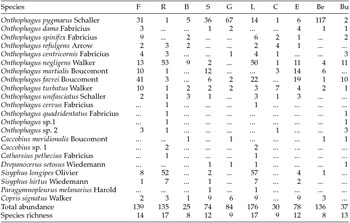
A total of 457 beetles belonging to 22 species and representing seven genera of the subfamily Scarabaeinae were recorded (Table 1). Of these, two species of Onthophagus and one of Caccobius could not be identified to species level. The rarefaction curve drawn between the species richness of dung beetles and sampling effort indicated an asymptote between 20–25 species, suggesting that the sampling intensity for the entire study was adequate.
Abundance of the true dung beetle species recorded, by habitat and dung type, in the Wasgomuwa National Park (n = 125 pitfalls). F – forest, R – riverine, B – bank, S – scrub and G – grass, L – leopard, C – cervid, E – elephant, Be – bear and Bu – buffalo

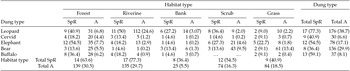
Analyses of the results showed significant differences across habitat types for species richness of dung beetles, but not for total abundance (one-way ANOVA: species richness: F = 3.34, P < 0.05; abundance F = 1.69, P > 0.05). The highest species richness of dung beetles was recorded in the riverine habitat (77% of the species) while bank and grass habitats were relatively species poor (36% in bank and 40% in grass). Moderately high numbers of species were recorded in the forest and scrub habitats. Abundance across habitats, although not significantly different, showed that forest and riverine habitats contained high numbers, grass and scrub moderate numbers, and banks low numbers (Table 2). Shannon–Wiener diversity index values decreased in the order: riverine (2.6), forest (2.5), scrub (2.4), bank (1.9) and grass (1.7).
Species richness (SpR) and abundance (A) of true dung beetles in the five selected habitat and dung types recorded from the pitfall traps (n = 125). The percentages (of the totals of 22 species/457 individuals) are given in parentheses

Across the dung types, there was a significant difference in the scarabs in terms of both species richness and abundance (one-way ANOVA: species richness: F = 4.09, P < 0.05; abundance: F = 0.02, P < 0.05). The leopard dung showed the highest values both for species richness (77%) and abundance (39%). Bear dung supported the lowest species numbers (36%), while the lowest abundance was in buffalo dung (3%). Diversity index values for the dung types decreased in the order: elephant (2.1), leopard (1.8), cervid (1.7), buffalo (1.6) and bear (0.7).
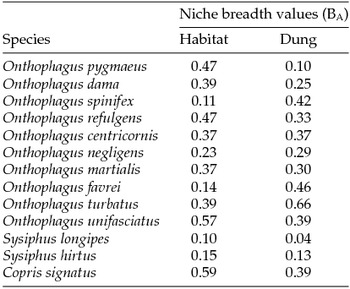
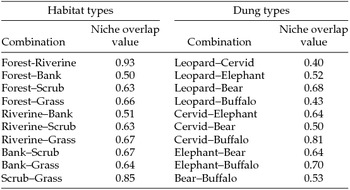
At the level of the individual species, it is noteworthy that none of the dung beetles was exclusively restricted to a particular habitat or dung type, with all species utilizing at least two types of both habitat and dung (Table 1). Nevertheless, some degree of specialization was evident when niche breadth values are considered (Table 3). Making a reasonable assumption that a value of 0.25 or below would indicate some degree of specialization in using habitat or dung types, three species (Onthophagus spinifex Fabricius, Onthophagus negligens Walker and Onthophagus favrei Boucomont) are habitat specialists while two (Onthophagus pygmaeus Schaller and Onthophagus dama Fabricius) are dung specialists. Interestingly, two others (Sisyphus longipes Olivier and Sysiphus hirtus Wiedemann) are both habitat and dung specialists. Niche overlap values (Table 4) conform to the expectation that, at the community level, greater overlap should be between assemblages in similar habitat types (e.g. forest–riverine; grass–scrub) and dung types (e.g. cervid–buffalo), than between dissimilar ones (e.g. forest and bank; leopard and cervid). This would, at least in part, be due the specificity in the use of different habitat and dung types by the majority of the dung beetle species (as indicated by the relatively low niche breadth values), providing support for the set out hypothesis.
Levin's standardized niche breadth (BA) values (on the scale of zero to one) for the two variables habitat and dung for 13 of the dung beetle species recorded in this study. (A value of one would indicate no specialization while a value of 0.25 and below was taken to indicate some degree of specialization.)

Niche overlap values (on the scale of zero to one) for dung beetle communities between pairs of habitat and dung types. (A value of one would suggest complete overlap while a value of zero would suggest no overlap.)

Discussion
Previous studies on food and habitat preferences of dung beetles, by exposure to different habitats or different dung types, within a restricted range in each case, have indicated habitat and dung selectivity (e.g. Vinod and Sabu, Reference Vinod and Sabu2007; Noriega, Reference Noriega2012). The present study is the first of its kind intended to gather information on the extent and ways in which food and habitat selectivity by dung beetles show up in a wild setting with a combination of habitat types and an array of large mammal species.
Considerable differences in the utilization patterns of true dung beetles was evident in respect of both the habitat and dung variables, and there are a number of habitat features that could account for this. For instance, the greater variety and density of large mammal fauna in forest and riverine vegetation compared to scrub and grass (Department of Wildlife Conservation, Sri Lanka, 2008), by providing a greater diversity and availability of resources, would be an important factor in accounting for the relatively rich communities of dung beetles found in forest and riverine vegetation in comparison to the scrub and grass. Another feature is the shade and cool conditions within the forest and riverine vegetation, in comparison to exposed bank, scrub and grass, which would make the former habitats more attractive to the dung beetles (Vinod and Sabu, Reference Vinod and Sabu2007). Additionally, bank, scrub and grass are exposed to higher temperatures and light levels, and crust formation in exposed dung pats would be more rapid here than in the other two habitats. The effect would be to reduce the time interval during which the former habitats are available to the beetles while also increasing adult and larval mortality (Klein, Reference Klein1989; Galante et al., Reference Galante, Mena and Lumbreiras1995; Duraes et al., Reference Duraes, Martins and Vaz-De-Mello2005). Vegetation characteristics also directly affect the choice of habitats by scarabs (Halffter and Mathews, Reference Halffter and Mathews1966; Hanski, Reference Hanski1981; Hanski Reference Hanski, Slanky and Rodriguez1987). In this case, forest and riverine habitats which lack thick ground cover, unlike the grass and scrub, may, for this reason, provide easier access to the beetles and aid in maneuverability, as suggested by Al-Houty and Al-Musalam (Reference Al-Houty and Al-Musalam1996) and Medina et al. (Reference Medina, Escobar and Kattan2002). As soil characteristics also affect the burrowing behaviour of dung beetles (Hanski and Cambefort, Reference Hanski and Cambefort1991; Davis, Reference Davis2000), the moist soil of forest and riverine habitats will be preferred to grass or scrub habitats.
The present study has divulged trends in dung preferences among the scarab beetles. Two of the important factors that are said to influence dung selection among beetles is the nutritional status of the resource (Ridsdill-Smith, Reference Ridsdill-Smith1986) and its odour (Wille et al., Reference Wille, Fuentes, Orozco and Soleis1974; Al-Houty and Al-Musalam, Reference Al-Houty and Al-Musalam1996; Finn and Giller, Reference Finn and Giller2002). It is possible that these were contributing factors in the present study. A noteworthy fact in this regard is that the leopard dung harboured a richer and larger community of dung beetles than the other four tested dung types. The leopard, being a carnivore, excretes more nitrogenous matter in comparison to the herbivores (Al-Houty and Al-Musalam, Reference Al-Houty and Al-Musalam1997), and resources high in nitrogen benefit dung beetles by increasing their reproductive performance (Davis, Reference Davis1989; Cambefort, Reference Cambefort, Hanski and Cambefort1991). Leopard dung would also act as a more powerful bait due to its stronger odour. A plausible explanation for the high diversity of scarabs in elephant dung, despite its lower nutritional value, is its greater availability in terms of volume in the forest in comparison to those of the other large mammals considered here. A previous study has shown that dung of omnivorous mammals was the most attractive to all dung beetle species in comparison to herbivore and carnivore dung (Bogoni and Hernández, Reference Bogoni and Hernández2014), which was not observed in the present study. This could be explained as being due to the high variability of the diet ranging from being herbivorous in one season to carnivorous in another, depending primarily on the available food resources.
Individual species varied in their extent of selectivity in respect of habitat and dung types as evident from the niche breath values obtained in this study. The majority of the scarabs had low niche breath values showing either habitat and/or dung selectivity. Examples are the habitat specialists O. spinifex, O. negligens and O. favrei; the dung specialists O. pygmaeus and O. dama; and the habitat and dung specialists S. longipes and S. hirtus.
Niche overlap values for dung beetles provide evidence for the basic premise that similar resources would support similar faunal communities. Previous studies (Department of Wildlife Conservation, 2008; Hewavithana, Reference Hewavithana2013) have reported that forest and riverine sites show similarities in terms of biotic and abiotic parameters such as the presence and extent of canopy cover, understory vegetation and litter cover, ambient temperature, humidity, wind velocity, soil temperature and soil moisture, and so also do grass and scrub. As expected, the present study shows that there is a high degree of overlap in the dung beetle communities between the two habitat types in each case. On the other hand, habitats with sharply different conditions had low overlap in the dung beetle communities. Interestingly, similar trends are evident for dung types. In the present study, a high degree of overlap was observed between ‘cervid and buffalo’ and between ‘elephant and buffalo’. Since the species are generalist herbivores, their dung could be expected to share similar communities of beetles. At the other extreme, Noriega (Reference Noriega2012) has reported a low overlap between dung beetle communities in the dung of two closely related monkey species (Lagothrix lagotricha and Alouatta seniculus), and this has been attributed to the highly specialized diet of each of these species. This would also support the premise that dung of animals having contrasting food habits would have a low possibility of sharing dung beetle communities. The values obtained for overlap are in agreement with this view as seen in the case of the ‘elephant and leopard’ and ‘cervid and leopard’, where one is an herbivore and the other a strict carnivore. The bear being an omnivore would be expected to have moderate levels of overlap with dung beetle communities inhabiting carnivore and herbivore dung, which was the case in the present study.
Resource utilization patterns exhibited by species are a trade-off between resource availability and their specific requirements (Santoro et al., Reference Santoro, Polidori, Asís and Tormos2011). In the present study, the niche breadth values of most of the species of dung beetles for habitat and dung were towards the lower end of the range indicating some degree of specialization, while the niche overlap values indicated that different habitat and dung types support dissimilar communities of dung beetles. It has been reported that specialization in dung beetles could be the result of reduced dung availability (Halffter and Matthews, Reference Halffter and Mathews1966; Davis and Sutton, Reference Davis and Sutton1997; Howden and Young, Reference Howden and Young1981). Thus, the specialization shown by individual species in this study supports the hypothesis set out that, while dung is perhaps a scarce resource (Vinod and Sabu, Reference Vinod and Sabu2007), partitioning it in terms of habitat and dung type could be a key mechanism which facilitates the coexistence of the rich community of scarab beetles in this park.
Conclusion
The present study carried out in a tropical monsoon forest of Sri Lanka, with a mosaic of habitat types and a range of large-mammal species, provides evidence of a relatively high degree of specificity in food and habitat selection as shown by the partitioning of these two resources by the diverse community of scarab beetles. Although there was some degree of overlap in the use of habitats and dung, many of the species preferentially used a selected range of both these variables, leading one to conclude that this is an important factor in enabling the coexistence of the dung beetle species in a wild tropical landscape.
Acknowledgement
Financial assistance from the University of Colombo, Sri Lanka, is acknowledged.