INTRODUCTION
The French language has pervasive phonological processes that cross word boundaries, i.e. sandhi phenomena. One such process is liaison which, as traditionally described, involves ‘latent word-final consonants surfacing phonetically before a vowel-initial word’ (Booij & De Jong, Reference Booij and De Jong1987: 1005). These latent consonants are associated with the preceding word in the collocation, often a grammatical or function word. These consonants would not be pronounced unless the following word is vowel initial. Most often, the result of liaison is the pronunciation of vowel-initial words with a consonant-initial syllable (Encrevé, Reference Encrevé1988). Thus, French-learning children would hear the word ami [ami] ‘friend’, pronounced alternatively as [nami] or [zami] inter alia, depending on the collocation frame, e.g. un ami [ .nami] ‘a friend’, les amis [le.zami] ‘the friends’. The related phenomenon of elision involves the lack of production of a schwa that usually appears in a function word (e.g. de [də] or le [lə]) before a vowel-initial word and the result is also the production of consonant-initial syllable (e.g. compare le garçon [lə.gaʁsõ] with l'ami [lami]Footnote 1). Liaison and elision in French may complicate children's ability to parse individual word roots because by operating across word boundaries it increases the number of phonological variants for a given word, and may render word boundaries opaque (see Nardy (Reference Nardy2003) for discussion). Liaison is lexically constrained or limited in productivity rather than applying across the board (Booij & De Jong, Reference Booij and De Jong1987; Bybee, Reference Bybee2001a), and thus infants cannot rely on liaison for regular phonotactic cues to infer word boundaries (cf. Saffran, Reference Saffran2001). This raises the question of how children come to understand that the word root is [ami] and, in turn, can use the root in novel collocations with the appropriately liaised consonant. That liaison is a challenge for young learners of French is evidenced by research showing that children do not completely master obligatory liaison until around six or seven years of age (Chevrot, Dugua & Fayol, Reference Chevrot, Dugua and Fayol2009; Nardy, Reference Nardy2003; Wauquier-Gravelines, Reference Wauquier-Gravelines2005). The present article focuses on the acquisition of liaison/elision within a constructivist framework, based on Bybee (Reference Bybee2001a; Reference Bybee, Bybee and Hopper2001b), and consistent with Chevrot et al. (Reference Chevrot, Dugua and Fayol2009) . We tested whether factors like frequency of collocation frame and semantic associations influenced children's abilities with liaison/elision. These data allowed us to replicate previous studies that outlined a developmental sequence in children's accuracy with liaison in production (e.g. Chevrot, Dugua & Fayol, Reference Chevrot, Dugua and Fayol2005; Dugua, Reference Dugua2002), and to determine whether development was more closely linked with age or vocabulary growth.
Before presenting our particular research questions and methods, we will first describe the process of liaison and elision in French and prior research on the acquisition of liaison. In the final section of this ‘Introduction’, we discuss constructivist approaches to phonological development and to the adult lexicon regarding liaison and elision.
Liaison and elision in French
As noted above, liaison is the production of an implicit word-final consonant from one word as the syllable onset of the next word when that second word is vowel-initial (Ayres-Bennett & Carruthers, Reference Ayres-Bennett and Carruthers2001; Klausenburger, Reference Klausenburger1984); compare (1a) and (1b). Elision is the omission of a schwa from a function word before a vowel-initial word, which results in the syllabification of the remaining consonant with the vowel, as in liaison (Tranel, Reference Tranel, Parodi, Quicoli, Saltarelli and Zubizarreta1996; compare (1c) and (1d)). Liaison and elision can occur in a variety of syntactic contexts, such as on the onset of a verb or a noun. For example, see the liaisons in (1a), (1e) and (1i) and the elisions in (1c) and (1f). Liaisons and elisions do not occur in all possible contexts meeting the basic phonological description. Researchers have noted that some liaisons seem to be obligatory, as between the determiner and the noun as in (1e) (Morin & Kaye, Reference Morin and Kaye1982). Other liaisons are optional, such as between a prenominal adjective and a noun, (1g) (Ågren, Reference Ågren1973; Morin & Kaye, Reference Morin and Kaye1982; Sampson, Reference Sampson2001). The optional liaisons are more likely to be produced in a formal context or by upper-class and/or highly educated people (Ågren, Reference Ågren1973; Encrevé, Reference Encrevé1988; Morin & Kaye, Reference Morin and Kaye1982). Invoking a scalar interpretation of obligatoriness, Bybee (Reference Bybee2001a; Reference Bybee, Bybee and Hopper2001b) notes that liaison is more likely to be optional for collocations occurring with low frequency in the language. In other instances, liaison is unlikely to occur, as in (1h), even though the liaison in the apparently analogous idiomatic expression (1i) is obligatory (Booij & De Jong, Reference Booij and De Jong1987; Klausenburger, Reference Klausenburger1984; Morin & Kaye, Reference Morin and Kaye1982).
- (1)
a Il est allé à la plage. [ɛ.tale] ‘he went to the beach’
b Il est parti à la plage. [ɛ.paʁti] ‘he left for the beach’
c Elle vient d'aller à la plage. [vi
 .dale] ‘she just went to the beach’
d Elle vient de rentrer de la plage. [vi
.də.ʁtʁe] ‘she just came from the beach’e J'ai un enfant. [
.nf] ‘I have a child’f J'ai beaucoup d'enfants. [boku.d
f] ‘I have many children’g J'ai un fin enseignant. [f
.seɲ] ‘I have a nice teacher’h Comment avez-vous su? [kɔmã.ave] ‘how did you[PL] know?’
i Comment allez-vous? [kɔmã.tale] ‘how are you[PL]?’
 .dale] ‘she just went to the beach’
 .də.ʁ
 tʁe] ‘she just came from the beach’
 .
In this article, we were interested in testing children's knowledge of liaison and elision with familiar words. To do this, we chose familiar vowel-initial nouns. The rest of our discussion will focus on liaison and elision with vowel-initial nouns.
Vowel-initial nouns make up a minority of nouns that children are likely to hear (Bybee, Reference Bybee2002). French nouns are almost always preceded by a determiner, with or without an intervening quantifier or a prenominal adjective (Fortin & Crago, Reference Fortin, Crago, Taylor and Leonard1999). Some examples of liaised and elided contexts in which the citation form ami [ami] could occur are listed in (2). Note that there are many different forms of the same word: [nami] (2a, 2d), [lami] (2b), [zami] (2c, 2e), [dami] (2f) and [tami] (2g), in addition to the citation form [ami]. In fact, the citation form of vowel-initial nouns rarely occurs, except following unchanging vowel-final prenominal adjectives such as joli (2h), following low-frequency prenominal adjectives such as fin (Sampson, Reference Sampson2001) and when calling out to something/someone (e.g. yelling Ami! Ami!; see Dugua, Reference Dugua2002). In most of the cases in (2), the liaison or elision is obligatory, with the exception of (2g), in which the liaison is optional (see Dugua, Reference Dugua2002; see also Booij & De Jong (Reference Booij and De Jong1987) for discussion).
- (2)
a un ami [
.nami] ‘a friend’ (liaison)b l'ami [lami] ‘the friend’ (elision)
c les amis [le.zami] ‘the friends’ (liaison)
d mon ami [m
.nami] ‘my friend’ (liaison)e deux amis [dø.zami] ‘two friends’ (liaison)
f beaucoup d'amis [boku.dami] ‘many friends’ (elision)
g un petit ami [
pəti.tami] ‘a little friend’ (literal) (liaison)h un joli ami [
Ʒoli.ami] ‘a pretty friend’
 .nami] ‘my friend’ (liaison)
Number is marked on the determiner in French, e.g. les vs. le/la, rather than on the noun, so note that the word-final written s on nouns is silent (amis in (2c), (2e) and (2f) is pronounced [ami], the same as in the other examples in (2)). Liaised and elided forms can be more or less reliably linked with number in French. For example, liaised forms with [z] are often plural while liaisons with [n] and elisions with [l] are usually singular (see also Morin & Kaye (Reference Morin and Kaye1982), who argue that [z] can be a number marker for some adjectives; examples in Armstrong (Reference Armstrong2001) would support that interpretation). This distributional link between a particular liaised consonant and number plays a role in our research questions, stated below.
Children's acquisition of liaison
Liaised forms clearly pose a parsing challenge for French-speaking children in the preschool years. Mis-parsed forms have been observed in children's spontaneous speech (Chevrot & Fayol, 2001, as cited in Chevrot et al., Reference Chevrot, Dugua and Fayol2005), including errors like that of a four-year-old girl of our acquaintance who said un beau narbre [.bo.naʁbʁ] ‘a beautiful tree’, suggesting that in her lexicon, arbre was a consonant initial word narbre, possibly due to her hearing un arbre [.naʁbʁ] ‘a tree’ in the input. In this section, we present a roughly ordered developmental sequence, based on the previous literature.
Chevrot et al. (Reference Chevrot, Dugua and Fayol2005) argued that children might initially start out producing liaised forms with the liaison consonant chunked at the beginning of the word, i.e. they assume that the words are consonant-initial. However, the evidence to date suggests that if such chunking occurs, it may be short-lived. When children have had little exposure to liaised words, they sometimes seem to mis-parse the liaised consonant as the initial consonant of the word (Morel, Reference Morel1994; see Chevrot et al., Reference Chevrot, Dugua and Fayol2005). Dugua (Reference Dugua2002; Reference Dugua2005) taught two- to six-year-old children vowel-initial novel words as the names of novel animals. She presented the novel words in collocations with either the determiner des ‘some’ or un ‘one’, prompting liaison (e.g. des aras [zaʁa] ‘some aras’, un aras [naʁa] ‘one aras’), and tested how they produced the novel word with the other determiner. She showed that the youngest children were more likely to include the initial [z] or [n] even with a change in determiner (e.g. des [n]aras [de.naʁa]) than the older children. In another task with the same group of children, Dugua (Reference Dugua2002; Reference Dugua2005) asked the children to call to different animals, some with vowel-initial names (like âne ‘donkey’). As noted earlier, adults would not produce a consonant liaison with a vowel-initial word in this context because there is no preceding word. The youngest children in Dugua's study produced an average of 35% of the vowel-initial real words with a consonant that could have originated from input collocations with liaison (e.g. nâne [nɑn] instead of âne [ɑn]). In contrast, the oldest children almost always pronounced the words with an initial vowel. In that task, most of the children's productions at all ages were vowel-initial. Taken together, these results suggest that French-speaking children do occasionally mis-parse words because of liaison, although even two-year-olds alternate between chunking, zero liaison (i.e. vowel-initial words) and correct liaison.
Furthermore, even by two years of age, French-speaking children show sensitivity to the frequency of liaison within collocations between the target noun and a preceding word (hereafter ‘the collocation frames’). This sensitivity is evident in young children's production of liaison depending on the obligatoriness. Dugua (Reference Dugua2002; Reference Dugua2005) showed that two- to six-year-old children produced the correct liaison consonant more often than an incorrect liaison consonant when uttering vowel-initial words preceded by un ‘one/a’, deux ‘two’, petit ‘little’ and gros ‘big’. All the children were more likely to produce the correct liaison consonant for obligatory co-occurrence frames (i.e. un and deux) than for optional co-occurrence frames (i.e. petit and gros). Dugua (Reference Dugua2002; Reference Dugua2005) assumed that the difference between the obligatory and the optional frames was an accurate representation on the part of the child's experience. In other words, because liaison consonants are not always produced following petit and gros, children are less likely to produce them. Still, it seems clear that children's production of liaison consonants is sensitive to collocation frames from the age of two years on. Note that Dugua (Reference Dugua2002; Reference Dugua2005) argued that the results are due to the obligatoriness of the liaison, although the optional frames are probably lower in frequency than the obligatory frames (cf. Bybee, Reference Bybee, Bybee and Hopper2001b).
Somewhere between three and five years of age, children seem to develop an abstract or productive understanding of liaison (Chevrot et al., Reference Chevrot, Dugua and Fayol2009; Chevrot, Chabanal & Dugua, Reference Chevrot, Chabanal and Dugua2007; Chevrot et al., Reference Chevrot, Dugua and Fayol2005; Wauquier-Gravelines, Reference Wauquier-Gravelines2005), as evidenced by their overgeneralizations of liaison to contexts in which they have never heard it. For example, children make errors by parsing [z]- and [n]-initial words (like zèbre ‘zebra’ and nombril ‘belly button’) as if the root started with a vowel. As a result, children produce novel liaised forms like un [n]èbre [.nɛbʁ] (target: un zèbre) or deux [z]ombrils [dø.z bʁi] (target: deux nombrils; see Chevrot & Fayol, 2001, as cited in Chevrot et al., Reference Chevrot, Dugua and Fayol2005). Further evidence of productive use of liaison comes from Dugua (Reference Dugua2002; Reference Dugua2005). She showed that by five to six years of age, children could produce the appropriate liaison consonant for the determiner after hearing a novel vowel-initial word only once with a different liaison consonant (see also Morel, Reference Morel1994).
In sum, young children sometimes mis-parse vowel-initial words with which they have little experience (Chevrot et al., Reference Chevrot, Dugua and Fayol2005). By the age of two years, French-speaking children produce some mis-parsed words, some correct liaisons and some zero liaison (i.e. vowel-initial words). With increasing exposure to French, children abstract and apply general rules or patterns about liaison (Chevrot et al., Reference Chevrot, Dugua and Fayol2009; Reference Chevrot, Dugua and Fayol2005). The obligatoriness (or frequency) of the collocation frame influences this developmental sequence (Dugua, Reference Dugua2002; Reference Dugua2005).
Toward a constructivist account of the acquisition of liaison
We adopt Bybee's (Reference Bybee2001a; Reference Bybee, Bybee and Hopper2001b) model of the lexicon in general, and her account of liaison in particular, as the framework for this study (see also Chevrot et al., Reference Chevrot, Dugua and Fayol2009; Chevrot et al., Reference Chevrot, Chabanal and Dugua2007). Previous rule-based accounts of French liaison have failed to account for a variety of contexts in which liaisons occur and do not occur (e.g. Booij & De Jong, Reference Booij and De Jong1987; Bybee, Reference Bybee, Bybee and Hopper2001b; Durand & Lyche, Reference Durand and Lyche2008; Klausenburger, Reference Klausenburger1984; Morin & Kaye, Reference Morin and Kaye1982). Bybee's model is consistent with usage-based or constructivist theories of acquisition (e.g. Tomasello, Reference Tomasello2003). We use the term ‘constructivist’ to describe the conceptualization of both the adult and child lexicon. We begin by outlining Bybee's constructivist model of liaison, specifically with nouns in the adult French lexicon, and then we discuss implications for acquisition.
Liaison/elision in the adult lexicon
Bybee (Reference Bybee2001a; Reference Bybee, Bybee and Hopper2001b) argues that liaison is not a general phonological rule in the modern French language, but instead is a process instantiated within particular constructions in the lexicon. We have already presented some of the evidence supporting this claim above. In Bybee's model, the construction is the basic unit of storage in the lexicon, rather than individual content words and bound morphemes. Constructions range in generality from fixed phrases like [c'est-à-dire] ‘that is to say’ to semi-general constructions with one open slot and grammatical material like [les+NOUN]definite plural ‘the nouns’, to the most general phrases with two open slots, like [DETERMINER+NOUN]. Note that the second construction is a subset of the third, more general construction, which in Bybee's (Reference Bybee, Bybee and Hopper2001b) terms, means it is a more specific construction. General and specific constructions emerge in the speaker's lexicon from frequently occurring collocations of words, and there can be concurrent layers of abstractness or generality, as the examples [les+NOUN]definite plural and [DETERMINER+NOUN] illustrate. Constructions vary in their productivity, leading to variation in real language use. Productivity of a construction is determined by token and type frequency. Token frequency refers to how often that particular collocation of words and their semantic features appear together. For example, if the word arbre ‘tree’ appears more often in the construction les arbres ‘the trees’ than in the construction un arbre ‘a tree’, the former construction has a higher token frequency, and thus would have greater lexical strength and would be accessed more quickly and easily by speakers. For constructions with one or more open slots, type frequency is the most important consideration for productivity. The more different collocations speakers experience fitting the construction schema [les+NOUN]definite plural, the higher the type frequency of this construction in the lexicon and the greater its productivity in the language as a whole. In the case of collocations involving function words for which sandhi phenomena occur, such as liaison and elision, different schema types are stored, one more general, e.g. [le+NOUN]definite plural, and one more specific, e.g. [[l]−[vowel]-NOUN]definite plural (Bybee, Reference Bybee2001a; Reference Bybee, Bybee and Hopper2001b).
An important point to make is that the construction schemas are product-oriented, not source-oriented, in Bybee's model. What this means is that schemas are like well-formedness conditions on output forms, without specification of what the input should be. This assumption leads to two effects important for our purposes. First, there is no derivation involved in the creation of output forms, so the processes of elision and liaison do not differ substantively on this approach. In other words, it is not the case that elision is conceived of as a two-step process of schwa deletion followed by resyllabification while liaison is conceived of as a one-step process of resyllabification. Both liaison and elision are collocation-embedded output forms. Second, more general constructions could, in principle, be applied where more specific ones exist. Bybee (Reference Bybee2001a) argues that the more general construction may be used more often, and this can result in the more specific construction being used infrequently by speakers, or lost completely from a language over time. Since the constructions with liaison and elision are, by definition, more specific, and apply to vowel-initial nouns which are less numerous in the language, they are fragile, and thus processes such as liaison and elision would be unevenly distributed throughout contemporary French speech, as is attested in the research cited above.
A final important point concerns the internal structure of the lexicon as a whole on this approach. As mentioned above, Bybee's model of the lexicon includes constructions as the basic organizing unit of storage, with phonological and semantic features defining the individual content words and constructions. An additional feature of this model is the assumption that multimorphemic words are also stored as wholes, and thus the lexicon is not broken down into roots and bound morphemes, joined by source-oriented concatenation rules. Morphological ‘rules’, such as adding -ed to make the past tense, are conceptualized as schemas, emerging on the basis of type frequency across numerous verb+ed phonological–semantic sequences in the lexicon. As we noted above, there is a strong correlation in French between the presence of the [n] as a liaised consonant and singularity, and [z] and plurality; particularly [z] because it has multiple sources, deux, les, des, ces, etc. It is possible that young French-learning children might develop a morphological schema for the plural that includes a [z] prefix, in addition to developing the construction schemas with numbers, quantifiers and determiners. In other words, it is possible they assume that liaison is a morphophonological phenomenon with semantic features involved, rather than a purely phonological part of a series of constructions with nouns. One variable that has not been studied is whether French-learning children show signs of attributing semantic content to the process of liaison. Accordingly, we examine this possibility in the present study.
A constructivist account of the acquisition of liaison/elision
Bybee's (Reference Bybee2001a; Reference Bybee, Bybee and Hopper2001b) model of liaison in the adult French lexicon is not, strictly speaking, an acquisition model; however, Bybee (Reference Bybee1995; Reference Bybee2002), discusses how her model of the lexicon in general is consistent with a usage-based or constructivist approach to acquisition. In Tomasello's (Reference Tomasello2003) usage-based theory of acquisition, constructions are also the main organizing unit for vocabulary and grammatical acquisition, and this approach has been extended to explain the early stages of segmental phonological acquisition in Vihman (Reference Vihman2002) . Essentially, in this approach, acquisition proceeds from units stored very specifically, i.e. as children have parsed them from the speech stream, to a linguistic system consisting of numerous abstract schemas for phonological, morphological and syntactic constructions. Frequency of constructions in the input is a key mechanism driving the acquisition process. For example, consider the example of what might appear to be an ‘across-the-board’ rule in the adult language, such as adding an -ed to a verb to form the past tense. Children might start adding -ed to verbs in a piecemeal fashion, using it more reliably with highly frequent individual verbs and constructions these verbs appear in, before the fully productive schema emerges. During this process, Bybee (Reference Bybee1995; Reference Bybee2002) predicts that stronger schemas could override more fragile schemas, so, for example, irregular past tense forms could appear over-regularized, e.g. dig as digged and not dug, because the stronger schema was applied. Thus a constructivist account does not predict that children would only repeat exactly what they hear from the input, even though it is an input-based theory.
Adopting a usage-based framework, Chevrot and colleagues have described a three-step acquisition process of liaison (Chevrot et al., Reference Chevrot, Dugua and Fayol2009; Chevrot et al., Reference Chevrot, Chabanal and Dugua2007). During the first step, children learn each vowel-initial word with a liaison consonant as the initial segment (e.g. [n]arbre for arbre). These chunks occur because children may not have yet constructed a sufficient paradigm for arbre to have extracted the correct root form, due to not having had sufficient exposure to the different constructions arbre appears in, e.g. token frequency, nor to other vowel-initial nouns in the indefinite article construction, e.g. type frequency. The second step is an association between the words appearing in common collocation frames (such as un or les) and the appropriate liaised form (e.g. [n]arbre and [z]arbre respectively). The third step would be the emergence of an abstract template for liaison production that could be extended to novel words.
Note that this characterization of children's acquisition of liaison does not address one of the most common errors noted in prior research: zero liaison. Chevrot et al. (Reference Chevrot, Chabanal and Dugua2007) showed that omissions of liaison were generally more common in children's spontaneous speech than substitution, even in obligatory contexts (see also Wauquier-Gravelines, Reference Wauquier-Gravelines2005). The zero liaison is puzzling because it is a form children would not hear often, and certainly not in the obligatory constructions (e.g. Dugua, Reference Dugua2002; Reference Dugua2005). Chevrot et al.'s (Reference Chevrot, Chabanal and Dugua2007) model assumes frequency of exposure in general as a factor in acquisition, for example in moving from the first to second step; however, their study did not directly probe the effects of individual collocation frequency and size of the children's lexicon on their accuracy in using liaison. Both of these factors could have an impact on children's emergent use of liaison and elision, if constructivist models are on the right track. Finally, they did not examine whether children assign semantic attributions to constructions with liaised consonants as a transitional phase when productivity emerges. The present study examines zero liaison, collocation frequency, lexicon size and semantic attributions in particular. We propose a constructivist model of the acquisition of liaison/elision that builds on Chevrot et al.'s (Reference Chevrot, Chabanal and Dugua2007) model.
Frequency of collocation frames
One of the primary purposes of this study was to test the effects of frequency of collocation frames on children's correct production of liaison or elision. Chevrot and his colleagues have argued that the high frequency of un and deux frames leads to correct production in those frames between four and five years of age; however, they merely assumed that these are high-frequency collocation frames. Accordingly, we gathered evidence, a priori, on the frequency of the frames used as stimuli in this study. To verify that un and deux collocation frames have higher frequencies than un petit and beaucoup de collocation frames, we examined the speech of French-speaking adults talking to preschool bilingual and monolingual children in Montreal from transcripts already analyzed for other purposes in published research (e.g. Genesee, Nicoladis & Paradis, Reference Genesee, Nicoladis and Paradis1995; Paradis, Nicoladis & Genesee, Reference Paradis, Nicoladis and Genesee2000). The transcripts were all based on free-play contexts and were taken from twenty-six hours of conversations with bilingual children and ten hours with monolingual children. As there were no differences between bilingual and monolingual children in the ratio of frequency of collocation frames that they heard, we present the data collapsed across the bilingual and monolingual children.
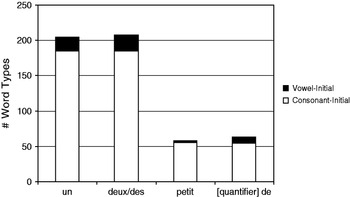
Figure 1 summarizes the numbers of types of nouns following un, deux or des,Footnote 2petit, or [quantifier] +de. The thirteen different quantifiers that occurred before de then a noun were the following: assez ‘enough’, beaucoup ‘a lot’, un bout ‘a bit’, cinq ‘five’, combien ‘how many’, moins ‘less/fewer’, paire ‘pair’, pas ‘not’, peu ‘few’, plein ‘lots’, plus ‘no more’, rien ‘nothing’ and trop ‘too many’. Figure 1 is in terms of word types rather than in tokens for two reasons. First, the token numbers were sometimes exaggerated by the high token frequency of some constructions (e.g. un autre ‘another’ and un petit peu ‘a little bit’). Second, productivity is thought to be related to type frequency rather than token frequency (e.g. Bybee, Reference Bybee1995). The token numbers can be found in the Appendix. As can be seen in Figure 1, un and deux/des are more frequent than petit or [quantifier]+de.
Number of noun and adjectives types in adult speech to French-speaking children following un, deux/des, un petit and beaucoup de.

To the extent that type frequency predicts productivity, we can expect that the children will be more correct in producing the liaison after un and deux than the liaison after un petit and elision after beaucoup de. It is also possible that the children will be more accurate with the elision after beaucoup de than with the liaison after un petit because of the greater number of vowel-initial nouns following [quantifier]+de. Note that Chevrot et al. (Reference Chevrot, Chabanal and Dugua2007) found that children were more accurate in producing the correct liaison following determiners (such as un and des) than after un petit. They attributed this finding to the optionality of the liaison after un petit (see also Dugua, Reference Dugua2002; Reference Dugua2005).
Effects of bilingualism on acquisition
Most of the children who participated in this study were bilingual. Before turning to the predictions for this study, it is important to review how bilingualism might impact on the results. This study was carried out in a part of Canada in which French is a minority language and English is the majority language. The French-speaking community is highly active in encouraging first language acquisition of French. Nevertheless, because of the predominance of English, most young French-speaking children also speak English.
By doing this research with bilingual children, we can test for effects of exposure time on children's acquisition of liaison (Chevrot et al., Reference Chevrot, Dugua and Fayol2005) and elision. The degree of exposure to each language has been found to be correlated with vocabulary size in young bilingual children (Pearson, Fernández, Lewedag & Oller, Reference Pearson, Fernández, Lewedag and Oller1997), and bilingual children's time of exposure to a language can change depending on their family's activities, including childcare situations or travel. It is undoubtedly because of this variability in exposure that vocabulary and age are not necessarily correlated in bilingual children (e.g. Nicoladis, Reference Nicoladis2003). We expected to find that vocabulary scores would be a better predictor of bilingual children's acquisition of liaison than age, because vocabulary scores are an indication of the effects of exposure time to and use of French. In addition, bilingual preschoolers have been shown to lag behind their monolingual peers in vocabulary size and morphosyntax in each language, or at least in the language they have less exposure to (e.g. Patterson & Pearson, Reference Patterson, Pearson and Goldstein2004; Thordardottir, Rothenberg, Rivard & Naves, Reference Thordardottir, Rothenberg, Rivard and Naves2006), indicating that, variations notwithstanding, their reduced input to a target language compared with monolingual age peers can impact on overall rate of development.
Bilingual acquisition not only differs from monolingual acquisition in terms of the outcomes of quantitative variation in input exposure, but also in terms of qualitative acquisition patterns that reflect interaction between the two developing languages. Researchers have found small but systematic evidence of cross-linguistic influence in bilingual children's speech (Hulk & Muller, Reference Hulk and Müller2000; Nicoladis, Reference Nicoladis2003; Paradis, Reference Paradis2001; Paradis & Navarro, Reference Paradis and Navarro2003). For example, Paradis (Reference Paradis2001) found that on a word repetition task, French–English bilingual children's syllable omission patterns were distinct from those of monolinguals for words whose prosodic structure was ambiguous between the French and English patterns, although they resembled their monolingual counterparts in each language for unambiguous words. Different explanations have been brought forward to explain why cross-linguistic effects occur for certain structures, and the explanation with the most empirical support to date is that cross-linguistic influence will most likely occur at points of structural overlap between the two languages (Hulk & Müller, Reference Hulk and Müller2000; Paradis, Reference Paradis2001). Structural overlap means that language A has one pattern for a target structure, but language B has more than one pattern for that structure. The presence of the structural pattern in language A influences the child to more often use the matching pattern in language B, even when the other options in language B might be more appropriate. In Paradis' (Reference Paradis2001) study, cross-linguistic influence was directional from French to English because English allows a variety of prosodic patterns for words, including the French iambic rhythm, while French is more limited. Turning to the study of liaison, pronunciation of vowel-initial words with a syllable-initial consonant does occur in English (an [n]apple; see also Armstrong, Reference Armstrong2001; Newton & Wells, Reference Newton and Wells2002). However, this phenomenon is without a doubt more restricted in English than in French, since at most there are two word forms undergoing this alternation (the apple [ðə.æpl] and an [n]apple [æ.næpl]). If experience with English influences children's French liaison patterns at all, it might actually accelerate their acquisition (cf. Paradis & Genesee, Reference Paradis and Genesee1996), particularly with [n] liaison because they would hear consonant-initial syllables with [n] before vowel-initial words in both languages. Alternatively and/or additionally, English phonological patterns (particularly syllable-initial vowels, as in the apple) might influence a greater use of zero liaison in French.
To check for the possible influence of these quantitative and qualitative features of bilingual acquisition in our data, we (i) compared the few monolingual children with the same number of bilingual children on their production of liaison, and (ii) correlated English vocabulary scores with the French liaison production.
The present study
The purpose of the present study was to test predictions about the acquisition of liaison/elision generated from a constructivist framework. Specifically, this study was designed to test whether children's production of liaison/elision in an elicitation task followed these predicted patterns:
(i) Developmental errors such as chunking and zero liaison/elision in production. Previous research has found that children initially mis-parse some vowel-initial words as consonant-initial words. We expected to find that children sometimes produced the target words with the same initial consonant in various collocation frames. We also expected to find zero liaison, based on prior research.
(ii) The link between frequency of collocation frames and production of liaison/elision. Chevrot et al. (Reference Chevrot, Chabanal and Dugua2007; Reference Chevrot, Dugua and Fayol2009) noted that children are more correct with producing liaison with more common constructions, but did not systematically investigate the frequency of these constructions. Dugua (Reference Dugua2002) suggested that children are sensitive to obligatoriness in their correct use of liaison, a possibly related but nonetheless separate concept from frequency. In this study, we examined children's correct productions with collocation frames that are very frequent (i.e. un ‘one/a’ and deux ‘two’) with collocation frames that are less frequent (i.e. un petit ‘a little’ and beaucoup de ‘a lot of’), with the expectation that children would produce correct liaison/elision more often with the former. In addition, the elision followed by beaucoup de is obligatory and the liaison following un petit is optional (Dugua, Reference Dugua2002).
(iii) The distributional link between liaised consonants and semantics. Since theoretical analyses of liaison in adult French have noted a connection between the grammatical feature number and certain liaised consonants, it is possible that children are sensitive to this relationship in their acquisition patterns. Specifically, we examined whether children's liaison patterns indicated that they might be using [n] to mark singular and [z] to mark plural.
(iv) The link between vocabulary size and liaison/elision. Given the evidence from previous studies that frequency of exposure to French is a critical variable in the acquisition of liaison (see Chevrot et al., Reference Chevrot, Dugua and Fayol2005), we expected to find relationships between children's production of target liaisons and their French vocabulary scores, but not their age or their English vocabulary scores, since French vocabulary would be the most sensitive measure of exposure time in bilingual children.
By testing these predictions, we also have the data to see if we can replicate the developmental sequence described by other researchers (e.g. Chevrot et al., Reference Chevrot, Chabanal and Dugua2007).
METHOD
Participants
Thirty-one children between the ages of 3 ; 1 and 5 ; 7 (mean=4 ; 8), participated in this study. Ten of the children were boys. According to parental report, six of the thirty-one children were functionally monolingual in French. The remaining twenty-five children were bilingual but, as is typical in this sociolinguistic setting, the children learned French and English from a variety of sources. All of the children were enrolled in French daycare or preschool and were learning English from the general population. Twelve of the children were simultaneous bilinguals, having heard both French and English since birth. Thirteen of the children were sequential bilinguals, seven having learned French only, on average 29 months before the onset of learning English (range: 12–42 months), and six having learned English only, on average 30 months before the onset of learning French (range: 12–60 months). All but the six French L2 children had at least one French-speaking parent at home.
For the analyses aimed at investigating developmental sequences, we divided the children into three roughly equal-sized groups based on their vocabulary scores (as will be seen below, the vocabulary scores were a better predictor of children's use of liaison than age). Group I included the children with the lowest vocabulary scores, Group III the highest vocabulary scores. Table 1 summarizes the background characteristics of these groups.
Background characteristics of vocabulary groups

Materials and stimuli
The Échelle de vocabulaire en image Peabody (EVIP: Dunn, Thériault-Whalen & Dunn, Reference Dunn, Thériault-Whalen and Dunn1993) was administered to all the children, according to the instructor's manual. The Peabody Picture Vocabulary Test, revised (PPVT-RIII: Dunn & Dunn, Reference Dunn and Dunn1997) was administered according to the instructor's manual to the twenty-five children whose parents had reported spoke some English.
To test children's knowledge of liaison and elision, we chose twelve words that started with vowels: ami ‘friend’, ange ‘angel’, arbre ‘tree’, avion ‘plane’, écureuil ‘squirrel’, enfant ‘child’, escargot ‘snail’, hippopotame ‘hippopotamus’, oignon ‘onion’, oiseau ‘bird’, oreiller ‘pillow’ and ourson ‘bear’. These words were all highly frequent,Footnote 3 based on transcripts of conversations between French–English bilingual children and French monolingual children and their native French-speaking parents in Montreal that had been collected and analyzed for prior research (the same data were used to identify the frequency of collocation frames in the ‘Introduction’).
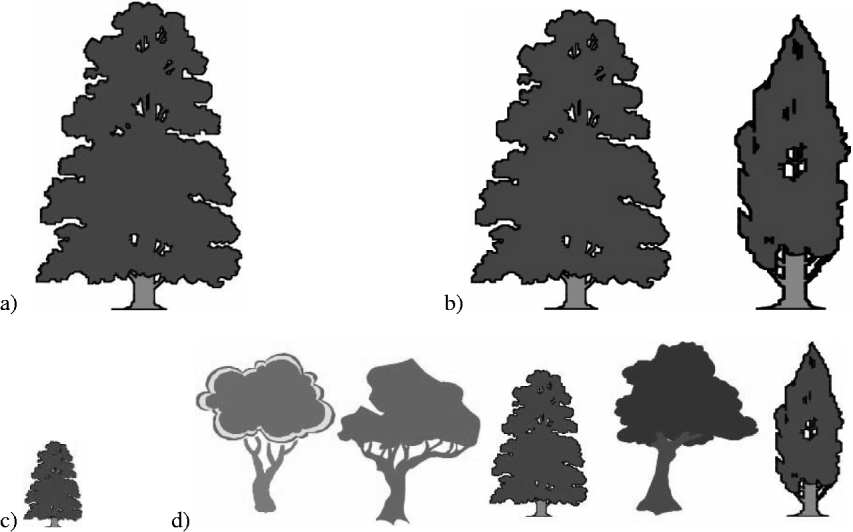
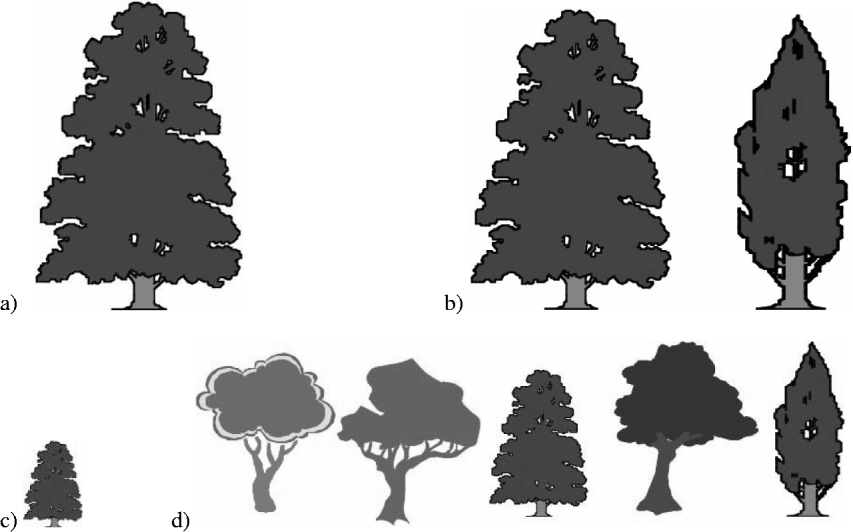
Four pictures to illustrate each item were designed in the following four conditions: (a) a single exemplar, (b) two exemplars, (c) a small exemplar and (d) a lot of exemplars. Figure 2 shows the example of arbre ‘tree’.
Stimuli for a) Un arbre, b) Deux arbres, c) Un petit arbre and d) Beaucoup d'arbres.
The pictures for the liaison/elision task were shown on a computer, to allow for the random order of presentation of the experimental items. Because the pictures were potentially ambiguous (e.g. we showed children a pillow and wanted them to call it by the vowel-initial oreiller ‘pillow’ rather than the consonant-initial coussin ‘cushion’), the experimenter had to name the first picture of each item. To introduce children to the task, two practice items (with consonant-initial words: chat ‘cat’ and carotte ‘carrot’) were administered to the children before the experimental items. Because these words were consonant-initial, the experimenter could give no clues as to how to use liaison/elision with those items when she named them. Because previous studies had shown high rates of correct use of the liaison consonant where it is obligatory, with un and deux, and lower rates in optional contexts (e.g. Dugua, Reference Dugua2002), we had either the un or deux condition appear first but with random order between those two conditions. We thought this order might lead to optimal performance for un petit and beaucoup de. Once both of these conditions had been presented, the children were presented with un petit and beaucoup de, also in random order. This manipulation ensured that the children had no experimenter-given examples with liaison/elision with the lower-frequency frames, since the child at this point already knew the noun to be used from the un and deux conditions, and the frames from the practice items, and the experimenter did not need to repeat it.
Procedure
The testing was done in a quiet place in the children's daycare or preschool. The PPVT was administered on a different day from the French sessions, by a native speaker of English, within about a week of the French sessions. The French sessions were administered by a native or fluent speaker of French. The EVIP was administered first, followed by the liaison task. A second experimenter recorded the child's responses on videotape for later transcription, and a wireless microphone was attached to the child's shirt. Videotape was considered preferable to audiotape because visual image of the face can assist in deciphering sounds when the child speaks softly.
The experimenter introduced the liaison task by explaining that she wanted to show the child some pictures. She first showed the two practice items (chat and carotte), and named each picture with un/une, deux, un(e) petit(e) or beaucoup de. The two practice items were followed by the twelve experimental items, presented in random order. As noted earlier, the first picture within each item was named by the experimenter (with the correct liaison of either [n] or [z], as appropriate), and the children then named the rest of the pictures, following the pattern of the initial practice items.
For the children who spoke English, the PPVT was administered either before or after the two tasks in French by a native English speaker.
Coding for liaison and elision
The children responded to all of the items. The children often repeated what the experimenter said for the first picture of each item. An initial analysis showed that their production of the target liaison was significantly more likely if they were repeating the experimenter's words than if they produced it spontaneously. For that reason, we did not include the child's first example of each item in the analysis. Thus, the total number of conditions for each item was 3 (i.e. either un or deux and un petit and beaucoup de). This step in the coding led to noticeably decreasing the analyzed data per child, but we thought it was necessary to eliminate any possible effects of repetition.
The first step in our coding was to simply identify the syllable-initial phoneme used in pronouncing each word. The children's syllable-initial phonemes fell into six categories: (i) [n] (e.g. un [n]ami [.nami] or un petit [n]ami [pəti.nami]), (ii) [z] (e.g. deux [z]amis [dø.zami] or beaucoup de [z]amis [boku də.zami]), (iii) [t] (e.g. un petit [t]ami [pəti.tami]), (iv) [d] (e.g. beaucoup d'amis [boku.dami]), (v) zero liaison/elision (e.g. un petit ami [pəti.ami], un ami [.ami]), and (vi) ‘other’. The ‘other’ category was rarely necessary. One child used an [l]-initial version of a vowel initial word (i.e. un petit [l]arbre [pəti.laʁbʁ]) and another child produced hippopotame with the first syllable omitted, (hi)ppopotame, and thus it was a consonant-initial word in that child's productions. Note that the categories involved in this initial step of coding include both correct forms and errors, such as producing ami with an initial [n] after the adjective petit.
For some analyses, our dependent measure was the percentage correct. To calculate the percentage correct, we counted the number of times the child produced the target consonant (i.e. [n] for un, [z] for deux, [t] for un petit and [d] for beaucoup de) as the initial sound of the word out of the total number of spontaneous productions for that condition. To calculate zero liaison/elision, we counted the number of times the child produced a zero liaison/elision out of the total number of spontaneous productions for that condition. For the stimuli words to be coded as zero liaison, they would be produced as follows: un arbre would be produced as [.aʁbʁ] instead of [.naʁbʁ], deux arbres as [dø.aʁbʁ] instead of [dø.zaʁbʁ], un petit arbre as [pəti.aʁbʁ] instead of [pəti.taʁbʁ], and beaucoup d'arbres as [bokudə.aʁbʁ] instead of [boku.daʁbʁ]. To calculate incorrect liaison/elision, we counted the total number of consonant-initial responses not corresponding to the target (e.g. for the target deux amis, we counted [n], [d] and [t] as incorrect liaison/elision) out of the total number of responses for that condition. For some analyses, our dependent measure was the percentage of a particular consonant. We calculated these percentages as the number of that consonant divided by the number of all forms produced by a child. For example, to see if the children were more likely to use [n] than [z] to indicate the singular, we calculated the total number of times they said [n] and [z] out of the total number of times that the children gave responses to the items with the collocation frame un petit _____. As noted earlier, the total numbers always excluded the children's direct repetition of the experimenter's pronunciation.
To count chunks, we analyzed the use of incorrect consonants to see if a child used the same liaison consonant in all three responses to an item. For example, if a child heard the experimenter say un ami and then said deux [z]amis [dø.zami], un petit [z]ami [pəti.zami]) and beaucoup de [z]amis [boku də.zami]. The maximum number of possible chunks was twelve, the number of items we presented to the children.
All of the children's utterances were transcribed for liaison and elision by a native French speaker. A second transcriber, a fluent speaker of French, independently transcribed two randomly chosen children's utterances. For 95% of the children's productions, the two transcribers agreed on what the child produced. In all cases of disagreement, the native French speaker's transcription was used.
RESULTS
Analysis of response types by frame
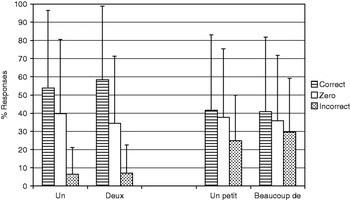
The first analysis was aimed at children's production by condition. Figure 3 summarizes the average percentage of children's responses in each condition that were correct, produced with zero liaison or produced with the incorrect liaison consonant.
Average (SD) percentage of children's responses by condition.

We compared the percentage correct for the more-frequent constructions (i.e. un and deux) and the less-frequent frames (i.e. un petit and beaucoup de) in a 2×2 ANOVA [Frequency-of-Frame×Number (singular or plural)]. Both variables are repeated variables. This analysis revealed no significant difference by Number (F<1) but a significant main effect for Frequency-of-Frame (F(1, 30)=6·93, p<0·02, η2p=0·188). There was no interaction effect (F<1). In sum, this analysis showed that the children were more likely to use liaison/elisions correctly in the more-frequent frames than the less-frequent frames. Note that there was no significant difference in the children's performance between the two lower-frequency liaison/elision frames (the optional-liaison un petit vs. the obligatory-elision beaucoup de).
We performed the same ANOVA with the children's use of zero liaison/elision. There were no significant differences in children's use of zero liaison/elision between conditions.
We also performed the same ANOVA on the children's rate of incorrect liaison/elision, (the use of a wrong consonant). Here, there was a main effect of the Frequency-of-Frame (F(1, 30)=13·47, p<0·01, η2p=0·310), and a main effect of Number (F(1, 30)=5·11, p<0·04, η2p=0·145). The interaction effect neared significance (F(1, 30)=3·84, p=0·059, η2p=0·113). The main effect for Number and the near-significant interaction effect are due to the children's greater use of an incorrect form with beaucoup de than with un petit, with no difference between un and deux.
The same pattern of results was revealed in analyses based on the items. In terms of percentage of items correct, there was no main effect for Number and no interaction effect. There was a significant main effect for Frequency-of-Frame (F(1, 11)=55·43, p<0·01, η2p=0·834). The children were more accurate with un (average by items=67·9%, SD=7·3%) and deux (M=66·3%, SD=10·4%) than with un petit (M=43·1%, SD=8·1%) or beaucoup de (M=41·3%, SD=7·9%).
The item analysis also revealed no significant differences in the children's use of zero liaison by condition. Across all conditions, the children used zero liaison with an average of 37·1% (SD=11·3%) of the items.
The item analysis on percentage incorrect revealed a main effect for Frequency-of-Frame (F(1, 11)=60·14, p<0·01, η2p=0·845) and a near-significant main effect of Number (F(1, 11)=4·75, p=0·052, η2p=0·301). There was also a significant interaction effect (F(1, 11)=9·48, p<0·02, η2p=0·463). As with the subject analysis, the children were more likely to use an incorrect form following beaucoup de (M=25·1%, SD=7·8%) than un petit (M=15·6%, SD=5·3%). In contrast, there was no difference between their use of incorrect forms following deux (M=6·5%, SD=4·7%) and un (M=7·2%, SD=10·0%).
Analyses of incorrect consonant responses: chunking and association of meaning
We next analyzed the use of incorrect consonants to investigate the presence of chunking, meaning the consistent use of one initial consonant across all three coded items, suggesting the child might have mis-parsed the root. The children used an average of 0·90 chunks (out of 12 items) (SD=2·04). The children chunked [n] (M=0·45, SD=1·15) approximately equally to [z] (M=0·42, SD=0·92). One child also chunked [l] in [l]arbre, as mentioned above. While at least one chunk was observed for every item, there were four items that were particularly likely to be chunked: [n]oreiller, [n]écureuil, [z]enfant and [z]ami.Footnote 4
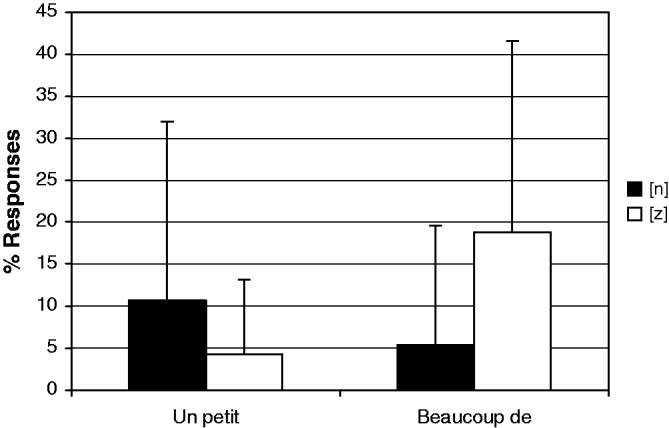
To see if children associated the sounds [n] and [z] with the semantic features of singular and plural respectively, we compared their rate of (erroneous) production of [n] and [z] following un petit and beaucoup de. If children associate meaning with those liaison consonants, we would expect more [n] following un petit and more [z] following beaucoup de (i.e. in contexts in which adults would never produce these forms). The results are presented in Figure 4. We analyzed the children's use of [n] or [z] with un petit or beaucoup de in a 2×2 [LiaisonConsonant×Condition] repeated-measures ANOVA. This analysis revealed a main effect for Condition (F(1, 30)=5·39, p<0·03, η2p=0·152), but no main effect for LiaisonConsonant (F(1, 30)=1·49, p=0·26). There was a significant interaction effect for LiaisonConsonant and Condition (F(1, 30)=10·09, p<0·01, η2p=0·252).
Average (SD) percentage of children's responses by condition with [n] or [z] liaison.
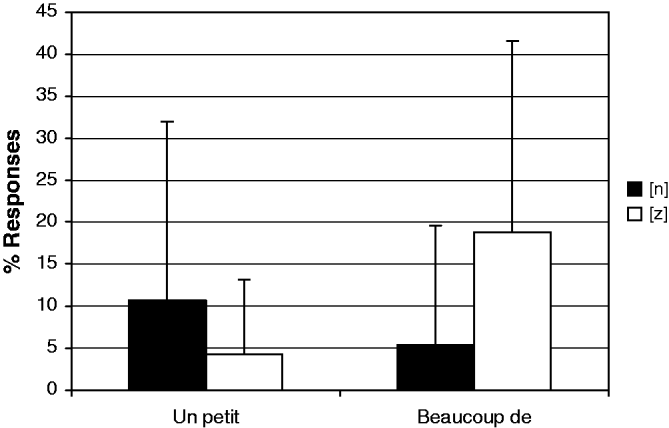
An item analysis revealed the same pattern. The children used [z] more often (M=18·7%, SD=7·5%) than [n] (M=5·4%, SD=3·5%) following beaucoup de and they used [n] more often (M=10·8%, SD=5·0%) than [z] (M=4·3%, SD=4·2%) following un petit. There was no main effect of LiaisonConsonant (F(1, 11)=2·47, p=0·12), but a significant main effect of Condition (F(1, 11)=29·17, p<0·01, η2p=0·726). There was a significant interaction effect (F(1, 11)=134·67, p<0·01, η2p=0·924).
These results mean that the children were more likely to produce [n] as opposed to [z] in a singular context (following un petit) and [z] than [n] in a plural context (following beaucoup de). The results were particularly strong for the beaucoup de condition.
Analyses of developmental trends
To see if the children's performance was related to vocabulary size in each language or to age, we conducted correlations between the main dependent measures (i.e. percentage correct, percentage zero, percentage incorrect and number of chunks) and age, PPVT and EVIP. Results are summarized in Table 2. Of the vocabulary and age variables, the children's French vocabulary (EVIP) was the only significant correlate of the dependent measures.
Correlations between age, PPVT, EVIP and dependent measures

notes: ** p<0·01, * p<0·05, † p<0·07.
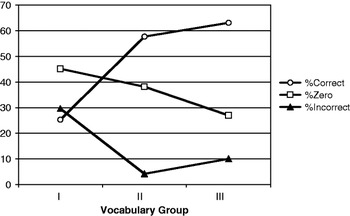
Because vocabulary was a stronger predictor than age, to further investigate developmental sequences, we calculated the average rates of percent correct, incorrect and zero liaison/elision for each vocabulary group (I=small, III=large), and plotted the results in Figure 5. As can be seen in Figure 5, the average rate of correct responses increased with higher vocabulary scores and the average rate of incorrect responses decreased with higher vocabulary scores. The average rate of zero liaison responses also decreased with higher vocabulary scores.
Average percentage of correct, zero liaison/elision and incorrect responses by vocabulary group.

Analyses of effects of bilingualism
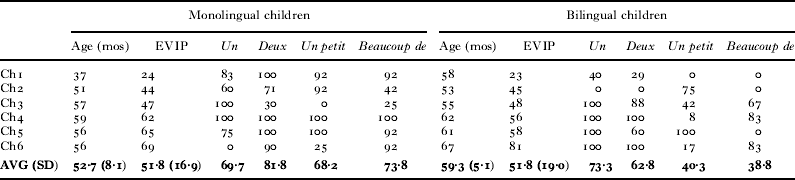
We compared the six monolinguals with six bilinguals matched as closely as possible on the basis of EVIP scores (see Table 3). We chose to match on EVIP scores rather than age as we observed that the vocabulary scores were a better correlate of liaison/elision development than age, as predicted. Note that while the average EVIP scores are the same in both groups, the match on vocabulary scores was far from close on an individual-by-individual basis.
Age, EVIP scores and percentage correct for each frame (monolingual and EVIP-matched bilingual children)
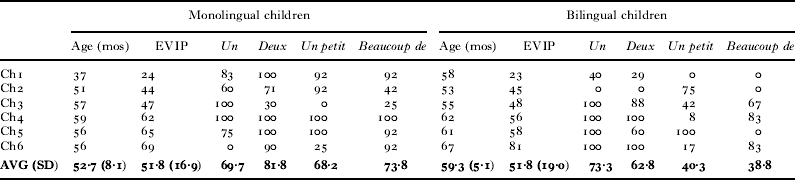
To understand if the monolingual children performed differently than the bilingual children on the frequent frames versus the infrequent frames, we conducted non-parametric Mann–Whitney U tests. We chose non-parametric tests because the sample size is small. We averaged the children's percentage correct scores for the frequent frames (un and deux), and for the less-frequent frames (un petit and beaucoup de) in order to reduce the number of pairwise comparisons. Results showed that there was no difference between the bilinguals and the monolinguals in their use of liaison for the frequent frames (monolingual: 76·09% (SD=21·68) vs. bilingual: 72·48% (SD=35·11), z=−0·323, p=0·75), but the monolinguals used liaison/elision significantly more often for the less-frequent frames (monolingual: 69·15% (SD=32·59) vs. bilingual: 39·59% (SD=20·32), z=−2·089, p=0·04). These results suggest that there is an effect of bilingualism on low-frequency liaised/elided forms.
DISCUSSION
The purpose of this study was to extend a constructivist account to children's acquisition of liaison and elision. In particular, we expected to find correct liaison alternating with zero liaison and incorrect liaison/elision in children of this age, which was borne out in our results. This indicates that the general patterns of the acquisition of liaison and elision in French are similar in monolinguals and bilinguals and across dialects. We also predicted that a number of variables would impact on French-speaking children's liaison. We discuss our findings with respect to each of these predictor variables, including bilingualism. Finally, we put forward a constructivist account of the acquisition of liaison/elision.
We tested the effect of frequency of the collocation frames. We showed that children produced the correct liaison more frequently after the obligatory contexts un and deux than the optional context un petit (as in Dugua, Reference Dugua2002; Reference Dugua2005). However, the children were also less likely to produce the correct elision following the obligatory beaucoup de context than following un and deux, and slightly less likely following the optional un petit. This finding supports claims by researchers that many sandhi phenomena, like elision and liaison, are strongly related (e.g. Klausenburger, Reference Klausenburger1984; Tranel, Reference Tranel, Parodi, Quicoli, Saltarelli and Zubizarreta1996). These results do not allow us to distinguish between the effects of frequency of the collocation frame in the input or obligatoriness (Bybee, Reference Bybee, Bybee and Hopper2001b; Dugua, Reference Dugua2002).
The children in this study were still producing some chunked forms, although at a very low rate overall (less that one out of twelve items, on average). Most of the children who produced chunks fell into the lowest vocabulary group. In the higher vocabulary groups, most of the children's incorrect liaison could be attributed to an association of a liaison consonant with singular [n] or plural [z]. The children produced the [n] liaison more often than [z] following un petit and the [z] liaison more often than [n] following beaucoup de. This was particularly true of beaucoup de, perhaps because [z] is more reliably linked to plurality (e.g. through multiple determiners and adjectives; see Morin & Kaye, Reference Morin and Kaye1982) than [n] is linked to singularity. This result suggests that children were associating [n] with singularity and [z] with plurality. Such an outcome is also in line with the model of the lexicon we are assuming, in that morphological rules are conceptualized as schemas emerging from the type frequency of the multimorphemic storage of words. Future studies could test whether children associate other liaison consonants with meaning. For example, because the [n] liaison consonant occurs after un ‘a/one’ and [l] occurs with the elision of the vowel following le or la ‘the [singular]’, children might associate [n] with ‘indeterminate’ and [l] with ‘determinate’. It is possible that these semantic features are established in development and retained even into adulthood, but are rather weak in strength in adults because of the specificity of the constructions in which they would appear.
It is also important to test one assumption we have made here (following others, including Chevrot et al., Reference Chevrot, Dugua and Fayol2005; Dugua, Reference Dugua2002), that children do not hear zero liaison in highly frequent, obligatory contexts. It is important to verify that adults do not produce zero liaison forms in high-frequency frames before we can conclude with certainty that these are part of the developmental process alone.
The children's French vocabulary scores were more strongly correlated with their liaison/elision acquisition than their age or their English vocabulary scores. Since size of vocabulary, in bilinguals in particular, is a reflection of amount of exposure, this result suggests that frequency of exposure to French is a more critical variable in the acquisition of liaison than chronological age (see Chevrot et al., Reference Chevrot, Dugua and Fayol2005). Age is a strong predictor for monolingual children's acquisition of liaison (e.g. Chevrot et al., Reference Chevrot, Dugua and Fayol2009), undoubtedly because age and exposure time to a language are strongly correlated in monolingual children. In the present study, the children with the lowest vocabulary scores were most likely to produce vowel-initial words, i.e. words with zero liaison, which are indicative of an early developmental stage. Note that both the link between liaison/elision and vocabulary size, and the prevalence of zero liaison as errors forms in children with small vocabularies, are consistent with the constructivist account we are assuming. This is because, on a constructivist model of the lexicon, the unit of storage is the word or phrase, and schemas for phonological processes like liaison and elision are emergent from stored words and phrases. The greater number of words and phrases stored increases the type frequency of a given schema, and in so doing increases the frequency and accuracy with which it is used by a speaker.
Most of the children who participated in this study were bilingual. There was only one statistically significant effect of bilingualism. That is, the vocabulary-matched bilinguals performed less well (i.e. lower percentage correct liaison/elision) than the monolinguals in the less-frequent collocation frames. However, this analysis was restricted to the six monolingual children who participated in this study. There were no significant correlations with the children's performance and English vocabulary scores. These results suggest that the children's bilingualism may have had some small effects on their acquisition, particularly with regard to low-frequency frames, but a larger group of monolingual children would be necessary to confirm that finding.
The rates of the children's production of liaison in obligatory contexts is a bit lower than has been reported for monolingual children within the same age range (e.g. Chevrot et al., Reference Chevrot, Dugua and Fayol2009; Chevrot et al., Reference Chevrot, Chabanal and Dugua2007; Dugua, Reference Dugua2005; Wauquier-Gravelines, Reference Wauquier-Gravelines2005). This result is undoubtedly due to the fact that the bilingual children's experience with French is lower than that of monolinguals of the same age, as evidenced by significantly lower vocabulary scores in French (e.g. Nicoladis, Reference Nicoladis2003). Note that the children's performance in this study was correlated with vocabulary scores. The children in this study produced more zero liaison forms than have been reported for monolingual children of the same age (e.g. Chevrot et al., Reference Chevrot, Chabanal and Dugua2007; Dugua, Reference Dugua2005; Reference Dugua2002). Wauquier-Gravelines (Reference Wauquier-Gravelines2005) also noted a high use of zero liaison forms in French–English bilingual children of three to four years of age. It is unclear whether the high use of zero liaison is due to the children's bilingualism or due to the lower vocabulary scores (recall that there was a trend for a negative correlation between vocabulary scores and the rate of zero liaison in this study). Future research could compare the results of bilingual and monolingual children more systematically.
A constructivist account of the acquisition of liaison
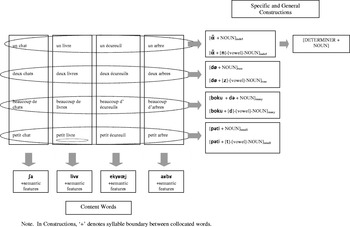
Figure 6 presents a schematic illustration of the lexical storage of the constructions tested in this study, with consonant-initial (chat ‘cat’, livre ‘book’) and vowel initial (écureuil ‘squirrel’, arbre ‘tree’) masculine nouns. It follows the concepts and notation used in Bybee (Reference Bybee2001a; Reference Bybee, Bybee and Hopper2001b); however, it is important to point out that her model is not, strictly speaking, a formal linguistic theory. The vertical boxes in Figure 6 show the construction paradigms for the individual nouns, which are stored as phonological sequences and associated semantic features. Note that the phonological sequence corresponding to the noun itself would have the greatest lexical strength when comparing vertically within each nominal paradigm of the constructions (see also Chevrot et al., Reference Chevrot, Dugua and Fayol2009). In other words, the sequence [ami] in isolation would have greater lexical strength than [nami] or [zami] because it appears inside every construction. Looking horizontally, the semi-general constructions are given for consonant-initial and vowel-initial nouns, with a more general construction given on the far right for the determiners. Notice that for the constructions with liaison, i.e. those with un, deux and petit, the constructions emerging from the vowel-initial nouns are more specific than the constructions for the consonant-initial nouns, e.g. [+NOUN]indef versus [+[n]-[vowel]-NOUN]indef (cf. Bybee, Reference Bybee, Bybee and Hopper2001b). In the case of the construction with elision, beaucoup de/d', the construction with consonant-initial nouns is also more general than the construction with vowel-initial nouns; compare [boku+də+NOUN]many and [boku+[d]-[vowel]-NOUN]many. Making reference to Figure 6, we propose a possible developmental sequence in the acquisition of liaison and elision, based on our findings and those of Chevrot et al. (Reference Chevrot, Chabanal and Dugua2007) . In this developmental sequence, we incorporate the following: an explanation for zero liaison, the impact of frequency of collocation frame, the relationship of accuracy with liaison and lexicon size, and the semantic associations with [n] and [z].
Illustration of lexical construction networks in French for masculine nouns and collocations with liaison/elision, based on Bybee (Reference Bybee2001a; Reference Bybee, Bybee and Hopper2001b).

Upon first hearing a content word in a construction with liaison/elision, children might assume that the consonant-initial form is the form of the content word. In this study, the children with the lowest vocabulary scores were the most likely to produce chunks, even for these familiar words, suggesting this possibility at early stages of French lexicon development, as proposed by Chevrot et al. (Reference Chevrot, Chabanal and Dugua2007) . As children hear the same word in multiple frames, and hear multiple frames of a similar type with other words, they gradually circumscribe the underlying vowel-initial root, and strengthen their content word and construction representations simultaneously, as shown in the vertical and horizontal arrows in Figure 6. At the same time as children produce incorrectly parsed forms, they are also likely to use zero liaison for two reasons: (i) the noun root itself is the most frequent phonological sequence in the emerging paradigm, and thus it has the greatest lexical strength and might be accessed more easily; (ii) the consonant-initial noun construction is more general than the vowel-initial noun construction, and these nouns are more frequent, and so the more general construction is overapplied to the specific construction with liaison until sufficient strength is built up for the more specific constructions, analogous to the process underlying over-regularization of irregular past tense forms. Thus, production of mis-parsed forms and zero liaison forms could co-occur in development.
Children's accuracy with liaison/elision should be piecemeal at first, so they would tend to use liaised or elided forms more often in high-frequency frames because the strength of these constructions in their lexicons would make them more productive, and less likely to be overridden by the more general consonant-initial construction. In this study, frequency of collocation frame influenced children's accuracy in producing liaison/elision and, importantly, frequency appeared to be a key variable. With even more exposure to more collocation frames and with increasing content word vocabulary (vertical in Figure 6), children gradually develop productive schemas even for the specific less-frequent constructions (horizontal in Figure 6). Along the way, children might also be assigning some semantic number feature to the specific constructions with [z] liaison, in a process analogous to the one they are using to assign semantic features to verbal inflections. An important point to keep in mind is that in Bybee's (Reference Bybee2001a; Reference Bybee, Bybee and Hopper2001b) model of the lexicon, fully 100% use of liaison in all possible constructions would never be achieved by these children because even adult French speakers use liaison in some lower-frequency constructions to a varying degree (e.g. Sampson, Reference Sampson2001).
In conclusion, we have shown that a constructivist account of children's acquisition of liaison and elision is plausible (following Chevrot et al., Reference Chevrot, Dugua and Fayol2009). Such an account would not only explain monolingual children's acquisition but also bilingual children's acquisition.
APPENDIX
This table summarizes the token number of times each word appeared before a noun or an adjective (either consonant-initial or vowel-initial) in the input count.