1. Introduction
The Asian continent was mainly formed during the Early Palaeozoic to Early Mesozoic by the amalgamation of several continental blocks (Cawood et al. Reference Cawood, Wang, Xu and Zhao2013; Metcalfe, Reference Metcalfe2013). As one of the largest of these blocks, the South China block (SCB) played an important role in the formation of the Asian continent. The SCB experienced three major orogenic events, i.e. Early Palaeozoic, Triassic, and Jurassic to Cretaceous (e.g. Wang et al. Reference Wang, Fan, Zhang and Zhang2013b and references therein), after its assembly during the Neoproterozoic period (Zhao & Cawood, Reference Zhao and Cawood2012; Qiu et al. Reference Qiu, Yang, Lu, Ling, Zhang and Wang2015). The Early Palaeozoic event is traditionally referred as the ‘Caledonian orogeny’ (or ‘Kwangsian orogeny’) in the literature (e.g. Ting, Reference Ting1929; Ren, Reference Ren1991; Li et al. Reference Li, Li, Wartho, Clark, Li, Zhang and Bao2010). It extends for c. 2000 km and possibly to the Korean peninsula and Indochina block (Ren, Reference Ren1991; Kim et al. Reference Kim, Oh, Williams, Rubatto, Ryu, Rajesh, Kim, Guo and Zhai2006). It includes Neoproterozoic to Lower Palaeozoic non-metamorphic or low-grade metamorphic sediments, Palaeoproterozoic to Lower Neoproterozoic high-grade metamorphic rocks, migmatites and granitoids (e.g. Ren, Reference Ren1991). However, compared to those Mesozoic thermo-tectonic activities which have attracted wide attention as they are related to abundant mineral resources (e.g. He & Xu, Reference He and Xu2012; Li, Qiu & Yang, Reference Li, Qiu and Yang2014; Sun, Ma & Liu, Reference Sun, Ma and Liu2017, and references therein), the Caledonian event in the SCB is still poorly constrained (e.g. Guo et al. Reference Guo, Shi, Lu, Ma, Dong and Yang1989; Wang et al. Reference Wang, Fan, Zhang and Zhang2013b). The orogeny has long been regarded as a consequence of continental or arc collisions (Guo et al. Reference Guo, Shi, Lu, Ma, Dong and Yang1989; Hsü et al. Reference Hsü, Li, Chen, Wang, Sun and Sengör1990), but more recent studies have revealed that the orogeny is actually an intraplate orogenic event (e.g. Shu et al. Reference Shu, Yu, Jia, Wang, Shen and Zhang2008; Charvet et al. Reference Charvet, Shu, Faure, Choulet, Wang, Lu and Breton2010; Faure et al. Reference Faure, Shu, Wang, Charvet, Choulet and Monie2010; Wang et al. Reference Wang, Fan, Zhang and Zhang2013b). For example, evidence of oceanic basin, ophiolite suite and/or subduction complexes associated with Early Palaeozoic oceanic subduction is absent in the SCB. Besides, contemporaneous volcanic arcs have so far never been documented in South China. Turbidites with Bouma sequences are also lacking despite widely developed thick flysch sedimentary successions Wang et al. Reference Wang, Fan, Zhang and Zhang(2013b). Meanwhile, issues like the geodynamic mechanism and the time limits for the orogenesis remain controversial (Guo et al. Reference Guo, Shi, Lu, Ma, Dong and Yang1989; Hsü et al. Reference Hsü, Li, Chen, Wang, Sun and Sengör1990; Wang et al. Reference Wang, Fan, Zhao, Ji and Peng2007; Shu et al. Reference Shu, Yu, Jia, Wang, Shen and Zhang2008; Charvet et al. Reference Charvet, Shu, Faure, Choulet, Wang, Lu and Breton2010; Faure et al. Reference Faure, Shu, Wang, Charvet, Choulet and Monie2010; Li et al. Reference Li, Li, Wartho, Clark, Li, Zhang and Bao2010; Wan et al. Reference Wan, Liu, Wilde, Cao, Chen, Dong, Song and Du2010). It has been speculated that intraplate orogenesis would be driven by: (1) the amalgamation of the SCB with the North China craton along the Qinling–Dabie–Sulu orogenic belt (Wan et al. Reference Wan, Liu, Xu, Zhuang, Song, Shi and Du2007, Reference Wan, Liu, Wilde, Cao, Chen, Dong, Song and Du2010; Wang et al. Reference Wang, Fan, Zhao, Ji and Peng2007), (2) underthrusting of the Cathaysia block beneath the Yangtze craton (Charvet et al. Reference Charvet, Shu, Faure, Choulet, Wang, Lu and Breton2010), or (3) plate interaction between South China and the Gondwana supercontinent during the Ordovician–Silurian (Li, Reference Li, Flower, Chung, Lo and Lee1998; Li & Powell, Reference Li and Powell2001). This is partly due to competing interpretations of the petrogenesis and tectonic setting for the Caledonian igneous rocks, and partly to a lack of recognition of anorogenic alkaline magmatism (Charvet et al. Reference Charvet, Shu, Faure, Choulet, Wang, Lu and Breton2010; Li et al. Reference Li, Li, Wartho, Clark, Li, Zhang and Bao2010; Wan et al. Reference Wan, Liu, Wilde, Cao, Chen, Dong, Song and Du2010; Feng et al. Reference Feng, Zhao, Ling, Chen, Chen, Sun, Jiang and Pu2014; Cai et al. Reference Cai, Tang, Zhang, Lv and Liu2017).
Thus, systematic investigation of the Early Palaeozoic (Caledonian) magmatism will help us to understand the temporal evolution of the igneous activities and the geodynamic processes during the orogeny. Granites can record significant information regarding the nature of orogenesis. Geological surveys have shown that the Caledonian granitoids are widespread in the eastern SCB and can be divided into massive and gneissoid granites. The massive granites are voluminous, whereas the gneissic ones are traditionally considered less voluminous and predominantly outcrop in several areas of the Wugong and northern Wuyi Domains in the SCB (Wang et al., Reference Wang, Fan, Zhang and Zhang2013b). The orthogneisses or migmatites in the Yunkai massif are traditionally thought to be the components of the Precambrian basement. However, recent geological and geochronological data suggest that many were actually formed in the Early Palaeozoic (e.g. Wan et al. Reference Wan, Liu, Wilde, Cao, Chen, Dong, Song and Du2010; Wang et al. Reference Wang, Wu, Zhang, Fan, Zhang, Zhang, Peng and Yin2012). Unfortunately, so far most workers have focused on the geochronology of the granites (e.g. Peng et al. Reference Peng, Jin, Liu, Fu, He, Cai and Wang2006; Zhou et al. Reference Zhou, Sun, Shen, Shu and Niu2006), while little attention has been given to the classification, petrogenesis and tectonic significance of the Caledonian granitic rocks in the SCB. Therefore, systematic investigation of the Caledonian granitic magmatism in the SCB will certainly help us to understand the temporal evolution of the igneous activities as well as the geodynamic processes during the orogeny (Li et al. Reference Li, Li, Wartho, Clark, Li, Zhang and Bao2010; Wang et al. Reference Wang, Fan, Zhang and Zhang2013b).
In this paper, high-precision geochronological and systematic geochemical data for the Palaeozoic gneissic monzogranites, porphyritic granodiorites and charnockites from the Gaozhou area situated in the southern margin of the SCB are presented. The aims of our study of the Caledonian granitoids are to: (1) investigate their petrogenesis and tectonic setting, (2) precisely constrain the timing of formation in the southern part of the SCB and (3) better understand the Caledonian orogenic processes in the SCB.
2. Geological setting and sample descriptions
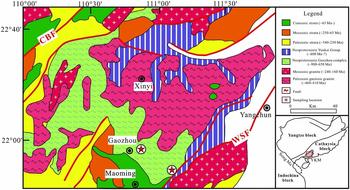
The SCB comprises the Yangtze block to the northwest and the Cathaysia block to the southeast (Fig. 1). Palaeoproterozoic to Mesoproterozoic basement of the Cathaysia block comprises gneisses, migmatites and plagioclase amphibolites (Li et al. Reference Li, Zhao, McCulloch, Zhou and Xing1997; Chen & Jahn, Reference Chen and Jahn1998). They are intruded by widespread Phanerozoic magmatic intrusions with different ages (e.g. Caledonian, Indosinian and Yanshanian episodes). The SCB develops a series of greenschist- to low amphibolitic-facies metamorphic terrains (e.g. Yunkai, Baiyun and Wuyi massifs). The Yunkai massif, one of the typical metamorphic terrains, is located across the western Guangdong and eastern Guangxi Provinces, and belongs tectonically to the Yunkai–Baiyun–Wuyi metamorphic belt as shown in Figure 1. It is a NE-trending metamorphic zone roughly bounded by the Wuchuan–Sihui shear zone and Cenxi–Bobai fault (Fig. 1). It has undergone complex tectonic evolution, and is mainly composed of Precambrian metamorphic basement, Palaeozoic – Early Mesozoic sediments and voluminous Caledonian foliated granites (Peng & Wu, Reference Peng and Wu1996; Ding et al., Reference Ding, Zou, Min, Yin, Du, Ma, Su and Shen2017). Both high- and low-grade basement rocks, believed to have different ages, occur in the Yunkai massif (Qiu et al. Reference Qiu, Peng, Zhang, Zhou, Zou, Deng and Lu1996; Zhong et al. Reference Zhong, You, Zhou and Han1996). The high-grade basement rocks mainly outcrop in the Gaozhou area and hence are named as the Gaozhou complex, whereas the low-grade basement rocks are more widespread and make up the essence of the Yunkai Group.
Geological map of the Yunkai massif in southern part of the South China block. The inset shows the Yangtze and Cathaysia block in the South China block. WSF: the Wuchuan–Sihui Fault, CBF: the Cenxi–Bobai Fault. YKM: the Yunkai massif. Song Ma is a suture zone. Modified after Chen et al. (Reference Chen, Liu, Lee, Xiang and Zhou2012).

Gneissic granitoids and charnockites are widespread in the Yunkai massif and form a large batholith in the centre of the area. Contact aureole can be observed between the granitoids and supracrustal rocks of the Yunkai massif (Zhong et al. Reference Zhong, You, Zhou and Han1996). Various geochronological data were obtained for the charnockites or gneissic granitoids (including migmatites) in the Gaozhou complex. For example, Jian (Reference Jian1991) and Zhou et al. (Reference Zhou, You, Zhong and Han1994) suggested, based on multi-grain zircon ages of 950–800 Ma, that most of the migmatites in the Yunkai massif were formed during the early Neoproterozoic. Zhong et al. (Reference Zhong, You, Zhou and Han1996) indicated that the charnockites might have been formed during the Early Palaeozoic, supported by U–Pb ages of 434.9 ± 1.3 Ma. Wan et al. (Reference Wan, Liu, Wilde, Cao, Chen, Dong, Song and Du2010) reported SHRIMP (sensitive high-resolution ion microprobe) zircon U–Pb ages of 443–430 Ma for three granitoids intruded in the Gaozhou complex. Wang et al. (Reference Wang, Zhang, Fan, Zhao, Zhang, Zhang, Zhang and Li2011) obtained zircon U–Pb ages of 452–443 Ma for three orthogneisses in the Yunkai Group, and 449 ± 5 Ma and 415 ± 7 Ma, respectively, for two granites. Recently published zircon U–Pb ages using laser ablation – inductively coupled plasma – mass spectrometry (LA-ICP-MS) also give ages of 445–441 Ma for gneissic granites in the Yunkai massif Wang et al. Reference Wang, Long and Zhou(2013a). Furthermore, Chen et al. (Reference Chen, Liu, Lee, Xiang and Zhou2012) obtained for the granulite, charnockite and gneisses in the Gaozhou complex an in situ EMP (electron microprobe) monazite date showing that significantly younger metamorphic ages of ~370 Ma and ~237 Ma occur for the charnockites and gneisses, except for the Caledonian ages. They thus suggested that the Gaozhou complex is a Caledonian high-grade metamorphic terrain, reactivated by the Hercynian and more vigorous Indosinian orogenies probably involving participation of fluid phases in the long course of retrogressive metamorphism during the early Phanerozoic. Altogether, most of the geochronological studies constrain the time of formation for the granitoids, migmatites and charnockites in the Gaozhou complex to a narrow span (450–430 Ma) related to the Caledonian orogeny (Wang et al. Reference Wang, Fan, Zhao, Ji and Peng2007, Reference Wang, Zhang, Fan, Zhao, Zhang, Zhang, Zhang and Li2011; Li et al. Reference Li, Li, Wartho, Clark, Li, Zhang and Bao2010; Chen et al. Reference Chen, Liu, Lee, Xiang and Zhou2012).
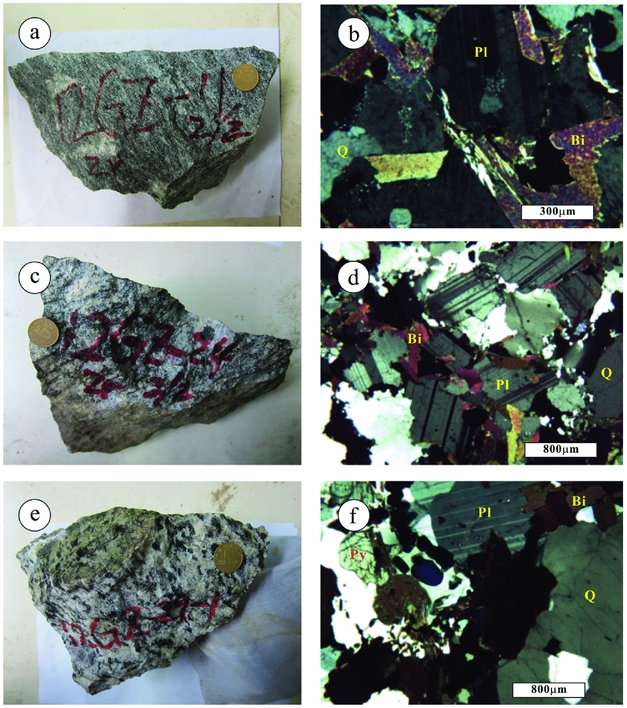
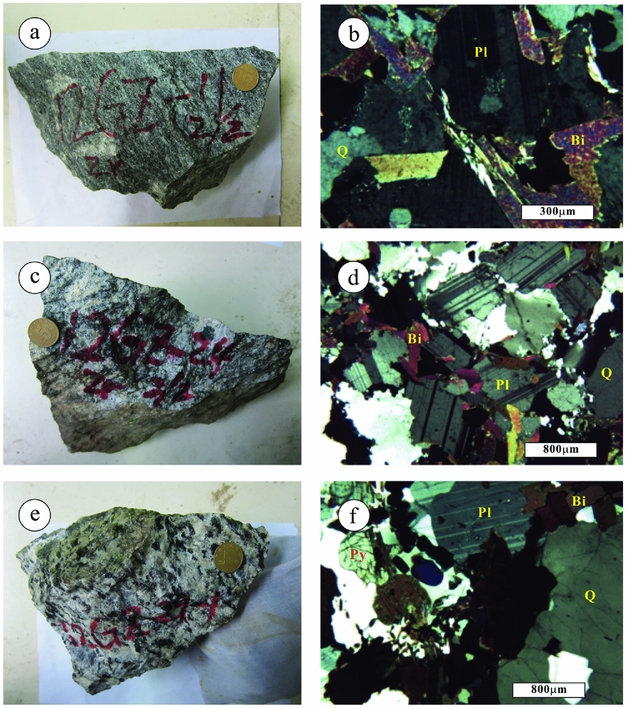
In this study, eighteen samples including eight gneissic monzogranites, five porphyritic granodiorites and five charnockites were collected in quarries or relatively fresh road cuts near Shikengtang, Huanglangen and Huangyajiao villages of Maoming city (Fig. 1). The medium-grained gneissic monzogranites from the Shikengtang area are grey in colour, and vary from non-foliated to foliated fabrics (Fig. 2a). They commonly show porphyritic texture with feldspar phenocrysts (10–13 %) in a groundmass of fine-grained K-feldspar (25–30 %), plagioclase (28–30 %, An = 27), quartz (20–25 %), biotite (8–15 %) and accesory minerals including apatite, tourmaline, zircon and Fe–Ti oxides (Fig. 2b). The samples from the Huanglangen location are porphyritic granodiorites. They have a porphyroid texture and exhibit massive structure (Fig. 2c). The phenocryst is dominated by subhedral microcline (~5 %) while the matrix is dominated by plagioclase (40–45 %), microcline (10–15 %), perthite (5–10 %), quartz (25–30 %) and biotite (5–10 %) (Fig. 2d). The samples from the Huangyajiao area are charnockites with varying assemblages of plagioclase (50–55 %), K-feldspars (10–15 %), quartz (20–25 %), biotite (10–15 %), hypersthene (1–5 %) and garnet (2–5 %), and occasionally secondary minerals of chlorite. Minor brownish biotite occurs either as intergrowth with pyroxene or along the grain boundaries of hypersthene, as a late-stage replacement of the orthopyroxene (Fig. 2e, f).
Photographs of the Yunkai Early Palaeozoic granitoids. (a) Hand specimen of the gneissic monzogranite; (b) photomicrograph of the gneissic monzogranite; (c) hand specimen of the porphyritic granodiorites; (d) photomicrograph of the porphyritic granodiorites; (e) hand specimen of the charnockite; (f) photomicrograph of the charnockite. Q: quartz; Pl: plagioclase; Bi: biotite; Py: pyroxene.
3. Analytical methods
Zircon grains were crushed and separated from representative gneissic monzogranite (12GZ-11), porphyritic granodiorite (12GZ-24) and charnockite (12GZ-29-1) samples using standard density and magnetic separation techniques. Representative grains were picked under microscope and cast in an epoxy resin. After polishing, the zircon grains were evaluated by cathode luminescence (CL) to detect their internal structures. The CL imaging was performed at the State Key Laboratory of Continental Dynamics (LCD), Northwest University in Xi'an, China, using a Quanta 400FEG environmental scanning electron microscopy equipped with an Oxford spectrometer and a Gatan CL3+ detector. Zircon U–Pb analysis was carried out using the LA-ICP-MS technique at LCD. The laser-ablation system comprises a GeoLas 2005 equipped with a 193 nm ArF-excimer laser coupled with an Agilent 7500a ICP-MS. Helium was used as the carrier gas to enhance the transport efficiency. The detailed analytical method is described elsewhere (Yuan et al. Reference Yuan, Gao, Liu, Li, Günther and Wu2004). Raw data were processed using the ICPMSDataCal (Ver.9.2) software (Liu et al. Reference Liu, Kelemen, Zong and Gao2008). Errors on individual analyses are at the 1σ level based on counting statistics. The Zircon 91500 was used as U–Pb isotope standard, and the silicate glass NIST 610 was used to calibrate U and Th contents. The laser spot diameter was 32 μm, while errors on pooled analyses are at 2σ level. All measurements were performed using zircon standard 91500 as the external standard with a 206Pb/238U ratio of 0.0914 corresponding to an age of 1064.5 ± 0.6 Ma (Wiedenbeck et al. Reference Wiedenbeck, Allé, Corfu, Griffin, Meier, Oberli, Quadt, Roddick and Spiegel1995). Apparent and concordia U–Pb ages were calculated using the ISOPLOT program (Ludwig, Reference Ludwig2001).
After petrographic examination, the freshest samples were selected for geochemical and Nd isotopic analyses at Zhongnan Mineral Resources Supervision and Test Center for Geoanalysis, Wuhan Center of China Geological Survey. Major elements were determined by fused glass disc method using a Panalytical Axios max X-ray fluorescence spectrometer. The analytical precision and accuracy are better than 5 % (SiO2) and 3 % (other oxides) based on the US Geological Survey (USGS) standards and duplicate analyses. Trace elements were analysed using a Thermo Fisher X Series-2 ICP-MS. Analyses of USGS standards AGV-1, GSR-3 and BCR-2 indicate that the accuracy and precision are better than 3 % (RSD) for most elements and about 5 % for some transition elements (Qiu et al. Reference Qiu, Yang, Zhao, Lu, Wu, Zhang and Zhang2016).
Sm–Nd isotopic analyses were performed using the ID-TIMS method by a Triton Ti Thermal Ionization Mass Spectrometer (TIMS). The detailed analytical method is described elsewhere (Qiu et al. Reference Qiu, Yang, Zhao, Lu, Wu, Zhang and Zhang2016). 143Nd/144Nd ratios were normalized to 146Nd/144Nd = 0.7219. The 143Nd/144Nd ratio of the ZkbzNd (JMC) standard measured during the run has an average of 0.511550 ± 0.000005 (2σ, n = 7). Analysis of BCR-2 gives 143Nd/144Nd = 0.512633 ± 0.000003 (2σ, n = 10), Sm = 6.637 ppm, Nd = 29.32 ppm, which agree well with recommended values within analytical errors.
4. Results
4.1. Zircon U–Pb geochronology
4.1.1. Gneissic monzogranite (12GZ-11)
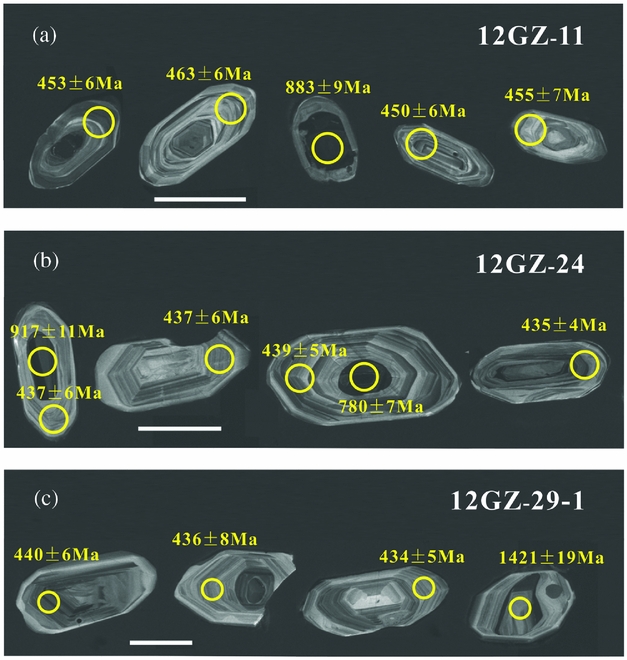
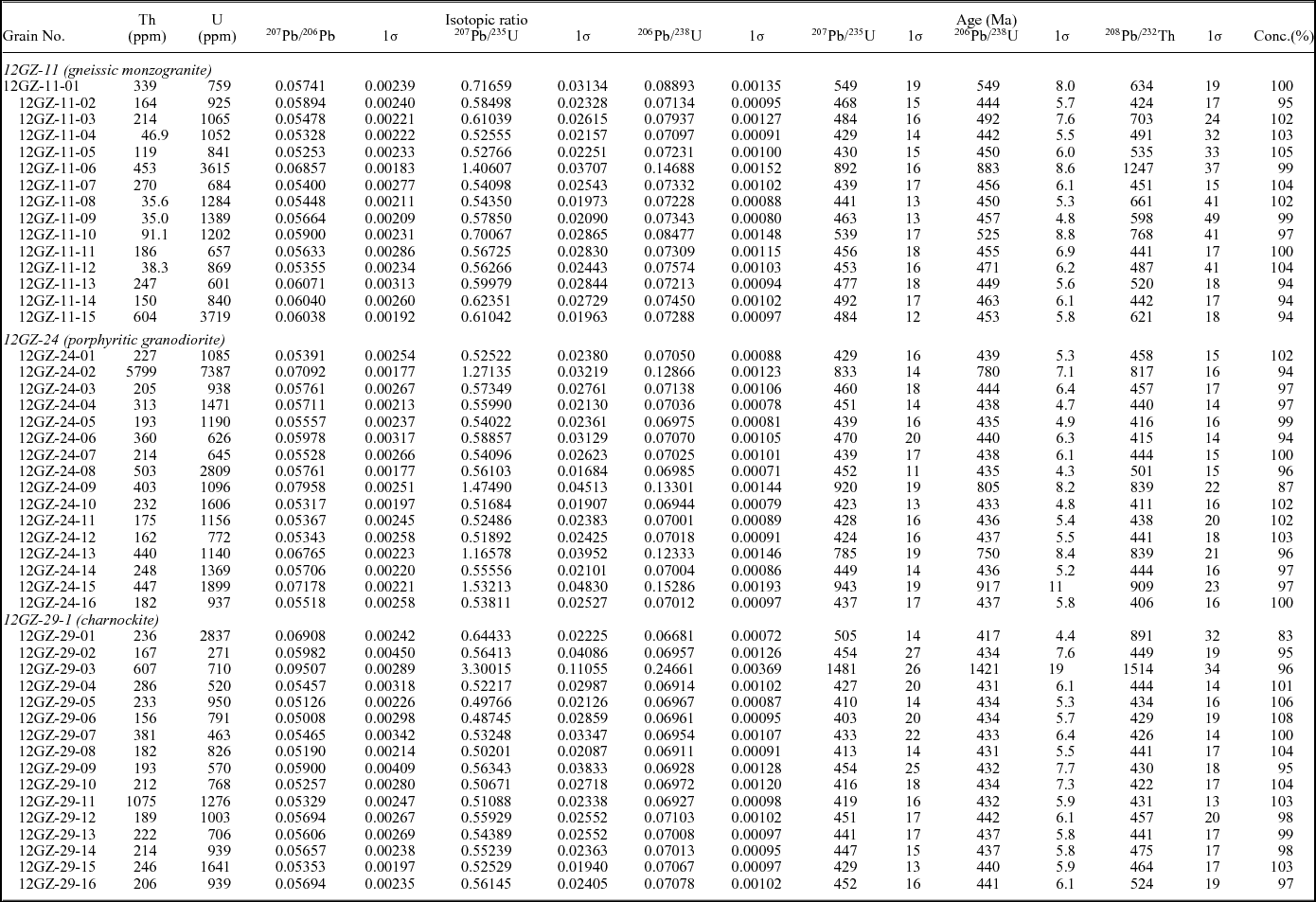
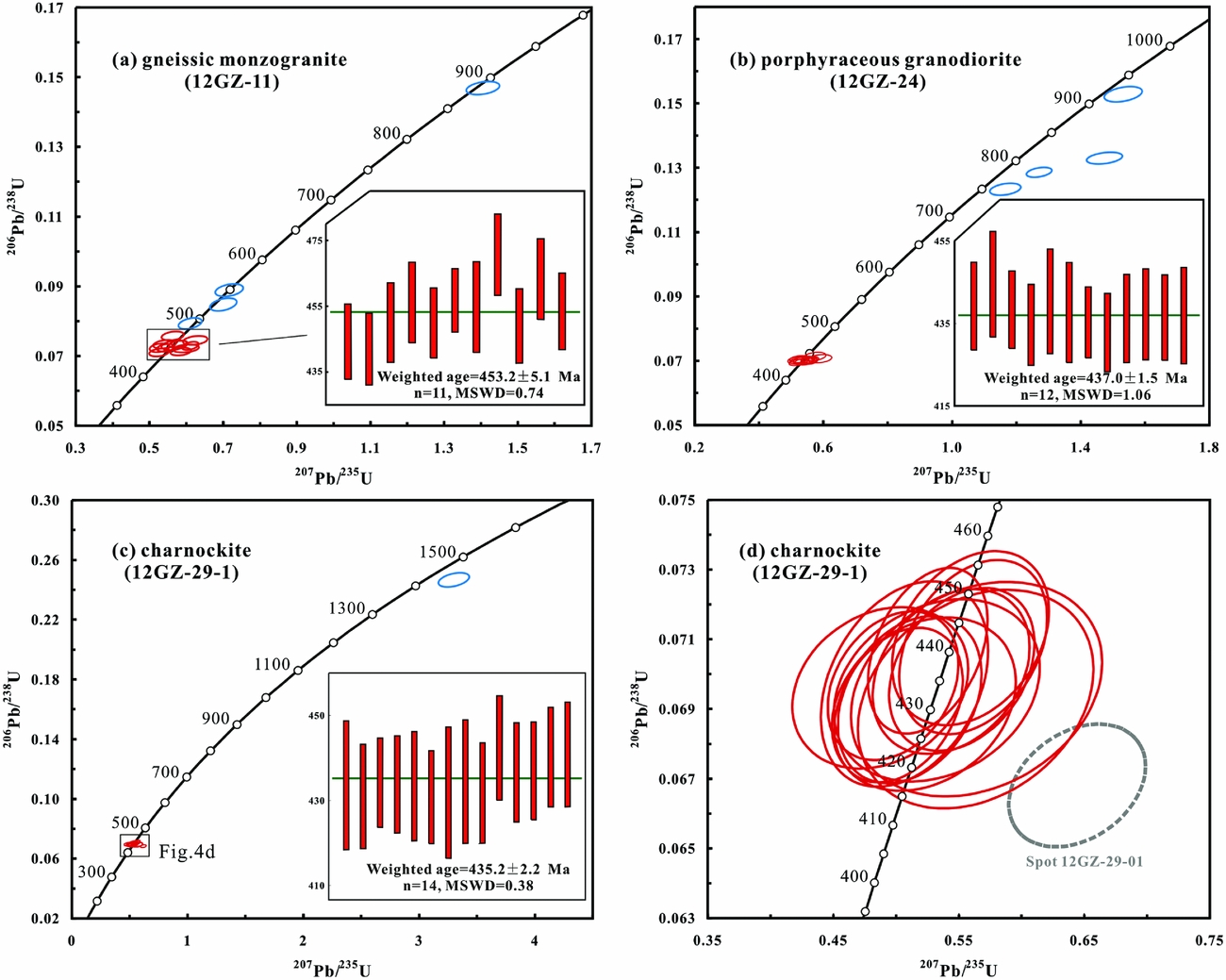
Zircons from the gneissic monzogranite in the Yunkai massif range from ~100 to 150 μm in length, and have length-to-width ratios of ~1.5:1 to 3:1. Most grains are euhedral to subhedral in form, and display clear oscillatory zoning, typical of magmatic origin (Fig. 3a). A total of 15 analyses on 15 zircons gave one Neoproterozoic (883 Ma) and three Early Palaeozoic (549–492 Ma) ages, interpreted to be inherited zircons (Table 1). The other zircons define a concordant weighted mean 206Pb/238U age of 453.2 ± 5.1 Ma (n = 11, MSWD = 0.74) (Fig. 4a). The result is interpreted as the best estimate of the crystallization age of the gneissic monzogranites.
Cathode luminescence (CL) images of typical zircon grains from the Yunkai Early Palaeozoic granitoids showing grain size, locations of the analytical spots and corresponding apparent ages.

U–Pb isotopic ratios and apparent ages of zircons from the Yunkai Early Palaeozoic granitoids.

Conc.(%) is percentage concordance defined as [(206Pb/238U age)/(207Pb/235U age)] × 100.
Decay constants: 235U = 9.8485 × 10⁻¹⁰, 238U = 1.55125 × 10⁻¹⁰, 238U/235U = 137.88.
U–Pb concordia diagrams for zircons from the Yunkai Early Palaeozoic granitoids. Errors are given at 2σ level.

4.1.2. Porphyritic granodiorite (12GZ-24)
Most zircons from the porphyritic granodiorite are subhedral to euhedral in form. The grains range from ~100 to 200 μm in length, and have length-to-width ratios of ~1:1–1:3. Dark inherited cores can be observed in some zircon grains under CL images (Fig. 3b). Sixteen spots on 14 zircon grains were analysed (Table 1). Except for four analyses with Neoproterozoic ages ranging from 917 to 750 Ma, the other 12 analyses give a weighted mean 206Pb/238U age of 437.0 ± 1.5 Ma (n = 12, MSWD = 1.06) (Fig. 4b). This age is interpreted as the crystallization age of the porphyritic granodiorites.
4.1.3. Charnockite (12GZ-29-1)
Zircons from the Yunkai charnockite range from ~120 to 250 μm in length, and have length-to-width ratios of ~2:1 to 4:1. Most grains are euhedral to subhedral in form. Inherited cores have only been observed in three zircon grains under CL images (Fig. 3c). Sixteen spots on 16 grains were analysed (Table 1), and most of them are concordant. Except for one highly discordant analysis (Spot 12GZ-29-01) with elevated U content (2837 ppm) and low Th/U ratio (0.08), the remaining 15 analyses from the samples define two clusters, with the younger one giving a weighted mean 206Pb/238U age of 435.2 ± 2.2 Ma (n = 14, MSWD = 0.38) with Th/U ratios of 0.15–0.84, interpreted as crystallization age (Fig. 4c, d). The other spot on the inherited core with a 206Pb/238U age of 1421 ± 19 Ma is indicative of inherited age (Fig. 4c).
4.2. Bulk-rock major and trace elements
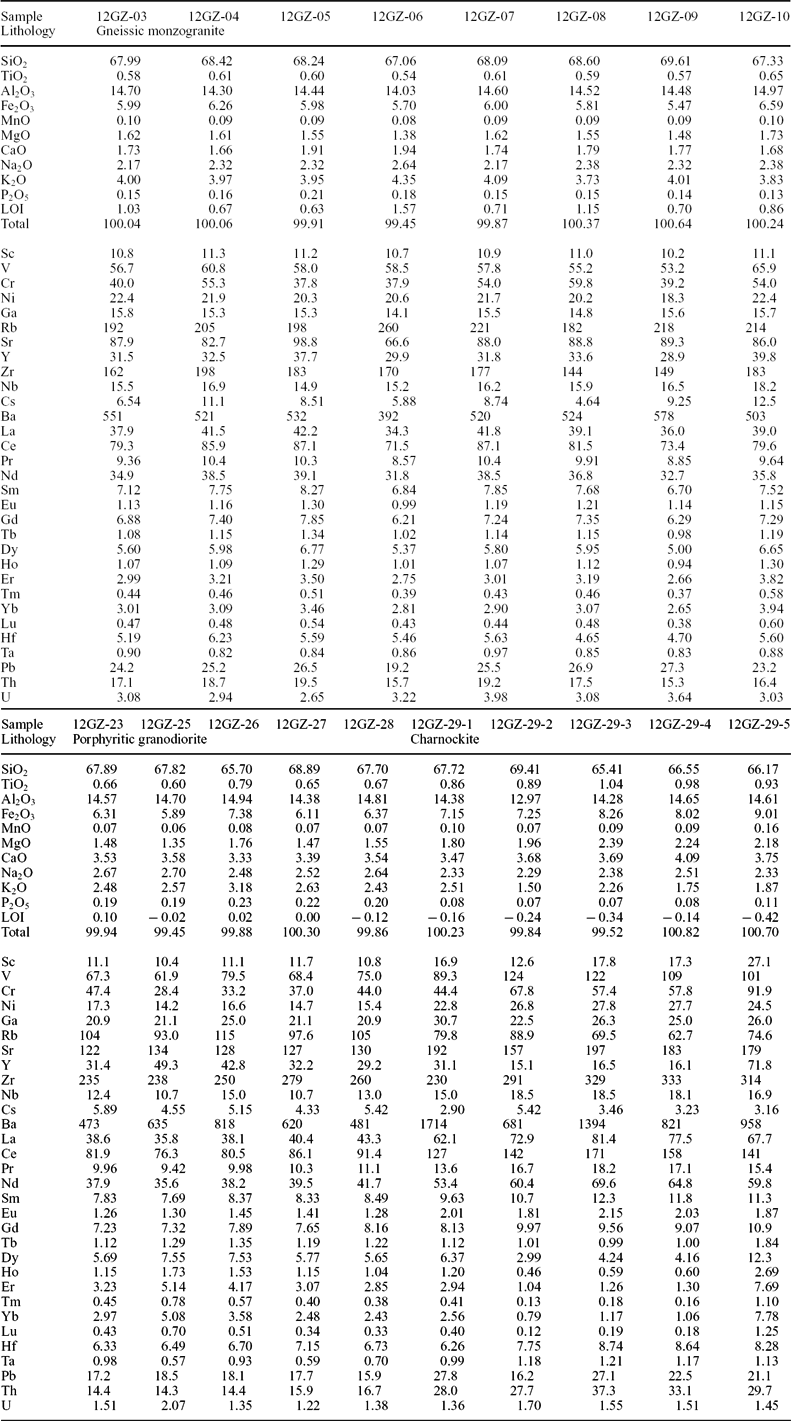
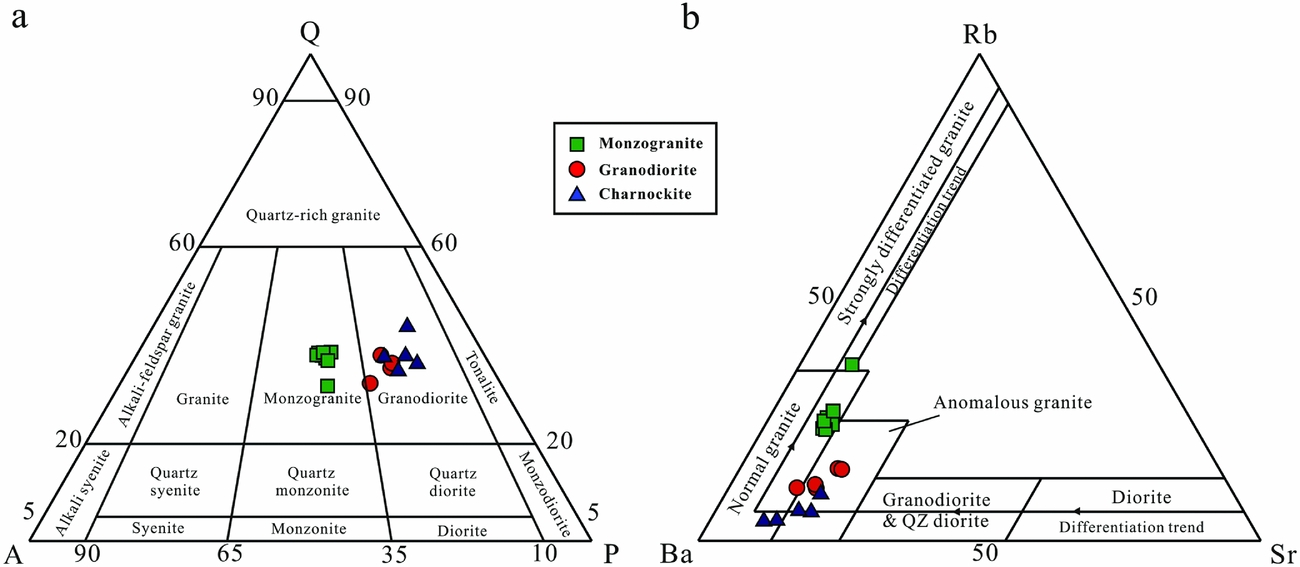
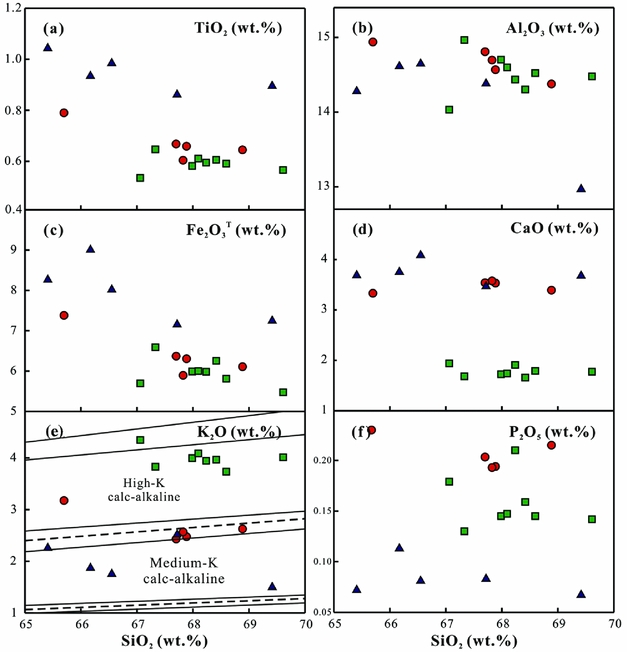
Elemental analyses for the Yunkai granitoids are presented in Table 2. Samples from the gneissic monzogranites (herein grouped as Group 1) have SiO2 of 67.75–69.65 wt. % (on volatile-free), high alkali contents with Na2O of 2.19–2.40 wt. %, K2O of 3.76–4.44 wt. % and relatively low CaO contents (1.66–1.94 wt. %). Modal mineral compositions obtained by point counting and then plotting on the normalized Q-A-P diagram reveal that all the samples fall into the monzogranite field (Fig. 5a). In the plot of Rb–Ba–Sr (Fig. 5b), these samples mainly fall within the field of normal granite, with one sample falling into the field of differentiated granite. They have A/CNK (molar Al2O3/(CaO + Na2O + K2O)) values ranging from 1.12 to 1.34, corresponding to strong peraluminous granites. On the Harker diagram (Fig. 6), Al2O3, Fe2O3T (total Fe expressed in the form of Fe2O3) and TiO2 broadly decrease with increasing SiO2, implying fractional crystallization of plagioclase and Fe–Ti oxides. However, CaO and P2O5 do not show correlations with SiO2, suggesting that significant fractional crystallization of apatites has not occurred. All the monzogranite samples are classified as high-K calc-alkaline series in the K2O vs SiO2 diagram (Fig. 6e).
Major (wt. %) and trace (ppm) elemental compositions of the Yunkai Early Palaeozoic granitoids.

(a) Normative Q-A-P and (b) Rb–Ba–Sr diagram for the Yunkai Early Palaeozoic granitoids.

Harker diagrams of selected major elements against SiO2 for the Yunkai Early Palaeozoic granitoids. K2O vs SiO2 diagram with nomenclature modified after Rickwood (Reference Rickwood1989). Symbols are the same as those in Figure 5.

In contrast, samples from the porphyritic granodiorites and charnockites (herein grouped as Group 2) feature low to medium SiO2 contents from 65.50 wt. % to 69.36 wt. % and higher CaO contents (3.34–4.05 wt. %) than the Group 1 samples. In the Q-A-P diagram (Fig. 5a), they are classified as granodiorite. In the plot of Rb–Ba–Sr (Fig. 5b), they fall within the field of normal granite and anomalous granite. The Group 2 samples possess intermediate to high Al2O3 contents (12.96–14.96 wt. %). The A/CNK values, ranging from 1.07 to 1.15, indicate that the samples are weakly peraluminous to strongly peraluminous. On the Harker diagram (Fig. 6), Fe2O3 and TiO2 decrease with increasing SiO2, whereas other oxides exhibit insignificant trends, consistent with the fractional crystallization of Fe–Ti oxides. Most of the granodiorite and charnockite samples are classified as medium-K calc-alkaline series in the K2O vs SiO2 diagram (Fig. 6e). The Group 2 samples have lower K2O/Na2O ratios (0.70–1.28 vs 1.57–1.88) and Rb/Sr ratios (0.13–0.45 vs 1.00–1.95) but higher REE contents (ΣREE = 196–373 ppm vs 174–214 ppm) than Group 1.
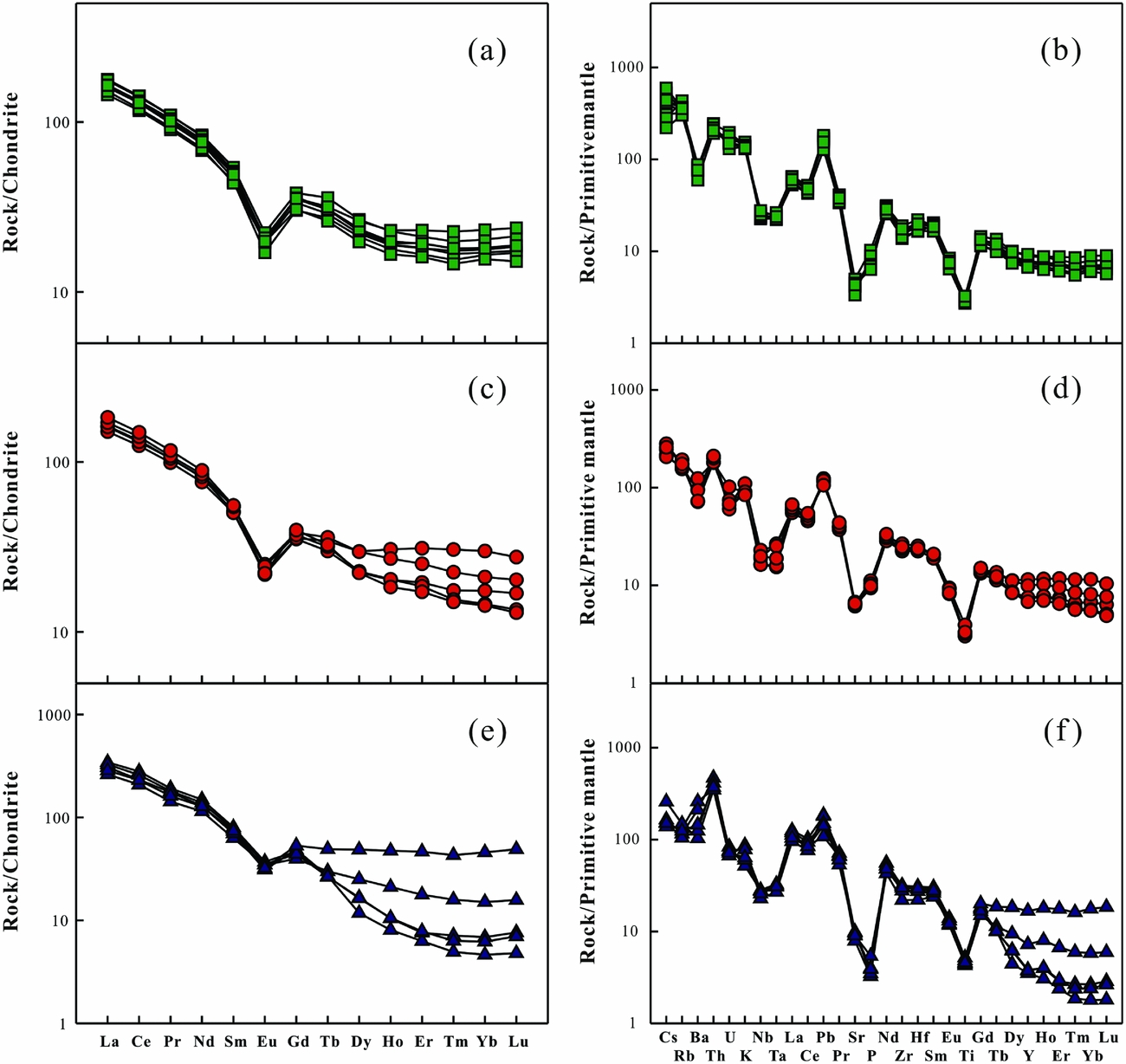
The chondrite-normalized REE patterns for both groups are shown in Figure 7. All the samples show similar fractionated REE patterns ((Gd/Yb)N = 5.05–66.3) featuring light rare earth element (LREE) enrichment and negative Eu anomalies (Eu/Eu* = 0.46–0.68). Overall, the Group 1 samples have relatively low contents of heavy rare earth elements (HREE). In comparison with those of Group 1, the Group 2 samples have variable LREE/HREE ratios with (Gd/Yb)N ratios ranging from 1.16 to 10.45. Large variation of the HREE contents is consistent with the different proportion of garnet in these samples. On the primitive mantle-normalized spiderdiagram (Fig. 7), all samples exhibit negative anomalies of Ba, Sr, HFSEs (Nb, Ta, P, Ti), and positive anomalies of Rb, K, Th, U and Pb elements.
(a) Chondrite normalized REE patterns and (b) primitive mantle normalized spiderdiagrams for the Yunkai Early Palaeozoic granitoids. Primitive mantle normalized values are from McDonough & Sun (Reference McDonough and Sun1995). Chondrite normalized values are from Sun & McDonough (Reference Sun and McDonough1989). Symbols are the same as those in Figure 5.

4.3. Sm–Nd isotope
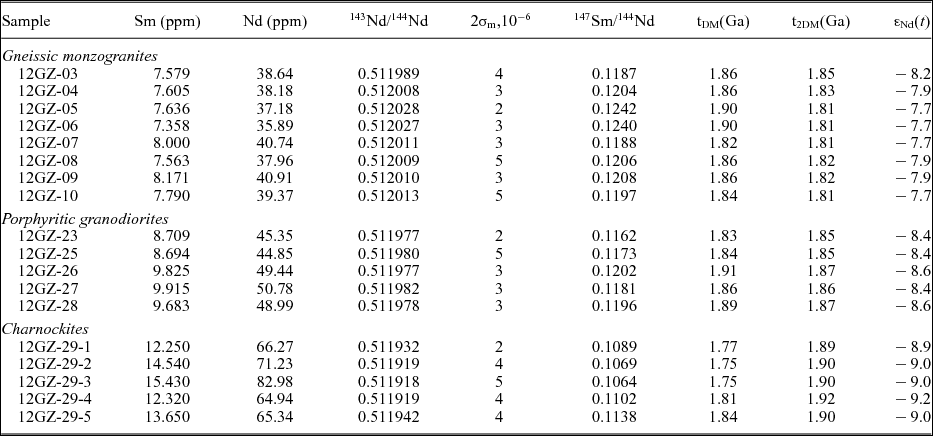
The Sm–Nd isotopic compositions are listed in Table 3. ε Nd(t) values were calculated using the crystallization ages (453 Ma for the Group 1 and 437 Ma for the Group 2 samples, respectively). Two groups of granites revealed relatively restricted Sm–Nd isotopic compositions. The Group 1 samples have ε Nd(t) values ranging from −8.2 to −7.7, corresponding to T DM ages ranging from 1.90 Ga to 1.82 Ga. In contrast, the Group 2 samples have ε Nd(t) values from −8.6 to −8.4 and −9.2 to −8.9, respectively. Their T DM ages range from 1.91 to 1.83 Ga and 1.84 to 1.75 Ga.
Sm–Nd isotopic compositions of the Yunkai Early Palaeozoic granitoids.

Note:
1. Sm, Nd contents are calculated by ID-TIMS, and their uncertainties are better than 5 ‰.
2. In t DM and t 2DM calculation, ratios of (143Nd/144Nd)DM, (147Sm/144Nd)DM and (147Sm/144Nd)CC took values of 0.51315, 0.2137 and 0.118, respectively, while t = 453 Ma for the gneissic monzogranites and t = 435 Ma for the porphyritic granodiorites and charnockites.
3. In ε Nd(t) calculation, ratios of (143Nd/144Nd)CHUR and (147Sm/144Nd)CHUR are 0.512638 and 0.1967, respectively, while t = 453 Ma for the gneissic monzogranites and t = 435 Ma for the porphyritic granodiorites and charnockites.
5. Discussion
5.1. The ages of the Yunkai Early Palaeozoic granitoids
High-precision results of in situ zircon U–Pb dating indicate that all the samples in this study display Early Palaeozoic ages. Recently, Wan et al. (Reference Wan, Liu, Wilde, Cao, Chen, Dong, Song and Du2010) reported SHRIMP zircon U–Pb ages of 443–430 Ma for three granitoids intruded into the Gaozhou complex. Wang et al. (Reference Wang, Zhang, Fan, Zhao, Zhang, Zhang, Zhang and Li2011) reported zircon U–Pb ages of 452–443 Ma for three orthogneisses in the Yunkai Group. Chen et al. (Reference Chen, Liu, Lee, Xiang and Zhou2012) also reported ages of 432.5 ± 3.2 Ma and 433.7 ± 3.5 Ma using the LA-ICP-MS zircon dating technique for two charnockites. In addition, zircon U–Pb ages using the LA-ICP-MS method give ages of 445–441 Ma for gneissic granites in the Yunkai massif (Wang et al. Reference Wang, Long and Zhou2013a). All ages are indistinguishable within error, suggesting that gneissic monzogranites, porphyritic granodiorites and charnockites in the Yunkai massif were intruded at c. 453–435 Ma. These dates are indistinguishable from the range of 450–430 Ma suggested for the Caledonian metamorphic and magmatic rocks in the SCB (Wang et al. Reference Wang, Fan, Zhao, Ji and Peng2007, Reference Wang, Zhang, Fan, Zhao, Zhang, Zhang, Zhang and Li2011; Li et al. Reference Li, Li, Wartho, Clark, Li, Zhang and Bao2010; Chen et al. Reference Chen, Liu, Lee, Xiang and Zhou2012). Further indication of an age difference between the earlier (~453 Ma) gneissic monzogranites and the later (~437–435 Ma) porphyritic granodiorites + chanockites is noteworthy. The findings reveal that the Caledonian magmatism in the Yunkai massif can be further divided at least into two stages.
5.2. Petrogenetic type of the Yunkai Caledonian granitoids
Granitic rocks can be divided into I-, S-, M- and A-types according to the nature of their sources and petrogenesis (Chappell & White, Reference Chappell and White1992). The Caledonian granitoids from the Yunkai massif have extremely negative whole-rock ε Nd(t) values and contain inherited zircons; thus they are not the M-type granites which formed from juvenile mantle-derived materials (Whalen, Reference Whalen1985).
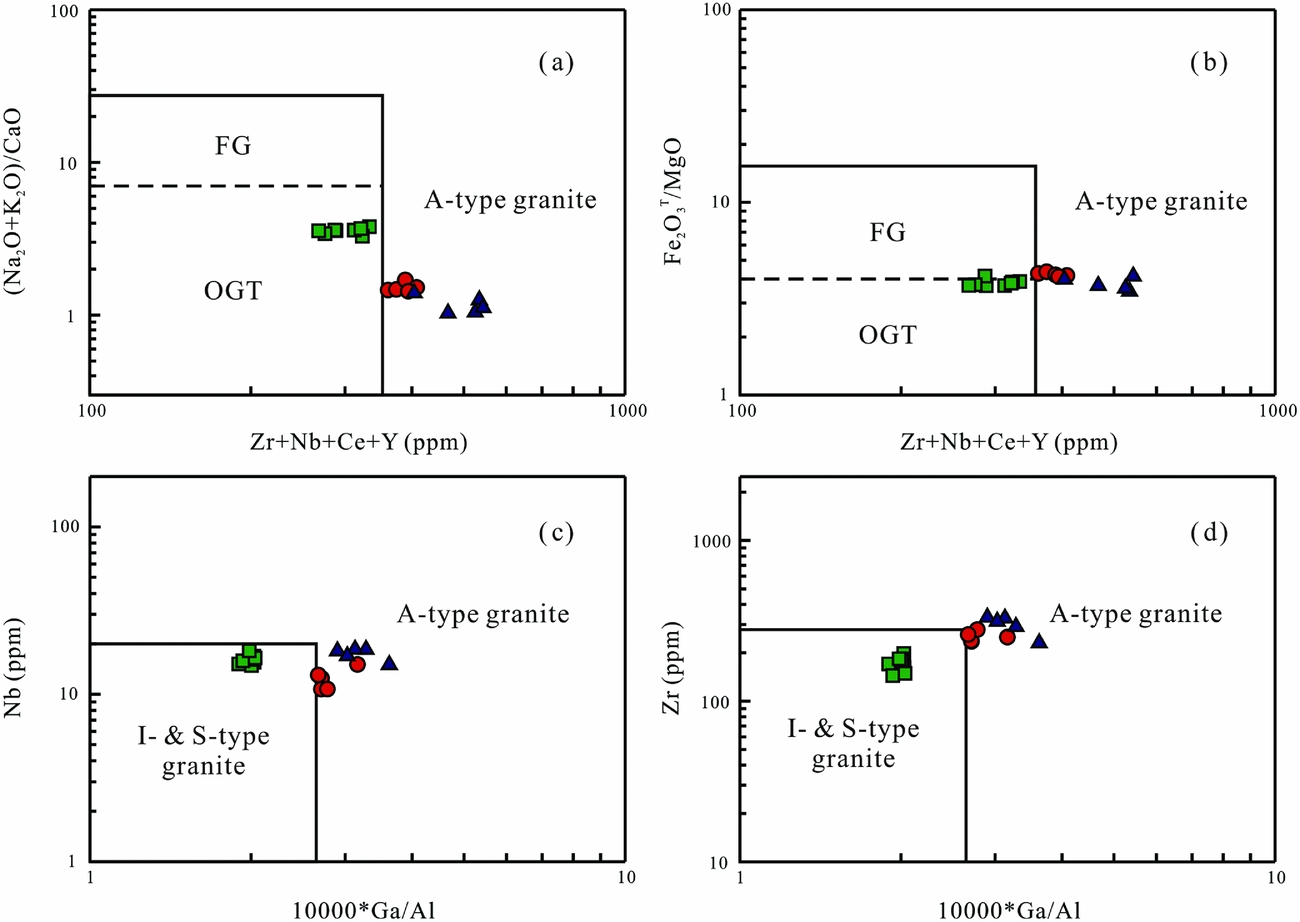
In this study, the monzogranites are strongly peraluminous with CIPW-normative corundum of 1.88–4.17 %. Besides, a P2O5 decrease with increasing SiO2 was not observed. These features are considered to be important criteria for distinguishing S-type from I-type granitoids (Chappell & White, Reference Chappell and White1992). Moreover, I-type granites generally contain amphibole, whereas the S-type granites usually contain minerals such as cordierite or tourmaline, but contain no amphibole (e.g. Jiao et al. Reference Jiao, Li, Huang and Deng2015; Tan et al. Reference Tan, Wang, Zhang, Li, Zhou and Wang2017). The gneissic monzogranites in the Yunkai massif contain tourmaline but carry no amphibole. They show comparable elemental compositions to the S-type granites from the Lachlan Fold Belt (Chappell & White, Reference Chappell and White1992) and have relatively low concentrations of Ce + Nb + Zr + Y (<350 ppm) and (K2O + Na2O)/CaO ratios (3.29–3.79), falling into the unfractionated granite field (Fig. 8) (Whalen, Currie & Chappell, Reference Whalen, Currie and Chappell1987). In addition, they have low Fe2O3T/MgO (3.69–4.14) and Sm/Nd ratios (0.20–0.22), also precluding intensive fractionation (Thuy et al. Reference Thuy, Satir, Siebel, Vennemann and Long2004; Qin et al. Reference Qin, Wu, Wang, Gao, Zhu, Zhou and Yang2014). Therefore, the studied monzogranites are classified as typical S-type granite.
(a) (K2O + Na2O)/CaO and (b) Fe2O3T/MgO vs Zr + Nb + Ce + Y and (c) Nb and (d) Zr vs 10000Ga/Al discrimination diagrams of Whalen, Currie & Chappell (Reference Whalen, Currie and Chappell1987) for the Yunkai Early Palaeozoic granitoids (FG: fractionated I-, M- and S-type granites; OGT: unfractionated I-, M- and S-type granites). Symbols are the same as those in Figure 5.

Conversely, the granodiorites and charnockites show high contents of total alkalis, HFSEs, REEs (except for Eu) and high Ga/Al ratios, as well as depletion in Ba, Sr, Ti and Eu, resembling those of typical A-type granites worldwide (e.g. Eby, Reference Eby1992; Anderson, Frost & Frost, Reference Anderson, Frost and Frost2003; Isseini et al. Reference Isseini, André-Mayer, Vanderhaeghe, Barbey and Deloule2012; Lei et al. Reference Lei, Wu, Chi, Gu, Dong, Qu, Jiang and Jiang2013; Johansson et al. Reference Johansson, Waight, Andersen and Simonsen2016). They also plot in the A-type granite field in the various chemical classification diagrams of Zr vs 10000Ga/Al, Nb vs 10000Ga/Al (Fig. 8) (Whalen, Currie & Chappell, Reference Whalen, Currie and Chappell1987). Also, all the granodiorites and charnockites in this study have relatively low concentrations of SiO2 (<70 wt. %) and low (K2O + Na2O)/CaO ratios (1.03–1.70), but high (Ce + Nb + Zr + Y) concentrations, suggesting that they are unfractionated A-type granites rather than fractionated I-type granites. Classification of A-type granites is also supported by the presence of minerals such as hypersthene, sphene and alkali perthite (e.g. Wormald & Price, Reference Wormald and Price1988; Bonin, Reference Bonin2007).
5.3. Petrogenesis and P–T conditions of the Yunkai Caledonian granitoids
All the studied samples are peraluminous rocks, implying that metasedimentary and/or metaigneous rocks might be involved in their petrogenesis (Kalsbeek, Jepsen & Nutman, Reference Kalsbeek, Jepsen and Nutman2001). Compositional variation of the samples probably resulted from fractional crystallization, magma mixing or partial melting. As mentioned above, the granites show decrease of Al2O3, Fe2O3T and TiO2 with SiO2 increase, and have pronounced negative Eu, Sr and Ba anomalies, indicating fractionation of plagioclase, biotite and K-feldspar. Negative Ti anomalies also indicate the fractionation of Fe–Ti oxides. However, the relatively low SiO2 contents (<70 wt. %) of the rocks mean that the fractionation process may not be a dominant mechanism. This is also consistent with their relatively low (K2O + Na2O)/CaO and Fe2O3T/MgO ratios. In the plot of Rb–Ba–Sr (Fig. 5b), most samples plot into the field of normal granite, also precluding the strong differentiated process. In addition, magma mixing of mafic and felsic magmas is impossible, since the granitoids have relatively consistent elemental geochemical features with extremely negative ε Nd(t) values, and no correlations between MgO and Nd isotopic compositions are observed. Magma mixing is also precluded by the absence of mafic microgranular enclaves (MME) (e.g. Barbarin, Reference Barbarin1988) in these granitic rocks. Therefore, we consider the chemical variations of the Yunkai granitoids to be mainly related to partial melting processes in the source region.
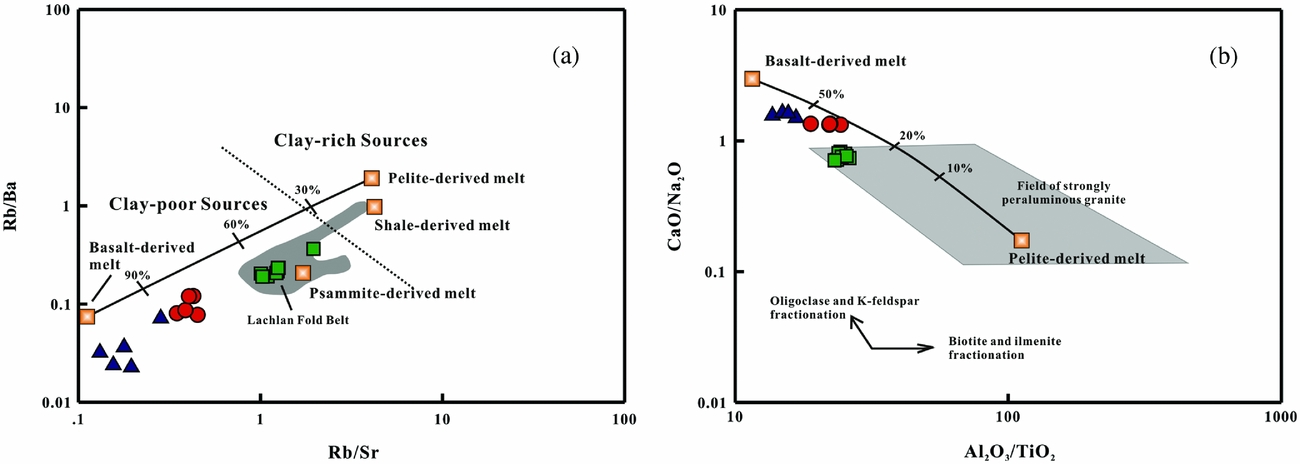
Compositional differences of the granitic magmas produced by partial melting of different sources (e.g. amphibolites, metagreywackes or metapelites) under various melting conditions can be distinguished in terms of molar oxides (e.g. Al2O3/TiO2 vs CaO/Na2O) or Rb/Ba vs Rb/Sr ratios (e.g. Patiño Douce & Harris, Reference Patiño Douce and Harris1998; Sylvester, Reference Sylvester1998; Altherr et al. Reference Altherr, Holl, Hegner, Langer and Kreuzer2000). The monzogranites have higher Rb/Sr but lower Sr/Ba and CaO/Na2O and CaO/(MgO + Fe2O3T) ratios. In the plot of Rb/Sr and Rb/Ba, they all fall within the field of clay-poor, plagioclase-rich psammitic source (Fig. 9), pointing to the dehydration-melting processes of biotite-bearing metagreywacke (Sylvester, Reference Sylvester1998). In addition, they contain Neoproterozoic to Early Palaeozoic inherited zircon grains and have Palaeoproterozoic Nd model ages, consistent with the age spectra and Nd isotopic compositions of the predominantly Neoproterzoic to Early Palaeozoic paragneisses in the Yunkai massif (e.g. Wan et al. Reference Wan, Liu, Wilde, Cao, Chen, Dong, Song and Du2010; Long et al. Reference Long, Xu, Wang, Zhou, Jin and Zhang2012). Thus, we suggest that the monzogranites might be derived from partial melting of the Yunkai paragneisses, including biotite dehydration reactions.
(a) Rb/Sr vs Rb/Ba and (b) Al2O3/TiO2 vs CaO/Na2O for the Yunkai Early Palaeozoic granitoids. The mixing curve between the basalt- and pelite-derived melts is from Patiño Douce & Harris (Reference Patiño Douce and Harris1998) and Sylvester (Reference Sylvester1998). Field of strongly peraluminous granites is from Sylvester (Reference Sylvester1998). Compositions for the granites from the Lachlan Fold Belt are from Chappell & White (Reference Chappell and White1992). Symbols are the same as those in Figure 5.

Conversely, the granodiorites and charnockites have higher Sr/Ba but lower Al2O3/TiO2, Al2O3/(MgO + Fe2O3T) plotting into the field close to the metabasaltic source with a higher feldspar/biotite ratio (Fig. 9), suggesting that they might have originated from a basaltic source region. As discussed above, the two types of granites belong to the typical A-type granites. So far, there has been no consensus on the petrogenesis of A-type granites (Bonin, Reference Bonin2007). The A-type granites generally fall into two categories, involving derivation from mantle-derived basaltic magma followed by differentiation (Turner, Foden & Morrison, Reference Turner, Foden and Morrison1992; Anderson, Frost & Frost, Reference Anderson, Frost and Frost2003), or partial melting of specific continental crustal protoliths (Collins et al. Reference Collins, Beams, White and Chappell1982; Creaser, Price & Wormald, Reference Creaser, Price and Wormald1991; Peng et al., Reference Peng, Wu, Gao, Zhang, Wang, Liu, Gong, Zhou, Hu, Liu and Yuan2012). The high Rb/Sr ratios and significant negative ε Nd(t) values suggest that the studied granodiorites and charnockites cannot be derived from mantle-derived magmas. Two models can be further proposed in regard to the crustal origin: (1) low degree of partial melting of dry, F−, Cl− enriched granulitic residue depleted by prior extraction of granitic melt (Collins et al. Reference Collins, Beams, White and Chappell1982); and (2) remelting of calc-alkaline granitoids (tonalite or granodiorite) at low pressure or high temperatures (Patiño Douce, Reference Patiño Douce1997).
Patiño Douce (Reference Patiño Douce1997) proposed that high-temperature dehydration melting of tonalite or granodiorite with a plagioclase-rich residual at 0.4–0.8 GPa can produce SiO2-enriched metaluminous A-type magmas, which are depleted in Al2O3 relative to alkalis and in MgO relative to TiO2. However, this cannot account for the peraluminous feature as well as relatively low (Na2O + K2O)/Al2O3, TiO2/MgO ratios and SiO2 contents of the Yunkai porphyritic granodiorites and charnockites. In contrast, experimental studies show that partial melting of crustal rocks can produce refractory granulitic residues, which have low (Na2O + K2O)/Al2O3 and TiO2/MgO ratios (Patiño Douce & Beard, Reference Patiño Douce and Beard1995, Reference Patiño Douce and Beard1996). Remelting of these residues is capable of generating peraluminous A-type granites with low (Na2O + K2O)/Al2O3 and TiO2/MgO ratios, consistent with the geochemical features of the Yunkai porphyritic granodiorites and charnockites. In addition, hypersthene–plagioclase granulitic and hypersthene–garnet granulitic enclaves are commonly observed in the charnockites (Peng et al. Reference Peng, Jin, Liu, Fu, He, Cai and Wang2006). They have massive structures, with sharp contacts, providing a likely source for the Yunkai Caledonian granodiorites and charnockites. Thus, we consider that the Yunkai ~435 Ma A-type granites might be produced by partial melting of refractory granulitic residues.
5.4. Tectonic implications
The Caledonian tectonic regime of the SCB has long been debated (e.g. Hsü et al. Reference Hsü, Li, Chen, Wang, Sun and Sengör1990; Charvet et al. Reference Charvet, Shu, Faure, Choulet, Wang, Lu and Breton2010; Faure et al. Reference Faure, Shu, Wang, Charvet, Choulet and Monie2010). The orogeny has been regarded as a consequence of continental or arc collisions (Guo et al. Reference Guo, Shi, Lu, Ma, Dong and Yang1989; Hsü et al. Reference Hsü, Li, Chen, Wang, Sun and Sengör1990). But, with increasing detailed geological studies, more and more evidence has suggested that the Early Palaeozoic orogeny in the SCB might be an intraplate orogeny (e.g. Shu et al. Reference Shu, Yu, Jia, Wang, Shen and Zhang2008, Reference Shu, Wang, Cawood, Santosh and Xu2015; Charvet et al. Reference Charvet, Shu, Faure, Choulet, Wang, Lu and Breton2010; Faure et al. Reference Faure, Shu, Wang, Charvet, Choulet and Monie2010; Wan et al. Reference Wan, Liu, Wilde, Cao, Chen, Dong, Song and Du2010; Chen et al. Reference Chen, Liu, Lee, Xiang and Zhou2012; Huang et al. Reference Huang, Yu, Li, Tong and Chen2013; Wang et al. Reference Wang, Long and Zhou2013a, Reference Wang, Fan, Zhang and Zhangb; Li et al. Reference Li, Li, Zhao, Yang, Liu, Guo, Wang, Hao, Zhang and Hu2016; Yan et al. Reference Yan, Shu, Faure, Chen and Li2017). Ophiolite suite and oceanic subduction-related calc-alkaline magmatism during the Early Palaeozoic are absent in the South China block. Furthermore, lithofacies palaeogeography of the South China block and palaeocurrent indicators in the Cambrian–Ordovician strata also suggest a northwestward sedimentary transport from the eastern Cathaysia block (e.g. Shu et al. Reference Shu, Yu, Jia, Wang, Shen and Zhang2008). Recently, Yan et al. (Reference Yan, Shu, Faure, Chen and Li2017) proposed that the intraplate orogeny is likely caused by a suspected East China Sea block subduction northwestward beneath the southeastern SCB together with the northwestern SCB subducted southeastward beneath the southeastern SCB.
Documented geochronological studies show that the Caledonian igneous rocks in the eastern SCB consist predominantly of granitoids and minor basaltic igneous rocks formed between 464 and 398 Ma with a cluster at 446–420 Ma (Wang et al. Reference Wang, Fan, Zhang and Zhang2013b; Zhong et al. Reference Zhong, Wang, Zhao, Liu, Ma, Zheng, Zhang and Luo2016). These igneous rocks mainly crop out in the Wuyi–Yunkai domain, but some are also distributed along both sides of the boundary between the Yangtze and Cathaysia blocks. Granites to the east of the Jiangshan–Shaoxing Fault were slightly earlier than the Caledonian granitoids to the west of the Fault. They generally do not exhibit younging trends propagating from east (coastal provinces) to west (the Xuefeng Domian) or from south (Yunkai) to north (Jiangnan). Previous studies of the magmatism also reveal that the onset time of the Caledonian orogenic event should not be later than 460 Ma. Granitoids older than 460 Ma are mainly concentrated along the Wuyi–Yunkai domain and are predominantly S-type granites, synchronous with the peak metamorphism of the orogeny, considered as compressional-related syn-orogenic granites (Shu et al. Reference Shu, Yu, Jia, Wang, Shen and Zhang2008; Huang et al. Reference Huang, Yu, Li, Tong and Chen2013; Xia et al. Reference Xia, Xu, Zou and Liu2014). However, the transition time from compression to extension of the event is still unclear, for the Caledonian A-type granites in the Yunkai massif have rarely been reported (Peng et al. Reference Peng, Jin, Liu, Fu, He, Cai and Wang2006). A-type granites can be emplaced in a variety of tectonic settings (Eby, Reference Eby1992), but are commonly considered as fundamental evidence for an overall non-compressional tectonic setting (Bonin, Reference Bonin2007; Dall'Agnol, Frost & Rämö, Reference Dall'Agnol, Frost and Rämö2012).
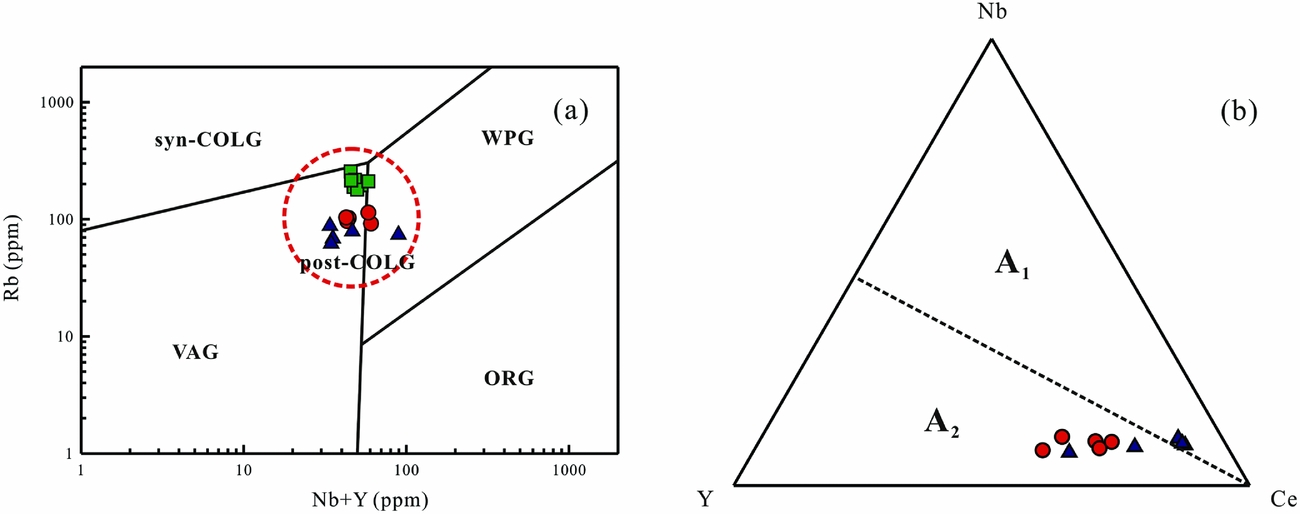
In this study, both Caledonian S-type and A-type granites are identified in the Yunkai massif. Our U–Pb dating results revealed that the earlier-stage S-type granites were formed at ~453 Ma, whereas the later-stage A-type granites were formed at ~435 Ma. In the tectonic discrimination diagrams, both S-type and A-type granites are plotted in the post-collisional granite field (Fig. 10a). In the case of the intracontinental orogeny of the SCB, it is unlikely that the origin of the A-type granites is related to an anorogenic setting, or extensional environment associated with subduction involving oceanic crust. Eby (Reference Eby1992) subdivided A-type granites into A1 and A2 groups. The A1 group represents alkaline magmas emplaced in an anorogenic setting, such as continental rift or intraplate environments, whereas the A2 group is derived from melting of continental crust or underplated mafic crust and emplaced in post-collisional settings. In the Y–Nb–Ce diagram, the Yunkai granodiorites and charnockites are mainly plotted into the A2 groups (Fig. 10b). Thus, a high-heat flow extensional environment involving the post-collision is the most likely scenario. These are the earliest post-collisional A-type granitoids reported in the Yunkai massif. They can be considered as the products of orogenic collapse at a post-collisional extension setting starting from ~450–435 Ma.
(a) Rb vs Nb + Y (after Pearce, Harris & Tindle, Reference Pearce, Harris and Tindle1984) and (b) Nb–Ce–Y diagram (Eby, Reference Eby1992) for the Yunkai Early Palaeozoic granitoids. WPG: within-plate granite; VAG: volcanic arc granites; syn-COLG: syn-collision granites; ORG: ocean ridge granites. Symbols are the same as those in Figure 5.

Actually, extension-related magmatisms have also been reported in other parts of the SCB, i.e. the ~436 Ma Taishan I-type granodiorites in the inner Cathaysia blocks (Huang et al. Reference Huang, Yu, Li, Tong and Chen2013), the ~415 Ma A-type granites in Jiangxi Province (Feng et al. Reference Feng, Zhao, Ling, Chen, Chen, Sun, Jiang and Pu2014), the ~410 Ma Xiawan and Duntou post-collisional I-type granites (Xia et al. Reference Xia, Xu, Zou and Liu2014) and the ~410 Ma Xiqin A-type granites in the northeastern Cathaysia block (Cai et al. Reference Cai, Tang, Zhang, Lv and Liu2017). Recently, a few extension-related mafic to ultramafic rocks have also been reported, such as the ~441–438 Ma Dakang gabbroic plutons (Zhang et al. Reference Zhang, Jiang, Wang, Liu, Ni and Long2015), the ~435 Ma Chayuanshan high-Mg basalts (Yao et al. Reference Yao, Li, Li, Wang, Yang and Li2012) and the ~434–420 Ma Longhugang, Xinchuan and Xinsi gabbros in the Yunkai and northern Guangdong areas (Wang et al. Reference Wang, Zhang, Fan, Zhang and Zhang2013c). Thus, the recognition of the timing and composition of the S-type gneissic monzogranites and the A-type granodiorites and charnockites in this study provides further constraints on the geodynamic transition from orogenic compression to post-orogenic extension at ~450–435 Ma.
6. Conclusions
From this study we can draw the following conclusions:
(1) Zircon U–Pb dating indicates that the gneissic monzogranites in the Yunkai massif were formed at 453.2 ± 5.1 Ma, whereas the porphyritic granodiorites and charnockites were generated at 437.0 ± 1.5 Ma and 435.2 ± 2.2 Ma, respectively, comtemporaneous with the widespread Early Palaeozoic (Caledonian) magmatism in the South China block.
(2) The gneissic monzogranites are S-type granites, formed by partial melting of the Neoproterozoic to Early Palaeozoic immature metagreywackes, whereas the porphyritic granodiorites and charnockites are A2-type granites, derived from a low degree of partial melting of the dry, granulitic residue depleted by prior extraction of granitic melt.
(3) The Caledonian granitoids in the Yunkai massif were formed in a post-collisional tectonic setting. A tectonic regime switching from compression to extension could have occurred as early as the Late Ordovician to Early Silurian (~450–435 Ma).
Acknowledgements
We thank editor Chad Deering and three anonymous reviewers for their thorough reviews and constructive criticisms. We appreciate the assistance of Dr X. M. Liu for the zircon LA-ICP-MS U–Pb dating. This study was supported by National Nature Science Foundation of China (Grants 41303026), the funded project of the China Geological Survey (Nos. 121201004000161412, 121201009000160902).