Introduction
Conopomorpha sinensis (C. sinensis) Bradley (Lepidoptera: Gracilariidae) is a major fruit borer pest of litchi and longan in Southeast Asia and Southern China (Yao & Liu, Reference Yao and Liu1990). Laying eggs on the fruit any time after flowering. The eggs hatch and the larvae immediately penetrate the fruits, feeding on the seed neck and causing additional harm by infecting the fruits with a vast variety of microorganisms that eventually destroy the crop (Thanh et al., Reference Thanh, Hai and Lachance2006; Wang et al., Reference Wang, Huang, Liang and Zeng2008). Control of the C. sinensis pest is hampered because the larvae live inside the plants. Most pesticides not only kill a large number of beneficial natural enemies, but also result in pesticide residues in the fruit and ecological harm via environmental pollution (Yi et al., Reference Yi, Wang and Huo2002; Chen et al., Reference Chen, Dong and Lu2010), both of which have serious impacts on human health and safety.
Generalist predators play a major role in the sustainable biological control of agricultural pests (Legaspi et al., Reference Legaspi, Legaspi, Meagher and Ciomperlik1996; Symondson et al., Reference Symondson, Glen, Wiltshire, Langdon and Liddell1996, Reference Symondson, Glen, Ives, Langdon and Wiltshire2002b ; Symondson, Reference Symondson2002a ; Foltan et al., Reference Foltan, Sheppard, Konvicka and Symondson2005). Arthropod predators have been identified as one of the most important factors in pest population control (Crocker & Whitcomb, Reference Crocker and Whitcomb1980; Luff, Reference Luff1983). Different methods of measuring predation efficiency on pests have been extensively studied. One traditional method is observation in the laboratory or in the field (Hengeveld, Reference Hengeveld1980), but predators and prey are often small, mobile, or live under dense vegetation, and arthropod predator–prey interactions are often difficult to observe, complicating the assessment of predation impact. One way to overcome these obstacles is through the analysis of the gut contents of field-collected predators (Kuusk et al., Reference Kuusk, Cassel-Lundhagen, Kvarnheden and Ekbom2008). This has primarily been performed by the biochemical research methods, such as immunolabeling techniques, monoclonal antibodies, marked radioisotopes, and protein electrophoresis analysis (Sunderland, Reference Sunderland and Symondson1996; Harwood & Obrycki, Reference Harwood and Obrycki2005). However, the practical applicability of these techniques is restricted in ecosystems that show high-species diversity (Symondson, Reference Symondson2002a ). Such diversity also influences the accuracy of the evaluation of predation, although some researchers have achieved a certain level of success (Zaidi et al., Reference Zaidi, Jaal, Hawkes, Hemingway and Symondson1999).
Recently, modern molecular biology techniques have been applied to detect pest residues in predators’ digestive tracts. Such techniques focus on conserved genetic regions, including the ribosomal internal transcribed spacer region, mitochondrial DNA, sequence characterized amplified regions (SCARs), and cytochrome c oxidase I and II (COI and COII) genetic markers (Agustí et al., Reference Agustí, De Vicente and Gabarra1999; Hoogendoorn & Heimpel, Reference Hoogendoorn and Heimpel2001; Gao et al., Reference Gao, Han, Zhao, Fan and Liu2006a ). Techniques using the polymerase chain reaction (PCR), in which the prey-specific DNA sequences are detected within the gut contents of predators, improve sensitivity and have the additional advantages of technical simplicity and rapid results. Such techniques have already been widely applied to investigate predator–prey interactions in entomology research (Gao et al., Reference Gao, Han, Zhao, Fan and Liu2006a ; Kuusk et al., Reference Kuusk, Cassel-Lundhagen, Kvarnheden and Ekbom2008; Song et al., Reference Song, Cong, Qian and Dong2008; Sint et al., Reference Sint, Raso, Kaufmann and Traugott2011).
The purpose of the present study was to develop an efficient tool for the identification of key predators of C. sinensis, with a higher degree of accuracy than previous studies (Wu et al., Reference Wu, Chen, Xu and Zhu1999; Gao et al., Reference Gao, Wu and Liang2006b ; Winson et al., Reference Winson, Liang, Liu and Chen2007a , Reference Winson, You and Liang b ). To do this, we firstly confirmed that DNA molecular markers can detect the C. sinensis species accurately by the specific primers. We then did a screening to find the dominant species of C. sinensis predators in the field and, finally, assessed the predation of two key predators (Menochilus sexmaculata adult and Propylea japonica adult) of C. sinensis through experimental evaluation of functional response and DNA detection periods. This approach provides an important theoretical basis for identifying the spectrum of predatory natural enemies and the development of sustainable control methods for C. sinensis.
Materials and methods
Sampling
The litchi orchard chosen for sampling was collected from Huangwei village, Conghua city, Guangdong Province, China, a region dominated by a subtropical monsoon climate, with distinct dry and wet seasons. The sampled area comprises a farmland ecosystem without any pesticide use. Between March 2012 and February 2013, arthropods from the litchi orchard were collected monthly by net for field assay. M. sexmaculata, P. japonica, and C. sinensis were collected for feeding experiments and were raised in the insectary of the insect and mouse ecological control research center, Guangdong Entomological Institute (temperature: 26±1 °C; photoperiod: L14: D10; relative humidity (RH): 60–80%).
DNA extraction, amplification, and verification of the species specificity of primers for C. sinensis
Prey DNA was extracted according to the method of An et al. (Reference An, Tan and Chen2002). Predator individuals were cleaned with ddH2O before being homogenized with a pestle at −20 °C for 5 min in 150 μl extraction buffer A (1% SDS, 50 mmol l−1 Tris–HCl, 25 mmol l−1 NaCl, and 25 mmol l−1 EDTA) in a 1.5 ml centrifuge tube. The mixture was then heated in 65 °C water for 45 min, and was mixed twice during this time. After this incubation and mixing, the same volume of extraction buffer B [3 mol l−1 KaliiAcetas (KAC, pH 7.2)] was added and the mixture was incubated on ice for 1 h. The solution was then transferred to a spin column, which was placed in a clean 1.5 ml centrifuge tube, centrifuged at 12,000 r min−1 for 10 min, transferred to a new, clean 1.5 ml centrifuge tube, and centrifuged again at 12,000 r min−1 for 10 min. An equal volume of cold absolute ethanol was then added, twice. The solution was then mixed and incubated at −20 °C for 1 h. Finally, it was centrifuged at 12,000 r min−1 for 10 min. The supernatant was removed and the pellets were washed twice with 70% ethyl alcohol, and then dried at room temperature (26±1 °C). The extracted DNA was finally dissolved in 50 μl 0.1×TE. The pure DNA extract integrity was verified by gel electrophoresis in 1% agarose gel, stained with GoldView (New Probe, China).
The C. sinensis-specific primer pair A (CsCOI – F:5′-CGAGCAGAATTGGGTAATCCAG-3′; CsCOI – R: 5′-CTACTGATCTTCCCCCATGAGC-3′) was designed using the sequence of C. sinensis COI (GenBank: HQ824810.1) using primer premier 5.0 software (Premier Biosoft, Palo Alto, CA, USA). For the PCR, primer pair A was used in 25 μl volume reactions containing 0.5 μl Taq DNA polymerase, 2 μl dNTPs, 2.5 μl 10×buffer, 1 μl of each primer, 1 μl of total DNA, and 17 μl ddH2O (TaKaRa, Japan). Amplification was performed in an Eppendorf Mastercycler ep (Eppendorf, Hamburg, Germany), with PCR-negative controls containing ddH2O instead of template DNA. The amplification profile was as follows: one denaturation step at 94 °C for 5 min, then 35 cycles of 94 °C for 30 s, 50 °C for 30 s, and 72 °C for 1 min;followed by a final extension at 72 °C for 5 min. To check the results, 5 μl of PCR products were run in a 1.0% agarose gel stained with GoldView in 0.5×TBE buffer (45 mmol l−1 Tris–HCl, 1 mmol l−1 EDTA) (Sangon, China), and the amplification products were analyzed by comparison with a DNA size marker (TaKaRa, Japan) run in parallel on the same gel.
The specificity of primer pair A was tested by PCR with DNA extracted from 27 other starved arthropods and three related species of C. sinensis from the litchi orchard (fig. 1), in order to avoid false positives. The DNA extract of C. sinensis was used as a positive control, and ddH2O was used as a negative control in the PCR.
PCR amplification of some species in litchi orchards using primer pair A. M: DNA marker; 1: Negative control; 2: Positive control adult of C. sinensis; 3: Henosepilachna vigintioctopunctata; 4: P. japonica; 5: L. imidiate; 6: M. sexmaculata; 7: Scymnus pullus (sp.); 8: Litchiomyia chinensis; 9: Chiagosnius (sp.); 10: Larva of Chrysopa sinica; 11: Adult of C. sinica; 12: Conopomorpha litchielle; 13: Ascotis selenaria; 14: Teraponera nigar; 15: Crematogaster (sp.); 16: Tapinoma melanocephalum; 17: Aphidoidea (sp.); 18: Geisha distinctissima; 19: Tetranychus cinnbarinus; 20: Bactrocera dorsalis; 21: Oxya (sp.); 22: Scipinia horrida; 23: Nezara viridula; 24: Olethreutes leucaspis; 25: Theridion octomaculatum; 26: L. magnifica; 27: Runcinia albostriata; 28: O. sertatus; 29: Asemonea tanikawai (sp.); 30: Erigonidium graminicolum; 31: Mantidae (sp.); 32: Labiidae (sp.).

Field assay
Arthropods collected from the same litchi orchard as the C. sinensis were identified to the species level. All predators were frozen immediately upon collection at −20 °C. Predator DNA extracts were tested for consumption of C. sinensis using primer pair A and the PCR protocol described above. The percentage of samples testing positive by PCR was calculated.
Functional response assay for predation of C. sinensis
A functional response assay was conducted for each of the two ladybug species (M. sexmaculata adult and P. japonica adult). Each species was investigated in a separate bioassay. Individuals of each species were separately placed in 25 ml culture tubes, provided with water supplied on soaked cotton, and starved for 48 h. The tubes were then sealed with a tampon to prevent predators from escaping and placed in a climatic chamber at 26±1 °C, 14:10 (L:D) photoperiod, and 60–80% RH. All functional response assays were performed under the same environmental conditions. C. sinensis eggs were introduced as prey inside a Petri dish (9 cm in diameter and 1.5 cm in height) at different prey densities (2, 4, 8, 12, 20, 40, or 60 eggs per arena). Each prey density was exposed to one starved individual of adult M. sexmaculata or P. japonica, and each assay was replicated eight times for each egg density. The negative controls consisted of arenas with the same densities of C. sinensis eggs but without any predators. After 24 h, the number of eggs eaten was recorded and the natural prey mortality was assessed. The difference in C. sinensis egg-predatory capacity of the two ladybug species was assessed by a generalized model of Rogers' random predator equation (Rogers, Reference Rogers1972; Juliano et al., Reference Juliano, Scheiner and Gurevitch2001; Vucic-Pestic, et al., Reference Vucic-Pestic, Rall, Kalinkat and Brose2010). The parameter estimates were obtained using a logistic regression analysis (SPSS 13.0, SPSS, America) to discriminate between types II and III functional responses (Xiao & Fadamiro, Reference Xiao and Fadamiro2010; Monzó et al., Reference Monzó, Sabater-Muñoz, Urbaneja and Castañera2011).The difference in C. sinensis egg-predatory capacity between the two ladybug species was analyzed by t-test (P<0.05).
DNA detection periods
Live adult specimens of M. sexmaculata and P. japonica were collected and starved for 48 h. They were maintained individually at 26±1 °C, 14:10 (L:D) photoperiod, and 60–80% RH. Water was only supplied on soaked cotton during this time. After starvation, one egg of C. sinensis was offered to each M. sexmaculata and P. japonica adult in a new 25 ml culture tube under the same environmental conditions (other than the egg, only water was given during this time). Thereafter, the predators that fed on the C. sinensis egg were selected and cultivated separately. Ten specimens of each predator were frozen at −80 °C at the end of each digestion time period (0, 2, 6, 12, 24, 48, and 72 h). The additional specimens of M. sexmaculata and P. japonica adults were starved for 2 days and frozen for use as negative controls.
DNA was extracted from each M. sexmaculata and P. japonica adult specimen as described above, and was used to generate a positive control comprising amplification of C. sinensis DNA by PCR from these predator samples using primer pair A. To determine the detectability period of C. sinensis from M. sexmaculata and P. japonica adults that had ingested one egg of C. sinensis under laboratory conditions, the positive reaction rates were subjected to Probit analysis using Proc Probit in SPSS 13.0 (SPSS, America). A Chi-square (χ2) test was performed to determine whether the data fit the Probit model. Then, the detectability half-life (post-ingestion time at which 50% of the positives were still detectable) was obtained (Chen et al., Reference Chen, Giles, Payton and Greenstone2000).
Results
Primer evaluation
Non-target testing of primer pair A with template DNA from 30 species from the litchi orchard indicated that the primers were specific for C. sinensis; none of the non-target species produced any amplicon of a size similar to the target C. sinensis fragment (fig. 1). Primer pair A was therefore deemed appropriate for use in further testing.
Tracking predators of C. sinensis in the field
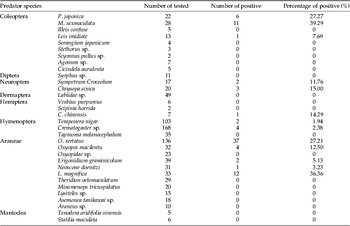
There was a large degree of variation in the percentage of predators that tested positive for C. sinensis DNA from the litchi orchard (table 1). We observed 32 predator species that preyed on C. sinensis, among them ladybugs, spiders, green lacewings (Chrysopa perla), predatory mirids (Campylomma chinensis), and ants. However, the percentage of predators that were positive for C. sinensis was moderate at best, with means between 0 and 40%. The predators with the highest proportion of positive detection were M. sexmaculata (39.3%), Leucauge magnifica (36.4%), P. japonica (27.3%), and Oxyopes sertatus (27.2%). These predators were clearly able to prey on C. sinensis, whereas the evidence regarding the other predators was equivocal.
The predatory detection of predators based on COI gene of C. sinensis in litchi orchards.

Functional response of M. sexmaculata and P. japonica
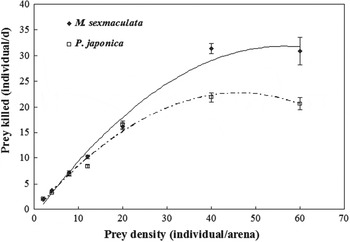
The consumption and hunting capacity of both M. sexmaculata and P. japonica increased with rising densities of C. sinensis eggs in the laboratory experiment, but the incremental increase in speed of consumption tended to slow as the densities of C. sinensis egg approached 40 per arena. A Holling type II functional response was obtained for C. sinensis egg consumption from the estimated curve and logistic regression of the data (fig. 2). Estimates of functional response parameters for the two species showed no significant differences in attack rate (a) between M. sexmaculata and P. japonica (a M. sexmaculata =1.020±0.009, a P. japonica =1.009±0. 414; F=3.284; df=14; P=0.798), whereas M. sexmaculata had a significantly shorter handling time (time taken to manipulate and swallow an egg, T h ) (T h M. sexmaculata =0.018±0.004, T h P. japoni ca =0.038±0.007; F=1.918; df=14; P=0.023). The theoretical maximal consumption rates for M. sexmaculata and P. japonica were 31.4±2.7 and 21.9±1.2 eggs per day, respectively. The maximum number of consumed eggs was significantly higher for M. sexmaculata than for P. japonica (F=1.415; df=14; P=0.006).
Observed number of C. sinensis egg killed by M. sexmaculata and P. japonica during 24 h and their functional response.

DNA detection periods
C. sinensis DNA was successfully detected in the M. sexmaculata and P. japonica predators that had fed on C. sinensis eggs. The positive detection rates were reduced over time, but DNA could still be detected at up to 72 h post-feeding (fig. 3). The negative correlation between time post-feeding and proportion of positives detected using primer pair A fitted the assumptions of the Probit model (χ2=4.113, df=7, P=0.767; χ2=7.630, df=7, P=0.366). The half-life for detectability was 16.3 h for M. sexmaculata and 6.0 h for P. japonica.
The relations of C. sinensis DNA detection probability and different digestion time in M. sexmaculata and P. japonica samples after feeding one C. sinensis egg, using primer pair A.

Discussion
The COI gene is a well-known, highly conserved protein-coding gene. Prey COI DNA can be amplified from the gut contents of generalist predators at high specificity and sensitivity (Pop et al., Reference Pop, Wink and Pop2003; Edgecombe & Giribet, Reference Edgecombe and Giribet2004; Admassu et al., Reference Admassu, Juen and Traugott2006). In our study, genomic DNA was extracted from the field-caught predators that were considered candidates for C. sinensis consumption, and then screened by PCR amplification of the C. sinensis COI gene sequence. This screening indicated that M. sexmaculata and P. japonica, two ladybug species, were the key predators of C. sinensis in the litchi orchard. Predation was further assessed by a functional response assay and an examination of the detection periods of prey DNA after consumption in the laboratory. Both of these laboratory analyses provided further proof that these two ladybug predators have the potential to be biological control agents for C. sinensis.
Until now, reports on biological control in litchi orchards have only considered the community dynamics of major pests and their natural enemies. The specific data on natural enemies of C. sinensis are few, but the known natural predators include C. chinensis (Hemiptera: Miridae), Trichogramma embryophagum (Hymenoptera: Trichogrammatidae), Trichogramma oleae (Hymenoptera: Trichogrammatidae), and Glyptapanteles conopomorphae (Hymenoptera: Braconidae) (Wu et al., Reference Wu, Chen, Xu and Zhu1999; Gao et al., Reference Gao, Wu and Liang2006b ; Winson et al., Reference Winson, Liang, Liu and Chen2007a , Reference Winson, You and Liang b ). Using molecular analysis, we identified several predators of C. sinensis, including previously unknown ones (table 1). Among these, we found two ladybug species (M. sexmaculata and P. japonica) that had the better direct control effects on C. sinensis than the other predators, according to subsequent feeding experiments. These species might be the main predators of C. sinensis. Spiders were highly abundant throughout the year, and the percentage of spiders that tested positive for prey DNA varied widely; spiders had been sampled from different farms and different collection dates. Spiders often show longer detection times than insects (Agustí et al., Reference Agustí, Shayler, Harwood, Vaughan, Sunderland and Symondson2003; Kuusk et al., Reference Kuusk, Cassel-Lundhagen, Kvarnheden and Ekbom2008), which may lead to overestimation of their predation rates in the field. In our field test, two spiders (L. magnifica and O. sertatus), which were abundant in the litchi orchard, also tested positive for C. sinensis DNA. However, they did not show any feeding preference for the eggs of C. sinensis, and took a long time to intermittently prey on an adult C. sinensis in a laboratory test. We speculate that meal size may influence the detection of prey DNA in the gut of predators, and secondary predation may be a significant source of error (King et al., Reference King, Read, Traugott and Symondson2008). DNA marker technology is an effective method for screening predators of C. sinensis and evaluating predation, but it cannot accurately reflect the true dynamics of the field because of spatial heterogeneity (Song et al., Reference Song, Cong, Qian and Dong2008). Therefore, the key predators of C. sinensis that we obtained from the field assay require further testing and research.
The results of our feeding experiments showed that the two ladybug species that had been identified by the field test as key predators of C. sinensis displayed strong predatory behavior. These laboratory results indicate clear potential for these species as the biological control agents against C. sinensis. The functional responses of both species followed the Holling type II model, in accordance with the pattern of many predators that have been shown to exhibit a good functional response (Xiao & Fadamiro, Reference Xiao and Fadamiro2010). Assumptions of the level of predation based on limited gastric volumes of natural enemies will tend to overestimate predation potential, since the functional responses of M. sexmaculata and P. japonica in the field cannot reach the level of a laboratory study. Since generalist predators feed on a wide variety of prey species in food-webs (Sunderland, Reference Sunderland and Holland2002), it may be possible that the amount of available alternative food varies in the litchi orchard, and high densities of alternative prey might temporarily lower the desired C. sinensis consumption. Therefore, to acquire the best control effect with the use of predatory natural enemies such as these, further studies of food-webs in natural ecosystems will be needed. A clear demonstration of successful field suppression of C. sinensis and other pest populations below economic thresholds is also required.
The time period during which residual prey DNA can be detected in the gut contents of predators is very important. Owing to DNA fragmentation during digestion, the detection time of prey DNA depends on the length of the amplification products (Agustí et al., Reference Agustí, De Vicente and Gabarra1999, Reference Agustí, Shayler, Harwood, Vaughan, Sunderland and Symondson2003; Chen et al., Reference Chen, Giles, Payton and Greenstone2000; Hoogendoorn & Heimpel, Reference Hoogendoorn and Heimpel2001), and this determines the practical feasibility of the PCR-based DNA analysis technique. Interestingly, Chen et al. (Reference Chen, Giles, Payton and Greenstone2000) found that sequence lengths shorter than 380 bp were optimal for aphid prey detection. In addition, Agustí et al. (Reference Agustí, De Vicente and Gabarra1999, Reference Agustí, De Vicente and Gabarra2000) and Zaidi et al. (Reference Zaidi, Jaal, Hawkes, Hemingway and Symondson1999) also found that larger fragments became undetectable in the gut more rapidly than smaller ones. In our study, ingestion of one C. sinensis egg by M. sexmaculata and P. japonica adults could be detected when the amplified fragment length was 319 bp, although the detection period was rather short. Moreover, most previous PCR-based analyses of predator gut contents have found retention half-life values far shorter than 24 h (Agustí et al., Reference Agustí, De Vicente and Gabarra1999, Reference Agustí, De Vicente and Gabarra2000; Chen et al., Reference Chen, Giles, Payton and Greenstone2000; Hoogendoorn & Heimpel, Reference Hoogendoorn and Heimpel2001), and different predators have varying digestion time for the same prey. For instance, the positive detection rate of Halmus chalybaeus preying on eggs of Eupithecia sp. was 85% after feeding for 24 h (Sheppard et al., Reference Sheppard, Henneman, Memmott and Symondson2004). The detection half-life of Leptinotarsa decemlineata egg DNA in the gut of a ladybug was 7 h, whereas the same DNA had a half-life of 50.9 h in the gut of Podisus maculiventris (Kuusk et al., Reference Kuusk, Cassel-Lundhagen, Kvarnheden and Ekbom2008). The present results suggest that positive prey DNA detection in M. sexmaculata and P. japonica indicates that they had fed on at least one C. sinensis egg 16.3 and 6 h before the DNA extraction, respectively. The DNA-based approach can help us to track trophic links and clarify the feeding patterns of these two ladybugs on C. sinensis within a specified space and time period on the basis of the time limit of this DNA-based test.
Predator–prey interactions take place as part of a complicated system characterized by dynamic interactions. The protection and use of natural enemies is an important part of community ecology, and forms the scientific basis for biological control. The predatory capacity of C. sinensis key predators in no-choice assays might differ from their capacity under field conditions, where alternative prey are abundant as part of the natural ecosystem. Indirect predation might also affect the gut content analysis, altering the evaluation of these predators. Therefore, to maximize C. sinensis control using M. sexmaculata and P. japonica, the population dynamics of these predators and other pests in the litchi orchards should be considered. The environment also needs to be considered in terms of the time of day when prey can be detected by predators (Li et al., Reference Li, Zhao, Tian, Wang, Ye and Xiao2010), because insects are poikilothermic, with metabolisms that can speed up when the environmental temperature rises. Predator size can be another important factor influencing the successful detection of prey remains in the gut (Hagler & Naranjo, Reference Hagler and Naranjo1997). Finally, variability in COI sequences among different populations of C. sinensis living in different ecological environments may also affect DNA detection (Shin et al., Reference Shin, Jung, Lee and Lee2013).
In conclusion, DNA-based techniques provide a more precise and more effective method for investigating predator–prey interactions than traditional techniques. The primer sets produced in this study provide useful tools for ecological studies of C. sinensis in the field. Our determination of the proportion of field-collected predators with detectable DNA from specific prey (C. sinensis) indicated that M. sexmaculata and P. japonica may play important roles in suppressing C. sinensis. This study represents a major first step in identifying potential key predators or trophic linkages of C. sinensis. The predation patterns and ecological relationships between the major C. sinensis predators and other pest species in litchi orchards remain to be studied further.
Acknowledgements
This work was financed by The National Natural Science Foundation of China (31171853; 31301664), Guangdong Natural Science Foundation (S2013040015901), and China Postdoctoral Science Foundation (2013M531829). We sincerely thank Professor Shoushan Huang for his kind classification and identification of arthropods in the litchi orchards, and we are grateful to the members of our laboratory for their cooperation in this work.