INTRODUCTION
SWEET CHESTNUT IN EUROPEFootnote 1
For millennia, the sweet chestnut tree (Castanea sativa) has been valued across Europe as a food and timber resource;Footnote 2 it currently forms 2.5 million hectares of orchard groves, coppices and high forest.Footnote 3 From pollen evidenceFootnote 4 it is thought that sweet chestnut survived in continental Europe during the last glacial period, in refugia in parts of the Caucasus, Turkey, Greece, Italy and Spain. Genetic studies of sweet chestnut populations across EuropeFootnote 5 have indicated three distinct genepools — ‘eastern’ (eastern Turkey eastwards), ‘central’ (western Turkey, Bulgaria and Greece) and ‘western’ (Italy, southern Switzerland, France, Spain, Portugal, England) — that correspond broadly with the identified glacial refugia.Footnote 6 Sweet chestnut was developed for cultivation for nut and wood production by the ancient Greek and Roman civilisations and then propagated extensively across Europe by monastic, royal and noble estates in the medieval period, for wood and food resources and cultural interests.Footnote 7
SWEET CHESTNUT IN BRITAINFootnote 8
Sweet chestnut presently forms a significant resource of ancient trees and woodland in Britain, growing on suitably acidic, sandstone-derived soils through east, south and west England and Wales to north-east Scotland: there are approximately 20,000 hectares of woodlandFootnote 9 and over 2,000 individual veteran trees of more than 5 m girth.Footnote 10 Sweet chestnut characterises historic cultural landscapes, including medieval deer parks and ancient coppice woodlands. Some sweet chestnut trees and coppice woods in England and Wales are documented from the twelfth century a.d., e.g. near Caerleon (Monmouths.) in the Goldcliff Priory charters,Footnote 11 or Castiard (Glos.) in the Flaxley Abbey Cartulary.Footnote 12 Dendrochronological evidence indicates that some living sweet chestnut trees in Britain exceed four hundred years of age;Footnote 13 some are considered to be much older.
However, sweet chestnut is regarded as a non-indigenous — even invasive — species in Britain: it is classified in current descriptions of the British flora as an archaeophyte of Roman originFootnote 14 that has now naturalised and functions as an indigenous species in some habitats.Footnote 15 Rackham characteristically described it as an ‘honorary native’.Footnote 16
The origins of the ‘Roman introduction to Britain’ thesis are unknown, but sweet chestnut's status as an indigenous or introduced species in Britain has been debated since at least the seventeenth century. John Evelyn's Sylva was first published in 1664,Footnote 17 when his observations on sweet chestnut did not consider its origins, whereas in his fourth edition of Silva in 1706 he stated: ‘Pliny … concludes them [sweet chestnuts] to be excellent food, and doubtless Cæsar thought so, when he transported them from Sardis first into Italy, whence they were propagated into France, and thence among us’.Footnote 18 Evelyn provided no justification for suggesting that sweet chestnut was introduced to Britain by the Romans, but he was cited later in a protracted debate in the Letters to the Royal Society in 1769–71, when several contributorsFootnote 19 presented evidence for sweet chestnut as an indigenous or an introduced species: the conclusion was that sweet chestnut was introduced, probably by the Romans.Footnote 20 Further consideration during the nineteenth century similarly concluded that the species was a Roman introduction to Britain,Footnote 21 but without any tangible evidence being cited.
Modern accounts of the British Flora have taken Godwin's seminal work History of the British Flora Footnote 22 as an authority for sweet chestnut's status as a Roman introduction to Britain.Footnote 23 Godwin was using new information that was unavailable to the earlier writers, derived from analysis of plant macrofossil remains recovered from archaeological and palaeoenvironmental investigations. Godwin cited nine published accounts to show that the first appearances of sweet chestnut plant remains in either the natural or the historic environment of Britain were in Roman contexts, with only slight and questionable evidence for sweet chestnut occurring in the pre-Roman period. Godwin's conclusions have been taken as the definitive position by leading writers ever since. For example, Rackham's research into ancient trees and woodlands in BritainFootnote 24 reiterated Godwin's evidence and stated ‘archaeologists have identified its [sweet chestnut's] wood or charcoal at many [sic] Roman sites from Essex to Dorset’.Footnote 25 Godwin had cautioned against presuming that the Romans grew sweet chestnut in Britain, stating that most of the archaeological finds (be they of wood, wooden artefacts or charcoal) could be of imported material,Footnote 26 but this caveat has been neglected.Footnote 27
Godwin's cited sweet chestnut records did not include any pollen finds: none had been reported in Britain at that time (1975) and no finds were reported subsequently by Huntley and Birks.Footnote 28 To date there are only two reports of sweet chestnut pollen in the British archaeological and palaeoenvironmental record for any period: a find in west Dorset,Footnote 29 which is undated; and a ‘tentative’ find in GloucestershireFootnote 30 from a context that has been radiocarbon dated to the early medieval period (see online table 1). Although the presence of sweet chestnut pollen in archaeological or palaeoenvironmental contexts could indicate that sweet chestnut was growing in a locality or region, pollen might derive from a distant source, for example in imported honey.Footnote 31 Sweet chestnut pollen is not widely dispersed away from the growing plant (it is more insect-pollinated than wind-pollinated), so naturally dispersed pollen will be relatively localised.Footnote 32 The apparent scarcity of sweet chestnut pollen finds is considered further below.
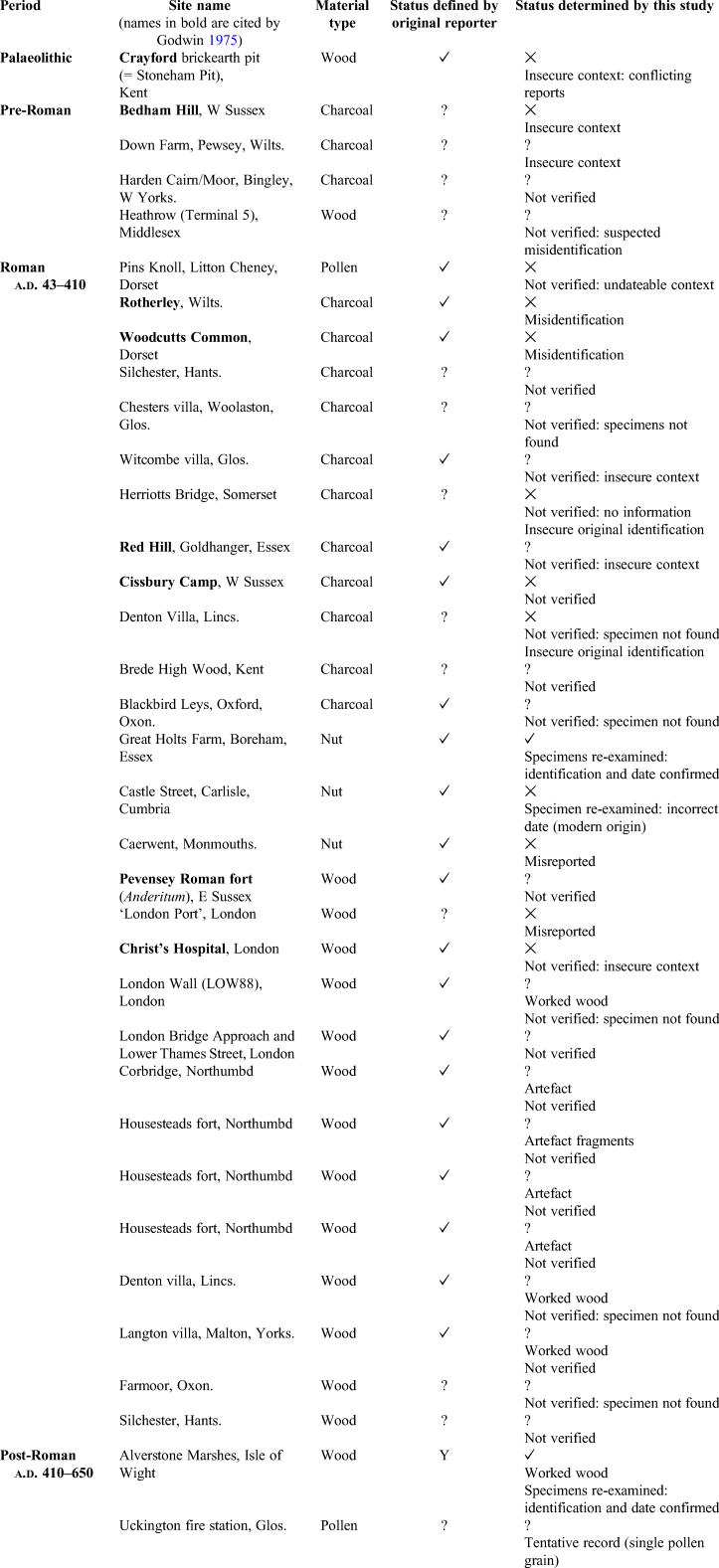
LIST OF PUBLISHED SITES REPORTING SWEET CHESTNUT (CASTANEA SATIVA) WOOD/CHARCOAL/NUTS/POLLEN IN BRITAIN, UP TO a.d. 650, RE-ASSESSED BY THIS RESEARCH

Status: ‘✓’ = verified as C. sativa, with defined chronology; ‘?’ = unverifiable identification and/or chronology; ‘✕’ = rejected.
The present research has comprehensively re-examined published archaeological and palaeoenvironmental reports covering all British records of sweet chestnut plant remains (wood, charcoal, nuts and pollen) for the pre-Roman and Roman periods; and also for the post-Roman period up to a.d. 650, to cover the possibility of finding evidence that might derive from sweet chestnut trees grown in an earlier period.Footnote 33 This paper focuses on the records cited by Godwin,Footnote 34 because his studies have gained iconic status and are the basis for many subsequent descriptions of sweet chestnut as a Roman introduction, which give the impression that sweet chestnut was commonly grown in Roman Britain for wood and nuts and was an important food and timber resource. For example, Stace and CrawleyFootnote 35 state ‘walnut and sweet chestnut were introduced by the Romans’ and ‘sweet chestnut probably reached Britain with the Romans, who used the nuts to feed their army’. There is no known evidence for these assertions and none is referenced by Howkins, their cited source for the history of sweet chestnut in Britain (who stated ‘caches of chestnuts found by archaeologists at Roman sites … e.g. Caerwent’Footnote 36).
We suggest that clarification of the status of sweet chestnut in Roman Britain is important given the number of food plants that were added to the diet at this time and the changes in culture and the expression of identity that this represents.Footnote 37 Furthermore, as a tree with a particular aesthetic, both as a specimen tree within formal gardens and as part of plantings within orchards or woods, sweet chestnut would have both physically altered the environment, creating novel habitats, and also transformed the way in which people both experienced and used these places.Footnote 38
METHODS
This research was undertaken primarily by analysis of published reports and scientific papers, supported by examination of archived specimens that were described in those reports and could be found.
LITERATURE REVIEW
All the published reports of sweet chestnut evidence from pre-Roman, Roman and early medieval period contexts in Britain were collated, using twelve main sources: Godwin's History of the British Flora (1st and 2nd editions);Footnote 39 Historic England (henceforth HE)’s three regional reviews of wood and charcoal recovered from archaeological interventions in England;Footnote 40 HE's regional reviews of macroscopic plant remains from northern England and the Midland counties of England;Footnote 41 HE's archaeobotanical database of sites in southern England;Footnote 42 and five independent reviews of archaeobotanical evidence in Britain.Footnote 43 In addition, the ABCDFootnote 44 and the current ADS (Archaeology Data Service) online search facilityFootnote 45 were interrogated, using ‘Castanea’ and ‘sweet chestnut’ as search terms. Several records were found on the ABCD and ADS databases that had not been included in the other reviews. The literature review was concluded at the end of 2017.
The section in Godwin's History of the British Flora Footnote 46 on sweet chestnut refers to selected British sites where it had been recorded in prehistoric and historic periods. All the publications cited by Godwin were examined: some had been incorrectly cited, requiring searches to locate the literature that had been intended to describe the sites and excavations he reported.
In support of the wider literature review, original authors and/or reporters were contacted, where possible, to confirm identifications, indicate locations of archived specimens and/or provide supplementary information on sample context or interpretation.
ARCHIVE SEARCHES FOR SPECIMENS
Excavation reports that referred to specific finds of sweet chestnut were used to locate where specimens might have been archived. Pastscape — the online database of the National Record of the Historic Environment (NRHE) (http://www.pastscape.org.uk) — was also used to locate potential archives. Archive searches were not undertaken where recent expert analysis had reported Quercus/Castanea (see below).
ANALYSIS OF SPECIMENS
Specimens recovered from archive stores were provisionally examined in the host museums by R.J. and/or Z.H.; some were then analysed in more detail by Z.H. and G.C. at the Historic England Laboratory, Fort Cumberland, Portsmouth, UK. Specimens were examined to:
(1) determine the accuracy of the sample and contextual information (for example, by checking sample labels against report details);
(2) determine whether a specimen ambiguously labelled ‘chestnut’ or ‘chesnut’ was sweet chestnut (Castanea sativa) or horse chestnut (Aesculus hippocastanum), since wood/charcoal of the latter has also been alleged for Roman contexts in several reports;
(3) confirm the original species identifications of wood/charcoal: at a microscopic level, the structures of Castanea and Quercus wood are very similar, and the reliable separation of the two is only possible with the presence of a particular feature (see below).
Some selected specimens (of sweet chestnut nut pericarp fragments) were submitted for radiocarbon dating by Peter Marshall (HE); and also assessed for ancient DNA (aDNA) by Robin Allaby and Oliver Smith at Warwick University.
Taxonomic identifications
A combination of texts and keysFootnote 47 was used for the wood/charcoal identifications. Reference material from Historic England's Wood and Charcoal Reference Collection (held at Fort Cumberland) was also consulted. All charcoal fragments were examined under an Olympus BHX high-power, light-reflecting microscope, at magnifications of between x100 and x500. Standard practice would be to examine freshly broken, clean planes of charcoal; however, given the associative value of this archival material, fragments were examined without breaking them. During the analyses, it was mostly — but not always — possible to see the necessary features from the fragments’ facets, in particular the Transverse Section (TS) and the Tangential Longitudinal Section (TLS).
Where possible, identifications were made to genus level. Secure identifications were only possible where the necessary diagnostic features were convincingly observed, ideally in multiple places on the same fragment. Quercus was differentiated from Castanea on the unequivocal presence of the main wood anatomical criterion — that is, the presence of multiseriate (MS) medullary rays. When there was any uncertainty about whether all the features required for a secure identification could be seen, the prefix ‘cf’ was used,Footnote 48 as in ‘cf Quercus (oak), cf Alnus (alder), cf Fraxinus (ash)’. It should be noted that it is possible that some of the identifications that remained uncertain could be determined if breaking the fragments were permitted.
Where visible, additional characteristics (such as growth ring counts and curvatures) were recorded for each fragment.Footnote 49 Fragments were also refitted, where obvious, to enable understanding of the original nature of the wood specimen.
RESULTS
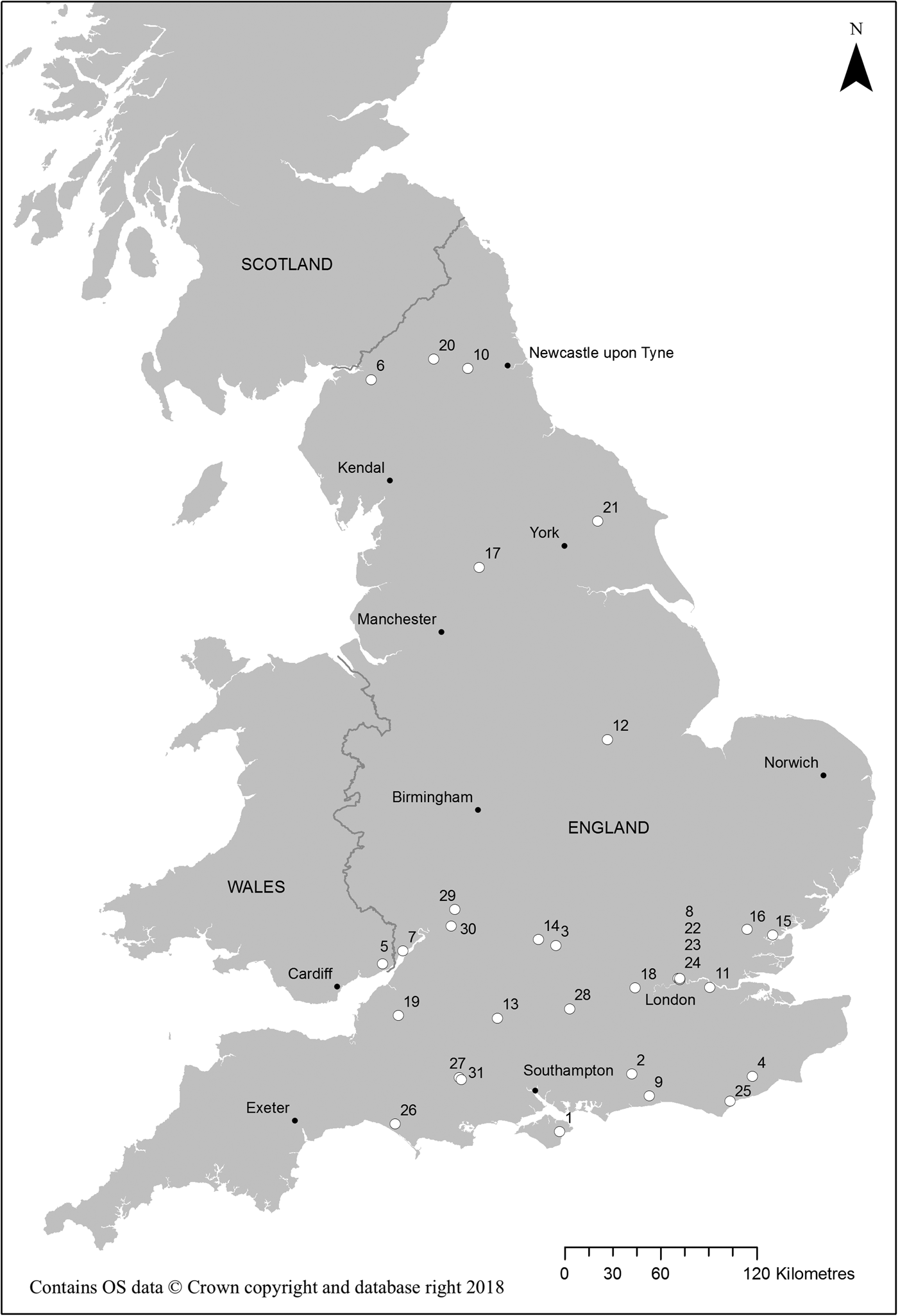
All the sites examined in this research are listed in table 1 and shown on fig. 1. The results of the examination and details of the re-assessment of the records are presented in online table 1. A reference list of all the plant taxa referred to in this paper is presented in online table 2.
Map showing sites examined in this research.

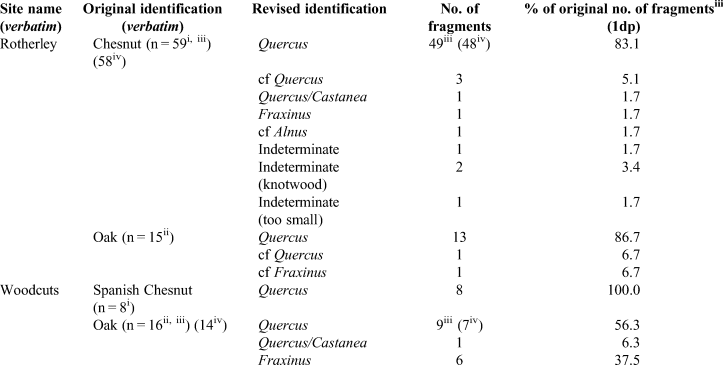
SUMMARY RESULTS OF THE RE-EXAMINATION OF CHARCOAL FRAGMENTS FROM ROTHERLEY AND WOODCUTTS, WITH REVISED IDENTIFICATIONS

Original identification by W. Carruthers (British Museum) in c. 1885; re-identification by Z.H. and G.C. in 2016–17.
i = all fragments available; ii = subsample of the total fragments; iii = fragment counts before refitting; iv = fragment counts after refitting.
Examination of the documentary sources found that some of the original citations were incorrect: these were traced and corrected where possible. It also revealed that some records were questionable in terms of the accuracy of the original wood/charcoal identification/reporting and of the contextual description and dating of the specimens. Investigation of the primary sources was therefore fundamental for this research.
REVIEWING GODWIN'S WORK
This research has undertaken a detailed review of all the sources cited by Godwin. Summarised information for all the reports of sweet chestnut evidence that Godwin cited,Footnote 50 and the results of the re-examination and re-assessment of the original published excavation reports and archived specimens of alleged sweet chestnut material, are presented in online table 3.
SUMMARY OF ACCEPTED RECORDS OF SWEET CHESTNUT IN BRITAIN PRE-A.D. 650, AS DETERMINED BY THIS STUDY

* = fully verified identification and date. Other records are presumed acceptable but are unverified, as explained in table 1, online table 1 and the main text.
Wood (worked/artefact) = London Wall (LOW88), Denton villa, Langton villa, Alverstone Marshes*, Corbridge, Housesteads fort (x3). Charcoal = Blackbird Leys. Nuts = Great Holts Farm*. Pollen = Uckington fire station.
ARCHIVE SEARCHES FOR SPECIMENS
Collections potentially containing archived or stored specimens of sweet chestnut material were identified from the literature review and from previous researchers: Brighton Museum; British Geological Survey (Keyworth); Dean Heritage Centre (Glos.); Gloucester City Museum; Horsham Museum; Isle of Wight Archaeology and Historic Environment Service; Jodrell Laboratory, Kew; Lincolnshire Archives (Lincoln); Museum of London; Museum of Sussex Archaeology (Lewes); Norwich Castle Museum; Oxfordshire County Museum Service; Pitt RiversFootnote 51 Museum (Oxford); Reading University Archaeology Department; The Salisbury Museum; Tullie House Museum and Art Gallery (Carlisle); Worcestershire Archive and Archaeology Service; Worthing Museum and Art Gallery.
Specimens were recovered from four of these collections; for all the other specimens sought, either the reported material had never been deposited, or it was not possible to locate it (even though records indicated that it had been accessioned). For example, specimens from six sites that had been described as Roman could not be found: London Wall (LOW88), Cissbury Camp, Blackbird Leys, Chesters villa, Denton villa and Witcombe villa.
ANALYSIS OF THE SPECIMENS
Analyses focused on specimens recovered from four museum archives for five sites:
Woodcutts Common (Dorset) and Rotherley (Wilts.)
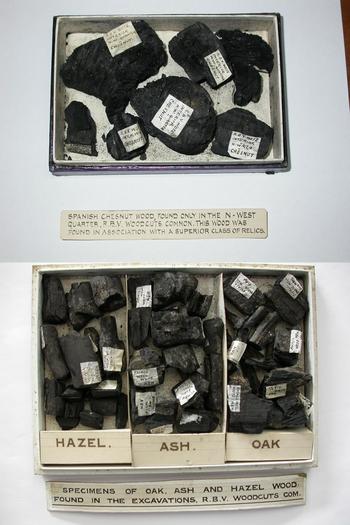
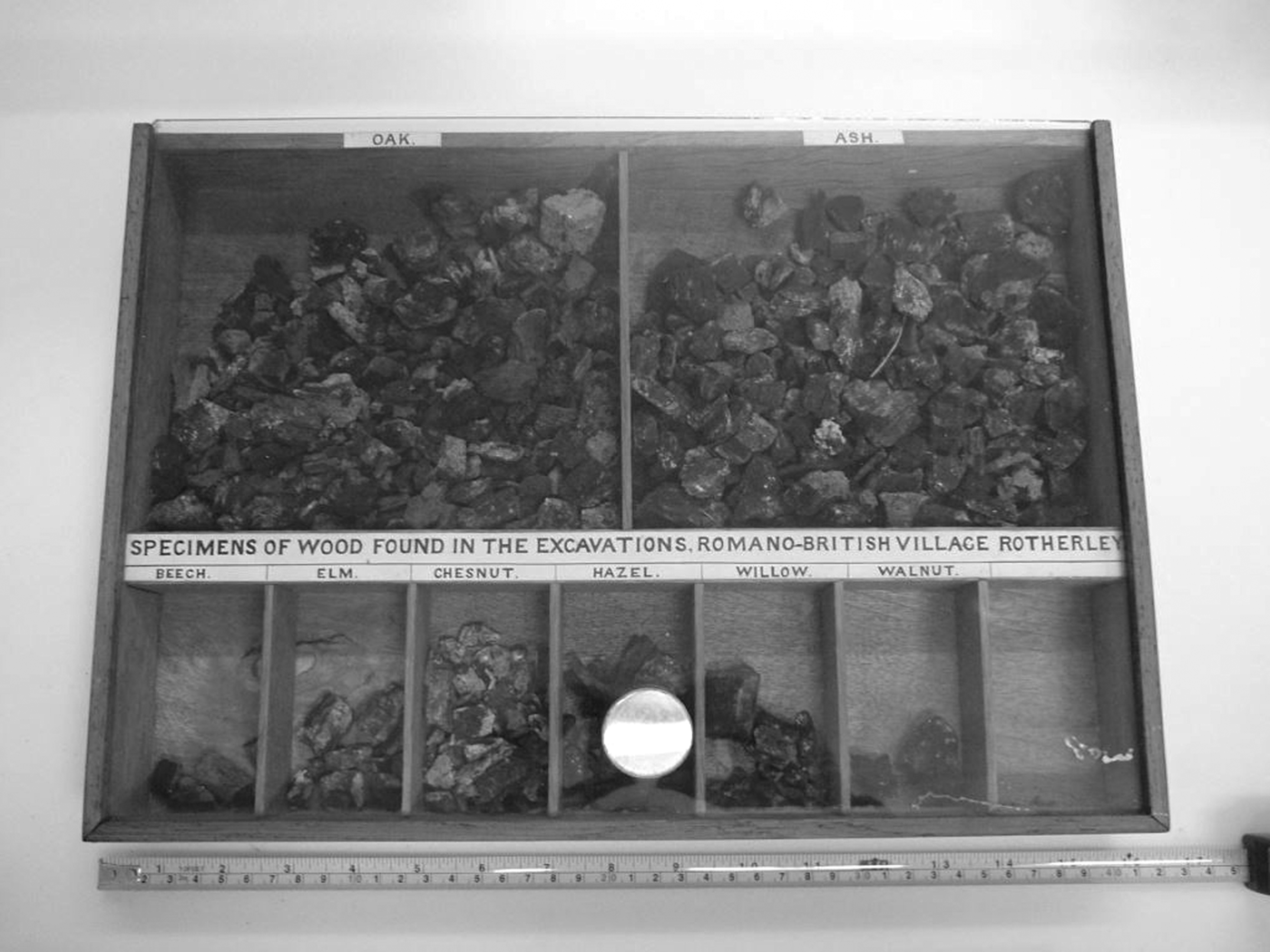
The Pitt Rivers Collection at The Salisbury Museum was found to contain charcoal material from two sites: Woodcutts Common,Footnote 52 excavated by Pitt Rivers in 1884–5; and Rotherley, excavated by Pitt Rivers in 1886–7. The material was originally archived and displayed at General Pitt Rivers’ own private museum at Farnham, Dorset, but was passed to the then Salisbury and Wiltshire Museum in 1975 by HM Treasury as part of the Wessex Collections. The details of the charcoal material (figs 2 and 3) are set out in Hazell and Campbell.Footnote 53
Archived specimens of ‘wood’ (charcoal) found in the Woodcutts excavations. (Photos: Z. Hazell © Historic England. Produced with permission of The Salisbury Museum)

Archived specimens of ‘wood’ (charcoal) found in the Rotherley excavations. (Photo: © R. Jarman. Produced with permission of The Salisbury Museum)

For the Rotherley collection, there appeared to be no differentiation in the archive between fragments recovered from different samples, features or contexts within the excavations: the fragments were grouped together by genus, regardless of provenance within the site. However, for Woodcutts, some of the fragments (of oak, hazel and ash) were individually labelled with their original site context.
All the alleged ‘sweet chestnut’ fragments of charcoal from Woodcutts Common (8) and at Rotherley (59) have been re-examined. Some of the fragments labelled ‘oak’ in these collections were also examined, in order to check their identifications. The results of the re-identification of the charcoal fragments, compared with their originally published identifications, are presented in table 2.
In total, three taxa have now been identified from all the material labelled as ‘chestnut’ from the Rotherley and Woodcutts sites: (i) Quercus and cf Quercus (oak); (ii) cf Fraxinus (ash); (iii) cf Alnus (alder). Two fragments now recorded as Quercus/Castanea (because no MS ray could be seen) are most likely to be oak, given the dominance of secure oak identifications at these sites. Additionally, some fragments are now recorded as Indeterminate (Indet.) because they are of knotwood (displaying non-typical wood growth) or too small in size for a reliable identification.Footnote 54
At Woodcutts, all the eight fragments that were originally recorded as ‘chestnut’ have now been securely re-identified as Quercus. At Rotherley the assemblage was more diverse, with the revised identifications of the fragments now including: Quercus; cf Quercus; Quercus/Castanea; Fraxinus; cf Alnus; and Indeterminate. Of these, secure identifications of Quercus were dominant. In addition, new identifications of ash have been made, with Fraxinus recorded at Woodcutts and cf Fraxinus at Rotherley.
Crucially, no secure identifications of Castanea were made at either site.
Castle Street, Carlisle (Cumbria)
The Tullie House Museum and Art Gallery archive was found to have the single sweet chestnut nut pericarp fragment that had been reported from archaeological excavations at Castle Street, Carlisle in 1981–2.Footnote 55 Although not mentioned within the excavation reports,Footnote 56 the find had been cited in a subsequent regional review and described as ‘presumed Roman’.Footnote 57 A full and updated account of this find is presented elsewhere.Footnote 58 The specimen was recovered and confirmed as sweet chestnut. The fragment has been analysedFootnote 59 for ancient DNA (aDNA), but although some DNA was identified, it was not possible to categorise it within the Castanea genome and so information regarding the possible provenance of this nut could not be derived. A collection of detailed images of the fragment is held by HE Photographic Archive, Swindon.
The specimen was radiocarbon dated and the resultFootnote 60 indicates that it dates to cal a.d. 1959–1960 (9% probability) or cal a.d. 1962 (3% probability) or cal a.d. 1979–1982 (83% probability). This sweet chestnut nut pericarp is therefore of recent origin and can be rejected from the corpus of Roman period evidence.
Great Holts Farm, Boreham (Essex)
The Norwich Castle Museum (Murphy Collection) archive was found to have the sweet chestnut nut pericarp fragments that had been recovered during archaeological excavations at Great Holts Farm in 1995.Footnote 61 A full and updated account of this find is presented elsewhere.Footnote 62 The sweet chestnut fragments were in a deposit of organic materials at the base of a well: the deposit was dated from associated ceramics to the Roman period (Context 6463, late third century a.d.Footnote 63). The well's construction was dated by dendrochronological analysis to after a.d. 188.Footnote 64 The basal deposit included remains of ‘exotic’ food plants (stone pine, walnut, olive, grape, cherry), hazelnut, apple and fish (including scad (Trachurus sp.) and ‘Spanish mackerel’Footnote 65): they were interpreted as waste cleared from the floor of the farmhouse and deposited in the well sometime in the late third century.Footnote 66
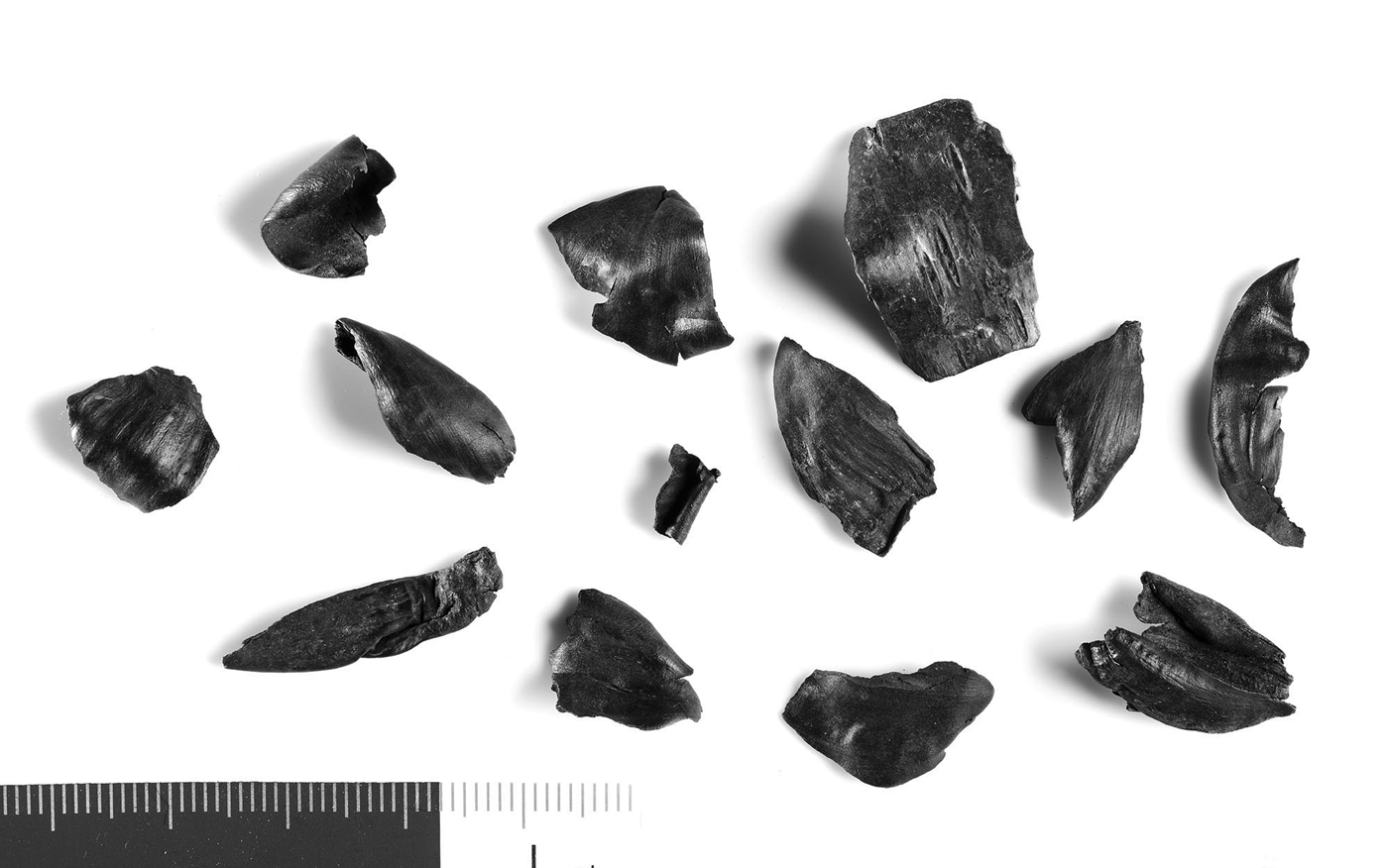
The sweet chestnut nut fragments were recovered from the archive store (accession no. NWHCM : 2013.123) and confirmed as sweet chestnut. The specimens were sampled for aDNA analysis, but no DNA could be extracted.Footnote 67 The nut pericarp fragments were photographed (fig. 4): a collection of detailed images of these fragments is held by HE Photographic Archive, Swindon.
A collection of Great Holts Farm sweet chestnut nut pericarp fragments. (Photo: © Historic England – Photographic Archive Ref. DP195960)

Three samples of pericarps representing three discrete nuts have been radiocarbon dated.Footnote 68 The three measurements are statistically consistent at 95% confidence (T = 1.2; T(5%) = 6.0;ν=2; Ward and Wilson Reference Ward and Wilson1978) and could therefore be of the same actual age. However, given there is no a priori evidence for these nuts being of the same age, the results have been combined in a chronological model, using the OxCal function Combine and the termini post quem provided by the tree-ring dating.Footnote 69 The model estimated that the Castanea nuts deposited in context 6463 date to cal a.d. 185–195 (1% probability) or cal a.d. 210–260 (73% probability) or cal a.d. 280–325 (21% probability), probably cal a.d. 220–255 (62% probability) or cal a.d. 305–315 (6% probability).
The Great Holts Farm sweet chestnut nut pericarps have thus been confirmed as third or fourth century cal a.d. in date, in agreement with the date previously derived from the ceramics in the well fill.Footnote 70
Alverstone Marshes, Brading, Isle of Wight
Specimens of waterlogged sweet chestnut wood (stakes and piles) excavated from Alverstone Marshes in 2005 were recovered from the storage tank at Isle of Wight Archaeology. Their identifications as sweet chestnut have been confirmed; they comprise roundwood with worked pointed ends. Radiocarbon dates have been obtained on some specimens, indicating sixth century a.d. and ninth–tenth century a.d. dates,Footnote 71 but the recording and analysis of the Alverstone Marshes material is still in progress. The record is included in the present study as there is a possibility that the timbers identified could derive from sweet chestnut tree(s) grown locally during the Roman period, although the wood could also have been imported.
DISCUSSION
Thirty-five records of sweet chestnut finds in pre-Roman and Roman Britain were collated from the literature review (table 1 and online table 1) and categorised as pre-Roman (5), Roman (28), and post-Roman up to a.d. 650 (2). The likelihood of discovering any further previous records in the published literature is considered to be low, given the comprehensive investigation by this and previous reviews, although ‘grey’ literature may contain additional records. Of these 35 records, just nine have been confirmed by this review as acceptable identifications of sweet chestnut from the Roman period (see table 3). Seven records are of artefacts or worked wood: a writing-tablet from Corbridge, a bung and chisel handle from Housesteads fort, and worked wood from Housesteads fort, Denton villa, Langton villa and Alverstone Marshes.
This number of records appears small, considering the oft-asserted opinions that sweet chestnut was introduced to Britain and grown by the Romans and that there have been ‘many Roman sites’ where it has been identified.Footnote 72 Only one of these records (the nut pericarps from Great Holts Farm) provides direct evidence for the use of sweet chestnut as a food resource.
Furthermore, none of these nine records of sweet chestnut artefacts, wood and nuts has been shown to derive from a sweet chestnut tree grown in Roman Britain: there is no evidence (such as pollen or dendroprovenancedFootnote 73 wood) that could be used to determine this. All the records could be of imported material: the Great Holts Farm nuts could have been imported as unprocessed food; the various artefacts (tool handles, bung, writing-tablet) could have been imported as finished objects; the worked wood and charcoal pieces could be of imported wood or wood products. The two records from the post-Roman period before a.d. 650 (the waterlogged wood from Alverstone Marshes and the single pollen grain from Uckington, see online table 1) might conceivably relate to sweet chestnut grown in Britain during the Roman period (see table 1).
Of the sweet chestnut records originally cited by Godwin,Footnote 74 we determined that none is definitely sweet chestnut and/or that the record is unlikely to be pre-Roman or Roman (online table 3).
This re-assessment of reports and specimens raises several issues regarding archaeological reporting and curatorial policies and practices that are discussed below.
THE METHODOLOGICAL PROBLEM: TESTING THE VERACITY OF PREVIOUSLY REPORTED WORK
Godwin's work and his History of the British Flora have been used as the basis of many discussions concerning the Pleistocene and Holocene history of the plant species found in Britain. However, the present study of sweet chestnut — just one of over 600 species in Godwin's magnum opus — has raised several questions regarding the reliability of the evidence presented: the original excavations and sampling; the analysis, identification and reporting of finds and contexts; and the subsequent citing (and re-citing) of original reports.
The excavation, sampling and storage process
The excavation methods used by Pitt Rivers at Woodcutts and Rotherley are rightly heldFootnote 75 to be a pioneering example of ‘modern’ archaeological techniques. It is, however, not surprising that it is not possible to determine the precise location of the reported finds, in particular the depth at which the charcoal specimens were recovered from the fill of the ‘small Roman well’ in the ‘North-West Quarter’ of Woodcutts.Footnote 76
Furthermore, although Pitt Rivers should be given due credit for recovering charcoal specimens from the Rotherley and Woodcutts excavations and attempting to record their contexts, the specimens were not archived and stored according to sample or context. Although a few individual charcoal fragments from Woodcutts were labelled, noting their wood type and archaeological feature, the identification was not always correct. The open design of the storage boxes could have resulted in loss of information, as specimens were not necessarily secure within the storage box compartments (figs 2 and 3).
Finally, of the collections examined, some contained very few specimens, even just one (Castle Street, Carlisle). This could be owing to small sample sizes (especially for antiquarian excavations), or only a few specimens being archived, and/or scarcity of the original remains. Whatever the reason(s), there is insufficient material for a thorough analysis.
The identification process
Differentiation between small fragments of Quercus and Castanea wood and charcoal is difficult. However, other species were also found incorrectly identified as Castanea during this work: at Rotherley and Woodcutts, fragments categorised as ‘chestnut’ have been re-identified as cf Fraxinus and cf Alnus, as well as Quercus and cf Quercus. Whilst confusion between Castanea, Quercus and Fraxinus might be understandable at a macroscopic level, given the similarity of the wood types (all three are ring porous), the reason for the misidentification of the cf Alnus fragment is unclear.
Re-visiting the charcoal recovered from these two early excavations demonstrates the potential value of re-examining archive material, not only to ensure that wood identifications and recording are to current standards, but also to verify the material's contribution to the understanding of vegetation history within Britain.
The reporting process
Some of the earlier archaeological reports include identifications to species level (rather than to genus) where anatomically there can be no justification. For example, LyellFootnote 77 reported oak specimens as ‘Quercus robur – oak’. Not only was using the Latin binomial Q. robur (pedunculate oak) inconsistent with the reporting of the common name simply as ‘oak’, but it discounts Q. petraea (sessile oak). Q. robur and Q. petraea are the two native oaks of the British Isles and it is not possible to differentiate their wood by their anatomical characteristics.Footnote 78
The citation process
Godwin's citation of publications by other authors has been shown here as occasionally imprecise and uncritical; he propagated technical errors of others and introduced further errors of reporting and citation. Subsequent authors, such as Rackham, have then cited his examples uncritically.Footnote 79 Some identifications and chronologies were noted as doubtful by the original reporters, but their uncertainty was not always referred to when cited. Recent accounts of the British floraFootnote 80 have accepted the received wisdom of previous workers, that sweet chestnut is a Roman introduction, without a re-appraisal such as undertaken here.
It is apparent from our research that reviewers, including Godwin, have relied too heavily on earlier workers. For example, Godwin used Pitt Rivers’ Rotherley and Woodcutts reports as evidence for sweet chestnut's presence in Britain during the Roman period, presumably relying upon the reputations of Pitt Rivers as archaeologist and Carruthers as taxonomist as proof of competence. Pitt Rivers has long been held as the ‘father of archaeological excavation’;Footnote 81 W. Carruthers was Keeper of Botany at the British Museum, Fellow of the Royal Society and President of the Linnean Society during the 1870s to 1890s. Yet identifications by Carruthers (or an assistant? — perhaps Ridley, who was his assistant at the British Museum at the time of the Pitt Rivers excavations and who also reported the Castanea wood find from the Crayford brickearth pit) have been shown by the present work to be incorrect.
THE ROMAN ARCHAEOPHYTE QUESTION
Whether sweet chestnut is indigenous to Britain has been debated since long before Godwin's work and the conclusion reached was that sweet chestnut was a Roman introduction. Godwin had access to scientifically based evidence from archaeological and palaeoenvironmental analyses, so his account of sweet chestnut first occurring in Britain in the Roman period appeared definitive.
Godwin cited nine sites in England where sweet chestnut had been recovered: six were from the Roman period. Two of these nine sites (Rotherley and Woodcutts) have now been disproved by the present work as unreliable or incorrect identifications of sweet chestnut; and the other seven sites have been disqualified on the basis of unverified sweet chestnut finds and/or the incorrect dating of contexts. None of Godwin's cited sites provides secure evidence for sweet chestnut growing in Britain before a.d. 650: neither do any of the other sites reported in the literature, as described in online table 1 and summarised in table 3, apart perhaps from the Blackbird Leys and London Wall (LOW88) finds of sweet chestnut charcoal and wood (neither of which could be located for verification by this study).
These findings need to be weighed against the current classification of sweet chestnut as a Roman archaeophyte.Footnote 82 Most recently, WitcherFootnote 83 has reviewed a selection of plant and animal species that are classified as ‘Roman introductions’ to Britain: he described sweet chestnut as ‘an archaeophyte, probably a Roman introduction’, without renewed assessment.
This research has not found any convincing evidence for sweet chestnut being grown in Britain before or during the Roman period. This may be because there is no evidence to be found, or because the evidence for sweet chestnut is difficult to obtain.
That sweet chestnut nuts were eaten in Roman Britain is demonstrated only by the find of pericarps recovered from the well fill at Great Holts Farm, Boreham, which have been confirmed as dating to the third or fourth century a.d. as part of this research (supra).Footnote 84 However, given the Mediterranean lifestyle suggested by the biological remains recovered from this rather unusual site and that there are no other remains of sweet chestnut nuts known there, it would appear that sweet chestnuts were likely imported along with other exotic foods from the southern provinces.Footnote 85
It is interesting to compare the case of sweet chestnut with those of other trees and shrubs with rather different histories. Although the cultivation of trees and shrubs requires investment and skills and the returns are not realised for a number of years,Footnote 86 this did not preclude the cultivation of ornamental evergreensFootnote 87 or the development of pomiculture in Roman Britain.Footnote 88 Van der Veen et al. argue that given the number of occurrences of macroscopic remains of cherry, plum, damson and walnut increases over the Roman period and that these remains have been recovered from rural sites, especially in the south-east of the country, orchards became part of the British landscape for the first time.Footnote 89 Sweet chestnut requires 10–15 years from planting to the first nut harvestFootnote 90 (similar to plum and cherry) and is readily established from seed or rooted material,Footnote 91 so there is no practical obstacle to sweet chestnut orchards.
One possible explanation for the absence of sweet chestnut in Roman Britain is that its introduction was unnecessary to the economy: its role may have been filled by indigenous trees and shrubs as sources of nuts/fruits and wood (such as hazel, beech or oak). Whether ecological, economic, social or cultural considerationsFootnote 92 were factors in this apparent absence of sweet chestnut from the Romano-British landscape is unknown. It may have first been cultivated as a rare exotic with a considerable time lag before it became established as a regular crop, as described for several introduced food plants in continental Europe.Footnote 93
THE POLLEN PROBLEM: IS SWEET CHESTNUT A ‘SILENT’ TAXON IN BRITAIN?
Documentary and place-name evidence confirms that sweet chestnut has been present in parts of the British landscape from at least the twelfth century,Footnote 94 but this contrasts with an almost mute post-medieval pollen record. Two sites with the earliest written records for the species in Britain (near Caerleon, Monmouths.,Footnote 95 and Flaxley, Glos.Footnote 96) presently have ancient sweet chestnut trees/stools growing in ancient woodland, yet published palaoenvironmental data from wetland sites nearby do not include any Castanea pollen.Footnote 97 This raises the question as to whether Castanea should be considered a ‘silent’ taxon in the British palaeoecological record, based on its relatively limited pollen dispersal,Footnote 98 rather like some insect-pollinated shrubs such as Rhamnus (buckthorn).Footnote 99 However, the paucity of pollen records of Castanea in Britain contrasts with some parts of mainland Europe, in which pollen of the species has been recorded, albeit sparsely, with many instances at less than 0.5 per cent of the pollen sum.Footnote 100 Its pollen has been recorded both in and occasionally outside putative refugial localities in Europe; and its presence at Corent, central France, has been used to infer pre-Roman local fruit growing and (by implication) cultural exchange with the Mediterranean world.Footnote 101 In Britain, the traditional management of sweet chestnut to produce stakes and small timber from short-rotation coppice does not allow much flowering and pollen production.Footnote 102 Conceivably, this might help explain the overall scarcity of British pollen records for Castanea, as could some analysts’ unfamiliarity with the pollen type, which can easily be mistaken for some herbaceous native taxa.Footnote 103
THE WOOD IDENTIFICATION PROBLEM: DIFFERENTIATING SWEET CHESTNUT FROM OAK
Sweet chestnut and oak woods can be similar at a microscopic, anatomical scale, meaning that it is often impossible to differentiate between them, especially in small fragments. Whilst it is possible to determine that wood is oak (and not sweet chestnut) from the presence of multiseriate rays, it is not always possible to say that wood is not oak (and is sweet chestnut) from the absence of multiseriate rays. Archaeological wood and charcoal remains are often small in size and charcoal can be vitrified,Footnote 104 constraining identification, as can unusual growth patterns (knotwood, or fast growth), subsequent deformation (cracks and splits) and sediment crust (obscuring features on the outer surfaces). Secure identifications of sweet chestnut are only possible from larger timbers and/or larger assemblages, where it is clear that the multiseriate rays typical of oak are absent.
Recommendations for identification
It is clear from this study that, even with access to high-quality research facilities, distinguishing between Castanea and Quercus can be problematic. Further research is needed, to enable Castanea and Quercus differentiation in wood or charcoal specimens, supplemental to the standard identification texts and keysFootnote 105 and supported by readily accessible type specimens and sharing of material between analysts.
Where it is impossible to distinguish Castanea from Quercus, it would be clearer to describe them as ‘Castanea/Quercus’ or ‘Quercus/Castanea’, depending on the more likely candidate. Any use of ‘cf’ or ‘?’ to indicate uncertain identifications must be unambiguous, clearly explained by specialists in their reports and included in subsequent citations.
THE ROLE OF MUSEUMS AND ARCHIVES
The present research would have been impossible without access to archived specimens: it has highlighted the crucial role of museum archives and archaeological stores in preserving material for subsequent re-analysis and interpretation (as recently emphasised in the Mendoza reviewFootnote 106). The principle of routine re-examination of curated material, to apply new techniques and information to old finds, is fundamental to the study of the past. This requires that excavated material is appropriately recorded, archived and preserved — essentially in perpetuity — as established by Codes of Good Practice for Archaeological Archiving.Footnote 107
The examinations of archived material presented in this work have only been possible through the diligence of archaeological excavators, recorders, archivists and curators in keeping unglamorous finds of plant material, in some cases for over 100 years. Noteworthy is the preservation of sweet chestnut nut pericarp fragments that had been recovered from Castle Street, CarlisleFootnote 108 and Great Holts Farm, Boreham:Footnote 109 only because these fragments had been kept in museum storage were they available for aDNA analysis and radiocarbon dating. The results of the direct radiocarbon dating have reiterated a very important principle: that reliance on dating by association can be misleading. The Castle Street, Carlisle, find has now been demonstrated to be modern; it is fortunate that the single specimen had been retained and could be re-examined.
In the context of the importance of the reliable dating of finds, a new assessment of the dendrochronological potential of sweet chestnutFootnote 110 has indicated that wood specimens of sweet chestnut, should they be found, can be cross-matched and cross-dated with oak reference chronologies, thereby reinforcing contextual and radiocarbon dating methods. This also opens up the potential for dendroprovenancing, as evinced by the research into the ‘Arade 1’ shipwreck (Portugal), which provides a useful example of dendrochronological analysis of sweet chestnut and oak timbers.Footnote 111
This work has identified instances where the archiving process has failed: reported finds have not been preserved; finds have been preserved but without their contextual description; or finds that had been kept could not be retrieved. It has also demonstrated the importance of depositing archive material in a suitable long-term repository (such as a museum archive): for example, we were unable to find the sweet chestnut charcoal specimens from Chesters Roman villa (Glos.), provisionally identified by Figueiral,Footnote 112 in the University of Reading Archaeology Department store or elsewhere. A review of the identification of these specimens, originally recovered in 1992, could have been very significant. The rarity of such specimens should be appreciated, so that the specimen is conserved and securely archived.
This research has highlighted the serious loss of information when non-artefactual — especially waterlogged — wood is not retained. A prime example is the case of the London Wall (LOW88) find,Footnote 113 where one of only three pieces of unworked waterlogged wood known to be Castanea found in Britain was not preserved and stored. Such loss of rare and precious evidence is disappointing, albeit understandable given the standard practice of not retaining unworked waterlogged woodFootnote 114 owing to the practical difficulties of its long-term storage.
Another important factor is the need to collate and manage an accurate inventory of published literature and grey literature. Efforts have been made over the past twenty years to provide solutions in the archaeological sector — such as the ABCD (ArchaeoBotaniCal Database), EAB (Environmental Archaeology Bibliography), OASIS (Online access to the index of archaeological excavations), ADS (Archaeological Data Service) and the regional archaeobotanical reviews funded by Historic England (formerly English Heritage). Some of these are now out of date. A call for progress on this front was made in 2007.Footnote 115 The present research was clearly assisted by the invaluable previous inventories of archaeological reports. However, in many instances, recourse had to be made to original authors and taxonomists to recover accurate information. In some instances, this ‘umbilical cord’ to original workers stretched back over fifty years to the 1960s: this is a risky (albeit very personable) way of accessing crucial information. Sharing full datasets, through publication and/or the use of a common database such as ArboDatFootnote 116 (Archaeobotanical Database), will also help ease data access.
CONCLUSIONS
The present re-assessment has shown that none of Godwin's citations of evidence of sweet chestnut being used or being grown in pre-Roman or Roman Britain can be sustained: the original records are either incorrect or cannot be definitively dated.
This study has verified only one record of sweet chestnut material from a Roman context in Britain: the sweet chestnut nut pericarps from Great Holts Farm, Boreham (Essex) (online table 1 and table 3). Although there are other finds of sweet chestnut artefacts, those (like the nuts) are likely to have been imported into Britain. Two other reported finds, anticipated to be acceptable as definitive sweet chestnut wood from secure Roman contexts, could not be found for verification — the piece of wood from London Wall (LOW88) and the charcoal fragments from Blackbird Leys.
Verification of sweet chestnut growing in Britain before, during or after the Roman period up to a.d. 650 has not been provided by existing finds. Therefore, we conclude that sweet chestnut cannot be classified as ‘a Roman introduction’, in the sense of it being first grown in Britain during the Roman period, unless there are new sources of evidence or clarification is forthcoming from improved analytical techniques. Sweet chestnut was certainly being grown in Britain (for its nuts and wood) by the twelfth century, but the date of its first planting is unknown.
The present research has highlighted the importance of preserving specimens for future studies, demonstrated notably by the ability to: (1) re-examine Pitt Rivers’ finds of charcoal from excavations in the 1880s; (2) submit for aDNA analysis and radiocarbon dating the sweet chestnut nut remains from excavations in 1981–2 and 1995; and (3) access the oral archive (supported by personal records and field books), where invaluable information still resides.
SUPPLEMENTARY MATERIAL
For Supplementary Material for this article please visit https://doi.org/10.1017/S0068113X19000011.
Note the Supplementary Material includes online tables 1–3.
ACKNOWLEDGEMENTS
We thank Jane Ellis-Schön and Valerie Goodrich (The Salisbury Museum) for enabling the examination of charcoal specimens from the Pitt Rivers Collection; Peter Murphy and Alan West for allowing the Great Holts Farm sweet chestnut nut pericarps in the Murphy Collection at Norwich Castle Museum to be assessed for aDNA analysis and radiocarbon dating; Tullie House Museum and Art Gallery Trust Carlisle for allowing the Castle Street, Carlisle sweet chestnut nut pericarp to be assessed for aDNA analysis and radiocarbon dating; Rebecca Loader (Isle of Wight Archaeology and Historic Environment Service) for providing access to the Alverstone Marshes wood specimens; Michael Fulford (University of Reading Archaeology Department) for searching for the Chesters villa charcoal specimens; James Salisbury at Worthing Museum and Art Gallery for searching for the Cissbury specimens; Lucy Hughes for access to the Rackham Archive at Corpus Christi College, Cambridge; Phillippa Turner at The Dean Heritage Centre, Forest of Dean, Gloucestershire; David Rice at Gloucester City Museum and Art Gallery; Louise Hughes at Bristol and Gloucestershire Archaeological Society Library, University of Gloucestershire, Cheltenham; Robin Allaby and Oliver Smith at Warwick University for the aDNA analysis of the sweet chestnut nut pericarps; Andrés Teira Brión (Universidade de Santiago de Compostela-USC, Spain) for sweet chestnut nut reference material from the Roman saltworks at O Areal, Vigo, Spain, for aDNA analysis; Dan Nesbitt at Museum of London Archaeological Archive and Research Centre (LAARC) for the London Wall (LOW88) information; Andy Maxted at Brighton Museum and Art Gallery for the Cissbury information; and Antony Lee at Lincolnshire Archives for the Denton villa information.
Historic England funded the radiocarbon dating of the sweet chestnut nut pericarp fragments from Great Holts Farm, Boreham and Castle Street, Carlisle. University of Gloucestershire contributed to the logistic costs of the research. University of Warwick contributed the aDNA analysis.
Information and comments were kindly provided by Martyn Allen, Graham Bathe, Paul Booth, Astrid Caseldine, Dana Challinor, Marco Conedera, James Davies, Anne Davis, Denise Druce, Isabel Figueiral, Peter Gasson, Damian Goodburn, Jacqui Huntley, Patrik Krebs, Mark Lewis, Alison Locker, Lisa Lodwick, Peter Marshall, Mike McCarthy, Gustav Milne, David Moon, Nigel Nayling, Tim Padley, Alan Paton, Liz Pearson, Ruth Pelling, Oliver Rackham, Suzi Richer, Mark Robinson, Danielle Schreve, Fritz Schweingruber, Nicky Scott, Roger Sidaway, Sue Stallibrass, Karen Stewart, Vanessa Straker, Ian Tyers, Marijke van der Veen, Charles Watkins and Rob Witcher. We thank two anonymous reviewers for their supportive comments.