Implications
Since January 2003, the provision of appropriate environmental enrichment to pigs has been mandatory across the European Union (Directives 2001/88/EC and 2001/93/EC). Pigs may experience stress and develop abnormal behaviour due to barren housing conditions in commercial pig husbandry and standard management procedures. This might affect their immune status and reduce welfare. The present paper suggests that enriched housing influenced the levels of natural autoantibodies (NAAb)-binding danger and neural antigens, which may reflect or affect their immune competence, (mental) health and welfare.
Introduction
Pigs in modern intensive husbandry systems can experience acute stress while being exposed to standard management procedures, such as tail docking, ear tagging and regrouping. The circumstances, under which pigs are kept, moreover, can lead to more sustained stress in these animals. Pigs in commercial husbandry usually live in barren, stimulus-poor conditions. The absence of suitable substrates for oral manipulation thwarts pigs from performing highly motivated behaviours such as rooting and chewing and may, therefore, induce chronic stress. Indeed, compared with pigs kept under more enriched conditions, barren-housed pigs show changes in hypothalamus–pituitary–adrenal (re)activity (de Jong et al., Reference de Jong, Prelle, van de Burgwal, Lambooij, Korte, Blokhuis and Koolhaas2000), a decline in spatial cognitive performance (Grimberg-Henrici et al., Reference Grimberg-Henrici, Vermaak, Bolhuis, Nordquist and van der Staay2016), suggesting impaired hippocampal functioning, and an increase in abnormal behaviours such as tail biting (e.g. Camerlink et al., Reference Camerlink, Turner, Bijma and Bolhuis2014). Moreover, barren housing also negatively affects mood of pigs, as reflected in a more pessimistic view of life (Douglas et al., Reference Douglas, Bateson, Walsh, Bédué and Edwards2012) and a decrease in play behaviours (Bolhuis et al., Reference Bolhuis, Parmentier, Schouten, Schrama and Wiegant2005). Part of the differences between animals in barren and enriched housing might be explained by cellular and molecular changes in the brain induced by environmental enrichment (Scholz et al., Reference Scholz, Allemang-Grand, Dazai and Lerch2015).
There are indications for an effect of environmental enrichment as opposed to barren housing conditions on immune functions in pigs (Bolhuis et al., Reference Bolhuis, Schouten, Schrama and Wiegant2003). Both acute and chronic stress have been shown to result in altered immune functions (Dhabhar, Reference Dhabhar2014). Moreover, psychosocial factors can affect functioning of the immune system (Dhabhar, Reference Dhabhar2014), as both a negative and a positive mood may trigger immune alterations (Koh, Reference Koh1998). Conversely, evidence is accumulating that mood and behaviour are affected by immune reactivity, including autoimmune responses towards brain and neuro-endocrine structures (Maier and Watkins, Reference Maier and Watkins1998).
Natural antibodies (NAb) are defined as immunoglobulins derived from self-renewing CD5+ B-1 cells (Casali and Notkins, Reference Casali and Notkins1989), without exogenous antigenic stimulation, and are found in all animal species tested so far (e.g. chickens: Sun et al., Reference Sun, Parmentier, Frankena and Van der Poel2011; bovine: Mayasari et al., Reference Mayasari, de Vries Reilingh, Nieuwland, Remmelink, Parmentier, Kemp and van Knegsel2015; and wild boar: Rossi et al., Reference Rossi, Doucelin, Le Potier, Eraud and Gilot-Fromont2013). Natural antibodies are important as first line of defence, and participate in physiological activities (Panda and Ding, Reference Panda and Ding2015). A large part of the NAb repertoire is directed to self-antigens, and these antibodies are referred to as NAAb. Blood levels of autoantibodies-binding neural antigens have been related to acute and chronic stress (Andrejević et al., Reference Andrejević, Bukilica, Dimitrijević, Laban, Radulovic, Kovacevic-jovanovic, Stanojevic, Vasiljevic and Marković1997; Zhou et al., Reference Zhou, Cheshire, Howell, Ryan and Harris1999), and could both reflect and affect neuronal functioning (Gold et al., Reference Gold, Pul, Bach, Stangel and Dodel2012). Myelin basic protein (MBP) is an important protein in the process of myelination of nerves in the nervous system, and it has been found that high levels of autoantibodies to MBP and other neural antigens were associated with neurological damage (Abou-Donia et al., Reference Abou-Donia, Abou-Donia, ElMasry, Monro and Mulder2013). Other studies reported relations between stress and autoantibodies-binding antigens reflecting cell damage and inflammation, such as phosphorylcholine (PC) (Lutz et al., Reference Lutz, Binder and Kaveri2009). Phosphorylcholine is a component of cell membranes which is recognized by IgM autoantibodies after cell damage (Kim et al., Reference Kim, Gershov, Ma, Brot and Elkon2002).
Previously, barren-housed and enriched-housed pigs were found to differ in levels of NAb binding the model antigen keyhole limpet hemocyanin (KLH) (Reimert et al., Reference Reimert, Rodenburg, Ursinus, Kemp and Bolhuis2014a). However, effects of environmental enrichment on NAAb-binding danger and neural antigens in healthy pigs (i.e. without clinical signs of illness) have not studied before. Our objective was to investigate the chronic effects of environmental enrichment (straw-enriched housing) v. barren housing on levels of NAAb-binding PC and MBP over time in pigs, and to study the effect of regrouping (inducing acute stress) on these autoantibodies. Individual characteristics of the pigs such as gender and personality, which influenced immune responses in other studies (Bolhuis et al., Reference Bolhuis, Schouten, Schrama and Wiegant2003; Reimert et al., Reference Reimert, Rodenburg, Ursinus, Kemp and Bolhuis2014a) were taken into account as well.
Material and methods
The established principles of laboratory animal use and care were followed, as well as the Dutch law on animal experiments. The Animal Care and Use Committee of Wageningen University & Research approved the experiment.
Animals and housing
A total of 480 pigs, equally divided over five batches, were used in this study and were the same pigs as described in Reimert et al. (Reference Reimert, Rodenburg, Ursinus, Kemp and Bolhuis2014b). Briefly, pigs were born at the Topigs Norsvin experimental farm in Beilen, the Netherlands, where they were housed in conventional farrowing pens with their sow. On the day of weaning, at 28 days of age, pigs were transported to experimental farm ‘de Haar’ of Wageningen University & Research, the Netherlands. Half of the pigs were housed in straw-enriched pens (~1 m2/pig) with 1.5 kg of straw and 12 kg of wood shavings (n=40 pens). The other half of the pigs were housed in barren pens (~1 m2/pig) with a partially slatted and partially concrete solid floor (n=40 pens). Litter mates were equally distributed over barren and enriched pens. Two hands of wood shavings were given to barren-housed pigs each day from 6 weeks of age onwards. Each pen was cleaned daily and afterwards enriched-housed pigs received 3 kg of fresh wood shavings and fresh straw (250 g at the start of experiment and then gradually increasing to 1.5 kg). A metal chain with a ball was present in each pen and at 8 weeks of age a jute sack was attached to the wall of each pen. The jute sack was replaced when worn.
Each pen contained six non-littermate pigs, three gilts and three barrows. Within each group, at least two pigs were classified as high resister (HR) and two pigs as low resister (LR) using a backtest. Groups diverged in estimated breeding values for indirect genetic effects (IGE) for growth during the finishing period (from ~25 to 110 kg), that is the heritable effect on the growth of their group members. During the finishing period, the growth of a pig is theoretically affected by each of its pen mates, and the genetic part of this effect is referred to as an IGE for growth. All pigs in a pen had either an estimated relatively positive (+IGE) or an estimated relatively negative (−IGE) on the growth of their pen mates (see Camerlink et al., Reference Camerlink, Bolhuis, Duijvesteijn, Van Arendonk and Bijma2013; Reimert et al., Reference Reimert, Rodenburg, Ursinus, Kemp and Bolhuis2014a for details).
Behavioural tests
Backtest
Pigs were subjected to a backtest at ~2 weeks of age to assess their personality or coping style (Bolhuis et al., Reference Bolhuis, Schouten, Schrama and Wiegant2003). Briefly, a piglet was manually restrained in supine position for 60 s. Classification of pigs was based on the number of struggles and the number of vocalizations. Piglets which showed two struggles and at least 25 vocalizations, or three struggles or more were classified as HR. The ones that showed zero or one struggle or two struggles with <25 vocalizations were classified as LR.
Regrouping test
A regrouping test was conducted at 9 weeks of age as an acute stressor. Regrouping usually leads to fighting to establish a new rank order and is known to induce acute stress in pigs (Camerlink et al., Reference Camerlink, Bolhuis, Duijvesteijn, Van Arendonk and Bijma2013). In short, a pair of pigs was regrouped for 24 h in a new pen with two other pairs of unfamiliar pigs. The same housing condition and IGE class were maintained when mixing pairs of pigs, as well as a balanced group composition for gender and coping style. All pigs were returned to their original pen and group after the 24 h test.
Blood collection and analyses
Blood samples were taken before (week 8) and 3 days after the regrouping test (week 9) and at 22 weeks of age. Blood was collected by immobilizing a pig on its back in a crib (weeks 8 and 9) or fixating the pig using a nose sling (week 22) after which blood was taken by venepuncture from the jugular vein. Housing condition and IGE class were taken into account in the order of blood collection. Blood was collected in serum separating tubes (Greiner bio-one, Alphen aan den Rijn, The Netherlands) kept at room temperature (RT) until incubation for 1 h at 37°C. After that samples were centrifuged at 5251×g for 12 min at −20°C. Sera were stored at −80°C until analysis.
Enzyme-linked immunosorbent assay
To be able to perform ELISA, IgG, IgM and IgA antibody titres specific for PC were measured using phosphorylcholine conjugated to bovine serum albumin (PC-BSA; Santa Cruz Biotechnology, Santa Cruz, CA, USA), and IgG and IgM antibody titres specific for MBP (Sigma-Aldrich, St. Louis, MO, USA) were determined by a two-step indirect ELISA similar to Bolhuis et al. (Reference Bolhuis, Schouten, Schrama and Wiegant2003). Preliminary analysis revealed too low-IgA levels binding MBP for further analysis. First, medium binding microtitre plates (Greiner bio-one) were coated overnight at 4°C with 0.5 µg/ml PC-BSA or 0.5 µg/ml MBP in coating buffer (0.05 M Na2CO3×10 H2O, pH 9.6). After washing with tap water containing 0.05% Tween 20, serial dilutions of serum were added and incubated for 1.5 h at RT. After washing, plates were incubated for 1.5 h at RT with a 1 : 20 000 (for MBP) and 1 : 40 000 (for PC-BSA) diluted peroxidase (PO)-conjugated goat antibody directed to swine IgGFC (GASwIgGFC/PO; Bethyl Laboratories, Montgomery, AL, USA) to detect binding of IgG, or with 1 : 20 000 (for MBP) and 1 : 40 000 (for PC-BSA) diluted PO-conjugated goat antibody directed to swine IgMFC (GASwIgMFC/PO; Bethyl Laboratories) to detect binding of IgM, or with 1 : 20 000 diluted PO-conjugated goat antibody directed to swine IgAFC (GASwIgAFC/PO, Bethyl Laboratories) to detect binding of IgA, respectively. After washing, tetramethylbenzidine and 0.05% H2O2 was added as a substrate and incubated for 10 min at RT. Reaction was stopped with 2.5 N H2SO4 and absorbance was measured at 450 nm with a Multiskan (Flow, Irvine, UK). Each absorbance was expressed relatively to the absorbance of a standard positive control serum sample, and antibody titres were expressed as log2 values of dilutions that gave extinction closest to 50% of E max, where E max represents the highest mean extinction of a standard positive serum present on every microtitre plate.
Statistical analyses
SAS (SAS 9.3; SAS Institute Inc., Cary, NC, USA) was used for all statistical analyses. Titres could not be obtained from all 480 pigs at each sampling period due to technical problems, and due to pigs being removed from the experiment for health reasons (see Reimert et al., Reference Reimert, Rodenburg, Ursinus, Kemp and Bolhuis2014b for details). From the enriched pigs, at 8, 9 and 22 weeks of age 236, 235 and 223 samples were analyzed and from the barren pigs 237, 234 and 226 samples. Phosphorylcholine-conjugated bovine serum albumin -IgA titres were log transformed to obtain normality of residuals. Antibody titres were analysed using a repeated linear mixed model. The fixed effects housing, IGE class, backtest classification, week, and their interactions, and gender, and its interaction with week and batch were included in the model, as well as the random effect of pen and litter. Values in time of individual pens, pigs and litter were taken as repeated measurements, that is IGE class, housing and batch effects were tested against the random effect of pen, and backtest classification and gender effects were tested against the random effect of pig.
Preliminary analyses revealed strong week effects for all variables. Therefore, effects of housing, IGE class, backtest classification and gender were also analysed for each week separately. A linear mixed model was used for this, with housing, IGE class, backtest classification, their two-way interactions, gender and batch as fixed effects and pen and litter as random effects. To investigate effects of housing, IGE class, backtest classification and gender on titres after acute stress, the ∆ between weeks 9 and 8 was calculated and subsequently analysed with a linear mixed model with the same fixed, except week and random effects as used for the per week analysis. Only significant effects (P<0.05) and tendencies (P<0.10) are reported. Significant interactions were further investigated with post hoc pairwise comparisons using the differences of the least square means. Results are presented as means±standard error of mean.
Results
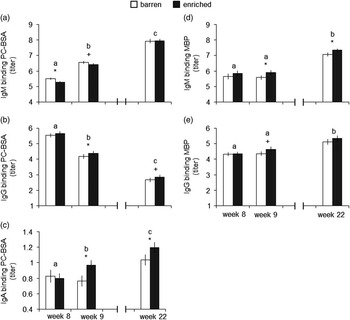
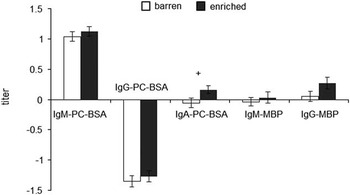
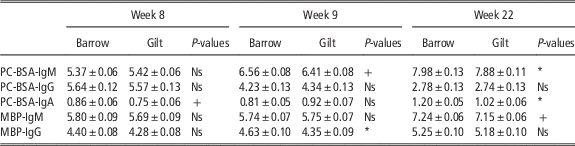
Titer of IgM, IgG and IgA antibodies in serum binding PC-BSA and IgM and IgG binding MBP are shown in Figure 1 (housing effects) and in Table 1 (gender effects). The analyses showed (additive, not interactive) effects of particularly housing and gender on titres over time, and therefore these two factors are highlighted separately. The change in antibody titres due to regrouping (∆ week 9−week 8) for both housing conditions is shown in Figure 2.
Means and standard error of mean of antibody titres. IgM (a), IgG (b) and IgA (c) titres to phosphorylcholine-bovine serum albumin (PC-BSA) and IgM (d) and IgG (e) titres to myelin basic protein (MBP) of pigs (n=80 pens) in barren and enriched housing conditions measured before a 24 h regrouping test at 8 weeks of age, 3 days after the regrouping test at 9 weeks of age and at 22 weeks of age. Effects of housing over all 3 weeks are reported in the text; significances of housing differences per week are indicated: *P<0.05; + P<0.10. Week differences are indicated by letters; weeks lacking a common letter significantly differ.

Means and standard error of mean of the variation in antibody titres between week 9, 3 days after a regrouping test, and week 8, before this test. IgM, IgG and IgA titres to phosphorylcholine-bovine serum albumin (PC-BSA) and IgM and IgG titres to myelin basic protein (MBP) of pigs (n=80 pens) in barren and enriched housing conditions for ∆ (week 9−week 8). Significances of housing differences are indicated: + P<0.10.

Means and standard error of mean of antibody titres of barrows and gilts determined before a 24 h regrouping test at 8 weeks of age, 3 days after the regrouping test, at 9 weeks of age and at 22 weeks of age

PC-BSA=phosphorylcholine-bovine serum albumin; MBP=myelin basic protein.
Effects of gender over all 3 weeks are reported in the text; significances of gender differences per week are indicated: *P<0.05; + P<0.10.
IgM, IgG and IgA titres binding phosphorylcholine-conjugated bovine serum albumin
IgM binding phoshorylcholine-conjugated bovine serum albumin
Titers of IgM binding PC-BSA tended to be affected by gender (P<0.10), with overall lower levels for gilts (6.56±0.06) than for barrows (6.60±0.07, see also Table 1) and were also affected by week (P<0.001). Post hoc analysis showed that titres increased from weeks 8 to 9 to 22 (Figure 1a). When analysing the effects per week, barren-housed pigs had higher IgM titres binding PC-BSA than enriched-housed pigs in week 8 (P<0.05), and they tended to do so in week 9 (P<0.10, Figure 1a). The increase in PC-BSA-IgM titres after regrouping (i.e. ∆ of week 9−week 8 as an effect of regrouping) was larger for barrows (1.17±0.08) than for gilts (0.99±0.07, P<0.05). There was no effect of housing on titre changes after regrouping (Figure 2).
IgG binding phosphorylcholine-conjugated bovine serum albumin
Phosphorylcholine-conjugated bovine serum albumin -IgG titres were affected by week (P<0.001) and decreased from weeks 8 to 9 to 22 (Figure 1b). When analysed for each week separately, barren-housed pigs had lower titres than enriched-housed pigs in week 9 (P<0.05) and in week 22 (P<0.10), with no housing effect in week 8 (Figure 1b). Gender did not affect PC-BSA-IgG titres (see Table 1 for means per week). The change in PC-BSA-IgG titres after regrouping (i.e. ∆) was not affected by any of the factors tested (Figure 2).
IgA binding phosphorylcholine-conjugated bovine serum albumin
Phosphorylcholine-conjugated bovine serum albumin-IgA titres tended to be affected by housing (P<0.10), with lower levels for barren-housed pigs than for enriched-housed pigs (overall: 0.99±0.04 v. 0.87±0.04, Figure 1c), particularly in weeks 9 and 22 (per week analysis, both P<0.001). In addition, effects of gender (P<0.05), week (P<0.001) and the interaction between gender and week (P<0.05) were found. Post hoc analysis showed that overall titres in weeks 8 and 9 were not significantly different, but differed from those in week 22. In gilts, however, PC-BSA-IgA titres in week 8 differed from those in week 9 (P<0.05, see Table 1 for means). Barrows had higher titres than gilts in week 22 (Table 1). The change in titres from weeks 8 to 9 (i.e. ∆) tended to be affected by housing (see Figure 2, P<0.10) and was affected by gender (gilts: 0.17±0.08; barrows: −0.06±0.07, P<0.05).
IgM and IgG titres binding myelin basic protein
IgM binding myelin basic protein
Myelin basic protein-IgM titres were affected by housing (P<0.001) (Figure 1d), with overall lower titres for barren-housed pigs (6.10±0.10) than enriched-housed pigs (6.36±0.10). Separate analyses per week revealed that MBP-IgM titres were particularly affected by housing in weeks 9 (P<0.05) and 22 (P<0.05) (Figure 1d). Moreover, a tendency for a gender effect was found (P<0.10), with overall lower titres for gilts (6.19±0.05) than for barrows (6.24±0.05). Myelin basic protein-IgM titres were higher in week 22 (7.20±0.04) compared with week 8 (5.75±0.05) and week 9 (5.75±0.05, week effect, P<0.05). Even though titres in weeks 8 and 9 were overall not significantly different, gender (P<0.10) tended to affect the ∆ in MBP-IgM titres (gilts: 0.10±0.08; barrows: −0.10±0.08).
IgG binding myelin basic protein
Myelin basic protein-IgG titres tended to be affected by housing (P<0.10) (Figure 1e), and were affected by gender (P<0.05) and week (P<0.001, Figure 1e). Barren-housed pigs (4.60±0.09) tended to have lower titres than enriched-housed pigs (4.78±0.10). Analysis of the effects for each week separately showed that MBP-IgG titres particularly tended to be affected by housing (P<0.10) in week 9. Gilts (4.60±0.05) had lower titres than barrows (4.75±0.06). Post hoc analysis showed those titres in week 22 were higher than those in weeks 8 and 9. The change in MBP-IgG titres from weeks 8 to 9 tended to be influenced by gender (P<0.10; ∆ gilts: 0.05±0.08; barrows: 0.28±0.10).
Effect of litter and individual characteristics
All autoantibody titres were affected by litter (P<0.001). Litter did not affect the titre changes from weeks 8 to 9 (after the regrouping test), with the exception of changes in PC-BSA-IgG titres (P<0.05). Backtest classification or IGE class did not affect antibody titres, except that PC-BSA-IgM tended (P<0.10) to be higher for −IGE pigs (6.59±0.08) than for +IGE pigs (6.38±0.08) in week 9.
Discussion
In this study, we investigated the chronic effects of a straw-enriched v. a barren housing environment, and the acute effects of regrouping on levels of NAAb-binding PC-BSA and MBP in pigs differing in gender, coping style and genetic background. Our study shows that these antibodies can be detected in blood of healthy pigs, and that their levels are related to housing conditions, regrouping stress and gender.
Housing effects
In the present study, serum levels of autoantibodies binding MBP were higher in pigs kept in an enriched environment from weaning at 4 weeks onward as compared with barren-housed pigs. As we distributed pigs from the same litters in a balanced manner over the two different post-weaning housing conditions and studied 40 pens per housing condition (80 pens in total), it is highly unlikely that these housing differences found in week 8 (and 9 and 22) are an artefact of coincidental differences that might have already existed in week 4. The housing effect on MBP titres was strongest for the IgM isotype. In man, NAAb (including MBP antibodies) in cerebrospinal fluid and blood have frequently been associated with neurologic diseases (Gold et al., Reference Gold, Pul, Bach, Stangel and Dodel2012). The sera of healthy humans, however, also contain MBP autoantibodies (Hedegaard et al., Reference Hedegaard, Chen, Sellebjerg, Sørensen, Leslie, Bendtzen and Nielsen2009). Autoantibodies-binding neural antigens may both have a pathological role in neural tissue and a protective role by regulating immune homeostasis (Gold et al., Reference Gold, Pul, Bach, Stangel and Dodel2012). The latter may hold for our healthy pigs as antibody titres to MBP were higher in enriched-housed pigs. Other studies have shown an impact of enrichment on other immune characteristics of pigs (Bolhuis et al., Reference Bolhuis, Schouten, Schrama and Wiegant2003; Reimert et al., Reference Reimert, Rodenburg, Ursinus, Kemp and Bolhuis2014a), including reduced haptoglobin levels (Reimert et al., Reference Reimert, Rodenburg, Ursinus, Kemp and Bolhuis2014b), and provided evidence that pigs reared in an enriched environment were less susceptible to a porcine reproductive and respiratory virus combined with Actinobacillus pleuropneumoniae challenge (van Dixhoorn et al., Reference van Dixhoorn, Reimert, Middelkoop, Bolhuis, Wisselink, Koerkamp, Kemp and Stockhofe-Zurwieden2016).
We can only speculate about the origin of the effect of enrichment on levels of MBP binding autoantibodies of the IgM isotype. First, the higher antibody levels may be related to the effects of enrichment on brain and behaviour of pigs, including their mental state. In humans, it has been suggested that emotional states, for instance anxiety and depression, could trigger immune alterations (Postal and Appenzeller, Reference Postal and Appenzeller2015), which may, in turn, affect (neural) cell injury, and as a consequence the release of cell constituents such as MBP (Abou-Donia et al., Reference Abou-Donia, Abou-Donia, ElMasry, Monro and Mulder2013). Second, a difference in hygienic conditions between the enriched and barren environment may have played a role, even though all pigs were housed in the same room. In this study, enrichment was provided in the form of straw bedding which is beneficial for pigs’ behaviour and welfare (Camerlink et al., Reference Camerlink, Ursinus, Bijma, Kemp and Bolhuis2015), but can also be a suitable environment for microbes (Tuyttens, Reference Tuyttens2005) and in this manner affect immune competence. Alternatively, lower MBP binding antibody titres in barren-housed pigs may reflect a continuous usage of the antibodies due to enhanced formation of immune complexes with MBP. Further research is needed to disentangle these potential effects of enrichment on the immune state of pigs, including their autoantibody levels.
Enrichment as compared with barren housing led to lower IgM and higher IgG antibodies binding PC-BSA at some time points when we analyzed levels of antibodies per week, and tended to increase overall titres of IgA binding PC-BSA. The response of PC-BSA to regrouping was generally not affected by housing, except for a tendency of enriched-housed pigs to show a higher increase in IgA-PC-BSA antibodies after regrouping. Apart from the potential influencing factors as discussed above for MBP, a housing difference in aggressive behaviour of these pigs over time, causing body lesions and thus cell damage (Camerlink et al., Reference Camerlink, Bolhuis, Duijvesteijn, Van Arendonk and Bijma2013) may explain the effects of enrichment on PC-BSA autoantibody levels. The exact consequences of these subtle differences in autoantibody levels in our study are unknown, but previous studies have found (even modest differences in) NAb to be linked with survival (Sun et al., Reference Sun, Parmentier, Frankena and Van der Poel2011) and fitness (Rossi et al., Reference Rossi, Doucelin, Le Potier, Eraud and Gilot-Fromont2013).
In brief, effects of housing on MBP autoantibody (mainly IgM) titres and to a lesser extent on PC antibody titres tentatively suggest that environmental conditions affect levels of autoantibodies binding (neural) antigens as a homeostatic response, which could have consequences for both pig health and welfare.
Regrouping effects
Remarkably, IgM and IgG binding PC-BSA, titres were significantly different between weeks 8 and 9, 3 days after the regrouping test. A similar effect was found for the titres of IgA binding PC-BSA, but in gilts only. An age effect seems unlikely here, given the short time span between both sampling days, suggesting an effect of acute stress. A previous study on the same pigs revealed that temporary regrouping activated the classical complement pathway and increased serum haptoglobin levels, suggesting acute regrouping stress (Reimert et al., Reference Reimert, Rodenburg, Ursinus, Kemp and Bolhuis2014a). Moreover, others reported a rise in serum autoantibodies after acute (restraint) stress (Andrejević et al., Reference Andrejević, Bukilica, Dimitrijević, Laban, Radulovic, Kovacevic-jovanovic, Stanojevic, Vasiljevic and Marković1997). Regrouping leads to mutual ranking fights, which can be quite vigorous. It is known to be stressful for pigs and the aggressive behaviour results in body lesions and scratches, in this regrouping test on average >70 per animal (Camerlink et al., Reference Camerlink, Bolhuis, Duijvesteijn, Van Arendonk and Bijma2013). The cell damage associated with stress and/or body lesions induced release of PC could explain why merely NAAb binding PC-BSA, but not those binding MBP, was affected by regrouping.
Week effects
All antibody titres measured were affected by week, and were generally highest at 22 weeks of age, except PC-BSA-IgG. The increase in antibody titres with time is in line with other studies reporting a rise of natural antibody titres with age (Reimert et al., Reference Reimert, Rodenburg, Ursinus, Kemp and Bolhuis2014a). In contrast, the level of IgG binding PC-BSA was lower in week 22 compared with weeks 8 and 9. A Spearman correlation test showed that PC-BSA-IgM and PC-BSA-IgG titres were significantly negatively correlated. Kim et al. (Reference Kim, Gershov, Ma, Brot and Elkon2002) tested the idea that IgM is responsible for complement activation on apoptotic cells via binding of antibodies targeting lysophospholipids, including PC. Under normal circumstances, lysophospholipids are recognized by IgM which activates the classical complement pathway preventing inflammation. In this study, pigs were all healthy and environmental enrichment or barren conditions may not have led to a shortage of IgM antibodies. When enough IgM is available, the animals can handle the clearance of PC that has been formed as a waste product due to stress. If, however, there is not enough IgM, IgG may be formed which might explain why there was a negative correlation between levels of PC-BSA-IgM and levels of PC-BSA-IgG.
Gender effects
Natural autoantibody can also be affected by gender (Nagele et al., Reference Nagele, Han, Acharya, DeMarshall, Kosciuk and Nagele2013). Except for IgG titres binding PC-BSA, all antibody titres measured in this study were affected or tended to be affected by gender. In general, barrows showed higher antibody titres binding PC-BSA and MBP compared with gilts. Nagele et al. (Reference Nagele, Han, Acharya, DeMarshall, Kosciuk and Nagele2013) also found higher NAAb levels in human males which would be in line with our study, although it should be noted that the male pigs were castrated. In general, the immune system of males and females differs significantly (Bupp, Reference Bupp2015).
Changes in antibody titres from weeks 8 to 9 after regrouping were also affected by gender, with the most marked effect on IgA titres which clearly increased in gilts, but decreased in barrows. In week 9, IgA titres binding PC-BSA in gilts were higher than in barrows, which may show a difference in how gilts and barrows deal immunologically with stress after regrouping. Whether sex steroids could underlie the immunological differences found between gilts and barrows remains to be studied. However, gilts and barrows, including the animals in this study, have been found to behave very differently in various novelty tests (e.g. Reimert et al., Reference Reimert, Rodenburg, Ursinus, Kemp and Bolhuis2014b) and in regrouping tests (Camerlink et al., Reference Camerlink, Bolhuis, Duijvesteijn, Van Arendonk and Bijma2013). Differences in dealing both behaviourally and immunologically with stress may partly explain the different autoantibody responses to regrouping in gilts and barrows.
Coping style and indirect genetic effects
Previous studies have shown that pigs diverging in coping style, that is the way they deal with stress as part of their personality, differ in immune characteristics, including NAb to KLH, and/or modulate the effects of environmental factors on immune responses (Schrama et al., Reference Schrama, Schouten, Swinkels, Gentry, de Vries Reilingh and Parmentier1997; Bolhuis et al., Reference Bolhuis, Schouten, Schrama and Wiegant2003; Oster et al., Reference Oster, Muráni, Ponsuksili, Richard, Turner, Evans, Thölking, Kurt, Klont and Foury2014; Reimert et al., Reference Reimert, Rodenburg, Ursinus, Kemp and Bolhuis2014a). No effects on levels of autoantibodies binding MBP and PC were, however, found in this study. Classification of pigs based on their IGE on the growth of their pen mates, which is known to influence fear levels (Reimert et al., Reference Reimert, Rodenburg, Ursinus, Kemp and Bolhuis2014b), aggression (Camerlink et al., Reference Camerlink, Bolhuis, Duijvesteijn, Van Arendonk and Bijma2013), occurrence of abnormal behaviour (Camerlink et al., Reference Camerlink, Ursinus, Bijma, Kemp and Bolhuis2015) and some (other) immune characteristics (Reimert et al., Reference Reimert, Rodenburg, Ursinus, Kemp and Bolhuis2014a) generally did not affect titres of autoantibodies binding MBP and PC either, except that PC-BSA-IgM tended to be higher for −IGE pigs than for +IGE pigs in week 9. The latter could be related to the higher level of aggression found in −IGE pigs when reunited with their own pen mates after the regrouping test (Camerlink et al., Reference Camerlink, Bolhuis, Duijvesteijn, Van Arendonk and Bijma2013).
Litter effects
Litter strongly affected titres of NAAb binding MBP and PC, in spite of the fact that at weaning, litters were split up, with siblings being equally distributed to barren v. enriched pens. The effect of litter on these antibodies could partly be related to the shared prenatal and early postnatal environment (until weaning at 4 weeks of age) of the sibling piglets, but could also reflect genetic effects. A genetic basis for NAb has been demonstrated in other species, such as cattle (Wijga et al., Reference Wijga, Bovenhuis, Bastiaansen, Arendonk, Ploegaert, Tijhaar and Poel2013) and poultry (Bao et al., Reference Bao, Bovenhuis, Nieuwland, Parmentier and van der Poel2016). To the best of our knowledge, it is unknown whether NAAb levels and their response to acute challenges are heritable in pigs.
Conclusion
In conclusion, environment, gender, litter and possibly regrouping stress affected blood levels of autoantibodies related with neural antigen (MBP) and cell damage (PC). In this study, enriched-housed healthy pigs were found to have higher levels of IgM and IgG binding MBP, and IgA binding PC-BSA in serum than barren-housed pigs which may reflect or affect their immune competence, (mental) health and welfare. More research is warranted to investigate the mechanisms by which environmental enrichment affects NAAb.
Acknowledgements
The authors would like to thank Mike Nieuwland, Ger de Vries Reilingh, Monique Ooms, Fleur Bartels, Irene Camerlink, Merel Verhoeven, Nanda Ursinus and Bjorge Laurenssen for skilful assistance in conducting the experiment and analyses. We are also grateful to the animal caretakers and students involved. Luo is financed by the China Scholarship Council.