Film music helps construct narrative, character, and emotion. But sometimes it almost literally bounces off the physical filmed environment. This article centers on Hollywood films of the 1930s and 1940s, a period when backlot sets played their own starring role in American cinema and the film score was coming into its own as a sonic companion to the visual element. These two major components of film construction are sometimes in dialogue. They share the industry's oscillation between creating ethnographically accurate communities and offering stereotyped, sometimes mythic, imaginings of particular places and populations, a duality I have discussed elsewhere.Footnote 1 As Michel Chion summarizes, “the history of film can thus be told as an endless movement of integrating the most disparate elements,” such as sound and image.Footnote 2 The thrust of this article is to concretize that integration within one subset of sound and image research: music and set construction.
The case studies below emerge from my encounter with a seminal examination of one favorite site of American cinema, New York City. James Sanders's Celluloid Skyline: New York and the Movies presents an exhaustive and incisive survey of how Hollywood filmmakers have worked with the components of that massive metropolis, using them as building blocks in the giant nursery of studio backlots.Footnote 3 By the late 1940s, new technologies and business arrangements made it possible for Hollywood to return to the actual streets of New York, but in the earlier period, certain sets stood patiently in Los Angeles, awaiting the next film crew as movie after movie consolidated viewers’ sense of the city. Sanders stresses the duality mentioned above: studios wanted to render New York as accurately as possible, but they also moved subtly to shape a mythic, iconic cityscape that has lasted into our times.Footnote 4 He catalogs every single aspect of city simulation from the waterfront to the penthouse, from the slum to the sleek office. The catalogue includes the city streets and façades that anchor my discussion of how music relates to the built environment of film. Below, I focus on just four of these set types: the bourgeois brownstone, the working-class street, the enclosed courtyard, and the construction site.
The Bourgeois Brownstone
A 1937 comment speaks to the prominence of this particular New York architecture: “all the ‘back lots’ in Hollywood will have three standbys—the old-style western town street, a group of odd foreign buildings set around a square, and a row of brownstone houses, the inevitable New York Street.”Footnote 5 In Celluloid Skyline, Sanders dissects two closely related films based on the bourgeois brownstone row: Life with Father (1947, dir. Michael Curtiz, music by Max Steiner), and The Heiress (1949, dir. William Wyler, music by Aaron Copland). As an experiment in mapping film music onto architecture, this pairing is ideal: two prominent composers and directors almost simultaneously write music that will bounce off the same built version of a fictional New York. Both movies are taken from hit plays based on books about life among the bourgeoisie of lower Manhattan in the nineteenth century. They share many filmmaking tasks, particularly period placement and architectural detail. One could hardly find more controls on the musical variable. Both scores were recognized with Oscar nominations. The two immediate questions are: do Steiner and Copland actually set the façade and street to music? And if so, do their visions diverge? The answer to both is—yes.
Life with Father comes from a much-read memoir by the son of a stockbroker about his autocratic but lovable dad in the 1890s. As a stage play, it holds the record for longest run of a non-musical show. Given the simplicity of the film's scoring, it seems that Steiner quickly sketched out a main title theme that could run through most of the movie, covering both the father and his proud townhouse. Steiner's solution is simple: go Irish. His jaunty melody has the telltale rhythmic moves and motifs of the music-hall Irish sound of the late nineteenth or early twentieth centuries. It opens with a pentatonic flourish of jaunty woodwinds over pizzicato backbeat strings to set a jocular tone. The opening descending E–D–C♯–A tetrachord rings out three times before finishing off with a dotted-rhythm snap sequence, also threefold. It's as subtle as a shillelagh. Main titles such as this one often had an ABA structure in classic Hollywood scores, set up in early work by Erich Korngold in Captain Blood (1935), in which the opening spells out swashbuckling vs. romance, or, later, Max Steiner's score for Mildred Pierce (1945). But for Life with Father, the same Steiner simply repeats the ho-ho-Irish theme, just augmenting it rhythmically with a forte flourish against a backdrop of sepia framed photographs of Old New York. This approach pairs architecture with music even before the narrative starts. This film wants to set the action firmly in a certain mythic New York, both visually and sonically.
Now, the music could change as we move to the film proper, which opens on our first view of the brownstone row. But they don't. As the same theme plays humorously and sentimentally (on bassoon), we see a curbstone with the name Day. An Irish cop approaches an Irish servant, who is scrubbing the steps because “that's the way Mr. Day likes it.” This emphasis on the façade as a site of social construction yokes music to architecture very concretely. Throughout Life with Father, virtually every time the action moves to the steps and the street, the main title theme comes back in a different guise—sped up, galloping to match the pace of a carriage, slowed down for emotion, or simply neutral as a locating device. Occasionally, the theme spills over to the oldest son as a nod to male lineage, and the boy also gets most of what's left over musically, a secondary romance theme for the get-the-girl subplot. It does seem that the composer can write a setting for a set and give it a geographic and narrative grounding. Musical variety takes a back seat to a stereotyped social and architectural view of bourgeois New York life—all economically situated on a Hollywood backlot.
The Heiress harbors some narrative similarity to Life with Father—an autocratic father—but is more complex in all respects because it began life as a deeply psychological character study in Henry James's novel Washington Square before its Broadway adaptation. While the studio stayed with the stock brownstone row exterior, they spared no expense and time in set design for the interior, sending art director Henry Horner to New York on and off for an entire year to sketch period New York bourgeois townhouses (the opening 1949 title specifies “a hundred years ago”). Accuracy was guaranteed via Horner's “’bible’: a thick notebook documenting every detail about the houses and the people who once lived in them.”Footnote 6 Sanders's analysis of the set includes ground plans of the actual brownstone from 1845 (because he knows which one Horner used as a basis) side by side with the modified design Hollywood needed to suit the demands of cinematography and the script. This shift moves the film along the spectrum from the ethnographic to the mythic. The filmmakers had to build more of a parlor than the architecture of the day allowed so as to locate the romance of the heiress, Catherine Sloper, and, importantly, to construct a space in which to place a the piano, on which her duplicitous, weak-willed suitor, Morris Townsend, could woo her with an eighteenth-century French parlor song, “Plaisir d'amour.” It is a key narrative feature, absent in the Henry James novel, and Montgomery Clift had to learn how to look like a piano player to make the scene work. The architectural accommodation of a musical object—the piano—as a powerful narrative device, in a designated space outside the original story's narrative, will return below, in an analysis of a radically different type of New York film, Dead End. Such continuities of practice help to ground the idea of music-architecture pairing.
Another musical animation of a set design brings the viewer to a garden back of the house, not featured in the Broadway play but written into the original novel. For the garden dance scene, the composer, Aaron Copland was also asked to supply his own facsimile of period music alongside tunes of the time. Again, altered architecture and music, blending accuracy and simulation, combine seamlessly.
This work process reveals the more significant conflicts between the producer/director team and the prestigious composer they hired for The Heiress. Copland had only recently achieved his status as the paramount musical shaper of American ideals, struggles, and lifestyle through his popular ballet scores and the film score for that quintessential American narrative, Our Town (1940). Unlike Steiner in Life with Father, Copland wanted to set the brownstone as part of a thoroughly original, contemporary symphonic score that would start with the main title and work through a number of striking themes. But he was overruled by his director, William Wyler, who felt it was more sensible to insert the romance theme as the second section of the main title, much to Copland's disgust. He felt betrayed.Footnote 7 Only in 1990 did Arnold Freed make a suite that restores Copland's original main title music.
But Copland did have his way with the music for the brownstone façade. It recurs repeatedly, despite the narrative's obsession with the interior patriarchal space of the living room and, secondarily, the passionate parlor. Sanders focuses on the sliding doors and the hallway of the carefully constructed set as physical embodiments of the father-daughter duel and the failed romance. The relations between these dominant interiors and the more generic street exteriors make a strong cinematic statement. Copland obliges, marking the arrival and departure of the characters viewed and heard from outside. James Lochner describes the brownstone theme as “a sequence of chromatic triads in three-quarter time” and quotes film historian Irwin Bazelon, who calls this architectural accompaniment “quiet, tranquil, and extremely pastoral in nature. It is a musical mood in which the composer is completely at ease.”Footnote 8 Indeed—Copland is comfortable with his idiom, as in Appalachian Spring, and makes no attempt anywhere in the score to introduce any New York–specific music, “pastoral” not being the usual sensibility for street scenes, as we will see below.
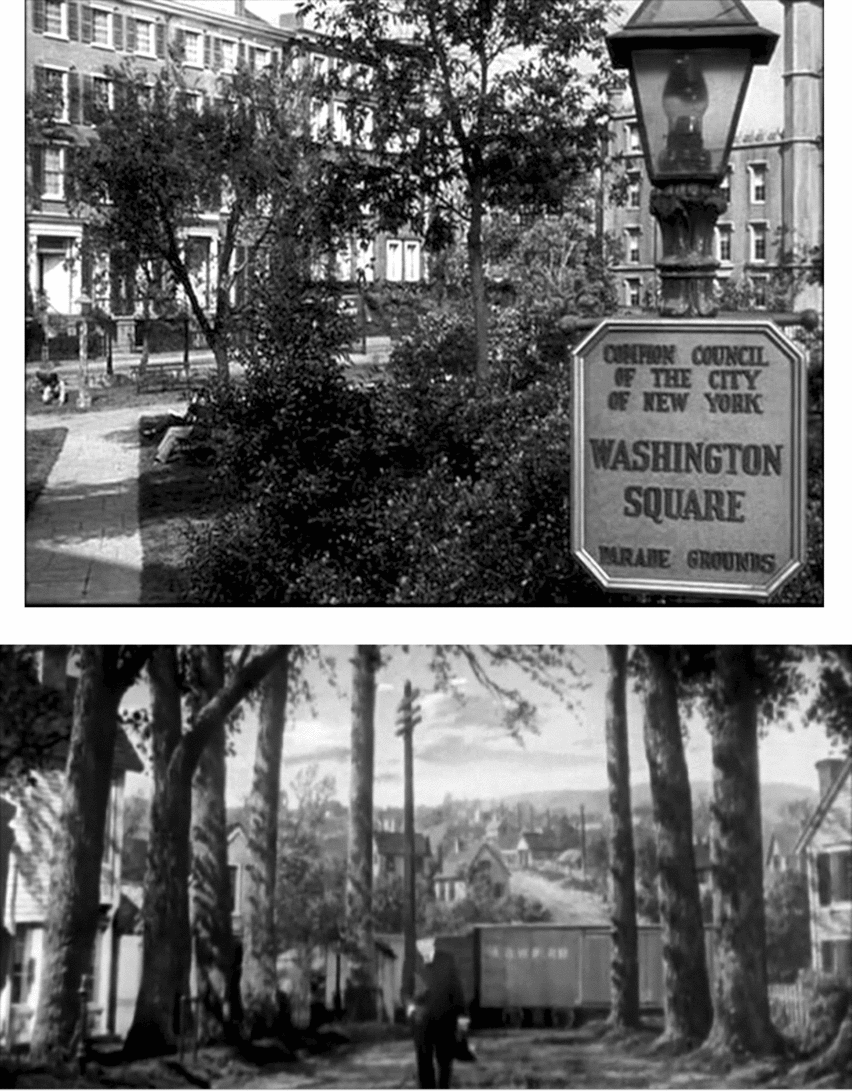
One way to get some leverage on Copland's compositional stance is to peek into his few other film scores. He makes similar moves for every movie. In Our Town, the opening presents a scene similar to Life with Father: it is breakfast time, and the camera comes down the street and shows us the house façades viewed through the transit of a paper boy, a walk-on player who matches the cop and the maid in New York (Figures 1 and 2). Unlike Steiner, but like his own work elsewhere, Copland offers the same type of yearning Americana that also turns up in a western setting for The Red Pony, released the same year as The Heiress (1949).Footnote 9 This composer believes that architecture needs music to construct a place and tone, but not in a way that will spatially locate the action. The local logic of the New York brownstone, New England village, or California cabin will not dictate his vision. All places, all narratives are capital-A American. Copland himself saw the set-matching situation differently, as a problem of not being able to write variably. He says, “The only problem I had with The Red Pony was that it was shot on the same ranch that was used for Of Mice and Men. Now I ask you: If you had to look at the same landscape every day, could you think up different music?”Footnote 10 This statement, while not acknowledging the uniformity of Copland's film scores, does confirm the idea that composers can feel a strong need to align music with the physical structure of the set.
Two streetscapes, one Copland sound. Film stills, The Heiress, William Wyler, dir., Paramount, 1949; Our Town, Sam Wood, dir., United Artists, 1940.

From the bourgeois brownstone, with its carefully curated exterior views, we turn to the position of the proletariat in the music-architectural scheme of Hollywood practice.
The Working-Class Street
Three films of the 1930s share several strategies for the set-score relationship, while sharply differing in other ways. Street Scene (1931, dir. King Vidor, music by Alfred Newman) created a New York template, as Sanders writes, “more than any other single film, it was Street Scene that established the iconic role of the tenement street within New York movies.” It is a set that contrasts sharply with the upscale environments described above: “Unlike the elegant but silent row-house façade, every inch of the tenement's exterior pulses with life,” and, at times, with the vernacular music of the neighborhood.Footnote 11 But first, the movie opens with an obviously constructed shot of the skyline, looking east towards the Chrysler Building, then the newest symbol of city luxury and style, accompanied by what would eventually be known as “New York” music. This cosmopolitan, upbeat sonic branding of Manhattan is based on the jazzy, urbane sound of George Gershwin and appears in many a movie. It features syncopation, scampering strings, and sharply profiled instruments such as clarinet and trumpet.
After this pairing of visual and audio glamor, the camera cranes down into a working-class neighborhood to the tune of “East Side, West Side,” an 1895 song that came to epitomize New York. Originally heavily Irish (featuring “me and Mamie O'Rourke”), the song matches the feel of Life with Father in terms of the setting/music pairing: specific place and time. This decidedly New York reference began as early as The Jazz Singer of 1927, the landmark talkie that moved cinema into the sound age. There, “East Side, West Side” opens the score, accompanying streetscape shots that locate the action on the Jewish Lower East Side, unlike the interethnic Upper West Side of Street Scene. So the general mythic nature of this particular song trumps the ethnic specificity of the narrative.
Street Scene’s music moves from the score's suggestion of an idealized New York childhood to an embodied one, as we see kids singing “The Farmer in the Dell” as a game song. This set-up relies on a strong association between children, street games, and city sets that would prove durable through Spike Lee's Crooklyn in 1994. The move to source sounds from the composed score is almost permanent in Street Scene. The studio did not ask Newman to write a full-blown score to underline the drama and pathos of the script, except for a brief gesture for the most melodramatic moment, a domestic murder. Almost the only other time we hear an orchestra comes at the opening of the second act of the script, thirty-six minutes in, where a reprise of the main title “New York music” offers solid narrative support for the storyline. This sense of music as pillar for narrative structure solidifies at the ending, when the opening music and skyline shot return together.
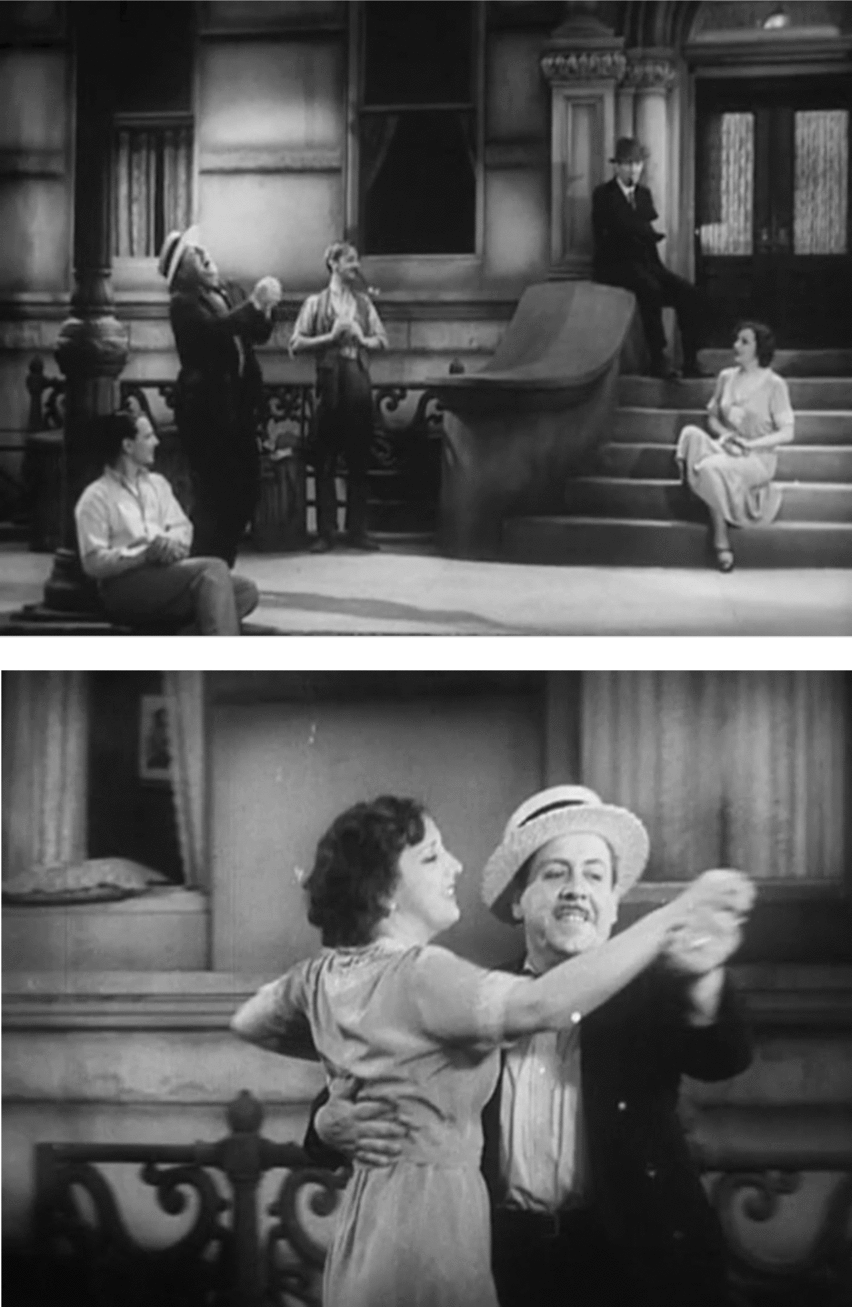
For the rest of the time, scattered source music helps to flesh out the talky, street-bound action, very much showing the origins of Street Scene in Elmer Rice's successful play. Unlike the move from stage to screen in The Heiress, Life with Father, and Dead End (discussed below), Street Scene rarely becomes cinematic. Instead, it relies on the variety of ethnic accents, intermittent spontaneous music, and strong interaction among stereotyped and well-acted characters who represent differing points of view about New York lower-class life. Chion speaks of an “ensemble of sounds” that have “a kind of quasi-autonomous existence with relation to the visual field,” and although Street Scene did not have the technical means to create what he calls an acoustic “superfield” that immerses the viewer in a soundscape, its overlaps of strong characters against a static setting offers significant sonic variety.Footnote 12 And it combines the accuracy of close observation with the stereotyping that builds the mythic New York of American cinema. Given the prevailing characterization of Italians at the time, it comes as no surprise that they do most of the singing, and the amateur tenor even whisks a young woman into a dance (Figures 3 and 4). A small segment of overlapping street cries by a junk man and an ice cream vendor, along with an overheard music lesson (also given by an Italian), supply aural ornamentation to the stable architectural setting.
Working-class musical pleasure on the streets of New York. Film stills, Street Scene, King Vidor, dir., Samuel Goldwyn, 1931.
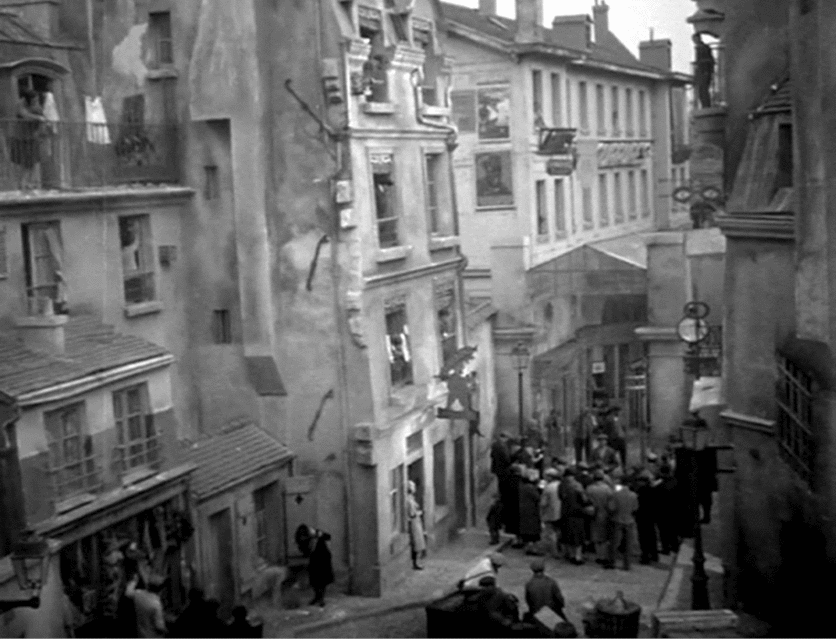
And so Street Scene offers simple and effective solutions to the music-architecture pairing. The bookending of the impersonal, glamorous city and its musical complement, along with the lack of continuous symphonic narrative support, allows the working class to sing for itself on the steps of its brownstone apartment house. It is an approach that seems highly resonant of the early 1930s, and not just in New York. A quick trip to Paris allows for a comparative view. In the same year as Street Scene, so not a case of intertextual influence, René Clair created Sous les toits de Paris (Under the Roofs of Paris), the first of his series about working-class life. Clair was quite vocal about his distrust of synchronized sound and used it sparingly in this period, so any introduction of music means the director wants a very specific pairing of sight and sound, not a generalized support system for the narrative. Like Street Scene, Sous les toits opens with a skyline-level view of a metropolis and then moves down into the neighborhood, an enormous set made to look like a real Paris quartier. Just as accurately, the music provides a popular French song—aptly titled “Sous les toits de Paris”—of the type that was sold in sheet music form by hawkers who taught the crowd the words. This communal activity, combining set and song, is what we see as the camera cranes down, with the melody rising in volume to synchronize with the visual approach to the song circle (Figure 5). Finally, the camera settles in at ground level, inside the group, where the viewer becomes part of the action. At the end of the film, as in Street Scene, we return to this opening moment with a reprise of the song circle as the camera cranes up and out and the music fades.
A Parisian proletarian singing circle. Film still, Sous les toits de Paris, René Clair, dir., Filmsonor, 1932.
Comparison makes the absence of symphonic city music in the Parisian film glaringly obvious. No jazzy glamor, just the voices of the proletariat. Perhaps that is appropriate for the French 1930s moment, but Elmer Rice's New York play is no less leftist than its European counterpart, so what accounts for the different musical solution to depict class identity? The answer possibly lies in the different ways that filmmakers and studios can build a mythic city, even while agreeing on basics of set design and rough content. A full comparative history of what role music plays in this image building would be revealing. The constructed image of Paris shown in Sous les toits was part of a concerted French effort to make the set “into a character, a star,” which “has to perform like any other artist.” A film's success depended on “the harmonious collaboration of all the competing elements of its construction.”Footnote 13 The resulting audiovisual architectural pairing, including the accordion, made Paris mythic in both across Europe and in American cinema.Footnote 14
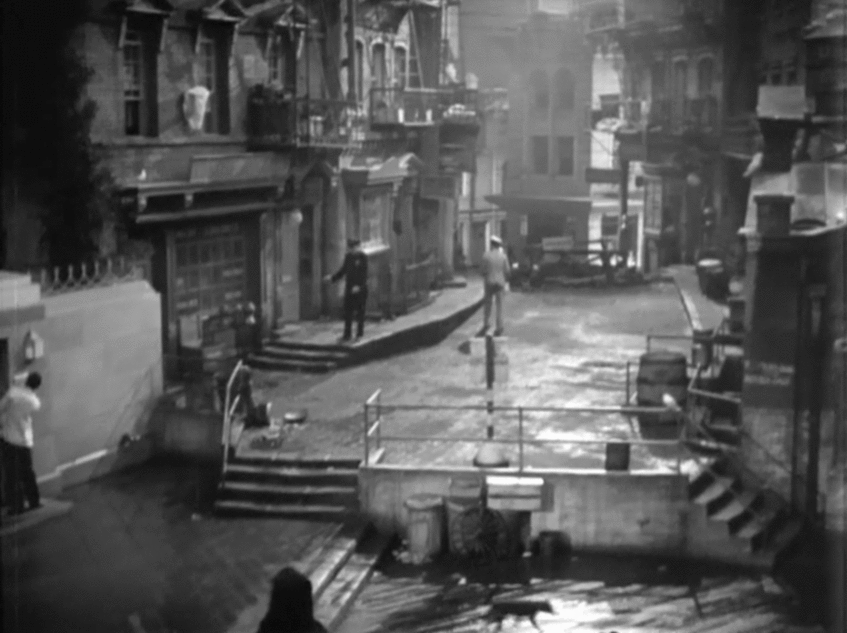
This apparently simple system of music-set synchronization in these early 1930s films on both sides of the Atlantic allowed for more complex interactions to emerge as sound was consolidated into the film product. Dead End (1937, dir. William Wyler, music by Alfred Newman) shares so many basic traits with Street Scene, including the composer, that it can well be seen as a successor. But its internal construction, particularly the music-architecture interplay, is so much denser and multilayered that it calls for a closer reading. Common to the two films is the bookending of a crane shot down from and back up to a set piece city, in and out of a working-class neighborhood, again accompanied by “New York” music. Neither film has a full symphonic score, relying on sonic sources that are close to the sets. Both share concerns for the fate of the poor, as seen through the fate of disadvantaged youth. But whereas Street Scene is visually sparse, theatrically stagy, and talky, Dead End edges towards the emerging genre that would eventually be labeled film noir. The set is ingenious and immense (Figure 6), including a simulated East River, the lighting is technically virtuosic, the cast of characters is complex, and the role of music imaginative. The imaginary cityscape of the opening and closing looks west towards an out-of-scale view of modern midtown and so fully complements the sheen of the accompanying silken strings. This approach aligns music with Donald Albrecht's analysis of modernist film architecture as suggesting “affluence, glamour and escape.”Footnote 15
Glamor vs. grit: the high-rise and slum of Dead End. Film still, William Wyler, dir., Samuel Goldwyn, 1937.
This view is interrupted by a didactic scroll, telling us that the rich have built a high-rise and moved into a poor neighborhood on the banks of the East River “and now the terraces of these great apartments look down into the windows of the tenement poor.” As the camera obligingly follows this view into the slum, the New York glamor music might shift perspective, but it obstinately does not. Even as the camera unflinchingly shows a woman dumping a pitcher onto a neighbor's head, or our future hero, unkempt and dirty, dragging a trash-can into the street, the orchestra plays through, offering Newman's lovely muted trumpet-violin duo. The high-rise and its doorman enter the picture, as morning comes to the neighborhood: the milkman is on his route, a cop rouses a vagrant from a bench. The point of view briefly shifts to an interior shot, rare in this film of exterior interplay, of a woman raising the shade. Unlike the situation in Clair's Paris, the tenement dwellers have no musical voice; the studio ethnomusicologist sleeps through the whole first act of the drama. And it stays that way well into the film, which continues without underscoring. Finally, however, a musical object in a charged space dramatically invades the sonic space left empty by lack of score.
This moment comes after the narrative establishes these facts: our hero Dave is close to his childhood sweetheart, (ethnically unpegged) Drina, but is drawn to the next-door rich blonde. Meanwhile, native son Babyface Martin, with his henchman Hunk in tow, is returning to the block to see his old mother and his own early girlfriend. All along, a group of ragged delinquent boys, including Drina's brother, function as Greek chorus in this drama of class conflict. In the original, successful play, these urchins take up most of the space, speaking in a meticulously spelled-out New York dialect.Footnote 16 The musical response to Dead End’s layered narrative aligns with the built reality of the set, even physically providing grounding. The main sonic actor, of all things, is a player piano.
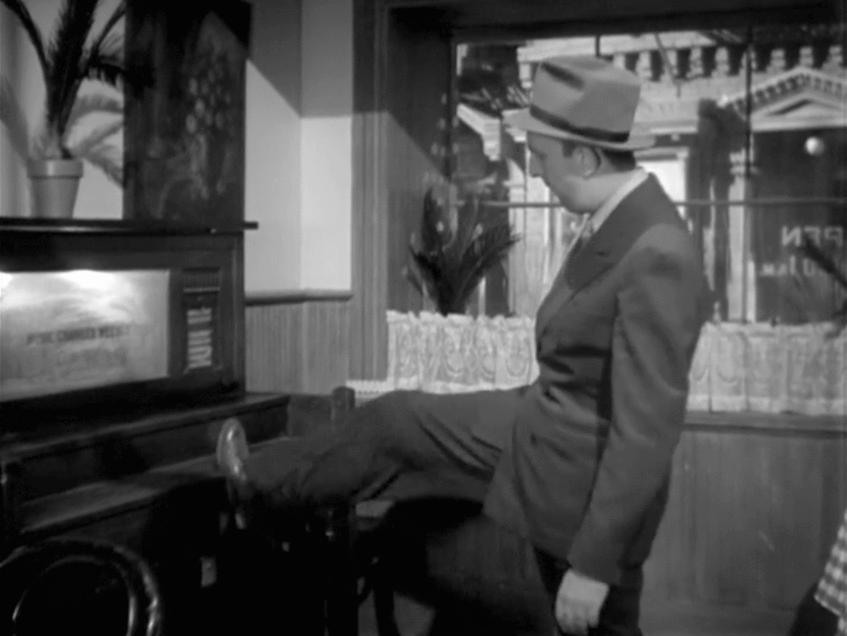
This ear-catching object appears in a café that is not even mentioned in the Broadway version of Dead End.Footnote 17 Like the parlor piano in The Heiress, it is a deliberate construction for film, a piece of “character architecture” that exists to offer a distinctive musical space and voice in a film without a score. Babyface retires to this café with Hunk no fewer than three times: once after his old mother utterly rejects him, the second after his old flame, who has become a hooker, walks away, and the third when he broods about how to recoup these emotional losses by kidnapping a rich kid from the high-rise. This trilogy of scenes stars the piano. Upon first entering the café, Hunk drops a coin to start the music. Babyface is enraged: “turn that thing off!” he cries. But it's not so easy—Hunk has to kick the piano to get it to shut up. “I thought some noise might cheer you up,” the sidekick says, but clearly it hasn't (Figure 7). The next time the pair comes in for a drink, after the sweetheart scene, the piano is already on. The Italian owner comically sizes up the situation and dramatically unplugs the instrument. These two moments provide just about the only comedy in a very dark film, literally and metaphorically.
Rage against the machine: Hunk silences the player piano. Film still, Dead End, William Wyler, dir., Samuel Goldwyn, 1937.
Why does Babyface want to kill the player piano? Perhaps the answer lies in the music. It's archaic, more 1900 than 1930s. In waltz-time, it stubbornly maintains the “rinky-dink” sound of its mechanics, and the simple structure of early Tin Pan Alley. Maybe it reminds Babyface of the youth he now looks back on bitterly, having been rebuffed by his mother and girlfriend, so it fulfills one of film music's basic tasks: give insight into a character's state of mind. The emotional trigger provided by the piano is located in a special space that exists only for this purpose. The piano's role as an object whose sound constructs the narrative is reinforced and dramatically extended in the third café scene. This time there's a set-up shot. Dave hears the faint sound of the mechanical plinking from his tenement window before we see the gangsters in the restaurant. The music has escaped the confines of its box and room and is taking over the soundscape of the neighborhood. Gloomy Babyface has lost his power over the song as he scowls on a seat.
In a remarkably structural way, the pianola persists as the action shifts out into the street, playing interminably (way longer than a nickel's worth of investment should allow) through the next sequence of shots. It becomes a kind of score after losing its source location, or what Chion would call a territory sound that can “serve to identify a particular locale through [its] pervasive and continuous presence.”Footnote 18 The gangsters move down under the river pier with their accomplice and scheme out the kidnapping. Only then does the music stop, as Dave confronts the bad guys, is knifed, punched, and thrown into the river. Suddenly a new sound arrives: hectic jazz, correctly contemporary with 1937, and it turns from score to source as we see the rich folks dancing high up on their terrace. Mopping his brow, the doorman becomes the working-class ethnomusicologist: “you'd think if they didn't have to work, they'd sit quietly and have a nice beer.” Class conflict, the engine of the original Dead End play, finally enters the film through architecturally aligned music.Footnote 19
This narrative focus will play out in two scenes that shift from a static to a more fluid sense of what music can do architecturally. The first brings the Dead End Kids into the sonic sphere. Located centrally between the high-rise and the slum, they can mediate the soundscape. Their leader snatches the song from the terrace—“Boo Hoo”—and mocks it. His class-driven sarcasm has found a suitable target. The song was actually current (written by Carmen Lombardo) and allows him to make fun of the poor little rich kids who can cry over love rather than poverty, suiting the progressive discourse of the Dead End play and film.
A subsequent entry of the high-rise jazz band changes its function. Dave is staging a break-up with the glamor girl. The 59th Street Bridge emerges as backdrop, certainly an early use of that architectural feature as a romantic setting. Here the background jazz is the precursor to the Gershwin setting of the same bridge in Woody Allen's Manhattan. This musical softening of an identifiably New York object marks a sharp screenplay departure from Sidney Kingsley's drama Dead End, whose stage directions describe the structure as “powerful and brutal in the stone and steel which it plants like uncouth giant feet on the earth.”Footnote 20 Kingsley's naturalism is not very romantic. The bridge's conversion into a rendezvous site shows how Hollywood channels practical architecture into the creation of a mythic New York. Now the jazz stands for the rich girl's world, which Dave is giving up in solidarity with his neighborhood and attachment to Drina. As she regretfully leaves the field of love, the socialite retreats to the high-rise, and the music stops as the gate shuts: an architecture-music pairing seals the scene. The careful timing contrasts sharply with the non-stop playing of the earlier pianola cue, which just kept on running mechanically. In this bridge-backed scene, music works in a more traditional way as narrative support, showing the fluidity of function and affect of this versatile sonic medium as it complements architectural detail.
Dead End makes room for only one more moment of source music, at the very end. The Dead End Kids’ leader jokes about Drina's brother Tommy having to go to reform school and remembers a neighborhood boy named Smoky that Tommy might meet there. Smoky used to sing “about an angel,” referring to the American prison song, “If I had the wings of an angel, over these prison walls I would fly.” The Dead End kids warble this tune as they exit stage right into an uncertain future. In a rare move, an on-screen song pairs with off-screen architecture. Finally, the neighborhood has a voice, and the movie should move directly to “The End.” Instead, the reprise of the New York symphonic sound and rising crane shot takes over the screen. The message might be: what you've just seen is merely another moment in the life of the unfeeling city, with its seven million stories.
In Dead End, music goes architectural beyond the basic mission of helping to build a sense of place, character, and message. After the framing establishing scenes, the ensuing sonic sparseness only accentuates the importance of musical intervention into a largely silent soundscape. Physically, music creates and nurtures the café space as a central node of sentiment. The player piano's release into the environment functions almost spatially. Through the low-high contrast of the archaic pianola and the jazzy, up-to-date terrace, time and space become multidimensional in ways that a standard, symphonic, surging score does not allow.
The Enclosed Courtyard
With its intensely closed architectural space, replicating a Greenwich Village courtyard, Rear Window (1954, dir. Alfred Hitchcock, music by Franz Waxman) triangulates the moves made by the earlier Dead End and Sous les toits de Paris. Sanders points out that the courtyard offers “perceived privacy [that] grows from the sense that, while others might be looking, it is reasonable to act as if they are not.”Footnote 21 Much of the time, we see the crowded, tiered, and often open apartments and fire escapes through the eyes of the voyeuristic Scottie, bedridden and bored. People keep exposing themselves to view, sometimes flagrantly. But what about aural exposure? The tenants often play their own private music, so they do seem to be imagining that although others might be listening, it doesn't matter. Mostly they use the radio—Miss Torso and her warm-ups in underwear, Miss Lonelyhearts and her imagined romance. Even at two in the morning, someone apparently has the radio tuned to a pop song, and no one complains.
One character, The Composer, is the exception to this indifference, occasionally making a sonic statement with his live music-making. Sometimes he's private, sometimes public, drawing in friends, and eventually even Miss Lonelyhearts, but often he's just working on the composition that will eventually flower as the real-life studio composer Franz Waxman's “Lisa” song, which trademarks the film and the glamorous character Lisa. But when The Composer moves to jazz, Rear Window draws on a sensibility that harks back to Dead End’s upscale terrace with its hot-band brashness. This gesture looks around the corner to the scores of emerging films such as The Man with the Golden Arm that will identify jazz with urban angst and danger.Footnote 22 It happens at the very opening of the Rear Window’s main title. Jazz suggests aggressive action and underscores two tense moments: the murdered-dog scene and the dangerous digging that Lisa does in search of criminal evidence. So despite the cozy courtyard atmosphere that provides light music, geniality, and occasionally comedy, in fact the space is still an urban one and so possibly menacing. Music allows for a dual reading of this variety of urban architecture.
The extra potential that live, rather than mediated, source music offers the architecture is reminiscent of Sous les toits de Paris, where the straitened streetscape allowed apartment dwellers access to public activity. But a large gap still separates the New York and Paris sensibilities. In the French film, as in Rear Window, the camera peeps into windows to watch the residents’ daily lives. But the Parisians are all singing the title song, which has penetrated their private spaces from the opening shot of their heartfelt collective performance around the song-promoter. The closed communal space suggests that private musical behavior can be viewed from outside, yet it works as a sign of social bonding rather than individual preference. Having the camera as the voyeur, rather than a single observer such as Scottie, reinforces the impression of distance from community.
The Construction Site
It is beyond the scope of this short introduction to a large topic to carry forward the Hollywood audio-vision of New York into our times. But one 1989 film suggests the persistence of a set-centered approach and allows for continuity in the music-architecture dialogue. Tap (1989, dir. Nick Castle, music by James Newton Howard) is a vehicle for dancer Gregory Hines and a stellar back-up cast of veteran hoofers. A central production number allows the set itself to generate the music, an idea used at the very beginning of sound cinema in Rouben Mamoulian's Reference Mamoulian and Rodgers1932Love Me Tonight. In Tap, Hines plays Max Washington, the son of a famous tap dancer, who looking for a comeback after a prison stint. Max refuses a job in what he sees as a phony Broadway tap-based show. To illustrate tap's earlier street-cred authenticity, he moves everyone outside. Alert to city sounds, he picks up work noises from a construction site—rhythmic jackhammers and all—to build a routine that the dancers joyously improvise on (Figure 8). As this sort of street action was not likely to be easily filmable in actual 1980s Manhattan, the crew created it as a set on a studio backlot. It's an interesting throwback to old American cinema that parallels Max's anachronistic, and similarly mythic, approach to creative work.
The hoofers and the hardhat meet on the construction site. Film still, Tap, Nick Castle, dir., TriStar, 1989.
Love Me Tonight, an American film, takes place in a mythic Paris, with some of the appeal to French working-class sonic solidarity found in the same year's Sous les toits de Paris. Mamoulian's movie is often cited by film historians and buffs as an innovative rethinking of the stage musical (it has Rodgers and Hart music). The opening of the filmed version, starring the French-American pairing of Jeanette MacDonald and Maurice Chevalier, is a strikingly inventive conceit. Street sweeping, blacksmithing, and other everyday Parisian activities build up on the soundtrack (a tough task in 1932) and turn into a city symphony that finally enters Chevalier's apartment as he gets out of bed. He shuts the window, declaring that Paris is too noisy for his taste. The director's move might be an extension of the 1920s European big-city portrait (e.g., Ruttman's 1927 Berlin: Sinfonie einer Grossstadt, “Symphony of a Metropolis,” with its musical title) into the audible space now available to moving pictures. I doubt the makers of Tap were consciously recycling Mamoulian's idea, but the notion of activating the set to partner with the score directly reinforces the way filmmaking aligns these two key components both realistically and mythically to integrate the viewer's narrative and sensory satisfaction.
In summary, focusing on New York locations suggests the many ways that architecture and music meet and interact on the set. They might often ignore each other, but their moments of mutual acknowledgement can be meaningful. After all, both set and music are studio constructions built by the same team. With the return to the streets of New York in the late 1940s, the combination of accuracy and stereotype discussed above was transferred to settings—real buildings—rather than sets. In Mighty Manhattan: New York's Wonder City (1949, dir. James Smith), location shots pair with underscoring in the most literal possible way: Trinity Church with “Battle Hymn of the Republic,” St. Patrick's Cathedral with “O Come, All Ye Faithful,” City Hall with “Columbia, the Gem of the Ocean,” Chinatown with “Chinatown, My Chinatown,” and the United Nations with a series of national anthems. Insidiously, a shot of the Women's Infirmary introduces “Ave Maria.” This heavy-handed parallelism of sound and setting is perhaps the logical outcome of the processes sketched out above, where I have hoped to show that music and architecture, two strong-minded elements of cinema structure, can talk to each other on equal terms.