Implications
When used under optimum conditions, sexed semen has the potential to add significant value in seasonal, pasture-based dairy production systems, both at farm and wider industry levels. It is likely that sexed semen will be used more widely as its fertility performance improves and the efficiency of the sorting procedure increases.
Introduction
Following the initial development of the flow-cytometric method of sex-sorting semen (Garner et al., Reference Garner, Gledhill, Pinkel, Lake, Stephenson, Van Dilla and Johnson1983), numerous technical advances have enhanced the throughput and sorting efficiency of the process (Sharpe and Evans, Reference Sharpe and Evans2009). Sexed semen is now widely available in dairy industries around the world, and is nearing commercial application in several other species (Seidel, Reference Seidel2012). The process distinguishes X- and Y-chromosome bearing sperm by measuring differences in fluorescence following staining the sperm with a non-toxic, DNA-binding dye (Hoechst 33342) (Johnson et al., Reference Johnson, Flook and Look1987). Despite reliably producing ~90% gender bias (Cerchiaro et al., Reference Cerchiaro, Cassandro, Dal Zotto, Carnier and Gallo2007; Borchersen and Peacock, Reference Borchersen and Peacock2009; DeJarnette et al., Reference DeJarnette, Nebel and Marshall2009), the fertility of the sexed semen product is compromised (Seidel, Reference Seidel2012).
The principle of seasonal, pasture-based systems is to maximise utilisation of grazed grass by matching the peak intake demands of the dairy herd to the flush of spring pasture growth (Dillon et al., Reference Dillon, Crosse, Stakelum and Flynn1995). The importance of reproductive performance is emphasised in seasonal production systems compared with year-round production systems, and is a key factor in determining profitability on pasture-based dairy farms (Veerkamp et al., Reference Veerkamp, Dillon, Kelly, Cromie and Groen2002; Beukes et al., Reference Beukes, Burke, Levy and Tiddy2010). As a result, the uptake and usage of sexed semen to date has been limited in seasonal pasture-based systems.
The majority of the current data available on the use of sexed semen, in both controlled research trials and on-farm records is from year-round production systems (DeJarnette et al., Reference DeJarnette, Nebel, Marshall, Moreno, McCleary and Lenz2008; Chebel et al., Reference Chebel, Guagnini, Santos, Fetrow and Lima2010). The objectives of this review are to summarise the existing information on the fertility performance of sexed semen, assess the current status of sexed semen use in seasonal pasture-based systems of dairy production, and evaluate the applications and cost-benefits of sexed semen use in such systems.
Fertility of sexed semen
The importance of fertility is greater in seasonal dairy production systems compared with year-round systems (Veerkamp et al., Reference Veerkamp, Dillon, Kelly, Cromie and Groen2002). The fertility of the sexed semen product, therefore, is one of the primary factors of importance when considering the use of sexed semen in seasonal, pasture-based production systems. The majority of early trials with sexed semen were conducted using virgin heifers, in order to capitalise on their inherent higher fertility compared with lactating cows. Initial results from Seidel et al. (Reference Seidel, Schenk, Herickhoff, Doyle, Brink, Green and Cran1999) indicated that it was possible to attain conception rates (CR) with frozen-thawed sexed semen containing 1 to 1.5×10⁶ sperm per straw that were ~70% to 90% of those achieved with conventional semen containing 20×106 sperm per straw. These preliminary results have since been confirmed by a number of larger studies that have demonstrated CR with frozen-thawed sexed semen (2×10⁶ sperm/straw) that were ~70% to 80% of the CR achieved with frozen-thawed conventional semen (15 to 20×106 sperm/straw) in both virgin heifers and lactating cows (DeJarnette et al., Reference DeJarnette, McCleary, Leach, Moreno, Nebel and Marshall2010; Norman et al., Reference Norman, Hutchison and Miller2010; DeJarnette et al., Reference DeJarnette, Leach, Nebel, Marshall, McCleary and Moreno2011; Healy et al., Reference Healy, House and Thomson2013).
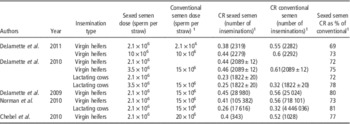
A number of studies investigated the potential of increasing the number of sperm per straw to improve CR with sexed semen (DeJarnette et al., Reference DeJarnette, Nebel, Marshall, Moreno, McCleary and Lenz2008; Schenk et al., Reference Schenk, Cran, Everett and Seidel2009; DeJarnette et al., Reference DeJarnette, Leach, Nebel, Marshall, McCleary and Moreno2011). CR in heifers inseminated with frozen-thawed sexed semen were improved when the number of sperm per straw was increased from 2×10⁶ to 10×106. The increased number of sperm in the sexed semen straws failed, however, to achieve CR comparable with those achieved with conventional semen (DeJarnette et al., Reference DeJarnette, Leach, Nebel, Marshall, McCleary and Moreno2011). A comparison of the CR achieved with sexed semen and conventional semen in recent studies with large numbers of inseminations is shown in Table 1.
A comparison of CR achieved with sexed and conventional semen in virgin heifers and lactating cows at 1st insemination only, in recently published large scale studies

1 CR=conception rate, the proportion of animals conceiving to a given insemination.
It has been suggested that using fresh sexed semen, thereby avoiding the cellular damage and losses associated with the freeze-thaw process (Watson, Reference Watson1995) may be a means to improve the fertility of sexed semen (Klinc et al., Reference Klinc, Frese, Osmers and Rath2007). Unpublished results from a field trial in New Zealand suggested that CR with fresh sexed semen were ~90% to 95% of those achieved with conventional, frozen-thawed semen (Livestock Improvement Corporation (LIC), 2012).
A large-scale field trial involving over 15 000 inseminations on 392 dairy farms was conducted in Ireland in 2013. The objective of the trial was to fully investigate the fertility of both fresh and frozen-thawed sexed semen relative to conventional semen in both virgin heifers and lactating dairy cows in spring calving, pasture-based dairy herds. Nine Holstein–Friesian bulls were used in the study, and each ejaculate was split to allow comparison of three sexed semen treatments (fresh sexed semen, 1×10⁶ sperm/straw; fresh sexed semen, 2×10⁶ sperm/straw; and frozen sexed semen, 2×10⁶ sperm per straw) with fresh conventional semen (3×10⁶ sperm per straw). Preliminary results based on ultrasound scans of roughly one quarter of the animals enrolled in the study indicate that CR with sexed frozen semen were ~87% of those achieved with conventional semen in both virgin heifers and lactating cows. Hence, the performance of sexed frozen semen relative to conventional semen was markedly improved compared with previous reports in the literature. CR achieved with the greater dose of fresh sexed semen (2×10⁶ sperm/straw) were ~80% of conventional, whereas the CR achieved with the lesser dose (1×10⁶ sperm/straw) of fresh sexed semen were slightly lower, at ~75% of those achieved with conventional semen. Body condition score (BCS) was measured on 1 to 5 scale in increments of 0.25 at the time of pregnancy diagnosis. Consistent with results from studies using conventional semen (Herlihy et al., Reference Herlihy, Crowe, Berry, Diskin and Butler2013), the preliminary results indicate that lactating dairy cows inseminated with sexed semen had greater (P<0.001) CR when BCS was ⩾3.0 compared with cows with BCS⩽2.75 (41.6% v. 28.5%, respectively). Similarly, lactating dairy cows inseminated with sexed semen that were ⩾63 days in milk (DIM) had greater (P<0.001) likelihood of conception compared with cows that were ⩽62 DIM (43.3% v. 27.3%, respectively). Cows that were both ⩾63 DIM and had BCS⩾3.0 had a likelihood of conception of 51.1%. Clearly, sexed semen should be targeted at the higher fertility animals in a herd (i.e. early calving cows in good BCS).
Applications of sexed semen
The potential benefits to a dairy farmer and the wider industry of a sexed semen product that delivers a 90% gender bias with minimal reductions in fertility are considerable. The direct effect of increased numbers of dairy heifer calves born in a herd using sexed semen immediately presents the farmer with a number of options.
Herd expansion
Dairy farmers in Ireland are currently restricted in the amount of milk they can produce by the constraints of the EU milk quota regime. The impending abolition of EU milk quotas, coupled with an ambitious target set by the Irish government in the Food Harvest 2020 report for a 50% increase in national milk output by 2020 (DAFM, 2010) presents a real opportunity for Irish dairy farmers to increase herd size and milk output. Bio-economic modelling was used to investigate the effects of using sexed semen on either virgin heifers only (Hutchinson et al., Reference Hutchinson, Shalloo and Butler2013a) or on both virgin heifers and lactating cows on herd expansion (Hutchinson et al., Reference Hutchinson, Shalloo and Butler2013b). These studies demonstrated that the use of sexed semen, either fresh or frozen, can facilitate faster, more profitable herd expansion in seasonal, pasture-based dairy herds.
The fertility assumptions utilised in those studies were that CR of fresh and frozen sexed semen were 94% and 75% of the CR of conventional semen, respectively. Based on the 2013 field data on the fertility performance of fresh and frozen sexed semen, some modifications to both the fertility assumptions and the scenarios used in the models (Hutchinson et al., Reference Hutchinson, Shalloo and Butler2013a and Reference Hutchinson, Shalloo and Butler2013b) are required.
Updated simulation models with preliminary field study data
In order to provide the most relevant and current information in this review, we have re-run the simulation models developed in the previous studies (Hutchinson et al., Reference Hutchinson, Shalloo and Butler2013a and Reference Hutchinson, Shalloo and Butler2013b) using the preliminary results from a sexed semen field trial that was conducted in Ireland in spring 2013. Full details on the methodology involved in the development of the model and assumptions have been previously described (Hutchinson et al., Reference Hutchinson, Shalloo and Butler2013a and Reference Hutchinson, Shalloo and Butler2013b).
The model described here evaluates only the use of sexed frozen-thawed (SFro) compared with conventional (Conv) frozen-thawed semen, as the SFro achieved the best CR of the sexed semen treatments evaluated in the field study. All assumptions used in the current model are consistent with those described in Hutchinson et al. (Reference Hutchinson, Shalloo and Butler2013b), with two exceptions. First, the CR achieved with SFro was increased to 87% of conventional. Second, SFro was used for the 1st 3 weeks of the breeding season only in both virgin heifers and lactating cows. Briefly, the model was based on a 12 week breeding season split into four equal 3 week periods. Cows and heifers were accounted for in different sections within the same model. For heifers, calculations were performed on the proportion of heifers not pregnant at the start of each of the four 3 week of periods using a 90% submission rate (SR, proportion of heifers intended to be bred that were inseminated within a 3-week period) and a 70% CR (proportion of heifers conceiving to a given insemination) using conventional semen. CR using sexed semen were 61%. Heifers were inseminated following spontaneous oestrus; use of synchronisation for the 1st insemination was not included in the model. All heifers that did not conceive in a given 3-week period were eligible for insemination in the next 3-week period. The heifers that conceived were attributed a conception date that was the median date of that 3-week period. The mean calving date for the following year was then calculated as the mean conception date plus 282 days. All heifers that conceived were included in the model for the lactating herd of their respective treatments (conventional frozen-thawed, sexed fresh or sexed frozen-thawed) the following year.
The model assumes that all replacement heifers had reached puberty and were eligible for breeding by ~14 to 16 months of age, and subsequently calved for the first time at ~23 to 25 months of age. Only heifers born within the 1st 6 weeks of the calving period were retained as dairy replacements.
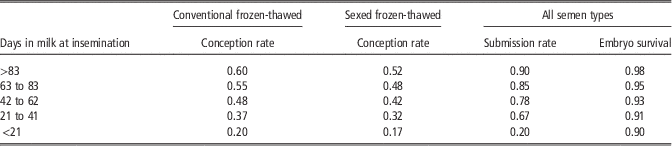
For cows, SR, CR and embryo survival rate in the model varied according to the cow’s DIM during the breeding season. The values used for SR, CR and embryo survival for all three semen types are summarised in Table 2. The values for conventional frozen-thawed semen were derived from two large field studies in pasture-based systems that indicated poorer reproductive performance in cows with short intervals from calving to planned start of mating (Herlihy et al., Reference Herlihy, Berry, Crowe, Diskin and Butler2011; Macmillan, Reference MacMillan2012). SR and embryo survival rates did not differ with semen type used. DIM at each stage of the breeding season was calculated from calving date until the 1st day of each 3-week period. The values for SR, CR and embryo survival (Table 2) were applied at herd level to the proportion of cows not pregnant in each of the four 3-week periods during the breeding season. All cows that did not conceive in a given 3-week period were eligible for insemination in the next 3-week period. Mean calving dates were calculated using the same method outlined in the heifer reproductive performance model. This mean calving date was then used in the model for the following year to calculate DIM at the date of planned breeding.
Assumptions used in the model for reproductive performance of lactating cows, using either conventional frozen-thawed or sexed frozen-thawed semenFootnote 1

1 Submission rate=proportion of cows intended to be bred that are inseminated within a 21-day period; conception rate=proportion of cows pregnant to a given insemination.
The number of cows that underwent embryo loss was calculated as a proportion of the cows that conceived in each 3-week period, and varied according to DIM at insemination. When embryo loss occurred, these cows were not eligible for re-insemination until 6 weeks after the initial successful insemination. Cows were not re-inseminated if embryo loss occurred after the end of the 12 week breeding season or if the initial successful insemination occurred within 6 weeks of the end of the 12 week breeding season.
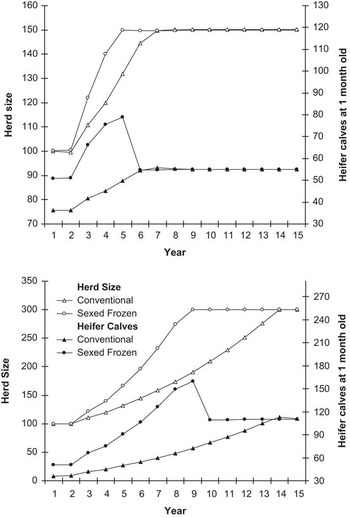
The key physical outputs from the SFro and Conv herds under both scenario 1 (S1; land available limits maximum herd size to 150 cows) and scenario 2 (S2; land available limits maximum herd size to 300 cows) are summarised in Figure 1. Under S1, the SFro herd reached maximum herd size in year 5 compared with year 7 in the Conv herd. Under S2, the SFro herd reached maximum herd size in year 9 compared with year 14 in the Conv herd. Under both S1 and S2, the SFro herds produced greater numbers of heifer calves in the 1st 6 weeks of the calving period compared with the Conv herd.
Herd size and number of heifer calves born in the 1st 6 weeks of the calving period surviving to 1 month of age in herds using sexed frozen-thawed semen or conventional frozen-thawed semen in both virgin heifers and lactating cows under scenario 1 (upper panel; land available limits maximum herd size to 150 cows) or scenario 2 (lower panel; land available limits maximum herd size to 300 cows).

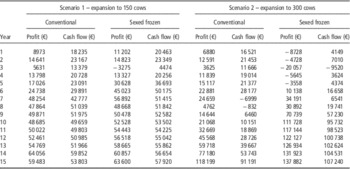
The key financial outputs from the SFro and Conv herds under both S1 and S2 are summarised in Tables 3 and 4. Under S1, cash flow remained positive in every year of the simulation. Under S2, cash flow remained positive in every year of the simulation with the exception of year 3 in the SFro herd and years 7 and 8 in the Conv herd.
Annual profit and cash flow from two herds using frozen-thawed sexed or frozen-thawed conventional semen in virgin heifers and lactating cows under scenario 1 (land available limits maximum herd size to 150 cows) and scenario 2 (land available limits maximum herd size to 300 cows)Footnote 1

1 In both virgin heifers and lactating cows sexed semen was used for the 1st 3 weeks of the breeding season only.
Discounted net profit and total cost of expansion over a 15-year period from two herds using sexed frozen-thawed or conventional frozen-thawed semen in virgin heifers and lactating cows under scenario 1 (land available limits maximum herd size 2 (land available limits maximum herd size to 300 cows)Footnote 1

1 In both virgin heifers and lactating cows sexed semen was used for the 1st 3 weeks of the breeding season only.
Discounted net profit was €33 570 and €235 435 greater for the SFro herd compared with the Conv herd under S1 and S2, respectively. Under S2, the total cost of expansion was €29 337 greater for the SFro compared with the Conv herd due to the faster rate of expansion in the SFro herd.
The results from the updated simulation models provide further evidence that sexed semen can be used as a tool to facilitate faster, more profitable expansion of Irish dairy herds. The strategy for sexed semen use (use for one artificial insemination (AI) only in virgin heifers and the 1st 3 weeks of the breeding season only in lactating cows) was based on feedback from farmers participating in the trial, and our experience of current AI practices in Irish dairy herds. The amended strategy under S2 compares favourably with those described in Hutchinson et al. (Reference Hutchinson, Shalloo and Butler2013b), as the SFro herd experiences a negative cash flow only in year 3 of the simulation. Without alternative sources of funding, any periods of negative cash flow can have severe negative implications for the viability of the farm business. The amended sexed semen use strategy presented here therefore demonstrates a more sustainable method of herd expansion, when compared with those described by Hutchinson et al. (Reference Hutchinson, Shalloo and Butler2013b).
The production of additional heifer calves with sexed semen, as demonstrated in the expansion models, can be applied in non-expanding herds to produce heifers for sale. The profitability of such an enterprise, however, will be largely dependent on market conditions, as is discussed in subsequent sections of this review.
Improved biosecurity
The use of sexed semen to provide additional replacement heifers for herd expansion may offer benefits in terms of improved biosecurity (Weigel, Reference Weigel2004). All replacements can be generated on-farm, thereby eliminating the need to buy in stock (and potential exposure to disease) from external sources.
Reduced dystocia
Dystocia impacts the profitability of dairy herds through losses in production, fertility, cow and calf mortality, increased culling and veterinary and management costs (Dematawena and Berger, Reference Dematawena and Berger1997). It has been demonstrated that by increasing the proportion of heifer calves born at the expense of heavier male calves, the incidence of dystocia is reduced in 1st-calving heifers (Norman et al., Reference Norman, Hutchison and Miller2010). Use of female sexed semen may reduce dystocia costs in 1st-calving heifers by ~20% (Seidel, Reference Seidel2003).
Increased rate of genetic gain
A number of authors (Hohenboken, Reference Hohenboken1999; Weigel, Reference Weigel2004; Khalajzadeh et al., Reference Khalajzadeh, Nejati-Javaremi and Yeganeh2012) have hypothesised that sexed semen may be used to accelerate the rate of genetic gain in dairy herds, by selecting only the highest ranking cows to breed replacements from with sexed semen. This may be further emphasised if replacements are bred only from virgin heifers, as these should be the animals with the highest genetic merit in the herd. Achieving greater genetic gain with sexed semen depends, however, on the availability of sexed semen from the highest genetic merit sires. The demand for conventional semen straws is typically greater than the supply for the highest genetic merit sires. Current sorting procedures incur high levels of sperm wastage, and hence the highest genetic merit sires are typically not sexed. Future improvements in the efficiency of sperm capture during the sorting process would make it feasible, and indeed financially attractive, for animal breeding companies to sort semen from high genetic merit sires. When this occurs, herd-owners will be able to breed replacements from only the highest genetic merit dams and sires, allowing selection pressure on both the male and female lines. This would have a favourable effect on the rate of genetic gain in dairy herds.
Heifer rearing
In order to obtain maximum lifetime milk production, all replacement heifers should be first bred at ~15 months of age (to calve at ~24 months of age), and this is particularly important in seasonal pasture-based systems. An efficient heifer rearing system is essential to meet these targets and ensure that replacement heifers maximise their potential as lactating animals. Archbold et al. (Reference Archbold, Shalloo, Kennedy, Pierce and Buckley2012) demonstrated that larger, well grown heifers had greater pubertal rates at mating start date (MSD), and were more profitable over their lifetime due to superior milk production and greater longevity. In seasonal systems, the use of sexed semen to produce all the replacement heifers in a short period at the start of the breeding season would favourably impact their subsequent productivity and longevity in the herd. These heifer calves will be closely grouped in terms of age, and it would therefore be easier to manage them as one group to meet the optimal target of 60% of mature BW at MSD (Archbold et al., Reference Archbold, Shalloo, Kennedy, Pierce and Buckley2012).
Beef production from the dairy herd
In non-expanding herds, the use of sexed semen enables the number of replacement heifers required to maintain herd size to be produced from a smaller proportion of the herd. This provides dairy farmers with the opportunity to increase revenues from the sale of calves for meat production, by breeding the remainder of the herd with semen from beef sires (McCullock et al., Reference McCullock, Hoag, Parsons, Lacy, Seidel and Wailes2013). Suitable beef sires would generate progeny that are easy calving with short gestation length (SGL). In Ireland, beef sired calves from the dairy herd (male or female) attract a premium of ~€150 compared with bull calves sired by a dairy sire (Bord Bia, Reference Bord2013). Clearly, this represents an economic stimulus to increase the proportion of offspring from the dairy herd with beef sires. A significant price differential between male and female beef offspring from dairy dams would need to exist to make it economical for herd owners to use Y-sorted semen from a beef sire on the proportion of their herd not bred to dairy sires. At present in Ireland, there is only a small price differential between male and female beef offspring from dairy dams, and hence no incentive to use Y-sorted semen.
Shortening gestation length
One of main drivers of profit produced per individual cow in seasonal-calving systems is lactation length; a cow that calves late in the spring will have a longer dry period (greater cost) and a shorter lactation (reduced income) than a cow that calves at the start of the calving period in late winter/early spring. After generating the required number of replacements using sexed semen, AI could be switched to using sires with very SGL on repeat breeders and at first AI in late-calving cows. This would ‘pull back’ the calving date in these cows, with the effect of condensing the calving pattern. This is a strategy being marketed by LIC in New Zealand (http://www.lic.co.nz/lic_Short_gestation.cfm accessed November 2013). The SGL sires with the shortest gestations are predominantly dairy breeds, but they are not suitable for generating replacements as they were identified based on their breeding value for gestation length only (i.e. breeding values for production traits ignored). The relative economic advantage of opting to increase the beef output from the dairy herd or to shorten gestation length will depend on regional differences in milk and beef prices.
Economics of sexed semen use
As outlined above, there are a number of potential applications and benefits of using sexed semen in seasonal, pasture-based production systems. There are, however, two primary negative factors that must be accounted for when considering the use of sexed semen. These are: (i) the price premium of sexed semen compared with conventional; and (ii) the reduction in fertility performance of sexed semen compared with conventional. A number of authors have examined the economic effects of sexed semen use in a variety of scenarios, both in year-round (Seidel, Reference Seidel2003; Olynk and Wolf, Reference Olynk and Wolf2007; McCullock et al., Reference McCullock, Hoag, Parsons, Lacy, Seidel and Wailes2013) and seasonal production systems (McMillan and Newman, Reference McMillan and Newman2011; Hutchinson et al., Reference Hutchinson, Shalloo and Butler2013a and Reference Hutchinson, Shalloo and Butler2013b). McCullock et al. (Reference McCullock, Hoag, Parsons, Lacy, Seidel and Wailes2013) described the economic advantage of using sexed semen as a function of interactions among three spheres of influence: the market environment, management practices and technological efficiency.
The breeding management practices employed in a herd will play a key role in determining the profitability of sexed semen use. Consistent with the use of conventional semen, heifers and cows must be healthy and well nourished, and efficient heat detection is required to achieve optimum fertility performance (Diskin and Sreenan, Reference Diskin and Sreenan2000; Roche, Reference Roche2006). Herds with sub-optimal fertility performance or pre-existing fertility problems are unlikely to achieve the pregnancy rates required to maximise the economic returns from investment in sexed semen use.
There is evidence that the reduction in fertility due to the sexing process is not consistent across sires (Borchersen and Peacock, Reference Borchersen and Peacock2009; Frijters et al., Reference Frijters, Mullaart, Roelofs, van Hoorne, Moreno, Moreno and Merton2009). With the advent and widespread uptake of genomic selection, an increasing proportion of the highest genetic merit sires available to producers are young sires evaluated based on genomic proofs (ICBF, 2013). This presents two issues that will be difficult to resolve in the short term: (i) low ejaculate volume produced by young bulls; and (ii) a priori ability to identify whether or not an individual bull is suitable for sexing. An ejaculate from a young sire (~15 months of age) typically has a smaller volume with fewer sperm cells compared with a mature sire (Mathevon et al., Reference Mathevon, Buhr and Dekkers1998). This presents a problem, as one of the criteria for an ejaculate to be considered suitable for sorting is that it contains at least 6 billion sperm cells. Ejaculates from young sires are therefore more likely to fail to meet the minimum standards required for processing. At present, the majority of dairy sires that are sorted are 2 years of age or older. While this overcomes the problem of low volume ejaculates with inadequate numbers of sperm cells, it slows down genetic progress.
The lack of any previous records of field fertility for young sires increases the risk of processing a sire with poor fertility. To date, no diagnostic test (or suite of tests) has been successfully developed to accurately predict sire fertility or how a sire will respond to the sexing process. The development of such a test would enable identification of low fertility sires or to screen out sires that undergo the greatest reduction in fertility following the sorting procedure. The identification and removal of these sires would ensure that only the most suitable sires are processed, thereby improving the relative performance of sexed semen compared with conventional semen.
The decision to use sexed semen may be driven by the desire to increase production of dairy heifers for expansion, production of dairy heifers for sale, or production of the required number of dairy replacements from a smaller number of breedings, thereby allowing a greater proportion of the herd to be bred to beef sires. In each of these scenarios, the prevailing market conditions will have a significant effect on the profitability of a breeding strategy that incorporates sexed semen. Hutchinson et al. (Reference Hutchinson, Shalloo and Butler2013a) identified critical cash flow issues and large reductions in farm profitability during periods of low milk price in a simulated herd using sexed semen to facilitate faster herd expansion. McMillan and Newman (Reference McMillan and Newman2011) conducted an economic appraisal of New Zealand dairy herds, and concluded that sexed semen will have a limited role in generating heifer replacements and increasing genetic gain in New Zealand dairy herds. At present in New Zealand, there is an adequate supply of replacements heifers, and there is very little value in beef production from the dairy herd (P. Amer, Abacus Bio Ltd, personal communication). Under these conditions, the management options for dairy farmers using sexed semen are limited. Further reductions in the fertility losses and the price premium associated with sexed semen are required to make sexed semen a more attractive breeding option for New Zealand dairy farmers (McMillan and Newman, Reference McMillan and Newman2011).
Widespread use of sexed semen will in turn have a significant impact on the market environment. In an expanding dairy industry using predominantly conventional semen, there is likely to be an under-supply of good quality replacement dairy heifers, leading to a rise in the purchase price of these heifers. Even a moderate uptake of sexed semen in such an industry will increase the supply of replacement heifers, leading to subsequent reductions in the price of heifers (De Vries et al., Reference De Vries, Overton, Fetrow, Leslie, Eicker and Rogers2008). Replacement heifer price is likely to be a key factor for dairy producers when considering the use of sexed semen, yet will also be strongly affected by the widespread use of sexed semen (De Vries et al., Reference De Vries, Overton, Fetrow, Leslie, Eicker and Rogers2008).
Ettema et al. (Reference Ettema, Østergaard and Sørensen2011) demonstrated that ignoring genetic progress when modelling reproductive strategies in a herd leads to the underestimation of the profitability of using sexed semen. The use of sexed semen, particularly on virgin heifers, should increase the rate of genetic gain in seasonal, pasture-based dairy herds. These gains, however, are dependent on the availability of sexed semen from the highest genetic merit bulls.
The area of new developments in technological efficiency is outside the scope of the current review. Evidently, however, there have been significant improvements in the technical processes involved in the production of sexed frozen-thawed semen. The results observed in the Irish field trial during spring 2013 compared with previous data available in the literature (Table 1) demonstrate significant improvements in the fertility of the sexed semen product. Inevitably, further improvements will follow and the gap in fertility between conventional and sexed semen will narrow. Improvements in the sexing process and improved fertility will undoubtedly make the technology an attractive breeding option for a greater number of livestock producers. Greater usage of sexed straws should result in reductions in the cost per unit to the producer. Both improvements in the fertility and reduced cost of the product will have significant implications for the future use of sexed semen in all types of dairy production systems.
Conclusions and future outlook
Sexed semen is now routinely used on heifers in many countries practising year-round calving. Preliminary results of a large-scale field trial conducted in Ireland in 2013 indicate that the fertility of sexed semen, traditionally the barrier to extensive uptake of the technology in seasonal dairy systems, has improved significantly from previous reports in the literature. A sexed semen product that reliably produces 90% heifer calves with minimal reductions in fertility has the potential to transform breeding management in seasonal, pasture-based systems of milk production. Economic modelling has been utilised in a number of studies to evaluate the economic benefits of using sexed semen. Individual simulations examine specific scenarios that are often specific to an industry or production system. These simulations, however, provide important information on the factors that will have greatest influence over the financial success of sexed semen use. The fertility of the sexed semen product will be the critical issue determining the uptake of sexed semen in seasonal, pasture-based systems. Further gains in the technical efficiency of the sorting process will continue to improve fertility, with subsequent effects on the uptake of the technology. Though dependant to some extent on market conditions, sexed semen has the potential to add significant value to seasonal, pasture-based dairy production systems, at both farm and industry level.
Acknowledgements
The 2013 sexed semen field trial was a collaborative venture between Teagasc, ICBF, Sexing Technologies, Dovea Genetics, Munster AI, Progessive Genetics and NCBC. Financial support from ABP, Dawn Meats, Kepak, Slaney and the Agricultural Trust are gratefully acknowledged.
Financial Support
Funding from the Irish Department of Agriculture, Food and Marine under competitive research grant RSF 11/S/116 is gratefully acknowledged.