1. Introduction
The Central Asian Orogenic Belt (CAOB), as the largest and most complex Phanerozoic accretionary orogenic belt, has experienced the subduction and closure of the Palaeo-Asian Ocean, late Palaeozoic post-collisional magmatic activity and Mesozoic–Cenozoic intracontinental orogenic activity after the final amalgamation (Şengör et al. Reference Şengör, Natal’in and Burtman1993; Windley et al. Reference Windley, Alexeiev, Xiao, Kröner and Badarch2007; Xiao et al. Reference Xiao, Windley, Yuan, Sun, Han, Lin, Chen, Yan, Liu and Qin2009; Reference Li, Wang, Wilde and TongLi et al. 2013a ,b, 2016, 2017). The Dunhuang region, situated in the southernmost CAOB, is bounded by the Beishan belt to the north and the Altyn Tagh to the south. The Dunhuang region has long been regarded as the Precambrian basement of the Tarim Craton (TC) or the North China Craton (NCC). However, recent studies have demonstrated that the Dunhuang region is part of the CAOB and shares a similar geological history with the Beishan orogeny (Zhao et al. Reference Zhao, Sun, Diwu, Guo, Ao and Zhu2016, Reference Zhao, Ao, Yan, Zhai, Zhang, Wang and Sun2019; Feng et al. Reference Feng, Lin, Davis, Staal, Song, Li, Li and Ren2018; Zhu et al. Reference Zhu, Wang, Zhao, Xu and Li2019; Xu et al. Reference Xu, Sun, Shi, Lu, Yu, Niu, Zhao, Han, Wang, Song and Cao2019). In the southern CAOB, the Beishan belt underwent a complex tectonic evolution and crustal growth during the Palaeozoic Era, and the widespread late early Palaeozoic granitic rocks in the southern Beishan orogeny constrain the timing of the collisional orogenic event (Zhang et al. Reference Zhang, Dostal, Zhao, Liu and Guo2011; Li et al. Reference Li, Wang, Wilde, Tong, Hong and Guo2012; Reference He, Zhang, Zong, Xiang and KlemdHe et al. 2014; Zhao et al. Reference Zhao, Sun, Diwu, Zhu, Ao, Zhang and Yan2017). After the closure of the Palaeo-Asian Ocean, Triassic granitoids were produced by a mixture of mantle and various amounts of crustal components in the Beishan belt (Li et al. Reference Li, Wang, Wilde, Tong, Hong and Guo2012). Many studies have been conducted on magmatism and tectonism in the Dunhuang region, focusing mostly on a series of Archaean–Palaeoproterozoic (c. 3.1–1.6 Ga) metamorphic and magmatic rocks (e.g. Mei et al. Reference Mei, Yu, Li and Zuo1997; Mei, Reference Mei1998; He et al. Reference He, Zhang, Zong and Dong2013; Zhang et al. Reference Zhang, Yu, Gong, Li and Hou2013; Zong et al. Reference Zong, Liu, Zhang, He, Hu, Guo and Chen2013; Zhao et al. Reference Zhao, Diwu, Sun, Zhu and Wang2013, Reference Zhao, Diwu, Zhu, Wang and Sun2015; Yu et al. Reference Yu, Zhang, Zhao, Gong and Li2014; Wang et al. Reference Wang, Han, Xiao, Wan, Sakyi, Ao, Zhang and Song2014); early Palaeozoic (c. 440–400 Ma) amphibolites, high-pressure granulites, metasedimentary rocks and granitoids (e.g. Zhang et al. Reference Zhang, Guo, Zou, Feng and Li2009; Meng et al. Reference Meng, Zhang, Xiang, Yu and Li2011; Zong et al. Reference Zong, Zhang, He, Hu, Santosh, Liu and Wang2012; He et al. Reference He, Zhang, Zong, Xiang and Klemd2014; Wang et al. Reference Wang, Han, Xiao, Wan, Sakyi, Ao, Zhang and Song2014); and late Palaeozoic (c. 370–310 Ma) plagiogranites, adakites, granodiorites and granites (e.g. Zhu et al. Reference Zhu, Wang, Xu, Chen, Ma, Li, Zhu and Li2014; Zhao et al. Reference Zhao, Diwu, Zhu, Wang and Sun2015, Reference Zhao, Sun, Diwu, Guo, Ao and Zhu2016). In previous research where Palaeozoic orogenies have been intensely studied, findings indicated that the Dunhuang region underwent Palaeozoic subduction and/or collision and was reactivated from a stable block to an accretionary orogenic belt (Zong et al. Reference Zong, Zhang, He, Hu, Santosh, Liu and Wang2012; He et al. Reference He, Zhang, Zong, Xiang and Klemd2014; Zhao et al. Reference Zhao, Diwu, Zhu, Wang and Sun2015, Reference Zhao, Sun, Diwu, Guo, Ao and Zhu2016). Permian–Triassic granitoids have been reported in Beishan, and investigations show that they were emplaced in a post-collisional setting (Li et al. Reference Li, Wang, Wilde, Tong, Hong and Guo2012, Reference Li, Wang, Wilde and Tong2013 a,b). By comparison, the late Palaeozoic to Mesozoic tectonic and magmatic evolution of the Dunhuang orogenic belt remains poorly understood. The precise ages and petrogenesis of the Permian–Triassic granites in the Dunhuang region can provide key evidence for constraining the tectonic evolution of the region.
This paper reports the occurrence of Permian and Triassic granites in the Dunhuang region and presents new zircon U–Pb ages, whole-rock geochemistry and Sr–Nd and zircon Hf isotope data. The objectives of this study were to investigate the geochemical characteristics and petrogenesis of these granitic plutons to shed light on the Permian–Triassic tectonic evolution and to understand the geodynamic processes during the Permian and Triassic period in the Dunhuang region.
2. Geological background and sampling
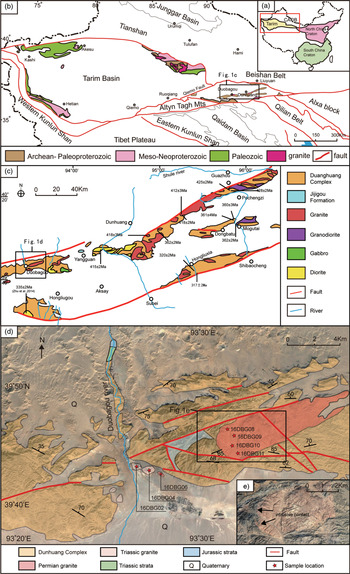
Bounded by the Beishan orogenic belt to the north, the Qiemo–Xingxingxia fault to the northwest and the Altyn Tagh fault to the southeast, the Dunhuang region is located at the junction of the TC, NCC and CAOB (Fig. 1a). The Dunhuang region, as a Palaeozoic orogenic belt and part of the CAOB, represents a vital component of the southernmost CAOB within the Tianshan–Beishan–Mongolia–Xing’anling orogen (Yue et al. Reference Yue, Liou, Graham, Hendrix and Davis2001; Xiao et al. Reference Xiao, Mao, Windley, Han, Qu, Zhang, Ao, Guo, Cleven, Lin, Shan and Li2010; Zhao et al. Reference Zhao, Sun, Diwu, Guo, Ao and Zhu2016; Wang et al. Reference Wang, Zhang, Chen, Liu, Zhang, Pham, Peng and Wu2018; Zhu et al. Reference Zhu, Wang, Zhao, Xu and Li2019). Meanwhile, the Beishan orogenic belt located to the north side of the Dunhuang region is also a part of the southernmost CAOB. In the Beishan orogenic belt, the early Devonian granites intruding the ophiolites in the Hongliuhe region imply an upper limit on the emplacement of the ophiolites and the final age of the collision (Guo et al. Reference Guo, Shi, Zhang and Zhang2006; Zhang & Guo, Reference Zhang and Guo2008). Coeval typical bimodal felsic (~280 Ma; Su et al. Reference Su, Qin, Sakyi, Liu, Tang, Malaviarachchi, Xiao, Sun, Dai and Yan2011) and mafic (295–250 Ma; Zhang et al. Reference Zhang, Dostal, Zhao, Liu and Guo2011) igneous series occur in the Liuyuan area, implying that the Beishan region evolved into a post-collisional rift setting (Chen et al. Reference Chen, Guo, Qi, Zhang, Pe-Piper and Piper2016). Triassic granitoids in the Beishan region were derived from the partial melting of crustal components involved in underplating-related mantle-derived magmas, which were related to lithospheric delamination and asthenospheric upwelling (Li et al. Reference Li, Wang, Wilde, Tong, Hong and Guo2012). Permian and Triassic magmatism in the Beishan region was developed in a post-collisional extensional setting.
(a) Simplified tectonic map of China. (b) Simplified geological map of the Dunhuang block and its adjacent areas (modified after Zhang et al. Reference Zhang, Yu, Gong, Li and Hou2013). (c) Simplified geological map of the Dunhuang Region (modified after Mei et al. Reference Mei, Yu, Li and Zuo1997; zircon ages from Zhao et al. Reference Zhao, Sun, Diwu, Zhu, Ao, Zhang and Yan2017). (d) Geological map of the Duobagou area produced by the Gansu Geological Bureau of China (GGBC, 1973). (e) Satellite image showing contact between the Duobagou granites and Dunhuang Complex.

The Dunhuang region is widely covered by Cenozoic sediments and exposes Precambrian tonalite–trondhjemite–granodiorite (TTG) gneisses, potassic granites and supracrustal rocks (Dunhuang Complex), and Silurian–Carboniferous magmatic and metamorphic complexes (Mei et al. Reference Mei, Yu, Li and Zuo1997; Zhang et al. Reference Zhang, Yu, Gong, Li and Hou2013; Zong et al. Reference Zong, Liu, Zhang, He, Hu, Guo and Chen2013; He et al. Reference He, Zhang, Zong, Xiang and Klemd2014; Wang et al. Reference Wang, Chen, Lu, Wang, Peng, Zhang, Yan, Hou, Zhang and Wu2016 a; Zhao et al. Reference Zhao, Sun, Diwu, Zhu, Ao, Zhang and Yan2017, Reference Zhao, Ao, Yan, Zhai, Zhang, Wang and Sun2019; Zhu et al. Reference Zhu, Wang, Zhao, Xu and Li2019) (Fig. 1b). The outcrops of these rock units are distributed along an ENE–WSW trend in the Dunhuang region (Fig. 1c). Unlike the wide occurrence of late Palaeozoic–Mesozoic granites/granitoids in the Beishan region (Li et al. Reference Li, Chung, Wilde, Jahn, Xiao, Wang and Guo2017), coeval granites/granitoids are not exposed widely in the Dunhuang region. Palaeozoic thermal activity in the Dunhuang region is represented by Silurian granitoids (430–410 Ma), Devonian granite (399 ± 3 Ma) and plagiogranite (363 ± 2 Ma), and Carboniferous adakitic rocks (335 ± 2 Ma) and monzonitic granite (317 ± 2 Ma) associated with orogenic events (Wang et al. Reference Wang, Han, Xiao, Wan, Sakyi, Ao, Zhang and Song2014; Zhu et al. Reference Zhu, Wang, Xu, Chen, Ma, Li, Zhu and Li2014; Zhao et al. Reference Zhao, Diwu, Zhu, Wang and Sun2015, Reference Zhao, Sun, Diwu, Guo, Ao and Zhu2016, Reference Zhao, Sun, Diwu, Zhu, Ao, Zhang and Yan2017). The Dunhuang region became involved in the orogenic event by the closing of the Palaeo-Asian Ocean at the end of late Palaeozoic time (Wang, Z. D. et al. Reference Wang, Guo, Yu and Zhang2019).
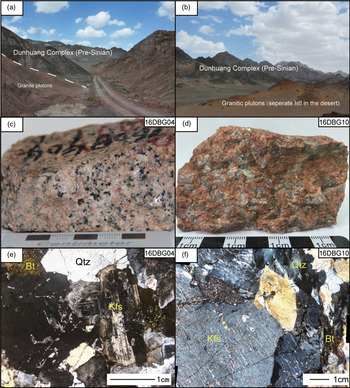
The Duobagou granites are located in the southwestern part of the Dunhuang region, ~110 km southwest of Dunhuang city, and intruded the surrounding Dunhuang Complex (Fig. 2a). The Dunhuang Complex in this area is composed of volcanic rocks and migmatites. From bottom to top, the Dunhuang Complex has been divided into (1) marble, biotite–hornblende–plagioclase gneiss and striated migmatite; (2) biotite–hornblende–plagioclase striated migmatite, amphibolite and serpentinized marble; and (3) biotite–hornblende–plagioclase striated migmatite (GGBC, 1973). There are mainly three granitic plutons exposed in the Duobagou region. The largest granitic pluton is 15 km long and 5 km wide, extending along an ENE–WSW direction. The other two small granitic plutons are near the Duobagou River. They appear as separate 1–2 km long and wide hills in the desert (Figs 1d, 2b).
(a) Field photograph showing contact between the Duobagou Permian granite and Dunhuang Complex. (b) Outcrop of Duobagou Triassic granitic pluton appearing like a separate hill in the desert. (c) Sample 16DBG04 from Triassic granite. (d) Sample 16DBG10 from Permian granite. (e) Photomicrograph of mineral compositions and textures of Triassic granite. (f) Photomicrograph of mineral compositions and textures of Permian granite. Kfs – K-feldspar; Bt – biotite; Qtz – quartz.

Seven representative granite samples from the three intrusive plutons were collected for further analysis in this study. All the samples were fresh and collected far from the boundary zone (Fig. 1d). Samples 16DBG08, 09, 10 and 11 were selected from the largest pluton. These samples are coarse-grained, consisting mainly of K-feldspar (~50 %), quartz (~30 %), biotite (~10 %) and plagioclase (~10 %) (Fig. 2d, f). Sample 16DBG06 from one small and separate intrusive pluton is medium grained, and the mineral components are similar to those of the former samples (Fig. 2b). Samples 16DBG02 and 04 from another separate and intrusive pluton are medium grained and composed of K-feldspar (~30 %), plagioclase (~20 %), quartz (~20 %), biotite (~15 %) and hornblende (~5 %) (Fig. 2c, e).
3. Methods
3.a. Zircon U–Pb dating
Zircon grains from the samples were separated through conventional heavy-liquid and magnetic techniques, mounted in epoxy and polished by the Langfang Yuneng Geology Service Company in Hebei Province, to yield a smooth, flat internal surface. The internal structures and potential target sites for U–Pb dating were obtained from cathodoluminescence (CL) images using a Quanta 200 FEG scanning electron microscope (SEM) at the Key Laboratory of Orogenic Belts and Crustal Evolution at Peking University, Beijing. Zircon U–Pb dating was performed via laser ablation inductively coupled plasma mass spectrometry (LA-ICP-MS) at the Key Laboratory of Orogenic Belts and Crustal Evolution, Peking University, Beijing. The diameter of the laser beam was fixed at 32 μm. The elemental concentration was calculated using NIST 610 glass externally and 29Si internally. Zircon Plešovice (337.3 ± 0.4 Ma; Sláma et al. Reference Sláma, Kosler, Condon, Crowley, Gerdes, Hanchar, Horstwood, Morris, Nasdala, Norbreg, Schaltegger, Schoene, Tubrett and Whitehouse2008), as an external standard, and Qinghu (159.5 ± 0.7 Ma; Li et al. Reference Li, Wang, Tong, Hong and Ouyang2009), as a monitoring standard (Xia et al. Reference Xia, Zhang, Xia and Bader2014), were used for the correction of isotope fractionation effects. For all samples, common lead was corrected following the method of Andersen (Reference Andersen2002). Only those analyses that were <10 % discordant were selected. The age calculations and concordia diagrams were accomplished using ISOPLOT 4.15 (Ludwig, Reference Ludwig2009).
3.b. Major- and trace-element analysis
All samples were analysed for major- and trace-element compositions. Major- and trace-element analyses were performed using an X-ray fluorescence spectrophotometer and ICP-MS on an ELEMENT XR mass spectrometer at the Geological Analysis and Research Centre of the Nuclear Industry of China. The precision and accuracy of the major- and trace-element data were determined based on the Chinese whole-rock standards GB/T 14506.14-2010 and GB/T 134 14506.28-2010 and the Chinese whole-rock trace-element and rare earth element (REE) standard GB/T 14506.30-2010, respectively. The analytical uncertainties of the major-element compositions were less than 5 %. For the trace elements, the relative deviation and relative standard deviation were lower than 5 %.
3.c. Sr–Nd isotope analyses
A Phoenix thermal ionization mass spectrometer was used to determine the Rb–Sr and Sr–Nd isotope ratios at the Geological Analysis and Research Centre of the Nuclear Industry of China. The precision and accuracy were determined based on the Chinese whole-rock Sr–Nd standard GB/T 17672-1999. The normalized isotope ratios were 145Nd/144Nd = 0.7219 and 86Sr/88Sr = 0.1194. Repeated analyses of standards yielded 87Sr/86Sr averages of 0.710239 ± 0.000011 (2σ, n = 6) for the NBS987 standard, and 143Nd/144Nd = 0.511862 ± 0.000010 (2σ, n = 6) for the La Jolla Nd standard. Total chemical blanks were <200 pg for Sr and Nd.
3.d. Zircon Hf isotope analyses
Zircon Hf isotope analyses were performed using a Nu Plasma 2 multi-collector (MC) ICP-MS at the Key Laboratory of Orogenic Belts and Crustal Evolution, Peking University, Beijing. An ArF excimer laser ablation system, Geolas HD (193 nm), was used for laser ablation analysis. Zircon 91500 was used as an internal standard with a value of 176Hf/177Hf = 0.282307 ± 31 (2SD) (Wu et al. Reference Wu, Yang, Xie, Yang and Xu2006; Wiedenbeck et al. Reference Wiedenbeck, Allé, Corfu and Griffin2010). Plešovice zircon was used as a secondary standard with a value of 176Hf/177Hf = 0.282482 ± 13 (2SD) (Sláma et al. Reference Sláma, Kosler, Condon, Crowley, Gerdes, Hanchar, Horstwood, Morris, Nasdala, Norbreg, Schaltegger, Schoene, Tubrett and Whitehouse2008). Instrumental conditions and data acquisition followed those described by Xie et al. (Reference Xie, Zhang, Zhang, Sun and Wu2008). A spot with a beam diameter of 44 μm was selected depending on the size of the ablated domains. All the analysed spots were located within zircons without cores or as far from the cores as possible.
4. Results
4.a. Zircon U–Pb ages
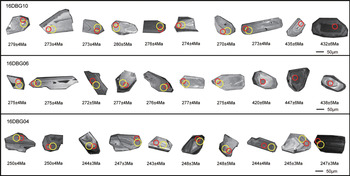
The zircon grains from these samples are transparent to translucent, and euhedral to prismatic. The CL images display oscillatory zoning (Fig. 3). Zircons with cores made up only less than 5 % of all the samples. Most of the zircon grains are 150–350 μm in length and 120–150 μm in width with Th/U ratios (0.70–1.67 from 16DBG04, 0.36–0.91 from 16DBG06 and 0.28–0.83 from 16DBG10) that indicate a magmatic origin (Belousova et al. Reference Belousova, Griffin, O’Reilly and Fisher2002).
Representative CL images of zircons from Duobagou granites. Red and yellow circles represent U–Pb and Lu–Hf analyses spots, respectively.

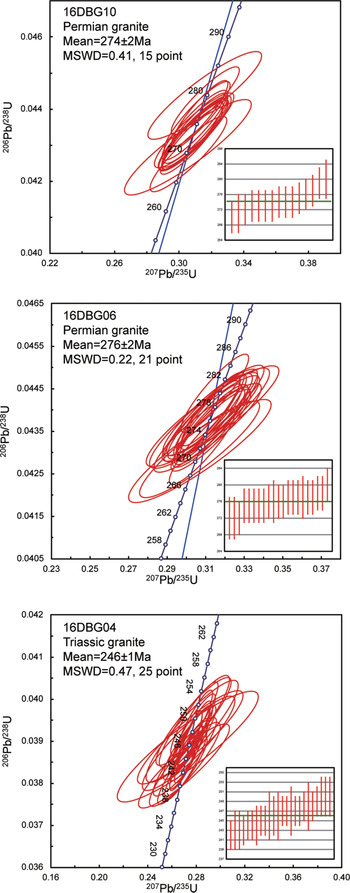
Eighteen zircon analyses were obtained using sample 16DBG10 from the largest pluton. Fifteen of the zircon grains have a weighted mean 206Pb–238U age of 274 ± 2 Ma (MSWD = 0.41) (Table 1; Fig. 4), which could represent the intrusion age of this sample. Three ages (432–435 Ma) from the zircon cores indicate that these are inherited zircons, probably from Silurian magmatic rocks that have been reported in past research (Wang et al. Reference Wang, Wu, Ma, Lei, Guo, Zhang and Chen2016 b; Zhao et al. Reference Zhao, Sun, Diwu, Zhu, Ao, Zhang and Yan2017; Zhu et al. Reference Zhu, Wang, Zhao, Xu and Li2019).
Zircon LA-ICP-MS U–Pb analytical data for the Duobagou granites

Weighted mean U–Pb ages of zircons from the Duobagou Permian and Triassic granites from the Dunhuang region. MSWD – mean square weighted deviation.

Twenty-one zircons from sample 16DBG06 of the eastern pluton near the Duobagou River yielded a weighted mean 206Pb–238U age of 276 ± 2 Ma (MSWD = 0.22) (Table 1; Fig. 4), which represents the emplacement age of the pluton. In addition, six 206Pb–238U zircon ages at 411–448 Ma indicate that these are also inherited zircons, probably from early Palaeozoic magmatic rocks that have been reported in past research (Wang et al. Reference Wang, Wu, Ma, Lei, Guo, Zhang and Chen2016 b; Zhu et al. Reference Zhu, Wang, Zhao, Xu and Li2019).
Twenty-five zircon grains from sample 16DBG04 of the western pluton near the Duobagou River were also analysed. The lengths and widths of the prismatic, transparent zircons range from 200 to 300 μm, and from 100 to 150 μm, respectively. Most of the zircons exhibited concentric oscillatory zoning in the CL images. The Th/U ratios (0.84–1.64) are indicative of a magmatic origin (Belousova et al. Reference Belousova, Griffin, O’Reilly and Fisher2002). The zircon U–Pb dating yielded a weighted mean 206Pb–238U age of 246 ± 1 Ma (MSWD = 0.47) (Table 1; Fig. 4).
In summary, the largest pluton (samples 16DBG08, 09, 10 and 11) and the eastern pluton (sample 16DBG06) near the Duobagou River were formed in early Permian time (276–274 Ma), whereas the western pluton (samples 16DBG02 and 04) near the Duobagou River was emplaced in Middle Triassic time (246 ± 1 Ma).
4.b. Whole-rock geochemistry
All the samples yielded low (<3 %) loss on ignition (LOI), indicating limited alteration. Granites from samples 16DBG06, 08, 09, 10 and 11 belong mainly to the high-K calc-alkaline and shoshonitic series (Fig. 5b). The SiO2 concentrations of these five granite samples range from 67.73 to 76.40 wt %. They exhibited high K2O (3.72–5.34 wt %), total alkalis (Na2O + K2O = 7.39–8.66 wt %) and K2O/Na2O ratios (1.01–1.65) (Table 2). These rocks demonstrated variable ranges of TFe2O3 (0.54–3.77 wt %) (molar Fe2O3 + (FeO * 1.111)), TiO2 (0.10–0.50 wt %), MgO (0.13–1.18 wt %) and Mg no. (23–38 (molar 100 * Mg/(Mg + TFe2O3)). The granites have A/CNK (molar Al2O3/(CaO + Na2O + K2O)) ratios of 0.93–1.02 and are slightly peraluminous (Fig. 5c).
Major- and trace-element discrimination diagrams for the Duobagou granites. (a) TAS classification diagram (after Middlemost, Reference Middlemost1994); (b) K2O versus SiO2 diagram (after Gill, Reference Gill1981); (c) A/NK versus A/CNK diagram (Maniar & Piccoli, Reference Maniar and Piccoli1989).

Major- and trace-element compositions of Permian–Triassic granites from the Duobagou area

Note: Mg no. = MgO/(MgO + FeOt) * 100; δEu = 2 * EuN/(Sm + Gd)N; N – normalized to chondrites (Sun & McDonough, Reference Sun, McDonough, Saunders and Norry1989).
These samples are enriched in light rare earth elements (LREEs) with (La/Yb)N = 10.2–29.54 and exhibited negative Eu anomalies (Eu/Eu* = 0.41–0.80) (Table 2; Fig. 6). These rocks are characterized by pronounced negative Nb, Ta, Sr and Ti anomalies and positive Th and Pb spikes in the primitive mantle-normalized trace-element variation diagram (Fig. 6).
(a, b) Chondrite-normalized REE diagrams for Duobagou granites. (c, d) Primitive mantle-normalized incompatible element diagrams for Duobagou granites (normalization values are from Sun & McDonough, Reference Sun, McDonough, Saunders and Norry1989).

Samples 16DBG02 and 04 have relatively lower SiO2 (67.03–69.84 wt %), K2O (3.93–3.98 wt %) and total alkalis (Na2O + K2O = 7.54–7.55 wt %) but higher MgO (0.95–1.12 wt %) and Mg no. (38.07–39.82). All samples are plotted in the high-K calc-alkaline granite field (Fig. 5b). They are peraluminous with low A/CNK ratios (1.01) (Fig. 5c). The granites are enriched in LREEs relative to heavy rare earth elements (HREEs), with (La/Yb)N ratios of 8.01–8.47, and are characterized by negative Eu anomalies (Eu/Eu* = 0.78–0.81) (Table 2). In the primitive mantle-normalized trace-element variation diagram, the granite samples display negative Nb, Ta and Ti anomalies (Fig. 6).
4.c. Whole-rock Sr–Nd isotopes
The whole-rock Rb–Sr and Sm–Nd isotope compositions of the seven Duobagou granite samples are presented in Table 3. The initial isotopic values are calculated based on the results of zircon U–Pb dating. Sample 16DBG11 has a high Rb/Sr ratio (>5) and is thus not acceptable for Rb–Sr analysis. The initial Sr isotope ratios (ISr) of the Permian granites range from 0.7034–0.7069, with ϵNd(t) values of −4.07 to −3.07. Meanwhile, the ISr values of the Triassic granites are 0.7070 to 0.7084, with ϵNd(t) values of −3.44 to −6.69 (Table 3).
Sr–Nd isotope composition of granite from the Duobagou area

* Indicates the measured value.
† Indicates the initial value.
‡ ϵNd(t) = ((143Nd/144Nd)m/(143Nd/144Nd)CHUR − 1) × 1000, (143Nd/144Nd)CHUR = 0.512638, (147Sm/144Nd)CHUR = 0.1967.
§ TDM1 = 1/λx ln(1 + ((143Nd/144Nd)s − 0.51315)/((147Sm/144Nd)s − 0.2137)).
¶ TDM2 = 1/λx ln(1 + ((143Nd/144Nd)s + (0.12 − (147Sm/144Nd)s)(eλt − 1) − (143Nd/144Nd)DM)/(0.12 − (147Sm/144Nd)DM)).
4.d. Zircon Hf isotopes
In situ zircon Hf isotopic analyses from these samples, which were analysed for U–Pb ages, are listed in online Supplementary Material Table S1. From sample 16DBG10 of the largest granitic pluton, 13 spots were obtained; these spots have a weighted mean 206Pb–238U age of 274 ± 2 Ma, 176Hf/177Hf ratios from 0.2826 to 0.2827 and ϵHf(t) values between −0.9 and +3.1. The calculated two-stage Hf model ages TDM2 of sample 16DBG10 range from 1.14 to 1.39 Ga. On the other hand, 21 analyses were performed on zircons from sample 16DBG06 of one small granitic pluton; the tested zircons have a weighted mean 206Pb–238U age of 276 ± 2 Ma, 176Hf/177Hf ratios from 0.2824 to 0.2827 and ϵHf(t) values between −5.4 and +2.0. TDM2 values range from 1.22 to 1.70 Ga. Finally, sample 16DBG04, which has a weighted mean 206Pb–238U age of 246 ± 1 Ma, yielded 176Hf/177Hf ratios from 0.2826 to 0.2827, positive ϵHf(t) values (+0.5 to +3.8) and TDM2 ranging from 1.08 to 1.31 Ga.
5. Discussion
5.a. Permian–Triassic magmatism in the Dunhuang region
The ages of the Duobagou granitic plutons, which used to be regarded as Palaeozoic plutons in the geological mapping of GGBC (1973), were uncertain because of the lack of dating. Zircons from these granites, with euhedral prismatic shapes and well-developed oscillatory zoning, have relatively high Th/U ratios, indicating a magmatic origin. Thus, the weighted mean 206Pb–238U ages should represent the emplacement ages of the plutons. LA-ICP-MS U–Pb zircon dating of samples from these three plutons yielded ages of, from youngest to oldest, 246 ± 1 Ma, 274 ± 2 Ma and 276 ± 2 Ma. Therefore, two periods of felsic magmatic activities in the Duobagou area have been determined: Permian and Triassic in the Dunhuang orogenic belt.
5.b. Petrogenesis
The Permian and Triassic granites belong to the high-K calc-alkaline and shoshonitic series and are plotted in the fields of I- and S-type granites (Fig. 7; Collins et al. Reference Collins, Beams, White and Chappell1982; Whalen et al. Reference Whalen, Currie and Chappell1987). An A/CNK ratio of 1.1 is considered to be the boundary between S-type and I-type granites (Chappell & White, Reference Chappell and White1992). In this study, the Duobagou granites all have low A/CNK ratios <1.1 (Fig. 5) and negative relationships between SiO2 and P2O5, indicating the petrogenesis of I-type granites (Fig. 8d). The metaluminous to peraluminous, high-K calc-alkaline features and the relative depletions in Nb, Ta and Ti and enrichments in large-ion lithophile elements (LILEs) are typical characteristics of I-type granites. In summary, the Duobagou Permian and Triassic granites are I-type granites, rather than A-type or S-type granites.
TFeO/MgO, Na2O + K2O, Y and Zn versus 10 000 * Ga/Al discrimination diagrams (Whalen et al. Reference Whalen, Currie and Chappell1987); A, I, S – fields for A-, I- and S-type granites, respectively.

Harker plots of selected major and trace elements for Duobagou granites from the Dunhuang region. Boundary between I- and S-type granites follows Chappell (Reference Chappell1999).

The presence of Ordovician–Silurian inherited zircons in samples 16DBG04 and 06 is indicative of assimilation of a particular Ordovician–Silurian crustal component within the upwelling source magma of the Duobagou granites. Ordovician–Silurian magmatism in the Duobagou area has been reported in past research (Wang et al. Reference Wang, Chen, Lu, Wang, Peng, Zhang, Yan, Hou, Zhang and Wu2016 a; Zhu et al. Reference Zhu, Wang, Zhao, Xu and Li2019), further confirming the possibility of assimilation of the Ordovician–Silurian crustal rocks. However, no xenoliths or enclaves have been observed in outcrops of the Duobagou granites. In addition, only a tiny amount (less than 5 %) of zircons with cores were observed from the samples. There are also no significant geochemical changes resulting from assimilation. Ordovician–Silurian magmatic rocks have been reported to be characterized by low K2O (~1–3 %), La (~19–43 ppm), Nb (~7–12 ppm) and Ta (~0.4–0.8 ppm); and high Na2O (~3–4 %), MgO (~2–5 %), Al2O3 (~15–17 %), TiO2 (~0.6–1.0 %), Sr (~460–1160 ppm), Cr (~73–253 ppm) and Ni (~42–100 ppm) (Zhu et al. Reference Zhu, Wang, Zhao, Xu and Li2019), whereas the Duobagou granites contain high K2O (~4–5 %), Nb (~8.5–26 ppm) and Ta (~1–2.5 ppm); and low Na2O (~3 %), MgO (~0.1–1 %), Al2O3 (11–15 %), TiO2 (~0.1–0.5 %), Sr (~25–430 ppm), Ni (~3–9 ppm) and Cr (~5–19 ppm). Therefore, even though minor assimilation cannot be completely ruled out, it was not a significant cause of the observed geochemical variations and not a major factor in the petrogenesis.
Both the Permian and Triassic granites have low MgO, Na2O/K2O ratios, Y and Yb contents and negative Eu anomalies, lower than those of TTGs and adakites (Condie, Reference Condie2005; Martin et al. Reference Martin, Smithies, Rapp, Moyen and Champion2005). Rocks with such compositions may originate from the partial melting of lower crust or subducted oceanic crust (Rapp et al. Reference Rapp, Shimizu, Norman and Applegate1999; Martin et al. Reference Martin, Smithies, Rapp, Moyen and Champion2005; Moyen, Reference Moyen2009). Both the Permian and Triassic granites have strongly negative Nb, Ta and Ti anomalies, but positive Zr and Hf anomalies (Fig. 6), suggesting the partial melting of the crust (e.g. Su et al. Reference Su, Qin, Sakyi, Liu, Tang, Malaviarachchi, Xiao, Sun, Dai and Yan2011). Negative Eu and Sr anomalies for both the Permian and Triassic granites suggest different amounts of plagioclase fractionation. The low Mg no., Cr, Ni and Th/La ratios are consistent with an origin that the granites were generated by the partial melting of lower continental crust (Fig. 9a) (Pitcher, Reference Pitcher1997; Wang et al. Reference Wang, McDermott, Xu, Bellon and Zhu2005). Meanwhile, the negative ϵNd(t) values (−3.07 to −6.69) for these granites also imply the dominant role of the crust material in the petrogenesis. Therefore, both the Permian and Triassic granites dominantly indicate crustal melts.
(a) Mg no. versus SiO2 diagram for Duobagou granites (after Wang YX et al. 2019). (b) Tectonic discrimination diagram (after Pearce et al. Reference Pearce, Harris and Tindle1984). Primitive mantle values are from Sun & McDonough (Reference Sun, McDonough, Saunders and Norry1989). syn-COLG – syn-collision granite; WPG – within-plate granite; post-COLG – post-collision granite; VAG – volcanic arc granite; ORG – ocean ridge granite.

Zircons in the Permian granites (16DBG06 and 10) have ϵHf(t) values ranging from −5.4 to +3.1 and Hf model ages TDM2 = 1.14–1.70 Ga. During the generation of granites, negative ϵHf(t) values are attributed to the contribution of old crustal rocks, whereas positive ϵHf(t) values usually reveal evidence of the input of juvenile mantle material into the petrogenesis (Kinny & Maas, Reference Kinny and Maas2003). Therefore, the Permian granites were derived mainly from the partial melting of crust formed during late Palaeoproterozoic to Mesoproterozoic times, with a small amount of mantle component involved. Negative ϵNd(t) values of −3.07 to −4.07 and Nd model ages of 1.37–1.47 Ga also suggest that these Permian granites were derived mainly from the reworking of Mesoproterozoic continental crust affected by the mantle melts to some extent. Compared with the Permian granites, the Triassic granites have lower contents of SiO2 (67.03–69.84 wt %) and K2O (3.93–3.98 wt %), and higher MgO (0.95–1.12 wt %), Cr and Ni (Table 3), suggesting less evolved crust-derived magmas. Zircons from the Triassic granites have positive zircon ϵHf(t) values (+0.5 to +3.8) and Hf model ages (1.08–1.31 Ga), indicating more juvenile sources compared with those of the Permian granites. Thus, the Duobagou Triassic granites (Fig. 10) were derived from the partial melting of Mesoproterozoic crust with significant input of mantle-derived materials.
ϵHf(t) versus age diagram. Data for middle Carboniferous granites from Hongliuxia, early Permian granite from Badaowan, Early–Middle Triassic granitoids from Dahuoluo and Late Triassic granitoids from Beishan are from Zhao et al. (Reference Zhao, Sun, Diwu, Zhu, Ao, Zhang and Yan2017), Zhang et al. (Reference Zhang, Wu, Zheng, Feng, Luo, He and Xu2012) and Li et al. (Reference Li, Wang, Wilde, Tong, Hong and Guo2012, Reference Li, Wilde and Wang2013 b), respectively.

5.c. Tectonic setting and implications
The Duobagou Permian–Triassic I-type granites exhibit typical subduction-related geochemical features (e.g. enrichments in LILEs and depletions in high-field-strength elements) (McCulloch, Reference McCulloch1991), and most of these rocks are plotted in the fields of volcanic arc and post-collisional granite in the Rb versus (Y + Nb) diagram (Pearce et al. Reference Pearce, Harris and Tindle1984) (Fig. 9b). However, these features do not mean that subduction was still active during the generation of the granitic plutons. Palaeozoic intrusive rocks from the Dunhuang tectonic belt were reported to reveal the magmatic evolution of a Palaeozoic accretionary orogeny on the southernmost margin of the CAOB (Zhao et al. Reference Zhao, Diwu, Zhu, Wang and Sun2015, Reference Zhao, Sun, Diwu, Zhu, Ao, Zhang and Yan2017). This Palaeozoic orogen in the Dunhuang region is considered to tectonically extend northward to the Beishan orogen, with the late Carboniferous marking the final stage of the orogeny (Zhao et al. Reference Zhao, Sun, Diwu, Zhu, Ao, Zhang and Yan2017).
The Dunhuang block was also involved in Palaeozoic accretionary orogenic processes related to the closure of the southern Palaeo-Asian Ocean (Wang et al. Reference Wang, Chen, Lu, Wang, Peng, Zhang, Yan, Hou, Zhang and Wu2016 a; Zhao et al. Reference Zhao, Sun, Diwu, Guo, Ao and Zhu2016, Reference Zhao, Ao, Yan, Zhai, Zhang, Wang and Sun2019). Late Devonian (370–360 Ma) intrusive rocks along the central part of the Dunhuang block were produced in a subduction-related arc setting, and Carboniferous intrusive rocks were developed in a transitional tectonic setting from compression to extension, representing the final stage of subduction (Zhao et al. Reference Zhao, Sun, Diwu, Zhu, Ao, Zhang and Yan2017). The Duobagou Permian–Triassic granites should have been formed in a post-collisional extensional setting. Given the petrogenesis and tectonic setting, the Duobagou Permian–Triassic granites were probably derived from the partial melting of thickened lower continental crust. On the age–ϵHf(t) diagram (Fig. 10), zircons from the Carboniferous intrusive rocks (320–317 Ma) have strongly negative ϵHf(t) values, with TDM2 ranging between the Mesoproterozoic and Archaean (Zhao et al. Reference Zhao, Sun, Diwu, Zhu, Ao, Zhang and Yan2017). Therefore, the Carboniferous intrusive rocks were dominantly derived from the partial melting of crust formed during the Archaean to the Mesoproterozoic periods. Zircons from the Duobagou Permian granites are plotted mainly in the field straddling the chondritic uniform reservoir (CHUR) reference line with ϵHf(t) between −5.4 and +3.1 (Fig. 10), implying that the formation of the Permian granites involved a late Palaeoproterozoic to Mesoproterozoic crustal source and a significant mantle component. The Duobagou Triassic granites (250–240 Ma) with positive ϵHf(t) values (+0.5 to +3.8) suggest more juvenile sources, indicating a greater contribution of mantle-derived melts. The increased input of juvenile material into the crustal source for the Permian to Triassic granites (Fig. 10) resulted in continuous crustal growth. Thus, the Duobagou Permian–Triassic magmatic activities may have involved crustal growth processes, accompanied by the reworking of old continental crust formed during late Palaeoproterozoic–Mesoproterozoic times.
The gravitational instability of thickened lower crust was proposed to have led to lithospheric delamination and asthenosphere upwelling in the Beishan region during late Permian to Middle Triassic times (Zhang et al. Reference Zhang, Dostal, Zhao, Liu and Guo2011; Li et al. Reference Li, Wang, Wilde, Tong, Hong and Guo2012), producing Permian felsic and mafic igneous series and Triassic granitoids. This model could have contributed to a post-collisional extensional setting not only in the Beishan but also in the Dunhuang region. The heating from upwelling asthenosphere and the regional extension would have triggered the partial melting of the lower crust, which would have then generated these Permian to Triassic granitic magmas (Fig. 11). Meanwhile, the lower crust was underplated by the mantle-derived magma, probably resulting in the formation of juvenile crust. The signature of the juvenile crust is recorded in the zircon ϵHf(t) values of >0 from the Duobagou Permian and Triassic granites. Furthermore, the intensity of the crustal growth appears to have been enhanced through time, which is also supported by the geochemical characteristics of the Duobagou Permian and Triassic granites with increasing zircon ϵHf(t) values. Therefore, during Permian and Triassic times, lithospheric delamination and asthenospheric upwelling had acted as the main mechanism for the partial melting of the lower crust and probably crustal growth in the Dunhuang and Beishan regions, and in an even more widespread manner in the southernmost CAOB.
Schematic diagram illustrating the Permian–Triassic tectono-magmatic evolution of the Dunhuang–Beishan region, northwestern China.

6. Conclusions
-
(1) The Duobagou intrusions are high-K calc-alkaline and shoshonitic series I-type granites. Zircon U–Pb dating revealed that two periods of magmatism occurred in the late Permian (276–274 Ma) and the early Mesozoic (246 ± 1 Ma).
-
(2) The Duobagou Permian–Triassic granites dominantly originated from the partial melting of late Palaeoproterozoic to Mesoproterozoic crust. The involvement of juvenile mantle-derived material also played a great role in the petrogenesis, especially for the Triassic granites.
-
(3) The Duobagou Permian–Triassic granites formed in a post-collisional extensional setting. Lithospheric delamination and asthenospheric upwelling were proposed to have caused partial melting of the lower crust, which may have been the mechanism for significant crustal growth during Permian and Triassic times.
Supplementary material
To view supplementary material for this article, please visit https://doi.org/10.1017/S0016756820000801
Acknowledgements
The authors are grateful to Dr Xiang Cheng and Dr Wei Du for our fieldwork. This research was financially supported by the State Major Science and Technology Project (grant number 2017ZX05008-001). We greatly acknowledge editor Dr Kathryn Goodenough and would like to thank two anonymous reviewers for the constructive reviews of the manuscript.