Introduction
In 1934 Giacomo Penso, a 15-year-old boy from Messina, wrote a passionate letter of admiration to Mussolini:
Duce! I love you, I love you! (…) I think I love you more than my father because you gave life to the people. Duce, I ask for just one thing, a photograph of you so that when I lie down to sleep at night first I can kiss the image of the Saviour of the world, then yours, Saviour of Italy. Duce, please make my wish come true. (ACS 1934)Footnote 1
Giacomo did not receive the yearned-for image of his putative ‘father’ as the letter was never answered (ACS 1934). However, his request was not completely wasted: reaching us today, together with similar archived requests, it has served a different purpose. Giacomo’s letter is a useful indicator of the role photography played in Mussolini’s appeal. Extensively photographed in informal as well as official poses, the Duce was the first modern dictator to be the object of systematic promotion and adoration through the strategic use of media. Photographs of his head and expressions, body and postures, were reproduced in their millions, and presented to Italians and the rest of the world via print, in books, newspapers, periodicals, posters and postcards. The Fascist leader’s idealised body and features, morphed through the photographic process, were communicated as an unmistakable physical model, emphasised through hyperbolic text: ‘It is enough to say Duce for everyone to see engraved in their memory his unmistakeable profile, male, rough, volatile, Roman’, wrote a contemporary illustrator in 1941 in a celebratory review of Mussolini’s portraits (Biazzi Reference Biazzi1941, 111).Footnote 2 By including visual signs and non-verbal gestures, Mussolini’s photographs formed a symbolic communication that had the purpose not only of diffusing his appearance, and thus contributing to the recognition of his likeness, but also of acting as a comprehensible visual narrative and ideological text aimed at shaping the viewer’s impressions and attitudes. Mussolini’s image management produced many notable shots, not always remarkable for their aesthetic qualities, although their form was intentional. As well as communicating messages, these images aroused emotions and set trends, thus acquiring iconic status.
A term previously used in art history and understood as having the conventional style of a religious image as object of devotion, today the word ‘iconic’ suffers from ‘invasive usage’ (Meades Reference Meades2009, 69–73). It has become a loose umbrella term for an image, an object, or bodily or gestural aspects of performance. In this article the term ‘iconic’ is intended to communicate recognisability, symbolic meaning and influence with relevance to a particular cultural and historical context. Mussolini’s iconic images are those which stand out, are widely recognised and still remembered (Hariman and Lucaites Reference Hariman and Lucaites2007, 27) (Shapiro Reference Shapiro2008, 815–819).
This article examines the particular role of Mussolini’s unclothed body in the iconography of Fascist propaganda. By deconstructing the leader’s ‘superhuman’ projection as a result of his self-branding, I will show how his choice to portray himself in iconic states of undress demonstrates his innovative capacity to harness a modern attitude towards self-portrayal, similar to those adopted by today’s Western heads of state, and how through strategic political use the initial visual configuration became the template for a range of variants. The discussion begins with an outline of the significance of male ‘nudity’ and its relevance for leadership; secondly, it considers photographs of the clothed-unclothed bodies of political leaders, reviewing the importance of corporeality in the construction of an icon. In conclusion reference is made to some well-known photographs of contemporary unclothed leaders, and to the renegotiation of Mussolini’s iconic images. Some images refer to the publicised propaganda event of the late 1930s, the Battle for Grain, and others are from the press that informed Italians of the Duce’s sporting activities.
Revealing the male body
The male nude had dominated the arts in earlier centuries, and was used to personify ideal virtues with themes drawn from classical iconography. As a subject for fine art, the nude was a matter of the soul, but with photography, which was seen as the medium of realism, issues developed around its treatment and brought the debate around the legitimacy of the nude to another level. Principally seen in privacy, the nude body in photography was something to be viewed behind closed doors. It implied ‘a sense of the hidden, the illicit, and of the secret’ with the main use being either for artistic reference or for pornographic voyeurism, but its audience was largely male (Clarke Reference Clarke1997, 123). To satisfy public sensibilities and moral concerns over possible suggestions of homosexuality, nude photographs of men would be ‘hidden’ and regarded as taboo, or at best camouflaged to make them socially tolerable (Weiermair Reference Weiermair1987, 11). With the growing interest in sport and naturist movements following the advent of modern nudism, perceptions started to change and, particularly after the First World War, photographs of the male nude became more acceptable.
Photography promoted the male nude through the cult of the body made healthy by physical exercise, which could be perceived as a revival of the Greek ideal of a sane mind in a healthy body, and thus beyond suspicion of eroticism (Weiermair Reference Weiermair1987, 15). Physically fit, muscular bodies of dancers and athletes became favourite models. For example, the idealisation of male nudity was represented in the work of a renowned studio photographer active in Rome from the 1930s, Elio Luxardo (1908–1969) who made studies of the professional boxer and world heavyweight champion Primo Carnera as well other athletes of the 1930s (Violo Reference Violo2000). The regime was quick to use Carnera’s image and adjust it to historical opportunity.The images in which Carnera displayed his idealised physique, the perfect and powerful body, were published in the press with other images of him in a militia uniform greeting the crowd with the Fascist salute, supported by statements exalting Italy and Mussolini: ‘I wanted to win for Italy and il Duce’ (Gazzetta dello Sport 7/1933, 3). Rather than manly beauty as a symbol of racial purity, the regime promoted the ideal sculpted male body, which through physical exercise contributed to character building and demonstrated strength of will (Mottadelli Reference Mottadelli2015, 162). The myth of Carnera’s powerful unclothed body became deeply rooted in the Italian collective imaginary.
The trope of the Herculean man was not completely unknown, though, and the positive response provoked by the boxer’s image management was also a consequence of the receptive environment. The strongman was a familiar character, especially in the early years of Italian cinema when spectators were first offered strongman images. The development of the aesthetic dimension that would so strongly characterise Mussolini’s leadership, with the use of his body and its capacity to mobilise symbols, can be traced to the early twentieth century. Western Europe witnessed a crisis surrounding the bourgeois model of male authority and a new representation of the male body then took shape in European culture. ‘Muscular, tanned, and either uniformed or unclothed’, this hypermasculinity corresponded, according to Maurizia Boscagli, to the rise of early mass consumer culture and ‘a new economy of gender’ (Boscagli Reference Boscagli1996, 1). Boscagli connects the sexualised spectacle of the male body to mass consumption, at a time when ‘monopoly capitalism called modern individuals to consume en masse’ (1996, 4).
As modern culture was predicated on physical prowess, the powerful male physique was now disciplined publicly. Men exercised outdoors, on the beach and displayed their physically fit bodies in still or moving images, in the sports tabloids or at the cinema. This vitalistic modern male body could now be achieved during the ‘free time’ created by the Taylorist organisation of labour, helped along by the consumption of commodities such as cosmetics, vitamins, and sports equipment. Preoccupation with exercise, athletics and diet also corresponded to changes in society: the expansion of the tertiary sector, the growing presence of women in public spaces, and the growth of a class of white-collar workers. To compensate for their ambiguous and threatened position in society, the suburban clerks looked to nature as an agent of renovation offering a way to recuperate virility and identity (Boscagli Reference Boscagli1996, 56–57). Through recognition of its structuring trope in the corporeality of the Nietzschean superman, (Boscagli Reference Boscagli1996, 78) the petty bourgeoisie and the younger generation could identify its self-representation with the idealised image of the natural body.
In the years preceding the First World War the icon of the unclothed male body became increasingly visible. Supported by the growing influence of the visual, the display of shirtless or partially naked muscular male bodies, seen in moving and still images, now meant fitness, ‘finalised effort’ and ‘productivity’ (Boscagli Reference Boscagli1996, 58). Of the muscled heroes performing ‘feats of athletic daring’ in blockbuster historical films such as Quo Vadis (1913) or Spartaco (1913) (Reich Reference Reich2013, 32), for which Italian cinema was at the time celebrated worldwide, the cinematic strongman Maciste, a Herculean athletic champion played in 1914 by Bartolomeo Pagano in the silent movie classic Cabiria, (Gundle Reference Gundle2013, 77) can be identified as the precursor of an aesthetic of male nudity subsequently influential in its application to leadership. Produced between 1914 and 1929, the approximately 30 films featuring Pagano in the role of Maciste conveyed the message that playing an extraordinary character, an ordinary Italian citizen could become exceptional (Reich Reference Reich2013, 5). As Boscagli notes, the superman with a proletarian body was strengthened by labour and rendered aristocratic (1996, 58). For his bravery and strength, as well as his kindness, he was known as ‘Il gigante buono’ (the gentle giant) (Reich Reference Reich2013, 33), the hero whose superhuman strength was placed at the service of good (Gundle Reference Gundle2013, 77). A figure from the universe of mass culture, he embodied the nation and a national spirit that pervaded Italy in the first half of the twentieth century. For Jacqueline Reich ‘his naked muscular sculpted body projected the ideal of good, male citizenship’ (2013, 7).
Aesthetics played a determining role in promoting the stereotype of the new Fascist man with the body beautiful becoming an important symbol. The portrayal of role models whose posture projected self-control, with muscles emphasising virility, symbolised the dynamism and discipline Fascism thought society lacked and needed. In Fascist thought and practice, the healthy and strong body promoting a healthy mind stood in contrast to the old ‘decadent and sick’ bourgeois society led by ‘feeble, effeminate and desexualised’ leaders (Ornelas Reference Ornelas2002, 66).
Clothed-unclothed political leaders
When considering the extensive photographic output sponsored by Fascist propaganda, we can see that a select set of images of Mussolini was often reproduced. Some of these still stand out, and include images of him as a bureaucrat in a wing collar, a politician in top hat, a ‘lion-tamer’ in a bowler hat, a ‘helmeted soldier’ in uniform (Burke Reference Burke2001, 73), a knight on horseback brandishing a sword, and, of particular interest for this article, as a shirtless worker harvesting and as a bare-chested well-toned athlete skiing. Together these formed a repertoire of easily recognisable images that were reproduced widely and used to ‘orient the individual within a context of collective identity, obligation, and power’ (Hariman and Lucaites Reference Hariman and Lucaites2007, 1). They were already treated as icons then, and now still have enough appeal to be reproduced as emblematic in present-day publications and illustrated biographies of Mussolini. As part of Fascist propaganda, they were seen repeatedly and when placed in particular situations could convey symbolic values. There was a startling new awareness of corporeal expression where the Duce’s face and body functioned together, as a powerful instrument of communication. This was likely to have been influenced by the theatrical acting technique and silent movies of the time. Fixed by the camera, and subsequently reproduced in differing formats and publications, images formed a collective album where Mussolini’s many roles were considered as part of the mission for national education (Sturani Reference Sturani2003, 114).
To influence, manipulate and spur Italians to action, Fascism appropriated and adapted religious forms for worldly purposes, employing a pervasive use of emotionally-laden imagery to attribute political appeal to the dictator’s body. As a locus of adoration, the photographic representation of the Duce’s heroic body was laden with symbols, accessories and elements that supported his decidedly theatrical and intensely visual public image. Mussolini conceived himself as a film hero (Gundle Reference Gundle2008, 53–55): he had no reservations about being represented as the virile Roman, with his profile and shaved head becoming ‘the face of the regime’ (Heller Reference Heller2008, 78). The theatrical poses and attitudes, together with the appropriate ‘costumes’, rather than being mere decorative accessories were symbolic, transforming the images into value-laden signs (Gundle Reference Gundle2013, 72). The Duce’s body, charged with symbolic elements, was used to propagate his heroic image as the Italian leader. For example, one of the abstract concepts represented through the personification that made power visible, and often used during the regime, was the traditional metaphor of horse and rider, where the figure of the leader was photographically translated into that of the Duce in uniform, with the uniform serving as the modern equivalent of armour. Mussolini’s body fed into personifications of the ruler, employing traditional, iconographical conventions that were already well absorbed into the collective imagination, which the regime adopted and revisited. Icons of the ruler as a bureaucrat, contadino or knight on horseback were fabricated with a purpose and perhaps now can be better understood as theatre and part of a choreographic space in the public representation of an idealised self.
Among the visual strategies adopted to promote the Duce, perhaps the most radical was the display of his unclothed body. In the 1930s, at the peak of his career as prime minister, Mussolini was on more than one occasion seen without the usual layers of garments. The display of the undressed figure of any public person other than film stars or athletes was without precedent. Garibaldi, for example, always kept his clothes on. His unconventional flowing and brightly coloured outfits, rather than his masculine physique, were an important element of his attractiveness. Garibaldi’s sex-appeal was that of a ‘romantic’, with ‘his scarlet tunic fitted loosely to the body’, worn almost like a flag, which, together with his long, blonde, wavy hair, projected an image that can be understood as ‘a kind of Italian fusion (or bricolage) of a Walter Scott hero and Mazzinian genius, of eclectic borrowings from romantic sensibilities and militant Jacobinism’ (Riall Reference Riall2007, 56). Whilst Garibaldi’s projected image was pure and heroic, the poet and public figure Gabriele D’Annunzio’s appeal was dark and provocative. His decadent style evoked Swinburne or Wilde more than Walter Scott’s heroes; his body was made appealing through a refined aestheticism. Indeed, he had ‘substantial defects for a potential leader’: bald (Ledeen Reference Ledeen2002, 11) and only a little taller than 5ft, D’Annunzio used the allure skilfully created around his persona to convey an attractive and glamorous figure. Everyday experience would be transformed deliberately into something unique and mythical. Even the loss of his hair at a very young age, for instance, was transformed into a ‘gift’, his ‘egg-shaped head was considered a thing of beauty and a sign of a superior being, as hair is not necessary for modern civil society’.Footnote 3 (Woodhouse Reference Woodhouse1999, 21–27) Losing an eye during the war, far from being a handicap, became ‘an inspiration for one of his best examples of prose’, although due to his ‘bad teeth’, the poet seldom smiled in front of a camera (21–27).Footnote 4 Nudity was not completely avoided by the Vate and, like Mussolini, he was photographed in various states of undress or even completely naked, albeit on a beach at the age of 25 in a photograph that may well not have been published in his lifetime.
For any public person to be represented in a state of undress was, for the period, unusual to say the least. In the early decades of the twentieth century no American politicians, let alone British, were photographed dressed in a way that was anything less than impeccable, nor was partial nudity employed by the other dictators contemporary with the Duce. The only public figure adopting a similar visual strategy in presenting his body in an exceptional way was Mahatma Gandhi. The pre-eminent leader of the independence movement in British-ruled India employed non-violent civil disobedience through ‘the activist asceticism of his somatic politics, his iconic serenity, and convenient passivity’ (Mazzarella Reference Mazzarella2010, 1) and cultivating a saintly image on the international circuit through the renunciation of sensuous gratification, which he symbolically exemplified by wearing a traditional khadi wrapped around his naked body, showing his arms and legs and on occasion his torso. Simply dressed and loosely attired, Gandhi met Mussolini in Rome in 1931 on his way home from the London Conference. Although there are no photographs portraying the two leaders together, images of Gandhi clad in his khadi, surrounded by regime representatives, were published in the press (Sofri Reference Sofri1988, 111).
Gandhi’s partly-exposed body also achieved iconic status thanks to photography and up to the present day the image of the ‘global saint’ has been successfully exported worldwide through modern mass culture such as the Oscar-winning film Gandhi (1982) (Mazzarella Reference Mazzarella2010, 14). The sacred dimension of his visual simplicity can be linked to the photographic medium’s ability to represent the invisible, the ephemeral, the sacred, as can be seen in the first photograph ante litteram of Christ’s face on the Shroud. Like the original ‘footprint’ in the history of photography, the Turin Shroud represents symbolically the quality of realism and veracity attached to photography. Contrary to the persuasive effects of icons and other traditional depictions of sacred events, more recent photographic reinterpretations of the saints, Jesus or the Virgin Mary suggest that the sacred aura of mythical figures is corrupted through the photographic process. Photographic reproductions of saintly figures lose the magical impact retained in painting (Dondero Reference Dondero2007, 83–85). Gandhi’s ‘renunciatory body’ in photography thus became a powerful tool of publicity (Mazzarella Reference Mazzarella2010, 21), with special iconic qualities and ‘brand recognition’ (20). This was a powerful strategy which functioned as a ‘doorway to public communication with a view to social change’ (23).
The unclothed body or exhibition of the male torso as a symbol of the power of action (or inaction in the case of Gandhi) and ethical transformation was already known as a propaganda tactic. At the end of the nineteenth century, the celebration of physical work had been translated into visual forms through propaganda material: the nobility of the working man, as an icon of socialism, was represented in drawings of men with their shirts off, often holding a tool (Martini Reference Martini2007, 81). While the female body in socialist iconography was dressed, the male body became increasingly revealed (Hobsbawm Reference Hobsbawm1978, 127). Male workers naked from the waist up would be represented in the act of hammering, harvesting or forging. Although unrealistic, since in real life peasants, factory workers or miners would rather protect their body, the three- and two-dimensional bare torso was a visually familiar icon. The image of the proletarian, almost invariably depicted as a blacksmith, gradually developed into a more precise and distinctive icon, often with a moustache and boots. The worker was sometimes presented as bare from the waist up or even, occasionally, entirely nude (Bonnell Reference Bonnell1997, 23). The socialist movement created a symbolic language to affirm its ideals and the naked muscular figure, in particular the male torso, was able to convey the personification of movement and struggle. The proletarian was transformed ‘into a Greek athlete’ who required not specialised skills or experience, but brute strength (Bonnell Reference Bonnell1997, 136).
The ‘exhibition of flesh’ adopted by Mussolini was part of the image of a ‘working-class boy made good’, (Hargreaves Reference Hargreaves2007, 36) and because of his social origin Mussolini could afford to disrobe in front of the camera. He could still project a convincing image without losing face as prime minister. Silvio Bertoldi’s chronicle of Mussolini’s life during the regime uses the camicia nera (black shirt) as a narrative tool to link the symbolic garment to the essence and contradictions of Fascist Italy (Bertoldi Reference Bertoldi2001). One of these was that Mussolini who ‘mise tutti gli italiani in uniforme’ was the one who wore the black shirt the least (Bertoldi Reference Bertoldi2001, 62), opting instead to wear the most bizarre sartorial combinations, such as ‘spats with a black shirt’ (Gundle Reference Gundle2013, 78). However, it was when Mussolini removed his clothes, or his ‘armour’, that he was able to project the image of a truly popular hero, as seen in the famous images of Duce-trebbiatore (Duce-thresher).
Harvesting bare-chested
The 1937 and 1938 Battles for Grain – during which the regime introduced incentives to boost the production of cereals in Italy and imposed tariffs on imported bread – were occasions when Mussolini removed his shirt in front of the cameras, both moving and still, to provide what were to become propaganda images, much publicised through Istituto Luce newsreels, the press and, later, books. This Luce image from 1938 (Fig. 1) was reproduced in Corriere della Sera and Pini’s biography of Mussolini. As a propaganda tool, the photograph of the Duce’s body half-clothed ‘ticked all the boxes’, conveying virility and athleticism whilst demonstrating the accessibility of the ruler, who came across as spontaneous even though the photograph was completely staged (Menduni Reference Menduni2008, 87). The images of the Duce stripped to the waist were those where he looked least awkward and was perhaps most in touch with his ‘real’ self. His apparent ease was probably due to the constructed image reflecting a part of his personality. As Pirandello noted, there was in the representation of the Duce a genuine reflection of his character that made him the ‘attore del proprio personaggio’, meaning that Mussolini was the conscious agent of his own image before being its interpreter. ‘He constructed a “type”, made partly from himself and partly from that which Italians wished him to be’ (Luzzatto Reference Luzzatto2001, 51).Footnote 5 The 1938 Battle for Grain series of images was edited with the purpose of showing the Duce in close contact with his people (Fig. 2). Like an actor in a film, bare-chested with his flat cap on, Mussolini posed and postured. Unlike a true peasant, who would seek to protect his skin from the sun, dust and wheat stubble, the shirtless Mussolini was determined to stand out and fulfil the role Italians expected him to play. He exhibited his disdain of liberal-bourgeois values and vaunted a celebration of the rural.
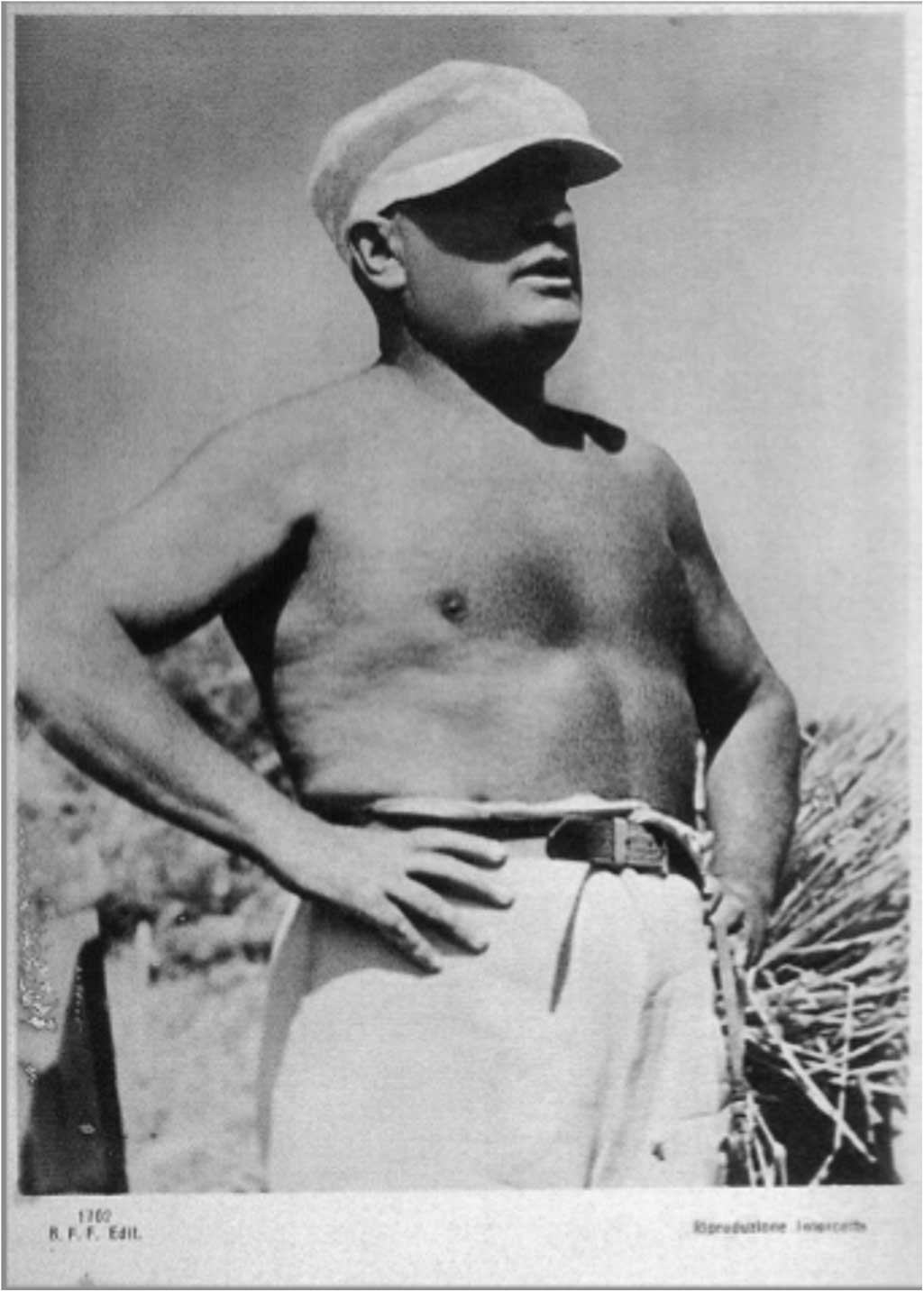
The event produced another image of Mussolini, this time alone against a neutral background, in which his naked torso was retouched to eliminate body-hair (Fig. 3). Reproduced in 1938 as a postcard for circulation beyond the event, this photograph was decontextualised to extend its relevance, allowing the viewers to project their own desire on to the Duce’s persona (Sturani Reference Sturani2003, 133). Hairless, and represented as athletic yet manicured, Mussolini’s unclothed body appears desexualised – the masculine and the feminine have become blurred (Scuriatti Reference Scuriatti2006, 146–165). Traditionally the hairy chest is associated with virility and masculinity, whereas the lack of hair has saintly connotations and the removing of hair is a prerogative of a woman. His body disrobed was reproduced as a ‘santino’,Footnote 6 evoking both the pure sacred dimension of Gandhi’s visual simplicity and the allure of a carte-de-visite, largely used by actors of the time to create connections, promote their image and generate income. Yet another image from the same series was of a type favoured by Mussolini at a later stage of the dictatorship, showing him in contact with the people (Fig. 4). The event that produced this, and other images, was recorded as a Luce newsreel. In it Mussolini is seen in front of cheering workers removing both his shirt and vest in preparation for threshing. The Duce, while disrobing, engages the excited crowds, his unclothed body appearing vulnerable but also virile. By getting down to essentials, as it were, he invites participation with him in the final phase of the harvest.
Mussolini’s radical originality regarding his representation needs to be viewed within a broader context. The image of the Duce undressed, usually showing his torso, which he seems to have considered his best feature, did not merely express an act of rebellion against bourgeois etiquette. It should be situated within the visual culture of a developing modern society characterised by the conflict between the idea of the new and nostalgia for tradition, a paradox which Mussolini strived to resolve. Committed to regenerating the nation, focusing on the power of the myth, Fascism’s programme of rebirth drew on existing, well established narrative conventions that were related to the sacred. The supernatural matrix of Mussolini’s representation through sacred imagery derived from allegorical and pagan as well as religious models, with the Duce appearing sometimes as Christ ‘appealing to Italy to rise again’, or as a king or emperor, or even as a type of Marianne ‘on a chariot drawn by white horses’ (Sturani Reference Sturani2003, 192–193).Footnote 7 In the context of the campaign for a rural Italy, Mussolini’s half-naked body, fixed and isolated through photography, was able to convey both the traditional image of the Duce-Saviour, whose body was offered to the Italians as if in a sacrifice, and at the same time the image of a ‘progressive’ politician who reduced his message to its extreme essence, enhancing its accessibility as much as possible, and therefore performing an act of modern mass communication. Although nudity from the waist up served the purpose of confounding the code of political conformism as a subversive communicative tool, overtly it helped to further the popular and populist appeal of Mussolini, while mobilising elements of sexual enticement.
Image management: the body made healthy
After the First World War, due to modern sport, the back-to-nature movement and the beginning of modern naturism, the male nude was seen in a different light. Photographs, once treated as taboo and associated with homosexuality, were now used to promote the cult of the body made healthy by physical exercise. The portrayal of role models whose posture projected self-control, with muscles emphasising virility, symbolised the dynamism and discipline Fascism thought society lacked. Mussolini’s photographs as action-man did sometimes exhibit flesh, as in the famous series of him skiing in 1937 at the new Terminillo resort, high in the Apennines to the east of Rome: in one shot in the snow, the sportsman Duce is stripped to the waist, holding skis-sticks, looking sideways, wearing a black cap, smiling, but with no skis (Fig. 5).Footnote 8 Part of a series subsequently published in the press, such as in the supplement L’Illustrazione Italiana Sportiva, this image may have been selected to emphasise authenticity by giving the impression of a casual snapshot. The Istituto Luce staged image of Mussolini bare-chested on the snowy slopes of Terminillo was taken by one of the ‘regular’ Luce photographers, Spartaco Appetiti, in 1937 and reproduced in various photographic collections. The ‘frozen’ look of Mussolini the skier was mostly due to the limited technology available yet does not detract from the potency this famous image must have had at the time. Similar to another sequence from the same series, also reproduced in Giorgio Pini’s biography in 1939, Mussolini as skier by Appetiti epitomises the development of the Duce’s photographic projection. The image underlines the unprecedented behaviour of a head of government. It was also reinterpreted as an action drawing on 7 February 1937, with the caption ‘Il Duce, grande sportivo, si è concesso un ottimo svago fisico sciando a torso nudo tra le nevi del Terminillo” (Fig. 6).
Interestingly the caption accompanying the series of images at Terminillo in L’Illustrazione Italiana on 24 January 1937 not only refers to Mussolini’s many sporting activities but also to his extraordinary prowess, as revealed in the photographs. The caption reads:
The extraordinary physical prowess of the Duce is revealed in all the sports that he practises, as soon as the serious duties of State allow him. Military and civil pilot, racing driver and motorcyclist, swimmer, fencer and horse-rider, the Duce practises all sports with perfect technique and magnificent zeal.Footnote 9
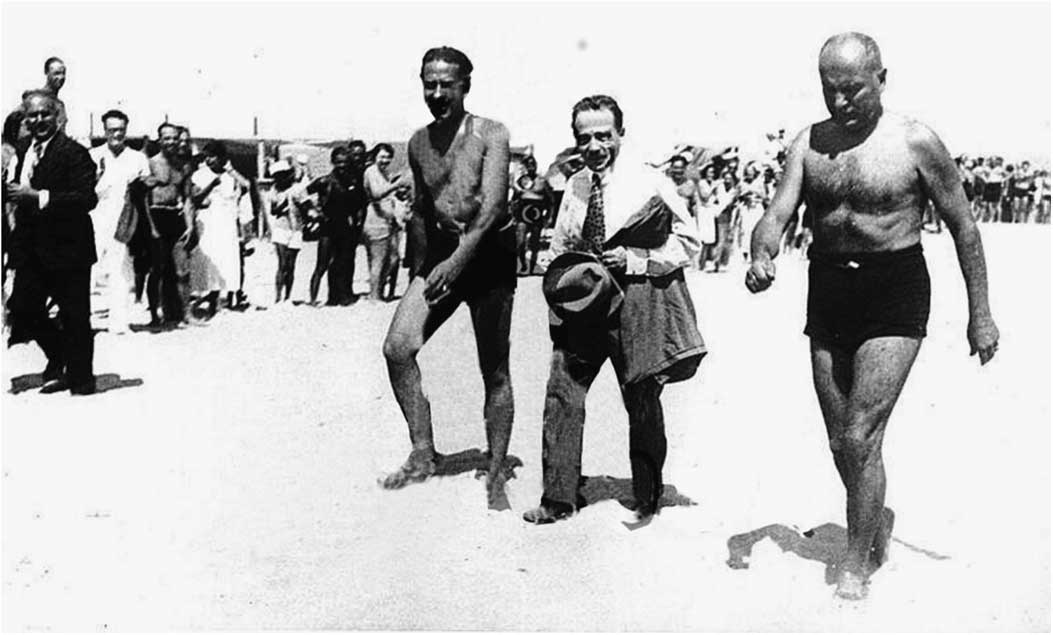
In fact Mussolini was also photographed in tennis gear, in a swimsuit on the beach, or dressed for skiing, oddly a torso nudo. A particularly noteworthy photograph was of Mussolini in trunks on the beach of Riccione in 1933 with the Christian Social chancellor of Austria Engelbert Dollfuss who, dressed in a suit and tie and holding his hat and jacket probably due to the heat, walks between the Duce and his son-in-law Ciano, minister for press and propaganda, who is also in swimming trunks (Fig. 7). Circulated in the local press and as a postcard, this image suggests further aspects of the role of Mussolini’s unclothed body in the production of a memorable photograph and highlights some visual clues about the contradictory relationship between the model of a healthy body and its exhibition.
This daring combination underscores the importance of Mussolini’s image management as part of an emerging code of representing politics that was influenced by new communication technology and commercial practices (Gundle Reference Gundle2008, 51). In stark contrast to the short, fully-dressed Austrian chancellor, the Italian dictator’s body, undressed, is even more emphasised. The Duce looks stronger, and overall in better shape, not only than Dollfuss, but also his younger son-in-law. In this image, despite its having been taken outdoors, the ingredients exalting the relation between body and nature are not present. The camera does not insist on the perfection of bodies, but rather on their physical performance which is enhanced by the juxtaposition between the objects in the composition. Mussolini’s body gathers here a dimension of stardom; he is contained and defined by the gaze of the surrounding crowd arranged in a single, seemingly endless line. Mussolini’s body unclothed becomes a political space ‘where virility, strength and health can be inscribed is a hallmark of Fascist rhetoric’ (Ornelas Reference Ornelas2002, 67). Here the unclothed body is inscribed into an area charged with sexual content ‘allow[ing] scopophilia (Freud’s term for the pleasure of looking) to dominate, but [doing] so in terms of a passive subject and an active eye with absolute power over what it sees, and upon which it looks as an invisible presence’ (Clarke Reference Clarke1997, 130).
The erotic charge of Mussolini marching unclothed does not appear to be provoked so much by the Duce being almost naked as by the challenge that the display of flesh represented within an established visual cultural code. The audacity of the vision was compounded by his unclothed body caught between a duplicate gaze, a construction that subverted the traditional treatment of male personality. Rather than facing the camera (and us) Mussolini looked sideways or down and by being looked at, instead of looking, the dictator evoked the wholly passive nature of the image and deferred to a female ideal based on notions of passivity. By changing the terms of reference, the spectacle of Mussolini’s body undermined the conventions for male portraits and the association with dominance. Encased within a public space and gaze, the Duce’s nudity related to ‘an index of beauty and passivity’ that deferred to a female-based ideal (Clarke Reference Clarke1997, 105). Through a kind of hybridisation among photographic genres, this image embraced the visual formulae pertaining to male and female realms, allowing it to be consumed by both.
Beyond propagandistic strategies, the image also reflected the influence of modern cultural forms such as cinema. The majority of films seen in Italy between the 1920s and the 1950s (excluding 1935–1945) were American. Over this period, the concession of new exhibition licences rose notably (Forgacs and Gundle Reference Forgacs and Gundle2007, 146). Going to the cinema became one of the most appealing recreational activities and films consequently influenced personal aspirations and ideals, as well as codes of representation. Hollywood stars, perhaps in reaction to imposed sobriety and patriotism, were particularly admired and, through the many photographs of them that circulated, their looks and fashion were followed and imitated. The growing mass culture, when people could enjoy more freetime and sport, saw an increased visibility of the body and at the same time a challenge to existing norms of behaviour and sexual mores. During the interwar years it was not uncommon to see photographs of actors and actresses in swimming costumes similar to the Mussolini image (Forgacs and Gundle Reference Forgacs and Gundle2007, 64–74). The fascination that the Duce inspired in Hollywood and how his body and histrionic gaze became the embodiment of his charisma is well known (Bertellini Reference Bertellini2005, 695). Likewise the dictator demonstrated a taste for American comedies and actors such as Mack Sennett, Charlie Chaplin and Laurel and Hardy (Bosworth Reference Bosworth2002, 278). In 1926, the Chicago Evening American described Mussolini as a movie star, by strictly correlating his physical appearance and his role as if he were a character actor: ‘He is a dominator, born to dominate and his face shows it: fear is utterly unknown to him’ (Bertellini Reference Bertellini2005, 695). Hollywood viewed the dictator as more than a passing infatuation (Gundle Reference Gundle2013, 77). He represented a fascinating past – an Italy of evocative archaeological and natural landscape, as well as cinematic melodramas and historical epics.
Compared to exotic and alluring Hollywood, the popular seaside resort of Riccione was certainly not as evocative, but perhaps precisely because of this, it was more useful for propaganda purposes. Understated but popular enough among Italians, it was the ideal scene to suggest a comfortable lifestyle with a hint of ‘glamour’: it projected a modern image of Italians – by then well in tune with the Fascist ethos – via a mix of free time, sport, healthy outdoor activities, and the cult of the body. Mussolini’s masculinity, personalised and sexualised by photography, assumes particular significance when considered in a specific historical context. ‘Stylish virility’ specific to Fascism and Mussolini’s political project was an original and effective visual code, able to translate elements from old iconographical traditions comprehensible to a society in transformation, whose tastes and aspirations were susceptible to modern forms of technology such as photography.Footnote 10
The icon renegotiated
As the locus of production of desire and pleasure (Boscagli Reference Boscagli1996, 11), the Duce was undoubtedly the dominant feature of Luce photographs.Footnote 11 Mussolini endorsed the celebration of his unclothed body as the embodiment of the new Fascist man from the very beginning of his political career. When Mussolini was newly appointed, and visiting London for the conference on reparations in 1922, the English newspaper The Sphere published an inset image of him fencing, an exercise he practised ‘before beginning his ministerial duties’ and also, more extraordinarily, an inset image of him in athletic vest and swimming trunks, which he is quoted as saying was the ‘garb he considered shows man at his best’ (Fig. 8).Footnote 12 At the height of his political career as Duce, Mussolini stripped to the waist for a photo opportunity that would demonstrate his dynamism and sensuality, creating a popular icon. Luce images of him in swimming trunks, skiing and harvesting bare-chested, were published at the time in various news media, in Italy and abroad, and would be further reproduced, including in Giorgio Pini’s biography and other print media, until 1942. This use of the photograph of his unclothed body beyond its original publication would, in a modern sense, already qualify these images as iconic. Contrary to moving images, which, according to Martin Kemp, never become truly iconic, still, flat images are able to carry a ‘special cognitive potency’ that works more effectively on perception and memory (Kemp Reference Kemp2012, 4). Mussolini’s iconic photographs offered a model Italians should aspire to, or an image of him they could carry within themselves, and being fixed images were more likely to crystallise in the consciousness of the nation.
Over 70 years after his death, Mussolini, through the continued circulation of his image, still stirs vivid memories in Italy and abroad. Despite the collapse of Fascism and the disasters of the war, the figure of Mussolini continues to exercise an appeal, and the Duce’s fame goes beyond the cult formed around his person when alive, to the extent that his face, gestures and physical presence are still instantly recognisable (Ventresca Reference Ventresca2006, 89). The solidity of his body, his large square jaw, strong neck and shoulders, full lips, piercing eyes and rotund skull, became skilfully framed in photographs as his somatic ‘shorthand’, or what contemporarily we would call his brand (Fig. 9).
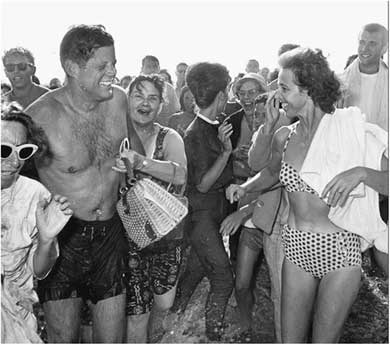
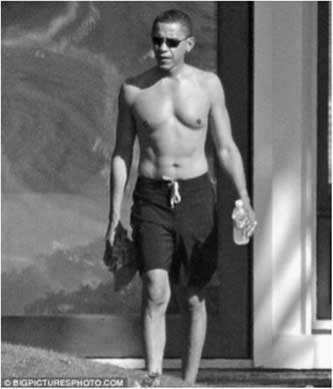
The new style of corporeality adopted by Mussolini for the first time as a modern Western head of government produced iconic images both to worship and imitate. Richard Bosworth believes Mussolini’s role as a leader ‘foreshadowed that world in which political chiefs have turned into travelling salespeople, more fascinated by image and spin than devoted to a deeper comprehension of society’ (Bosworth Reference Bosworth2002, 173). Photojournalism, as an important source for images used as propaganda, contributed to the construction of Mussolini’s cult of personality. Since his time, other heads of government have followed a similar trend and enjoyed pin-up status. Chairman Mao swimming, John F. Kennedy at the beach, Bill Clinton in trunks, bare-chested Vladimir Putin swimming, fishing and horse-riding and Barack Obama ‘showing off his impressively muscled tummy and a toned pair of “pecs” while on holiday in Hawaii’,Footnote 13 all have their origins in Mussolini’s presenting the unclothed body of the leader for political purposes (Figs. 10-11-12). Although the registers of Fascist propaganda were not completely converted into an industry, and Mussolini was not purely a celebrity, well executed and managed photography helped make him into an icon.
The Battle for Grain in 1938, published in the Corriere della Sera and in Giorgio Pini’s 1939 biography of Mussolini

The Battle for Grain, 1938

Postcard from 1938, with the chest hair retouched

This type of image showing the Duce among the people was much used in the later years of the regime. This is in Latina, 1938


Mussolini at Terminillo, early 1937. This Luce image was part of a series of photographs of the Duce skiing, both clothed and bare-chested, that was published in L’Illustrazione Italiana. Figure 6 shows a reinterpretation of the photograph as an action drawing, published in La Tribuna Illustrata of 7 February 1937

Mussolini, his son-in-law Ciano and, between them, the Austrian chancellor Dollfuss on the beach at Riccione, 19 August 1933

Mussolini in The Sphere, 16 December 1922. It is interesting to note the two inset images of him in a bathing costume and fencing

Mussolini at Terminillo, 1937

John F. Kennedy taking an impromptu dip at the beach in Santa Monica as throngs of admirers try to get close. Taken by Los Angeles Times photographer Bill Bee and published on 20 August 1962

Vladimir Putin became a sex symbol in Russia after he was pictured stripped down to the waist in Siberia, in the summer of 2010

“Commander in briefs: Obama shows off his war chest on holiday in Hawaii”, Daily Mail 23 December 2008

Acknowledgements
The author would like to thank Professor Stephen Gundle for his support and guidance with this article and the anonymous reviewers for their helpful suggestions on an earlier draft.
Notes on contributor
Alessandra Antola Swan completed a First Class Honours Degree at Royal Holloway and a Masters Degree with Distinction, for which she was awarded the ASMI Prize. Her article ‘Ghitta Carell and Italian studio photography in the 1930s’ was published in Modern Italy, 8 (2011), 249–273. She completed a PhD on the photographs and photographers of Benito Mussolini under the supervision of Professor Stephen Gundle as part of the AHRC-sponsored project The Cult of the Duce. Mussolini and the Italians, 1918–2005 for which she contributed a chapter, ‘Photographing Mussolini’, published in the project edited volume in June 2013. She has been the treasurer of ASMI since December 2011 and organised the 2013 Annual ASMI Conference in London, Iconic Images in Modern Italy: Politics, Culture and Society. In December 2013, Alessandra was invited to give the paper Benito Mussolini’s photogenic charisma: the portrait as a propaganda tool, at the Colloque international Le Portrait Politique at the Maison d’Italie, Cité Internationale Universitaire, Paris, which will be part of a forthcoming publication. She is the 2016 ASMI annual conference administrator and is working on the publication of her thesis, ‘Mussolini and Photography: Images and the Construction of a Personality Cult’.