Introduction
Sumatra is one of the Begonia diversity hotspots in Indonesia; currently, there are 63 accepted species known from the island, with most of them being endemic (Hughes et al., Reference Hughes, Girmansyah and Ardi2015, Reference Hughes, Moonlight, Jara, Tebbitt, Wilson and Pullan2015–). Bracteibegonia is a small section of the genus which is distributed in Sumatra and Java, with Sumatra as its centre of diversity. Currently, there are 12 species known in this section, with only one species (Begonia lepida Blume) in Java; the other 11 are endemic to Sumatra (this study; Hughes et al., Reference Hughes, Girmansyah, Ardi and Nurainas2009; Girmansyah, Reference Girmansyah2012; Hughes et al., Reference Hughes, Girmansyah and Ardi2015; see Appendix). The section was proposed by Candolle (Reference Candolle1859) to accommodate two related species, Begonia bracteata Jack and B. lepida, which are allied to those in Begonia sect. Petermannia (Klotzch) A.DC. but consistently different in several characters. The section is characterised by few-flowered and bisexual inflorescences with no separation between the basal female and the distal male portion, as commonly found in Begonia sect. Petermannia, and persistent bracts (Doorenbos et al., Reference Doorenbos, Sosef and Wilde1998).
This paper describes two new species from Sumatra in Begonia sect. Bracteibegonia: B. curvifolia Ardi and B. ocellata Ardi. All available Begonia material in ANDA, B, BO, E, K, L and SING has been consulted, and therefore it must be assumed, at least until more intensive collecting reveals otherwise, that these species have restricted distributions and are endemic to West Sumatra.
Key to Begonia sect. Bracteibegonia in Sumatra (Hughes et al., Reference Hughes, Moonlight, Jara, Tebbitt, Wilson and Pullan2015–)
1a. Stipules broadly ovate, leaf-like, staying green near the apex of the plant______2
1b. Stipules lanceolate, not leaf-like, rapidly drying to become papery____________3
2a. Leaves sinuate; male flower tepals ovate__________________B. aberrans
2b. Leaves sinuate-dentate; male flower tepals orbicular____________B. horsfieldii
3a. Leaves dentate-denticulate or serrulate, margin hairy__________________4
3b. Leaves entire to sinuate-dentate or crenate, margin glabrous____________6
4a. Leaves with dense soft white hairs above____________B. bracteata
4b. Leaves with evenly spaced bristles above between the veins____________5
5a. Leaves elliptic to rhomboid, 2.5–5.5 × 1.2–2.5 cm; androecium symmetrically clustered, c.25 stamens________________________B. jackiana
5b. Leaves suborbicular 6–9 × 2–4.5 cm; androecium asymmetrically clustered, c.18 stamens____________________________________B. ocellata
6a. Plants less than 20 cm tall, becoming repent and rooting at the lower nodes, often with fewer than 5 leaves________________________7
6b. Plants taller than 20 cm, not repent, usually with more than 5 leaves______10
7a. Inflorescence protandrous________________________8
7b. Inflorescences protogynous________________________9
8a. Male flowers with 2 tepals; fruits deflexed, wings rounded at base and at apex____________________________________B. beludruvenea
8b. Male flowers with 4 tepals; fruits slightly deflexed, wings subcuneate at base and subtruncate at apex______________________________B. curvifolia
9a. Inflorescences in short and compact cymes; male flowers with 4 tepals; fruits strongly deflexed, wings rounded at base and cuneate at apex______B. verecunda
9b. Inflorescences lax cymes; male flowers with 3 tepals; fruits not deflexed, wings cuneate at base and subtruncate at apex____________B. triginticolium
10a. Leaf lamina ovate-lanceolate, base subcordate; male flowers with 4 tepals; fruit cuneate at base______________________________B. lepidella
10b. Leaf lamina elongate-lanceolate, base narrowly cuneate; male flowers with 2 tepals; fruit rounded at base____________________________________B. flexula
Species Descriptions
Begonia curvifolia Ardi sp. nov. § Bracteibegonia – Type: Cultivated from material collected in the wild (Indonesia, West Sumatra, Tanah Datar, Lintau Buo) Wisnu H. Ardi WI 190 (holo BO, iso SING).
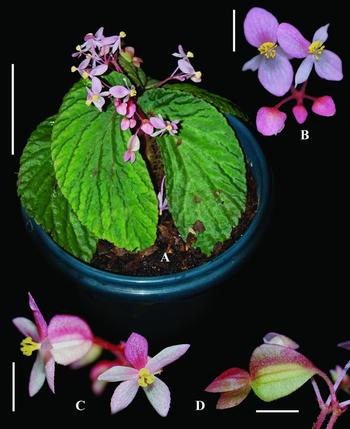
Closest to Begonia verecunda M.Hughes from Gunung Leuser National Park, similar in its small stature, leaf shape and male flowers with four tepals, but differs in having a laterally curved midrib (not straight), fruits slightly recurved (not strongly recurved), wings subcuneate at the base and subtruncate at the apex (not rounded at the base and the apex), and entire ovary placentae (not bilamellate). Fig. 1.
Begonia curvifolia Ardi. A, Habit (scale bar, 5 cm); B, male flowers (scale bar, 1 cm); C, female flowers (scale bar, 1 cm); D, ovary with tepals (scale bar, 1 cm). (Photograph: Wisnu Ardi.)

Perennial, monoecious herb, lower part of the stems prostrate and creeping, rooting at the nodes when in contact with the substrate, erect part to c.13 cm tall, with a dense indumentum of multicellular, red bristles. Stem few-branched; internodes 1.5–3 cm long, to c.6 mm in diameter, terete, greenish at the base and reddish at the apex. Leaves alternate; stipules persistent, 4–7 × 1.5–3 mm, triangular-ovate, prominent and hairy, apex filiform, margin ciliate, concolorous with the stem, semitranslucent at the margins; petioles c.0.5–4 cm long, shorter towards the apex, with dense indumentum of red bristles; lamina basifixed, 8–11.5 × 3.5–5 cm, asymmetrical, curved laterally along the midrib, narrowly obovate, base cordate and lobes slightly overlapping, apex acute, margin crenate-dentate, adaxially mid-green, sometimes with a blue iridescence, glabrous or with sparse, evenly spaced, red bristles, prominent between the veins, abaxially maroon red with hairs on veins, primary veins 7 or 8, actinodromous, secondary veins craspedodromous. Inflorescences protandrous; bisexual, a single monochasium or sometimes dichasially branched with a central flower and two monochasia, each with 3 or 4 male flowers and a single female flower at end of each monochasium, peduncle c.4–6 cm long, pinkish to reddish, hairy, bracts triangular c.1.5–2 mm long, red, margin serrulate. Male flowers: pedicels 10–20 mm long, hairy, pink; tepals 4, two outer elliptic, 9–11 × 6–8 mm, margin serrulate, apex rounded, pinkish, abaxially sparsely hairy, two inner tepals narrowly elliptic, c.9–12 × 3–4 mm; androecium of 26–31 stamens, asymmetrically clustered like a bunch of bananas, yellow, filaments c.1.5 mm long, anthers c.1 mm long, oblong, dehiscing through unilaterally positioned slits about half as long as anthers, apex retuse. Female flowers: pedicels c.5–10 mm long, hairy, pink; tepals 5, white to pale pink, unequal, the four larger 6–8 × 3–4 mm, elliptic to asymmetrically elliptic, sparsely hairy on abaxial surface, margin serrulate, apex acute, the smallest one 2–3 × 6–8 mm, elliptic; ovary cylindrical, c.5–10 × 3 mm (excluding wings), widest point subapically c.3 mm, white, pinkish, glabrescent, locules 3, placentation axile, placentae entire, wings 3, equal, white tinged with pink, base subcuneate, margin ciliate, apex subtruncate, style basally fused, 3-branched, each stylodium bifurcate in stigmatic region, stigmatic surface a spirally twisted papillose band, c.2.5–3.5 mm long, orange. Fruits with semipersistent tepals, slightly recurved on a stiff pedicel, c.10 mm long, wings as in ovary. Seeds barrel-shaped, c.0.4 mm, collar cells about a quarter the length of seed.
Distribution and habitat
Endemic to West Sumatra. Known from Lintau Buo (the type locality), where it grows on shaded clay soil banks over limestone base rock at 300–400 m altitude, and also from Batang Pangean Nature Reserve, Sijunjung (from a cultivated collection with no voucher).
Etymology
The specific epithet is derived from the Latin curvi- (curved) and folia (leaves), after the curved shape of the leaves.
Conservation status
Begonia curvifolia is currently known from two localities in West Sumatra, Lintau Buo and Sijunjung, which are separated by c.45 km, and is an obviously rare and local endemic species. We have no information on the population sizes at these localities, or on the status of the Lintau Buo site apart from the fact that it is not protected. We consider Begonia curvifolia to belong to the IUCN category Data Deficient.
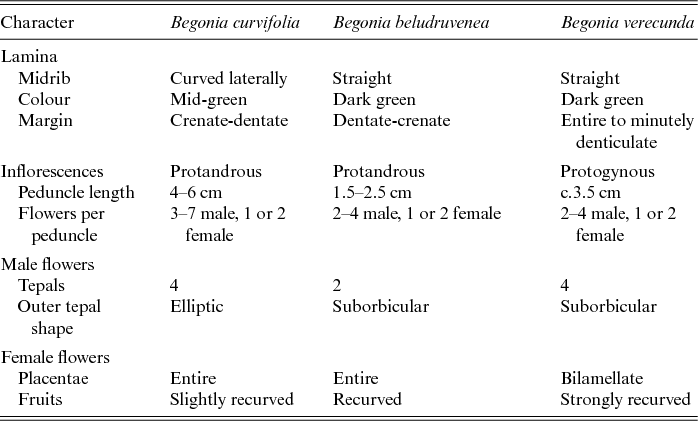
This species mostly resembles Begonia verecunda, but it can be easily distinguished by several key characters (see Table 1). Entire placentae are found in only 4 of the 12 species of Begonia sect. Bracteibegonia: B. beludruvenea M.Hughes (Hughes et al., Reference Hughes, Girmansyah and Ardi2015), B. triginticolium Girm. (Girmansyah, Reference Girmansyah2012), and B. curvifolia and B. ocellata, which are described here. A comparison of the salient features of Begonia curvifolia with allied species is shown in Table 1.
Begonia ocellata Ardi sp. nov. § Bracteibegonia – Type: Cultivated from material collected in the wild (Indonesia, West Sumatra.) Wisnu H. Ardi WI 191 (holo BO).
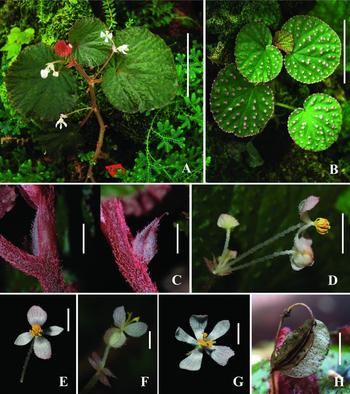
Begonia ocellata is distinct among Sumatran members of Begonia sect. Bracteibegonia in its suborbicular leaves. Fig. 2.
Begonia ocellata Ardi. A, B, Habit (scale bar, 5 cm); C, stipule (scale bar, 5 mm); D, male inflorescence (scale bar, 1 cm); E, male flower (scale bar, 1 cm); F, female flower, side view showing ovary (scale bar, 0.5 cm); G, female flower (scale bar, 0.5 cm); H, mature fruit (scale bar, 0.5 cm). (Photograph: Wisnu Ardi.)

Comparison of Begonia curvifolia, Begonia beludruvenea and Begonia verecunda

Perennial, monoecious herb, stems initially semi-erect, to 9 cm, but prostrate and creeping in older plants, rooting at nodes when in contact with substrate, to c.15 cm, with a dense indumentum of multicellular, red bristles. Stem branched; internodes 1.5–3 cm long, to c.6 mm in diameter, terete, reddish. Leaves alternate; stipules, persistent, 6–12 × 4.5–7 mm, triangular, ovate, slightly anisophyllous, midrib slightly prominent and sparsely hairy, apex shortly filiform, margin ciliate, concolorous with the stem; petioles c.2–4 cm long, shorter towards apex, with a dense indumentum of red bristles; lamina basifixed, 3.5–6.5 × 4–7 cm, asymmetrical, suborbicular, base cordate and lobes overlapping, apex rounded, margin undulate-serrulate with teeth pointed, adaxially brownish green, slightly iridescent, sometimes with pink spots between veins and a pink band along margin, red bristles between veins, abaxially maroon-red with hairs on veins, primary veins 6 or 7, actinodromous, secondary veins craspedodromous. Inflorescences protandrous; bisexual, a single compressed monochasium with 3 or 4 male flowers and a single female flower at end of monochasium, peduncle c.4–4.5 cm long, pinkish, densely hairy, bracts ovate c.1.5–2 × 4.5 mm long, red, margin serrulate. Male flowers: pedicels 2–3 cm long, hairy, white; tepals 4, two outer elliptic, 9 × 5–5.5 mm, margin serrulate, apex rounded, white tinged pink or red, abaxially hairy, two inner tepals narrowly elliptic, c.9 × 3–3.5 mm, margin entire, apex acute; androecium of c.18 stamens, asymmetrically clustered like a bunch of bananas, yellow, filaments c.1.5 mm long, anthers c.1–1.5 mm long, oblong, dehiscing through unilaterally positioned slits about half as long as anthers, apex retuse. Female flowers: pedicels c.4 mm long, hairy, white; tepals 5, white tinged pink, unequal, the three larger obovate 8–9 × 3.5–4.5 mm, sparsely hairy on abaxial surface, margin serrulate from middle part up to apex and entire from middle part down to base, apex emarginate, the two smaller elliptic c.8 × 2.5 mm, abaxially glabrescent; ovary cylindrical, c.5 × 1.5 mm (excluding wings), white, tinged pink, glabrescent, locules 3, placentation axile, placentae entire, wings 3, equal, white tinged with pink, base rounded, margin ciliate, apex subtruncate, widest point subapically c.2 mm long, style basally fused, 3–branched, each stylodium bifurcate in stigmatic region, stigmatic surface a spirally twisted papillose band, c.4.5–5 mm long, orange. Fruits with semipersistent tepals, deflexed on stiff pedicels, c.8 mm long, ovary cylindrical c.10 × 3.5–4 mm, wings equal, with rounded base and apex, widest point at middle, to 3 mm. Seeds unknown.
Distribution and habitat
Endemic to West Sumatra, exact locality unknown.
Etymology
The specific epithet of ocellata (Latin) refers to the orbicular, spotted leaves, which resemble the ocellate river stingray (Potamotrygon motoro).
Conservation status
We lack information on the type locality, therefore we consider Begonia ocellata to belong to the IUCN category Data Deficient.
Begonia ocellata has been propagated for sale among Begonia collectors in Indonesia and neighbouring countries; it is a rather attractive species in cultivation. Begonia ocellata is one of the most distinct species in Begonia sect. Bracteibegonia, with its colourful suborbicular leaves decorated with pink spots between the veins and a pink band running along the margin, and the showy white tinged pink or red flowers immediately make it a very striking species.
Acknowledgements
The authors would like to express gratitude to the curators of A, ANDA, B, BM, BO, CEB, E, K, L and SING for allowing access to herbarium material, and to Mr Alfaret Dongoran, Mr Siaw Yu Zhang and Mr Zulherman for their kindness in donating invaluable specimens. The Royal Botanic Garden Edinburgh is supported by the Scottish Government's Rural and Environment Science and Analytical Services Division.
Appendix
Species of Begonia sect. Bracteibegonia in Sumatra
Begonia aberrans Irmsch.
Begonia beludruvenea M.Hughes
Begonia bracteata Jack
Begonia curvifolia Ardi
Begonia flexula Ridl.
Begonia horsfieldii Miq. ex A.DC.
Begonia jackiana M.Hughes
Begonia lepidella Ridl.
Begonia ocellata Ardi
Begonia triginticolium Girm.
Begonia verecunda M.Hughes