Introduction
Within the National Health Service (NHS), many acute ENT services are led by newly graduated foundation doctors, the so-called “ENT SHO”. These Senior House Officers (SHO) require a great deal of practical skills when managing patients with acute issues. A systematic review from 2016 identified that confidence in managing ENT patients is low amongst doctors based on their undergraduate training and supported the need for further research into the impact of this on post-graduate ENT practice.Reference Ferguson, Bacila and Swamy1 One study has shown that 68 per cent of junior doctors expected to cover ENT overnight had no prior ENT experience, and 42 per cent did not feel comfortable managing acute issues.Reference Biswas, Rafferty and Jassar2
The majority of undergraduate curricula focus solely on ENT anatomy and physiology, with limited attention to surgical management of pathology; which has negative implications for management of basic ENT complaints such as antibiotic prescribing in otitis externa and oxygen administration in laryngectomy patients.Reference Mayer, Smith and Carrie3–Reference Darr, Dhanji and Doshi5 With patient safety paramount during on-call and out-of-hours shifts, there is a clear gap to support the rotating junior doctor cohort to prepare them for their ENT attachments.Reference Jackson and Moreton6 Likewise, the national General Medical Council (GMC) survey often identifies deficiencies in induction training in the national GMC survey.7
Bootcamps have grown in popularity in various parts of medical and surgical training, recognised as an effective and efficient way to rapidly improve knowledge, confidence and surgical skill.Reference Robinson, Hopkins, Brown, Bowman, Abdelrahman and Iorwerth8–Reference Blackmore, Austin, Lopushinsky and Donnon10 These programmes deliver an intensive learning experience, designed to standardise learners’ knowledge and skillset within the context of their current training posts.
This study follows a piece of research performing a needs-based learning assessment for ENT SHOs working in the NHS, which identified the need for simulation-based training to facilitate safe and efficient work within the role of the ENT SHO.Reference Morris, Owens and Cserzo11 This study highlighted the need for focussed simulation and non-technical skills training with a near-peer training model.Reference Morris, Owens and Cserzo11 As such, the curriculum of the current induction programme was mapped to these outcomes, to capture the specific needs of these rotating junior doctors.Reference Morris, Owens and Cserzo11
Aims
This study aims to present the outcomes of a standardised and national training programme which has been accepted in Wales as a mandatory part of the induction process to support the rotating ENT SHO cohort.
Methodology
Bootcamp design
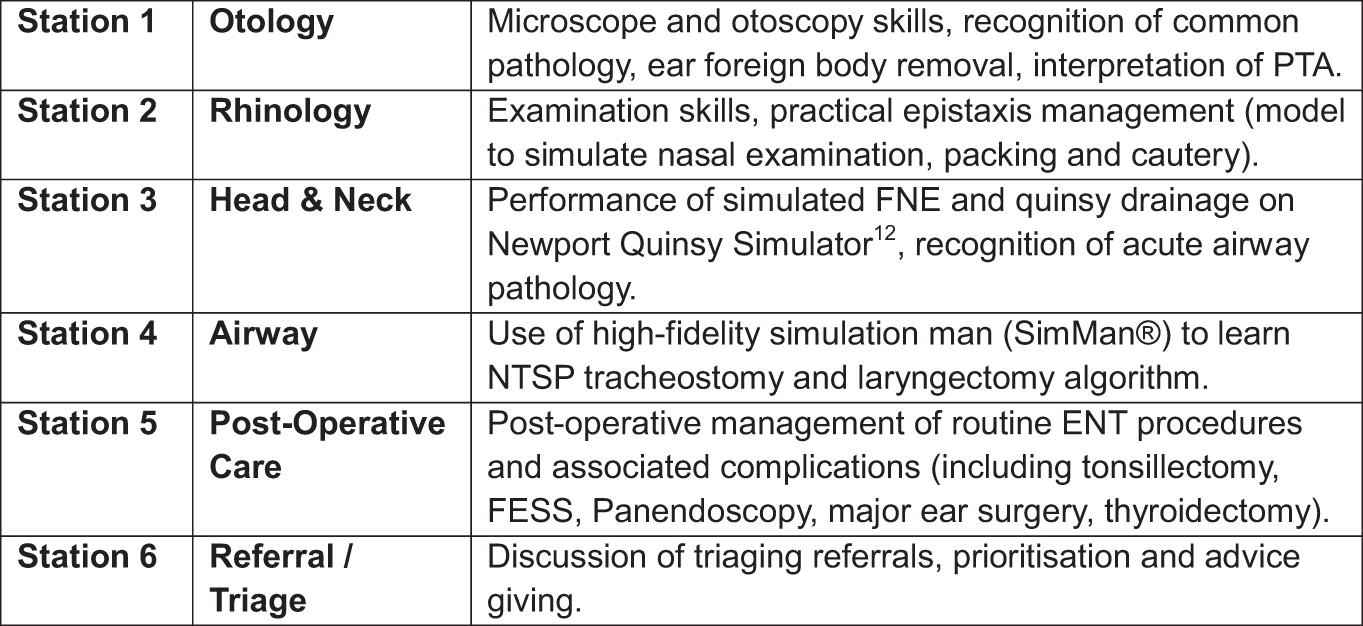
The format of the bootcamp was designed and established in response to the outcomes of the existing learning needs assessment (Figure 1).Reference Morris, Owens and Cserzo11 Each station included a balance of knowledge and skill acquisition; using high-fidelity simulation methods including epistaxis model, The Newport Quinsy Simulator, SimMan® for National Tracheostomy Safety Project tracheostomy algorithms, microscope and model head for micro-otoscopic skills; as well as opportunity to simulate non-technical skills such as the General Practitioner (GP) referral and advice-giving process.Reference Sheehan, Green and Grimshaw12, 13
Stations and mapped curriculum for induction bootcamp day including station activities.

Approval was sought and granted from all training centres within Wales; with agreement to release rotating trainees for 1 day during the first week of their rotation to attend a centralised unit which provided the 1-day induction bootcamp. All participating units agree to cover the day shift and corresponding night shift with a non-training grade doctor, experienced SHO (for example CT2) or a middle-grade stepping down into SHO role.
During the 1-day course, junior trainees rotate through six stations, facilitated by a mixed, near-peer faculty of ENT Registrars and Consultants. The faculty-to-participant ratio is typically 1:4, requiring eight faculty members on each run of the course.
The bootcamp is hosted at a centralised Medical Education Centre in one unit in Wales where all participants have access to simulation lab. This is provided free of charge for all attendees. Consumable equipment has been purchased via a grant from Health Education & Improvement Wales (HEIW).
Data collection
Planning of the course followed the Stufflebeam’s Context, Input, Process and Product (CIPP) model. Following an initial learning needs assessment, feedback tools were designed in order to gain continuous feedback and modify the course delivery as needed over each iteration.Reference Morris, Owens and Cserzo11, Reference Stufflebeam14
Participants were asked to complete pre- and post-course questionnaires. Likert scales are used to assess pre- and post-course confidence in the taught areas. Open text questions are also included to ensure that additional learning needs are captured and addressed prior to the next iteration (if participants feel that the current curriculum does not capture their needs). A pre- and post-course multiple-choice question (MCQ) assessment was undertaken to judge objective improvements in participants’ knowledge as a result of the course.
Participants
All rotating ENT SHO (Foundation Year [FY] 1, FY2, GP trainee, Core Trainee [CT] 1, CT2), Physicians Associate (PA) and Advanced Nurse Practitioners (ANP) are required to attend when commencing new rotations in ENT departments in Wales. Relevant staff from all eight training units in Wales attend. Six iterations of the induction bootcamp have taken place between August 2022 and April 2024; these occur on a four monthly basis for the rotating cohorts of junior doctors.
Analysis
Anonymised data were collated into Excel (Redmond, WA, USA). Paired t-test was used to compare pre- and post-session mean confidence scores, with a p value < 0.01 needed for statistical significance.
Results
In total, 152 participants have attended and completed the pre-/post-course questionnaires during the five iterations of the bootcamp. This comprised: 43 FY1 doctors, 56 FY2, 16 Surgical CTs, 23 GP CTs, 5 Junior Clinical Fellows, 3 ANPs, 1 PA and 5 Medical Student observers. The mean ENT experience was 0.9 months based on prior undergraduate or post-graduate attachments (range 0–24 months).
A total of 100 per cent of participants (n = 152) stated that they felt more confident as a result of the course and that it fulfilled their pre-specified aims. The most commonly praised aspects of the course were the hands-on experience, simulated referral triage process and near-peer learning model which consolidated their working relationship with senior colleagues.
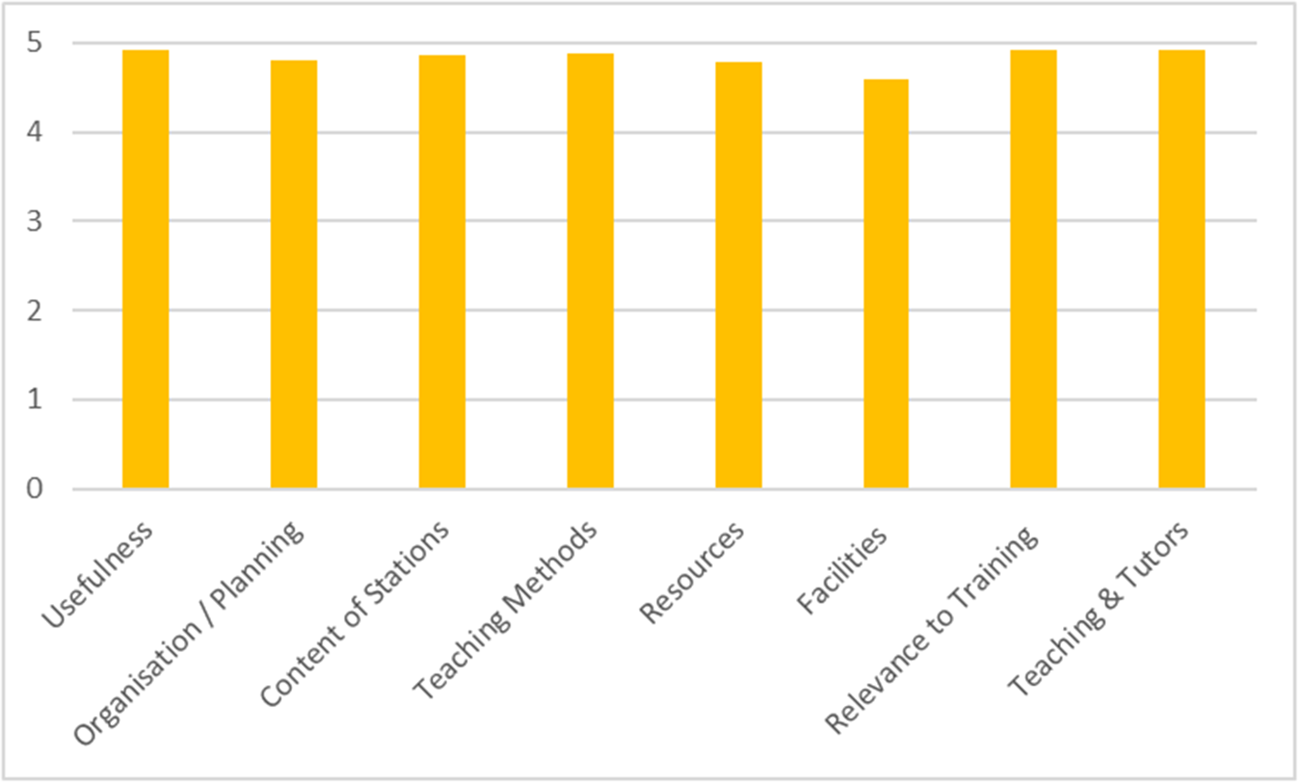
Course satisfaction was high across all areas assessed. Participants were asked to assess the course on a number of domains ranging from 0 (very poor) to 5 (excellent). The course was rated highly for a number of factors including usefulness, teaching and methods used (Figure 2).
Mean overall participant satisfaction scores (0 lowest satisfaction – 5 highest satisfaction).

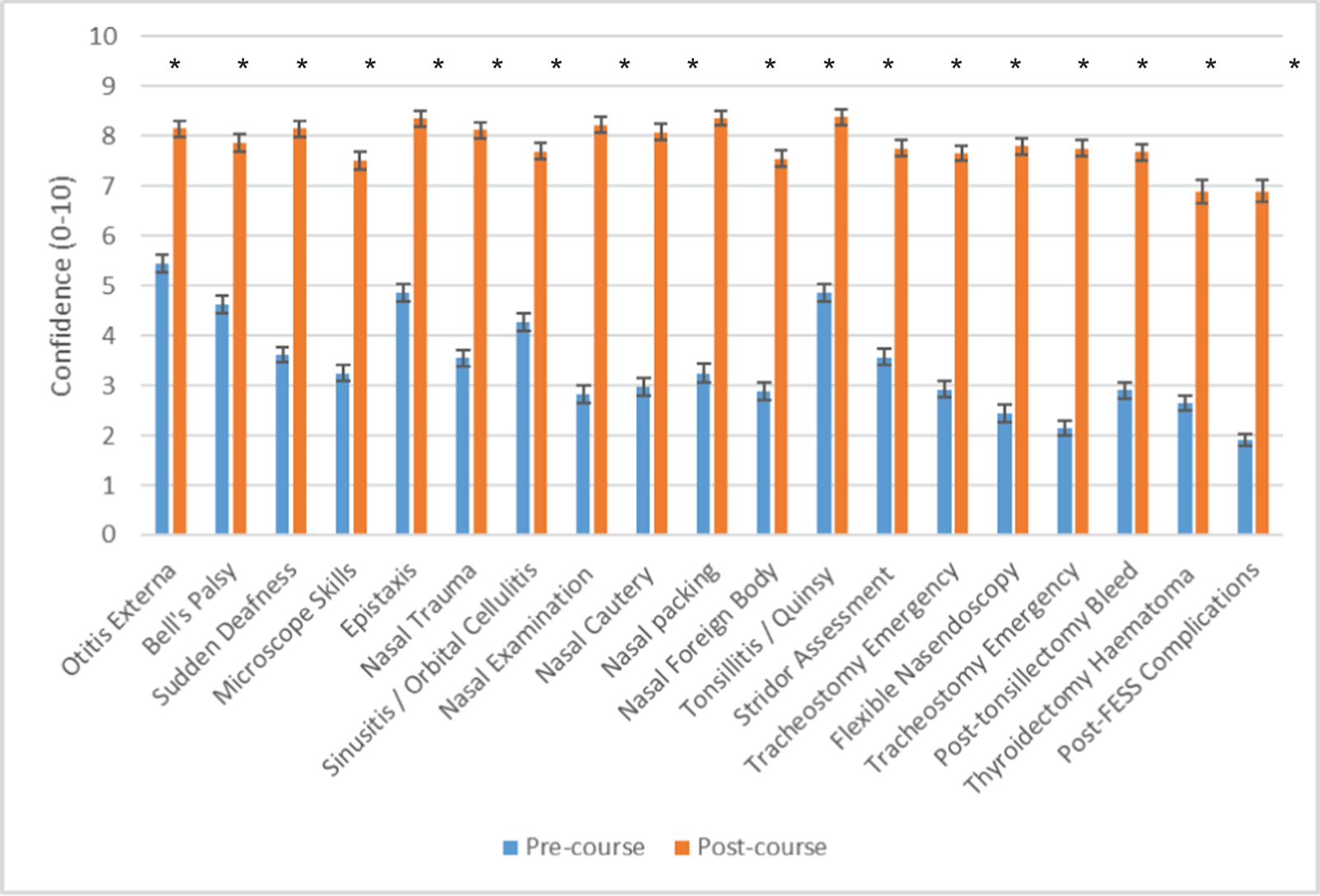
Subjective benefit from the course was ascertained by participants’ self-reported confidence in various areas of the curriculum from 0 (no confidence) to 10 (utmost confidence) (Figure 3). All areas demonstrated a statistically significant improvement in self-rated confidence; even in the areas with high pre-course knowledge such as management of otitis externa, tonsillitis and epistaxis. The most significant improvement was observed in emergency tracheostomy management (2.2 to 7.8), flexible nasendoscopy (2.4 to 7.8) and nasal examination (2.8 to 8.2). All changes in mean pre- and post-course knowledge observed statistical significance with p < 0.01.
Mean attendee self-reported confidence in curriculum domains (mean pre- and post-scores with standard deviation; where * indicates p < 0.01).

Based on the objective assessment, participant knowledge improved from a mean score of 68.5 per cent (range 30–100 per cent) to 96.5 per cent (range 60–100 per cent).
As a proxy measure of success, the GMC national training survey outcomes for all ENT units in Wales (where available) were reviewed for the dates before the course was implemented and compared to the subsequent survey outcomes.7 The mean induction score in 2019 was 70.5 per cent compared to 78.0 per cent in 2023’s survey.
Discussion
This is the largest formal, national and mandatory bootcamp induction course offered for junior doctors in ENT to the authors’ knowledge. Using a combination of small-group teaching, high-fidelity simulation training and practical skills sessions, trainees were exposed to all areas of emergency ENT at a level anticipated for a day 1 ENT SHO on-call. The course curriculum was mapped to a focussed learning needs assessment, capturing both anticipated and unanticipated needs of rotating doctors.Reference Morris, Owens and Cserzo11 The course has demonstrable subjective benefit for junior doctors rotating into ENT attachments, which corresponds to greater trainee satisfaction in the 2023 GMC survey within the units in Wales.
Despite the “first on-call” being an established role for ENT SHOs, no consensus exists about the expectations for the care they provide.Reference Morris, Owens and Cserzo11 Therefore, providing a needs-based induction has demonstrable benefits in medicine, equipping rotating junior doctors with an improved baseline of knowledge and skills.Reference Whallett15 Providing this in an accelerated learning programme, frequently termed a “bootcamp”, has been recognised as an effective and efficient way to rapidly improve knowledge and skill at the Core Surgical Trainee level.Reference Robinson, Hopkins, Brown, Bowman, Abdelrahman and Iorwerth8, Reference Brown, Egan, Ansell, Abdelrahman, Harries and Bowman9 This allows standardisation of juniors’ abilities according to their job’s expectations and aims to ease the transition from Medical Student, to Foundation Doctor, to Core Surgical Trainee, respectively.
The largest increases in confidence were seen in the most emergent or unfamiliar skills, such as tracheostomy emergency and flexible nasendoscopy, which reinforces the unfamiliarity rotating junior doctors have when undertaking routine tasks within their first on-call role. This contrasts to previous work defining the ideal ENT curriculum, which had less emphasis on practical skill need and more on anatomy and physiology of ENT pathology.Reference Mayer, Smith and Carrie3, Reference Lloyd, Tan, Taube and Doshi16 It was also apparent that, prior to this course, many SHOs did not feel confidence managing simple post-operative care for common operations, such as tonsillectomy, thyroidectomy, panendoscopy and Functional Endoscopic Sinus Surgery (FESS), which was a novel finding in both the learning needs assessment and course outcomes.Reference Morris, Owens and Cserzo11
This simple yet effective educational intervention has improved the confidence and abilities of rotating junior doctors to work in ENT departments in Wales. The authors believe that this bootcamp demonstrates an ideal, evidence-based curriculum and format for other training deaneries wishing to implement a standardised induction for their rotating junior doctor cohort.
• There is a clear gap in post-graduate education to support the rotating junior doctor cohort and prepare them for their ENT attachments.
• This is the first national ENT SHO Induction Bootcamp to provide rotating ENT SHO with both the technical and non-technical skills needed for their ENT first on-call role.
• 100 per cent of attendees demonstrated both an objective and subjective benefit after attending this course.
• The greatest increases in self-reported confidence were seen in the most emergent or unfamiliar skills, such as tracheostomy emergency and flexible nasendoscopy.
• This showcases an evidence-based curriculum and format for other training deaneries wishing to implement a standardised induction for their rotating junior doctor cohort.
Conclusion
With patient safety paramount during on-call and out-of-hours shifts, there is a clear gap to support the rotating junior doctor cohort to prepare them for their ENT attachments. This novel ENT bootcamp provides a needs-based induction process for all ENT SHO in Wales to standardise their abilities, knowledge and confidence prior to starting a new rotation in this inherently practical specialty. This bootcamp is now a mandatory component for all rotating junior doctors entering ENT attachments in Wales and identified a format that can be easily adopted across other deaneries.
Acknowledgements
All staff at the University Hospital Llandough Education Centre and teaching faculty.
Funding statement
No funding was received for the research. Consumable course equipment has been purchased via a trainee grant from Health Education & Improvement Wales (HEIW).
Competing interests
None.
Ethical standards
Formal ethical approval was not required for this work.