




No CrossRef data available.
Article contents
Structure of the microfilarial reservoir of Loa loa in the human host and its implications for monitoring the programmes of Community-Directed Treatment with Ivermectin carried out in Africa
Published online by Cambridge University Press: 05 October 2004
Abstract
This paper describes the structure of the microfilarial reservoir of Loa loa in an endemic population of central Cameroon. The possible effects of age and sex on the prevalence and intensity of microfilaraemia have been explored. Logistic analysis showed that the prevalence of microfilaraemia increased significantly with age, reaching 60% in the oldest males. This result suggests that the figure commonly reported, according to which only one third of the infected individuals were microfilaraemic, should be reconsidered; in addition, as part of surveys of loiasis, crude microfilaraemia prevalence values should be replaced by adjusted ones. The intensity of infection did not show any age-specific change. As a result, even if the oldest members of the male population are clearly the most at risk of developing post-ivermectin serious adverse reactions, especially Loa-encephalopathy, the other members of the population are not risk-free. Therefore, in those areas where the African Programme for Onchocerciasis Control is undertaking regular mass distributions of ivermectin for onchocerciasis control, and where loiasis is co-endemic, no subpopulation should be excluded from surveillance and monitoring during community directed treatments with ivermectin.
Keywords
Information
- Type
- Research Article
- Information
- Copyright
- © 2004 Cambridge University Press
INTRODUCTION
Loa loa is a filarial worm that parasitizes humans and some species of monkey and which is transmitted by tabanids belonging to the genus Chrysops. Studies have shown that hybridization between the human and simian ‘strains’ of Loa is possible (Duke, 1964). However, as the microfilariae (mfs) of each of the strains show opposite 24-hour periodicities (diurnal in human and nocturnal in monkeys), and as the vector species commonly biting these hosts are not the same, the life-cycles of human and simian Loa appear to be separated, and it has been suggested that the two parasites may be in the process of speciation (Duke & Wijers, 1958). The distribution of Loa loa is mainly restricted to Central Africa (Rodhain & Rodhain-Rebourg, 1973; Boussinesq & Gardon, 1997).
In humans, infection with Loa loa, or loiasis, is usually revealed by episodic migration of the adult worm under the conjunctiva of the eye (‘eye worm’), and by transient, localized, itching, subcutaneous oedematous swellings, known as ‘Calabar swellings’. These signs and symptoms are mild, but still constitute one of the main causes of consultation in health structures in Central Africa (Boulesteix & Carme, 1986; Pinder, 1988). More importantly, individuals harbouring high densities of Loa mfs in the blood may, after having received an antifilarial treatment with diethylcarbamazine or ivermectin, develop serious adverse effects (SAEs), particularly encephalopathies, which may be fatal (Fain, 1978; Carme et al. 1991; Gardon et al. 1997; Boussinesq et al. 2003; Twum-Danso, 2003a,b). These events are uncommon but, in areas where loiasis and onchocerciasis are co-endemic, they may hamper the activities of the African Programme for Onchocerciasis Control (APOC), which is based on annual community-directed treatments with ivermectin. Besides ethical issues (in the absence of a preliminary diagnosis of onchocerciasis, the treatment may expose the individual to a risk, without any proven benefit), the risk of occurrence of SAEs makes it necessary to put in place specific monitoring procedures in those areas at risk, which in turn have to be carefully delineated (Thomson et al. 2000; Obsomer et al. 2002; Takougang et al. 2002). Lastly, the fear of SAEs may clearly have a very negative impact on the participation of communities in ivermectin distribution campaigns.
As the probability of developing an SAE is closely correlated with the intensity of any pre-treatment Loa microfilaraemia, one might consider the possibility of identifying, before the distribution of ivermectin, those individuals at risk. Unfortunately, the only means currently available of doing this would be to perform systematic parasitological examinations of calibrated blood smears on all members of the population, which is not practical as a routine. For lack of anything better, it is thus crucial to identify those factors associated with the presence of a high Loa microfilaraemia. The characterization of a subpopulation in which the risk of SAEs is increased would allow us to concentrate those activities (recording, surveillance, etc.) aimed at limiting the negative consequences of SAEs.
Before the present study, various surveys had shown that levels of microfilaraemia tended to increase with age, and were usually higher in males than in females (e.g. for Cameroon: Kershaw et al. 1953; Ripert et al. 1977, 1980; Haumont et al. 1992), but the numbers of communities and patients examined did not permit a detailed analysis of the factors associated with the presence of microfilaraemia. Besides this, it had been shown that, at the community level, there is a close relationship between the prevalence and intensity of Loa microfilaraemia (Boussinesq et al. 2001; Takougang et al. 2002). These results suggest that the distribution of the Loa mfs in the human population could be described as it is for many parasites (Crofton, 1971), including helminths (Shaw & Dobson, 1995; Shaw, Grenfell & Dobson, 1998), and especially filariae (Pichon et al. 1980; Grenfell et al. 1990; Das et al. 1990; Basañez & Boussinesq, 1999), in the form of a negative binomial distribution (NBD).
Although the population biology of L. loa probably shares many characteristics with those of other helminth species, most authors who have studied this parasite have emphasized its specific features. One of the most striking is the fact that very high loads of mfs, reaching 500000 per ml of blood, are not uncommon. This feature contrasts with the values reported for lymphatic filariasis, in which the mfs, although of similar size to those of L. loa, rarely exceed concentrations of 20000 mfs per ml (e.g. Brengues, 1975). A second characteristic of L. loa is that a high proportion of subjects, whose infection is ascertained from a history of ‘eye worm’, do not present mfs in their blood (Kershaw, 1950; Fain, 1978); and it is commonly said that two-thirds of the individuals infected with L. loa are amicrofilaraemic (Dupont, Zue-N'Dong & Pinder, 1988; Pinder, 1988; Noireau et al. 1990; Touré et al. 1997). It has been suggested that this phenomenon of so-called ‘occult loiasis’ is associated with immunological mechanisms (Akué, Hommel & Devaney, 1997, 1998; Baize et al. 1997; Winkler et al. 1999; Akué & Devaney, 2002; Akué et al. 2002) and that it is partly related to familial genetic factors (Garcia et al. 1999). However, the pattern of distribution of those individuals with occult loiasis within the global reservoir of the parasite has never been documented in detail.
The present paper gives, for the first time, a detailed description of the distribution of L. loa microfilarial densities in a human population. The study is based on extensive parasitological surveys performed in central Cameroon, which have allowed us to explore the effects of age and sex on the prevalence and intensity of microfilaraemia.
PATIENTS AND METHODS
Study area, selection of subjects and parasitological examinations
The study areas and the methods used for selecting and examining subjects have been described in detail elsewhere (Gardon et al. 1997; Boussinesq et al. 2001). Briefly, the data analysed in the present paper were collected as part of 2 distinct studies. The first set of data (study A) corresponds to epidemiological surveys of filarial infections, conducted in 1991–1993 in 31 communities of the contiguous Lékié and Mbam Divisions of the Central Province of Cameroon, where 4307 subjects [ges ]5 years old were examined. The second set of data was collected as part of a trial conducted in 1995–1996 in the Lékié Division to evaluate the incidence of Loa-related post-ivermectin SAEs and to identify risk factors associated with the latter. During this trial (study B), 4160 subjects [ges ]15 years old were examined in 36 communities. In both studies, the populations of the villages had been informed, by an official notice brought one week before, as well as by a meeting, that a medical team would visit their village, and that all volunteers to participate in the examination would have to come at a given place and given day. They were told that the examinations were free of charge and aimed at measuring the microfilarial densities in their blood, and they were informed that the results would be provided to them.
From the total number of patients examined, and the data of the last nation-wide census performed in 1987, one can calculate that the examinations covered in average 29% (range following the various villages: 4–71%) of the total population during study A, and 28% (range: 10–85%) during study B.
Each blood sample was collected by finger-prick, between 10:00 and 16:00 h, in a non-heparinized capillary tube, and calibrated thick blood films were immediately prepared, using either 30 μl (study A) or 50 μl (study B) of blood. Each Giemsa-stained smear was then examined under a low-power microscope and all the Loa mfs present on the slide were counted. All the persons examined had been questioned as to whether they had received any antifilarial treatment previously, and the data from those few who had been treated during the last 5 years were discarded from analysis. Thus, 213 among the 4307 individuals examined during study A, and 291 among the 4160 individuals examined during study B, were discarded from statistical analysis.
Indicators of interest
Two main aspects of the structure of the L. loa microfilarial reservoir have been analysed: the prevalence of microfilaraemia and its intensity in the human population.
The prevalence has been defined as the proportion of patients presenting at least 1 Loa mf in their thick blood smear. We assumed that the individual microfilarial loads did not vary significantly between 10:00 and 16:00 h (Kershaw, 1950). The examinations were done on blood smears of 30 μl during study A, and blood smears of 50 μl during study B.
As the 5 to14 year-old age-group was only present in study A, the mf reservoir corresponding to this age-group was described, but not included in the other parts of the analysis, for which we pooled the data of all individuals aged [ges ]15 years old examined during the two studies.
No standard indicator has so far been recommended to define the intensity of infestation with L. loa at a community level. In the literature, this intensity is defined either by the arithmetic mean, or the geometric mean, or the median of the individual mf densities; and this either on those patients who are microfilaraemic or on the totality of the patients examined (Fain et al. 1974; Noireau et al. 1989; Ufomadu et al. 1991; Boussinesq et al. 2001). We have limited our calculations to geometric means of the loads in microfilaraemic patients. In addition, as one of the main objectives of this study was to identify any groups particularly at risk of adverse reactions to ivermectin treatment, we further analysed the prevalence of mf densities >8000 mfs per ml (PMF8000) in the different strata of the population. The latter value corresponds to the one above which the risk of post-ivermectin serious adverse reactions (defined as reactions requiring full time assistance by the relatives during at least week), is significantly increased (Gardon et al. 1997).
Possible explanatory variables
The structure of the L. loa reservoir, as defined above (prevalence and intensity) has been analysed and evaluated according to two individual intrinsic factors, namely sex and age.
As one of our objectives was to identify sub-populations particularly at risk of developing SAEs, we decided to include age as a categorical rather than a continuous variable. The odds ratios (ORs) associated with continuous variables are often difficult to interpret in logistic regression models. Thus the following age classes were used for the analysis: 15–19, 20–29, 30–39, 40–49, 50–59 and [ges ]60 years.
Data analysis
As a first step, we defined 3 levels of endemicity, according to the prevalence of microfilaraemia in the population aged [ges ]15 years old. We restricted the calculation to this age-group because the examinations performed as part of study B were limited to this subpopulation. The limits of the 3 classes of prevalence were chosen arbitrarily, so that we could obtain sufficient numbers of individuals in each stratum. Thus the following classes of prevalence were used for the descriptive analysis: <25%, 25–35% and [ges ]35%.
The communities examined were regrouped, according to the criteria of endemicity defined above; the population was thus classified by prevalence group.
Trends in mf prevalence were first studied on the whole population by a logistic regression model with mixed effect, accounting for any possible effect of intra-community clustering. As preliminary analysis suggested that there may be a significant interaction between sex, age and that this latter may differ between the two surveys (see Table 1), the effect of age on microfilaraemic status was then studied for each sex and each survey.

Goodness-of-fit of the logistic models were evaluated using the Hosmer and Lemeshow test (Hosmer & Lemeshow, 1989) after grouping the data into 10 nearly equal-size groups. Odds ratios are given with their 95% confidence intervals (95% CI).
Assuming that mf distribution would be overdispersed rather than normally distributed, negative binomial regressions with mixed effect, accounting for any possible effect of intra-community clustering, were used to explore the relationship between mf counts, age-group and sex.
Studies of trends in intensity of infection were then restricted to that part of the population whose phenotype was defined for sure: i.e. microfilaraemic individuals. The effects of age and sex on the probability of harbouring mf densities >8000 mfs per ml amongst microfilaraemic individuals were studied by logistic regression in the same manner as the mf prevalence.
Statistical analysis was performed using STATA version 6.0 (Stata Corporation, TX, USA).
RESULTS
Trends in prevalence of microfilaraemia
The numbers of males and females examined and the prevalence of Loa microfilaraemia are presented in Table 1 for each age-group and each endemicity level.
Among male subjects, the prevalence tended to increase with age up to 40–49 or 50–59 years, and then tended to plateau. In communities with the lowest levels of endemicity, the highest values recorded were 20–35% but they reached values exceeding 60% in areas of high endemicity. For female subjects, the prevalence seemed to be much more stable between 15 and 50 years but, after this age, a marked increase in prevalence was recorded in those communities with high or intermediate levels of endemicity, and, in both studies, more than 40% of the females [ges ]60 years old were found to be microfilaraemic.
The logistic regression analysis performed on the whole population showed that the interaction term between age and sex was highly significantly associated with the microfilaraemic status and that the probability of being microfilaraemic was about 2-fold higher during the study B (Fig. 1).

Fig. 1. Odds ratio and 95% confidence intervals (95% CI) for logistic regression with mixed effect (accounting for potential intra-community clustering) of microfilaraemic status on sex, age and survey (study group), estimated on the population aged 15 years and more, never treated with any antifilarial drug, and examined during study A and study B (N=6663). Baselines are categories female sex, 15–19 year age-group, and study A (volume of blood sampling=30 μl). Goodness-of-fit was tested using the Hosmer and Lemeshow test: χ2=4·12, degree of freedom (D.F.)=8, P=0·846.
Logistic models performed on separate sex and survey, confirmed that the pattern of acquisition of the microfilaraemic status seemed to be sex-related, with a plateau following an increasing phase for males, and a plateau followed by a late increase in mf prevalence for females (Fig. 2).

Fig. 2. Odds ratios and 95% confidence intervals (95% CI) for logistic regression of microfilaraemic status on age for (A) males (N=1280) and (C) females (N=1514) examined during study A, and (B) males (1694) and (D) females (2175) examined during study B.
Intensity of infection
Figure 3 represents box plot diagrams showing the quartiles, the median, and the range of the microfilaraemias for each given sex, age group, and level of endemicity. It shows that very high mf loads can be seen in patients of very young age, and suggests that the levels of microfilaraemia did not increase with age. The geometric means of the mf densities in microfilaraemic patients, in relation to sex, age, and level of endemicity, also did not show any particular trend with age. This is confirmed by the results of the negative binomial regression, performed to evaluate the relationships between microfilaraemia, age, and sex (Table 2).

Fig. 3. Distribution pattern with median and quartiles (boxplots) and geometric mean ([lozf ]) of the positive microfilarial counts by age-group and sex (□ females; males), in the communities grouped according to their level of endemicity: (A), (D) endemicity <25%, (B), (E) endemicity 25–35% and (C), (F) endemicity [ges ]35%. (A), (B), (C), and (D), (E), (F) correspond to the communities surveyed as part of study A and study B, respectively.

All the microfilaraemic males between 15 and 19 years old examined during study A in the villages with a prevalence [ges ]35% showed more than 8000 mfs per ml; this was probably due to the low number of microfilaraemic patients (5 individuals) belonging to this class (see Table 1). In most of the other age classes, and similarly in both sexes, the PMF8000 were about 20% of the microfilaraemics in areas of low endemicity and 35–40% in those of higher endemicity (Fig. 4).

Fig. 4. Proportion of patients harbouring mf densities >8000 mf per ml of blood among (A) male and (C) female microfilaraemic individuals examined during study A, and (B) male and (D) female microfilaraemic individuals examined during study B, according to age, sex and endemicity level. Error bars represent 95% confidence intervals calculated using an exact method. Legend for age groups: □ 5–14 years; 15–19 years; 20–29 years; 30–39 years; 40–49 years; 50–59 years; 60 years and over.
The logistic regression analysis, restricted to the microfilaraemics, showed that independently of the data set, neither age nor sex were significantly associated with such high loads (Fig. 5).

Fig. 5. Odds ratios and 95% confidence intervals (95% CI) for logistic regression with mixed effect (accounting for potential intra-community clustering) of high microfilarial densities (>8000 mf per ml of blood) on sex, age and survey (study group), estimated on the microfilaraemic population aged 15 years and over examined during study A and study B (N=1707). Baseline category are female sex, 15–19 year age-group, and study A (volume of blood sampling=30 μl). Goodness-of-fit was tested using the Hosmer and Lemeshow test: χ2=4·12, degree of freedom (D.F.)=8, P=0·846.
DISCUSSION
Recently, some methods have become available for identifying and delimiting those areas where there is a risk of Loa-related SAEs after ivermectin treatment (Thomson et al. 2000; Boussinesq et al. 2001; Obsomer et al. 2002; Takougang et al. 2002). But still little is known about the structure of the mf reservoir in the human population within a community, and thus which subpopulations of this community are particularly at risk of developing an SAE. To document this, we undertook this detailed analysis, based on extensive parasitological surveys performed in the Mbam and the Lékié divisions, in the Central province of Cameroon, where most of SAEs have been recorded so far (Twum-Danso, 2003a).
Effect of age on the presence/absence of Loa loa microfilaraemia
In the first part of the analysis, we have shown that the prevalence of the Loa microfilaraemia tended to increase with age. This result confirms observations made by a number of authors who performed descriptive surveys (e.g. Kershaw et al. 1953; Ripert et al. 1977, 1980), and the detailed analysis done by Garcia et al. (1999), who found, in a village of southern Cameroon where the level of endemicity was particularly high, that among several factors (sex, age, occupation, and duration of time spent outdoors), age was the only one related to the presence of the Loa microfilaraemia.
Two issues should be raised regarding the age profiles of microfilaraemia observed in central Cameroon. The first one is that in the most highly endemic villages, the prevalence of Loa microfilaraemia in the oldest males ([ges ]50 years old in study A and [ges ]60 years old in study B) reached, or even exceeded 60%. This result, as well as those presented in other studies (Takougang et al. 2002), seems to contradict the common statement that whatever the level of endemicity and whatever the age, two-thirds of the infected population have an occult loiasis, i.e. harbour adult worms but will be permanently amicrofilaraemic (Pinder, 1988; Dupont et al. 1988; Akué, Dubreuil & Moukana, 2001; Wahl & Georges, 1995). Clearly, this is not the case for the elderly living in hyperendemic villages in central Cameroon. The marked increase in the prevalence of Loa mf with age should lead investigators to analyse prevalence data cautiously, to avoid using crude prevalences of Loa microfilaraemia, but instead to calculate sex- and age-adjusted prevalences, as for onchocerciasis (Moreau, Prost & Prod'hon, 1978). To illustrate this point, we have represented in Fig. 6, for each community surveyed in this study, its crude and standardized mf prevalence, according to the Onchocerciasis Control Programme (OCP) standard population. It appears that the prevalence of Loa microfilaraemia in some communities would have been significantly overestimated (e.g. Guientsing and Boyabissoumbi, surveyed during study A) or, with possible serious implications in terms of monitoring SAEs, largely underestimated (e.g. Nkolmebanga and Nkolangoun, surveyed during study B).

Fig. 6. Crude ([squf ]) and standardized (□) microfilarial prevalence (A) in the 31 communities of the Mbam and Lékié divisions surveyed during study A and (B) in the 36 communities of the Lékié division surveyed during study B.
In addition, our results should be discussed in the light of the genetic study on the predisposition to be microfilaraemic for Loa presented by Garcia et al. (1999). These authors performed a segregation analysis on 74 nuclear families living in an endemic village, and their results indicated that about 59% of the exposed population were predisposed to be microfilaraemic, whereas 41% had a very low life-time risk of harbouring mf. When comparing this finding with ours, we may assume that the totality of the subpopulation of males aged [ges ]60 years had been exposed to such a degree of transmission, that they should all have become infected, and that all the susceptible individuals should have become microfilaraemic whereas the others were presumably resistant.
Another issue concerns the mechanisms associated with the increase in the prevalence of microfilaraemia with age. It might be supposed that the increase in prevalence of microfilaraemia would simply be the consequence of an increase in the proportion of persons infected, and that, after several infective bites by Chrysops, the probability of becoming microfilaraemic would increase progressively. However, it has been shown that, in areas hyperendemic for loiasis, a high proportion of very young children (2 years old) showed Loa-specific antibodies, although no mfs were found in their blood (Goussard et al. 1984). This result suggests that some mechanisms, possibly immunological, regulate the appearance of microfilaraemia, and that these mechanisms are already active in the first years of life. Then, one may assume that, maybe because of the progressive increase in the number of parasites in the organism, the mechanisms preventing or limiting the appearance of mfs in the peripheral blood become progressively inefficient during the host's life-time, and that this may vary between individuals (Pinder, 1988).
Recent advances in immunology have demonstrated the implication of different immunological factors and their presumed respective rôles in filariasis establishment. Thus, a high level of parasite transmission would lead to a depression in the proliferation of T cells of infected hosts (Akué et al. 2002). This immunodepression would facilitate the adult worms' establishment which in turn, would promote the circulation of mfs (Hoffmann et al. 2001). The persistence of those mfs would be facilitated by the IL-10 cytokine (Hoffmann et al. 2001). Baize et al. (1997) demonstrated that microfilaraemic individuals were characterized by an absence of Th1 and Th2 response (except interleukin-10 (IL-10)), which was induced or maintained by the presence of mfs. It has also been shown that lymphocytes of L. loa infected patients could produce antibodies in response to low concentrations of Brugia malayi adult antigens but not to high concentrations (Nutman, Withers & Ottesen, 1985). These results suggest that a heavy adult worm burden may thus suppress immunity against incoming infective larvae, like it has recently been suggested for the parasite density regulation in onchocerciasis (Duerr et al. 2003), or against the other stages of the parasite in the human host. No method allowing for quantifying the Loa adult worm burden in the human host is yet available and it seems technically very difficult to test for these hypotheses in vivo, but mathematical modelling approaches as proposed by Duerr et al. (2003,2004) for onchocerciasis may contribute to the clarification of this point.
Effect of sex on the presence/absence of Loa loa microfilaraemia
For both data-sets A and B, the prevalence values recorded in males were generally higher than in females. This phenomenon was also reported in most the surveys on loiasis (e.g. Kershaw et al. 1953; Ripert et al. 1977, 1980), and may be explained, on the one hand, by differences in the everyday activities, and thus in exposure to infective bites of the Chrysops or, on the other hand, by physiological differences related to sex. Two studies have been conducted in Cameroon to evaluate whether exposure to the vectors was associated with the presence of a Loa microfilaraemia. One of them suggested that neither sex, nor the type of activity (i.e. agriculture in the forest versus other activities), nor the duration of time spent outdoors between 6:00 and 22:00 h ([ges ]50% versus <50%) were significantly associated with the presence of mfs, and that the only factor significantly associated with the presence of microfilaraemia was age (Garcia et al. 1995). We have also studied the respective effects of sex, age, and degree of exposure to Chrysops bites ([ges ] versus <15000 L3 received within the last 10 years, calculated using a formula including the Chrysops infection rates in areas of different vegetational types, and the respective durations of time spent by the individuals in the latter), on the presence of microfilaraemia. The results showed that high levels of exposure to Loa infective larvae had no effect on the presence of microfilaraemia, but that age and sex did so (Pion et al. 2000). These two studies thus led to contradictory results, and we have no explanation for this finding.
Besides this, experimental infections performed using animal models have shown that the establishment and development of filarial parasites may be different between males and females (Ash, 1971; Denham, 1974), and that hormonal factors may account for these differences (Reynouard et al. 1984; Nakanishi et al. 1989; Rajan et al. 1994). In the human host, it has also been shown that there were sex-related differences in the immunological responses against infections due to protozoa (Roberts, Walker & Alexander, 2001), Schistosoma (Remoué et al. 2001), and Wuchereria bancrofti (Dutta & Diesfeld, 1994); but, to our knowledge, no such phenomenon has been reported so far for L. loa.
The increase in the prevalence of L. loa microfilaraemia seems to follow different patterns for males and females. In females, the trend in the prevalence to increase occurred particularly late in life (after 50 years of age). A study of the distribution of the mf loads of W. bancrofti had shown that these tended to be lower in those females of reproductive age; and the authors conclude that this reduction may result from hormonal changes associated with female reproduction, possibly in combination with other factors (Alexander & Grenfell, 1999). Besides this, it has been shown that, in a mouse model, the presence and persistence of mfs of Litomosoides sigmodontis strongly depended on the production of IL-10 (Hoffmann et al. 2001), and that production of IL-10 was augmented in post-menopausal females (Deguchi et al. 2001). The late increase in the prevalence of Loa microfilaraemia in the female population could be explained by changes in the hormonal balance, which might be related to the production of IL-10 after the menopause.
Intensity of infection
Although the mfs of L. loa are of similar size to those of W. bancrofti, both the mean intensities of infection and the maximal densities observed in the present study were much higher. This discrepancy in abundance may be explained by a particularly important shedding activity of L. loa (Eberhard & Orihel, 1986), and is probably maintained because the human host shows a good tolerance to the parasite due to the generally low pathogenic characteristic of the latter. Higher levels of mf infection may compensate for a less important vector/host contact (because of lower densities of Chrysops silacea and C. dimidiata, the two main vectors of L. loa, compared to the mosquito vectors of lymphatic filariasis) and for the fact that, in general, the majority of human hosts do not show Loa mfs in their peripheral blood and thus only few bloodmeals are infective for the vectors.
Relationship between age and the mean of positive microfilarial loads
One of the most unexpected and interesting results of the present study concerns the changes, with age, in the intensity of infection among the microfilaraemic individuals. The mean mf densities appear to be more or less constant from very young ages, and the figures presented in this paper suggest that, in those patients who become microfilaraemic, the mf loads increase steadily in a few months or years, to reach a given level, which can be very high. It is well known that the Loa microfilaraemia in any individual remains more or less constant over time (Noireau & Pichon, 1992; Garcia et al. 1995), and that there is a genetic predisposition to be microfilaraemic (Garcia et al. 1999). One may therefore assume that those predisposed persons show a rapid increase in their microfilaraemia, and that, once a given level is reached, they keep it all through their lives. This phenomenon is very similar to the pattern observed in West Africa with W. bancrofti (Brengues, 1975) but differs completely from the pattern observed with other filariae such as Onchocerca volvulus, for which both the prevalence and the mf loads in positive individuals increase with age (Basañez & Boussinesq, 1999). The phenomenon observed with L. loa raises a number of questions. The first one is to know whether, similarly to those associated with the presence/absence of microfilaraemia, there are genetically-related mechanisms governing the ‘optimal’ level of microfilaraemia reached in any individual, and thus whether there is a predisposition to develop a high, moderate, or low Loa mf density. Several studies have shown that some individuals are predisposed to harbour high infections with such and such a helminth parasite (Schad & Anderson, 1985; Bundy et al. 1985). Unfortunately, as there is currently no drug which has a complete macrofilaricidal activity against L. loa, it would be difficult to perform longitudinal studies, following up the effects of the re-infections (and the level to which the microfilaraemia re-increases) after the parasite has been eliminated from the organism. The second question concerns the mechanisms allowing the patient to keep such stability in their microfilaraemia, in spite of the repeated infective bites by the Chrysops. The parasite stage (adult or mfs) which triggers the regulating mechanisms, and the level at which the latter acts remains unknown. These issues should certainly lead investigators to continue studies on the immunological responses to L. loa, some of which may need to be done on the Loa-primate models.
Finally, from a practical point of view, the fact that very young children may present important Loa microfilaraemia should be emphasized. Although the prevalence of microfilaraemia in the younger children is usually low, and thus, in the total subpopulation of children, the number of those with high mf loads is still low, our study shows that SAEs can indeed occur in children and thus that young age should not be considered as an argument against a diagnosis of Loa-related SAE.
Identification of the subpopulation which is most at risk of developing marked adverse reactions post-ivermectin
The results of our analysis have shown that, whatever the age class and the sex, about one third of the persons who were found microfilaraemic harboured densities exceeding 8000 mfs per ml, and were thus at increased risk of developing marked adverse reactions after ivermectin treatment. From the figures observed in the various strata studied, it appears that, in those areas hyperendemic for loiasis, more than 20% of the males more than 50 years old present such a risk of marked reactions.
In conclusion, the present study demonstrated that age and sex had important effects on the presence of Loa microfilaraemia in the individuals, and that this should lead to the replacement of crude prevalences by adjusted ones as part of the surveys of loiasis. We have shown that the figure according to which only one third of the infected individuals were microfilaraemic was not so clear-cut. Our analysis on the intensity of infection has provided results strongly suggesting that the passage from the status of amicrofilaraemia to the ‘cruising’ Loa microfilaraemia is fairly rapid, and occurs within several months; and that young children may present high microfilaraemias similar to those recorded in adults. From this result, we conclude that, even though the oldest members of the male population, which present the highest prevalence values, are clearly the most at risk of developing post-ivermectin SAEs, no subpopulation should be excluded from surveillance and monitoring during community-directed treatments with ivermectin.
This study was supported by the Institut de Recherche pour le Développement (IRD). Some of the data were collected as part of surveys supported by Helen Keller International, and the UNDP/World Bank/WHO Special Programme for Research and Training in Tropical Diseases (TDR). S. D. S. Pion is deeply grateful to Dr F. Lacoste for his financial support. We wish to thank Dr J. Owona, former Minister of Public Health, who provided ethical clearance for study B. We are grateful to Drs F. J. Louis and P. Richard, to Demanga-Ngangue, V. Foumane, and T. Nyiama, and to the personnel of the Laboratoire Mixte IRD-CPC d'Epidémiologie et de Santé publique at Yaoundé for their participation in the field work and in the examination of the slides. We thank Dr F. Noireau for his helpful comments on the manuscript.
References
REFERENCES
AKUÉ, J. P. &
DEVANEY, E. (
2002).
Transmission intensity affects both antigen-specific and nonspecific T-cell proliferative responses in Loa loa infection.
Infection and Immunity
70,
1475–1480.CrossRefGoogle Scholar
AKUÉ, J. P.,
DEVANEY, E.,
WAHL, G. &
MOUKANA, H. (
2002).
Expression of filarial-specific IgG subclasses under different transmission intensities in a region endemic for loiasis.
American Journal of Tropical Medicine and Hygiene
66,
245–250.CrossRefGoogle Scholar
AKUÉ, J. P.,
DUBREUIL, G. &
MOUKANA, H. (
2001).
The relationship between parasitological status and humoral responses to Loa loa antigens in the Mandrillus sphinx model after immunization with irradiated L3 and infection with normal L3.
Parasitology
123,
71–76.CrossRefGoogle Scholar
AKUÉ, J. P.,
HOMMEL, M. &
DEVANEY, E. (
1998).
IgG subclass recognition of Loa loa antigens and their correlation with clinical status in individuals from Gabon.
Parasite Immunology
20,
387–393.CrossRefGoogle Scholar
AKUÉ, J. P.,
HOMMEL, M. &
DEVANEY, E. (
1997).
High levels of parasite-specific IgG1 correlate with the amicrofilaremic state in Loa loa infection.
Journal of Infectious Diseases
175,
158–163.CrossRefGoogle Scholar
ALEXANDER, N. D. &
GRENFELL, B. T. (
1999).
The effect of pregnancy on Wuchereria bancrofti microfilarial load in humans.
Parasitology
119,
151–156.CrossRefGoogle Scholar
ASH, L. R. (
1971).
Preferential susceptibility of male jirds (Meriones unguiculatus) to infection with Brugia pahangi.
Journal of Parasitology
57,
777–780.CrossRefGoogle Scholar
BAIZE, S.,
WAHL, G.,
SOBOSLAY, P. T.,
EGWANG, T. G. &
GEORGES, A. J. (
1997).
T helper responsiveness in human Loa loa infection; defective specific proliferation and cytokine production by CD4+ T cells from microfilaraemic subjects compared with amicrofilaraemics.
Clinical and Experimental Immunology
108,
272–278.CrossRefGoogle Scholar
BASÁÑEZ, M.-G. &
BOUSSINESQ, M. (
1999).
Population biology of human onchocerciasis.
Philosophical Transactions of the Royal Society of London, B
354,
809–826.CrossRefGoogle Scholar
BOULESTEIX, G. &
CARME, B. (
1986).
Encéphalite au cours du traitement de la filariose à Loa loa par la diéthylcarbamazine. A propos de 6 observations.
Bulletin de la Société de Pathologie Exotique
79,
649–654.Google Scholar
BOUSSINESQ, M. &
GARDON, J. (
1997).
Prevalences of Loa loa microfilaraemia throughout the area endemic for the infection.
Annals of Tropical Medicine and Parasitology
91,
573–589.CrossRefGoogle Scholar
BOUSSINESQ, M.,
GARDON, J.,
GARDON-WENDEL, N. &
CHIPPAUX, J. P. (
2003).
Clinical picture, epidemiology and outcome of Loa-associated serious adverse events related to mass ivermectin treatment of onchocerciasis in Cameroon.
Filaria Journal
2 (Suppl. 1),
S4.CrossRefGoogle Scholar
BOUSSINESQ, M.,
GARDON, J.,
KAMGNO, J.,
PION, S. D. S.,
GARDON-WENDEL, N. &
CHIPPAUX, J. P. (
2001).
Relationships between the prevalence and intensity of Loa loa infection in the Central province of Cameroon.
Annals of Tropical Medicine and Parasitology
95,
495–507.CrossRefGoogle Scholar
BRENGUES, J. (
1975).
La filariose de Bancroft en Afrique de l'Ouest.
Mémoires ORSTOM
79,
299p.Google Scholar
BUNDY, D. A. P.,
THOMPSON, D. E.,
GOLDEN, M. H.,
COOPER, E. S.,
ANDERSON, R. M. &
HARLAND, P. S. (
1985).
Population distribution of Trichuris trichiura in a community of Jamaican children.
Transactions of the Royal Society of Tropical Medicine and Hygiene
79,
232–237.CrossRefGoogle Scholar
CARME, B.,
BOULESTEIX, J.,
BOUTES, H. &
PURUEHNCE, M. F. (
1991).
Five cases of encephalitis during treatment of loiasis with diethylcarbamazine.
American Journal of Tropical Medicine and Hygiene
44,
684–690.CrossRefGoogle Scholar
CROFTON, H. D. (
1971).
A quantitative approach to parasitism.
Parasitology
62,
179–193.CrossRefGoogle Scholar
DAS, P. K.,
MANOHARAN, A.,
SRIVIDYA, A.,
GRENFELL, B. T.,
BUNDY, D. A. P. &
VANAMAIL, P. (
1990).
Frequency distribution of Wuchereria bancrofti microfilariae in human populations and its relationships with age and sex.
Parasitology
101,
429–434.CrossRefGoogle Scholar
DEGUCHI, K.,
KAMADA, M.,
IRAHARA, M.,
MAEGAWA, M.,
YAMAMOTO, S.,
OHMOTO, Y.,
MURATA, K.,
YASUI, T.,
YAMANO, S. &
AONO, T. (
2001).
Postmenopausal changes in production of type 1 and type 2 cytokines and the effects of hormone replacement therapy.
Menopause
8,
266–273.CrossRefGoogle Scholar
DENHAM, D. A. (
1974).
Studies with Brugia pahangi. 6. The susceptibility of male and female cats to infection.
Journal of Parasitology
60,
642.Google Scholar
DUERR, H. P.,
DIETZ, K.,
SCHULZ-KEY, H.,
BUTTNER, D. W. &
EICHNER, M. (
2004).
Density-dependent parasite establishment suggests infection-associated immunosuppression as an important mechanism for parasite density regulation in onchocerciasis.
Transactions of the Royal Society of Tropical Medicine and Hygiene
97,
242–250.Google Scholar
DUERR, H. P.,
DIETZ, K.,
SCHULZ-KEY, H.,
BUTTNER, D. W. &
EICHNER, M. (
2003).
The relationships between the burden of adult parasites, host age and the microfilarial density in human onchocerciasis.
International Journal for Parasitology
34,
463–473.Google Scholar
DUKE, B. O. L. (
1964).
Studies on loiasis in monkeys. IV. Experimental hybridization of the human and simian strains of Loa.
Annals of Tropical Medicine and Parasitology
58,
390–408.CrossRefGoogle Scholar
DUKE, B. O. L. &
WIJERS, D. J. B. (
1958).
Studies on loiasis in monkeys. I. The relationship between human and simian Loa in the rain-forest zone of the British Cameroons.
Annals of Tropical Medicine and Parasitology
52,
158–175.CrossRefGoogle Scholar
DUPONT, A.,
ZUE-N'DONG, J. &
PINDER, M. (
1988).
Common occurrence of amicrofilaraemic Loa loa filariasis within the endemic region.
Transactions of the Royal Society of Tropical Medicine and Hygiene
82,
730.CrossRefGoogle Scholar
DUTTA, S. N. &
DIESFELD, H. J. (
1994).
Evidence of sex variations in microfilaraemia and fluorescent antibody titre level at puberty in a bancroftian filariasis endemic area.
Journal of Communicable Diseases
26,
43–51.Google Scholar
EBERHARD, M. L. &
ORIHEL, T. C. (
1986).
Loa loa: output of microfilariae in single pair infections.
Tropical Medicine and Parasitology
37,
369–374.Google Scholar
FAIN, A. (
1978).
Les problèmes actuels de la loase.
Bulletin of the World Health Organization
56,
155–167.Google Scholar
FAIN, A.,
ELSEN, P.,
WERY, M. &
MAERTENS, K. (
1974).
Les filarioses humaines au Mayumbe et dans les régions limitrophes (République du Zaïre). Evaluation de la densité microfilarienne.
Annales de la Société Belge de Médecine Tropicale
54,
5–34.Google Scholar
GARCIA, A.,
ABEL, L.,
COT, M.,
RANQUE, S.,
RICHARD, P.,
BOUSSINESQ, M. &
CHIPPAUX, J. P. (
1995).
Longitudinal survey of Loa loa filariasis in southern Cameroon: long-term stability and factors influencing individual microfilarial status.
American Journal of Tropical Medicine and Hygiene
52,
370–375.CrossRefGoogle Scholar
GARCIA, A.,
ABEL, L.,
COT, M.,
RICHARD, P.,
RANQUE, S.,
FEINGOLD, J.,
DEMENAIS, F.,
BOUSSINESQ, M. &
CHIPPAUX, J. P. (
1999).
Genetic epidemiology of host predisposition microfilaraemia in human loiasis.
Tropical Medicine and International Health
4,
565–574.CrossRefGoogle Scholar
GARDON, J.,
GARDON-WENDEL, N.,
DEMANGA-NGANGUE,
KAMGNO, J.,
CHIPPAUX, J. P. &
BOUSSINESQ, M. (
1997).
Serious reactions after mass treatment of onchocerciasis with ivermectin in an area endemic for Loa loa infection.
Lancet
350,
18–22.CrossRefGoogle Scholar
GRENFELL, B. T.,
DAS, P. K.,
RAJAGOPALAN, P. K. &
BUNDY, D. A. P. (
1990).
Frequency distribution of lymphatic filariasis microfilariae in human populations: population processes and statistical estimation.
Parasitology
101,
417–427.CrossRefGoogle Scholar
GOUSSARD, B.,
IVANOFF, B.,
FROST, E.,
GARIN, Y. &
BOURDERIOU, C. (
1984).
Age of appearance of IgG, IgM, and IgE antibodies specific for Loa loa in Gabonese children.
Microbiology and Immunology
28,
787–792.CrossRefGoogle Scholar
HAUMONT, G.,
TRIBOULEY-DURET, J.,
VILLARD, H.,
GUY, M.,
LUCCHESE, F.,
SAME EKOBO, A. &
RIPERT, C. (
1992).
Etude épidémiologique des filarioses (onchocercose, loase, mansonellose), dans la vallée de la Kadei (Cameroun).
Bulletin de liaison et de documentation de l'OCEAC
99,
34–39.Google Scholar
HOFFMANN, W. H.,
PEAFF, A. W.,
SCHULZ-KEY, H. &
SOBOSLAY, P. T. (
2001).
Determinants for resistance and susceptibility to microfilaraemia in Litomosoides sigmodontis filariasis.
Parasitology
122,
641–649.CrossRefGoogle Scholar
HOSMER, D. W. &
LEMESHOW, S. (
1989).
Applied Logistic Regression, 1st Edn.
John Wiley and Sons,
New York.
KERSHAW, W. E. (
1950).
Studies on the epidemiology of filariasis in West Africa, with special reference to the British Cameroons and the Niger delta. I. Methods of survey for infections with Loa loa and Acanthocheilonema perstans.
Annals of Tropical Medicine and Parasitology
44,
361–378.CrossRefGoogle Scholar
KERSHAW, W. E.,
KEAY, R. W. J.,
NICHOLAS, W. L. &
ZAHRA, A. (
1953).
Studies on the epidemiology of filariasis in West Africa, with special reference to the British Cameroons and the Niger delta. IV. The incidence of Loa loa and Acanthocheilonema perstans in the rain-forest, the forest fringe and the mountain grasslands of the British Cameroons, with observations on the species of Chrysops and Culicoides found.
Annals of Tropical Medicine and Parasitology
47,
406–425.CrossRefGoogle Scholar
MOREAU, J. P.,
PROST, A. &
PROD'HON, J. (
1978).
Essai de normalisation de la méthodologie des enquêtes clinico-parasitologiques sur l'onchocercose en Afrique de l'Ouest.
Médecine Tropicale
38,
43–51.Google Scholar
NAKANISHI, H.,
HORII, Y.,
TERASHIMA, K. &
FUJITA, K. (
1989).
Effect of testosterone on the susceptibility of C57BL/6 mice to infection with Brugia pahangi with reference to inflammatory cell response.
Journal of Parasitology
75,
455–460.CrossRefGoogle Scholar
NOIREAU, F.,
APEMBET, J. D.,
NZOULANI, A. &
CARME, B. (
1990).
Clinical manifestations of loiasis in an endemic area in the Congo.
Tropical Medicine and Parasitology
41,
37–39.Google Scholar
NOIREAU, F.,
CARME, B.,
APEMBET, J. D. &
GOUTEUX, J. P. (
1989).
Loa loa and Mansonella perstans filariasis in the Chaillu mountains, Congo: parasitological prevalence.
Transactions of the Royal Society of Tropical Medicine and Hygiene
83,
529–534.CrossRefGoogle Scholar
NOIREAU, F. &
PICHON, G. (
1992).
Population dynamics of Loa loa and Mansonella perstans infections in individuals living in an endemic area of the Congo.
American Journal of Tropical Medicine and Hygiene
46,
672–676.CrossRefGoogle Scholar
NUTMAN, T. B.,
WITHERS, A. S. &
OTTESEN, E. A. (
1985).
In vitro parasite antigen-induced antibody responses in human helminth infections.
Journal of Immunology
135,
2794–2799.Google Scholar
OBSOMER, V.,
BOUSSINESQ, M.,
KAMGNO, J.,
MAYAUX, P.,
CONNOR, S. J.,
MOLYNEUX, D. H. &
THOMSON, M. C. (
2002).
Use of geographical information systems and remote sensing technologies in the mapping of Loa loa.
Transactions of the Royal Society of Tropical Medicine and Hygiene
96,
364.Google Scholar
PICHON, G.,
MERLIN, M.,
FAGNEAUX, G.,
RIVIERE, F. &
LAIGRET, J. (
1980).
Etude de la distribution des numérations microfilariennes dans les foyers de filariose lymphatique.
Tropenmedizin und Parasitologie
31,
165–180.Google Scholar
PINDER, M. (
1988).
Loa loa – a neglected filaria.
Parasitology Today
4,
279–284.CrossRefGoogle Scholar
PION, S.,
BOUSSINESQ, M.,
OUDIN, B. &
PICHON, G. (
2000).
Approche d'une modélisation de la transmission de la loase humaine dans deux villages du Cameroun.
Proceedings of the Congrès de la Société Française de Parasitologie,
Montpellier, France, 1–3 mars 2000, p.
30.
RAJAN, T. V.,
NELSON, F. K.,
SHULTZ, L. D.,
BEAMER, W. G.,
YATES, J. &
GREINER, D. L. (
1994).
Influence of gonadal steroids on susceptibility to Brugia malayi in Scid mice.
Acta Tropica
56,
307–314.CrossRefGoogle Scholar
REMOUÉ, F.,
TO VAN, D.,
SCHACHT, A. M.,
PICQUET, M.,
GARRAUD, O.,
VERCRUYSSE, J.,
LY, A.,
CAPRON, A. &
RIVEAU, G. (
2001).
Gender-dependent specific immune response during chronic human Schistosomiasis haematobia.
Clinical and Experimental Immunology
124,
62–68.CrossRefGoogle Scholar
REYNOUARD, F.,
BARRABES, A.,
LACROIX, R. &
COMBESCOT, C. (
1984).
Etude de l'influence de 17 β-oestradiol, de la progestérone et de la testostérone sur la parasitose à Dipetalonema vitae du hamster doré femelle castré, Cricetus auratus.
Annales de Parasitologie Humaine et Comparée
59,
237–244.CrossRefGoogle Scholar
RIPERT, C.,
AMBROISE-THOMAS, P.,
RIEDEL, D.,
ROUSSELLE-SAUER, C.,
ZIMFLOU, A. &
IBRAHIMA, H. (
1977).
Epidémiologie des filarioses à L. loa et D. perstans dans sept villages de la province du Centre-sud du Cameroun.
Bulletin de la Société de Pathologie exotique
70,
504–515.Google Scholar
RIPERT, C.,
TCHAMFONG NJABO, R. &
SAME EKOBO, A. (
1980).
Etude épidémiologique des filarioses humaines: loase, dipétalonémose, tétrapétalonémose, chez les pêcheurs Douala de l'estuaire du Wouri (Cameroun).
Revue d'Epidémiologie et de Santé Publique
28,
331–339.Google Scholar
ROBERTS, C. W.,
WALKER, W. &
ALEXANDER, J. (
2001).
Sex-associated hormones and immunity to protozoan parasites.
Clinical Microbiology Reviews
14,
476–488.CrossRefGoogle Scholar
RODHAIN, F. &
RODHAIN-REBOURG, F. (
1973).
A propos de la distribution géographique de la loase.
Médecine et Maladies Infectieuses
3,
429–436.CrossRefGoogle Scholar
SCHAD, G. A. &
ANDERSON, R. M. (
1985).
Predisposition to hookworm infection in humans.
Science
228,
1537–1540.CrossRefGoogle Scholar
SHAW, D. J. &
DOBSON, A. P. (
1995).
Patterns of macroparasite abundance and aggregation in wildlife populations: a quantitative review.
Parasitology
111 (Suppl.),
S111–S127.CrossRefGoogle Scholar
SHAW, D. J.,
GRENFELL, B. T. &
DOBSON, A. P. (
1998).
Patterns of macroparasite aggregation in wildlife host populations.
Parasitology
117,
597–610.CrossRefGoogle Scholar
TAKOUGANG, I.,
MEREMIKWU, M.,
WANDJI, S.,
YENSHU, E. V.,
ARIPKO, B.,
LAMLENN, S. B.,
EKA, B. L.,
ENYONG, P.,
MELI, J.,
KALE, O. &
REMME, J. H. (
2002).
Rapid assessment method for prevalence and intensity of Loa loa infection.
Bulletin of the World Health Organization
80,
852–858.Google Scholar
THOMSON, M. C.,
OBSOMER, V.,
DUNNE, M.,
CONNOR, S. J. &
MOLYNEUX, D. H. (
2000).
Satellite mapping of Loa loa prevalence in relation to ivermectin use in west and central Africa.
Lancet
356,
1077–1078.CrossRefGoogle Scholar
TOURE, F. S.,
BAIN, O.,
NERRIENET, E.,
MILLET, P.,
WAHL, G.,
TOURE, Y.,
DOUMBO, O.,
NICOLAS, L.,
GEORGES, A. J.,
McREYNOLDS, L. A. &
EGWANG, T. G. (
1997).
Detection of Loa loa-specific DNA in blood from occult-infected individuals.
Experimental Parasitology
86,
163–170.CrossRefGoogle Scholar
TWUM-DANSO, N. A. Y. (
2003 a).
Serious adverse events following treatment with ivermectin for onchocerciasis control: a review of reported cases.
Filaria Journal
2 (Suppl. 1),
S3.Google Scholar
TWUM-DANSO, N. A. Y. (
2003 b).
Loa loa encephalopathy temporally related to ivermectin administration reported from onchocerciasis mass treatment programs from 1989 to 2001: implications for the future.
Filaria Journal
2 (Suppl. 1),
S7.Google Scholar
UFOMADU, G. O.,
NWOKE, B. E. B.,
AKOH, J. I.,
SATO, Y.,
EKEJINDU, G. O. C.,
UCHIDA, A.,
SHIWAKU, K.,
TUMBAU, M. &
UGOMO, K. K. (
1991).
The occurrence of loiasis, mansonellosis and wuchereriasis in the Jarawa valley, central Nigeria.
Acta Tropica
48,
137–147.Google Scholar
WAHL, G. &
GEORGES, A. J. (
1995).
Current knowledge on the epidemiology, diagnosis, immunology, and treatment of loiasis.
Tropical Medicine and Parasitology
46,
287–291.Google Scholar
WINKLER, S.,
WILLHEIM, M.,
BAIER, K.,
AICHELBURG, A.,
KREMSNER, P. G. &
GRANINGER, W. (
1999).
Increased frequency of Th2-type cytokine-producing T cells in microfilaremic loiasis.
American Journal of Tropical Medicine and Hygiene
60,
680–686.CrossRefGoogle Scholar

Table 1. Proportions of individuals showing a Loa loa microfilaraemia amongst the total number of subjects never treated (in parentheses) in each sex-, age-, and endemicity category in the 23 villages of the Lékié and Mbam divisions surveyed in 1991–1993 (study A) and in the 36 villages of the Lékié division surveyed in 1995–1996 (study B)
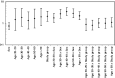
Fig. 1. Odds ratio and 95% confidence intervals (95% CI) for logistic regression with mixed effect (accounting for potential intra-community clustering) of microfilaraemic status on sex, age and survey (study group), estimated on the population aged 15 years and more, never treated with any antifilarial drug, and examined during study A and study B (N=6663). Baselines are categories female sex, 15–19 year age-group, and study A (volume of blood sampling=30 μl). Goodness-of-fit was tested using the Hosmer and Lemeshow test: χ2=4·12, degree of freedom (D.F.)=8, P=0·846.
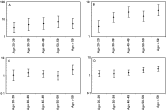
Fig. 2. Odds ratios and 95% confidence intervals (95% CI) for logistic regression of microfilaraemic status on age for (A) males (N=1280) and (C) females (N=1514) examined during study A, and (B) males (1694) and (D) females (2175) examined during study B.
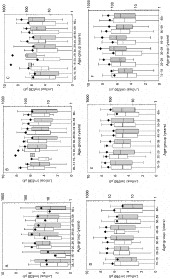
Fig. 3. Distribution pattern with median and quartiles (boxplots) and geometric mean ([lozf ]) of the positive microfilarial counts by age-group and sex (□ females; males), in the communities grouped according to their level of endemicity: (A), (D) endemicity <25%, (B), (E) endemicity 25–35% and (C), (F) endemicity [ges ]35%. (A), (B), (C), and (D), (E), (F) correspond to the communities surveyed as part of study A and study B, respectively.
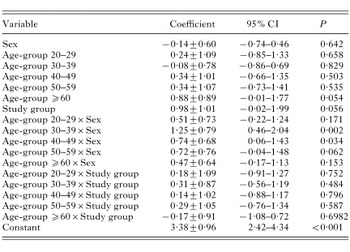
Table 2. Coefficients and significance levels for negative binomial regression with mixed effect (accounting for potential intra-community clustering) of Loa loa microfilarial densities on sex, age and survey, estimated on the population aged 15 years and more, never treated, and examined during study A and study B (N=6663)

Fig. 4. Proportion of patients harbouring mf densities >8000 mf per ml of blood among (A) male and (C) female microfilaraemic individuals examined during study A, and (B) male and (D) female microfilaraemic individuals examined during study B, according to age, sex and endemicity level. Error bars represent 95% confidence intervals calculated using an exact method. Legend for age groups: □ 5–14 years; 15–19 years; 20–29 years; 30–39 years; 40–49 years; 50–59 years; 60 years and over.
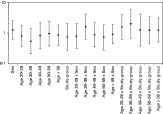
Fig. 5. Odds ratios and 95% confidence intervals (95% CI) for logistic regression with mixed effect (accounting for potential intra-community clustering) of high microfilarial densities (>8000 mf per ml of blood) on sex, age and survey (study group), estimated on the microfilaraemic population aged 15 years and over examined during study A and study B (N=1707). Baseline category are female sex, 15–19 year age-group, and study A (volume of blood sampling=30 μl). Goodness-of-fit was tested using the Hosmer and Lemeshow test: χ2=4·12, degree of freedom (D.F.)=8, P=0·846.
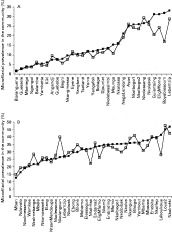
Fig. 6. Crude ([squf ]) and standardized (□) microfilarial prevalence (A) in the 31 communities of the Mbam and Lékié divisions surveyed during study A and (B) in the 36 communities of the Lékié division surveyed during study B.
 You have
Access
- 28
- Cited by