‘Those who left for the front line? Well, there was Haile Gashaw, you know him well. Also, Kassahun Täshomä, from the other side of the hill, and Habtamu’s two sons.’ Alämitu slowly listed the names.Footnote 1 On that day in May 2023, we were alone in her house, and for the first time since my return, she had agreed to talk about one of the war’s most intense periods.
In the autumn of 2021, nine young men from her small hamlet left for war. At that time, troops from Tigray, further north, had invaded the Amhara region, making their way towards the capital, Addis Ababa. Alämitu had heard how their advance left a trail of widespread destruction, and how the federal army was losing ground. At that point, many Amhara farmers abandoned their fields, joined newly formed militias, and took to the front lines. ‘They all left overcome by “ardour” [yägalä sǝmet], when hearing qärärto,’ she continued. ‘They heard the songs from a vehicle’s loudspeaker, and off they went. First three of them, then the next day the others.’ At that time, she insisted, everyone felt the urge to join in, including herself when she heard the qärärto songs while visiting a village a few kilometres away. Even an eighty-year-old man was determined to go and proved hard to hold back.Footnote 2
‘Do you remember the poems from these qärärto?’ I asked. Alämitu hesitated, her gaze sweeping across the mud wall: ‘There were so many poems …’ Still, one stood out: ‘We used to hear it a lot from the phones. How does that poem go again? My mother is ailing, my Ethiopia is ailing, down is her legs her destination; up is her head … something like this.’ Everyone was singing it back then, she said: ‘All the men kept repeating my mother is ailing. And they still sing it today.’ Suddenly, she brightened up: ‘You can hear it, call me on my phone!’ I dialled her number, and we waited for her ring-back tone. Against a backdrop of rifle fire and shouts, a male voice rose:
Oh, path in the mountains, oh you proud one
Proud one, proud one, proud one
(Tell him: ‘Proud one!’)
Oh, my country, my country is ailing
Oh, my goodness, oh temper of a brave, oh hero
Oh, path in the mountains, my country is ailing, oh you proud one
My mother is ailing
Down is her destination and up is her head, oh hero, my goodness
My mum is ailing, my mother Ethiopia is ailing
Oh, my goodness, my goodness, my goodness, my goodness
Up is her head, proud man, her head, her head
To children full of lice she gave birth, who do her no favours
Oh, my goodness, my goodness, my goodness, my goodness, my goodness
(Say: ‘My goodness!’)Footnote 3
Alämitu lives in a rural district within the Amhara region of Ethiopia, along the bend of the Blue Nile, in the former province of Gojjam. Since 2016, the country has been rocked by political crises, the most intense and violent being the conflict between the Tigray People’s Liberation Front (TPLF) and the federal government from 2020 to 2022, in which Amhara regional forces and militias took part. What Alämitu recounted is the story of a pivotal moment in the war. But it is also a story of circulation. At its core is a sung poem, played through modern devices such as vehicle loudspeakers, shared via mobile phones, memorized, recited, and eventually performed again by local singers. That day, as I sat with her, I recognized the song within the first few seconds. For over a year, I had come across it among the many files stored on the memory cards of mobile phones. And for over a year, my interlocutors had been pointing it out as being worthy of attention, as saying something about the experience of both those who went to the front and the many more who stayed behind.
This article explores the connection between musico-poetic circulation and the ways in which conflicts are recounted and collectively given meaning. Drawing on two decades of ethnographic fieldwork in the region, it focuses more specifically on two field trips: one in May 2022, shortly after the end of hostilities; and another in May 2023, at a time of increasing instability.Footnote 4 It highlights the key role mobile phones have come to play in the social life of northern Ethiopia’s highlands over just a few years. In doing so, this article contributes to current debates in anthropology on the ways in which new information and communication technologies affect social relations, open up new communicative spaces, or build on pre-existing modes of exchange (Horst and Miller Reference Horst and Miller2006; Archambault Reference Archambault2017; Vokes Reference Vokes2018; Crowdy and Horst Reference Crowdy and Horst2022). I do not focus here on phones as tools for interpersonal communication, but rather on the possibilities they offer for producing, playing, exchanging and storing audio and video files. For my interlocutors, these are among the phone’s main uses and a major part of its appeal. The files in question are audio or video recordings of sung poetry performances, captured in contexts such as weddings, funerals or military gatherings, sometimes hundreds of kilometres away. While some undergo visual or sound editing, their production and circulation – mainly via Bluetooth and SD cards – remain largely independent of the new music industry.Footnote 5 What is setting these files in motion? And why do they feature so prominently in stories of war? These are the questions I seek to answer.
By revisiting the concept of ‘mediatized orality’ (Zumthor Reference Zumthor2008), I analyse the relationships formed with and around these files: the circumstances of their production and reception, the conversations and reminiscing that accompany them, and their echoes in new voices. We will see that the poems captured and ‘entextualized’ (Barber Reference Barber2007) in these files circulate along trajectories that extend in two directions: spatially, connecting local affairs to national issues; and temporally, bridging past and present. These poetic trajectories, I argue, have a long history that predates the arrival of new technologies, as evidenced in the Ethiopian historiographical tradition of the royal chronicles. They constitute a distinctive ‘regime of circulation’ (Cody Reference Cody2009), now amplified by technological mediation.
I want to make clear that this article does not offer an analysis of the political roots of the conflict, nor of the responsibilities for the war crimes committed in its course. My aim is both narrower and broader. Narrower, because its focus is limited to the situated point of view of inhabitants of a valley as they construct meaning for the troubled times they are living through. Broader, because by showing how the many voices of ‘collective remembering’ (Wertsch Reference Wertsch, Boyer and Wertsch2009) are woven into poetic circulation, it sheds light on a long-rooted practice of representing conflict, and, ultimately, of fashioning the past. In contemporary rural Ethiopia, what people do with phones, and with the files they carry, draws on this practice. It also transforms it, opening up ways of representing and appropriating pressing issues surrounding ethnicity, nation and history.
Echoes from the front line
In October 2021, a young man named Kassa sent me a five-minute video via the messaging application WhatsApp. Originally from the same hamlet as Alämitu, Kassa now resided in a large roadside village and had seized the opportunity of a visit to the regional capital, Bahir Dar, to connect to the internet. The message accompanying the video was brief: ‘a funeral at our village’. The scene captured in the video was striking (as can be seen via the link in the footnote), unlike anything I had witnessed during previous visits to the region.Footnote 6
In an open area, a crowd gathers around a dozen men who take turns singing or declaiming loudly while at least as many relatives of the deceased bounce or stride around. Shots ring out from various directions, some dangerously close to the crowd, leading organizers to frequently caution: ‘Not this way, there are people!’ The video is captured from the front rows, among a group of squatting men, many of whom are armed with Kalashnikovs. Enthusiastic exclamations (‘It was said!’) periodically rise from this group. Amid the confusion and gunfire, warlike phrases and evocations of the dead come to the fore:
To enemies he never gives respite (It was said!)
The one ahead of all others (It was said!)
There, in his place of hiding (It was said!)
A tree grows lush where he spent the day (It was said!)
…
The likes of Getie, let us mention them (It was said!)
The likes of Shäñä, let us mention them (It was said!)
So that, as days go by, we do not forget them (It was said!)Footnote 7
That year I could not travel to the area. In November 2020, war erupted between the government, led by Prime Minister Abiy Ahmed since 2018, and the Tigray People’s Liberation Front (TPLF), which for twenty-seven years had controlled the Ethiopian state through its ruling party, the Ethiopian People’s Revolutionary Democratic Front (EPRDF). Although the conflict primarily unfolded in Tigray, it also drew in special forces from the Amhara regional state and Amhara militia known as fanno. These forces played a key role in forcefully annexing disputed territories between the two regions, notably Wälqayt along the Sudanese border (Labzaé Reference Labzaé2023), highlighting a rise of Amhara ethnonationalism marked by contradictions. Historically associated with the ancient kingdom and its rulers, the term ‘Amhara’ was not originally an ethnonym (Pausewang Reference Pausewang2005). However, the culture of the court and the Amharic language were central to the expanding state in the nineteenth and twentieth centuries, prompting subjugated groups to define themselves in contrast to them. In 1995, a federal system based on ethnic lines was established, which the inhabitants of the Amhara region came to view as unfavourable, marginalizing them and tolerating increasing violence against them. Starting in 2015, Amhara nationalism began growing in urban centres, described by observers as a ‘reverse discourse’ (Tazebew Reference Tazebew2021) or ‘counter-narrative’ (Yetena Reference Yetena2022) put forth by the heirs of an empire as they came to terms with being one ethnic group among many. But how could farmers, whose identities are tied to the old provinces and smaller ‘countries’ within them, embrace the broader, more abstract, appellation of ‘Amhara’?
As long as the war remained localized in Tigray, Gojjam farmers were minimally involved. However, in August 2021, the TPLF breached a ceasefire and launched a full-scale offensive, extending towards the east into Afar and to the south into Amhara. For months, their troops seemed to be advancing inexorably. Shortly after Kassa shared his video with me, Prime Minister Abiy Ahmed announced a general mobilization, but news of losses had already spurred massive participation in the region. Many men enlisted in district-organized militias or joined the fanno. Fighting never reached Kassa’s village, but everything in the video pointed to war. Had the deceased died in battle? By the time I posed this question, Kassa had gone offline.
I had to wait until my return in May 2022 to hear the answer: this was the funeral of an old man, and it had nothing to do with the war. At the time, Kassa and I were at the home of one of his cousins, who was hosting a small gathering. My friend asked me to play the file, and a small crowd quickly formed. Some who had attended the funeral pointed out where they had been standing – thankfully not in the centre, the most dangerous spot. Silence fell over the room, punctuated by murmurs and the sounds of lips being pursed. Halfway through the video came distinctly the name of a man killed twenty years earlier in a notorious family feud, this locality’s most infamous affair. One of the guests abruptly stepped away: ‘That’s enough, turn it off!’ The mood became heavy as everyone sat back down and I was left with lingering questions. Why were these poems echoing the war? And why the mentions of those deceased?
A few minutes later, a crackling sound came from the phone of another one of our companions: ‘My country is ailing …’ On the screen a highly compressed music video showed a man singing in a mountain landscape, rifle on his shoulder, surrounded by soldiers. His name, Tämächä Nǝgus, appeared in a corner. ‘When people heard this qärärto, they were so surprised, they kept saying “Oh my goodness!”,’ Kassa said, mimicking listeners grasping their cheeks. ‘So many people left [for the front] after that,’ he continued. ‘I was visiting a friend in prison when I saw it on television, and I too wanted to leave.’ This was my first encounter with the file.
Old genres and a new object
A scene such as this one would have been unimaginable just a few years earlier. In his book Under Construction, Daniel Mains (Reference Mains2019) explored how major development projects in Ethiopia, like road construction, are experienced by the population. Very little, however, has been said of the upheavals caused by the spread of mobile communication infrastructure and technologies.Footnote 8 Until 2018 or 2019, it was impossible to reach Alämitu or her neighbours by phone. Their hamlet, like many others, is connected to neither a road nor the electricity grid. In that respect, rural inhabitants live in a daily world very distinct from that of both towns and large roadside villages, even though they are familiar with them: they attend markets there, take their grain to the mill, and sometimes catch rumours of national matters. With the expansion of mobile coverage, small stores selling and repairing mobile phones at a low cost have become additional stops. Young men were the first to own phones, followed by well-to-do farmers; now most families have one.Footnote 9 These are rarely smartphones but rather inexpensive feature models. They offer the advantage of relatively long battery life and can store large numbers of MP3 or MP4 files, most of them featuring qärärto and fukära.
Before mobile phones became widespread, hearing recorded music in rural areas was a rare occurrence. This stood in sharp contrast to urban settings, where music plays continuously from loudspeakers. While towns embraced throughout the twentieth century various genres of popular music, rural regions maintained a strong preference for the performance of sung poetry. In Gojjam, qärärto and fukära are held in the highest regard. For at least two centuries these genres have been documented in the writings of travellers and researchers under the label of ‘war songs’ or ‘soldiers’ songs’ (Berhane-Selassie Reference Berhane-Selassie2018). This label is misleading since qärärto is performed by most men, and sometimes women, in various social circumstances: weddings, funerals, work parties, and even in solitude. But the genre does have a connection with conflict. Qärärto is about voicing one’s perspective on specific issues, such as personal disputes and well-known local affairs. These affairs include conflicts over land and cattle, often involve homicides and revenge, and require the taking of sides. Valued for the expertise it demands in composing rhymed distiches (two-line poems, called gǝṭǝm) and mastering the intricate, highly ornamented melodic contour (zema), qärärto also requires some ability for the listeners to fully grasp during performance: distiches are obscured by repetitions, added words and nominative calls to the audience.Footnote 10 Cryptic imagery, requiring a fine-grained understanding of the context, adds another layer of complexity (Morand Reference Morand2017).
Often following qärärto in performance, fukära is declaimed at a rapid rate in a long series of distiches. Fewer people master its distinctive virtuosity. In both genres, the heroic ethos, the competition between the performers taking turns, the intimidating gestures (tense bodies, shouts, rifles raised or drawn), and the loud reactions of the audience all contribute to stirring up the atmosphere, fostering a sense of ‘ardour’ (Morand Reference Morand2017). In a context where everyone is armed, the sensitive nature of the poems and the risk of performances escalating out of control can make recording undesirable. Thus, at a wedding in May 2023, a man warned me not to record when he later took his turn at qärärto, as he had ‘something to say’.
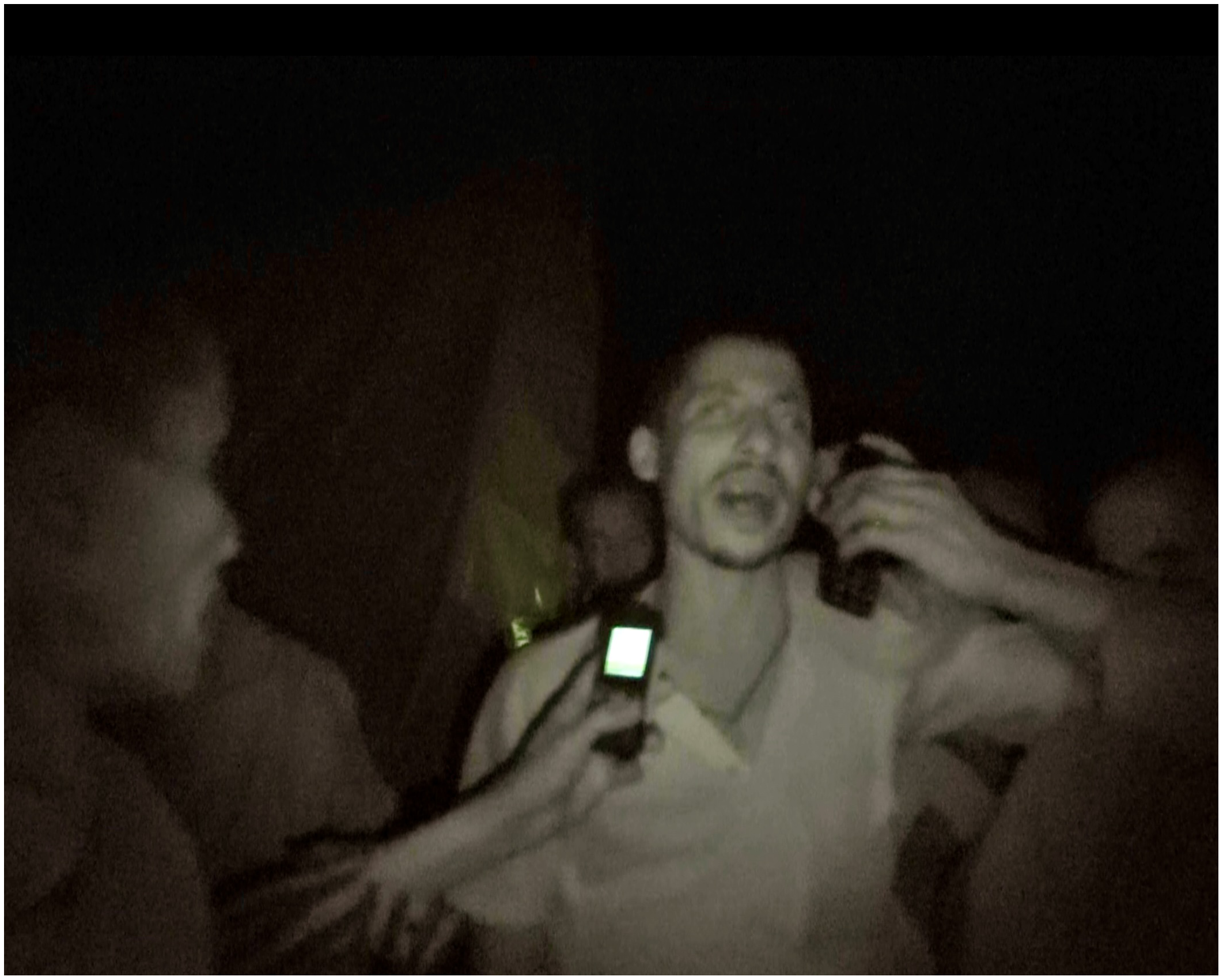
However, as Kassa pointed out, ‘People nowadays record whenever they hear something that pleases them.’ By ‘people’, he means younger men in their twenties. I have yet to witness a middle-aged man or a woman pulling out their phone during a wedding or funeral, although they do have an interest in later listening. The rare video recordings focus on dramatic moments, like gunfire, and are taken from a distance. Audio recordings, however, are all about capturing the poems, ideally from close range and surrounded by the audience’s reactions, which tend to offer a masculine perspective of the event.Footnote 11 During nighttime performances, the person recording might lean close to the singer, holding the phone just a few centimetres from their face (Figure 1).
A man singing qärärto is recorded by two others during festivities.

Popular recordings circulate within close circles of friends and kin, passing from one phone to another. In the process, they join other files of non-local origin – snippets from distant places, music videos, montages. This signals another shift: a renewed urban appreciation for two genres recently seen as things ‘of the past’.Footnote 12 The lines between urban and rural, recorded music and local performances, have become increasingly blurred; and as files circulate, concern for faraway places comes to the fore.
Files in circulation: the ‘time of qärärto’
In 2022 and 2023, examining the contents of memory cards felt like exploring the sediments of the political upheavals that have rocked the region. The earliest files date back to the summer of 2016, during the violent suppression of demonstrations by the EPRDF government and the ensuing riots. Brief excerpts of victims’ funerals, highly compressed and barely audible, began circulating within Amhara activist circles. Over the following two years, several neo-traditional singers (referred to locally as ‘artists’, an English loanword), previously unfamiliar with qärärto and fukära, started incorporating elements of these genres into their music videos. This meant imitating the melodic contours, as well as adopting the poetic style characterized by proverbial phrases, hyperbolic tone and clever wordplay. In addition to these rare music videos, one began to see a proliferation of amateur montages created by activists in cities such as Bahir Dar and Gondar (Morand Reference Morand2020). These montages typically feature recordings of anonymous rural singers and incorporate visuals showcasing symbols of the ‘Amhara struggle’, such as the flag, historical figures, or photographs of deceased militants.Footnote 13 They often include the addition of masinqo, the bowed lute played by azmari, hereditary musicians highly favoured in towns. Exclamations, shouts and simulated gunfire further contribute to the impression of a heated performance.
During these tense pre-war years, the dynamics of file circulation were also established. For instance, the journey of a music video typically begins with its upload to various YouTube channels and Facebook pages. However, since internet access remains costly, even for urban residents, the easiest way to access these videos is by visiting stores where downloaded videos are sold either in bulk or individually. Mobile stores in rural marketplaces acquire the files on flashcards and then sell them in highly compressed versions tailored to their customers’ phones. Yet, sales are not the primary method of distribution. Circulation mainly occurs through direct sharing via Bluetooth or memory card. Files pass from hand to hand within networks of acquaintances, particularly among kin, as people move around, travel to the market and visit each other, gradually reaching even remote corners. Raw excerpts of performances follow a similar circulation pattern but without involving stores, as these are never sold. Some of them, moving beyond their locality of origin, make their way to towns, where they may become the basis for new montages that, in turn, join the broader movement. Thus, this circulation is both multidirectional and decentralized. While the raw material primarily originates from rural areas, the journey of the files passes through two pivotal points: the cities, where editing, uploading and downloading occur, and the rural marketplaces, where diffusion is amplified. In the year leading up to the war, files, rumours of Wälqayt and talk of wrongs suffered by Amhara were thus making their way together through small marketplaces and beyond (Morand Reference Morand2020).
When war began, a new actor entered the scene: regional state television. As the mobilization against the ‘junta’ (as Abiy popularly termed it) gained momentum, television broadcasts included events supporting military operations, often featuring performances of qärärto. Reports from the front showed morale-boosting concerts and glimpses of fighters marching to battle. These broadcasts were uploaded to the channel’s Facebook page, and from there made their way into general circulation. Television also aired a few music videos. Young men in a rural marketplace recounted one that had left a lasting impression on them. ‘That azmari woman, oh, her! So many people went to war after hearing her,’ one exclaimed. An audio version found on a phone played poems that were all threats to the TPLF:
Ah, tell him
Evaluate where the limit of patience lies
Having come close to the eye, now it’s touching the nose
Ah, tell him
For sure a Habesha won’t sleep in front of the enemy
Indeed, he will respond by cutting off necks
Ah nature, ah man from Menz, ah killer, come, come.Footnote 14
In the spring of 2022, returning fighters brought new files to their villages, initiating a new wave of dissemination. As tensions between the fanno militias and the government escalated over demands to surrender weapons, qärärto performances began targeting Abiy Ahmed instead of the TPLF. Regional television stopped broadcasting videos, and, starting in April 2023, a mobile internet blackout also removed this nodal point from the circulation network. Stored on SD cards, files continued to be added, deleted and sometimes reinserted into what appeared as a transient archive. Reflecting with me on the events of the past few years, an older farmer depicted the autumn of 2021, when people departed to fight in distant zones, as ‘the time of qärärto’.
From stories of war to the ‘truth’ of a music video
Let us pause to consider the issues raised so far. The circulation of these files seems to be forging unprecedented connections between geographically distant areas – such as the small ‘countries’ of Gojjam and the disputed territories. Yet, an enigma persists: qärärto and fukära performances are deeply participatory, grounded in interpersonal dynamics. So, how are these voices from afar listened to and what meaning do they convey beyond their original context? So far, we have encountered stories of decisive listening, particularly during the weeks of mobilization. What is remarkable about these stories is how they mark a turning point: upon hearing a recording of qärärto, men enlisted, stirred by emotion. These stories ignore individual motivations and construct an image of collective impulse, one in which even those who stayed behind participated: they would have joined too, if not for having young children to support or being too old.Footnote 15 What can we make of such retrospective accounts? Why do specific voices stand out, and what of their traces are still lingering on phones?
In a posthumous essay published in 2008, the theorist of oral poetry Paul Zumthor explored the concept of ‘mediatized orality’, a term he had briefly introduced in 1983. His aim was to examine the implications of sound and image reproduction technologies on oral genres: what happens to performance when co-presence is absent? When performers and listeners do not share the same physical space, direct personal communication cannot develop. According to Zumthor, this absence is partially compensated for by the imagination. He argued that this mental reconstruction, being fundamentally individual, results in a weaker, more internalized form of participation. Although Zumthor acknowledged the existence of what he termed ‘emotional conjunctures’ – exceptional instances of large-scale collective expression – he did not elaborate on the processes that might lead to them.
In our case, two avenues are worth exploring. The first has to do with the inherently communal nature of listening. Unlike the ‘privatized’ form of mobile listening often described (Bull Reference Bull2015), listening in the Ethiopian highlands is always a group activity – so much so that most people do not own earphones. The second relates to something Zumthor rightly emphasized: recordings play with our perception of time. When available at will on a mobile phone, a file replicates the timing of a performance while allowing its manipulation – by pausing, rewinding, restarting, and so on. To better understand the dynamics at play, let me delve into a particularly memorable episode from my fieldwork, a moment involving a former fighter, his wife, and a few qärärto files.
It was May 2023, and I was sitting with Getanäw in his house, in a small market town. I had met him a few days earlier at a festive gathering, where his qärärto skills had made a strong impression on me. When I learned that he had volunteered in a district militia from September 2021 to January 2022, I asked him if he would discuss his experiences with me. His wife sat next to us, preparing coffee while actively participating in the conversation. I started recording.
Getanäw spoke slowly, choosing his words with care. He had gone to war because the Tigrayan troops were advancing, and the country needed defending. Being in his forties and having young children had been no deterrent. Everything had happened quickly, starting with a visit from district officials organizing the militia. Once he and his friends decided to join, they climbed into a truck, travelled to the regional capital, and from there, in a convoy of ninety trucks (his wife insisted on the number), they found themselves on the front lines at Gashäna, in North Wällo. At this point, his story began to lose momentum. In a few sparse words, he recalled scenes of utter devastation: buildings destroyed, fields ravaged, and not a single eucalyptus tree left standing. They faced fatigue and hunger, enduring whole days without a meal. And, of course, there was the fighting. He stayed there for six months and returned with a Kalashnikov seized from the ‘junta’.
I steered the conversation back to that first day – the day of departure. How had it gone? Getanäw brightened, recounting how he had sung qärärto while firing his rifle:
The ones not meant to die will not die, the ones not meant to heal will not heal
Why, like the male donkey, balance from one side to the other?Footnote 16
‘This is what I said!’ he exclaimed, with a small laugh.
Qärärto was one of the reasons he left. He believed that when fear gripped the militia, he would know how to ignite their spirits. Indeed, he had sung extensively during the war, he explained, and he recited some of the poems for me. When I asked about performances on the front lines, he pointed out that no one sang in the trenches, especially not at night, as the enemy was right across from them. But when the time came to enter battle, qärärto was needed for courage, and several singers took turns.Footnote 17
‘Are there any recordings of these moments?’ I asked.
‘None!’ Getanäw was adamant: there had been no electricity there, and no phones.
At this point, his wife jumped in. ‘Yes, there is one! You have it on your phone!’ After a brief hesitation, Getanäw reached for an old phone and searched with difficulty. ‘Wait, I’ll play it for you.’ He tapped on a file, let it play for a few seconds, then tried another. Eventually, he found it and we listened, his wife nodding in satisfaction, as I recognized a now familiar voice:
Oh … my country is ailing, my mother is ailing …
I was taken aback: ‘Is this not the work of an artist?’
‘No!’ they both exclaimed. Getanäw continued: ‘He’s a soldier! He was with us in Gashäna. A man from Gojjam, a farmer like us.’ From the phone, the song unfolded:
Down is her destination and up is her head …
To children full of lice she gave birth, who do her no favours
Getanäw smacked his lips slightly, then declared loudly: ‘This is the truth!’ (awnät). He added after a pause: ‘This is it, the exact [tǝkǝkkǝl] qärärto of the front.’
How should we interpret this statement? The issue is not whether the recording authentically comes from the front line. Both Getanäw and his wife knew that no such documentary recordings circulate and that this one, like others, had been captured far behind the lines, and then edited as a music video. Yet, something compelled them to share it with me: the belief that it holds a value of ‘truth’ about the fighter’s experiences. In this sense, their reaction mirrors that of audience members during a live performance, where exclamations such as ‘This is the truth!’ or ‘This is exact!’ are common and expected: they serve as markers of approval for the point of view expressed.
Here, the poem does not recount any specific event or military action; instead, it outlines circumstances. A country, classically likened to a mother, is portrayed through a memorable image as torn apart and suffering.Footnote 18 The insult to the TPLF that concludes the poem encapsulates the idea of endured injustice and a morally justified call to action. The identity of the singer is also key: word of mouth identifies him as a man from rural Gojjam. Others suggest he was an auto-rickshaw driver in the town of Adet, also in Gojjam. In either case, he is said to have abandoned everything to journey to the war’s most intense battlefronts, armed only with his old rifle. Several people told me that journalists heard him there, later recorded him, and then edited the video. Getanäw lends credence to these reported stories through his own accounts of the war – accounts echoed by his wife – and ultimately through his endorsement. As we will now see, this approval is a crucial step in poetic trajectories.
Poetic trajectories: the making of a collective voice
Getanäw continued searching through his phone. The file he now played was a performance recently recorded in his own village and featured an azmari. As his wife explained the story evoked by the first poem – a young man ‘from the country’ shot in the back during the 2016 protests – Getanäw followed the song with concentration. As it ended, he repeated the final line aloud:
It is for the sake of the country that the brave one was sacrificed.Footnote 19
His wife promptly repeated it, stressing each word. As a new poem followed, Getanäw recited each line as it emerged:
Oromo and Amhara, Tigray and Amhara
Were once united, living together
Doctor Abiy came and started a quarrel between themFootnote 20
Getanäw repeated the last line once more and remarked: ‘He insulted Abiy.’
‘This is the truth!’ exclaimed his wife.
Getanäw turned to me: ‘This is the truth, isn’t it?’
As we see, mediated listening involves reconstructing a context: who is singing and what is the situation. Sharing might imply clarifying its origin, as a friend of Kassa’s did when he showed us a file and explained it came from Wälqayt and had been given to him by a fighter returning from that area. In the case of video files, people, places and gestures are scrutinized for clues. Poems, however, always receive the most attention. As they unfold line by line, they prompt exclamations, small lip sounds, and sometimes soft murmurs. But there is more: during playback, a member of the group might repeat one or more poems. This re-vocalization reveals the structure of the distich and clarifies its meaning, which is then collectively interpreted within the reconstructed context. Besides aiding interpretation, reciting the poem in one’s own voice also signifies endorsement. By appropriating the words, the speaker presents the perspective as their own to those present, who in turn react with affirmations such as ‘This is the truth’. Thus, gathered around a phone, the small group recreates, in a subdued manner, active participation in a performance.Footnote 21
For the few urban residents who have access to them, sharing files on social networks follows this pattern. In 2022, a resident of Bahir Dar showed me a Facebook post she had liked: a video accompanied by a brief written commentary featuring a distich and a closing statement – ‘Indeed, this is the truth.’ Social networks, however, are not the only places where written poems circulate. With the expansion of schooling, the practice of writing them as distiches (stripped of added words and calls) has become quite common in towns. Letters announcing memorials (täzkar), for instance, sometimes include poems previously sung at the deceased’s funeral and always invite re-vocalization.Footnote 22 Recipients read them aloud, passing the paper around with sighs and murmurs, as the memory of the burial briefly traverses the room.
Re-vocalization is thus rooted in older forms of poetic fixation and always serves, in some sense, as a device for reminiscing. Chief among these is memorization: the ability to ‘catch’ (mäyaz) a distich on the fly during performance and later quote, recite or sing it in solitude is highly valued (Morand Reference Morand2015). This process of rendering a stretch of discourse salient and detachable from its original context – what Barber (Reference Barber2007), following others, calls ‘entextualization’ – creates a series of echoes between original performances and subsequent utterances. In other words, it produces effects similar to those of quotation (see also Finnegan Reference Finnegan2011). It carries, sometimes for years to come, a vivid sense of what has been.
As our conversation neared its end, Getanäw played another file, this one featuring himself. That day, back in his village after the ceasefire, he had sung the qärärto ‘exactly like at war’. As we listened to the file, he repeated his poem line by line before concluding proudly: ‘So I said! While firing!’
If he is obstinate, the soldier of the junta
Cut him and pile him like harvested wheatFootnote 23
First sung during the war and then again at home, captured in a file and kept on his phone, and finally recited during playback, this poem bears testimonial value: an account of what Getanäw ‘said’ at the front and how he said it. Weaving poems, either one’s own or someone else’s, into storytelling – as Getanäw did throughout our conversation – is very common. In the spring of 2022, regional television aired short programmes titled ‘Acts of Violent Wrongdoing’ (Yäbädäl gǝf), featuring testimonies of the TPLF’s invasion. During one broadcast I watched with friends, a former fighter appeared on screen and was recognized by one of them as a distant relative, drawing everyone’s attention. While recounting a battle, the fighter recited a poem he remembered hearing on the battlefield, prompting an outpouring of exclamations and murmurs. Perhaps one of my friends, upon hearing it, ‘caught’ the poem, planning to later perform it or dictate it to another singer, whose voice would become yet another vehicle.
Poems thus embark on trajectories that extend beyond the individual voice that first uttered them. Through series of fixation and re-vocalization they acquire a distinct density, one of accumulated voices, each appropriating the poem’s meaning as their own. Closely intertwined with accounts of events and endorsed for their ‘truth’ at each step, poems become integral to ‘collective remembering’ – to borrow a concept from Wertsch (Reference Wertsch, Boyer and Wertsch2009), which emphasizes the distributed nature of collective memory.
Interestingly, descriptions of such trajectories can be found in Ethiopian historiographical documents. Ethiopia’s culture of writing, backed by political and religious authorities, has a long history (Barnes and Carmichael Reference Barnes and Carmichael2006). One of its prominent genres is the chronicle, known as tarik (‘history’). From the fourteenth or fifteenth century up until the early twentieth century, chronicles detailed the exploits of kings and princes. Despite being primary sources for Ethiopian history, they have received limited attention for their literary qualities and their relationship with oral genres (Wion Reference Wion2012; De Lorenzi Reference De Lorenzi2015).Footnote 24 Richard Reid (Reference Reid2006) has suggested the existence of continuities between their narratives of warfare and the rhetoric of remembrance adopted by the Eritrean Popular Liberation Front. What he overlooked, however, is the transition in the nineteenth century from Geez (the liturgical language) to Amharic. Amharic chronicles are remarkable, as Didier Morin (Reference Morin, Ege, Aspen, Teferra and Bekele2009) pointed out, for their use of oral registers, with their pages peppered with distiches attributed to nobles, soldiers or anonymous individuals.
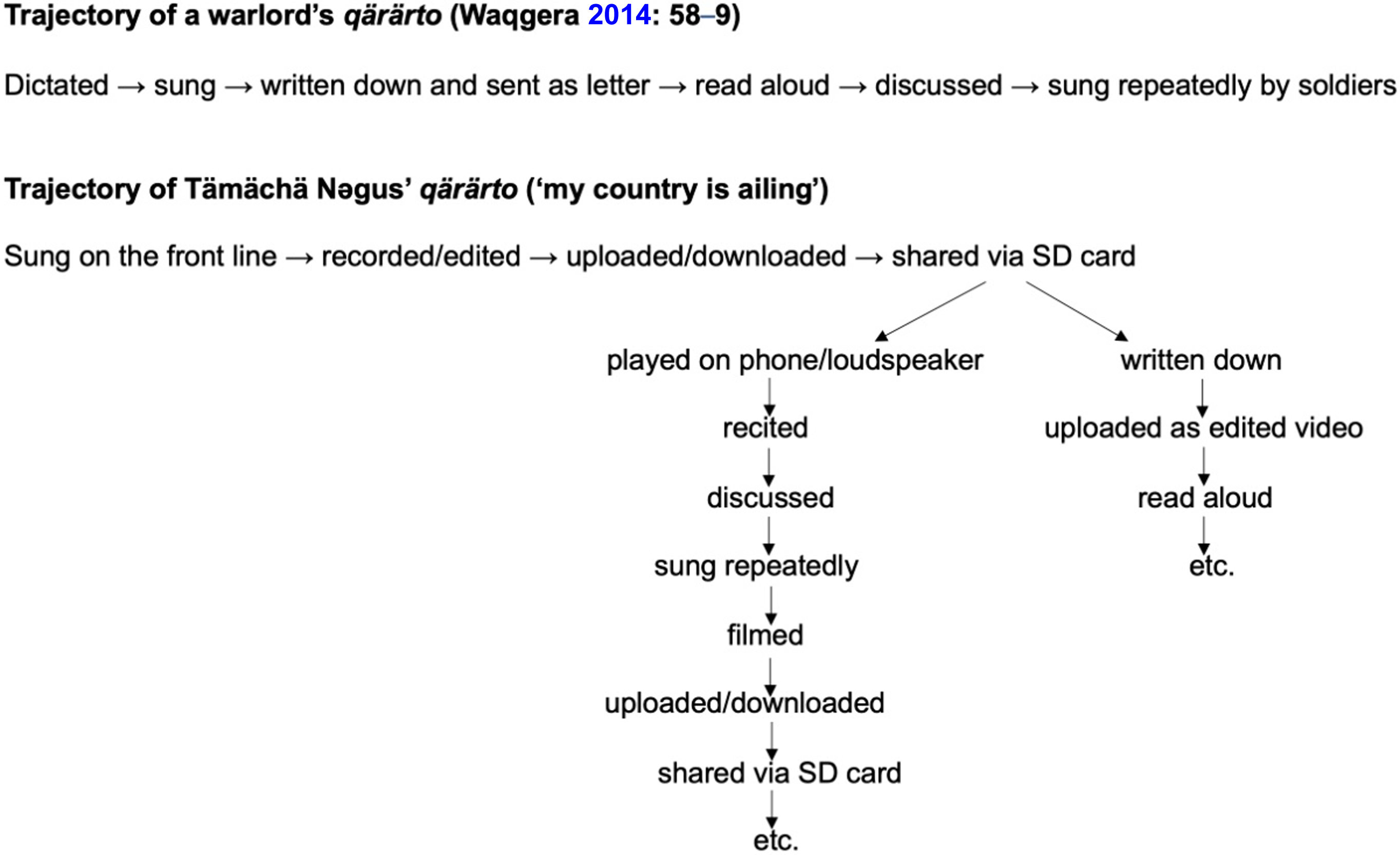
This is the case with the Goğğam Chronicle (Waqgera Reference Waqgera2014), one of the last of the genre. Written by a local intellectual between 1901 and 1925, it recounts the history of the nineteenth century through the lens of power struggles in Gojjam. Presenting himself as a serious writer of history, the author notes in his preface that he collected his material from various elders (ibid.: 29). This primary material consists in large part of poems and the stories that accompany them. Let me take one example. In Chapter XXII (ibid.: 58–9), a warlord sends a message to his enemy: he dictates an incomplete qärärto distich to an azmari, who sings it, and then has it written down on paper. The message reads: ‘He who looks like a king/One who puts on a crown, has come.’ This letter is sent without any additional comments to his rival, who asks his entourage to read it aloud and help him decipher the meaning. The answer is clear: ‘We must take up arms,’ he is told. Chaos ensues, with anxious soldiers repeating the fragment in turn. This example illustrates how multiple voices become the medium for a message that circulates from one group to another. Composed by the warlord, the fragment is first dictated, then sung. Fixed in writing, it travels to his rival, where it is re-vocalized and discussed. Finally, it continues its journey sung by soldiers. Under the chronicler’s pen, this trajectory tells of the forces at play as well as the atmosphere on the eve of battle.
Files follow similar trajectories. Consider the example of ‘My country is ailing’, which Figure 2 compares to the fragment in the Goğğam Chronicle.
Two trajectories of fixation and re-vocalization.

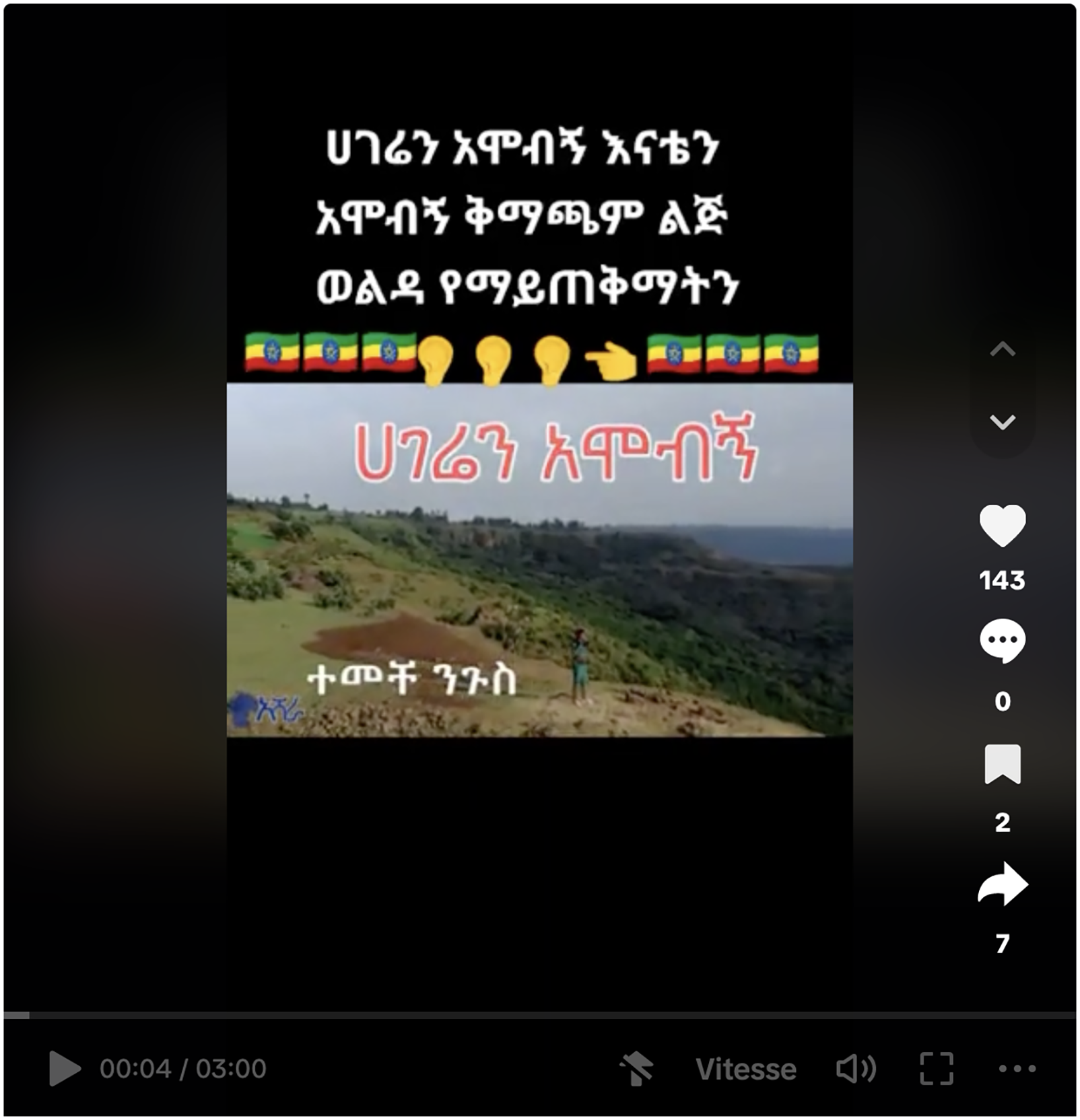
‘My country is ailing’ was originally performed by a fighter named Tämächä Nǝgus. A recorded version was edited into video format and uploaded to the internet. Once downloaded, its trajectory branched out: audio and video versions aired on public transport, in stores and on television. Compressed formats circulated via mobile phones, ensuring rapid and extensive dissemination. Repeated listening in small groups, reinforced by personal accounts, prompted reactions, memorizations and new performances, making this poem arguably the most re-vocalized of the mobilization period. Some of these performances were caught on camera. For example, a young woman, rifle slung over her shoulder, performed the poem for an audience of soldiers. A video of her performance started circulating on phones and on YouTube.Footnote 25 Finally, a few montages appeared, featuring the poem in written form, further inviting re-vocalization (Figure 3).
Screenshot of a TikTok video.

As these trajectories unfold, a form of depersonalization occurs. In this respect, the process differs markedly from the ‘culture of circulation’ observed by Flagg Miller (Reference Miller2005) in South Yemen, where poets, confronted with the wide distribution of their work through writing and recordings, and with the repetition of their poems by new singers, mark their authorial voice in their compositions. Our case more closely resembles that of Somali love songs, which become ‘animated with an increasing number of voices’ (Woolner Reference Woolner2023: 4) as they move through time and space. The initial fanno singer, while not erased (as the recording preserves an audible trace of him), becomes part of a collective voice, one composed of all those who have subsequently re-vocalized the poem. This is how a shift occurs from a clear ‘he says/said’ to something more like ‘it is/was said’.Footnote 26 Several months after the fighting ended, the poem had attained the status of a truth that transcended individual experiences, encapsulating a shared condition at a precise moment: the cry of a suffering Ethiopia, the imperative to respond, and the ‘ardour’ felt by all. A narrative for a pivotal moment of the war had stabilized.
Of faraway places and times past
One might think that poetic trajectories end once they reach this collective dimension, but this is far from the case: poems continue their journeys, transformed and often reinvested in new contexts. Take the video of the young female singer with the rifle mentioned earlier. Immediately after ‘My country is ailing’, she begins a second poem, developing the image of the suffering mother and concluding with a new accusation:
There is no doctor to be found, for my mum my country
Her ailment they made worse, spreading untrue rumoursFootnote 27
We find a similar development in a poem Getanäw recounted singing on the front lines. Here, the country is referred to with a masculine pronoun and a collective possessive. While no longer depicted as a mother, the country remains in a sorrowful condition:
Our country is ailing, he travels on a stretcher
We will not leave until we see the end of this matterFootnote 28
These transformations result from the way in which poems are composed. Amharic poems strike a delicate balance between known formulas and creativity: shifts and surprises enhance poetic appreciation, especially when the new poem offers an original perspective. Starting with a familiar poetic formula (hemistich or full line), the performer creates a new poem with a unique ending, slightly altering its direction. In these cases, an explicit connection is forged between the original poem and its transformed version. Our two variations here, sung in the context of the front, could be seen as extensions of the trajectory of ‘My country is ailing’.
Sometimes, more complex scenarios develop where poems clearly diverge from a trajectory. Consider the video of the funeral sent by Kassa, with its surprising warlike tone for a man who died of old age. Here, poetic formulas originating from the war are repurposed to address matters of concern at a local level (the ‘country’ in its narrowest sense), shedding light on current or longstanding issues, such as the wound of a decades-old murder. This repurposing and mixing creates interpretive links between the national and local contexts, bridging geographical distances and distinct times. A video from the funeral of a prominent figure (let’s call him Tesfaye), given to me by his family, offers a striking example. This man, who died at the age of over eighty years, was a member of a prestigious descent group and renowned as a ‘patriot’.Footnote 29 His large funeral in 2022 gathered hundreds of attendees. Former fanno fighters, who came for the occasion, recited fukära such as this one:
Ah, Tesfaye, ah the father of Gizew
In the time of the junta, he died for the cause (This is the truth!)
In that country, Shashämäne
Cruel barbarians massacred the population
Onäg Shäne cruel Wäyane
Let me see the trenches being destroyed (Joy!)Footnote 30
In this tribute to the deceased, the performer spans three timeframes, and as many locations. Lines three to five explicitly reference the massacre of at least a hundred individuals identified as Amhara in 2020 in the town of Shashämäne, in Oromia,Footnote 31 and associate the Oromo Liberation Army (referred to as Onäg in the Oromo language and labelled as Shäne by Abiy Ahmed) with the TPLF (commonly known as Wäyane before 2020), linking them as allies against the Amhara. However, lines two (‘In the time of the junta, he died for the cause’) and six (‘Let me see the trenches being destroyed’) refer to the recent war: the fukära performer, who had just returned from the front lines, speaks of them in the present tense as an eyewitness. It is highly likely that these lines were composed by amalgamating elements from separate poems. Tesfaye, who lived his entire life in his valley of origin, emerges not only as a witness to the struggle but also as a militant whose death resonates with the sacrifices of all fighters.
In some scenarios, echoes between spaces and times are accentuated even further, engaging what Turino (Reference Turino1999) would call ‘semantic snowballing’. In May 2023, I came across an audio file on a phone. I was told that this was a recording dating back to the Ethiopian–Eritrean war (1998–2000), and that it originally aired on the radio during that period. Radio played a significant role during the war; in the 2000s, I heard veterans share listening stories that closely resembled those we have discussed.Footnote 32 In this recording, an azmari woman sings qärärto poems, including the following:
On the other side [of the river] a bad man is calling out
On this side [of the river] a bad man is calling out
Hero, won’t you come? This problem is oursFootnote 33
I was immensely surprised. I had heard this poem (with a few variations) many times in the 2000s, but not in association with war; its performances were all tied to village conflicts. The origins of the poem were no longer explicit, and whenever I asked about its meaning, war was never mentioned. This poem, born during an earlier conflict and once broadcast on the radio, had been integrated into the local repertoire. Now, it had been digitized and its circulation revived during a new war. As it gained a new layer of meaning, the original voice re-emerged from anonymity: her name was Asräs, I was told, the woman who so remarkably stirred people to take up arms.
Conclusion: files, poetic trajectories, and the fashioning of the past
Let us revisit our initial questions. What did the introduction of mobile phones bring about in Ethiopia’s Northern Highlands? What is setting files in motion? And why do they play such a prominent role in stories of war?
Re-vocalization in small group conversations, memorization and inclusion in storytelling all reveal a relationship with files modelled on the participatory nature of live performances. At the same time, digital fixation is integrated into longstanding practices of circulating poems, which themselves involve fixing (notably by writing) and re-vocalizing. In that sense, patterns of circulation have long had a history of ‘mediatized orality’. However, digital files offer a novel capability: even when they depend largely on the physical movements of individuals (as is the case here), they endow trajectories of circulation with unprecedented reach and speed, including in remote areas. Along their path, files connect distant geographical regions, bringing their names and issues into everyday conversations. This circulation has undoubtedly contributed since 2016 to the ongoing shaping of the Amhara region as a unified entity, and it paved the way for the remarkable ‘emotional conjuncture’ that retrospectively defined autumn 2021.
In examining these trajectories, I have shifted away from viewing them through the lens of ideological propaganda. Not that propaganda is absent from the current political climate – quite the contrary. However, the decentralized circulation of poems is better understood as a collective endeavour – that of the building of voice, rather than the dissemination of ideology from a group of militants. In this discussion, I have focused on the trajectory of one poem due to its prominence in conversations during my stays. Yet, many others circulate, affirming the ‘truths’ of events, echoing one another, sometimes fading away to re-emerge later. Here, phones bring a new feature into everyday life: a personal archive, albeit a fleeting one, since SD cards have limited storage, and phones are often lost. Through their preservation of voices that once stood out, the files stored on them offer traces of past listening – layers of time retrievable at the touch of a finger, potentially recontextualized with renewed strength and meaning.
The concern for the past is central here. The genres of qärärto and fukära, long linked to conflict with their tropes and formulaic devices, serve as ‘schematic templates’ for remembering (Boyer and Wertsch Reference Boyer and Wertsch2009; Frow Reference Frow2014 [Reference Frow2005]), as events gain meaning through the poems composed in their course. Poems are then particularly suited to retrospective narration of lived events. They provide a potent way to encapsulate a situation, present it publicly and shape recollection; detachable and repeatable, they ‘stick’ and thus ‘make a mark’ (Barber Reference Barber2007: 215). For this reason, they lend themselves to the kind of historical writing that was pursued by nineteenth-century chroniclers – an endeavour that would benefit from an examination through the lens of an ‘anthropology of history’ (Palmié and Stewart Reference Palmié and Stewart2016).
I heard more than once, from fighters and civilians alike, that the files they kept on their phones were the very stuff of history (tarik, also the word for ‘chronicle’), and that future historians would need them to establish what had happened in these troubled times. Here, reflecting on the past also means imagining what future may lie ahead, and what causal connections might be drawn between past, present and yet-to-happen events. In recent years, these concerns have coalesced into a long-term perspective: a broader understanding of ethnicity conceived not only in terms of territorial extension but also as rooted in a shared past (as noted by Tazebew Reference Tazebew2021). And so, at the funeral of Tesfaye, nothing less than a rebuttal to accusations of colonial violence and an appeal to future historical accounts concluded the fanno fighter’s fukära:
Someone who lived in peace with all nations and nationalities
Someone who kept the honour of Ethiopia
Let history testify it is Amhara (Joy! It was said!)Footnote 34
In May 2023, uncertainty prevailed, and poetic circulation continued unabated. In Gojjam, both returned combatants and resigned bystanders interpreted it as a clear sign: a new war was coming.
Katell Morand is an associate professor of Anthropology and Ethnomusicology at the University of Paris Nanterre and the Centre de recherche en ethnomusicologie (LESC-CREM). Her research has appeared in journals such as L’Homme, Terrain, Annales d’Ethiopie, Cahiers de Littérature Orale and Cahiers d’Ethnomusicologie and in several edited volumes, such as the Oxford Handbook of Ethiopian Languages (2023). She has been a guest editor for Cahiers de Littérature Orale and Cahiers d’Ethnomusicologie, both in 2020.