The bidirectional cavopulmonary anastomosis, or bidirectional Glenn procedure, is well-established as the second stage of palliation for single-ventricle heart disease.Reference Lamberti, Spicer and Waldman 1 , Reference di Carlo, Williams, Freedom, Trusler and Rowe 2 Controversy exists regarding when to perform the second-stage palliation.Reference Jaquiss, Ghanayem and Hoffman 3 , Reference Ashburn, Blackstone and Wells 4 Earlier timing of surgery, along with home-monitoring programmes, has been attributed to decreasing inter-stage mortality for patients with single-ventricle anatomy.Reference Ghanayem, Tweddell, Hoffman, Mussatto and Jaquiss 5 Contemporary papers, however, suggest that patient risk profile, for example, interval cardiac reoperation or moderate–severe ventricular dysfunction, should be considered at the time of the Glenn operation.Reference Meza, Hickey and McCrindle 6 , Reference Meza, Hickey and Blackstone 7 There is still debate in the literature on when to perform this important step in palliation.
Several studies have investigated post-operative outcomes after the Glenn procedure.Reference Aeba, Katogi, Kashima, Omoto, Kawada and Omae 8 – Reference Hansen, Uebing and Furck 10 The study findings describing feasibility of the operation in patients younger than 3 months have been reported with non-inferior survivability.Reference Petrucci, Khoury, Manning and Eghtesady 11 Using the National Pediatric Cardiology Quality Improvement Collaborative database, comprised solely of patients with Norwood physiology, Baker-Smith et al found that at the time of Glenn operation, younger age – that is 2–4 months versus 4–6 months – was associated with longer post-operative stays, although the association was not present in multi-variable regression.Reference Baker-Smith, Goldberg and Rosenthal 12
At Lucile Packard Children’s Hospital, we generally perform the Glenn operation between 3.5 and 4.5 months according to the following algorithm. Patients who undergo a Norwood operation or aortopulmonary shunt for single-ventricle palliation are enrolled in an inter-stage home-monitoring programme. This programme focusses on close care coordination and aggressive nutritional interventions, and close physiologic monitoring. The components and outcomes of the programme for Norwood patients have been previously described.Reference Siehr, Norris and Bushnell 13 Patients are routinely referred for pre-Glenn haemodynamic catheterisation at 3 months of age with an operative date scheduled between the age of 3.5–4.5 months, with the timing of surgery within that range tailored to the patient’s ongoing clinical status. Patients with other anatomic variants who are not felt to be at high risk of sudden death do not undergo inter-stage surveillance and are referred for non-urgent Glenn at the discretion of their community cardiologist. With this approach, inter-stage mortality as low as 2% has been achieved in our institution.
This study sets out to investigate the potential unintended negative consequences of performing Glenn operations at 3.5–4.5 months of age to mitigate risk of inter-stage mortality and determine whether post-operative length of stay is shorter when performing non-urgent Glenn operation at an older age.Reference Reddy, Liddicoat and Hanley 14 , Reference Reddy, McElhinney, Moore, Haas and Hanley 15 We hypothesised that patients who were older at the time of surgery would have non-inferior inter-stage mortality and shorter post-operative length of stay.
Methods
All patients undergoing a bidirectional Glenn operation at Lucile Packard Children’s Hospital Stanford between 1 January, 2010 and 31 July, 2015 were reviewed for this retrospective single-centre cohort study. Patients were included if the bidirectional Glenn operation occurred on the day of admission, excluding those who required admission to the hospital before their procedure.
Demographic data were collected from each patient, including age at the time of surgery, weight and height associated with z-scores at the time of surgery, gender, and underlying cardiac anatomy. In addition, clinical features including ventricular function categorised as normal versus mildly depressed or higher and level of atrioventricular valve regurgitation categorised as none versus mild or greater, pre-operative medications, and haemodynamic information including aortic saturation, cardiac index, pulmonary vascular resistance, ventricular end-diastolic pressure, and Qp:Qs ratio were recorded. Surgical data including use of cardiopulmonary bypass and additional procedures done during Glenn operation, for example, pulmonary arterioplasty or tricuspid valvuloplasty, were collected. Post-operative data were collected for each included weight at the time of discharge or on post-operative day 7 – whichever came first, in order to calculate weight change after surgery – oxygen saturation at discharge or post-operative day 7 (whichever came first), ventricular systolic dysfunction categorised as none versus mild or greater, duration of chest tube drainage, duration of mechanical ventilation, 30-day re-admission rate after discharge, and unplanned cardiac reoperation during the hospitalisation.
To evaluate the effects of our programmatic approach, we classified patients according to age into <4 and ⩾4 months of age as our primary exposure. Our primary outcome was post-operative length of stay after Glenn. Secondary outcome measures included duration of chest tube drainage, duration of intubation after the operation, change in weight compared to admission, and 30-day re-admission rates.
Statistical analysis
Pre-operative, operative, and post-operative variables were summarised using standard descriptive statistics with age groups classified into <4 and ⩾4 months of age as our primary exposure. Continuous variables were reported as means with SD for normally distributed variables and as median with interquartile range for skewed continuous variables. Categorical variables were analysed using Fisher’s exact test for discrete variables, Student’s t-test for normally distributed continuous variables, and Mann–Whitney U-test for skewed variables. Then, to avoid selection bias, we applied logistic regression with age group as outcome by including any variables associated with age group from univariate analysis as covariate. Propensity scores were obtained from the logistic regression for each patient in order to obtain a composite score that was used to represent the inter-group difference. To generate the propensity score, we used the binary age group variable as the outcome, performing a logistic regression with covariates including pre-operative oxygen saturation, pre-operative feeding status, surgery type, pre-operative cardiac index, and pre-operative ventricular function. These covariates were identified by stepwise regression using predictors associated with the outcome at a p-value of <0.1 after multi-variable adjustment and the covariates deemed to be of clinical interest.
To account for the nature of non-normally distributed length of stay, we performed a sensitivity analysis using logged length of stay as the outcome but the conclusion was unchanged.
Statistical significance was determined a priori as a two-tailed p-value of <0.05. Statistical analysis was performed with the Statistical Analysis System software, version 9.4 (SAS Institute, Cary, NC, United States of America).
Results
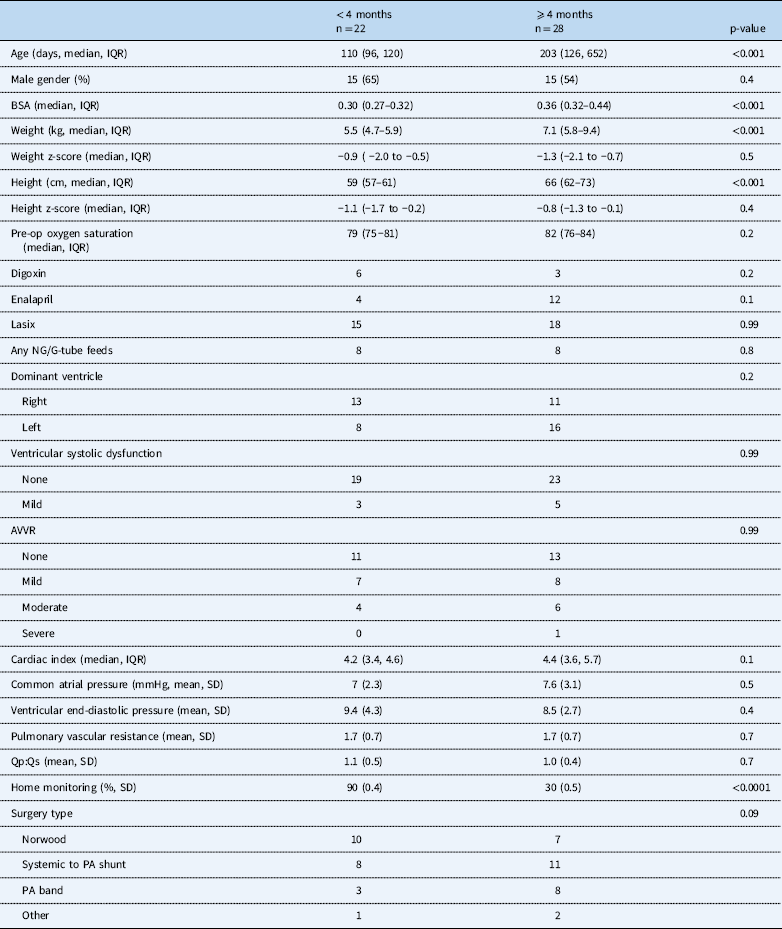
Over the study period, totally 72 patients underwent the Glenn operation, out of which 22 patients were excluded because their admission date was before their surgical date. A total of 50 patients whose admission date was the same as that of their operation were identified and included in the study. Overall, 22 patients (44%) underwent the bidirectional Glenn operation at an age <4 months, while 28 patients (56%) underwent the operation at an age ⩾4 months. Although the two age-based cohorts were different in terms of length and weight, they did not differ in terms of z-scores for length and weight (Table 1). Those who were >4 months of age at the time of surgery were less likely to be enrolled in the single-ventricle home-monitoring programme (p-value <0.0001), likely because, at the time of surgery, they were deemed at lower risk for inter-stage mortality. The two cohorts were indistinguishable in their pre-operative saturation, dominant ventricle, stage one surgery type, catheterisation haemodynamics, degree of atrioventricular valve regurgitation, and pre-operative ventricular function. One patient of age >4 months in the cohort underwent placement of an aortopulmonary shunt in the post-operative period due to cyanosis.
Comparison of pre-operative demographic and clinical factors by age.

AVVR=atrioventricular valve regurgitation; BSA=body surface area; IQR=interquartile range; LOS=length of stay; PA=pulmonary artery; SD=standard deviation
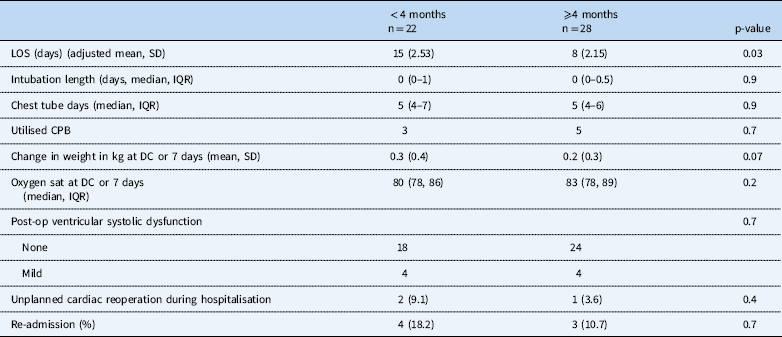
The two cohorts were indistinguishable with regards to post-operative saturation, use of cardiopulmonary bypass, change in weight after surgery, post-operative ventricular function, length of intubation, duration of chest tube drainage, rate of additional cardiac surgeries during the admission, and rates of re-admission (Table 2).
Comparison of post-operative outcomes by age.

CPB=cardiopulmonary bypass; DC=discharge; IQR=interquartile range; LOS=length of stay; SD=standard deviation
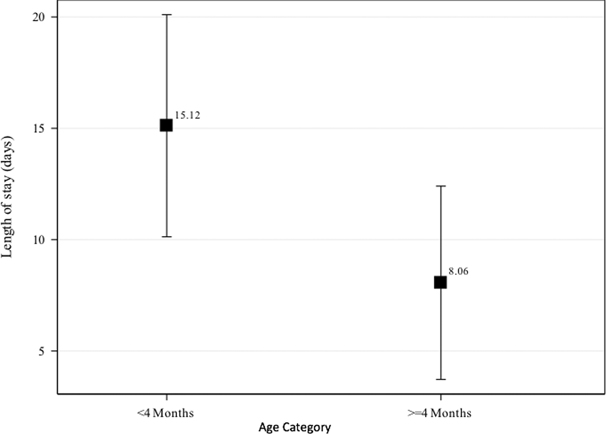
Using the above-described propensity score and age at the time of surgery, a multi-variable regression analysis was performed. This showed that surgery performed before 4 months remained associated with longer length of stay (Fig 1). There was no difference in the secondary outcomes of length of chest tube drainage, length of intubation, and 30-day re-admission rates after the operation between both groups.
Adjusted length of stay of each age category.

Discussion
We aimed to determine the association of age at the time of Glenn operation on early post-operative outcomes, including hospital length of stay, a proxy for increased resource utilisation. We found that, in an institution that routinely performs the bidirectional Glenn operation at 3 months of age, performing this surgery at an age younger than 4 months was associated with longer hospitalisation compared to an older cohort but with no other early morbidity.
Several studies have investigated the relationship between age and post-operative outcomes and inter-stage mortality. The rationale for earlier timing includes decreasing the volume load from the single ventricle and an earlier transition to a more stable circulation (shorter inter-stage period with resultant lower inter-stage mortality). Petrucci et al found that the post-operative course was more complicated for those younger than 3 months of age in that cardiac ICU length of stay, hospital length of stay, and length of respiratory failure were all prolonged in the younger cohort.Reference Meza, Hickey and McCrindle 6 Hill et al used the National Pediatric Cardiology Quality Improvement Collaborative database to evaluate the influence of timing of the Glenn operation on inter-stage mortality and morbidity across centers.Reference Lee, Aiyagari, Hirsch, Ohye, Bove and Devaney 9 Using a cut-off of 153 days, this group showed that mortality was higher in centres who operated later, and that post-operative morbidity was not significantly different in the centres who performed the Glenn operation at a younger age. Centre variability, including variability in the components of the home-monitoring programme, may in part explain this observation. We found when using a more restrictive cut-off of 4 months that post-operative length of stay was longer with no other early morbidity. Over the course of the inter-stage home-monitoring programme at Stanford, from 2005 to 2015, the Norwood inter-stage mortality rate was 2%. During the 5-year study period, our Norwood inter-stage mortality rate at Stanford was 5.7%. Inter-stage mortality for single-ventricle patients not undergoing surveillance has not been formally tracked, but we are not aware of any deaths. This is compared to national inter-stage mortality rates of 10–15% at the start of the study period and 6% across the National Pediatric Cardiology Quality Improvement Collaborative by 2013.Reference Anderson, Beekman and Kugler 16
One notable finding was that prolonged length of stay in the younger cohort could not be explained by anatomic, functional, echocardiographic or haemodynamic differences, although our cohort size is limiting this interpretation. Our findings are similar to other reports that describe an important and independent association between age at the time of the bidirectional Glenn and longer hospital duration.Reference Aeba, Katogi, Kashima, Omoto, Kawada and Omae 8 Our cohort was similar to that of other studies describing an important incidence of poor growth in the inter-stage period that closely correlates with poor outcomes and longer length of post-operative stay following the bidirectional Glenn operation.Reference Anderson, Beekman and Border 17 , Reference Anderson, Beekman and Eghtesady 18 We surmise that lower weight-for-age z-score, observed similarly in both cohorts, may have differential clinical influence with more significance attributed to younger age at the time of surgery. Pulmonary maturity may also play a factor: smaller children are associated with lower functional residual capacity which might lead to a propensity for more problems with areas of intrapulmonary shunting in the post-operative period. However, we did not find important differences in post-operative duration of mechanical ventilation or chest tube drainage.
Our findings were comparable to other studies that did not observe a higher mortality event rate in the inter-stage period based on age at the time of the stage 2 palliation. However, it has been importantly noted that children who underwent the bidirectional Glenn operation at a younger age in our study were more likely to be enrolled in the home-monitoring programme and as such had been pre-identified as at high risk for sudden death. The relationship between enrolment in the home monitoring programme and younger age at surgery can be described by our programmatic approach to refer Norwood physiology and shunted patients for evaluation and surgery at 3 months of age. Though the two study groups appear anatomically similar, there may be additional clinical and/or non-clinical features related to enrolment in the home monitoring programme that may explain the differences in post-operative outcomes. For example, a patient who underwent a Norwood and was growing well with good saturations may have been scheduled for surgery at 4 months and 1 week of age, which still fits our clinical paradigm but, in this study, places them in the older cohort. On the contrary, there were patients in the older than 4 months cohort who had essentially no risk of sudden death based on their anatomy and as such they were referred for Glenn operation much later. These subtleties may have made distinctions in our data less clear.
It is important to note that determining the optimal timing for the Glenn operation among patients that may vary importantly in presentation, co-morbidities, and anatomic type must factor in multiple variables, of which age is only one. However, most clinical features, such as co-morbidities, are not modifiable whereas age at surgery is modifiable. Focussing on the influence of age at surgery may allow for modifiable improvement plans. Both study cohorts had commensurate pre-operative clinical features. We found that timing of surgery correlated with significant differences in post-operative length of stay. This disparity may serve as an important target to improve the value in healthcare delivery for single-ventricle reconstruction. Those efforts may include improving the candidacy of younger patients, for example nutritionally, and/or modifying the timing of surgery to better balance post-operative outcomes with preserved inter-stage survivability. Several studies have recently looked into the optimal timing of the Glenn operation,Reference Meza, Hickey and McCrindle 6 , Reference Meza, Hickey and Blackstone 7 , Reference Meza, Jaquiss and Anderson 19 , Reference Alexander-Banys, Axelrod, Siehr and Wright 20 with the overall conclusion that performing the Glenn operation between 3 and 6 months may maximise inter-stage survival. Our study reports the experience of an institution that performs the Glenn operation at a relatively earlier age with excellent inter-stage survival and shows an association of increased post-operative length of stay in the youngest patients.
This study has important limitations that must be considered. First, our study is retrospective in nature, which can lead to the intrusion of bias, but the two cohorts do not have significant demographic differences (Table 1). This study was also completed at a single centre which may influence the generalisability of the findings, as there are differences in practice from centre-to-centre. For example, cardiopulmonary bypass is not routinely used to complete this surgery at Stanford. Therefore, the post-operative course may be different at institutions that perform the Glenn with cardiopulmonary bypass. We limited our study population to only those patients who were not hospitalised before their second stage palliation; therefore the data in this study may not apply to those patients that are admitted to the hospital before their operation. In these patients delaying the operation may not be an option.
Given the difference in the proportion of patients who were part of the home monitoring programme between the two cohorts, the populations may be different in ways that were not measured that may account for changes in post-operative length of stay. The study focussed on short-term outcomes; long-term benefits of earlier offloading of the single ventricle and outcomes after Fontan completion are important to consider in future studies. A larger sample size may identify factors that are associated with increased post-operative length of stay.
Conclusion
We found that Glenn procedures performed just after 4 months of age improves post-operative length of stay with no adverse effect on inter-stage mortality. In the absence of clinical need for earlier surgery, it is possible that a delay in the preferred timing of the Glenn operation may safely optimise healthcare resource conservation and promote value-based healthcare.
Acknowledgements
None.
Financial Support
This research received no specific grant from any funding agency, commercial or not-for-profit sectors.
Conflicts of Interest
None.