Rare Neuromuscular diseases (NDs) are different genetic illnesses with a chronic course of disease progression, low prevalence and high geographical dispersion. The main symptoms of these disorders are progressive loss of muscular strength, atrophy or hypertrophy, fatigue, muscular weakness, and spasticity or rigidity. Muscles or nerves are affected, and other organs and tissues, such as the heart or the central nervous system, may also be involved (ASEM, 2008).
Illness-related symptoms can cause high levels of disability in people with rare NDs and can worsen health-related quality of life (HRQoL). It is important to address the difficulties these populations experience in their daily routines to improve their general health status and their quality of life. Several studies have examined HRQoL in people with rare NDs. Twork, Wiesmeth, Klewer, Pöhlau, and Kugler (Reference Twork, Wiesmeth, Klewer, Pöhlau and Kugler2010) indicated lower levels of HRQoL in a sample of 1,518 patients affected with Myasthenia Gravis (MG) compared to those in a healthy group. A negative correlation between illness stability and mental health was also found. Otherwise, Leonardi et al. (Reference Leonardi, Raggi, Antozzi, Confalonieri, Maggi, Cornelio and Mantegazza2009) pointed out that HRQoL of the MG patients studied in their study was inversely proportional to the illness gravity. Similar decrease in HRQoL was found in other studies with other type of disorders: amyotrophic lateral sclerosis, facioscapulohumeral muscular dystrophy (FSHD), and other dystrophies (Kierkegaard, Harms-Ringdahl, Holmqvist, & Tollbäck, Reference Kierkegaard, Harms-Ringdahl, Holmqvist and Tollbäck2011; Winter et al., Reference Winter, Schepelmann, Spottke, Claus, Grothe, Schröder and Dodel2010). Previous studies have also reported that psychosocial dimensions, such as social support and self-efficacy, are relevant in the improvement of HRQoL (Fioravanti, Casale, Mantegazza, Leonardi, & Raggi, Reference Fioravanti, Casale, Mantegazza, Leonardi and Raggi2010). HRQoL and psychosocial variables can be improved using new technologies.
The concept of telecare or teleassistance, meaning the use of new technologies to provide health care services, includes a wide range of modalities such as videoconferencing, e-mail, online chat sessions, forums, telephone calls, and mobile phone messages. These tools could be considered an alternative, innovative way to improve the HRQoL of people with disabilities (Ferrer-Roca, Garcia-Nogales, & Peláez, Reference Ferrer-Roca, García-Nogales and Peláez2010; Lázaro, Amayra, López, De la Cruz, & Alday, Reference Lázaro Pérez, Amayra Caro, López Paz, De la Cruz Beldarrain and Alday2009; Polisena et al., Reference Polisena, Tran, Cimon, Hutton, McGill, Palmer and Scott2010).
Teleassistance has been used in the setting of multiple diseases, including cancer (Kroenke et al., Reference Kroenke, Theobald, Wu, Norton, Morrison, Carpenter and Tu2010), diabetes (Polisena et al., Reference Polisena, Tran, Cimon, Hutton, McGill and Palmer2009), post-traumatic stress disorder (Sloan, Gallagher, Feinstein, Lee, & Pruneau, Reference Sloan, Gallagher, Feinstein, Lee and Pruneau2011), obesity (Watson, Bickmore, Cange, Kulshreshtha, & Kvedar, Reference Watson, Bickmore, Cange, Kulshreshtha and Kvedar2012), chronic respiratory failure (Vitacca et al., Reference Vitacca, Bianchi, Guerra, Fracchia, Spanevello, Balbi and Scalvini2009), cystic fibrosis (Hubbard, Broome, & Antia, Reference Hubbard, Broome and Antia2005), brain injury (Rotondi, Sinkule, & Spring, Reference Rotondi, Sinkule and Spring2005), chronic pain (Macea, Gajos, Daglia Calil, & Fregni, Reference Macea, Gajos, Daglia Calil and Fregni2010), and stroke (Chumbler et al., Reference Chumbler, Rose, Griffiths, Quigley, McGee-Hernandez, Carlson and Hoenig2010). The majority of these studies consider teleassistance a beneficial and useful resource.
Few studies have examined the application of new technologies to improve health in people with rare NDs (Amayra, Lázaro, López, & De la Cruz, Reference Amayra Caro, Lázaro Pérez, López Paz and De la Cruz Beldarrain2008; Lázaro et al., Reference Lázaro Pérez, Amayra Caro, López Paz, De la Cruz Beldarrain and Alday2009; López, Amayra, Lázaro, De la Cruz, & Alday, Reference López Paz, Amayra Caro, Lázaro Pérez, De la Cruz Beldarrain and Alday2009; Soutter et al., Reference Soutter, Hamilton, Russell, Russell, Bushby, Sloper and Bartlett2004). These studies conclude that teleassisstance is an important and useful tool at improving quality of life of children and adolescents with Duchenne muscular dystrophy, along with their relatives. Furthermore, Vitacca et al. (Reference Vitacca, Comini, Tentorio, Assoni, Trainini, Fiorenza and Scalvini2010) conducted a study on telecare in patients with amyotrophic lateral sclerosis (ALS) and their caregivers and concluded that the applied program could be useful for following up with ALS patients. Likewise, the study of Boeschoten et al. (Reference Boeschoten, Nieuwenhuis, van Oppen, Uitdehaag, Polman, Collette and Dekker2012) found that online applied problem solving therapy is feasible and reduces depressive symptoms in patients with multiple sclerosis.
Health-related quality of life can be affected by a lack of social networks or by daily problems coping with a disease. Mobility limitations or the challenges this population may face in locating other rare ND patients nearby can be palliated by videoconferencing. This tool is an available way of keeping in contact with people with rare NDs who live in rural areas and may not have easy access to psychosocial care services. Rural living and the elevated rate of geographical dispersion of this population can complicate the creation of social networks among equals. Studies about this topic conclude that telemedicine or teleassistance are suitable methods for assisting people with rare NDs in rural environments (Ferrer-Roca et al., Reference Ferrer-Roca, García-Nogales and Peláez2010; Rabinowitz et al., Reference Rabinowitz, Murphy, Amour, Ricci, Caputo and Newhouse2010) or geographically isolated populations (Backhaus et al., Reference Backhaus, Agha, Maglione, Repp, Ross, Zuest and Thorp2012). Furthermore, these authors highlight that videoconferencing psychotherapy “is a viable alternative to in person therapy”.
Satisfaction with teleassistance has been assessed in some studies as a measure of the acceptance of this new tool of intervention. Mair and Whitten (Reference Mair and Whitten2000), for example, conducted a review of 32 studies on videoconferencing use and concluded that teleconsultation is an acceptable method of connection in a variety of circumstances. Doorenbos et al. (Reference Doorenbos, Eaton, Haozous, Towle, Revels and Buchwald2010) found that online support groups are a valuable method of connecting people who have similar experiences. Another study, conducted by Gustke, Balch, West, and Rogers (Reference Gustke, Balch, West and Rogers2000), showed that participants’ satisfaction with 495 interactive teleconsultations in real time was high (98.3%). Finally, Vitacca et al. (Reference Vitacca, Comini, Tentorio, Assoni, Trainini, Fiorenza and Scalvini2010) found that 79% of patients and caregivers were highly satisfied with the telemedicine program they used.
The purpose of the present study responds to the lack of actual researches about teleassistance and HRQoL in people with rare NDs. The aim is to assess the effectiveness of an online psychosocial support program in this population to improve HRQoL levels through social interaction with affected equals.
Methods
Participants
Forty-five people (23 males and 22 females) with MG, FSHD, Becker muscular dystrophy (BMD), limb-girdle muscular dystrophy (LGMD), and other related diseases constituted the sample. The patients were recruited from the Hospital of Cruces and the Hospital of Basurto (Biscay), as well as from national associations of people affected by NDs. The participants’ ages ranged from 19 to 79 (mean = 50.56, SD = 14.07) years. A convenience sampling was conducted, assigning participants to one of two groups: the Experimental Group (EG) (n = 24), which received the online intervention, or the Control Group (CG) (n = 21). Bearing in mind the low prevalence of the population under study and the difficulty in obtaining the sample, the availability of a computer and a webcam was considered a main variable when assigning a person to the experimental group. Eligibility criteria included: confirmed ND diagnosis by a neurologist (ICD-10), age greater than 18 years, and agreement to participate in the study as demonstrated by signing an informed consent form. Participants in the EG were also expected to have a computer, a web camera, and access to the Internet at their homes. Exclusion criteria included severe psychopathology (e.g., psychosis) and/or sensorial difficulties that affect the management of the teleassistance program.
Instruments
A structured interview was administered at the beginning of the study to assess participants’ sociodemographic information. HRQoL was measured using the World Health Organization Disability Assessment Schedule II (WHO-DAS II) (World Health Organization, 2001), the SF-36 Health Survey questionnaire (Ware & Sherbourne, Reference Ware and Sherbourne1992), and the Sickness Impact Profile (SIP) (Bergner, Bobbitt, Pollard, Martin, & Gilson, Reference Bergner, Bobbitt, Pollard, Martin and Gilson1976). Previous studies have investigated the suitability of these instruments for assessing quality of life levels, and satisfactory results have been obtained (Leonardi et al., Reference Leonardi, Raggi, Antozzi, Confalonieri, Maggi, Cornelio and Mantegazza2010; Winter et al., Reference Winter, Schepelmann, Spottke, Claus, Grothe, Schröder and Dodel2010).
The WHO-DAS II measures disability. The 36-item version was administered in this study. Participants were asked to indicate on a 5-point scale (from 1 “no difficulty” to 5 “complete difficulty/cannot do”) if they have had any difficulty in the last 30 days due to health status in performing a variety of tasks related to 6 different domains: 1) Understanding and communicating, related to concentration, memory, problem solving, learning new tasks, and communication; 2) Getting around, referred to the difficulty in standing for periods of 30 minutes, standing up from sitting down, moving inside home or getting out of one’s home, and walking long distances; 3) Self-care, which includes activities such as getting dressed, washing the whole body, eating, and staying by oneself for a few days; 4) Getting along with people, which includes aspects related to maintaining a friendship, interpersonal skills with family and friends and with strangers, and difficulties in sexual relations; 5) Life activities, referred to the difficulty in the development of housework; and 6) Participation in society, which includes difficulties in participating in community activities, time spent on the disease, emotions, finances, family, and leisure. The Spanish version of the questionnaire by Vazquez-Barquero, Herrera, Vázquez, and Gaite (Reference Vázquez-Barquero, Herrera, Vázquez and Gaite2006) was used in the present study. The reliability reported by these authors was high (up to .80) for five of the six domains and for the global scales. The “Getting along with people” domain had a value of .76. Internal consistency indicated very high Cronbach α values for the global scales (.93) and Cronbach values of up to .70 for each of the domains.
The SIP is an instrument that measures behavioral changes related to health and dysfunction. A total of 136 items and 12 categories comprise the instrument. The categories include: 1) Sleep and rest; 2) Eating; 3) Work; 4) Home management; 5) Recreation and pastimes; 6) Ambulation; 7) Mobility; 8) Body care and movement; 9) Social interaction, referring to a reduction in social visits, a reduction in group social activities, decreased sexual activity, and decreased interaction with people; 10) Alertness behavior, related to difficulty in reasoning and problem solving, memory and/or concentration problems, and an increased number of minor accidents; 11) Emotional behavior, which is related to anxiety, complaints of pain or discomfort, and hopelessness about the future; and 12) Communication. A physical domain, a psychosocial domain, and a total index are also included. Scores range from 0–100, with a higher score indicating a worse health status. The Spanish version shows a high internal consistency (.95). Reliability is also high, with a Cronbach alpha of .96 (Badía & Alonso, Reference Badía and Alonso1994).
The SF-36 was created by the Medical Outcome Study (MOS). It measures both mental and physical status through eight dimensions: physical functioning, role-physical, bodily pain, general health, vitality, social functioning, role-emotional, and mental health. Scores range from 0 to 100, with higher scores indicating a better HRQoL. Internal consistency values are up to .70 in all the dimensions, with a range between .71 and .94 (Alonso, Prieto, & Antó, Reference Alonso, Prieto and Antó1995; Ayuso-Mateos, Lasa, Vázquez-Barquero, Oviedo, & Díez-Manrique, Reference Ayuso-Mateos, Lasa, Vázquez-Barquero, Oviedo and Díez-Manrique1999).
Finally, a semi-structured interview was created to assess satisfaction with the teleassistance program. Questions about satisfaction with group sessions, topics discussed, support material, and the teleassistance program used were asked.
Procedure
To conduct the present study, a quasi-experimental static-group comparison design with pre-test and post-test was conducted. Several psychometric tests were administered before and after the online intervention to compare both measures and assess if statistically significant differences appeared. The time between these assessments was approximately 4.5 months.
In a first stage, a web site was created (http://neuromusculares.deusto.es). On this web page, participants had access to information about their own disease, a forum, and the videoconference program. Before the program was launched online, an assessment was conducted in person for both groups (experimental and control) by psychologists at the aforementioned hospitals and associations, as well as at the Universidad de Deusto. Participants were assigned to one of two groups by convenience: a videoconference intervention group and a control group, taking into account the availability of a computer and a webcam to be assigned to the first one. Intervention had a total duration of three months. Seven one-hour sessions were conducted, one every two weeks. The intervention was conducted by an expert psychologist via the Skype computer program in group videoconference sessions of four to five people. Sessions were conducted in an experimental room, from which participants were video-called. They remained in their homes participating with their personal computers. The goal of the program was to create a social network between affected people and to improve their HRQoL. The online psychosocial program was based on Cognitive-Behavioral Therapy (CBT), and involved several areas: First, an assessment of the expectations towards the online intervention was carried out in order to identify and clarify the aims of the psychosocial program. Second, a psychoeducation on relevant aspects of neuromuscular diseases was conducted (the explanation of symptoms, changes in the familiar and personal area, exacerbations, or daily obstacles). The third area to discuss about was emotional reactions to NDs, where the aims were to identify emotional reactions to the disease, to differentiate between healthy and unhealthy emotional expressions, to manage unhealthy emotions, and to strengthen the use of adaptive emotions when communicating. In the fourth area of the intervention a guided imagery to reduce stress and anxiety levels was explained. An audio file was sent by email with instructions to achieve a relaxation status. Fifth, to increase the perception of control participants were said to identify negative automatic thoughts related to the ND, to modify them and to replace them with more adaptive ones (cognitive restructuring, based on Beck cognitive therapy) in order to reduce the feeling of uncertainty associated with disease evolution and future quality of life. Finally, participants were provided with problem solving strategies. Problems related to daily life with the disease or with other areas were classified and tackled with strategies based on the D’Zurilla and Nezu model. In addition, home tasks were put such as self-reports about thoughts, emotional reactions or important problems.
Individuals who did not know how to use Skype or how to navigate the Internet or the study’s website received a telephone call to guide them through the program and to solve their doubts. Participants could also communicate with the team by e-mail to get their questions answered. After the online program was completed, a post-test was conducted that utilized the same instruments used in the pre-test stage and a final interview to assess satisfaction with the teleassistance program.
Data analysis
Statistical analysis was performed using the SPSS v.18 program. Chi square test and Student’s t-test were used to verify the homogeneity between the experimental and the control groups before and after the intervention program. A non-parametric Mann-Whitney U test was performed to analyze the inter-group variability, and the Wilcoxon test was also conducted to assess the intra-group variability between the pre-test and post-test scores. P-values < .05 were considered to indicate significance. The effect size was also calculated in order to calculate the strength of the correlations obtained.
Results
The analysis of the data indicated that the experimental and the control group were homogeneous in the following variables assessed: gender (χ2(1) = .573, p = .449), type of ND (χ2(8) = 9.209, p = .325), other non-NDs (χ2(1) = .025, p = .873) , marital status (χ2(5) = 2.152, p = .828), employment situation (χ2(8) = 14.359, p = .073), and psychological and/or psychiatric support (χ2(1) = .402, p = .526).
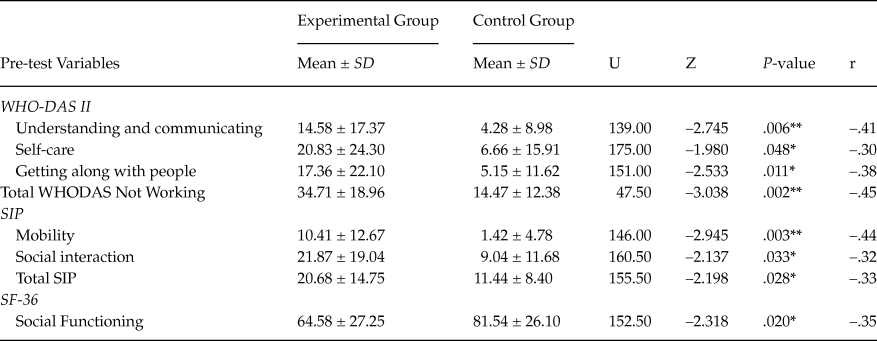
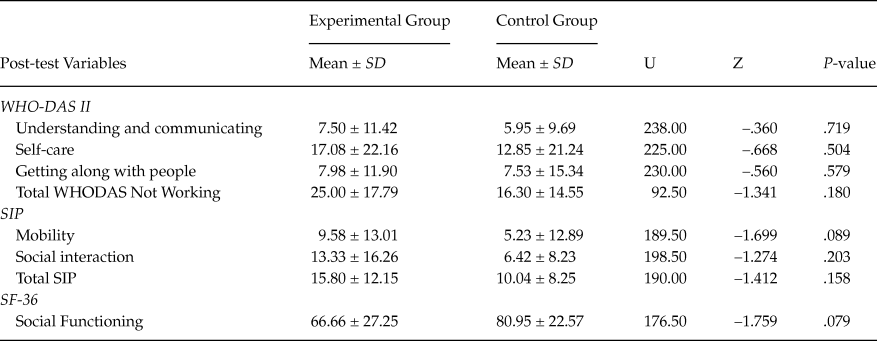
The inter-group variability for the pre-test stage revealed no significant differences between the EG and CG in the following areas: Psychosocial area (“Participation in society”, “Alertness behavior”, “Emotional behavior”, “Recreation and pastimes”, “Role Emotional”, “Mental Health”, “Mental Scale” and “Psychosocial Domain”), Physical area (“Getting around”, “Life activities”, “Sleep and rest”, “Body care and movement”, “Home management”, “Ambulation”, “Communication”, “Work”, “Eating”, “Physical Domain”, “Physical Functioning”, “Role Physical”, “Bodily Pain”, “Vitality” and “Physical Scale”) and General Health area (“Total WHODAS Working” and “General Health”). Otherwise, significant differences were found (p ≤ .05) in the social domain, cognitive domain, physical domain and general health domain. In the social domain, higher scores were obtained in the EG compared to the CG in the variables “Getting along with people”, “Social Interaction” and “Social Functioning”. In the cognitive domain, results indicated higher scores in the EG in “Understanding and communicating”. In the physical domain, higher scores were found in the EG in “Self-care” and “Mobility”. Finally, the general health domain revealed higher scores in the EG compared to the CG in “Total WHODAS Not Working” and “Total SIP”. Medium effect sizes were obtained for the aforementioned variables (see table 1). No significant differences were found for/in the inter-group variability of the post-test stage in all the variables assessed (see Table 2).
Comparison between the mean scores of the EG and the CG: Pre-test

Notes: EG = Experimental Group; CG = Control Group; SD = Standard Deviation; U = Mann-Whitney U value; r = Effect size.
* p ≤ .05.
** p ≤ .01.
Comparison between the mean scores of the EG and the CG: Post-test

Notes: EG = Experimental Group; CG = Control Group; SD = Standard Deviation;
U = Mann-Whitney U value.
* p ≤ .05.
** p ≤ .01.
The intra-group variability between the pre-test and post-test mean scores indicated significant differences in the following variables of the EG.
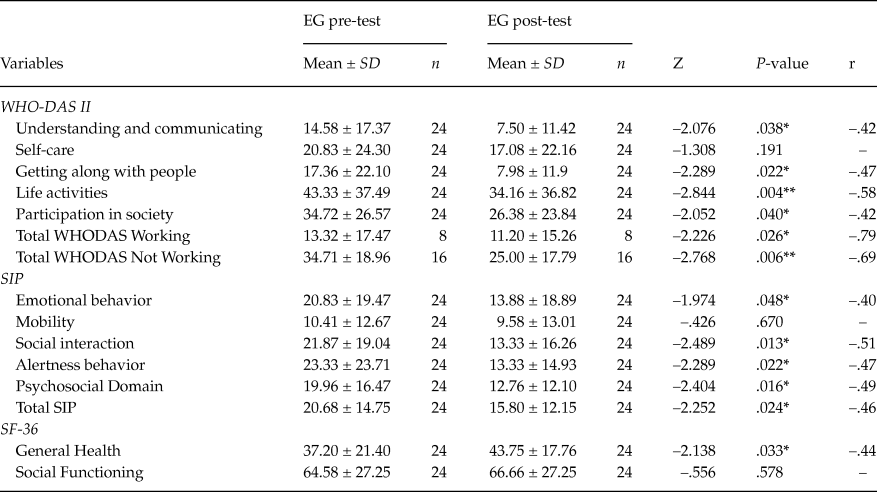
Considering the results obtained from the WHO-DAS II questionnaire analysis, it can be concluded that significant differences were found between the pre-test and post-test scores of the experimental group for several domains of this instrument (p ≤ .05). Specifically, as reported in table 3, the scores for the domains “Understanding and communicating”, “Getting along with people”, “Life activities”, “Participation in society”, “Total WHODAS working”, and “Total WHODAS not working” were reduced in the post-test stage. A medium effect size ranging between r = –.42 and r = –.58 was obtained for all domains with the exception of “Total WHODAS Working” and “Total WHODAS Not Working” which yielded a larger effect (r = –.79, r = –.69 respectively). Significant differences between the pre-test and post-test scores were not found for the control group for most of the WHODAS-II domains except “Life activities”, the score of which increased from pre- to post-test (z = –1.960, r = –.43, p ≤ .05).
Pre-test and post-test mean scores: Experimental group

Notes: EG = Experimental Group; SD = Standard Deviation; r = Effect size.
* p ≤ .05.
** p ≤ .01.
Taking into account the SIP results in the experimental group, the scores in five categories of this instrument were significant decreased post-test compared with pre-test (p ≤ .05). The effect size obtained was medium and ranged from –.40 to –.51. This significant reduction occurred in “Emotional behavior”, “Social interaction”, “Alertness behavior”, “Psychosocial Domain” and “Total SIP” (see table 3). There were no significant differences in any categories for the control group (p > .05).
The SF-36 questionnaire results indicated a statistically significant increase in the post-test score compared with the pre-test score on the “General Health” scale (z = –2.138, r = –.44, p ≤ .05) (see table 3). The control group did not have significantly different pre-test and post-test scores on this scale (p > .05).
Regarding satisfaction with the teleassistance program, 84.85% of the participants reported high levels of satisfaction with the group sessions, and 95.85% reported that the topics discussed were adequate. Finally, 83.3% of participants reported that they would participate in future projects involving videoconferencing.
Discussion
The main aim of the present study was the development of an online tool that would support people with NDs, help develop their social networking, and improve their HRQoL. A pre/post comparison of measures on three psychometric instruments was performed to identify any changes in participants’ psychosocial health. A control group was included to examine the teleassistance program’s effectiveness in a more reliable manner.
Results showed a greater disability and worse HRQoL in the EG before intervention compared to the CG in the following areas: psychosocial, physical and general health. After the teleassistance program, scores in these areas were homogeneous in both groups due to the improvement in the HRQoL of the EG.
In the psychosocial area there was an improvement in concentration, memory, problem solving, social interaction, group social activities, mood and complaints of pain or discomfort. Clinically, when the scores of the variables included in this area are compared to those from other authors with similar pathologies (Leonardi et al., Reference Leonardi, Raggi, Antozzi, Confalonieri, Maggi, Cornelio and Mantegazza2010; Vazquez-Barquero et al., Reference Vázquez-Barquero, Arias, Peña, Díez, Ayesterán and Miró1991), some aspects should be highlight. First, before intervention, participants of the actual study had higher levels of disability than those reported by these authors. Second, after intervention, lower levels of disability were obtained for the present study. In the physical area, a reduction in the difficulties when developing housework properly was obtained. Clinically, after intervention, participants in the actual study had worse disability than that reported by Leonardi et al. (Reference Leonardi, Raggi, Antozzi, Confalonieri, Maggi, Cornelio and Mantegazza2010), in spite of the improvement in such area. Finally, the general health area also indicated an improvement in HRQoL levels in the intervention group. Clinically, before intervention, participants’ general health was worse or similar in this area than that reported by other authors (Leonardi et al., Reference Leonardi, Raggi, Antozzi, Confalonieri, Maggi, Cornelio and Mantegazza2010; Twork et al., Reference Twork, Wiesmeth, Klewer, Pöhlau and Kugler2010; Vázquez-Barquero et al., Reference Vázquez-Barquero, Arias, Peña, Díez, Ayesterán and Miró1991; Winter et al., Reference Winter, Schepelmann, Spottke, Claus, Grothe, Schröder and Dodel2010). After intervention, participants of the actual study obtained a similar or better general health compared to the studies cited. The control group did not obtain any relevant significant change in these areas.
These findings suggest that the online program applied is a feasible tool at improving psychosocial, physical and general health aspects, decreasing illness impact and increasing HRQoL of people with rare NDs. These results are congruent with those found by other authors (Amayra et al., Reference Amayra Caro, Lázaro Pérez, López Paz and De la Cruz Beldarrain2008; Lázaro et al., Reference Lázaro Pérez, Amayra Caro, López Paz, De la Cruz Beldarrain and Alday2009; López et al., Reference López Paz, Amayra Caro, Lázaro Pérez, De la Cruz Beldarrain and Alday2009). The lack of studies analyzing videoconference and HRQoL in people with rare NDs leads us to take into account studies of videoconferencing psychotherapy in non NDs. Shepherd et al. (Reference Shepherd, Goldstein, Whitford, Thewes, Brummell and Hicks2006) concluded that a psychological treatment by videoconferencing improved quality of life in people with cancer disease. Emotional and functional well-being were specially benefited after the intervention. Social and physical well-being were indirectly improved.
One of the main aims of the actual study was to create social networks in order to increase social interaction and social support between people affected with a similar rare ND. Increasing social support can be considered a primary aim when improving HRQoL. Schwartz and Frohner (Reference Schwartz and Frohner2005) highlight the significant contribution of this variable to the quality of life, indicating its positive correlation with mental health levels in people with MS. Wilson, Washington, Engel, Ciol, and Jensen (Reference Wilson, Washington, Engel, Ciol and Jensen2006) also indicate that perceived social support is a significant variable in the prediction of mental health in people with NDs. In fact, their findings reveal a better psychological adjustment with a higher perceived social support.
The intervention of the actual study is based on CBT, which seems to be an ideal model to improve HRQoL in people with NDs (Cosio, Jin, Siddique, & Mohr, Reference Cosio, Jin, Siddique and Mohr2011). In this sense, it can be reported the effectiveness of psychological and social intervention programs at improving HRQoL in this population (Hart, Fonareva, Merluzzi, & Mohr, Reference Hart, Fonareva, Merluzzi and Mohr2005).
In summary, changes after the teleassistance program were significant in the experimental group in psychosocial, physical and general health aspects, indicating a reduction in the subjective level of disability and an improvement in HRQoL. Of note, the results reveal that social functioning is an important variable related to HRQoL and people with NDs (Graham, Rose, Grunfeld, Kyle, & Weinman, Reference Graham, Rose, Grunfeld, Kyle and Weinman2011).
New technologies seem to be a suitable method of intervention in people with NDs. Indeed, participants’ satisfaction with the videoconferencing program was very high and was similar to that found by Doorenbos et al. (Reference Doorenbos, Eaton, Haozous, Towle, Revels and Buchwald2010), Gustke et al. (Reference Gustke, Balch, West and Rogers2000), Mair and Whitten (Reference Mair and Whitten2000), and Vitacca et al. (Reference Vitacca, Comini, Tentorio, Assoni, Trainini, Fiorenza and Scalvini2010).
Certain limitations should be considered when interpreting the results of this study. First, sample was not randomized. Second, there were some difficulties obtaining the sample because of diagnosis delay, geographic dispersion, and low disease prevalence. However, the sample size is sufficient, considering the prevalence of NDs in the general population (ASEM/AFM, 2004; Emery, Reference Emery1991). Third, only participants who had access to a computer and to the Internet were benefited. Fourth, computer-illiterate participants did not benefit; they were included in the control group. Finally, a three, six and twelve months’ follow-up would be necessary to assess if these changes remain over time.
In conclusion, the results showed that seven-session videoconferencing effectively improved HRQoL levels in people with NDs. Social interaction appears to play a significant role in it. Further research including the use of teleassistance as a complementary tool for intervention and assessment would be useful in order to enhance the knowledge of NDs and HRQoL.