Introduction
Current progress in our understanding of the relationships among Ascomycota is substantial, and the recent advances in the phylogeny and evolution of lichen-forming Ascomycota associating with cyanobacteria is no exception (Schoch et al. Reference Schoch, Sung, López-Giráldez, Townsend, Miądlikowska, Hofstetter, Robbertse, Matheny, Kauff and Wang2009; Wedin et al. Reference Wedin, Wiklund, Jørgensen and Ekman2009, Reference Wedin, Jørgensen and Ekman2011; Otálora & Wedin Reference Otálora and Wedin2013; Otálora et al. Reference Otálora, Aragón, Martínez and Wedin2013, Reference Otálora, Jørgensen and Wedin2014; Spribille & Muggia Reference Spribille and Muggia2013; Ekman et al. Reference Ekman, Wedin, Lindblom and Jørgensen2014; Magain & Sérusiaux Reference Magain and Sérusiaux2014; Miądlikowska et al. Reference Miądlikowska, Richardson, Magain, Ball, Anderson, Cameron, Lendemer, Truong and Lutzoni2014). Identifying and interpreting characters relevant for the classification of higher taxonomic ranks is a fundamental question in the phylogenetic-systematic study of the Ascomycota. Fungal classification is full of examples of groups where the current taxonomy is based on erroneous or dubious observations or interpretations of morphological structures. This is a problem which is particularly relevant for small and inconspicuous groups of cyanobacterial lichens.
During our ongoing studies of the phylogeny and character evolution of the Lichinomycetes, one of the largest remaining poorly understood groups of cyanobacterial lichens, a highly deviant genus was found to be Epiphloea, where the sequences of all molecular markers obtained were very different from other Lichinomycetes. Preliminary BLAST searches showed similarities with the Collemataceae, another group of cyanobacterial lichens. Epiphloea has for a long time been considered closely related to the Lichinomycete genus Heppia in Heppiaceae (Zahlbruckner 1924–Reference Zahlbruckner1925; Eriksson Reference Eriksson1999; Lumbsch & Huhndorf Reference Lumbsch and Huhndorf2007), although they differ in spore characteristics and photobiont (i.e. Nostoc and muriform spores in Epiphloea, Scytonema and simple spores in Heppia). In the latest major treatment of Epiphloea, Jørgensen (Reference Jørgensen2007) reported the asci to be prototunicate (thin-walled throughout and opening by apical rupturing), a common trait in Lichinomycetes. Jørgensen’s statement, however, differs from earlier observations by Zahlbruckner (Reference Zahlbruckner1919), who described the asci as having rounded and, at first, thickened tips that suggests a non-prototunicate ascus type.
The aim of this study is to clarify the phylogenetic placement of Epiphloea. To achieve this, we performed a phylogenetic analysis which included putative relatives based on DNA sequences of the mitochondrial SSU rDNA and the nuclear protein coding gene Mcm7. In order to re-evaluate and assess relevant morphological attributes, we studied the thallus and ascoma characteristics of both species in the genus, including type material, with particular focus on the ascus apex characteristics.
Material and Methods
Molecular study
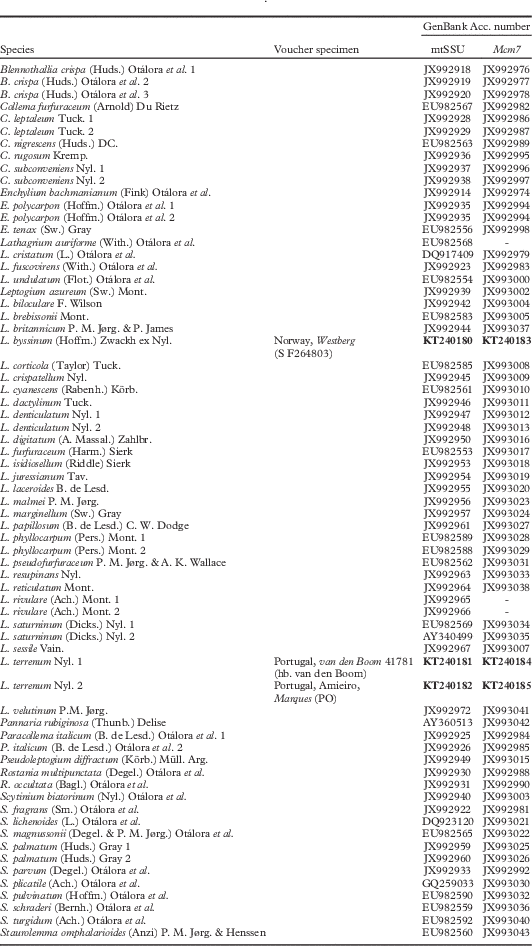
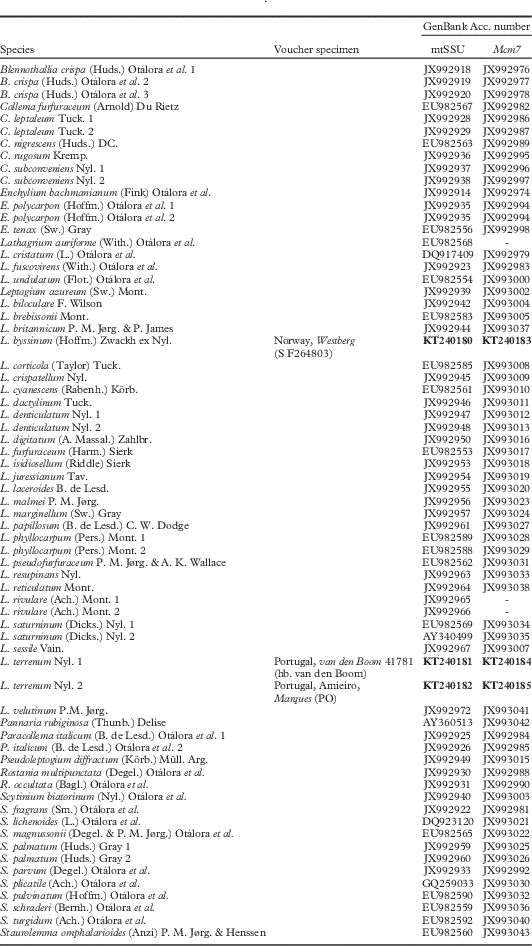
For the phylogenetic study, we included three samples of Epiphloea and a wide selection of Collemataceae members (Table 1), representing all groups identified by Otálora et al. (Reference Otálora, Aragón, Martínez and Wedin2013, Reference Otálora, Jørgensen and Wedin2014). As in these previous studies, we used two members of Pannariaceae, Pannaria rubiginosa (Thunb. ex Ach.) Delise and Staurolemma omphalarioides (Anzi) P. M. Jørg. & Henssen, as outgroups rooting the tree with the latter. DNA was extracted using DNeasy Plant Mini Kit (Qiagen) and innuPREP Plant DNA Kit (Analytik Jena), according to the manufacturers’ instructions. Amplifications were performed using 1:10 diluted DNA and with mtSSU1 and mtSSU3R (Zoller et al. Reference Zoller, Scheidegger and Sperisen1999) primers for the mtSSU region. For amplification of the Mcm7 region, we used the primers Mcm7-709for and Mcm7-1348rev (Schmitt et al. Reference Schmitt, Crespo, Divakar, Frankhauser, Herman-Sackett, Kalb, Nelsen, Rivas Plata, Shimp and Widhelm2009). When no bands were obtained in the PCR, we carried out a nested PCR using 1 µl of the PCR product and the internal primers Mcm7-CalicF and Mcm7-CalicR (Prieto et al. Reference Prieto, Baloch, Tehler and Wedin2013).
GenBank accession numbers for specimens used in this study. New sequences are indicated by accession numbers in bold
PCR amplifications were performed using Illustra™ Hot Start Mix RTG PCR beads (GE Healthcare, UK) in a 25 µl volume, containing 3 µl of diluted genomic DNA, 10 µM of each primer and distilled water. Amplifications were performed using the following procedure: initial denaturation at 95°C for 15 min, followed by 35 cycles of 95°C for 45 s, 56°C for 50 s, 72°C for 1 min, followed by a final extension at 72°C for 5 min. PCR products were subsequently purified using the enzymatic method Exo-sap-IT (USB Corporation, Santa Clara, California, USA) or spin columns (Geneaid Gel/PCR DNAFragments Extraction Kit). The purified PCR products were sequenced using the same amplification primers.
Sequences were assembled and edited using Sequencher v. 4.10.1. (Genes Codes Corporation, Ann Arbor) and deposited in GenBank (Table 1). These sequences were added to the Collemataceae alignment provided by Otálora et al. (Reference Otálora, Aragón, Martínez and Wedin2013), using MacClade 4.01 (Maddison & Maddison Reference Maddison and Maddison2001) and adjusted and reduced manually. Ambiguous regions (sensu Lutzoni et al. Reference Lutzoni, Wagner, Reeb and Zoller2000) and introns were delimited manually and excluded from the phylogenetic analyses.
Independent analyses were carried out in both data sets (i.e. mtSSU and Mcm7 alignments) using maximum likelihood-based inference (ML) in RAxML ver. 8.1.11 (Stamatakis Reference Stamatakis2014) and a GTRGAMMA model for tree inference. Bootstrapping was performed with a GTRCAT model and 1000 replicates. In order to check incongruence between the two analyses, we compared ML-BS individual gene trees, considering a conflict when a supported clade (bootstrap support >70%) for one marker was contradicted with significant support by another. Because no supported nodes were in conflict, the data were combined into a single data matrix. The combined maximum likelihood (ML) analyses were run with three distinct partitions (mtSSU, 1st and 2nd codon position for Mcm7 and the 3rd codon position for Mcm7), using the same settings as in the individual analysis.
We selected the best-fit models of nucleotide substitutions based on the Akaike Information Criterion (AIC) using jModeltest 0.1.1 (Posada Reference Posada2008). The GTR model (Rodríguez et al. Reference Rodríguez, Oliver, Marin and Medina1990) was selected for the three partitions, with a gamma distributed rate variation across sites with four categories and an estimated proportion of invariable sites. All parameters were unlinked, with rates allowed to vary across partitions under a flat Dirichlet prior.
The Bayesian inference was performed using MrBayes 3.2.3 (Ronquist et al. Reference Ronquist, Teslenko, van der Mark, Ayres, Darling, Höhna, Larget, Liu, Suchard and Huelsenbeck2012). Two runs of 10 million generations, starting from an initial random tree and employing four simultaneous chains, were executed. A tree was saved every 100th generation. To ensure that stationarity and convergence were reached, to verify if mixing was appropriate, and choose a suitable burn-in, we plotted the log-likelihood values against the time generation with Tracer v.1.5.0 (Rambaut & Drummond Reference Rambaut and Drummond2007). A burn-in sample of 25 000 trees was discarded for each run. The remaining 150 000 trees (pooled from both independent runs) were used to estimate branch lengths and posterior probabilities (PPs). The analyses were run on the CIPRES Science Gateway v. 3.3 (Miller et al. Reference Miller, Pfeiffer and Schwartz2010).
Selected specimens examined. Epiphloea byssina (Hoffm.) Henssen & P. M. Jørg. Germany: Baden-Württemberg: Heidelberg, W. v. Zwackh-Holzhausen (Lich. exs. 174) (UPS 111320 (L-62566)—neotype!; M-0154536, M-0154537—isoneotypes!). Bavaria: ad terram nudam prope Eichstadt [Eichstätt] in Bavaria, F. Arnold (Körber, Lich. Sel. Germ. 60; as Collema cheileum var. byssinum) (B).—Poland: Wojew. Dolnośląskie: Silesia, Hirschberg, auf Mauern, J. v. Flotow (Deutsch. Lich. 143A; as Collema cheileum var. byssaceum) (HBG).—Sweden: Uppland: Bondkyrko par., Norby, auf lehmigen Äckern, 7 vii 1920, G. Du Rietz (as f. obscurius Du Rietz) (B).—Norway: Oppland: Vågå municip., Nordherad, E of Svarthåmårbekken, by the parking lot just S of the road Fv454, on soil, 61·8674°N, 8·9886°E, 680 m, 30 vi 2013, M. Westberg (S F264803).—Russia: Sverdlovsk: Distr. Pervouralsk, Sloboda village, limestone outcrops on Chusovaya River, on soil, 2002, A. Paukov AGP20020804-02 (UFU) (dupl. hb. Schultz).
Epiphloea terrena (Nyl.) Trevis. France: Languedoc-Roussillon, Dept. Pyrénées Orientales: Colliour, Pla de las Fourques, in fossa arcis Fortrand, 5 vii 1872, W. Nylander (H-NYL 42806—lectotype!). Provence-Alpes-Côte d’Azur, Dept. Vaucluse: Vaucluse, Morières, Plateau de Gadagne, ad terram argillaceo-sabulosum secus viam im vicinitate Querceti ilicis, 12 ii 1971, G. Clauzade & C. Roux (Vězda, Lich. sel. exs. 987) (W 1975-261).—Portugal: Norte, Distr. Vila Real: Amieiro, terricolous on side of dust road, UTM 29TPF 3471, 7 iii 2012, J. Marques (PO) (HBG DNA no. 3731); Vale do Moinho, terricolous on side of dirt road, 7 iii 2012, J. Marques (PO) (dupl. hb. M. Schultz 17149). Centro, Distr. Coimbra: Ribeira de Relvas, 2011, J. Marques 686 (PO) (dupl. hb. M. Schultz 17150). Algarve, Distr. Faro: NE of Albufeira, c. 7 km ENE of Paderne, along new road from Espargal to the south, W slope of small hill, low calcareous outcrops and a few Ceratonia siliqua trees, terricolous, 37·214°N, 8·1202°W, 235 m, 2009, P. van den Boom 41781 (hb. P. van den Boom) (HBG DNA 3707).—Spain: Canary Islands: Tenerife, NW, near Buenavista del Norte, road to La Costa and Punta de la Laja, coastal scrub with Euphorbia spp., ± exposed soil crust, 28·375°N, 16·833°W, 50 m, 2001, M. Schultz 17083e (hb. M. Schultz).
Heppia despreauxii (Mont.) Tuck. USA: Arizona: Cochise Co., c. 2 km S of Tombstone, soil over calcareous rock, 1999, M. Schultz 16097a (hb. M. Schultz).
Results
A total of six sequences were generated for this study (Table 1). The combined data set consisted of 69 taxa and 1227 unambiguously aligned sites, 663 for the mtSSU and 564 for the Mcm7.
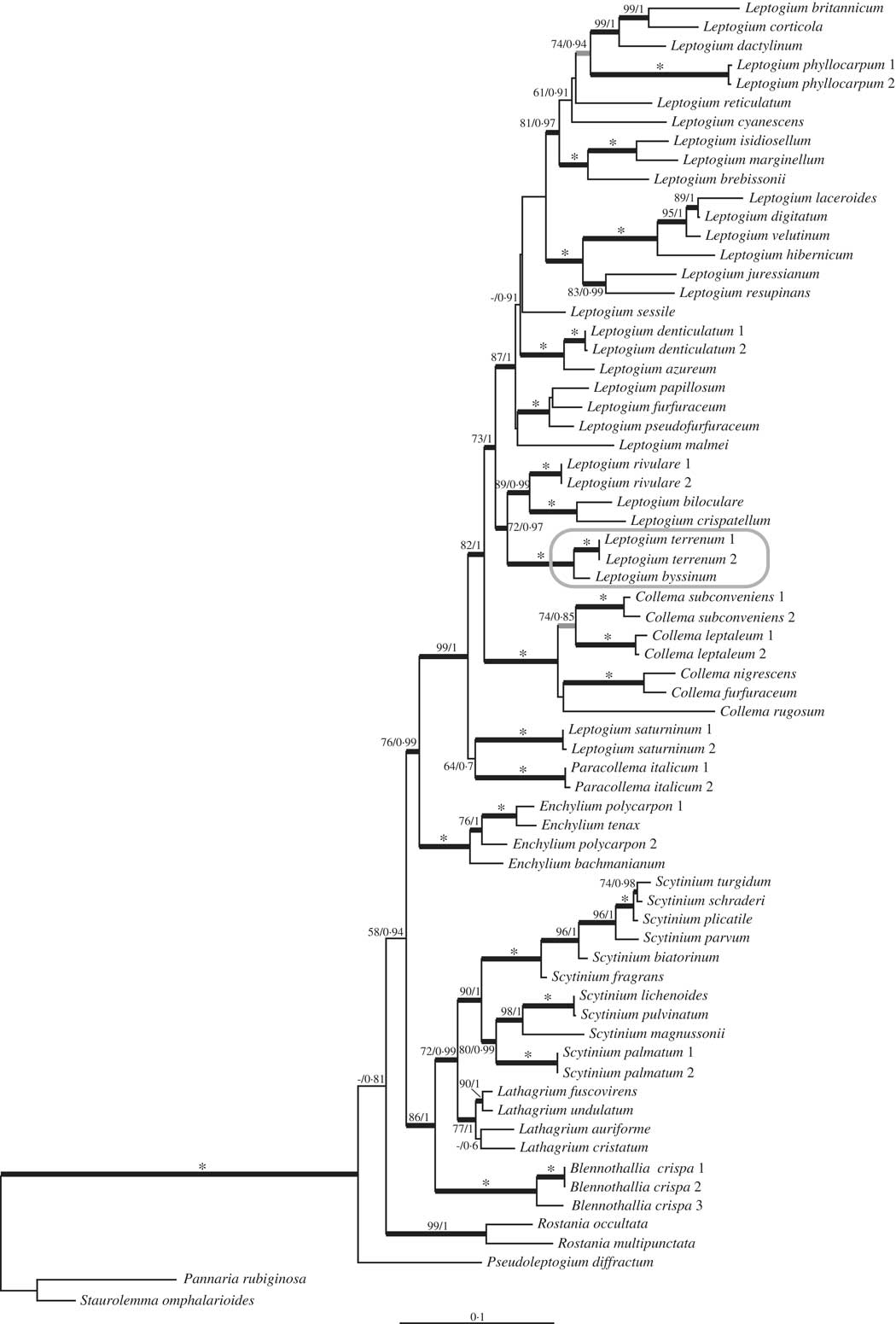
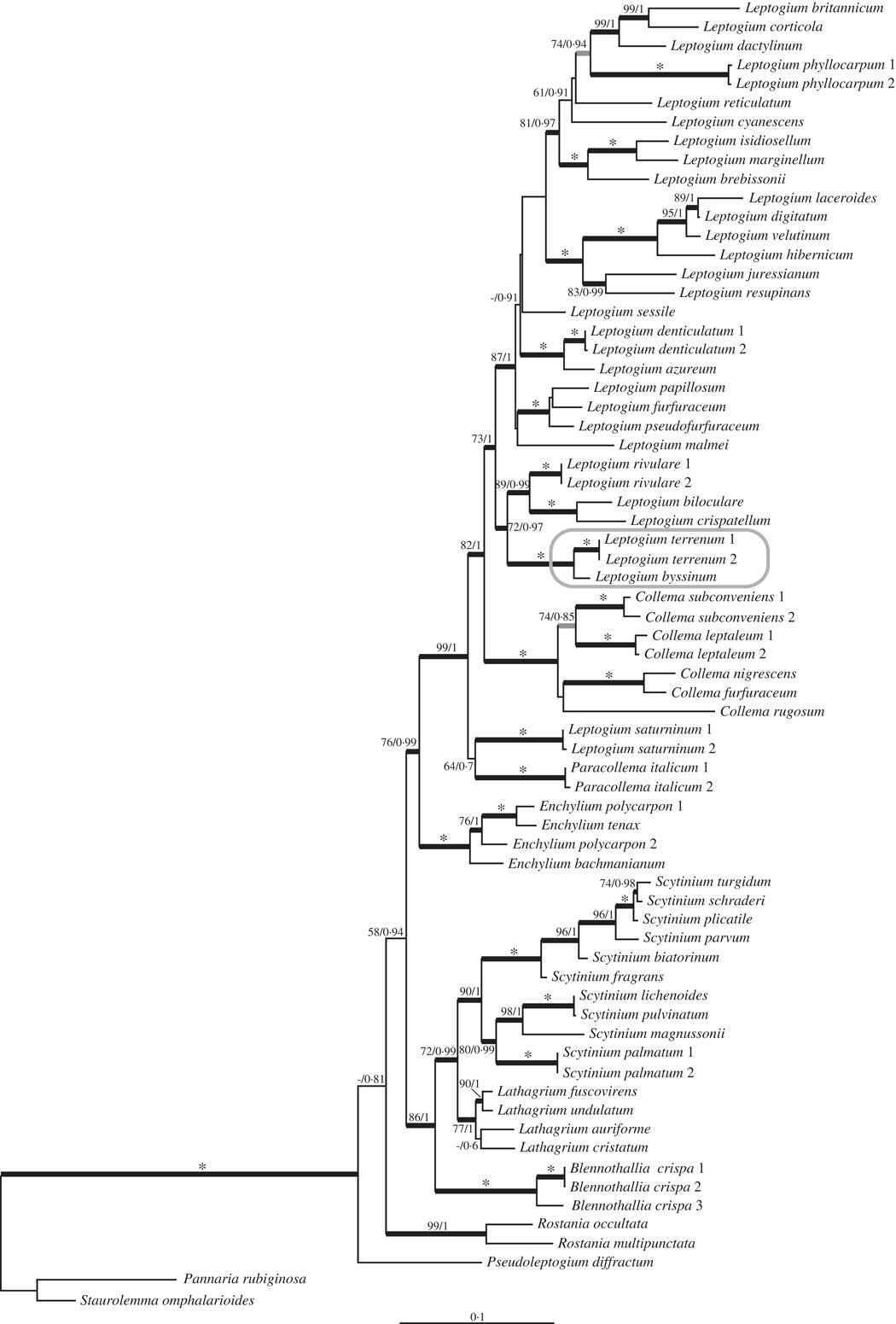
Maximum likelihood analyses resulted in a single most likely tree with an ln-likelihood of −13452·12. The harmonic mean ln-likelihood from the Bayesian analysis was −13968·6. The tree topologies obtained by the maximum likelihood and the Bayesian approaches did not show any significant conflict (Fig. 1).
Phylogenetic position of Epiphloea within the family Collemataceae. Best tree from RAxML with bootstrap support (ML-BS) and posterior probabilities (PP) obtained in the Bayesian analysis. * Indicates a support value of 100% for ML-BS and 1 for PP. Supported clades by both analyses (ML-BS>70, PP>0·95) are marked with thicker black branches and with thicker grey branches when the node is only supported by one of the two analyses.
Discussion
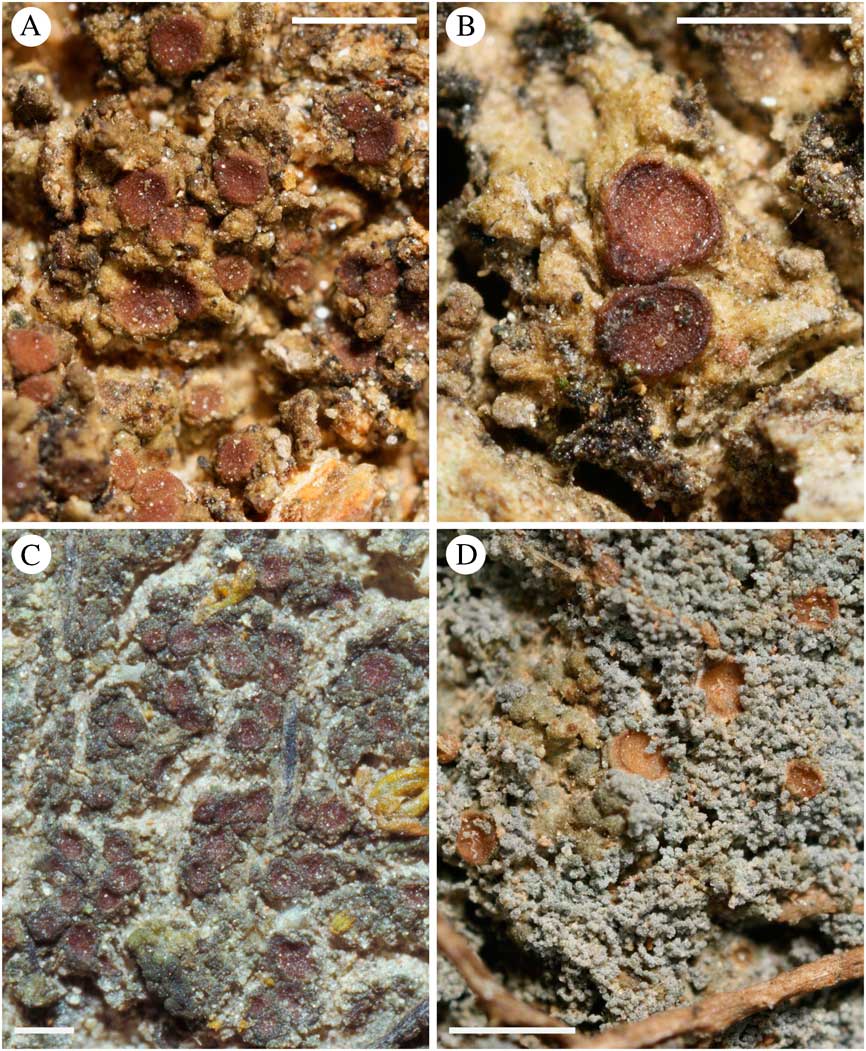
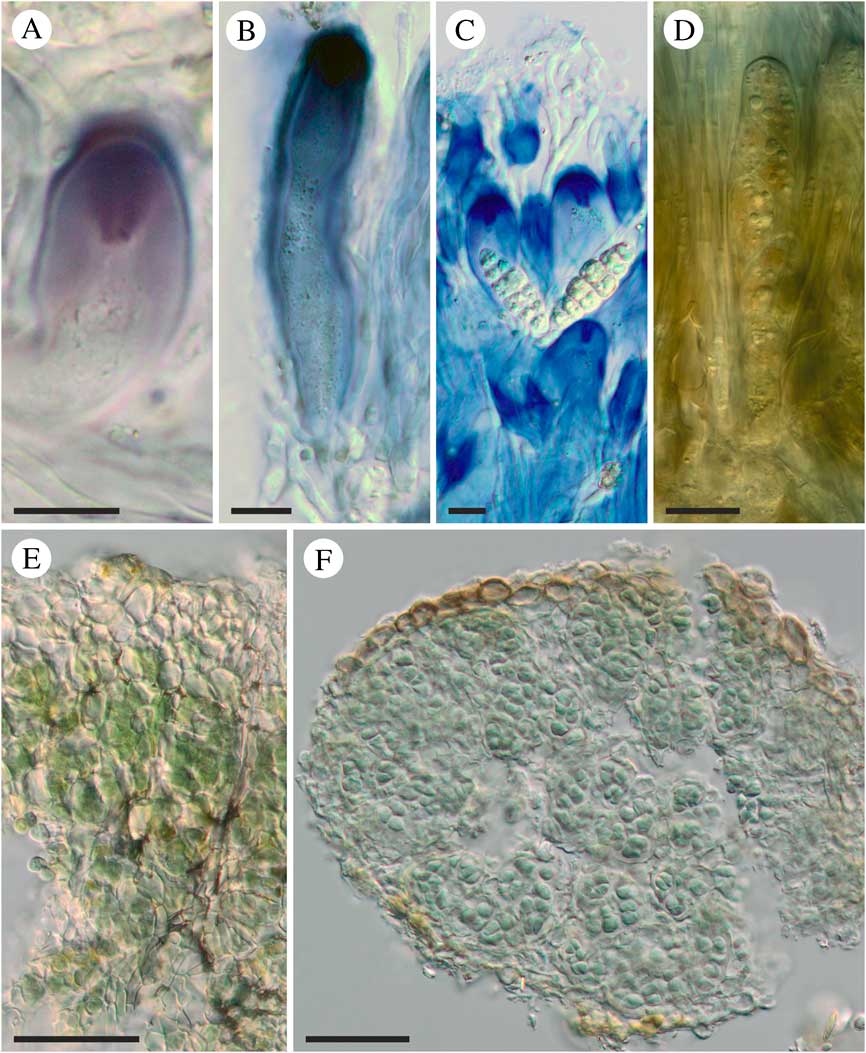
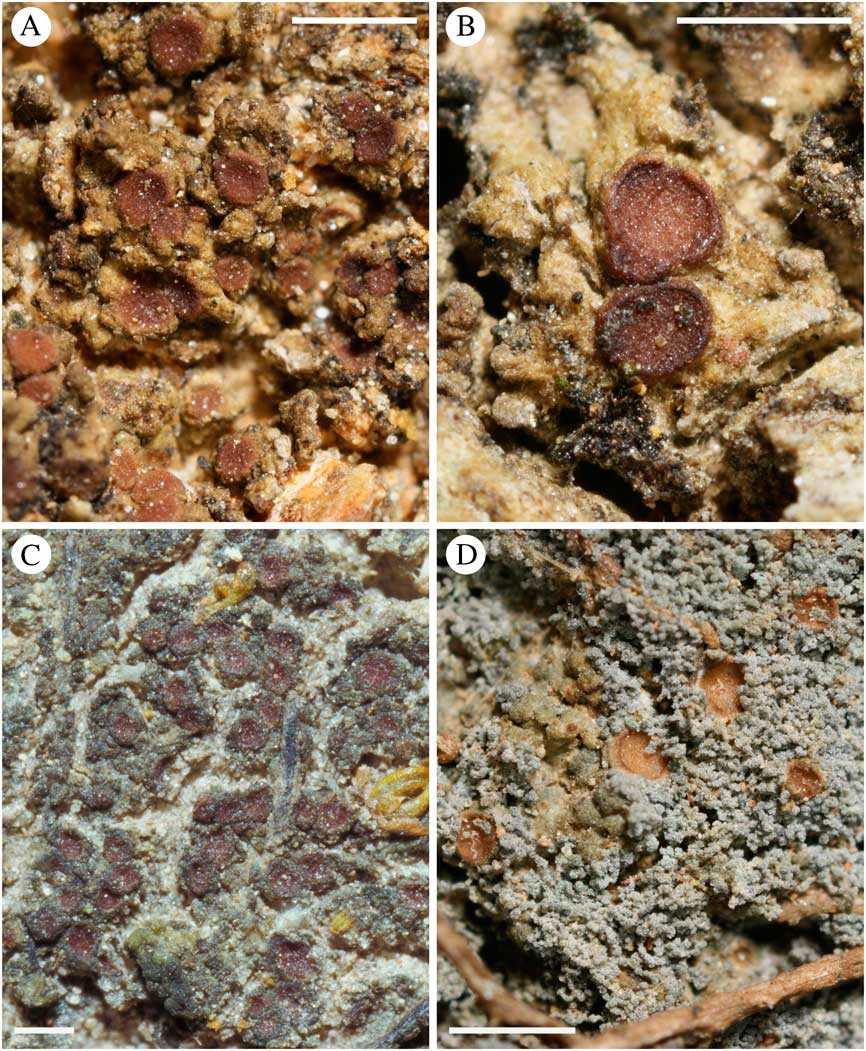
Here we show that Epiphloea clearly belongs within the Collemataceae. This is not surprising as the Epiphloea species were classified in Collema or Leptogium when they were originally described and are very similar to other Collemataceae (sensu Wedin et al. Reference Wedin, Wiklund, Jørgensen and Ekman2009 and Otálora et al. Reference Otálora, Aragón, Martínez and Wedin2013) in morphology (i.e. thallus structure, photobionts and ascospores; Fig. 2). Pycnidia have not been reported previously in the two Epiphloea species nor have we succeeded in seeing them. Contrary to some recent suggestions, our observations of type and other material showing that the asci in Epiphloea are Lecanoralean, with well-developed apical domes and distinct tube-like amyloid apical structures similar to other Collemataceae (Fig. 3A–C). This observation is clearly supported by the phylogenetic relationship found here. In contrast, the asci are always thin-walled in Heppiaceae (Fig. 3D), where Epiphloea used to be classified. It should be noted, however, that juvenile asci of Epiphloea are sometimes still thin-walled due to incomplete development, whereas the mature asci observed by us always had amyloid apical structures. Thus the phylogenetic placement is also supported by the ascus apex characters.
A & B, Leptogium terrenum; A, olivaceous, small-squamulose thallus, apothecia adnate, with dark red discs (Marques s. n., dupl. hb. M. Schultz 17149); B, apothecia with distinct proper exciple (Marques 686, dupl. hb. M. Schultz 17150). C & D, Leptogium byssinum; C, dark olivaceous, crustose thallus, with semi-immersed apothecia (Flotow, Deutsch. Lich. 143A, HBG); D, thallus almost entirely dissolved into leprose, bluish (olive) granules, apothecia with brownish discs (Paukov AGP20020804-02, dupl. hb. M. Schultz). Scales =1 mm. In colour online
A–D, asci stained with Lugol’s solution after pretreatment with KOH. A & B, Leptogium terrenum, ascus with amyloid, tube-like apical structure (Vězda, Lich. sel. 987, W 1975-261); C, Leptogium byssinum, like A & B, but with muriform ascospores (Körber, Lich. sel. 60, B); D, Heppia despreauxii, thin-walled, prototunicate ascus not staining with iodine, ascospores simple (Schultz 16097a, hb. Schultz); E, Leptogium terrenum, thallus cross-section showing upper cortex of isodiametric cells, photobiont layer with densely reticulate, vertically elongated cells (Marques s. n., dupl. hb. M. Schultz 17149); F, Leptogium byssinum, thallus granule surrounded by single-row cortex, photobiont layer with densely reticulate hyphae (Du Rietz, B). Scales =10 µm. In colour online.
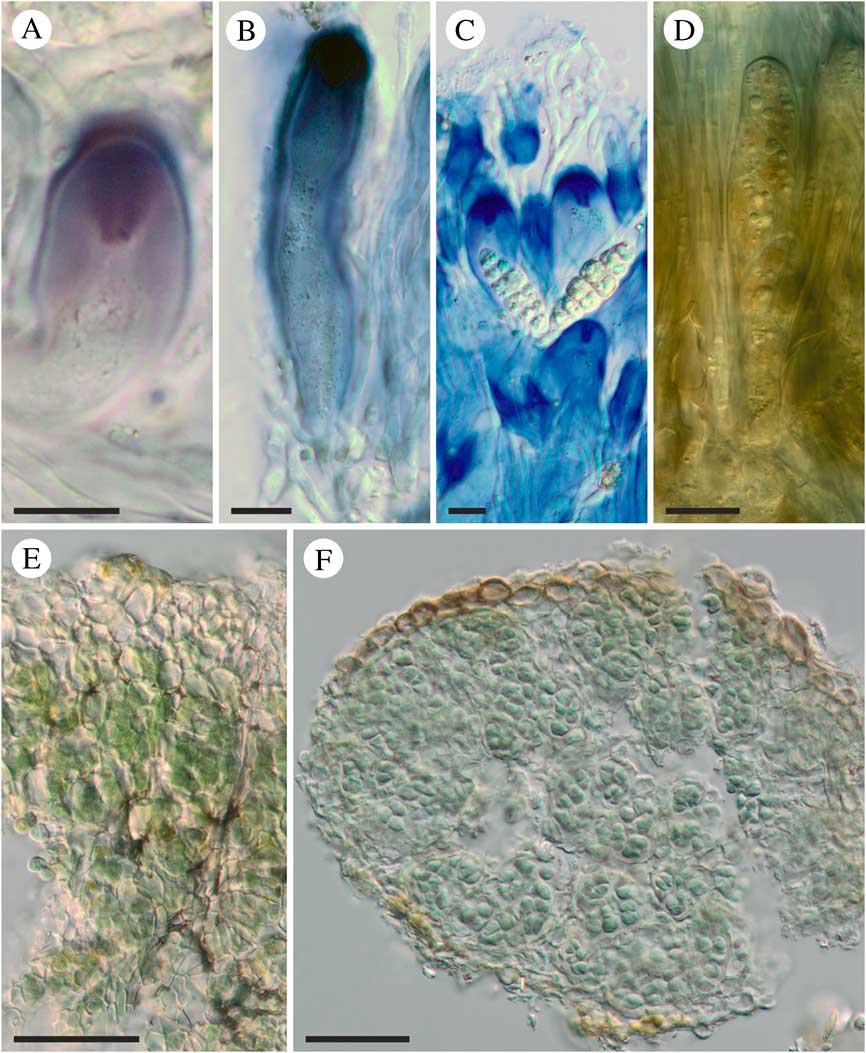
Both Epiphloea species are part of Leptogium s. str. (sensu Otálora et al. Reference Otálora, Jørgensen and Wedin2014), and both already have names coined in this genus. Leptogium s. str. chiefly contains corticolous species with a few exceptions such as Leptogium cyanescens (corticolous to saxicolous) or L. britannicum (growing on coastal soils). Leptogium byssinum (Hoffm.) Zwackh ex Nyl. and L. terrenum Nyl. are two further examples of non-corticolous, soil dwelling species in the newly circumscribed genus. Furthermore, the thallus anatomy, especially in L. terrenum, adds to the variability of the genus by including species with a ± paraplechtencymatous thallus (otherwise found in some species of Scytinium). On the other hand, both species share the typical eucortex of Leptogium: a single layer of isodiametric cells in L. byssinum (Fig. 3F) and two to three rows of isodiametric cortex cells in L. terrenum (Fig. 3E).
Leptogium byssinum and L. terrenum form the sister clade to Leptogium rivulare, L. crispatellum and L. biloculare, a relationship which is not so easy to explain. Difficulties in the interpretation may be due to a still incomplete taxon sampling. Leptogium rivulare has an unique ecology, growing on seasonally submerged exposed roots, soil or occasionally on rock along the margins of sluggish rivers and ponds. Leptogium crispatellum is an epiphyte known only from New Zealand. Leptogium biloculare is an epiphytic species occurring in moist, montane to subalpine regions in Australia. The three species seem to form a natural group within Leptogium s. str., but their molecular relationship with Epiphloea is not obviously corroborated by morphological and anatomical evidence. It rather seems that Leptogium byssinum and L. terrenum form a group within Leptogium s. str., with preference for disturbed and dry soil habitats combined with an otherwise somewhat unusual thallus anatomy. The general similarity in overall macro-morphology of L. byssinum and L. terrenum to species of Heppia (Lichinomycetes) is likely to be the result of parallel evolution, as these distinctly unrelated taxa have adapted to similar environmental conditions in dry soils where they form part of biological soil crusts.
Nomenclatural Summary
Leptogium (Ach.) Gray nom. cons. prop. (Jørgensen et al. Reference Jørgensen, Otálora and Wedin2013)
= Epiphloea Trevis., Rendiconti Reale Ist. Lombardo Sci., ser. 2 13(3): 73 (1880) syn. nov.; type: E. terrena (Nyl.) Trevis.
= Amphidium Nyl., Lich. Pyren. Orient.: 72 (1891) nom. illeg., non Schimp. 1856 (bryophytes, nom. cons.); type: Amphidium terrenum (Nyl.) Nyl.
Leptogium byssinum (Hoffm.) Zwackh ex Nyl.
Actes Soc. Linn. Bordeaux 21: 270 (1857); Epiphloea byssina (Hoffm.) Henssen & P. M. Jørg., Nordic Lich. Fl. 3: 144 (2007) syn. nov.
The following description largely follows that given by Jørgensen (Reference Jørgensen1994), but according to our observations the asci are Lecanoralean with a distinct apical dome and a strongly amyloid tube-like structure (Fig. 3C).
Thallus forming a thin crust over bare soil breaking up into irregularly shaped areoles up to 3 mm in size, consisting of brownish granules that sometimes become increasingly dissolved into bluish, leprose granules resembling soralia (Fig. 2D), or it remains ± crustose and corticate (Fig. 2C), attached to the substratum by pale rhizohyphae. Photobiont layer with short chains of Nostoc and densely reticulate to paraplectenchymatous hyphae. Medulla absent, upper and lower cortex composed of a single row of isodiametric cells, 4·5–8·0×4–6 µm in size.
Apothecia circular, immersed to semi-immersed, rarely adnate, up to 2 mm diam.; disc dark reddish to brownish, initially concave, later plane, surrounded by thin thalline margin which becomes obscured in sorediate thallus parts (Fig. 2C & D). Hymenium 100–150 µm high, KOH/IKI+ blue; proper exciple laterally thin, up to 10 µm thick, composed of ellipsoid to elongated cells, 5–8×3·0–3·5 µm, exciple apically thickened, cells roundish, 8·0–11·5×7–9 µm, pale reddish brown-coloured, subhymenial layer 30–40 µm high; paraphyses simple, straight, 1–2 µm thick, terminal cells slightly enlarged. Asci narrowly clavate, 60–100×10–15 µm in size, 8-spored, Lecanoralean, with a distinct amyloid tube-like apical structure. Ascospores hyaline, ellipsoid, muriform, 16–28×7–15 µm.
Pycnidia unknown.
Leptogium terrenum Nyl.
Flora 56: 195 (1873); Epiphloea terrena (Nyl.) Trevis., Rendiconti Reale Ist. Lombardo Sci., ser. 2 13(3): 73 (1880) syn. nov.; Amphidium terrenum (Nyl.) Nyl., Lich. Pyren. Orient.: 72 (1891) syn. nov.
Thallus resembling Heppia, with smaller irregularly shaped squamules; thallus subcrustose, (yellowish) olive, 0·4–1·2 mm wide, tightly to loosely adpressed (Fig. 2A), often divided into small lobules 0·4–0·8 mm in size, up to 150 µm thick, pale below, attached to the substratum by robust, pale rhizohyphae that are indistinctly separated from the photobiont layer and composed of 1–2 rows of relatively large, isodiametric cells 10–15 µm in size. Photobiont layer with short chains of Nostoc and mostly vertically arranged, reticulate hyphae composed of elongated cells (Fig. 3E). Medulla absent, lower cortex usually inconspicuous (obscured by rhizohyphae), with 1–2 rows of small, ± isodiametric cells, 5·0–7·5 µm in size.
Apothecia circular, at first semi-immersed, soon adnate, 0·6–0·9 mm diam.; disc reddish to reddish brown, widely exposed (Fig. 2B). Hymenium 100–125 µm high, KOH/IKI+ blue; proper exciple distinct, hyaline, composed of small cells of 5–10 × 3–5 µm, subhymenial layer up to 100 µm thick (medial sections!); paraphyses simple, straight, 1·5–2·0 µm thick, terminal cells slightly enlarged. Asci narrowly clavate, 80–90 × 11–22 µm, 8-spored, Lecanoralean with a distinct amyloid tube-like apical structure (Fig. 3A & B). Ascospores hyaline, muriform, 15–26 × 9·5–12·0 µm.
Pycnidia unknown.
This project was funded by two grants from the Swedish Taxonomy Initiative (Svenska Artprojektet) to MP in collaboration with MW and MS. We would like to thank Joana Marques (Kew), Martin Westberg (NRM) and Pieter van den Boom (Son) for putting fresh material at our disposal. Alexander Paukov (Yekaterinburg) is thanked for additional study material. The curators of the herbaria in B, GZU, M, STU, UPS and W are thanked for handling loan requests and we are grateful to M. G. Otálora for sharing the alignment and for her useful comments.