The movement of people across borders affects international relations and domestic politics.Footnote 1 Internationally, increased immigration and emigration challenge state sovereignty,Footnote 2 increase dependencyFootnote 3 and expand transnational linkages.Footnote 4 Domestically, migration not only contributes to the internationalization of local and domestic politics,Footnote 5 but also affects national security and social stability.
China is deeply affected by the movement of people across borders: though China was not founded or built by immigrants, as were the United States, Canada and Australia, overseas returnees have played an active role in China's modern history. The first group of returned students who studied in the United States in the 1880s became engineers, naval commanders, government ministers and even a prime minister.Footnote 6 Between 1896 and 1911, a “Japan fever” saw at least 22,000 Chinese studying in Japan, and these returnees were very active in the 1911 Revolution, giving Japan great influence on Chinese politics for decades. Founders of both the Nationalist (KMT) and Communist (CCP) parties studied in Japan, including Sun Yat-sen, Chiang Kai-shek and Wang Ching-wei of the KMT, and Chen Duxiu and Li Dazhao of the CCP. In fact, many of the top KMT leaders in the 1930s were returnees. Similarly, many Long Marchers, who led the CCP for decades, studied or worked in Europe, including Deng Xiaoping 邓小平, Zhou Enlai 周恩来 and Zhu De 朱德.
Many Chinese leaders of the 1990s received education abroad: Jiang Zemin 江泽民, Liu Huaqing 劉華清 and Li Peng 李鹏, for example, had studied in the former Soviet Union in the 1950s. Today, more and more foreign-educated returnees are joining the political, academic, cultural and economic elite.Footnote 7 Among members of the 16th CCP Central Committee, overseas returnees held nine full seats and 13 alternate seats, accounting for 4.5 per cent and 8.2 per cent respectively. At the same time, 5.8 per cent of provincial leaders have overseas experience, as do 13.6 per cent of government ministers. By 2008, China had two ministers with overseas PhDs, while perhaps 100 officials at the vice-governor level and above have spent at least one year studying or researching overseas.
But does overseas study affect the attitudes of returnees? Are they more open to international values and universal norms than those who do not study abroad? Although the jump in the number of returnees is a recent phenomenon, if between 40,000 and 50,000 students return from overseas every year, imbued with more pro-Western attitudes, and if these people join the business, academic, cultural and even political elite, their impact on China's future foreign policy could be significant.
Political psychologists believe that cross-cultural experiences change political values.Footnote 8 Research on political socialization emphasizes the malleability of political attitudes during the formative stages of adulthood, when people respond to life transition, social change and other socializing influences.Footnote 9 Thus, students entering foreign universities could be deeply influenced by their host country's values, making the age when someone studies abroad an important variable in their foreign policy orientations. If these students return home, they could strengthen links to their “host” country, or at the very least, be better informed about their host country's value system.
China seriously constrains the impact of public opinion on Chinese foreign policy.Footnote 10 Nevertheless, as they take leading positions in many key universities and government think tanks, and debate foreign policy in the media, returnees may indirectly affect foreign policy by making their preferences known to what Gabriel Almond called “the attentive public.”Footnote 11 And as China's foreign policy making process becomes increasingly pluralistic, the views of returnees and the attentive public may influence government policies or, at a minimum, constrain its decision-making.Footnote 12
This article looks at the foreign policy attitudes of a cohort of returnees who studied in Japan and Canada over the past 15 years. The literature on immigration categorizes industrialized countries into three types according to their immigration history and policy – classic, reluctant and latecomersFootnote 13 – and returnees undergo different experiences in their “host” country. With Canada belonging to the “classic” type and Japan to the “latecomers,” Canada has made migration easy for overseas Chinese students, whereas settling in Japan is quite a challenge. Nevertheless, compared to people who have not studied abroad, our returnees are more “internationalist” on some dimensions than people who have not studied abroad, while showing less nationalistic sentiment. So even though we cannot assert that the values of returnees have a significant impact on Chinese foreign policy, they are likely to support China's increasing integration into the international system.
Methodology
Our study draws on surveys carried out in 2006–07 by the Ministry of Education's Chinese Service Centre for Scholarly Exchange (CSCSE), with the co-operation of the Centre on China's Transnational Relations at the Hong Kong University of Science and Technology. CSCSE is the government agency responsible for certifying the overseas degrees earned by returnees. Given the propensity in China for people to put fraudulent credentials on their CV, most employers want proof that the returnee actually completed their degree as they claim.
The survey of returnees from Japan was completed in 2006. Over 50,000 returnees have registered their degrees with the CSCSE, of whom about 7,000 had returned from Japan. The CSCSE selected one of every two names from Japan, tried to contact them, asked them to fill in a questionnaire and, if they agreed, mailed it to them. The CSCSE followed up with a phone call to encourage them to respond. They received 1,381 surveys, a 46 per cent response rate. The survey of returnees from Canada was carried out in summer 2007 and followed the same strategy. Drawing on a list of 2,233 returnees from Canada, the CSCSE found 1,215 people who were mailed a survey questionnaire. Eventually, 529 people replied, yielding a response rate of 44 per cent.Footnote 14
The CSCSE list misses some returnees. The degree certification system was only established in the late 1990s so it has no records of early returnees. In addition, returnees who set up their own company need not validate their degrees and few chose to do so. Nevertheless, this is the most comprehensive list of returnees available in China for a national survey and we believe the missing returnees do not bias the results.
Not only did we find differences between returnees and people who did not go overseas, but we also discovered significantly different attitudes towards international affairs among returnees from Japan and Canada. Perhaps some self-selection was involved here, as those who wanted a more liberal education chose Canada over Japan. Yet, as we show, on some dimensions returnees from Canada were more, not less, hawkish than returnees from Japan.
The Flow of Students In and Out of China
Massive numbers of Chinese students and scholars have gone overseas to study and carry out research since China opened in the late 1970s. By the end of 2008, over 1,395,000 Chinese had gone abroad to study and nearly 390,000 had returned.Footnote 15 The current wave of overseas study is the largest in Chinese history. For many years the United States received the most students, but recently the United Kingdom and Japan have hosted the largest number.Footnote 16 Of the 44,565 returnees who had registered with the CSCSE as of 2005, around 10,000 returned from the UK and 5,000 from Japan (see Table 1).
Overseas Degrees Authenticated by CSCSE, 1991–2005

Note:
This breakdown is based on the total number of degrees that have been authenticated by the CSCSE between 1991 and 2005. Data in parenthesis are the total number of degrees validated during the entire period.
Source:
Shao Wei, “Jin wunian zifei chuguo liuxue qingkuang huigu yu zhangwang” (“Review and prospectus of studying aboard by self-financed students in the past five years”), Chuguo liuxue gongzuo yanjiu (Research on Study Abroad), Vol. 51 (2006), pp. 64–70.
According to the Japan Student Services Organization, an independent Japanese institution, in 2007 Japan hosted 71,277 Chinese students, 60 per cent of all its international students. Canada hosted far fewer students overall than Japan, and while it remains attractive to Chinese students, fewer go there than to the US, UK, Germany or Japan. According to Citizenship and Immigration Canada, the number of Chinese students going to Canada was approximately 1,000 annually until 1997. The numbers took off in 1998, after the Canadian Education Centre Network opened its first office in Beijing, reaching around 10,000 annually in recent years.
Theory and Research Questions
Scholars see an individual's subjective values and predispositions, their experiences, and their economic interests as determining their attitude towards foreign policy. Converse believed that people possess “constrained belief systems,” which affect their political attitudes.Footnote 17 So, their views on some issues could predict their views on others, due to an interconnection among their values. Other studies found that people's political attitudes and opinions towards domestic politics were consistent with certain core beliefs and values, such as humanitarianism, equality of opportunity and individualism.Footnote 18 Foreign-policy attitudes were also structured by core values, such as militarism, internationalism and ethnocentrism.Footnote 19 Scholars see two kinds of internationalism, “co-operative internationalism” and “militant internationalism.”Footnote 20 The former revolves around “co-operative ties with other nations,”Footnote 21 while the latter involves support for using military force in the international arena.Footnote 22
Economic interest may determine foreign policy preferences, particularly towards trade. Potential losers under free trade oppose it, while potential beneficiaries support it.Footnote 23 In the United States, economic interests are the most important pathway through which the international economy influences public opinion.Footnote 24 Finally, individual belief systems can reflect real life experiences, such as one's social or economic situation.Footnote 25 Thus, cross-cultural experience generates predictable changes in political values.Footnote 26
Many of these factors play out in the lives of returnees to China, leading us to generate several hypotheses. First, since they have had a close relationship with the outside world, their overseas experience and self-interest should cause returnees' values to reflect “co-operative internationalism” more than “militant nationalism.”
Second, because overseas experiences can deepen people's understanding of foreign cultures, which in turn can create positive feelings towards their host country, returnees will have a more positive image towards their “host” country than towards other foreign countries.
Third, most developed countries promote free trade, so the values of an open global economy could have affected returnees while overseas. They would have seen how free trade benefited foreign citizens and China. On returning, they may engage in international exchanges, making them beneficiaries of the free flow of goods and services. In fact, many returnees see international ties as being to their comparative advantage.Footnote 27 Thus we hypothesize that personal interest makes returnees more supportive of free trade than the general Chinese public.
Finally, the political cultures of Canada and Japan differ, and the media in these two countries present different portraits of the world. So returnees' experiences are likely to be quite different. For example, Canada is much more welcoming to mainland students than Japan, even allowing mainlanders to count some of their years in universities towards their citizenship; Japan, on the other hand, makes it very difficult for mainland students to stay. As a result, we hypothesize that returnees in China from Japan and Canada will have different attitudes towards international affairs.
Our analysis involves three steps. First, we compare the views of our returnees to the middle class in China. If we find that China's middle class, most of whom have not studied abroad, share attitudes with the returnees, we can discount the impact of the overseas experience. Second, we present the data from the two surveys, and third, we compare the attitudes of returnees from Canada and Japan.
Returnees' Foreign Policy Attitudes
To capture the returnees' attitudes towards, or images of, different countries, we used a feeling thermometer, asking returnees to express their feelings towards seven states – the US, Russia, France, Japan, Canada, DPRK (North Korea) and India. While the survey involved a scale from −5 to +5, we recalculated their responses, yielding a scale from 0 (most unfavourable) to 100 (most favourable).Footnote 28
Feelings towards a foreign country indicate the image that country has in a returnee's value system, and the image one holds of a country can influence how one views that country's foreign policy. For example, softer perceptions of the former Soviet Union in the late 1980s triggered more “dovish” attitudes towards Russia's policies.Footnote 29
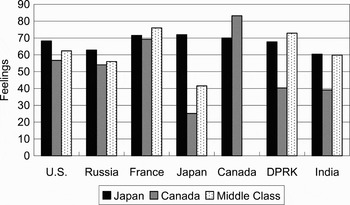
To assess the impact of overseas study, we compare the views of our returnees to the images of foreign countries as held by China's middle class.Footnote 30 We use the middle class as our comparative group as the vast majority of returnees will move into the middle class when they return to China. We extract the values of the middle class from the Global View 2006 Survey of Public Opinion and Foreign Policy which was carried out in the United States, China, India, Australia and South Korea in 2006 by the Chicago Council on Global Affairs and the Asia Society.Footnote 31Figure 1 compares the average scores of the country image among returnees from Canada, Japan and China's middle class for six different countries; the higher the score, the more positive the image. Returnees from Japan and Canada each favoured their host country, indicating the impact of their overseas experience. Returnees from Japan prefer Japan above all other countries.Footnote 32 In contrast, returnees from Canada are significantly more hostile to Japan than to any other country. Similarly, returnees from Canada favour Canada above all other countries. In fact, the most positive image in all three surveys was that held by returnees from Canada towards Canada.
Feelings of Returnees and China's Middle Class towards Seven Countries

Returnees from Japan have a much more positive image of Japan than the middle class, a finding consistent with our first hypothesis. However, the middle class in China has a more positive view of Japan than the returnees from Canada; in fact, the most negative image in the three surveys is held by returnees from Canada towards Japan. So, while living in Japan created a positive image of Japan, staying abroad in Canada, and perhaps having the freedom to read about Sino-Japanese relations, may generate more negative feelings than would be developed by staying at home in China.
Because returnees from Canada and Japan held distinctly different images of countries that were not their host country, the host country's political culture and information flow may affect a person's views of the world. The media in Western societies, such as Canada, is more critical towards other countries, and their citizens emphasize individualism more than Far Eastern societies such as Japan. As a result, returnees from Canada were more critical towards foreign countries than returnees from Japan. So, even though Japan's populace and media dislike North Korea, returnees from Japan were less hostile towards the Hermit Kingdom than returnees from Canada. Not surprisingly, returnees from Canada also view the United States less positively than returnees from Japan. Again, the host country's media and the political climate probably influenced the returnees' views, as Canada's political culture is far more critical of the US than Japan's. Similarly, given the large number of Indian immigrants in Canada, returned Chinese from Canada may have a more critical view of them than returnees from Japan who have limited interactions with Indian skilled workers.
Subjective Orientations towards Foreign Policy
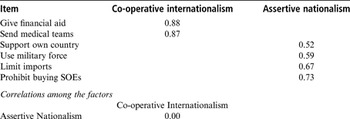
Each respondent was asked 11 questions about their foreign policy orientations. An exploratory factor analysis shows that six questions are interrelated, forming two factors which we label as “co-operative internationalism” and “assertive nationalism”Footnote 33 (Table 2). “Co-operative internationalism” reflects a willingness to help other nations,Footnote 34 and in our study is measured by a returnee's response to two statements: “China should increase its financial aid to Third World countries”; and “Though Africa is far away from China, we should increase our medical teams to serve our African friends.” “Assertive nationalism” is based on responses to four statements, and we further divide it into two sub-categories, “political nationalism” and “economic nationalism.” Assertive nationalism treats outsiders, or the “out-group,” as a negative reference group which challenges the “in-group's” (China's) interests and identity.Footnote 35 In China, assertive nationalists attribute China's weakness to external economic exploitation and cultural infiltration, pursuing a cautious Chinese involvement in world affairs as they seek to limit its vulnerabilities and potential humiliations.Footnote 36
Factor Analysis of Co-operative Internationalism and Assertive Nationalism
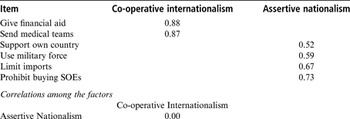
The two questions assessing “political nationalism” are: “Everyone should support their own country even if they think it is wrong” (support own country); and “To protect our country's national interests, we should use military force if necessary” (use military force). The two questions assessing “economic nationalism” are: “To protect our country's economy, we should limit other countries' imports” (limit imports); and “We should prohibit foreigners from buying our large state-owned enterprises” (prohibit buying SOEs).
Table 2 shows that the two co-operative items are not correlated with the four nationalist items, indicating that we are correct to cluster these attitudes in this way. Together, these two factors explain 53 per cent of the variance of our six questions, with “co-operative internationalism” and “assertive nationalism” explaining 27 per cent and 26.5 per cent of the variance respectively.
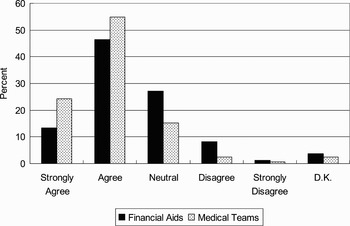
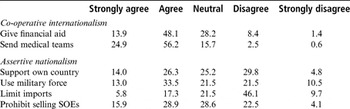
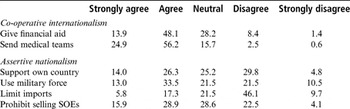
Figure 2 shows the level of support for “co-operative internationalism” among our returnees. They view China's role in international affairs positively; 60 per cent agree that China should increase its financial aid to Third World countries, and 79 per cent support more medical teams for Africa. An analysis of variance finds no statistically significant difference between returnees from Japan and Canada on these two questions at the .05 level,Footnote 37 showing that returnees from these two countries share similar subjective orientations towards international co-operation.
Support for “Co-operative Internationalism” (Combined Views of Returnees from Japan and Canada)

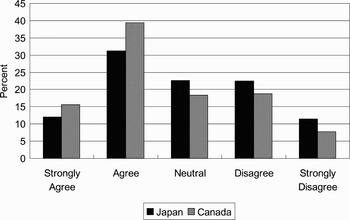
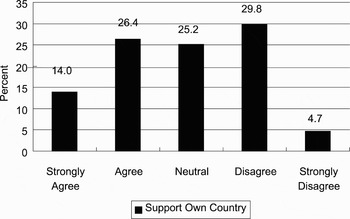
On the other hand, the difference in attitudes between returnees from Canada and Japan towards “using military force to promote China's national interest” is statistically significant (p >.05), with the former group being more nationalistic (Figure 3).Footnote 38 Among all returnees, 44 per cent support the use of military force and 30 per cent oppose it. But returnees from Canada are more hawkish than returnees from Japan: more than 55 per cent of returnees from Canada agree with using military force if necessary, while only 43 per cent of returnees from Japan do. This finding, while somewhat surprising, could reflect the strong pacifist ethos in Japan, something most non-Japanese ignore in their rush to emphasize Japan's militaristic tradition. After all, Japan is the only country in the world to suffer a nuclear attack and Hiroshima Day is a major event in the Japanese political calendar.
Support for Using Force to Promote China's National Interest

Similarly, 40 per cent of returnees from both countries will support China's foreign policy, even if it is wrong (Figure 4), while 35 per cent are more introspective, saying that their support of China's foreign policy depends on whether it is right or wrong. Nevertheless, more agree with the idea of using force than disagree with it.
People who “Support China's Foreign Policy, even if it is Wrong”

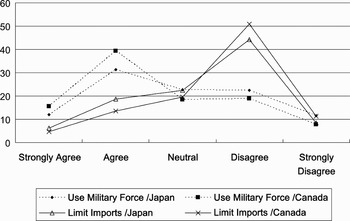
We measure support for economic nationalism by a returnee's views about “limiting imports” and “prohibiting the sale of large SOEs to foreigners.” However, only the difference between returnees from Japan and Canada for the idea of “limiting imports” is statistically significant (p < .000). Figure 5 shows the differences between returnees from Japan and Canada on the questions that measure political and economic nationalism and which are statistically significant.
Support for Economic and Political Nationalism

While returnees from Japan are more pacifist than returnees from Canada, the latter are more supportive of free trade, as returnees from Canada more strongly oppose limiting imports than returnees from Japan. Perhaps the greater openness of the Canadian economy towards foreign (particularly Chinese) imports affects their views. But, taking the returnees together, only 22 per cent support “limiting imports,” while less than 30 per cent support “prohibiting foreigners from buying our large SOEs” (Table 3). Again, this group of returnees is quite liberal and supports opening China to the international system.
Overseas Returnees' Views on International Affairs
We next tested the hypothesis that personal interest leads returnees to support free trade. Here we compare the views of returnees from Japan who work for firms with Japanese investment with the rest of the returnees from Japan in terms of their support for “assertive nationalism.” Employees in these firms should oppose constraints on Japanese imports into China because import constraints would put their jobs at risk. Among the 1,400 returnees from Japan, 25 per cent work for Japanese-invested firms, and our analysis (Table 4) shows that whether or not one works for a Japanese firm affects one's views towards foreign trade.
“Assertive Nationalism,” by Employment in Japanese-invested Firms

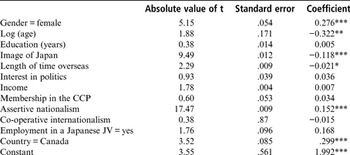
A hard-line nationalistic, and strongly anti-Japanese, sentiment was measured by views towards the statement: “In order to force Japan to make concessions in the East China Sea, I support boycotting Japanese goods.” Responses ran from “strongly disagree” to “strongly agree.” To understand why someone would hold this view, which reflects “economic nationalism,” we tested a multiple regression model (Table 5).
Support for Boycotting Japanese Goods to Pressure Japan

Notes:
* p > .05; ** p >.01; *** p > .001.
As predicted by the literature, older people (age) are less willing to support a boycott than younger people. (The negative score shows opposition to the statement.) People who are “assertive nationalists” are more likely to support a boycott, as are those who studied in Canada (rather than Japan). Similarly, those with a more positive image of Japan oppose a boycott, as do those who have stayed overseas for a longer period. Length of time overseas also leads to less support for the boycott, as predicted. The only surprising finding is that more women than men support the boycott, as it is commonly believed that, on views of war and use of force in foreign policy, women are more dovish than men.
Comparing Returnees and China's Middle Class
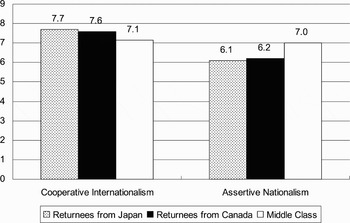
This section compares the subjective orientations of returnees and members of the middle class in China towards co-operative internationalism and assertive nationalism (Figure 6).Footnote 39 We draw the middle-class dispositions from the 2006 China General Social Survey (GSS), an annual survey of urban and rural households in China.Footnote 40 The 2006 GSS questionnaire included questions about international affairs which matched the questions in the CSCSE survey.Footnote 41
Comparing Foreign Policy Values, Returnees and the domestic Middle Class

Results confirm our hypotheses about returnees' attitudes towards international affairs. First, returnees believe more strongly in co-operative internationalism and are less supportive of assertive nationalism than China's middle class.Footnote 42 Of course, a selection bias could be at work, as people who go abroad may be internationalists to begin with. Second, the benefits of international exchanges cause returnees to favour free trade over economic nationalism, a result consistent with Johnston's findings that travel abroad and socio-economic class have an important interactive effect in promoting more liberal attitudes towards trade.Footnote 43 However, returnees and the middle class are closer in their attitudes towards co-operative internationalism than they are towards assertive nationalism, showing that, on the latter, the impact of overseas experiences is more extensive.
Conclusion
Studying overseas affects one's views towards the international system. Returnees looked more favourably on their “host” country than they did on any other country, so hosting Chinese students who return home is a wise policy, as it enhances a host country's “soft power.”Footnote 44 Returned students – academics, scientists, businessmen or political elites – either become part of the “attentive public”Footnote 45 which pays attention to international affairs, or they become opinion leaders who can create a positive view in China about the country where they studied or worked. No wonder the Japanese government funds so many Chinese students to come to Japan. Seeing this link, China's government has mobilized its educational establishment to increase substantially the number of foreign students in China. That number is now well over 100,000, making China one of the top five destinations for foreign students in the world.
Second, the returnees supported international co-operation more than members of the middle class. But people with greater affinity for international co-operation were more likely to go abroad in the first place. Still, living abroad should generate a globalist viewpoint.
Third, the media and the political environment in the two countries are important, as people who studied in Canada or Japan had different feelings towards all other countries, as well as different orientations towards international affairs in general.
Yet while returnees supported engaging the developing world, and are less jingoistic than those who have never gone abroad, a strikingly significant proportion of returnees support Chinese foreign policy, regardless of “whether it is right or wrong.” Many accept using force to promote China's national interests, with sojourners to Canada being more assertive than those who went to Japan. Perhaps Japan's post-Second World War pacifist ethos plays a role. In any case, returned students rally around China's flag which helps explain the intense nationalism displayed by overseas mainland students during the Olympic torch relay. Again, self-selection could be at work, as the more nationalist students are more likely to return. But an intense patriotic education campaign filled China's classrooms in the wake of the 1989 Tiananmen crackdown. It is possible that the young age of the returnees, or their access to information, also explains why those who studied in Canada are even more anti-Japanese than the domestic middle class.
Nevertheless, we know little about the returnees' direct impact on China's foreign policy. Walter Lippmann believed that public opinion is a projection of elite opinion.Footnote 46 Thus the middle class in China is quite patriotic. But returnees are better informed on foreign policy issues than Chinese with little overseas experience and perhaps have stable, deeply held views. Returnees in academia or business have channels by which they send their views to the top political elites – through think tanks, policy papers, meetings, journals and business associations.Footnote 47 Though only a few returnees may make it to the inner circle and become actual policy makers, the impact of an informed citizenry on foreign policy is likely to increase over the coming decades.
Returnees constitute a tiny minority; very few Chinese have lived abroad for any length of time. And it remains to be seen if and when elites and members of the middle class who possess overseas experience will influence state policy. Nevertheless, China's modern history shows the enormous impact of the students who returned to China after studying abroad. They led the modernization of the late 19th century, they overthrew the Qing Dynasty in the 1900s, and they led the KMT and the CCP in their struggle for power from the 1920s to the late 1940s. The cohort that returned from the Soviet Union in the 1950s ruled China for a decade in the 1990s, transforming China's economy and its place in the world. As we look ten years down the road, we may find another cohort of returnees influencing China's ties to the world.