Few international issues generate as much heated debate as the reform of the United Nations Security Council.Footnote 1 This is simply because, even though the Security Council has no army at its command, its decisions are invested with a legitimacy greater than that of any government or rival international organisation. The Security Council is in this respect ‘the most powerful international institution in the history of the nation-state system’.Footnote 2 It is generally agreed that in redefining the distribution of power among states, a reform of the Security Council would signal the dawn of a new global order. While studies on the reform of the Council are relatively abundant, it is surprising that this literature should neglect the historical roots of that process as consistently as it does. In particular, analyses comparing and contrasting the reform of the Security Council with other similar historical episodes of institutional design are extremely rare. This deficiency is precisely what we wish to help correct here.
The debate on the reform of the Security Council can be conceptualised as the most recent episode in the evolution of World Governing Councils (WGCs), that is, the highest-level intergovernmental bodies charged with regulating the international use of violence.Footnote 3 For sure, WGCs have not been truly global until recently, and their capacity to act has always been constrained by power politics. Yet the concept of WGCs is useful to designate those political institutions that have attempted to define the norms and practices of international security over the last two centuries. The evolution of WGCs has been punctuated by three key events: the formation of the Concert of Europe in 1815; the establishment of the Council of the League of Nations in 1919; and the creation of the Security Council in 1945. As a political history analysis demonstrates, a comparison between the current situation and those prevailing in 1815, 1919, and 1945 offers a wealth of lessons, particularly with regard to the continuities running through those episodes. Obviously, a comparison such as this cannot serve as a basis for predicting the outcome of the present debate on the reform of the Security Council, but it nevertheless facilitates the identification of structural tendencies that are likely to affect coming discussions on WGCs, and hence shape the future of international governance.
The article argues that the modern evolution of WGCs is characterised by increasing inclusiveness. Indeed, the history of WGCs shows a trend toward more participation and transparency. As evolving norms and practices of inclusion accumulate over time, they provide new resources in the political struggle over the design of international security governance. While the movement away from concerns of stability, efficiency and power, and toward issues of democracy and openness must not be considered unidirectional or irreversible, our analysis demonstrates that the tendency has been largely continuous over the past two centuries. To explain this pattern of change, we offer some conjectures about an evolutionary social mechanism that we call the ‘ratchet effect’ in international security dynamics.Footnote 4 Norms of inclusiveness, we argue, are the result neither of teleology nor of moral entrepreneurs. Instead, they are the side effects of political struggles over the process and the substance of international negotiations, which, by locking in, tend to constrain future decisions.
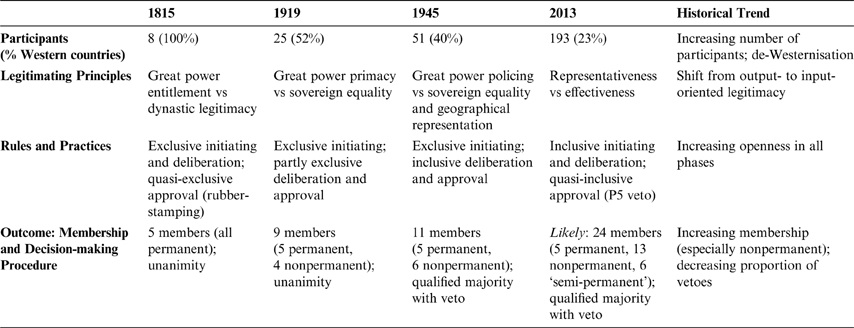
As our study shows (see Table 1), from Vienna to recent discussions on Security Council reform, the ratchet effect has operated on four key variables: (1) the number of participants involved in the deliberations; (2) the legitimating principles put forward by the participants; (3) the rules and procedures of the deliberations; and (4) the outcome of the discussions. In terms of process, the historical analysis of these four variables suggests that the formation and transformation of WGCs have been structured by the political baselines produced by past practices. In terms of substance, our study makes clear that the nature of debates has been shaped increasingly by the diffusion of democratic norms. While a true evolutionary theory of international relations is not yet at hand, we propose that transformations in global governance occur in response to a movement of integration that can be described as ‘a slow process of civilization’.Footnote 5
Historical trends in the formation and transformation of WGCs (1815–2013)

The article will likely raise scepticism from scholars who consider the history of WGCs as a good illustration of how world affairs tend to reduce to power politics. Indeed, compared to most other international organisations, the Security Council remains a very exclusive forum because of its limited membership and the veto right it guarantees to the so-called ‘P5’ countries. Even the International Monetary Fund (IMF), which has often been portrayed as the most antidemocratic of all international institutions, has recently undertaken reforms to give more voice to rising powers and nonstate actors. By contrast, the Security Council has remained essentially unchanged since the 1960s. In fact, one could argue that its inclusiveness has actually decreased in recent decades as UN membership expanded. Our point, however, is that this focus on exclusion captures only a limited part of the story about WGCs, especially when we look at their formation and transformation. These defining episodes are always structured by a tension between exclusionary and inclusionary tendencies. Departing from conventional wisdom, our article emphasises the cumulative aspect of these inclusionary forces. As will be shown, this approach adds an essential dimension to the analysis of WGCs. In particular, it better explains why the current debate over the reform of the Security Council is a political process that is overall more transparent and open than any comparable episode in human history.
The article is divided into two sections. The first includes four historical vignettes summarising the major issues arising from the establishment of the Concert of Europe, the creation of the Council of the League of Nations, the creation of the Security Council, and the current reform of the Security Council. The second section presents a comparative study of these four key episodes in the evolution of WGCs. Our analysis first highlights the four key variables mentioned above. This comparative section then seeks to clarify the theoretical meaning of our findings. It shows that the ratchet effect captures the evolutionary process by which practices create changing baselines that structure political debate and strategy in the unfolding of history.
I. The governance of international security in historical perspective
a. Vienna and the Concert of Europe
The Congress of Vienna, which was held between November 1814 and June 1815, transformed the international order through the establishment of the Concert of Europe. This institution refashioned the practices and norms of international security governance and can be considered the first historical instance of a WGC.
An exclusive club
The Concert of Europe was the product of the Quadruple Alliance formed by Austria, Prussia, Russia, and Great Britain. Bonded together by the war against Napoleon and a conservative ideology centered on the maintenance of order and the legitimacy of divine right, the Quadruple Alliance was made official in the Treaty of Chaumont (9 March 1814), where the signatory states ‘now referred to themselves as the “great powers”’.Footnote 6
The Concert of Europe had a considerable impact on nineteenth-century international relations, one that, according to numerous authors, was ‘remarkably positive’.Footnote 7 Most significantly for our analysis, it changed the conduct of foreign policy by instituting a new kind of multilateral framework. Indeed, the Concert of Europe is closely associated with a policy of balance of power regulated by an ‘exclusive club’ of powerful states.Footnote 8 As Elrod explains, the Concert of Europe ‘consisted only of the great powers; lesser states were occasionally consulted when their interests were involved, but they possessed few rights and certainly not that of equality’.Footnote 9 Some observers contend that the hegemony of the great powers was supported by ‘the tacit acceptance’ of smaller powers that saw in the established order a way to ensure their independence and their rights.Footnote 10 While it is difficult to provide evidence of such ‘acceptance’, what is beyond doubt, however, is that as of the Congress of Vienna, the Concert of Europe helped to reconfigure the international system by institutionalising a new hierarchy of states.Footnote 11
The idea of the Congress of Vienna was inscribed in the first Treaty of Paris (30 May 1814), which was signed, following Napoleon's abdication, by eight countries: the members of the Quadruple Alliance, three states referred to as sous-alliés (Spain, Portugal, Sweden), and France. The forthcoming diplomatic conference was intended ‘to confirm the Paris peace treaty, fill some gaps, and tie the pieces of the settlement together’.Footnote 12 The treaty signatories were not, however, all on an equal footing. Actually, a secret article of the agreement stipulated that the congress would be regulated ‘upon the principles determined upon by the Allied Powers amongst themselves’.Footnote 13 It was true, as suggested by Chancellor Metternich of Austria, that the Congress of Vienna was without precedent and that it ‘could not model itself on any predecessor’.Footnote 14 Yet, in establishing ground rules in the most discretionary manner possible, the great powers had taken every political precaution in order that the event remain under their control.
In the autumn of 1814, while preparations for the Congress were underway, tensions flared up among the Quadruple Alliance, sparking a debate on how the deliberations of the conference should be conducted. Great Britain favoured a council of eight (including all the signatories of the Treaty of Paris), whereas Prussia insisted on the need to restrict the steering committee to the four allied powers. After two weeks of negotiations, during which France and the sous-alliés argued in support of an inclusive approach, an ambiguous compromise temporarily quelled the dispute. Officially the Congress would be under the supervision of the Committee of Eight, but the need for ‘free and confidential communication’ among the great powers was recognised as well.Footnote 15 This clause would ultimately give the members of the Quadruple Alliance unlimited latitude.
In fact, the Eight handled minor territorial matters and appointed the technical committees – such as those concerned with international rivers and diplomatic precedence – but the Four retained control of all sensitive political issues. This division of responsibilities prevailed until the Saxon and Polish questions began to split the Quadruple Alliance. At that point, France's participation in the inner circle seemed ever more crucial in order to keep tensions from escalating. Thus, as of 9 January 1815, ‘the Council of Four became the Council of Five’, which eventually emerged as the ‘the directing organ of the Congress’.Footnote 16 Talleyrand of France, who until then had actively endorsed a policy of openness based on the principle of dynastic legitimacy, provided a perfect example of realpolitik when he ‘gave up his concern for the lesser states' rights’.Footnote 17
It should be kept in mind that hundreds of political leaders had travelled to Vienna. Members of many royal families came in the hope that the congress ‘would restore their stolen “rights”’, and the smaller states wished to gain possession of ‘long-coveted cities and counties’.Footnote 18 As for the peoples of Europe, they were of course shut out of the diplomatic negotiation. Still, they viewed the Concert as ‘a constituent body of Europe which should settle on lofty principles of justice and equity the great problems resulting from twenty years of war’.Footnote 19 These aspirations, however, came up against the wall of exclusion erected by the Council of Five.
The small states, in fact, were never invited to comment on the meeting's agenda, the decision-making process determined by the Eight or the composition of the committees. Their participation was confined to the technical committees and to the committees charged with the geographical ‘subsystem’ to which they belonged.Footnote 20 One of the basic principles at work within the Congress of Vienna was that only the interests of the great powers were broad enough to ‘encompass the whole’.Footnote 21 As noted by Webster, ‘[n]o appreciable difference would have been made in the final settlement at Vienna if the large majority of the plenipotentiaries had never appeared there at all. They merely acted as a picturesque and expensive background to the real Congress of Vienna.’Footnote 22 This appraisal appears all the more justified because ‘the congress never met in full session, with all of the invited parties involved, until the signing of the Final Act in June 1815’.Footnote 23
A limited enlargement by cooptation
The exclusion practiced in Vienna was maintained until the Concert experience came to an end at the time of Germany's unification. After Napoleon took up arms again and was defeated at Waterloo, the members of the Quadruple Alliance institutionalised their strategy in the second Treaty of Paris (20 November 1815), in which they agreed ‘to renew their Meetings at fixed periods … for the purpose of consulting upon their common interests’.Footnote 24 Over the years, the Concert of Europe did coopt new members but it continued to operate on the premise that the great powers comprised ‘a unique and special peer group’.Footnote 25 One of the main privileges enjoyed by the members of this group was veto power. Thus, writes Elrod, ‘unanimity rather than majority rule prevailed in European meetings’.Footnote 26
The Concert of Europe expanded at a snail's pace. In 1818, at the Congress of Aix-la-Chapelle, France became the first state to benefit from its expansion. Later, at the Congress of Paris in 1856, the Ottoman Empire was acknowledged as a ‘partner’, and Italy joined the group in 1867. In sum, during its whole existence, the Concert opened its doors to only a few militarily and economically powerful nations. It took the First World War to resurrect the idea of a world governing council. And, as the next section will show, more inclusive norms were to be applied to the design of the new body.
b. The League Council
The Paris Peace Conference, which began on 18 January 1919, was a turning point in the history of world politics because out of it was born the first permanent organisation designed to maintain international peace, the League of Nations. Even though students of International Relations generally consider it a failure, the experience of the League represents an extraordinary source from which lessons can be drawn regarding the evolution of WGCs.
Paris 1919: The initiative of the victors
The Paris Conference was held amid tensions between forces of conservative and liberal internationalism. On one hand, global order remained almost entirely under the control of the great powers that had formed an alliance to defeat Germany: the United States, France, Italy, Japan, and Great Britain. During the Conference, the ‘Big Five’ club was even further reduced to the ‘Big Four’ when Japan's demands for racial equality were rejected. The central concern of the great powers was ‘to retain control of whatever occurred’.Footnote 27 There was clearly an air of Vienna in this ‘conferential Tzarism’,Footnote 28 such that for some observers the Paris Peace Conference looked more like an inter-Allied meeting than a world congress.Footnote 29
Yet, at the same time, the Paris Conference gave smaller states an unprecedented voice. The new dynamic resulted largely from the experiences of the peace conferences held in The Hague in 1899 and 1907. The Hague process was initiated by Russia's Nicholas II, who was probably more preoccupied by the relative decline of his country's power than he was motivated by a profound commitment towards international disarmament.Footnote 30 In any case, the Hague conferences represented a decisive moment in the history of modern diplomacy. From a legal point of view, these conferences led to the creation of a Permanent Court of Arbitration as well as to the adoption of a series of international conventions dealing with issues such as the pacific settlement of international disputes, the laws of war, and the rights and obligations of neutral countries. From a more political perspective, the Hague conferences marked a turning point in the evolution of multilateralism because they were ‘the most widely attended conferences to date’. The 1909 meeting gathered 44 countries coming ‘from Europe, North and South America and Asia’.Footnote 31 For sure, the Hague process remained largely restricted to what was then called the ‘civilized nations’. Yet the rules of participation established at these conferences helped, to a limited but nevertheless very real extent, to institutionalise the principles of universality and interstate equality as part of prevalent international practices.
The collapse of the great multinational empires due to the war would also foster the rise of small states by strengthening the right to self-determination. Following the deadliest conflict in history, many observers and diplomats firmly believed in the establishment of a new world order inspired by Wilsonian ideals: ‘The equality of nations upon which peace must be founded if it is to last’, President Wilson had declared in 1917, ‘must be an equality of rights; the guarantees exchanged must neither recognize nor imply a difference between big nations and small, between those that are powerful and those that are weak.’Footnote 32 These democratic principles, which were at odds with the reality of power politics, clearly affected the political dynamics of the Paris Peace Conference.
The Council's genesis: The small stand up to the big
The Covenant of the League was among the central issues discussed at the Paris Conference. The major powers managed quite quickly to impose their idea that the body would have a bicameral structure, an Assembly open to all member-states and a more restricted executive Council. But the makeup of the Council, where the important decisions were to be made, was the subject of a fierce confrontation between great powers and smaller states.
The face-off began with the debate on the composition of the Commission that would draft the League's Covenant. The United States and Great Britain were openly hostile to the active participation of small states. Wilson, in particular, proposed to confine the role of smaller nations to reviewing the draft to be drawn up by the great powers. Mindful of the need to offset Anglo-American domination, the French took on the role of defending the smaller nations. At the insistence of Prime Minister Georges Clémenceau, it was eventually agreed that the League Commission would include five representatives of small states, alongside the ten delegates of the great powers.Footnote 33 However, the concession made by the ‘Big Five’ did not satisfy the small states, which demanded the inclusion of four additional representatives from their group. The initial response of the Americans and the British was to reject this demand. But thanks to France's support and the leadership of Paul Hymans, the Belgian Minister of Foreign Affairs, the small states argued that an enlarged Commission would be ‘more fair’, and managed to tip the vote in their favour.Footnote 34
Reflecting the international balance of power, the Covenant draft that was submitted for discussion at the League Commission – the so-called Hurst-Miller draft – was a synthesis of the proposals formulated by the United States and Great Britain. The document proposed the formation of an executive council limited to the five great powers, an arrangement justified by the principle that those countries were the only ones to be ‘directly affected by all matters within the sphere of action of the League’.Footnote 35 The only sign of an opening toward other countries was a clause to the effect that they could participate in Council deliberations, by invitation, if their interests were ‘directly affected’.
During the ensuing debate, the small states denounced the backward step that the Hurst-Miller proposition represented in comparison with the drafts of the covenant that Wilson himself had written. Indeed, until then Wilson had promoted the notion of a Council that, alongside the great powers, would also have included delegates from four countries ‘drawn in annual rotation from two panels, one of which shall be made up of the representatives of the States ranking next after the Great Powers and the others of representatives of the minor States’.Footnote 36 Paul Hymans went so far as to liken the Hurst-Miller proposal to a re-edition of the Holy Alliance.Footnote 37 In a similar vein, the Chinese representative affirmed: ‘the smaller nations must not be made to feel that there is a gulf between the great powers and the smaller ones’. In support of the small states' point of view, Léon Bourgeois of France argued that if the Council's power were to be concentrated in the hands of the great powers alone, there would be a risk of them acting ‘rather for peace than for peace founded on justice’.Footnote 38
Revising his previous positions, Wilson contended that the League Council must be restricted to ‘interested parties’.Footnote 39 He argued that since the great powers would have to shoulder the bulk of the League's military and economic burden, the creation of the organisation would have to be accomplished ‘without [it] making the [great] powers too uneasy’.Footnote 40 Meanwhile, the British representative, Lord Robert Cecil, contested above all the idea that the Council might institutionalise a quasi equality between the great and the small powers. Cecil pointed out that the smaller states' demand would entail the ‘real risk of one or two great powers holding out’.Footnote 41 His position was based on reasons of justice and pragmatism. For Cecil, ‘the real security for the small nations must be the sense of justice of the large ones’.Footnote 42 He was furthermore convinced that, whatever was decided as to the Council's makeup, the small powers would ‘join [the League] anyway’.Footnote 43
Today, it seems extraordinary that the impasse, which Cecil described as a ‘great and fundamental difference of opinion’,Footnote 44 was resolved in less than ten days. The Commission ultimately accepted the proposal of the small countries: a Council comprised of nine members, with permanent seats reserved for the great powers. The proposal also stipulated that the representatives of the small countries would be selected by the Assembly, ‘from time to time in its discretion’.Footnote 45 It was furthermore agreed that until the inaugural election of the Assembly, ‘representatives of Belgium, Brazil, Spain and Greece shall be members of the Council’.Footnote 46 According to certain analysts, the small powers had scored ‘an absolute victory’.Footnote 47 For others, there was ‘no doubt’ that ‘the true victors were the great powers’.Footnote 48 Certainly, the great powers could celebrate the fact that the compromise cemented their ‘right of primacy’ in international law.Footnote 49 In addition, Council decisions were to be made unanimously, which amounted to a veto for great powers. Finally, the American and British governments could draw comfort from the fact that the ‘paper obligations’ of the Covenant had been kept at an ‘absolute minimum’.Footnote 50 The small states were undoubtedly aware that the compromise they had wrested was not about to overthrow the mastery of might in international relations. Yet their political achievement constituted a major innovation. While the great powers had succeeded in institutionalising a de facto situation, the small states had effectively managed to transform the governance of international security by introducing a new principle of democratic inclusion.
Ever more inclusive expansions
Over the years, the flexible amendment rules specified in the Covenant were such that the composition of the Council fluctuated widely. Since the United States Senate never ratified the Versailles Treaty, of which the Covenant was a part, the League Council was at first comprised of four great powers and four smaller powers, so that the great powers were deprived of a majority. The Manchurian and Ethiopian crises subsequently led to Japan and Italy withdrawing from the League – and its Council – in 1935 and 1937 respectively. On the other hand, two new permanent seats were granted, to Germany (1926) and then the Soviet Union (1934), when those countries joined the organisation. Both those seats disappeared, of course, with Germany's withdrawal (1935) and the USSR's expulsion (1939) from the organisation. Following these changes, Great Britain and France were the only remaining permanent members of the League Council when the Second World War broke out.
The number of nonpermanent members of the Council also changed considerably over time. Between 1920 and 1922, due to the League's increased membership (from 42 to 52) and the fact that the small states originally appointed to the Council had acquired ‘something like a vested right to re-election’,Footnote 51 the organisation created two new nonpermanent seats to be filled by the Assembly. In 1926, Germany's admission to the Council was offset by the addition of three nonpermanent seats. Those three seats were intended for three-year terms, but with a two-thirds majority the Assembly could re-elect their incumbents indefinitely. This is what allowed Spain and Portugal to become ‘semi-permanent’ members, and to sit on the League Council continuously. From a normative perspective, it should be noted that, as of 1920, the election of nonpermanent members was based on the principle of ‘equitable geographical distribution’.Footnote 52 This principle was applied in a way that made it possible for the ‘chief groups’ (that is, Latin America, Asia, the countries of the Little Entente, ex-neutral Europeans, and the British Commonwealth) to ‘always be represented’.Footnote 53
Compared to the Concert of Europe, the experience of the League of Nations brought about a twofold evolution of WGCs. On one hand it legalised the special status of the great powers but on the other hand, it also legitimised the active participation of the small states. Often downplayed, this second trend illustrates how WGCs began to be more inclusive. Thanks to the ratchet effect, the trend was still palpable when the UN was created in 1945 and remains today one of the main features of the debate on the reform of the Security Council.
c. The Security Council
International security governance made a qualitative leap with the adoption of the UN Charter on 26 June 1945 at the San Francisco conference. Designed essentially by the United States, Great Britain, and the Soviet Union during the Second World War, the Security Council enshrined the special role of the great powers by granting them rights surpassing the ones they enjoyed in the League Council. At the same time, the San Francisco conference made it possible for the Security Council's creation to be the subject of unparalleled deliberations among the world's governments.
The leadership of the great powers
The UN and the Security Council were the results of negotiations dominated by the major powers allied against Germany and Japan during World War II. Until the San Francisco meeting the negotiations sometimes included four parties – the United States, Great Britain, the Soviet Union, and China – but China's contribution to the ‘Big Four’ was always marginal. In view of the leadership they exercised during the war, it was no surprise that the great powers expected the Security Council to grant them special status. In the United States, for instance, President Roosevelt had often articulated the idea that after the war the United States, Great Britain, the Soviet Union, and China ‘for many years to come … would have to police the world’.Footnote 54 Churchill, for his part, had publicly envisioned the creation of regional councils under the overarching supervision of a Supreme World Council comprised of the Big Four and ‘certain other Powers’.Footnote 55 Finally, the USSR was resolved to maintain its alliance with the United States and Great Britain, and to preserve an ‘absolute veto’Footnote 56 in order to defend its interests.
There is nothing ambiguous about the major powers' monopoly on the initiation and drafting stages of the establishment of the Security Council. The Teheran conference (November 1943) gave Roosevelt, Churchill, and Stalin the opportunity to meet for the first time, and to agree on the principle that was to become the keystone of the postwar world order: unanimity of the great powers.Footnote 57 A few months after the Teheran accord, the Dumbarton Oaks conference (August–October 1944) was where the first complete draft of the UN Charter was written. That draft included an agreement on the membership of the Security Council, which was to comprise 11 states, of which five permanent members: the Big Four and France.
Compared to the membership issue, the decision-making process within the Security Council – which involved defining the majority rule for a resolution to be adopted as well as the use of the veto right – gave rise to far more strenuous discussions. Attentive to the positions of its dominions and of the other smaller powers, Great Britain defended the notion that ‘a Great Power should never be permitted to vote and exercise its veto when … involved in a dispute before the council’.Footnote 58 The British also preferred a two-thirds majority because it would give more weight to the nonpermanent members of the Council. Conversely, the Soviets demanded that the principle of great power unanimity be fully maintained and believed it would be more efficient if decisions were made on the basis of a simple majority.
Even though the Americans ultimately sided with the British, the situation remained deadlocked until the Yalta Conference (4–11 February 1945). There, it was agreed that Security Council decisions on substantive questions would be adopted with a qualified majority of seven votes, and that the use of the veto would be subject to a single exception: cases related to the peaceful resolution of a conflict in which a great power is involved. As Hurd has observed, this reservation was the expression of a desire for compromise between the interests of the great powers and those of other states: ‘With military enforcement against one's self subject to the veto but a peaceful settlement not so, the permanent members were assured of being able to avoid hostile actions against themselves while at the same time maintaining at least an appearance for small and medium states that the permanent members could not foreclose all critical discussions against them in the Council.’Footnote 59 Official invitations to the San Francisco conference were sent out in March 1945, ‘and those invited were told at the same time about the agreement reached at Yalta on the voting procedure in the Security Council’.Footnote 60
San Francisco: An open debate
The great powers' monopoly on the design of the UN and the Security Council had prompted many states to express criticisms to the effect that the overall process was deeply antidemocratic. The organisers of the San Francisco conference were therefore faced with a formidable political challenge. ‘This challenge’, writes Hurd, ‘was met by a strategy of legitimation by the sponsoring states that relied above all else on the legitimating power of procedural correctness.’Footnote 61 The first stage in that strategy consisted in making the event as inclusive as possible. Fifty states – almost twice the number of signatories of the United Nations Declaration of 1942 – took part. Enemy states were excluded but in accordance with the colonial episteme of the day, those fifty states could pretend that they represented nearly the entire international community.
The section on the Security Council, like the rest of the Charter, was submitted for examination to a committee in which any state could propose amendments and where decisions were made by a two-thirds majority. Thus, ‘the Great Powers were obliged to convince, or at least cajole, other states into accepting their schemes’.Footnote 62 Out of this arrangement came ‘the most extensively multilateral debate ever held for the shaping of the broad outlines of the world political system’.Footnote 63 Even if the Conference was ‘a Great Power affair’, according to Simpson, ‘the adoption process was much more egalitarian than at Versailles, where the Great Powers controlled the steering committee and acted as gatekeepers for any proposals’.Footnote 64
One issue under discussion concerned the nonpermanent seats. A number of middle powers (Canada, Australia, the Netherlands, India), hoping to gain privileged access to the Council, endeavoured to have the criteria for the selection of nonpermanent members defined so that a states' contribution to international security would be more effectively taken into account. The smaller states, for their part, stressed the need to ensure broad geographical representation.Footnote 65 The sponsoring powers, wishing to reconcile the different positions, succeeded in having an amendment adopted whereby the election of nonpermanent members would be done with ‘due regard being specially paid in the first instance to the contribution of members of the Organisation towards the maintenance of international peace and security and towards the other purposes of the Organisation, and also to equitable geographical distribution’.Footnote 66
A number of countries also proposed that the total membership of the Council be raised to 15. They argued that a 15-member Council would be more representative but not less efficient. They furthermore pointed out that if the Council had only six elected members, the criterion of geographic distribution would be inapplicable, and that the criterion pertaining to a state's contribution to the maintenance of international security would preclude the election of smaller states. Grounding their arguments in notions of representativeness and legitimacy, the great powers retorted that an 11-member body would guarantee a proper balance between great and small powers. They also stressed that a smaller Security Council would speed up its response time, and that the security of small states would be served better by a more compact and stronger Council than by a larger but weaker one.Footnote 67 Ultimately, the nations in favour of an expanded Council withdrew their proposed amendment and the project of an 11-member body was adopted with no opposition (with six abstentions).Footnote 68
Although the small states had soon accepted a form of veto for the great powers, this issue sparked the sharpest debates. One of the American delegates, Senator Arthur Vandenberg, aptly summed up the delicacy of the situation in his journal: ‘This ‘veto’ bizness [sic] is making it very difficult to maintain any semblance of the fiction of “sovereignty equality” among the nations here at Frisco.’Footnote 69 To begin with, a number of delegations demanded clarification on the extent of the veto. In a break with established procedure, a bloc-to-bloc dialogue was organised between small and big powers. It was agreed that ‘the other members of the Conference would submit questions to the sponsoring powers about the interpretation of the voting formula’ and that ‘the latter would agree on a joint statement in reply’.Footnote 70 After some internal waffling the Big Five finally presented a collective answer, insisting on the notion that from their standpoint they were duty bound ‘to serve and not to dominate’.Footnote 71 In substantive terms, the response of the great powers was centered on the distinction between ‘procedural’ issues – where the veto is not allowed – and ‘other’, ordinary matters. It specified that any decision about a threat to international security should be regarded as an ordinary matter, whereas potential threats ought to be seen as a procedural issue.
Many states, finding such explanations inadequate, subsequently strived to restrict the use of the veto. Under the leadership of the Australian Minister of Foreign Affairs, Herbert Evatt, the opposition found expression in a proposed amendment, which would turn out to be the only one put to a vote. The proposal demanded that the veto be used exclusively in relation to issues pertaining to Chapter VII of the Charter. For the Big Five, the amendment was unacceptable and they vehemently fought against it. Even though the Australian proposal was defeated by a divided vote of twenty to ten, with 15 abstentions,Footnote 72 it transformed the mood of the conference. Following their defeat, Hurd explains, ‘the opponents of the veto ceased trying to alter the text of the Charter and switched to supporting the new organization, making much of the justificatory reasoning in the Great Powers' statements’.Footnote 73 In the final analysis, the great powers' initial project for the Security Council was scarcely altered. However, this project was adopted within the framework of a process that was certainly more open and transparent than in 1815 and 1919. The ratchet effect towards more inclusiveness in WGCs was thus once again visible.
The 1963 expansion: Geographical distribution gains traction
The security architecture inherited from San Francisco came under revision during the 1960s, when four nonpermanent seats were added to the Council. With the rise of the Non-Aligned Movement (NAM), African and Asian states had gained new political momentum at the UN. In December 1963, in tandem with a group of Latin American countries, the NAM tabled a draft resolution calling for the addition of four nonpermanent seats. Predictably, permanent members were quick to object; the Soviet Union, for one, based its opposition on the absence of Communist China from the Council.Footnote 74 A resolution was nonetheless adopted by a vote of 97 to 11, with four abstentions (including those of the United Kingdom and the United States). After the General Assembly vote, in an attempt to regain the favour of newly independent states, Moscow changed its position and ratified the proposed amendment within days. Faced with similar pressures, Taipei, Paris, London, and finally Washington followed suit.
Within a year and a half, two thirds of the UN members, including the five permanent members of the Council, had ratified the Charter amendment.Footnote 75 Rather unexpectedly, advocates of increased inclusiveness were able to win over those who benefited the most from exclusivity. The impact of normative arguments seems to have been particularly strong when one considers that the P5 countries had the legal power to reject the proposed amendment. It is moreover noteworthy that the 1963 resolution allowing the expansion of the Council stipulated that the ten nonpermanent seats would be filled according to a strict pattern. Five would come from Africa and Asia, one from Eastern Europe, two from Latin America, and two from Western Europe and other states.Footnote 76 More than ever, the legitimacy of a WGC was tied to a geographical and – implicitly, at least – demographic balance.
d. Reforming the Security Council (1993–2013)
In recent years, the debate over reforming the Security Council has gone through various phases as its normative terms shifted noticeably. More specifically, matters of representativeness have come to trump the focus on efficiency of the immediate aftermath of the end of the Cold War. As such, current discussions over Security Council reform provide the latest example of a historical trend toward more inclusiveness in the evolution of WGCs.
The failure of the Razali plan: The ball changes hands
With the end of the Cold War, a consensus quickly emerged within the UN membership that the composition of the Security Council did not reflect anymore the new reality of world politics. In December 1992, the General Assembly invited member states to express their views on the ‘Question of Equitable Representation on and Increase in the Membership of the Security Council’ (RES 47/62). From the outset, participation in debates was open to all states. In the fifty-some position papers submitted, two main visions emerged about legitimating principles. The orthodox view was, to use Australia's words, that ‘[t]he principal concern in any review should be to maintain and, where possible, enhance the effectiveness of the Security Council’.Footnote 77 Prominent among those voices in favour of output legitimacy were the P5, which, in the wake of the Gulf War, took special pride in the Security Council's ‘newly acquired energy and operational effectiveness’.Footnote 78 Even Japan's 1992 bid for a permanent seat was justified along similar lines of contribution to the maintenance of international peace: ‘in the future’, declared Japan's representative, ‘we do not want to be just good taxpayers, but to have a word to say on the important decisions that are taken in the United Nations’.Footnote 79
Against this orthodoxy, a number of UN member states, mostly from the developing world, sought to cast Security Council reform under a different light. Pakistan, for instance, expressed the view that ‘the process of democratization and the transparency in the work of the United Nations and its many bodies should avoid perpetuating the current inequities by creating new centres of privilege’.Footnote 80 In a more self-interested fashion, India argued that ‘population’ – which ‘represents both an expression of the principle of democracy and an element of power’Footnote 81 should preside over expansion, while Nigeria declared that ‘[f]or the Security Council to be representative it must sufficiently reflect the population distribution of the world.’Footnote 82 According to this heterodox position, representativeness, fairness, transparency, participation, equitable geographical distribution, and democracy should inform the reform process.
At first dominated by Western voices, the reform debate changed directions in 1993 when the Non-Aligned Movement, under Indian leadership, initiated the creation of an Open-ended Working Group on the reform of the Security Council. In this Working Group, which worked according to consensus, arguments about order, efficiency, and stability gave way to various ‘proposals aimed at making the Security Council more representative of the UN as a whole, at augmenting the power of the countries of the South, and at reducing … the perceived monopoly of power of the permanent five’.Footnote 83 In its February 1995 platform, for instance, the NAM conditioned its support of Germany and Japan to the accession of at least three developing countries to permanent status (the ‘2+3’ proposal).
Around the same time, under Italy's leadership a group of countries dubbed the ‘Coffee Club’ came out against any expansion in the permanent category, emphasising the inherent inequality of that status. In the Italian ambassador's words, ‘the five current permanent members are all from the northern hemisphere, and almost all of them are fully industrialized. Adding two more with the same profile (that is, Germany and Japan), rather than correcting this imbalance, would clearly aggravate it.… The end result would be a small directorate of big countries, making critical decisions on questions that affect us all, but on which we have no say.’Footnote 84 Democratic principles were thus put front and center. Quickly, a number of countries, including Argentina, Canada, South Korea, Libya, Mexico, Pakistan, Spain, Turkey, and Ukraine, joined their voices in advocating enlargement to nonpermanent membership only. Their opposition grew stronger when three permanent members of the Council, Russia, the UK and the US, began to promote variants of the ‘2+3’ proposal in order to preserve what Bourantonis calls ‘the principle of great power cooperation’.Footnote 85
In order to solve the deadlock, in 1997 General Assembly President Ismail Razali proposed a reform plan providing for five new permanent seats (devoid of veto: ‘To do so would be to compound an inequity’, declared RazaliFootnote 86) and four new nonpermanent seats. The process that led to the Razali Plan was meant to be inclusive, with 165 delegations consulted. However, the plan was defeated when the ‘Coffee Club’ was able to secure Resolution 53/30 which ensured that any reform of the Security Council would be decided through a formal Charter amendment – a procedure that the Razali Plan had tried to circumvent by placing the first stages of reform under Article 18 of the Charter regarding ‘important questions’. This vote killed momentum in favour of reform for the next few years.
The 2005 World Summit: When inclusion breeds division
After the failure of the Razali Plan, the next push came not from member states, but from Secretary-General Kofi Annan, who in 2003 tasked a ‘High-level Panel on Threats, Challenges and Change’ to examine the issue. Consisting of 16 members, the Panel's composition allowed for wide geographic representation while also ensuring the full presence of the P5. In its report, the High-level Panel proposed two criteria for new representation on the Security Council: ‘those who contribute most to the United Nations financially, militarily and diplomatically’ and ‘[those] more representative of the broader membership, especially of the developing world’.Footnote 87 While similar to the Charter's criteria for nonpermanent seats, the Panel's proposal differed in three ways pertaining to legitimating principles and Council membership. First, it applied these criteria not only to nonpermanent seats, but also to new permanent members. Second, it added a financial dimension to contribution to peace and security, which enlarged the notion beyond hard power. Third, it specifically mentioned the developing world and omitted geography as the fundamental criterion of representativeness.
In March 2005, Secretary-General Annan endorsed the two reform models outlined by the High-level Panel. In Model A, six new permanent seats – without veto – would be created alongside three new nonpermanent seats. Model B, for its part, called for the creation of eight four-year, renewable-term seats, in addition to one new nonpermanent seat. In both cases, a review was to be held in 2020. In terms of procedure, the Panel and Annan also supported a new system of ‘indicative voting’, by which Security Council members, including permanent ones, would have to render public their positions on a proposed action.Footnote 88 Overall, the 2004–5 reform proposal, which originated from international officials as opposed to the UN members, sought to relax the exclusiveness of the Council in at least three ways: first, by enlarging the number of permanent seats (model A) or by linking extended stays on the Council to regular elections (model B); second, by introducing a review mechanism ensuring further consultations with the wider UN membership in the medium term; and third, by imposing a limited form of accountability on the exercise of the veto.
Annan's project, however, was immediately met with contestation. By July 2005, three distinct groups of states – the Group of Four (G4: Brazil, Germany, India and Japan), Uniting for Consensus (UfC: essentially the former Coffee Club), and the African Group (comprised of all African UN members) – had come forward with separate draft proposals in preparation for the upcoming World Summit. The G4 text suggested adding six permanent and four nonpermanent seats. UfC proposed ten new nonpermanent seats, subject to renewal. The African Group, finally, advocated two new African permanent seats, to be attributed internally. Despite long negotiations, the G4 and the African Group failed to find an agreement, largely because the former were willing to compromise on the veto for new members, while the latter refused. Short of the required two-thirds majority at the General Assembly, the G4 proposal also faced opposition from the P5, with the US and China lobbying to stop the reform momentum and Russia showing no enthusiasm. Despite the unprecedented inclusiveness of the 2004–5 UN debate on the future of the Security Council, its ultimate fate was in part decided by a privileged few. In the end, no vote was taken on Council reform on the occasion of the 2005 Summit.
Current negotiations: The imperative of democratic principles
Despite the significant ‘reform fatigue’ that ensued the 2005 deadlock, debates over Security Council reform resumed in 2007. A group of developing countries nicknamed ‘L.69’ tabled a draft resolution in September 2007 calling on the General Assembly ‘to immediately commence results-oriented intergovernmental negotiations’.Footnote 89 This initiative led to a rapprochement between two G4 members (Brazil and India) and other developing nations, including small islands and major African countries (Nigeria and South Africa). Thanks to this realignment, L.69's will to ‘enhancing the Council's responsiveness to the views and needs of … developing countries’ has remained, so far, a central axis in reform debates.Footnote 90 With the adoption of its Resolution, L.69 (with the G4) triumphed over UfC opposition in moving reform negotiations from a consensus-based working group to an informal plenary session of the General Assembly (with vote-taking). In December 2009, G4 members plus South Africa started to compile signatures in order to request the chairman of this forum, Ambassador Zahir Tanin, to present states with a negotiating text. In the end, 140 countries supported the initiative, including France and the United Kingdom. During the meetings held over the following year, key issues debated included whether to create a new category of ‘semi-permanent’ seats, how to select potential new permanent members, and whether to curtail the use of veto.
Not much progress has been registered since, and at the time of writing, negotiations remained largely stuck. All in all, reform debates cannot be said to have made a lot of progress over the past generation. The basic cleavage, between those that pursue permanent membership and those that oppose them, remains as central as ever. That stalemate shows no signs of abating so far. However, over the past two decades the terms of the debate have shifted rather significantly. Gradually, notions of representativeness have come to take over earlier concerns for efficiency and order. Even G4 members, who aspire to exclusive privileges, now couch their arguments along democratic principles. In line with the ratchet effect, inclusionary principles have gained a legitimating power that they never had in past discussions concerning the formation of WGCs.
II. The politics of inclusion: A comparative analysis
a. Historical trends
This section draws a set of comparisons between the four historical episodes surveyed above. We focus on four key dimensions: (1) the number and origins of participants in the formation and transformation of world governing councils; (2) the main contending principles of legitimacy; (3) the key rules and practices that structure the process throughout its various phases; and (4) the nature of the governing council created, especially with regards to membership and decision-making procedures. All of the trends that we identify are possibly reversible and many of them are not perfectly linear. However, the historical record suggests that the evolution of WGCs has been strongly shaped by a political dynamics of inclusion. Our findings are summarised in Table 1.
Participants: More numerous and more diverse
With regards to the number and origin of participants, the historical trend across the four episodes is striking: governments involved are ever more numerous, moving from a sheer eight in 1815Footnote 91 to 25 in 1919, 51 in 1945, and finally 193 participants in 2013. This exponential increase implies not only that the entire world population is now represented in the current reform process, but also that it can speak with many voices. In fact, the universalising trend is even more striking when considering the decreasing proportion of participants of Western origin: from 100 per cent in the Concert of Europe, Western countries now amount to less than a quarter (23 per cent) of the UN membership involved in Security Council reform debates. As argued before, a turning point in expanding the international society was the Hague conferences organised at the turn of the twentieth century. Decolonisation then helped multiply UN membership almost fourfold. Of course, this evolution in numbers did not automatically translate in decreasing Western influence over the design of WGCs. Yet it remains striking that the non-Western world's participation in today's negotiations bears absolutely no resemblance to what it was two hundred years ago: from completely absent, non-Western states now represent an overwhelming majority.
Legitimating principles: From output to input legitimacy
Our second comparative dimension, legitimating principles, allows us to unearth a key evolution of the last two centuries: a gradual shift from output to input notions of legitimacy. As various experts have explained, input legitimacy refers to the capacity of a political system to reflect the preferences of the members of a community. By contrast, output legitimacy relates to the capacity of a political system to achieve its substantive purposes and increase public welfare.Footnote 92 It is important to recall that the distinction between input and output legitimacy is seldom clear-cut. In the four episodes surveyed above, powerful states have simultaneously argued that they had the right to dominate, and that their domination would serve the common good. Nonetheless, when one compares contemporary debates over Security Council reform with similar episodes of the past, the importance granted to the notion of representativeness (and, to a lesser extent, to transparency and accountability) has no historical equivalent. In 1815, for instance, the two main contending visions rested on the natural rights of great powers to dominate vs those of monarchical dynasties to possess sovereignty. The latter principle, which challenged the domination of the allied powers, was mainly championed by France's Talleyrand who built on Louis XVIII's status as a ‘legitimately restored monarch’ to invoke a ‘droit d'antique possession’.Footnote 93
Understandings of legitimacy had considerably shifted by the early twentieth century. Most noticeably, the principle of sovereign equality was bolstered by the Hague conferences. Depicted as ‘major diplomatic assemblies of the small states on equal terms with the great powers’,Footnote 94 these conferences ushered an era of positive legalisation that stood in contrast with the natural law doctrine of previous centuries. Wilson's Fourteen Points, including the notion of self-determination, also strengthened the challenging principle of sovereign equality. In the end, though, Wilson, like his British counterparts in Paris, defended the principle of great power primacy in the remaking of the world order. Significantly, their rhetoric was not anymore that of a natural entitlement to command, as in Vienna, but rather of a responsibility associated with certain privileges. In 1945, the San Francisco conference gave way to a similar balancing act. While a majority of participating states supported the principle of great power policing, several of them also expressed serious reservations to institutionalised privileges like the veto right. Notions of sovereign equality loomed large in the heated debates that took place in 1945, as did the principle of geographical representation with regards to the selection of nonpermanent seats.
While already discernible in 1919 and in 1945, growing concerns about input legitimacy became particularly clear in the post-Cold War era. In the early 1990s, a majority of UN member states advocated reform with an eye to rendering the Security Council more efficient. New permanent members, for example, had to be the ones who could deliver the best contribution to the maintenance of world peace. Notions of effectiveness remain important to this day, but they have gradually lost prominence to the idea of representativeness. It is by now uncontroversial among UN members, for instance, that new permanent seats should go to the developing world. As non-Western voices grow louder, the reform debate has increasingly come to take place against a background of democratic principles, including representativeness, diversity, accountability, and transparency.
Rules and practices: An increasing openness
When it comes to rules and practices, the historical trend clearly points towards slowly increasing openness. For heuristic purposes, the constitutive process can be divided in three phases: initiation, deliberation, and approval. We argue that over the past two hundred years, thanks to evolving formal and informal procedures, the influence of smaller states has perceptibly grown, compared to that of great powers, at all stages.
On the exclusive side of things, the Congress of Vienna was a watershed in establishing hierarchical distinctions between great and small powers, with the sous-alliés in the middle.Footnote 95 At the institutional level, the great powers created a complex ‘system of committees’Footnote 96 whose membership they strictly controlled. At the top sat a Directing Committee, comprised of Austria, Great Britain, Prussia, Russia and, from January 1815 on, France. Smaller powers were confined to functional committees with limited political consequences like the Committee on International Rivers.Footnote 97 In the end, both deliberations and decision-making remained under ‘great power tutelage’ with ‘exclusive prerogative of decision making’.Footnote 98 To put it cynically: ‘The Allies deemed it necessary to preserve the “initiation” in their own hands and by “initiation” they really meant “decision”.’Footnote 99 As for the Congress itself, its role was limited to that of a ‘ratifying instrument of the decisions the four Great Powers’, as Webster explained.Footnote 100 Overall, then, the Congress of Vienna was a highly exclusive affair. Nonetheless, it paved the way to modern multilateralism, notably by enlarging the society of states and by regularising its diplomatic meetings.
1919 was a milestone in terms of inclusion. While great powers retained control over the set-up and the drafting of the League Covenant, they agreed to include four smaller countries in the Commission that presided over deliberations. In this case, it was primarily France's Clémenceau who ‘championed the small states' right to full participation’ and ‘eventually convinced the British and American leaders’.Footnote 101 For the first time in history, great powers formed a minority in the constitutive process of a WGC. Despite these considerable gains, however, overall the design of the League of Nations was characterised by the clear preponderance of great powers.
In 1945, the San Francisco conference brought about new procedures of deliberation and approval whose inclusiveness was unprecedented. Although the drafting of the UN Charter was kept under the control of the American, British, and Soviet great powers, the text was put up for debate by representatives of fifty governments over a two-month period. Throughout the spring of 1945, small and middle powers were given a tribune to express their views and try to win a few amendments. According to Bosco, Roosevelt envisioned the San Francisco conference as an opportunity for smaller states to ‘blow off steam’; he had no intention to move away from the ‘great-power dominion’ that he had envisioned with his four ‘policemen’.Footnote 102 In the end, though, the San Francisco conference participants had to approve (by a two-thirds majority vote) each and every article of the Charter – a procedure that constrained great power influence to an unparalleled degree. While the outcome confirmed the principle of ‘great power leadership’, the constitutive process recognised more than ever the value of inclusiveness.Footnote 103
In the post-Cold War era, finally, all stages of the constitutive process have been characterised by unprecedented inclusiveness. For one thing, the Open-ended Working Group that presided over reform debates for 15 years was initiated by the Non-Aligned Movement, which is not exactly a club of great powers. Since then, dozens of members have tabled proposals, including draft resolutions – witness, for instance, the many initiatives taken over the years by the Small Five group (S5), comprised of Costa Rica, Jordan, Liechtenstein, Singapore, and Switzerland. Second, in the many forms that it has taken so far (ad hoc working group, informal plenary sessions, etc.), the deliberation process has remained open to all interested UN members, with most of them expressing their views at one point or another. That said, when it comes to the approval procedure the picture is more ambiguous, insofar as any Charter amendment requires ratification by two-thirds of UN member states, including all P5 countries. As a result, in the current negotiations over Security Council reform great powers exert their influence indirectly, through the veto specter: overall they do not take an active part in drafting and deliberation, knowing full well that in the end any decision will require their assent.
Outcome: Ever-larger WGCs
Finally, with regards to the shape and functioning of the governing councils created (more specifically the number and status of members as well as decision-making procedures), we observe a trend toward increasing membership and, in proportional terms, a diminishing number of veto points.
The number of states involved in WGCs has risen steadily, from 5 in 1815 to 9 in 1919, 11 in 1945, and 15 in 1963; that number could go up to 24 in the near future. To be sure, the gradual enlargement of WGCs has been partially offset by the fact that WGC members represent a smaller proportion of the international community. In 1945, for example, the Security Council included 21.6 per cent (11/51) of the UN membership. That proportion fell to 12.8 per cent (15/117) in 1965, when the 1963 amendment came into force, and it could decline to 12.4 per cent (24/193) if current reform propositions were adopted. These figures indicate that the politics of inclusion does not operate in a linear way, and they remind us that WGCs remain very elitist clubs. At the same time, these numbers must be put in the context of the unique expansion in the number of sovereign states since the end of the Second World War. With this special context in mind, it would be counterintuitive to argue that the Security Council is becoming increasingly exclusive.
Our analysis also shows a relative decrease in veto points. In 1815, the Directing Committee was comprised of only five great powers acting in accordance to unanimity rules. The dominance of great powers over world governance was total. Then, in 1919, the war winners sought to strike a balance between preserving decision-making within their hands and addressing the small states' demands for inclusion. As Sharp notes, part of the answer came with the Plenary Conference, ‘which all recognised Allied States would attend but where discussion would be limited’.Footnote 104 In terms of outcome, two observations seem important. First, as with the Concert of Europe, the League Council's consensus rule meant that each individual member – including the small powers – disposed of an actual veto on decision-making. And second, due to the successive withdrawal of different great powers, for most of its existence, the League Council was comprised of a majority of nonpermanent members.
Unanimity rule came to an end in 1945, when the Security Council, then comprised of 11 members, began to work on the basis of qualified majority. The change introduced a significant difference among Council members: permanent members benefited from a veto, while others had only a normal vote. Also noteworthy is the fact that in the Security Council, great powers have always formed a minority (from 45 per cent in 1945 to 33 per cent after the 1963 amendment). This proportion will most likely decrease even further should current reform debates produce an agreement. The addition of more nonpermanent seats as well as ‘semi-permanent seats’ would mean that veto holders may count for only 21 per cent (5/24) of Council membership in the future.
b. Theoretical conjectures: The ratchet effect in the evolution of WGCs
How is it possible for a normative pattern such as the one we describe in this article to set in over the long run? In this section we hypothesise the existence of a ‘ratchet effect’ in the modern evolution of WGCs, by which changing patterns of practice lock in and accumulate over time. The ratchet effect seeks to describe a cumulative trend toward increasingly inclusive practices and principles in the formation and transformation of WGCs over the past two centuries. Our argument highlights the evolutionary consistency of historical practices, which, although at times deviating, generally add up in a larger pattern. We suggest that the operation of this ratchet effect toward more inclusiveness operates at two levels. In terms of process, past and current practices tend to form new baselines for future negotiations. When it comes to substance, the wider diffusion of democratic norms over the past two hundred years provides a direction for change.
In terms of social process, the key mechanism at work is the logic of practicality, by which established ways of doing things today flow from past practices and inform future ones.Footnote 105 What social and political actors do (and the way they do it) stems from a know-how that is derived experientially, that is, from the ‘done thing’.Footnote 106 In other words, agency rests on established ways of doing things, which do not preclude deviation, improvisation, and calculation, but rather define their scope. Practices structure interactions,Footnote 107 and that is arguably why they tend to exhibit some regularity over time. To take an everyday example, the reason why handshaking sticks as a greeting practice is that it allows its practitioners to go on with the rest of their interaction, whether it is business, friendship, first encounter, or else. As teenagers often remind us, there are many ways to improvise with, or subvert the standard handshake, but overall the practice retains its key structuring effects. Social actors return to established practices because they form the mutually recognizable patterns from which we can engage with the world. As a result, ‘practices carry the past into the present; and the present into the future’.Footnote 108
It is the socially public dimension of practices – the fact that they belong to collectives – that generates their structuring effects. Publicness is a necessary condition for social structures to obtain and enter the realm of epistemically objective reality. In that sense, the ratchet effect does not necessarily presume shared ideas about appropriateness. A practice perspective emphasises the social game itself, not the inner constraining force of individual beliefs. As Jackson explains, the practice of public rhetoric sets ‘boundaries of action’: ‘policymakers enact those policies that they can justify in a manner acceptable to their audience’.Footnote 109 Practitioners need not be convinced of the legitimacy or the rationality of established ways of doing things. In fact, they may not even think about it. For practice to produce socially structuring effects, practitioners simply have to be confronted with a social configuration in which deviation from prevalent ways of doing things renders engaging with the world more difficult, if not outright impossible.
The implication is that practices produce ratchet effects by creating ‘baselines’ for interaction. They form the social structure under which deals are made, debates are conducted, decisions are taken, and challenges are raised. This is the case, for example, when we observe that it has now become virtually impossible for UN member states to take a stance on Security Council reform (as self-serving as it may be) without framing it in terms of democratic principles. Democratisation practices have come to form the seat of argument at the UN. This is not to say that this increasingly inclusive baseline goes uncontested. Hypocrisy and normative challenges abound. Nonetheless, the practice baseline skews the range of legitimate arguments and practices, reinforcing certain positions and ways of doing things at the expense of others.
In international politics, the regular enactment of a practice within a particular political context of state-to-state relations organises social exchanges along more or less shared lines, which structure both the space and discourse of interaction. This social structure, once in place, tends to outlive its context of emergence, primarily because it generates a new set of political resources which actors may wield in future struggles. For instance, Voeten argues that practices matter in rhetorical manipulation because they ‘create informal norms that structure the collective bargaining process’.Footnote 110 Since multilateral diplomacy in WGCs inevitably entails an audience, a form of ‘public reason’ emerges, by which participants come to present even selfish interests as conform to the norms and practices that the group upholds.Footnote 111
In the evolution of WGCs, the empirical evidence for the existence of a practice-based ratchet effect lies in the disappearance of certain ways of doing things over time (for example, secret treaties between great powers) and the consolidation of others (for example, a negotiating forum open to all). A practice becomes ratchet when its performance requires little or no justification in order to count as the socially competent way of doing things. For instance, in today's Security Council reform debate, the practice of referring to ‘equitable geographical distribution’ goes largely unchallenged, even though it emerged only a few decades ago. Empirically, this practical baseline would be weaker if countries felt the need to constantly invoke past debates when they draw on the argument in contemporary discussions; yet they essentially do not. In a counterintuitive sense, then, the ratchet effect is strongest when it is least visible.
The impact of evolving diplomatic practices on the creation and the transformation of WGCs has combined with a more substantive trend in the modern normative landscape: the global rise of democracy. Our argument stems from the observation that political debates are conducted ‘within, across, and above national borders, in processes that remain distinct but that are also interconnected and coherent’.Footnote 112 From this standpoint, the discussions that go into the formation and transformation of WGCs take place against the backdrop of the other political debates occurring in the global public sphere. Given that the development of democracy arguably constitutes the most powerful social movement of the last two hundred years, it is not surprising that its norms of inclusiveness and transparency have gradually infiltrated into all types of political institutions, including international organisations.
‘As democracy has become more widely accepted as the best form of government domestically’, explains Robert Keohane, ‘its international analogues have also made inroads.’Footnote 113 In this process, the creation in 1919 of a tripartite governance model at the International Labour Organisation (ILO) as well as the introduction in 1979 of universal suffrage elections for the European Parliament constitute illustrative milestones. Also of significance is that over time, several international organisations have sought to foster accountability by setting up consultative and participative mechanisms with civil society. Quite revealingly, the contemporary UN discourse increasingly insists that democratic norms apply to the international level just as well as they do nationally. ‘Democratization within States may fail to take root’, argued UN Secretary-General Boutros Boutros-Ghali, ‘unless democratization extends to the international arena.’Footnote 114
In accordance with Boutros-Ghali's insight, a number of critics convincingly argue that ‘by democratic standards, … the twentieth-century model of multilateralism is highly deficient’.Footnote 115 This criticism is particularly true with regards to the League Council and the Security Council. Yet, from a historical perspective, it seems clear that values such as openness and pluralism have come to play a growing role in the debates over the formation and transformation of WGCs. While the result of this evolution remains far away from the ideal model of cosmopolitan democracy, the process has contributed to the emergence of what Acharya calls a ‘multiplex world’.Footnote 116
It is also worth noting that the global expansion in the number of democracies has been no more linear than the trend toward more inclusive WGCs that we document in this article. The setbacks that occurred in the 1920s, 1960s, and 2000s are testimony to the fact that the so-called democratisation ‘waves’ have been far from irreversible.Footnote 117 While Tocqueville was right in considering the rise of democracy as a major turning point in modern history, he also pushed teleology too far by describing its spread as ‘irresistible and universal’.Footnote 118 The ratchet effect intends to offer a more nuanced take on a historical trend that, while building up overall, is also punctuated with periods of decline. In that sense, the at times erratic movement toward more inclusion in WGCs echoes quite well the wavering history of democratic progress on a global scale.
It is generally admitted that states, through their foreign policies, project domestic values onto the international stage.Footnote 119 The democratic peace theory is undoubtedly one of the more convincing examples of how this mechanism of norms diffusion operates. The international projection of domestic values certainly helps explain why Belgium in the 1920s, Australia in the 1940s, and India in the 2000s have all pleaded in favour of democratising WGCs. That being said, this article also suggests that as they enter the public sphere, political principles are often subject to conflicts of interpretation. In this connection, it is striking that the rise of democracy in the post-Cold War era has opened a new chapter in the North-South divide. While Northern countries have insisted on strengthening national democracy across the developing world, Southern states have been relatively more concerned with the need to democratise international institutions, including the Security Council.
The evolution of WGCs can thus be explained as the product of a ratchet effect in which two mechanisms are involved. In terms of content, the rise of democracy has provided a normative framework that profoundly shaped the historical trend that we observed. Compared with Vienna, Versailles, and San Francisco, current discussions on Security Council reform pay much more attention to arguments about representativeness and transparency. In terms of form or process, public performance helps understand how micro-struggles add up into broader patterns over time. Inside WGCs, context-specific political fights and pronouncements accumulate to produce unintended, long-term tendencies. It follows from this analysis that the evolution of WGCs boils down neither to the triumph of democratic ideals over narrow national interests, nor to cost-benefit calculations trumping legitimating principles.
The artificiality of the power vs morality opposition shows particularly well in contemporary debates over Security Council reform. Everyone is in favour of a more democratic body, but this normative discourse serves contrasting positions. Brazil and India use demographic equity as a criterion to boost their bid for a permanent seat – a particularly unaccountable privilege to covet. Japan and Germany put on the same trick, using a variant of the ‘no taxation without representation’ motto. Middle powers emphasise electoral accountability to oppose new permanent seats and ensure their continued presence as nonpermanent members of the Council. And African countries use justice and historical repair as their main criteria for democratic legitimacy. There is no doubt that these positions serve as ‘a false front, covering up the political interests of states’.Footnote 120 Nonetheless the accumulation of inclusionary narratives, thanks to the ratchet effect, drives history forward. In the case of WGCs, we argue, in the twenty-first century it has become virtually impossible to talk about reform without using democratic ideals as a common template for debate.
In his study of the politics of international law at the Security Council, Johnstone documents ‘the civilizing force of hypocrisy’. For him, ‘[h]aving to pay lip service to the collective interest and shared principles does not turn states into paragons of virtue, but it does force them to moderate the rhetorical positions they take.’Footnote 121 Our historical analysis supports this conclusion. Raw power and self-interest matter a great deal in world politics. But over the long run, democratic norms and practices have generally served the interests of subordinate actors on the global stage, from developing countries to civil society. This is, perhaps, the most striking paradox of the ratchet effect: while it originated inside a number of great powers with democratic credentials, the politics of inclusion have often turned into a ‘weapon of the weak’Footnote 122 in the modern history of global governance.
Conclusion
This article has demonstrated the existence of a ratchet effect in the evolution of World Governing Councils. Throughout the modern era, WGCs have become increasingly inclusive, as changes obtained in earlier phases locked in and framed ensuing debates. From the Concert of Europe to contemporary discussions on Security Council reform, through the founding of the League of Nations and the UN, (1) the number of (state) participants in consultations and decisions has steadily increased and diversified; (2) the normative principles that inform negotiations have tilted in favour of input legitimacy; (3) the rules and practices structuring the constitutive process have become more open; and (4), the resulting governing bodies have presented an enlarging membership with a smaller number of veto points. To be sure, WGCs remain elite clubs, with institutionalised privileges and selective membership, but over time there is a clear trend toward more inclusiveness.
The ratchet effect helps understand the strong path dependence of the processes that have shaped the gradual transformation of international security governance.Footnote 123 Our analysis thus sheds new light on the current debate concerning the reform of the Security Council, which is certainly not about to fade away. Of course, no one can predict how or when the reform process will end, but it appears unlikely that the genie of reform will slip back into the bottle from which it emerged two decades ago. The reason for this is obvious: a great many governments are convinced that the changes that have occurred in the international distribution of power since the end of World War II should be reflected in the operation of the world's highest-level body charged with regulating the international use of violence. In the battle over the future architecture of global governance, the politics of inclusion will certainly remain a key axis of contention.