Hematopoietic stem cell transplantation (HSCT) has emerged as a potentially curative therapy for many diseases, including high-risk hematologic malignancies and immunodeficiencies. Reference Henig and Zuckerman1 Notwithstanding advances in HSCT, transplant-related morbidity and mortality remain significant. Reference Crotta, Zhang and Keir2 Renal complications after HSCT contribute substantially to this risk of mortality: fewer than one-third of patients requiring renal replacement therapy (RRT) survive to hospital discharge, Reference Michael, Kuehnle and Goldstein3,Reference Flores, Brophy and Symons4 and a doubling in serum creatinine level is associated with a doubling in mortality. Reference Patzer, Kentouche, Ringelmann and Misselwitz5 Thus, recognizing early, potentially reversible instances of acute kidney injury (AKI) is germane to improving transplant outcomes.
Patients who have undergone HSCT have multiple risks for AKI. Patients may enter transplant with disease- or therapy-related chronic kidney disease (CKD). Reference Kist-van Holthe, Van Zwet, Brand, Van Weel, Vossen and Van der Heijden6 Transplant conditioning regimens can cause acute and chronic renal insufficiency. Reference Caliskan, Besisik, Sargin and Ecder7–Reference Raina, Herrera and Krishnappa9 Posttransplant complications can induce prerenal stressors, including bacteremia, Reference Caliskan, Besisik, Sargin and Ecder7 sinusoidal obstruction syndrome (SOS, formerly known as veno-occlusive disease or VOD), Reference Lopes, Jorge and Silva8,Reference Kist-van Holthe, Goedvolk and Brand10,Reference Ileri, Ertem and Ozcakar11 and graft-versus-host disease (GvHD). Reference Lopes, Jorge and Silva8,Reference Krishnappa, Gupta, Manu, Kwatra, Owusu and Raina12 Medications used after transplantation may also be nephrotoxic. Reference Caliskan, Besisik, Sargin and Ecder7,Reference Ileri, Ertem and Ozcakar11,Reference Sorkine, Nagar and Weinbroumm13 Among nephrotoxins, vancomycin is commonly used after HSCT for gram-positive coverage for patients with hemodynamic instability or as empiric therapy for prolonged (>48 hours) febrile neutropenia. Reference Hazar, Gungor and Gur Guven14 Although data on the impact of vancomycin use on AKI in this population are sparse, Reference Raina, Herrera and Krishnappa9,Reference Didsbury, Mackie and Kennedy15 increasing evidence shows that vancomycin is nephrotoxic and may have synergistic nephrotoxicity when used in combination with piperacillin-tazobactam. Reference Jeffres16–Reference Downes, Cowden and Laskin20 Minimizing additive nephrotoxicity due to unnecessary vancomycin use is therefore important, and antimicrobial stewardship program (ASP) interventions to decrease vancomycin use have been successful after HSCT without increased rates of bacteremia. Reference Benoit, Goldstein and Dahale18
Given evidence of vancomycin-associated nephrotoxicity, an ASP intervention in the Boston Children’s Hospital (BCH) HSCT unit in April 2017 was implemented to decrease unnecessary vancomycin use. Vancomycin was commonly used in the HSCT unit in patients with persistent (>48 hours) febrile neutropenia. Given the association between vancomycin use and nephrotoxicity and the clear connection between AKI and adverse patient outcomes, including progression to CKD Reference Belayev and Palevsky21 and mortality, Reference Kanduri, Cheungpasitporn and Thongprayoon22 we sought to determine whether this ASP intervention brought about a durable decrease in vancomycin use and whether it was associated with a decrease in rates of vancomycin-associated AKI.
Methods
Antimicrobial stewardship intervention
The HSCT clinical director designed a practice change with the BCH ASP director in which vancomycin would be discontinued after 48 hours if cultures were negative in stable patients without another indication for vancomycin. In patients with persistent or new fevers or clinical instability, restarting vancomycin was left to the discretion of the physician. A report of patients receiving >48 hours of vancomycin was sent to the clinical director twice weekly and was reviewed with HSCT physicians weekly starting on April 11, 2017. Nurses were instructed to alert treating physicians when vancomycin was used for >48 hours in patients with negative cultures. Notably, analysis of 1 year of blood culture data from all HSCT patients performed prior to study inception indicated that only 9 cultures became positive after 48 hours, including 4 regarded as contaminants, 3 among patients already being treated for known bacteremia, and 2 that would have not been affected by the discontinuation of vancomycin. Thus, early discontinuation of vancomycin would not have resulted in any untreated bacteremia.
Study design
We performed a retrospective cohort study of patients receiving a HSCT at BCH. Patients were eligible for inclusion if they had been admitted to the HSCT service with a stem cell infusion occurring between January 1, 2015 (27 months before the intervention), and March 31, 2019 (24 months after the intervention), if they were ≥3 months old, and if they received at least 1 dose of vancomycin. There were no exclusion criteria. Notably, we did include patients who were transferred to the intensive care unit (ICU), where care was comanaged by the HSCT and ICU teams. Data were collected from the time of admission to the HSCT service (either the date of hospital admission or date of transfer from a different hospital service) until 90 days after transplantation. For patients who received a second stem cell infusion within 90 days, data for the first infusion were censored the day prior to (1) the start of conditioning for the second transplant or (2) the second stem cell infusion if the second transplant was unconditioned. Data were collected via review of electronic medical records (EMR) by the lead author (H.R.H.). Every tenth chart was reassessed for accuracy at the end of the data collection process as a quality control measure.
The primary outcome was vancomycin-associated AKI, defined as AKI while receiving vancomycin therapy or within 72 hours of discontinuation in patients undergoing conditioning through up to 90 days after HSCT. AKI was defined using the Kidney Disease Improving Global Outcomes (KDIGO) criteria, Reference Kellum, Lameire and Aspelin23 with any increase in serum creatinine to 1.5 times baseline within 7 days or ≥0.3 mg/dL above baseline within 48 hours defined as stage 1 AKI, an increase to 2.0 times baseline classified as stage 2 AKI, and an increase to 3.0 times baseline, an absolute increase to 4.0 mg/dL alongside an increase of ≥0.3 mg/dL or the need for renal replacement therapy classified as stage 3 AKI. These were calculated from manual review of serum creatinine trends. The KDIGO AKI urine criteria were not used because nephrotoxic AKI is usually nonoliguric in nature. Reference Schetz, Dasta, Goldstein and Golper24 The secondary outcome was vancomycin days of therapy (DOT), calculated as the number of inpatient days in which a patient received any effective dose of vancomycin (ie, for patients receiving intermittent dosing of vancomycin due to a supratherapeutic trough, days in which the vancomycin level remained >10 µg/mL were counted as vancomycin DOT). We also noted episodes of supratherapeutic vancomycin troughs, defined as trough level >20 µg/mL. Episodes of vancomycin exposure were dichotomized based on the timing of the first dose of vancomycin: if the first dose of a continuous course of vancomycin was administered before April 2017, the course was considered before the intervention. If the first dose was administered starting in April 2017 or later, the course was defined as after the intervention.
Demographic characteristics included age at admission, sex, race, or ethnicity as recorded in the EMR, and BMI at first transplant. Potential confounders included underlying diagnosis, degree of HLA matching (autologous vs fully matched vs mismatched), and conditioning regimen used (myeloablative vs a composite of reduced intensity, metaiodobenzylguanidine [MIBG], or no conditioning). We quantified exposure to additional nephrotoxins Reference Raina, Herrera and Krishnappa9,Reference Goldstein, Mottes and Simpson25 at any dose or frequency during the study interval, including acyclovir, amikacin, liposomal amphotericin, carboplatin, carmustine, cidofovir, cisplatin, cyclophosphamide, cyclosporine, famciclovir, fludarabine, foscarnet, ganciclovir, gentamicin, ibuprofen, iodinated contrast, ifosfamide, ketorolac, methotrexate, naproxen, oxaliplatin, pentamidine, pentostatin, piperacillin-tazobactam, tacrolimus, tobramycin, trimethoprim/sulfamethoxazole, valacyclovir, valganciclovir, and voriconazole. Both oral and intravenous routes of administration were included; medication routes without significant systemic bioavailability (eg, oral vancomycin, inhaled pentamidine) were not.
The Dana Farber Cancer Institute Institutional Review Board (IRB) reviewed the protocol and deemed the study exempt.
Statistical analysis
Patient characteristics before and after the intervention were summarized with descriptive statistics: count and percentage for categorical variables and median and interquartile range (IQR) for continuous variables. Patient demographics, markers of disease severity, and other transplant-related risk factors for AKI were compared between the 2 groups using univariate Wilcoxon signed-rank tests and χ2 tests for subject-level characteristics and using univariate repeated measures models for transplant- and exposure-level characteristics. The repeated measures models were used to account for within-subject and within-transplant correlations.
Random intercept logistic regression models were used to estimate the subject-specific risk of AKI with clustering at the subject and transplant level. These models were used to test for an interaction between the intervention and vancomycin days of therapy and to evaluate the effect of the intervention with and without adjustment for risk factors associated with AKI. Using these models, the unadjusted odds ratio (OR) and adjusted odds ratio (aOR) were estimated. The following risk factors were assessed for inclusion in the multivariable model using a univariate repeated measures logistic model: positive blood culture within 72 hours prior to vancomycin initiation, residence in ICU at time of vancomycin initiation, previous episode of AKI within 4 weeks of vancomycin initiation, CKD, conditioning regimen, transplant type (allogeneic vs autologous), and previous lifetime transplant. A risk factor was included as a covariate in the final multivariable model if P < .10.
To better understand the interrelation between vancomycin days of therapy (the intended mechanism of the intervention) and the intervention itself, a mediation analysis was utilized. The total effect of the intervention on excess risk of AKI was estimated and partitioned into 2 causal pathways: the direct effect of the intervention and the indirect effect of the intervention through vancomycin DOT. Two models were used for the estimates: (1) a log-binomial model of AKI as a function of the intervention and vancomycin DOT and (2) a linear model of vancomycin DOT as a function of the intervention. AKI is not a rare outcome among HSCT patients. Therefore, a log link was optimal for the outcome model and effects were reported on the excess relative risk scale. Reference Valeri and VanderWeele26 Models were estimated with and without adjustment for risk factors associated with AKI. To account for clustered data at the patient and transplant level, effect estimates were bootstrapped with 2,000 replications to produce bias-corrected confidence intervals.
Next, the changes in the DOT for before versus after the intervention were compared using an interrupted time series analysis with segmented Poisson regression and accounting for repeated measures. In this analysis, the unit-level vancomycin DOT per 1,000 inpatient days was compared for the postintervention period (27 months) with the preintervention period (27 months). To account for autocorrelation in our monthly data, 12 lags were evaluated using backward elimination to fit the most parsimonious model. Residual, autocorrelation function, and partial autocorrelation function plots were evaluated to check model fit and assumptions. Analyses were conducted using SAS version 9.4 software (SAS Institute, Cary, NC).
Results
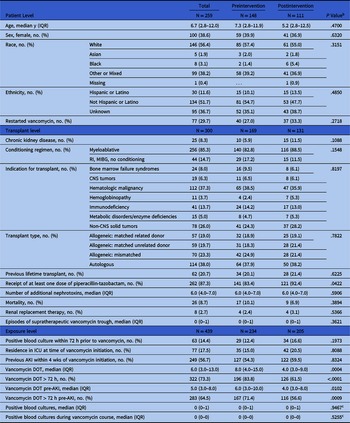
Among 259 unique patients, 222 had 1 transplant, 33 had 2 transplants, and 4 had 3 transplants. Patient-level (n = 259), transplant-level (n = 300) and vancomycin exposure–level (n = 439) preintervention versus postintervention comparisons of covariates are included in Table 1. The median patient age at admission was 6.7 years (range, 3 months to 26 years). Total vancomycin days of therapy ranged from 1 day to 46 days, with a median of 8 days before the intervention versus 4 days after the intervention (P = .0004). The proportion of patients receiving a prolonged (>72 hours) course of vancomycin was significantly higher before the intervention than after the intervention (83.8% vs 61.5%; P < .0001). Patients had similar rates of restarting vancomycin before and after the intervention (P = .2718). The proportion of patients receiving at least 1 dose of piperacillin-tazobactam was higher after the intervention (83.4% vs 92.5%; P = .0422). We detected no significant differences in the median number of nephrotoxins, the number of positive blood cultures, in-hospital mortality, or the need for renal replacement therapy. All other subject-level, transplant-level, and exposure-level characteristics did not differ between the preintervention and postintervention groups. Before the intervention, there were 106 episodes of vancomycin-associated AKI: 22 KDIGO stage 1 (21%), 40 stage 2 (38%), and 44 stage 3 (41%). After the intervention, there were 69 episodes of vancomycin-associated AKI: 22 stage 1 (32%), 29 stage 2 (42%), 18 stage 3 (26%). The distribution of AKI stages did not differ significantly before and after the intervention (P = .0797). Before the intervention, there were 2,514 vancomycin DOT among 7,859 inpatient days, compared with 1,507 vancomycin DOT among 6,895 inpatient days after the intervention.
Demographic and Clinical Characteristics Assessed at the Patient (n = 259), Transplant (n = 300), and Exposure (n = 439) Levels for Differences Before Versus After the Intervention a

Note. RI, reduced intensity; MIBG, metaiodobenzylguanidine; IQR, interquartile range; CNS, central nervous system; DOT, days of therapy.
a Patient-level factors were evaluated at the first transplant per patient and transplant-level factors were evaluated at the first vancomycin exposure per transplant.
b Patient-level P values derived from Wilcoxon signed-rank and χ2 tests; transplant- and exposure-level P values derived from univariate repeated measures models to account for within-subject and within-transplant correlation.
c 3 subjects (9 observations) with >10 positive blood cultures were classified as outliers and excluded from repeated measures models.
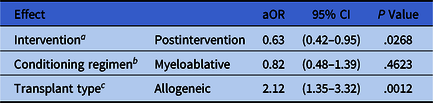
The unadjusted odds of AKI after the intervention were 39% lower than the preintervention odds (OR, 0.61; 95% CI, 0.41–0.92; P = .0176). This association remained significant after adjusting for conditioning regimen and transplant type (aOR, 0.63; 95% CI, 0.42–0.95; P = .0268) (Table 2). Patients with an allogeneic transplant had more than twice the odds (aOR, 2.12; 95% CI, 1.35–3.32; P = .0012) of AKI compared to those with an autologous transplant. Conditioning regimen was not significantly associated with AKI in the multivariable model (aOR, 0.82; 95% CI, 0.48–1.39; P = .4623).
Random Intercept Model Evaluating the Association Between Intervention and Acute Kidney Injury Adjusted for Covariates Associated With AKI at α = 0.1 (n = 259 Patients and n = 439 Exposures)

Note. aOR, adjusted odds ratio; CI, confidence interval.
a Reference: preintervention period.
b Reference: reduced intensity, MIBG, and no conditioning.
c Reference: autologous.
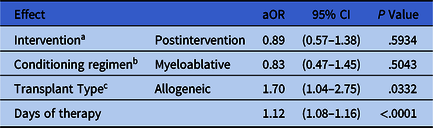
In the model with vancomycin days included the interaction between intervention and vancomycin days of therapy was not significant (P = .1202), indicating that the total effect of the intervention on AKI did not change by patients’ DOT. Notably, when the interaction was dropped from the model, there was an association between vancomycin DOT and AKI (P < .0001), but not intervention and AKI (P = .5934) (Table 3). This finding suggests that vancomycin DOT is on the causal pathway and mediates the effect of the intervention on the outcome. Therefore, a mediation analysis was conducted to determine the indirect effect of vancomycin DOT on the overall effect of the intervention. After adjusting for risk factors associated with AKI, transplant type and conditioning regimen, the mediation analysis revealed a 25.31% (95% CI, 1.89–43.44; P = .0172) reduction in total excess risk of AKI after the intervention, with 14.16% (95% CI, 7.69–24.78; P = .0064) attributable to the indirect effect of vancomycin DOT. Therefore, 14.2% (56%) of the 25.3% total effect of the intervention was due to the indirect effect of the decrease in vancomycin DOT.
Random Intercept Model Evaluating the Association Between Intervention, Days of Therapy, and Acute Kidney Injury Adjusted for Covariates Associated with AKI at α = 0.1 (n = 259 Patients and n = 439 Exposures)

Note. aOR, adjusted odds ratio; CI, confidence interval.
a Reference: preintervention period.
b Reference: reduced intensity, MIBG, and no conditioning.
c Reference: autologous.
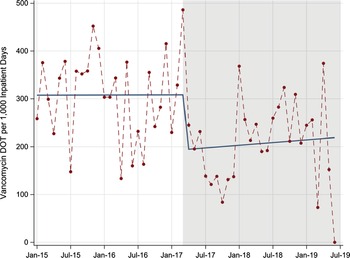
Results from interrupted time series modeling show that the baseline rate of unit-level vancomycin DOT in December 2014 was 307.45 per 1,000 inpatient days (95% CI, 235.74– 379.15) with an immediate decrease in DOT after the intervention by 114.37 per 1,000 inpatient days (95% CI, 15.68–213.07; P = .0275) (Fig. 1). The mean DOT per 1,000 inpatient days were 307.82 (95% CI, 272.73–342.91) before the intervention compared to 206.78 (95% CI, 173.42– 240.15) after the intervention. The estimated difference in slope before and after the intervention was 0.90 DOT per 1,000 inpatient days (95% CI, −5.43 to 7.23; P = .7814). This finding indicates that the average monthly change in DOT postintervention was not significantly different from the monthly change before the intervention, suggesting durability of the postintervention change.
Interrupted time series evaluating the impact of a targeted antimicrobial stewardship program (ASP) intervention on unit-level vancomycin DOT per 1,000 inpatient days. The baseline rate of vancomycin DOT in December 2014 was 307.45 per 1,000 inpatient days (95% CI, 235.74–379.15; P < .0001) with a postintervention decline of 114.37 DOT per 1,000 inpatient days (95% CI, 15.68–213.07; P = .0275).

Discussion
In this study, an ASP intervention targeting prolonged vancomycin use among stable patients undergoing HSCT with negative blood cultures was successful in reducing overall exposure to vancomycin, with a decrease in both total vancomycin DOT per 1,000 inpatient days and median duration of vancomycin courses. In addition, there was a 37% decrease in the adjusted odds of vancomycin-associated AKI in the postintervention period; more than half of this reduction in risk was mediated by the reduction in vancomycin DOT. Interestingly, transplant type but not conditioning regimen was associated with AKI, which likely reflects the independent risk of an immunologically dissimilar (ie, allogeneic) transplantation (eg, GvHD) compared with an autologous transplantation. Reference Raina, Herrera and Krishnappa9
Minimizing AKI in this patient population is crucial because mortality is high (65% Reference Bunchman, McBryde, Mottes, Gardner, Maxvold and Brophy27 to 90% Reference Patzer, Kentouche, Ringelmann and Misselwitz5 ) in patients who require continuous dialysis after HSCT. This study adds to the growing literature Reference Benoit, Goldstein and Dahale18 demonstrating that minimizing nephrotoxic antimicrobial exposure after HSCT is possible without a concomitant increase in infection, given no change in the number of positive blood cultures. Importantly, reduced exposure is associated with lower rates of nephrotoxin-associated AKI, indicating nephrotoxin exposure is a modifiable risk factor for AKI post-HSCT.
Our ASP intervention was implemented amid increasing efforts nationwide to reduce nephrotoxin-associated AKI, chiefly the Nephrotoxic Injury Negated by Just-in-time Action (NINJA) project. Reference Goldstein, Mottes and Simpson25,Reference Goldstein, Dahale and Kirkendall28 Benoit et al Reference Benoit, Goldstein and Dahale18 recently reported on a successful effort to decrease exposure to piperacillin-tazobactam (PTZ) and vancomycin among patients undergoing HSCT, and they found an associated decrease in nephrotoxin-associated AKI (24 to 6 days per 1,000 patient days). By contrast, our intervention centered on vancomycin alone, and the use of PTZ remained high. In this context, decreasing exposure to vancomycin was critical given the expanding literature, including HSCT populations, indicating that the combination of vancomycin and piperacillin-tazobactam confers a high risk of AKI. Reference Luther, Timbrook, Caffrey, Dosa, Lodise and Laplante19,Reference Downes, Cowden and Laskin20,Reference Clemmons, Bech, Pantin and Ahmad29
Moreover, our findings add to literature suggesting that vancomycin use is a modifiable risk factor for AKI among pediatric inpatients. A study of general pediatric patients without baseline renal insufficiency demonstrated that AKI occurred in 14% of patients receiving vancomycin and that odds of AKI increased with both increasing dose and duration of vancomycin therapy. Reference Sinclair, Yenokyan, McMunn, Fadrowski, Milstone and Lee30 A similar earlier study demonstrated a 14% incidence of vancomycin-associated nephrotoxicity with a 3-fold higher rate among patients with trough concentrations ≥15 mg/L. Reference McKamy, Hernandez, Jahng, Moriwaki, Deveikis and Le31 Additional evidence from the adult literature has demonstrated that vancomycin-associated nephrotoxicity is associated with increased hospital length of stay, Reference Kullar, Davis, Levine and Rybak32 increased need for dialysis, Reference Bamgbola33 and higher mortality. Reference Shen, Chiang and Chen34
Strengths of this study include a relatively large sample size compared with prior published studies, Reference Michael, Kuehnle and Goldstein3,Reference Kist-van Holthe, Van Zwet, Brand, Van Weel, Vossen and Van der Heijden6,Reference Ileri, Ertem and Ozcakar11,Reference Hazar, Gungor and Gur Guven14,Reference Esiashvili, Chiang, Hasselle, Bryant, Riffenburgh and Paulino35 use of a quasi-experimental design to assess the impact of a discrete intervention at a specific time, and demonstration of a change in both vancomycin use for a patient population and in an objective patient-level clinical outcome. Notably, stage 2–3 AKI was common (75% of all AKIs) in this cohort, indicating that the decrease in overall AKI included a decrease in more severe, clinically significant AKI. Our use of a mediation analysis allowed us to establish what proportion of the change in outcome was mediated by the reduction in vancomycin DOT, the target of the intervention. We also examined changes in serum creatinine using primary laboratory data rather than relying on clinician documentation of AKI, which may underestimate incidence of AKI. Reference Campbell, Li and Kotwal36 In addition, by examining the subject-level characteristics noted above, we evaluated for potential confounders of the relationship between vancomycin administration and AKI, unlike other recent studies. Reference Benoit, Goldstein and Dahale18 Moreover, we were able to make a definitive determination of baseline CKD because all patients undergoing HSCT had had a baseline nuclear medicine GFR study.
This study had several limitations. It was retrospective in design, with the potential for residual confounding, particularly in a heterogenous clinical population. Potential confounders of the relationship between vancomycin exposure and AKI that we did not assess included incipient transplant-related thrombotic microangiopathy Reference Laskin, Goebel, Davies and Jodele37 and the temporality of exposure to other nephrotoxins relative to timing of AKI. In addition, it has been well established Reference Laskin, Goebel and Davies38 that serum creatinine is an imperfect surrogate of glomerular filtration, given its variance with muscle mass and hydration status Reference Filler and Lee39 ; it is particularly insensitive for declines in renal function in pediatric patients undergoing HSCT. Reference Laskin, Nehus, Goebel, Furth, Davies and Jodele40 Very few patients required renal replacement therapy or died during our study period, which limited our ability to comment on the impact of this intervention on severe AKI. Finally, because we only collected data up to 90 days after transplantation, we were not able to assess the impact of this intervention on CKD after transplantation.
Thus, we implemented an antimicrobial stewardship intervention that was safe and effective in reducing vancomycin exposure among patients undergoing HSCT, and we demonstrated that this intervention was associated with a decrease in AKI. These results suggest that ASP interventions can be successful even in severely immunocompromised patients and that prioritizing appropriate antibiotic use can have a meaningful impact on clinical patient outcomes. Future quality improvement efforts could target vancomycin in combination with other nephrotoxic medications with the aim of further minimizing transplant-associated renal morbidity.
Acknowledgments
The content is solely the responsibility of the authors and does not necessarily represent the official views of Harvard Catalyst, Harvard University and its affiliated academic healthcare centers, or the National Institutes of Health.
Financial support
H.R.H. received grant support from the Boston Children’s Hospital Fred Lovejoy Housestaff Research and Education Fund. This work was conducted with support from Harvard Catalyst, The Harvard Clinical and Translational Science Center (National Center for Research Resources and the National Center for Advancing Translational Sciences, National Institutes of Health Award no. UL1 TR001102) and financial contributions from Harvard University and its affiliated academic healthcare centers. L.G. receives support from a Thrasher Research Fund Early Career Award, and a Harvard University Center for AIDS Research Developmental Award (grant no. P30 AI060354).
Conflicts of interest
All authors report no conflicts of interest relevant to this article.