INTRODUCTION
Parasites affect fitness of host organisms in various ways. Reduction in growth, fecundity and survival, changes of behaviour and sexual characteristics and many other maladaptive alterations of infected individuals could have significant consequences at not only individual, but population, community and ecosystem levels (Bush et al. Reference Bush, Fernández, Esch and Seed2001; Thomas et al. Reference Thomas, Guegan and Renaud2005). In ecological parasitology, platyhelminths and protozoan parasites are well studied in this context. However, less is known for Myxozoans, cosmopolitan metazoan parasites found in various fishes (Kent et al. Reference Kent, Andree, Bartholomew, El-Matbouli, Desser, Devlin, Feist, Hedrick, Hoffmann, Khattra, Hallett, Lester, Longshaw, Palenzeula, Siddall and Xiao2001; Canning and Okamura, Reference Canning and Okamura2004; Lom and Dykova, Reference Lom and Dykova2006), some amphibians and reptiles (Eiras, Reference Eiras2005), birds (Bartholomew et al. Reference Bartholomew, Atkinson, Hallett, Lowenstine, Garner, Gardiner, Rideout, Keel and Brown2008) and rarely in mammals (Friedrich et al. Reference Friedrich, Ingolic, Freitag, Kastberger, Hohmann, Skofitsch, Neumeister and Kepka2000; Dykova et al. Reference Dykova, Tyml, Fiala and Lom2007; Prunescu et al. Reference Prunescu, Prunescu, Pucek and Lom2007). Over 2000 myxozoan species have been described (Lom, Reference Lom and Rohde2005; Lom and Dykova, Reference Lom and Dykova2006) but the majority of studies focused on their phylogeny, general biology, pathology and epidemiology, and relatively few ecological studies have been conducted (Canning et al. Reference Canning, Tops, Curry, Wood and Okamura2002).
Myxobolus cerebralis is one of the most well studied myxozoans. It is well known as a causative agent of whirling disease in salmonid fish (Hofer, Reference Hofer1903). Due to its devastating effects on wild and cultured trout populations (Nehring and Walker, Reference Nehring and Walker1996; Vincent, Reference Vincent1996; Baldwin et al. Reference Baldwin, Peterson, McGhee, Staigmiller, Motteram, Downs and Stanek1998; Hedrick et al. Reference Hedrick, El-Matbouli, Adkison and MacConnell1998; Rognlie and Knapp, Reference Rognlie and Knapp1998; Bartholomew and Reno, Reference Bartholomew, Reno, Bartholomew and Winton2002) understanding the interactions between M. cerebralis and the fish host, aiming for the development of control measure, has been the central focus of past research. The revelation of the parasite's development within the fish host (El-Matbouli et al. Reference El-Matbouli, Hoffmann and Mandok1995), studies on the infectious mechanisms (Kallert et al. Reference Kallert, Ponader, Eszterbauer, El-Matbouli and Haas2007), the pathology (Hofer, Reference Hofer1904; Schaperclaus, Reference Schaperclaus1931) and molecular based investigations (Antonio et al. Reference Antonio, Andree, McDowell and Hedrick1998; El-Matbouli et al. Reference El-Matbouli, Holstein and Hoffmann1998; Andree et al. Reference Andree, El-Matbouli, Hoffman and Hedrick1999; El-Matbouli and Soliman, Reference El-Matbouli and Soliman2005; Baerwald et al. Reference Baerwald, Welsh, Hedrick and May2008) have deepened our knowledge on the disease and the parasite. However, the extent to which the parasite affects its invertebrate host, Tubifex tubifex, is relatively unknown and information on the M. cerebralis–T. tubifex interaction is limited.
Involvement of T. tubifex in the life cycle of M. cerebralis has only been revealed in the last few decades (Markiw and Wolf, Reference Markiw and Wolf1983; Wolf and Markiw, Reference Wolf and Markiw1984; Wolf et al. Reference Wolf, Markiw and Hiltunen1986; El-Matbouli and Hoffman, Reference El-Matbouli and Hoffman1989). The oligochaete becomes infected by M. cerebralis through ingestion of myxospores. Development and multiplication of the parasite takes place between the gut epithelial cells of the oligochaete (El-Matbouli and Hoffmann, Reference El-Matbouli and Hoffmann1998) and typically takes about 2–3 months (Markiw, Reference Markiw1986; El-Matbouli and Hoffmann, Reference El-Matbouli and Hoffmann1998; El-Matbouli et al. Reference El-Matbouli, McDowell, Antonio, Andree and Hedrick1999; Gilbert and Granath, Reference Gilbert and Granath2001; Stevens et al. Reference Stevens, Kerans, Lemmon and Rasmussen2001; Kerans et al. Reference Kerans, Stevens and Lemmon2005) until waterborne triactinomyxon spores (TAMs) are released to the water with the worm feces (Gilbert and Granath, Reference Gilbert and Granath2001). During this period, the parasite undergoes a phase of sexual reproduction which has only been observed in the oligochaete host and not in the vertebrate host, thus T. tubifex is considered to be the definitive host (El-Matbouli and Hoffmann, Reference El-Matbouli and Hoffmann1998; El-Matbouli et al. Reference El-Matbouli, Holstein and Hoffmann1998). Infection in T. tubifex may persist for the duration of the worm's lifespan and release of TAMs can occur periodically over the span of at least a few years (Gilbert and Granath, Reference Gilbert and Granath2001).
Tubifex tubifex is a cosmopolitan aquatic oligochaete worm found in benthic substrates in various freshwater environments. They are not only an important component of aquatic food webs but play a key role in structuring and functioning of the aquatic ecosystems. Their activities enhance nutritional exchange and control the bio- and physico-chemical status of the sediment (Brinkhurst and Gelder, Reference Brinkhurst, Gelder, Thorpe and Covich1991; Covich et al. Reference Covich, Palmer and Crowl1999; Mermillod-Blondin et al. Reference Mermillod-Blondin, Gerino, Degrange, Lensi, Chasse, Rard and Des Chatelliers2001). Tubificid worms are highly tolerant to survive in harsh environmental conditions and are often used as biological indicators or for bioassay studies (Reynoldson, Reference Reynoldson1994). Despite their importance, taxonomy and identification of T. tubifex is complicated and somewhat ambiguous as their morphological characteristics may vary depending on the environmental conditions (Chapman and Brinkhurst, Reference Chapman and Brinkhurst1987). Although a PCR assay has been developed to assist species identification (Hallett et al. Reference Hallett, Atkinson and Bartholomew2005), reproductive organs (e.g. penis sheath) required for confident identification may be resorbed during the reproductively inactive seasons (Poddubnaya, Reference Poddubnaya1984) or due to environmental stress (Kaster and Bushnell, Reference Kaster and Bushnell1981a). To date, 6 lineages of T. tubifex have been identified based on mitochondrial DNA sequences (Sturmbauer et al. Reference Sturmbauer, Opadiya, Niederstatter, Riedmann and Dallinger1999; Beauchamp et al. Reference Beauchamp, Kathman, McDowell and Hedrick2001) and susceptibility to M. cerebralis is highly variable among lineages (Beauchamp et al. Reference Beauchamp, Gay, Kelley, El-Matbouli, Kathman, Nehring and Hedrick2002; Arsan et al. Reference Arsan, Hallett and Bartholomew2007), populations (Rasmussen et al. Reference Rasmussen, Zickovich, Winton and Kerans2008) or even clonal lines (Baxa et al. Reference Baxa, Kelley, Mukkatira, Beauchamp, Rasmussen and Hedrick2008). It has been shown that exposure to M. cerebralis reduces fitness (Kerans et al. Reference Kerans, Rasmussen, Stevens, Colwell and Winton2004), population growth, biomass (Kerans et al. Reference Kerans, Stevens and Lemmon2005; Rasmussen et al. Reference Rasmussen, Zickovich, Winton and Kerans2008), and individual weight (Stevens et al. Reference Stevens, Kerans, Lemmon and Rasmussen2001; Steinbach-Elwell et al. Reference Steinbach-Elwell, Kerans, Rasmussen and Winton2006) of T. tubifex. The majority of these studies concerned propagation and differential effects of the parasite on genetically distinct populations of oligochaetes. However, detailed effects of M. cerebralis on the general biology of the definitive host and the variability in the effects of the parasite among worms at different developmental stages remain unclear. In the present study, we investigated the effect of M. cerebralis on general biological characteristics of T. tubifex. Maturation, fecundity, survival and feeding of T. tubifex exposed to M. cerebralis were compared to unexposed ones. The main objectives of our study were to determine (1) differences in susceptibility to M. cerebralis between different developmental stages of individual T. tubifex, (2) the effects of M. cerebralis on reproductive development of T. tubifex and (3) the effects of M. cerebralis on feeding ability of T. tubifex.
MATERIALS AND METHODS
Experimental animal
Tubificid oligochaetes used for the experiment were raised from cocoons obtained from the laboratory stock culture. Worms in the stock culture were originally collected from a local pond and have been maintained in parasite-free laboratory conditions for over 2 years. The culture contained at least 2 species of oligochaetes. Results of the PCR assay (Hallett et al. Reference Hallett, Atkinson and Bartholomew2005) on a number of worms from the stock culture, identified individuals possessing hair chaetae as T. tubifex. Mitochondrial lineage II and III have been identified from the culture, but high infection prevalence, up to >90%, in other infection trials indicates that the lineage III is the dominant strain (Sturmbauer et al. Reference Sturmbauer, Opadiya, Niederstatter, Riedmann and Dallinger1999; Beauchamp et al. Reference Beauchamp, Gay, Kelley, El-Matbouli, Kathman, Nehring and Hedrick2002).
Worms were kept in a plastic container with quartz sand substrate (<250 μm) at ambient room temperature (15±2°C) and fed weekly with a mixture of dried Spirulina, dried Artemia, flake fish food and algae wafers. Screening for TAMs was conducted occasionally to ensure the worms were parasite free. All the worms used for the experiment were individually checked in a 48 well-plate under a dissecting microscope for presence of hair as well as their maturation status (for the maturation experiment only) and obvious physical damage. Maturation was determined based on the development of clitellum. Individuals with an obvious clitellum were considered as ‘mature worms’ and those without apparent thickened body wall at glandular section were considered as ‘immature worms’.
Maturation experiment
Mature and immature T. tubifex were exposed to M. cerebralis myxospores to determine the effect of the parasite on survival, growth, reproductive development and fecundity. Fifty mature or immature worms were selected randomly for each container (N=16) and weighed in en masse on a nylon mesh after removing excess water with paper towel. They were then placed in a plastic beaker (diameter×height, 7·2×9·4 cm, 8 beakers for each group) with 50 ml of quartz sand and 100 ml of tap water. Mean weight of a single mature and immature worm was calculated to be 2·49±0·36 and 9·43±1·03 mg, respectively (mean±s.d. otherwise stated). In addition, 4 beakers were prepared, each of which contained 100 twenty-day-old ‘juvenile’ worms to assess susceptibility of very young worms to M. cerebralis. Juveniles were not weighed because they were too small for accurate measurement. All worms were kept in the beakers for 48 h and then exposed to the parasite. Exposure of T. tubifex to M. cerebralis myxospores was conducted using the general method described by Kallert et al. (Reference Kallert, El-Matbouli and Haas2005). Briefly, myxospores were collected by homogenization of experimentally infected rainbow trout, Oncorhynchus mykiss (ca. 10 cm in length). An aliquot of homogenate containing 50 000 myxospores (1000 spores per worm) was added to each beaker. An equal volume of homogenate from non-infected trout was added to the control group. Four replicates for exposed and control groups were prepared for the mature and immature groups, the juvenile group was set up in duplicate. To maximize spore uptake, no food was given during the first 2 weeks post-exposure (p.e.). Worms were maintained with slight aeration and were given equal amounts of food once a week. Overlaying water (approximately 80%) was changed at 6 weeks and 12 weeks p.e.
Screening for TAMs was first conducted 3 months p.e. and weekly thereafter. At 109 days p.e. (2 weeks after first detection of TAMs), substrate from each beaker was sieved and all worms, cocoons, and offspring (larvae) were counted. Survivors were individually placed in 48 well-plates and monitored for 7 days to assess infection status by checking TAMs release. Worms were also checked for their maturation status indicated by presence of a clitellum. For infected worms, total numbers of TAMs released by each individual during 48 h was calculated by enumerating TAMs in 10 μl of water from each well (0·5 ml water in a well, 2 counts per well). In cases where worms released only small numbers of spores which were detected in the well but not in 10 μl samples, total number of TAMs in the well was estimated to be 50. Worms that did not release any TAMs during 7 days were considered to be ‘non-releasing’. After checking for spore production, infected and non-releasing worms were weighed (wet weight, in groups of 5 worms) and growth rate was calculated as follows: (average initial weight of a single worm−average weight of a single worm at the end)/initial weight.
Because a large proportion of infected mature worms had resorbed their clitella during the experiment, a further experiment was performed to investigate the relationship between M. cerebralis infection and clitellum formation. Eighty mature or 60 immature infected worms without a clitellum were selected and divided into 2 beakers (30 or 40 worms in a beaker). Worms in one beaker were exposed at 30°C for 4 days to overcome the infection (El-Matbouli et al. Reference El-Matbouli, McDowell, Antonio, Andree and Hedrick1999) and then kept at 15°C for a further 16 days. Another beaker was kept at 15°C for the entire time. After 20 days, worms were re-checked for infection and clitellum development. Because exposure to high temperature may induce development of clitellum, 2 beakers each containing 50 immature worms that had never been exposed to the parasite were prepared as a control.
Feeding experiment
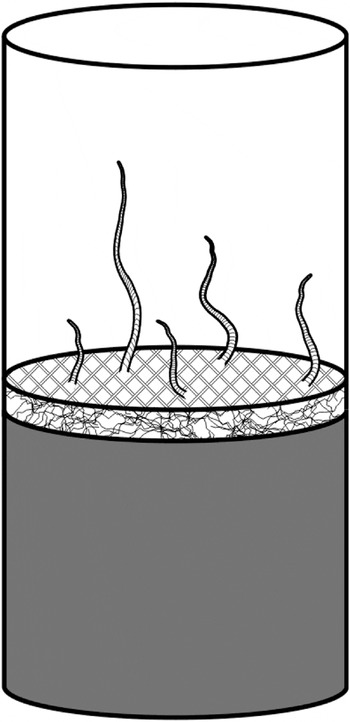
Effects of M. cerebralis on feeding of T. tubifex were investigated by comparing the defecation rates of infected and uninfected worms. For experimental infection, uninfected stock worms were divided into 2 containers (28 g wet weight worms in each) and exposed to fish homogenate containing 560 000 myxospores (20 000 spores per g worms) or an equal amount of non-infected fish homogenate (control). Worms in the two containers were treated equally with sand substrate and very slow flow through water at ambient temperature. After 4 months, 50 size-matched infected and uninfected control worms were selected. Infection was confirmed by detection of TAMs release using the well-plate method. Measurement of defecation rate followed general setups described by Kaster et al. (Reference Kaster, Klump, Meyer, Krezoski and Smith1984) and Volpers and Neumann (Reference Volpers and Neumann2005). Worms were placed in a plastic tube (2·0 cm×8·5 cm) half filled with autoclaved mud and a thin layer of polyester floss on top which was covered by a nylon mesh (Fig. 1). Worms extrude their posterior ends from the substrate, so the feces were deposited on top of the mesh. Five infected (TAM-releasing) or uninfected worms (non-exposed control) were weighed and placed in an experimental tube. A total of 10 tubes for each treatment group were prepared and placed in a water bath which was kept at a temperature of 20±1°C. Worms were first acclimatized in the tubes for 3 days then defecated materials deposited on top of the mesh were carefully collected with a pipette every 24 h for 7 consecutive days. After each collection, the mesh was pushed down so there was no gap between the mud surface and the floss. Collected fecal material was centrifuged for 1 min at 20 800 g, dried at 45°C for 24 h and weighed.
Schematic diagram of the experimental setup used to measure defecation rate. A plastic tube (diameter×height, 20×75 mm) was half-filled with autoclaved mud (grey) on top of which a thin layer of polyester floss and a nylon mesh was placed. Defecated materials from worms (5 per tube) were deposited on top of the mesh.

Statistical analyses
All data were tested for distributional normality using the Shapiro-Wilk test. A Chi-Square test was used for comparisons of survival rate, infection prevalence and proportion of clitellated individuals between the groups. A Wilcoxon Rank Sum test was used for the analysis involving number of TAMs released by the worms. Student's t-test was used to detect the difference in cocoon and larvae production and for feeding rate. P values of less than 0·05 were considered statistically significant. Statistical analyses were performed using SAS JMP ver. 7.
RESULTS
Maturation experiment
A summary of the maturation experiment is presented in Table 1. Infection prevalence, determined as the proportion of TAM-releasing individuals during 109–116 days p.e., was significantly higher for the mature group than the for immature group (χ1df2=5·83, P=0·0157) and that for juveniles was significantly lower than for all other groups (mature group χ1df2=101·30, P<0·0001, immature group χ1df2=60·21, P<0·0001). Exposure to M. cerebralis did not affect the survival of immature, mature and juvenile T. tubifex. In general, death rate was approximately 15–25% regardless of infection and age of the worms. Also, the parasite did not seem to affect growth of the oligochaete. The weight of immature worms, regardless of parasite exposure, nearly doubled during the experiment whereas the mature worms lost some weight. However, TAM-releasing individuals tended to be heavier than non-releasing ones. The average calculated weight of single TAM-releasing and non-releasing individuals was 7·03±1·52 and 6·77±1·51 mg for mature worms or 8·13±1·44 and 7·07±1·86 mg for immature worms, respectively. The difference in weight between infected and uninfected worms was significant only for mature worms (t51=−2·67, P<0·0289).
Summary of results from the maturation experiment
(Data are the mean (±s.d.) from 4 replicates from mature and immature oligochaetes or 2 replicates from juveniles. Asterisks indicate significant (P<0·05) differences; na indicates data not available.)

Production of TAMs appeared to be dependent on the developmental status of the host. The average number of TAMs released by a mature oligochaete during 48 h was approximately 9 or 4-fold higher than that of immature (Z=−7·41, P<0·0001) or juvenile T. tubifex (Z=−3·74, P=0·0002), respectively. Juveniles tended to produce more TAMs than immature worms (Z=2·07, P=0·0383), but it has to be noted that the number of infected juveniles was relatively low. Although no quantitative measurement was conducted, a considerable proportion of the spores released by immature worms were smaller and seemed to be without fully developed sporoplasm.
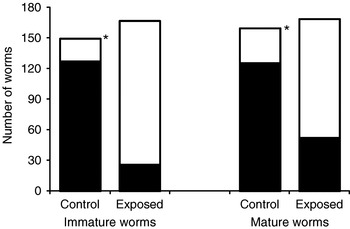
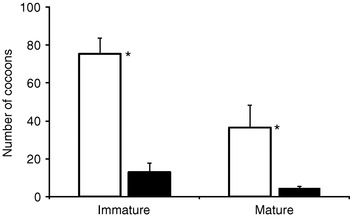
Reproductive development of T. tubifex was inhibited by M. cerebralis. The majority (83%) of unexposed immature worms became reproductive (clitellated) over 3 months experimental period whereas only 13% of exposed worms developed a clitellum (χ1df2=167·58, P<0·0001, Fig. 2). Moreover, 77% of exposed mature worms had resorbed their clitellum while a loss of this sexual organ was observed in only 29% of controls (χ1df2=78·16, P<0·0001). Out of 137 TAM-releasing mature and immature worms, only 9 individuals possessed an obvious clitellum (6·56%). Corresponding with the development (or resorption) of clitella, cocoon production was significantly lower in the exposed worm than the control (Fig. 3, mature worm t6=−6·51, P<0·0006, immature worm t6=−2·67, P<0·0371). On the other hand, the number of hatched larvae found in exposed and control groups did not differ between immature and mature worms (Table 1). No cocoons or larvae were found from the juvenile group.
Proportions of clitellated (closed bars) and non-clitellated individuals (open bars) at 109 days p.e. Immature oligochaetes did not possess clitella and all mature ones were clitellated at the time of exposure.

Mean (+s.e.m.) number of cocoons found after 109 days p.e. in unexposed control (open bars) and exposed (closed bars) immature and mature worm population.

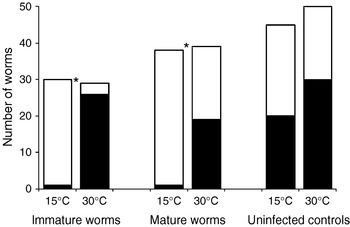
Exposure to high temperature did not affect oligochaete survival. Only 1 immature and 1 mature worm died as a result of this drastic change of temperature. All the TAM-releasing worms no longer shed spores after exposure to 30°C and a large proportion of them (immature worms 89·7%, mature worms 48·7%) re-developed clitella (Fig. 4). On the other hand, infection prevalence of immature and mature worms kept constantly at 15°C remained at 96·7 and 76·3% respectively, and they were still non-clitellated. The proportion of clitellated individuals was significantly different between temperature-treated and untreated infected groups (immature worms χ1df2=53·31, P<0·0001, mature worms χ1df2=24·92, P<0·0001). For uninfected controls, the proportions of clitellated worms were 60·0% and 44·4% for temperature-treated and untreated groups, respectively and there was no statistical difference (χ1df2=2·31, P<0·1288).
Proportion of clitellated (closed bars) and non-clitellated worms (open bars) after exposure to 30°C for 4 days and then 15°C for 2 weeks (N=40), or after being kept constantly at 15°C (N=30). All immature and mature worms were confirmed to release TAMs prior to change of temperature. Uninfected controls were non-clitellated oligochaetes (N=50) that were not exposed to the parasite.

Feeding experiment
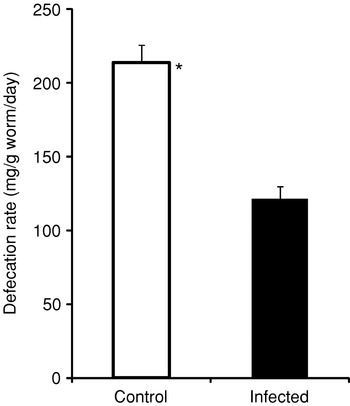
The overall mean defecation rate during a 1-week experiment was approximately 40% lower in M. cerebralis infected oligochaete (t122=−6·43, P<0·0001) than the uninfected worm. The estimated amount of mud processed per day (dry weight) for a single infected worm (0·88±0·49 mg) was only about half that of a single uninfected worm (1·53±0·72 mg). This equals 121·49±67·99 and 213·82±99·07 mg mud (dry) per 1 g of worm (wet weight), respectively (Fig. 5). Mean weight of single-infected and uninfected worm used for the experiment was calculated to be 7·26±1·93 and 7·28±0·91 mg, respectively.
Total mean (+s.e.m.) daily defecation rate of uninfected control (open bar) and TAM-releasing worms (closed bar) during 7 monitoring days. The values are presented as mg of defecated materials (dry weight) per g worms (wet weight) per day.

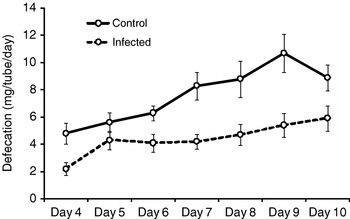
The amount of fecal deposition increased over time (Fig. 6). Daily defecation consistently increased up to Day 9 for controls and until the end of the experiment for infected worms. The largest difference in mean defecation rate between the two groups was observed at Day 9 when infected worms processed only half the mud compared to uninfected controls (5·4±2·80 and 10·7±4·47 mg per tube per day for infected and control worms, respectively).
Change in mean (±s.e.m.) daily defecation rate between uninfected control (solid line) and TAM-releasing worms (broken line). The values are means of 10 tubes and refer to mg of defecated materials (dry weight) per tube (5 worms each) at each monitoring day.

DISCUSSION
The results of the present study demonstrate that infection by M. cerebralis strongly reduces the reproductive ability of T. tubifex. Reduction of oligochaete fitness due to M. cerebralis infection has previously been demonstrated at the population level. However, it was not clear whether such a phenomenon is due to death, slow growth, or low reproduction of infected individuals (Stevens et al. Reference Stevens, Kerans, Lemmon and Rasmussen2001; Kerans et al. Reference Kerans, Rasmussen, Stevens, Colwell and Winton2004; Rasmussen et al. Reference Rasmussen, Zickovich, Winton and Kerans2008). Our data clearly show that M. cerebralis induces temporal castration, indicating this is the main cause of the reduced fitness or population growth of infected T. tubifex.
We observed no difference in survival and growth between infected and uninfected T. tubifex regardless of maturation status. Although some died during the 3-month experiment, death rate (range 8–42%) was not associated with infection. Physical damage or stress from handling might be the cause of death. Regardless of infection, immature worms nearly doubled their weight while mature worms lost some weight during the experiment. We provided equal amounts of food to all groups but the amount might have been insufficient for mature worms to grow further or to maintain their condition. Contradictory to our result, Stevens et al. (Reference Stevens, Kerans, Lemmon and Rasmussen2001) showed that weight gain of individual worms was higher for unexposed T. tubifex compared to those exposed to M. cerebralis, though they did not differentiate mature and immature worms. Quality and quantity of food, culture conditions, as well as duration of the experiment may have led to such differences between the two studies. Nevertheless, the result of the present study provides strong support for their (also by Kerans et al. Reference Kerans, Rasmussen, Stevens, Colwell and Winton2004; Rasmussen et al. Reference Rasmussen, Zickovich, Winton and Kerans2008) previous suggestion that reduction of population growth in M. cerebralis infected T. tubifex is mainly due to their low fecundity and not the result of reduced survival.
The effect of M. cerebralis on fecundity of its oligochaete host is clearly indicated by the over 80% reduction of cocoon production in the parasite-exposed group. This is consistent for both mature and immature worms. However, numbers of hatched larvae found in exposed and unexposed groups did not differ. This is probably because the parasite impairs host reproduction only after it reaches a certain developmental stage and/or the parasite intensity reaches some threshold. Development of M. cerebralis typically takes 3–4 months (or 1320–1456 degree days in some strains of North American tubificids) until TAMs are released (Markiw, Reference Markiw1986; El-Matbouli and Hoffmann, Reference El-Matbouli and Hoffmann1998; El-Matbouli et al. Reference El-Matbouli, McDowell, Antonio, Andree and Hedrick1999; Gilbert and Granath, Reference Gilbert and Granath2001; Stevens et al. Reference Stevens, Kerans, Lemmon and Rasmussen2001; Kerans et al. Reference Kerans, Stevens and Lemmon2005). On the other hand, T. tubifex embryos require about 20 days to hatch at 15°C (Kaster, Reference Kaster1980). Therefore, larvae found in the beakers had been produced within the first 1–2 months p.e. while cocoons retrieved at the end of the experiment were laid within the last month (89–109 days p.e.). It can be suspected that the effect of the parasite on host fecundity is maximized during the period when large numbers (up to several thousands) of spores are produced daily. Infected worms release TAMs for a few months (Gilbert and Granath, Reference Gilbert and Granath2001) and if their reproduction is greatly reduced during this time, it would have a considerable influence on population growth as observed in past studies.
Development or resorption of clitella was clearly associated with infection, or more precisely, release of TAMs. About 94% of TAM-releasing worms were non-clitellated and this is likely another example of parasitic castration. The clitellum is a sexual characteristic commonly exhibited among various species of annelids. It consists of secretory glands for copulative mucus, cocoon wall and albumin in which eggs are deposited (Barnes, Reference Barnes1987). Therefore, development of a clitellum is essential for reproduction in T. tubifex. Moreover, the function of the clitellum changes from reproduction to the formation of a resistant cyst under conditions of dessication (Kaster and Bushnell, Reference Kaster and Bushnell1981a) and/or food shortage (Anlauf, Reference Anlauf1990). Encysted worms are capable of surviving in a semi-moist environment for about 70 days in the laboratory or for 5 months during drought conditions in the field (Kaster and Bushnell, 1981 a; Anlauf, Reference Anlauf1990). Presumably, such cysts may also protect T. tubifex from predators (Kaster and Bushnell, Reference Kaster and Bushnell1981b). Therefore, infection with M. cerebralis may indirectly make T. tubifex more vulnerable to desiccation, food shortage and predation by prohibiting mucus secretion. It has been shown that resorbtion of the clitellum can also be induced by toxic substances in Limnodrilus hoffmeisteri (Rodriguez et al. Reference Rodriguez, Arrate, Martinez-Madrid, Reynoldson, Schumacher and Viguri2006). Although the underlying mechanisms behind such phenomena are unclear, M. cerebralis infections may induce physiological changes in oligochaetes similar to other stressors. Even though the majority of TAM-releasing worms were not clitellated, they re-developed a clitellum and also stopped releasing TAMs after being kept at 30°C. Because we did not perform molecular and histological analyses, it is not absolutely certain whether worms completely overcame the infection or the non-sporogonic parasite remained in the worms. El-Matbouli et al. (Reference El-Matbouli, McDowell, Antonio, Andree and Hedrick1999) observed degeneration of various developmental stages between the worm's gut epithelial cells after keeping infected T. tubifex at 25°C and 30°C for 3 days. Our results confirm this finding and demonstrate that increasing water temperature is indeed an effective way to reduce TAM abundance in the environment without killing T. tubifex.
Inhibition of reproductive activity in parasitized animals is a well-known trait commonly exhibited in a wide variety of host-parasite systems (Baudoin, Reference Baudoin1975). Reduced fecundity can be an adaptive ‘strategy’ of the host to maximize future reproduction after overcoming infection (van Baalen, Reference Van Baalen1998; Hurd, Reference Hurd2001) or merely a byproduct of infection. Most likely the latter is the explanation for the reduced fecundity in the M. cerebralis-T. tubifex system, because infection may persist for the lifespan of the host (Gilbert and Granath, Reference Gilbert and Granath2001) and likely has no adaptive significance. However, a long-term experiment would be necessary to clarify how long reproductive depression could last at natural temperatures and whether the lifetime fecundity is reduced to the same extent. The mechanisms for parasitic castration range from sex determination, metabolic disturbance to direct damage to the reproductive organs. One possible explanation for the low fecundity of infected T. tubifex is their lower energy intake.
Our feeding experiment showed that infected (TAM-releasing) worms feed 40% less than healthy worms. Similarly, the mechanism behind fecundity reduction in a mosquito, Aedes aegypti, infected by malaria Plasmodium gallinaceum is thought to be reduced food intake and imbalanced energy allocation (Freier and Friedman, Reference Freier and Friedman1976; Maier et al. Reference Maier, Becker-Feldman and Seitz1987; but see Rivero and Ferguson, Reference Rivero and Ferguson2003). Development of M. cerebralis occurs within the intestine of T. tubifex and causes hypertrophy of the epithelial cells (El-Matbouli and Hoffmann, Reference El-Matbouli and Hoffmann1998). Such pathological damage of the digestive tract may reduce the worm's capability to digest and/or ingest food materials. Infected worms also seem to be generally less active (Shirakashi, personal observation) which suggests a lower metabolic rate. In addition, nutritional competition between the host and the parasite may cause lower reproductive success for the host. Nutritional requirements of the parasite depend on the biomass of the parasite (Hurd, Reference Hurd2001). Even though M. cerebralis is microscopic, production of thousands of TAMs may require a considerable amount of nutrients. The combination of reduced energy intake and extra energetic loss to the parasite may prohibit worms from allocating energy for reproduction. Reduced feeding should have other physiological effects on infected worms. Although reduced growth rate of infected T. tubifex has been shown in a previous study (Stevens et al. Reference Stevens, Kerans, Lemmon and Rasmussen2001), we could not detect such an effect in our 3-month experiment. This could be due to the duration of the experiment, the experimental condition and the sample size. Also, onset of reduced feeding remains unclear. Long-term monitoring is required to clarify the association between feeding and growth of infected worms.
We hypothesize that under limited food conditions, M. cerebralis likely has an even greater effect on the host, e.g. its survival. Increase of the daily defecation rate observed during the present experiment is consistent with past studies (Kaster et al. Reference Kaster, Klump, Meyer, Krezoski and Smith1984; Volpers and Neumann, Reference Volpers and Neumann2005). Worms may need some time to acclimatize to the unfamiliar experimental conditions to maximize their feeding. Therefore, the defecation rate, or the amount of mud that worms can process in each day is probably underestimated from that in the natural environment.
Inhibition in reproductive development and reduction in fecundity and feeding activity may also exist in other myxozoa-oligochaete systems. For example, McGeorge et al. (Reference McGeorge, Sommerville and Wootten1997) reported that a large proportion of an oligochaete population (consisting of Tubificidae, Lumbriculidae and Enchytraeidae), that were infected with several myxozoan species, were immature. However, whether this is due to infection or just seasonal phenomena is unclear, other myxozoan species may have similar effects to their oligochaete hosts as we showed in the present study for M. cerebralis. Such effects could have ecological consequences. Aquatic oligochaetes are not only an important part of the food web but play a crucial role in carbon recycling in benthic fauna. Through their bioturbational activities (mixing of sediment by biological activities) organic compounds trapped in sediment are processed and become reusable in the ecosystem. Although infection prevalence for M. cerebralis in natural T. tubifex populations is typically less than 10% (Rognlie and Knapp, Reference Rognlie and Knapp1998; Zendt and Bergersen, Reference Zendt and Bergersen2000; Beauchamp et al. Reference Beauchamp, Gay, Kelley, El-Matbouli, Kathman, Nehring and Hedrick2002; DuBey and Caldwell, Reference Dubey and Caldwell2004), infections from various myxozoan species could cause significant influences on structure and function of an entire ecosystem.
Infected mature worms produced considerably larger numbers of TAMs than immature ones. Production of TAMs appears to be influenced by various environmental factors such as temperature (El-Matbouli et al. Reference El-Matbouli, McDowell, Antonio, Andree and Hedrick1999; Kerans et al. Reference Kerans, Stevens and Lemmon2005) and substrate types (Arndt et al. Reference Arndt, Wagner, Cannon, Smith, Bartholomew and Winton2002; Blazer et al. Reference Blazer, Waldrop, Schill, Densmore and Smith2003). All oligochaetes in the present study were kept under similar conditions, thus differences in TAMs production likely arose from the developmental stage or size of the host. As many TAMs released by immature hosts were somewhat unusual in size and shape, it may be that the parasite takes longer time, or cannot develop properly within a smaller host. This suggestion is supported by the greater weight of TAM-releasing worms compared to non-releasing worms and also by the fact that the prevalence of TAM-releasing juveniles was low. The parasite may require larger physical space or some physiological factors for proper development and multiplication. Susceptibility to M. cerebralis or production of TAMs is highly variable between genetically distant populations (Beauchamp et al. Reference Beauchamp, Gay, Kelley, El-Matbouli, Kathman, Nehring and Hedrick2002; Arsan et al. Reference Arsan, Hallett and Bartholomew2007) or even among genetically closely related populations of T. tubifex (Baxa et al. Reference Baxa, Kelley, Mukkatira, Beauchamp, Rasmussen and Hedrick2008; Rasmussen et al. Reference Rasmussen, Zickovich, Winton and Kerans2008). Although we have no molecular data for the oligochaete used in the present study, the probability of immature and mature worms being genetically far apart from each other is low. Worms were originally collected from a single pond and raised from cocoons in the laboratory. The stock culture contained worms of various sizes and developmental stages and individuals were randomly selected to be used for the experiment. The composition of mature and immature worms can be a possible explanation for the variability in the production of TAMs between genetically similar populations. Our future research will include molecular and histological analyses to help the understanding of the relationship between the development of TAMs and size (or age) of tubificid worms in more detail.
In conclusion, our experiment provided empirical evidence that M. cerebralis impairs clitellum formation and reduces fecundity in T. tubifex, possibly by reducing host feeding activity. In addition, we showed that variability in TAMs production could arise from differences in size or developmental status of the host. As M. cerebralis invades a wide range of geographical locations, it is important to understand its interaction with the oligochaete host to determine its impact on an aquatic ecosystem.
This study was funded by the Alexander von Humboldt-Stiftung, Germany to S.S. We thank S. Ihmels for her assistance and D. Grabner and D. Kallert for comments on an earlier version of the manuscript.