


The United Nations estimates that about 690 million people are currently affected by hunger worldwide, and its prevalence is constantly rising(1). Food insecurity, a typical indicator of the lack of subsistence, broadly refers to the status of being without sufficient nutritious and safe food and having limited ability to acquire such food(Reference Gorton, Bullen and Mhurchu2–Reference Ma, Gee and Kushel4). Food insecurity generally has adverse effects on health and is associated with diabetes(Reference Chan, DeMelo and Gingras5), obesity(Reference Finney Rutten, Yaroch and Patrick6), psychological stresses and depression(Reference Jebena, Taha and Nakajima7,Reference Ramsey, Giskes and Turrell8) , children’s inadequate physical development and diverse illnesses(Reference Drennen, Coleman and Ettinger9,Reference Schmeer and Piperata10) and underutilisation of medical care resources(Reference Kushel, Gupta and Gee11). Therefore, many countries have endeavoured to tackle food insecurity problems of socio-economically vulnerable groups by improving existing food systems and implementing food aid programmes(1,Reference Finney Rutten, Yaroch and Patrick6) . Yet there has been limited attention to other risk factors of food insecurity, such as housing.
Previous research has investigated food insecurity of disadvantaged groups in relation to their housing circumstances(Reference Ma, Gee and Kushel4,Reference Huang and King12–Reference Fafard St-Germain and Tarasuk15) . It was found that food insecurity is prevalent among households who suffer housing instability which can be defined as limited access to adequate housing(Reference Kushel, Gupta and Gee11,Reference Fafard St-Germain and Tarasuk15–Reference Silva, Kleinert and Sheppard18) . In addition, non-homeowners are more likely food insecure than homeowners(Reference Fafard St-Germain and Tarasuk19–Reference Lee and Kim21), and market renters, particularly those who are in immediate need for subsidised housing or experience rent arrears are more likely to have food insecurity(Reference Fafard St-Germain and Tarasuk19,Reference Kirkpatrick and Tarasuk22) . It was also identified that food insecurity and housing instability are independently associated with unfavourable health and social outcomes among the poor(Reference Ma, Gee and Kushel4,Reference Kushel, Gupta and Gee11,Reference Silva, Kleinert and Sheppard18) .
Nevertheless, there remain two significant research gaps. First, there are few studies that examined how housing instability, particularly housing affordability, affects food insecurity of low-income households using longitudinal data(Reference King13). Resource-constrained families often confront difficult choices of spending household income between competing basic needs, such as food and housing. As housing cost is usually far greater and more inelastic than food cost(Reference Stone23), an increase in housing expenditure within a limited income is likely to affect food expenditure and food insecurity(Reference Kirkpatrick and Tarasuk22,Reference Kirkpatrick and Tarasuk24) . While few scholars have identified the correlations between housing cost burden and food insecurity among low-income households using cross-sectional data(Reference Fafard St-Germain and Tarasuk15,Reference Kirkpatrick and Tarasuk22,Reference Kirkpatrick and Tarasuk24) , there is limited evidence for whether unaffordable housing actually causes food insecurity. Second, given the competing needs for food and housing under the limited household income among poor families, little is known about whether decreased housing cost can improve low-income people’s food security. There are various types of in-kind and in-cash housing assistance programmes to help alleviate the housing affordability problems of low-income households. If housing cost burden leads to or exacerbates household food insecurity, we can posit that the monetary resources freed up by housing assistance could be utilised to improve household food security conditions. However, the effects of housing assistance on food insecurity have been largely unexplored(Reference Kirkpatrick and Tarasuk22).
The current study intends to fill these gaps by examining the following two research questions: (1) Are families with housing cost burden likely to have household food insecurity? and (2) Does housing assistance reduce household food insecurity? The current study investigated these questions using the longitudinal data on welfare among low-income households in South Korea (Korea hereafter). In Korea, 5·4 % of the households experience food insecurity, but 21·5 % of the families below the poverty line are food insecure(Reference Kim, Kim and Shin25). Despite some food assistance programmes targeting children from low-income families and elderly persons living alone, there has been limited policy discussion on the potential effect of housing cost burden or housing assistance on food insecurity, while poor families’ housing affordability problems have remained unfavourable(Reference Ha26,Reference Lee27) . Currently, two modes of housing assistance are being implemented in Korea to alleviate low-income families’ housing cost burden: in-kind assistance in the form of public housing and in-cash assistance in the form of housing benefit as part of the social safety net package and cash subsidies for home purchase or rental deposit payment. Low-income households are also free to use other allowances or cash subsidies from the local governments to pay for their housing. While the effectiveness of these programmes has been debated(Reference Choi, Kwon and Lim28–Reference Jin30), our study intends to extend this discussion by examining the effects of these assistance programmes that can alleviate housing cost burden on low-income families’ food insecurity. The findings will enable us to draw some causal inferences about housing affordability and food insecurity and contribute to the international literature on nutrition and health of disadvantaged people.
Methods
Data
The current study used longitudinal data from the Korean Welfare Panel Study, one of the nationally representative longitudinal datasets, which was co-launched by Seoul National University and the Korea Institute for Health and Social Affairs. The Korean Welfare Panel Study collects detailed information of demographic characteristics, socio-economic status, welfare-related status and health conditions every year. The Korean Welfare Panel Study dataset was approved by the Institutional Review Board of Korea Institute for Health and Social Affairs. Using stratified sampling design, Korean Welfare Panel Study initially collected 7072 households at baseline in 2006 and has added samples since 2012 in preparation for decreasing follow-up rates. Because the current study was interested in examining household-level effects, our study used household-level data from 2007 to 2018 which constituted a total of twelve waves. In line with the research questions concerning low-income households, we restricted the study participants to those in the lowest 40 % of household income distribution who were deemed susceptible to material hardship, such as that related to food and housing. After excluding the first wave data in 2006 that does not contain the information about housing expenditure and missing variables of observations in each wave, our final sample consisted of 31 304 household-level observations over the survey periods from 5466 households.
Measures
Food insecurity is the key dependent variable in our study. We used two items that measured food insecurity: (1) ‘In the past year, were you and other members in your family unable to eat balanced meals because there was not enough money to purchase food?’ and (2) ‘In the past year, did you and other members in your family ever cut the portion size of the meals or skip meals because there was not enough money to purchase food?’ These two items are in line with the measurement widely adopted in previous research that used the Korean Household Food Security Survey Module, with proved internal consistency, which was developed based on the US Household Food Security Survey Module guidelines(Reference Lee and Kim21,Reference Kim, Kim and Shin25,Reference Coleman-Jensen, Rabbitt and Gregory31) . If the study participants answered ‘yes’ to either of the two questions, we defined them as ‘experiencing food insecurity’ (otherwise = 0).
The primary independent variables are in-kind and in-cash housing assistance that the study participants were receiving at the time of data collection. We defined households living in below-market housing constructed with the government subsidies as in-kind housing assistance recipients, and households receiving housing benefit for rent payment or cash subsidies for home purchase or rental deposit payment as in-cash housing assistance recipients. As low-income families may use other sources of monetary subsidies for housing expenses, we also counted other types of in-cash assistance allocated to the household, such as living allowance provided by the national government and other types of in-cash transfer provided by the local governments.
Housing cost burden, another key independent variable as well as mediator, was calculated based on the data about household income and housing expenses. Household income included earnings, cash transfers and capital gain, and housing expense was computed by aggregating the payments of monthly mortgage, interest, rent and utility (e.g., electricity, heating, water, maintenance fees) which allows us to measure gross amount of expenditure related to housing(Reference Herbert, Hermann and Mccue32). When it comes to the standards or indicators of appropriate housing expenditure level, there has been a normative concern about how much of the household income should be left after paying for housing to ensure meeting other necessities, including food(Reference Stone23). In the housing literature, it has been considered a norm that if a household pays more than 30 % of the household income, the household is deemed to experience housing cost burden(Reference Pelletiere33). This conventional standard originated in the nineteenth century’s norm that working class families spent about 1 week’s earnings for a month’s rent in the USA(Reference Yates34). Since then, this 25 % of income standard was used in the US housing policies to measure housing affordability until it was increased to 30 % in the 1980s(Reference Herbert, Hermann and Mccue32,Reference Pelletiere33) . The 30 % of income standard is widely adopted in housing research and policymaking across nations(Reference Stone23,Reference Pelletiere33–Reference Baker, Pham and Daniel35) . This threshold is critical particularly to low-income groups because the remaining 70 % of the income may not suffice to meet their non-housing needs(Reference Stone23,Reference Yates34) . Therefore, if a study participant spent more than 30 % of his or her household income as housing expense, the household was regarded as experiencing housing cost burden (otherwise = 0).
Statistical analyses
We first presented the frequency and distribution of the study population according to each study variable to explore the general characteristics of the study population. Then we conducted logistic regression analysis to examine whether housing cost burden is associated with food insecurity. For all analytic processes, we used a fixed effects model. Since this model primarily focuses on within-subject differences that can coincide with changes in outcomes over the observation periods, it allows for assessing potential effects of changes in explanatory variables on dependent variables by adjusting for confounded or unmeasured individual differences(Reference Baker, Bentley and Mason36). Therefore, we conclude that this approach can better explore the extent to which changes in food insecurity occur if any changes in housing cost burden/housing assistance occur over time points. In order to assess whether housing assistance reduces the probability of food insecurity by lowering housing cost burden, we used a mediation analysis model. According to Baron et al. (Reference Baron and Kenny37), mediation effects are supported if (1) an independent variable significantly influences a dependent variable; (2) an independent variable significantly influences a mediator and (3) the influence of an independent variable on a dependent variable decreases (partial mediation) or disappears (complete mediation) when the mediator is controlled for. Following the analytic steps suggested by Baron et al. (Reference Baron and Kenny37), we tested the mediation effect of housing cost burden on the relationship between housing assistance and food insecurity (Fig. 1). In-cash housing assistance and in-cash assistance from all sources (including in-cash housing assistance and other cash subsidies) were considered separately to identify the effect of in-cash housing assistance on food insecurity.
Mediation analysis diagram: The effect of housing assistance on food insecurity through housing cost burden

Covariates, such as household income, housing tenure, household size and survey years, were all controlled for. STATA/se version 15.0 (Stata Corp) was used for statistical analysis, and (adjusted) OR and 95 % CI were presented in all models.
Results
Overall characteristics of the sample
The analytic sample consisted of 5466 low-income households, of which 19·3 % were found to have food insecurity, while 25·6 % experienced housing cost burden during the observation period (Table 1). Among the total observations, 48·3 % were found to earn below 50 % of the poverty line (50 % of median income) and 7·5 % were found to earn 75 % or above of the poverty line. Also, 68·0 % were owner-occupiers, including mortgagors, whereas 32·0 % were renters. The proportions of households receiving in-cash housing assistance, in-cash assistance from all sources and in-kind housing assistance in the sample were 22·2, 75·9 and 8·5 %, respectively.
Descriptive statistics of the full sample over waves (31 304 observations from 5466 households)

* The term ‘poverty line’ in the current study refers to 50 % of the median household income.
Effects of housing cost burden on food insecurity
Table 2 shows the result of fixed effects analysis of the association between housing cost burden and food insecurity. The OR accounted for covariates including income, household size and survey years. The OR of reporting food insecurity was significant among those who became cost-burdened families (adjusted OR: 1·26, 95 % CI 1·14, 1·40). We also stratified analysis by housing tenure. It was found that while housing cost burden was associated with food insecurity among renters (OR: 1·41, 95 % CI 1·22, 1·63), it was not among owner-occupiers (OR: 1·14, 95 % CI 0·95, 1·35).
Fixed effects logistic regression: housing cost burden and food insecurity by tenure (18 048 observations, 2253 households)

Adjusted for income level, household size and waves.
***P < 0·001.
Effects of housing assistance on food insecurity: mediation effect of housing cost burden
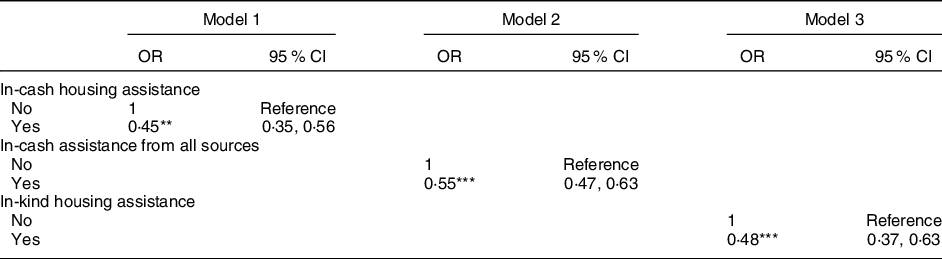
Another fixed effects logistic regression was performed with the covariates adjusted for to examine the effects of housing assistance on housing cost burden. To present the result more succinctly, housing tenure was adjusted for in all mediation analyses. As presented in Table 3, the OR of housing cost burden was all below one for the three types of assistance. This result indicates that in-cash housing assistance (adjusted OR: 0·45, 95 % CI 0·35, 0·56), in-cash assistance from all sources (adjusted OR: 0·55, 95 % CI 0·47, 0·63) and in-kind housing assistance (adjusted OR: 0·48, 95 % CI 0·37, 0·65) were associated with a lower likelihood of transitioning into housing cost burden. This result met the first requirement of the mediation analysis model that the influence of independent variables (in-cash and in-kind assistance) on the mediator (housing cost burden) is statistically significant.
Fixed effects logistic regression: housing assistance and housing cost burden (17 044 observations, 2265 households)
Adjusted for income level, tenure, household size and waves.
**P < 0·01, ***P < 0·001.
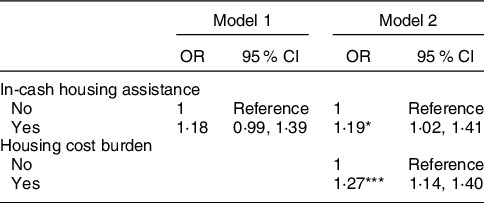
Table 4 illustrates the result of the mediation effect of housing cost burden on the relationship between in-cash housing assistance and food insecurity. When food insecurity was regressed on in-cash housing assistance (model 1), the result was statistically insignificant (adjusted OR: 1·18, 95 % CI 0·99, 1·39) which indicates that in-cash housing assistance did not translate into reduction of food insecurity. In model 2 where housing cost burden was included, in-cash housing assistance (adjusted OR: 1·19, 95 % CI 1·02, 1·41) and housing cost burden (adjusted OR: 1·27, 95 % CI 1·14, 1·40) both increased the likelihood of food insecurity, and these effects were statistically significant. This result shows that housing cost burden did not play as a mediator on the relationship between in-cash housing assistance and food insecurity. Rather, in-cash housing assistance and housing cost burden both operated as predictors of food insecurity.
Fixed effects logistic regression: in-cash housing assistance, housing cost burden and food insecurity (18 048 observations, 2253 households)
Adjusted for income level, tenure, household size and waves.
*P < 0·05, ***P < 0·001.
Table 5 shows the result of the mediation effect of housing cost burden on the relationship between in-cash assistance from all sources and food insecurity. In model 1, in-cash assistance from all sources was negatively associated with food insecurity (adjusted OR: 0·63, 95 % CI 0·56, 0·72). When housing cost burden was included (model 2), its association with food insecurity was significant (adjusted OR: 1·24, 95 % CI 1·12, 1·37), and adjusted OR of food insecurity among households with in-cash assistance from all sources changed to 0·64 while remaining significant (95 % CI 0·56, 0·73). The mediation analysis result requires cautious interpretation as the OR are below one, indicating the negative influence of independent variable on dependent variable. Hence, the increased OR from model 1 to model 2 should be interpreted that the effect size of in-cash assistance from all sources on food insecurity has decreased. Therefore, the implication of this result is that partial mediation exists in the association between in-cash assistance from all sources and food insecurity through housing cost burden.
Fixed effects logistic regression: in-cash assistance from all sources, housing cost burden and food insecurity (18 048 observations, 2253 households)

Adjusted for income level, tenure, household size and waves.
***P < 0·001.
Table 6 shows the result of the mediation effect of housing cost burden on the relationship between in-kind housing assistance and food insecurity. Those who became public housing residents showed a lower likelihood of reporting food insecurity (adjusted OR: 0·62, 95 % CI 0·48, 0·80) (model 1). When housing cost burden was included (model 2), adjusted OR of reporting food insecurity changed to 0·64 (95 % CI 0·50, 0·83) while the association between housing cost burden and food insecurity was significant (adjusted OR: 1·25, 95 % CI 1·12, 1·38), that is, the effect size of in-kind housing assistance on food insecurity has decreased. Similar to the interpretation of the result in Table 5, it can be understood that partial mediation exists in the association between in-kind housing assistance and food insecurity through housing cost burden.
Fixed effects logistic regression: in-kind housing assistance, housing cost burden and food insecurity (18 048 observations, 2253 households)

Adjusted for income level, tenure, household size and waves.
**P < 0·01, ***P < 0·001.
Discussion
The findings of the current study show that household food insecurity is more prevalent among low-income groups (19·3 %) than the whole population of the panel study (9·1 %), and housing cost burden is also more common among this income segment (25·6 %) compared with the whole panel study population (15·3 %). It implies that food insecurity and housing cost burden are archetypal characteristics of low-income families. The evidence presented above affirms that housing cost burden is likely to increase the probabilities of falling into food insecurity among low-income households, which addresses the first research question. However, as demonstrated in previous research(Reference Fafard St-Germain and Tarasuk19,Reference Mclntyre, Wu and Fleisch20) , this association was significant among renters, not among owner-occupiers. It partly supports the assumption that poor people with limited income tend to reduce their food expenditure when housing cost increases and exceeds certain level of household income – 30 % in the current study, and renters are more vulnerable to this problem. This result indicates that the housing affordability problem is a significant risk factor of food insecurity among low-income households, particularly non-homeowners. Relating to the second research question, the current study demonstrated that in-kind housing assistance, in-cash housing assistance and in-cash assistance from all sources are all effective in alleviating housing cost burden of low-income families to some extent. However, we found that only in-kind housing assistance and in-cash assistance from all sources are associated with the lower likelihood of food insecurity as they relieve housing cost burden, while in-cash housing assistance is associated with the higher likelihood of food insecurity.
The findings of the current study have several important implications. While both in-kind and in-cash housing assistance programmes reduce housing cost burden, in-cash housing assistance alone seems ineffective to relieve food insecurity alongside housing cost burden. This result could be partly attributable to the small amount of in-cash housing assistance in the form of monthly housing benefit or one-off cash subsidies. In view of the constantly increasing housing prices in the market, it has been noted that housing cost burden is greater among in-cash housing assistance recipients compared with in-kind housing assistance recipients in Korea(Reference Park and Jun29). Therefore, the finding of our study implies that the amount of in-cash housing assistance provided to low-income Koreans may suffice merely to lessen housing cost burden to some extent, but it is insufficient to enable to free up portion of household income to secure adequate food consumption. Our study also showed that food insecurity is higher among in-cash housing assistance recipients than non-recipients, indicating that in-cash housing assistance plays a role as a marker of food insecurity rather than a countermeasure. In this regard, public housing has a comparative advantage over housing benefit in terms of its impact on residents’ food security and, by extension, health.
Moreover, the current study found that in-cash assistance from all sources, including in-cash housing assistance, livelihood benefits from the national government and other allowances from the local governments, reduces not only housing cost burden but also food insecurity. This result demonstrates that in-cash assistance provided by the public sector in various forms is effective in helping low-income families to pay for housing and food which are the most basic needs of human beings. However, despite its convenience and flexibility in terms of distribution and utilisation, in-cash assistance can be a double-edged sword in meeting diverse basic needs of low-income people. If low-income households cannot afford market housing with current income and even with in-cash housing assistance, they are likely to use part of other in-cash assistance for housing expenses, in which case their other basic needs, such as food, education, transportation and medical care, would be essentially compromised. Conversely, low-income households without housing cost burden or food insecurity may deliberately free up monetary resources, including in-cash housing assistance, for food expenses, in which case the quality of housing could be largely compromised(Reference Kirkpatrick and Tarasuk22). It is also noted that unequal in-cash assistance provided by different local governments with varied financial capabilities might aggravate regional disparity of housing cost burden and food insecurity. In particular, more careful policy design is required to embrace the needs of those who live in poverty but receive only in-cash assistance related to housing as they are subject to lack of resources to secure adequate food.
Conclusion
The current study is one of the few studies that investigated the effects of housing affordability on food insecurity among low-income households, using longitudinal data. We employed the fixed effects model that can solely estimate the effects of housing cost burden and housing assistance programmes on food insecurity, which allowed us to draw rational causal inferences from the dataset. The associations between housing assistance and food insecurity through housing cost burden demonstrate that housing cost burden potentially limits food access among poor families, and that housing assistance, particularly public housing and sufficient in-cash assistance, is conducive to alleviating food insecurity. A closer re-examination of various housing assistance programmes is needed to address low-income families’ food insecurity problems affected by housing cost burden.
An issue that was not addressed in the current study due to the limitation of the dataset is whether low-income people who are experiencing neither housing cost burden nor food insecurity are actually suffering poor housing quality. In addition, whether a household is receiving regular food aids through informal social network or social organisations was not controlled for in our analyses because of the data unavailability. Future research on other potential mediators linking housing expenses and food insecurity, the relations between housing affordability, housing quality and food insecurity, and the effects of energy insecurity as part of housing cost burden on food insecurity would advance our knowledge of how low-income families utilise their limited resources to ensure access to adequate food.
Acknowledgements
Acknowledgements: Not applicable. Financial support: This research received no specific grant from any funding agency, commercial or not-for-profit sectors. Conflict of interest: There are no conflicts of interest. Authorship: B.K.S.: developing conceptual framework, designing the study, writing up the manuscript. G.-R.P.: analysing data, writing up the results, advising on result interpretation. Ethics of human subject participation: The current study was conducted according to the guidelines laid down in the Declaration of Helsinki and all procedures involving research study participants were approved by the Institutional Review Board of Korea Institute for Health and Social Affairs. Written informed consent was obtained from all subjects.



