Advances in the treatment of childhood cancer have dramatically improved survival over the last several decades with current 5-year overall survival rates over 80% resulting in an estimated 430,000 childhood cancer survivors living in the United States.Reference Howlader, Krapcho and Miller1 However, cardiovascular disease remains the leading cause of non-cancer-related mortality in these survivors.Reference Mertens, Liu and Neglia2 Childhood cancer survivors at risk for cardiac dysfunction fall along a continuum of cardiovascular risk with a proportion of survivors who may benefit from paediatric cardiology consultation or ongoing cardiology care. However, due to lack of formal training in cancer therapeutics and their cardiac toxicities, many paediatric cardiologists may not be aware of the specific risks posed to survivors. In fact, a recent study showed that nearly 40% of adult cardiologists reported discomfort with the cardiovascular care of oncology patients.Reference Barac, Murtagh and Carver3 This results in many cancer survivors not receiving guideline-directed care for their cardiovascular risk.Reference Yoon, Telli, Kao, Matsuda, Carlson and Witteles4, Reference Ammon, Arenja and Leibundgut5 For this reason, we sought to assess the baseline knowledge of paediatric cardiologists in our large state-wide practice with regard to the cardiovascular aspects of childhood cancer survivors and subsequently measured the impact of an educational intervention.
Materials and methods
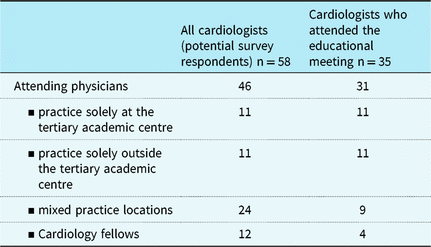
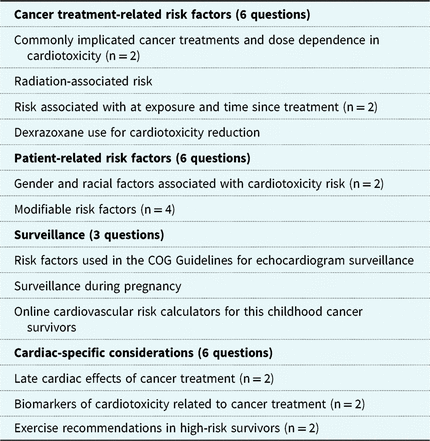
A survey consisting of 21 multiple choice and true–false questions was developed by a multi-disciplinary team of paediatric cardiologists and cancer survivor specialists (Supplemental Table). The survey questions had four themes such as cancer treatment-related risk factors (n = 6), patient-related risk factors (n = 6), recommended surveillance for cardiac late effects based on the Children’s Oncology Group Long-Term Follow-Up Guidelines for Survivors of Pediatric, Adolescent and Young Adult Cancers, version 4.0 (COG guidelines) (n = 3),6 and cardiac-specific questions (n = 6). In February 2016, the anonymous survey was electronically distributed to cardiologists in a large paediatric cardiology program, which comprised 58 cardiologists (46 attending physicians, 12 training fellows). The cardiology practice consisted of 22 clinics throughout the state of Georgia in a mix of rural and urban locations. While the practice is affiliated with a large academic institution, at the time of the survey only 24% of attending physicians practiced solely at the tertiary care hospital with 24% practicing solely in affiliated clinics throughout the state and 52% with mixed practices (Table 1). In the year the survey was conducted, there were nearly 30,000 outpatients evaluated by the practice with over 38,000 clinic appointments and over 18,000 transthoracic echocardiograms.
Characteristics of cardiologists in the practice

Three months after the initial survey, a multi-disciplinary educational session on cardio-oncology was presented at the practice’s monthly operations meeting. Sixty-seven per cent of the practice’s attendings and 33% of the fellows were in attendance (Table 1). The presentation included information on common cardiotoxicities related to cancer treatment and published guidelines related to cardiovascular risk surveillance. The slides from the presentation were distributed via e-mail to all members of the division as well as an answer key for the survey with references. A month after distribution of the answer key, a follow-up survey was mailed to the original cohort. The content of the follow-up survey was the same as the baseline survey but the order of questions was scrambled. In order to improve the response rate, a reminder e-mail was sent 4 weeks following the distribution of the follow-up survey.
Statistical methods
Statistical analyses were performed by using SAS v9.4 (Cary, North Carolina, United States of America) and statistical significance was assessed at the 0.05 level. Per cent of providers who answered correctly was calculated for each question. Pre-intervention and post-intervention correct responses were compared using McNemar’s tests. Theme results and overall results were reported as mean per cent correct ± standard deviation and were compared using paired t-tests.
Results
Pre-intervention results
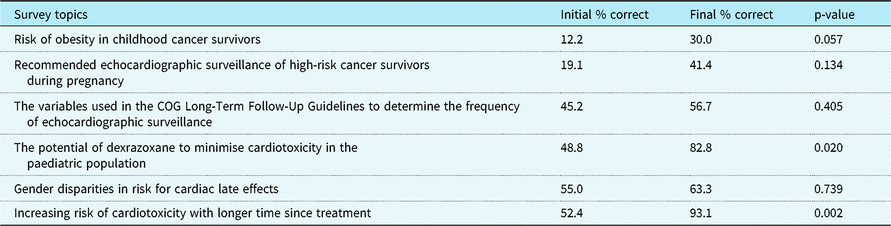
The initial response rate was 72.4% (42/58) with 68.8 ± 10.3% of the questions answered correctly. The theme with the most need for improvement was recommended surveillance for cardiac dysfunction, with the average correct response rate of 49.6 ± 26.7%. Overall, the most common misconception was that survivors have an increased risk of future obesity compared to siblings (12.2% correct). The topics with the lowest correct response rate are listed in Table 2.
Topics included in the survey and educational intervention

COG: Children’s Oncology Group
There were also several important areas where the need for further education of cardiologists was identified (Table 3). While 97.6% of the cardiologists correctly recognised that cardiac complications are the most common non-malignant cause of morbidity and mortality in childhood cancer survivors, less than half (45.2%) were able to correctly identify the treatment and risk-related variables used to determine surveillance frequency in the COG Guidelines,6–Reference Mulrooney, Yeazel and Kawashima8 and only 52.4% of respondents correctly answered that risk for cardiac dysfunction increases with time since treatment. Regarding interventions to mitigate cardiac risk, only 48.8% correctly answered that dexrazoxane has been associated with decreased risk of cardiotoxicity in the paediatric population.Reference Lipshultz, Scully and Lipsitz9, Reference Lipshultz, Rifai and Dalton10 Both non-modifiable patient risk factors (i.e., female gender) and modifiable risk factors (i.e., co-existing hypertension) associated with greater risk for cardiotoxicity were only correctly identified amongst 55.0 and 59.5% of cardiologists, respectively.6 Concerning surveillance recommendations, only 19.1% correctly identified the recommended timing of surveillance echocardiograms during pregnancy for high-risk female survivors, in which echocardiograms are recommended during the third trimester with close monitoring during labour and delivery due to the risk of cardiac failure.6
Pre-intervention questions that were most commonly answered incorrectly and per cent correct on the follow-up questionnaire

COG: Children’s Oncology Group
See Supplemental Table for complete list of questions
Regarding specific cardiac late effects, 61.9% of cardiologists correctly identified the wide spectrum of cancer treatment-associated cardiac disease (cardiomyopathy, congestive heart failure, pericardial fibrosis, valvular disease, atherosclerotic heart disease, and arrhythmias),6 and 75.6% correctly selected all of the echocardiographic measures shown to be different amongst cancer survivors at high and low risk for cardiomyopathy with normal systolic function (end-systolic wall stress, left ventricular end-diastolic diameter, left ventricular mass, and tissue Doppler).6
Post-intervention results
Following the educational intervention, 30 cardiologists (51.7%) responded to the post-intervention survey. There was an overall significant improvement in correct answers from 68.8 ± 10.3 to 79.2 ± 16.2% (p = 0.009). When evaluating the questions by themes, there was a significant improvement in treatment-related risk (p = 0.008) and surveillance (p = 0.025) as well as borderline improvement in patient-related risk (p = 0.066) and cardiac-specific (p = 0.255) (Fig. 1). The questions with the most improvement pertained to risk of cardiac dysfunction with time since treatment (52 versus 93%, p = 0.002) and the role of dexrazoxane in cardioprotection (49 versus 83%, p = 0.020). Other questions with significant improvement related to the fact that African-Americans are at increased risk for late cardiotoxicity (65 versus 93%, p = 0.035), and that there is a web-based risk-assessment tool to estimate the risk of congestive heart failure in survivors by age 40 (85 versus 100%, p = 0.025).Reference Chow, Chen and Kremer11 Following the educational intervention, the two questions with correct response rates that remained less than 50% pertained to the risk of obesity in survivors (30.0% correct) and the timing of surveillance echocardiograms during pregnancy in high-risk survivors (41.4% correct).
Comparison of per cent correct responses before and after survey. Asterisks indicate significant improvement (p ≤ 0.05). The number in parentheses corresponds the number of questions in that category.

Discussion
This study assessed the knowledge of paediatric cardiologists regarding cardiotoxic risk in childhood cancer survivors and documented improvement in knowledge after a concise in-person and online teaching intervention. Overall, we found that our practice had good knowledge of cardiac late effects in childhood cancer survivors with a baseline overall correct response rate of nearly 70%. However, we were able to identify specific knowledge deficits about the care of paediatric cancer survivors, particularly around cardiovascular surveillance. With a multi-disciplinary educational initiative tailored to cardiologists, we succeeded in significantly improving the overall correct response rate to nearly 80%, with the most notable improvement in the theme of surveillance for cardiac dysfunction after cancer treatment. Importantly, these data highlight that while paediatric cardiologists may not be sufficiently armed with the knowledge to provide comprehensive care to childhood cancer survivors, a concise, distributable educational intervention can successfully enhance physician awareness.
Despite both a growing number of childhood cancer survivors and wide recognition that cardiovascular disease is a leading cause of morbidity and mortality in this population, most cardiologists have little training in surveillance for or treatment of cardiovascular late effects.Reference Barac, Murtagh and Carver3 Previous publications have uncovered perceived deficits cardiologists have when caring for survivors. In 2014, Barac et al sent a survey to 444 cardiologists including adult and paediatric providers, mostly within academic settings. They found that amongst responding cardiologists, 39% reported not feeling comfortable with cardiovascular care related to cancer. They also rated their oncology peers as “average” in their understanding of the impact of cancer treatment on the cardiovascular system, and 52% of the cardiologists agreed that a dedicated cardio-oncology program would improve patient care.Reference Barac, Murtagh and Carver3 Similarly, in a 2015 survey of 303 French medical oncologists, only 35% managed cardiovascular toxicities based on guidelines from expert oncology societies, none were aware of recommendations from expert cardiology societies, and the rate of screening for cardiovascular disease was significantly higher pre-chemotherapy than post-therapy, when many complications develop. Nearly 90% of the oncologists supported the development of cardio-oncology programs.Reference Jovenaux, Cautela and Resseguier12 In response to this, a number of professional societies including the American College of Cardiology (ACC), National Cancer Institute (NCI), National Heart, Lung and Blood Institute (NHLBI), American Society of Clinical Oncology (ASCO), and National Comprehensive Cancer Network (NCCN) have created Cardio-Oncology member sections, educational initiatives, and guidelines.Reference Shelburne, Adhikari and Brell13–Reference Ruddy and Moslehi15 While these may direct the development of national guidelines in the area, they do little to address the funding, infrastructure, and educational barriers cited by cardiologists.Reference Barac, Murtagh and Carver3 Additionally, dedicated cardio-oncology programs are not feasible in small practices and rural locations, making dissemination of information critical.
Little has been published about specific knowledge deficits of paediatric cardiologists in regard to risk for cardiovascular dysfunction in childhood cancer survivors. Perhaps not surprisingly, the cardiologists in this study had the highest pre-and post-intervention cumulative scores on the cardiac-specific considerations, including topics related to cardiac involvement, heart failure assessment, and exercise recommendations. Unfortunately, the participants had the lowest knowledge in the areas of surveillance and treatment-related risk factors, which are arguably more important given that paediatric cardiologists are tasked with providing counselling about screening, health behaviours, and management of co-existing cardiovascular risk factors. Knowledge regarding these themes impacts patient education regarding risk modification which is particularly important because cardiovascular disease in survivors is more likely to present many years after the completion of cancer treatment. This was clearly demonstrated in a report from the St. Jude Lifetime Cohort, which found an increased prevalence of several cardiovascular conditions from 3–24% in survivors aged 30–39 years to 10–37% in survivors over 40 years.Reference Mulrooney, Armstrong and Huang16 However, only approximately half of paediatric cardiologists correctly identified that cardiovascular disease increases with increasing time since treatment on the initial survey. Our educational initiative not only significantly improved cardiologists’ understanding of long-term risk for survivors (p = 0.002), but also led to significant improvements in the themes of surveillance and treatment-related risk factors by focusing attention on these areas (50–67%, p = 0.025 and 72–84%, p = 0.008, respectively).
Our methodology could be replicated and tailored to the needs of other paediatric cardiology programs at little to no cost. In the era of modern medical education, smart-phone and web-based educational tools have moved from a supplement to the forefront. Our educational initiative has the potential to be more far-reaching if converted to a web-based platform, with broader implications for those cancer survivors who receive care in community-based practices rather than tertiary care academic settings. This has the potential to improve the status quo of under-diagnosed and undertreated cardiovascular disease in this population.Reference Yoon, Telli, Kao, Matsuda, Carlson and Witteles4, Reference Ammon, Arenja and Leibundgut5 Additionally, there are multiple other resources for cardiologists both online and within the medical community to help individualise care for survivors based on their specific risk factors. Cardiologists can begin by reviewing the COG Guidelines which are freely available online and describe the recommended frequency of screening echocardiograms based on radiation and anthracycline exposure as well as providing references upon which the recommendations were based (survivorshipguidelines.org/).6 To determine specific radiation or anthracycline doses, cardiologists should familiarise themselves with asking survivors questions like “Did you receive radiation that could have included your heart?” or asking them to provide a summary of cancer treatment from their treating institution. Alternatively, cardiologists should develop relationships with local oncologists to foster communication and improve consultations.
While this study evaluated paediatric cardiologists’ knowledge deficits surrounding survivor care and assessed the positive impact of an educational intervention, there are limitations to our study as well. First, due to the anonymous nature of the survey, responses were not paired and individual improvement scores could not be calculated. Moreover, it prevented us from determining if respondents were present at the educational session. Additionally, we did not assess the long-term effect of our intervention in participants’ knowledge as the repeat survey was sent less than 12 months following the initial survey and less than 6 months following the educational initiative. Furthermore, we also did not ascertain if the gain in knowledge impacted the cardiologists’ practice and improved the care of cancer survivors. However, future directions of this study include evaluation of the number of survivors receiving guideline-directed cardiac surveillance, recommendations, and treatment in our practice in order to assess the effect of these interventions. We would also like to assess survivor and provider satisfaction regarding the comprehensiveness of care.
Conclusions
We have shown that a survey assessing paediatric cardiologists’ knowledge of cardiac care in childhood cancer survivors successfully identified areas on which to focus an educational intervention. This allowed us to target deficits with a multi-disciplinary intervention that was associated with a significant improvement in knowledge amongst paediatric cardiologists. This underscores a need for further education of paediatric cardiologists to improve the overall care of childhood cancer survivors and the need for further collaboration between paediatric cardiologists and oncologists in the care of these patients.
Acknowledgements
None.
Financial Support
This research received no specific grant from any funding agency, commercial or not-for-profit sectors.
Conflicts of Interest
None.
Ethical Standards
The authors assert that all procedures contributing to this work comply with the ethical standards of the relevant national guidelines on human experimentation and with the Helsinki Declaration of 1975, as revised in 2008, and has been approved by the institutional committee of Children’s Healthcare of Atlanta.
Supplementary Material
To view supplementary material for this article, please visit https://doi.org/10.1017/S104795111900088X.