Growing evidence suggests that natural disasters are being reported more frequently. 1,Reference Jennings2 Some modeling suggests that natural disasters including tropical cyclones and hurricanes could become even more common. Reference Woodward and Samet3-Reference Gutmann, Rasmussen and Liu5 When preparing for a hurricane, many planning measures need to be considered such as infrastructure improvements, evacuation routes and plans, temporary shelters, and hazard removal. While the risk for communicable diseases following hurricanes is known to be high, Reference Watson, Gayer and Connolly6 recent hurricanes have demonstrated that such events can exacerbate chronic illnesses. Reference Saulnier, Brolin Ribacke and von Schreeb7-Reference Schnall, Roth and LaPlace Ekpo11
Asthma is 1 of the most common chronic illnesses in children, affecting approximately 6 million children in the United States. 12 It disproportionately affects low-income communities, which are also disproportionately affected by hurricanes. 13,Reference Burger, Gochfeld and Lacy14 Asthma exacerbations are common and can be fatal or life-threatening, requiring emergency care. Reference National Asthma and Prevention15 Over half of US children with asthma had 1 or more asthma exacerbations in the past year. 13 Each year in the United States, asthma results in more than 500,000 emergency department visits and more than 80,000 hospitalizations among children. 13 Often, asthma exacerbations can be prevented by actions to control asthma, including taking asthma medication as prescribed and reducing exposure to asthma triggers (eg, mold, viral infections, smoke, airborne chemicals). Reference National Asthma and Prevention15
Some literature has described asthma exacerbations and worsened asthma after hurricanes. Reference Febres-Aldana, Oneto and Csete16,Reference Arcaya, Lowe and Rhodes17 Children are more vulnerable than adults in emergency situations, including after hurricanes 18 ; however, less is known about specific after-event factors that might predispose children to asthma exacerbations. The objective of this systematic literature review was to identify and summarize research that has been conducted to answer the research question, “what are the effects of hurricanes on children with asthma?” by identifying factors associated with increases in asthma-related outcomes, defined as self-reported symptoms or emergency department visits for asthma following hurricanes. The synthesis of this information will aid in developing disaster preparedness planning that reduces the burden of asthma in children following hurricanes.
Methods
Using the Preferred Reporting Items for Systematic Reviews and Meta-Analyses (PRISMA) guidelines, Reference Moher, Li berati and Tetzlaff19 a systematic literature review was conducted to assess existing literature on the impact of hurricanes on children with asthma in the United States. In collaboration with librarians at the Stephen B. Thacker Centers for Disease Control and Prevention (CDC) Library, the authors developed key terms: “asthma,” “asthma attacks,” “hurricanes,” “disaster,” “chronic disease,” “post-disaster,” “asthma morbidity,” “asthma burden,” “environmental health,” “mold,” “allergens,” and “stress-induced asthma.” Medline, Embase, Global Health, PubMed, and Scopus databases were searched for articles published in English between January 1990 and June 2019 using the search terms found in Supplementary Table S1. The final search of the databases was completed on July 1, 2019. Title and abstract were reviewed for all abstracts returned using the initial search terms. Articles were included if they were published in a peer-reviewed journal and included data on children with asthma after a hurricane. After reading abstracts, articles were excluded if they were systematic reviews, focused exclusively on adults, or focused on worker or responder health (usually less generalizable to children).
Because of the limitations of conducting field studies with vulnerable populations in the wake of a disaster, there were no study design or quality inclusion criteria. For these reasons, and due to limited study types that can be rapidly conducted in a postdisaster setting, a formal quality assessment was not completed. Three authors (K.C., J.H., A.P.) abstracted data on hurricane, study population, study design, exposure, outcome(s), data source, and asthma-related health data (ie, presence of asthma, asthma symptoms, asthma medication use, or asthma-related health-care use). Data on environmental exposures were abstracted only if they were analyzed in relationship to asthma-related health outcomes. In lieu of a formal quality assessment, 2 reviewers individually reviewed articles to assess quality, abstract studying findings, and note research limitations.
Results
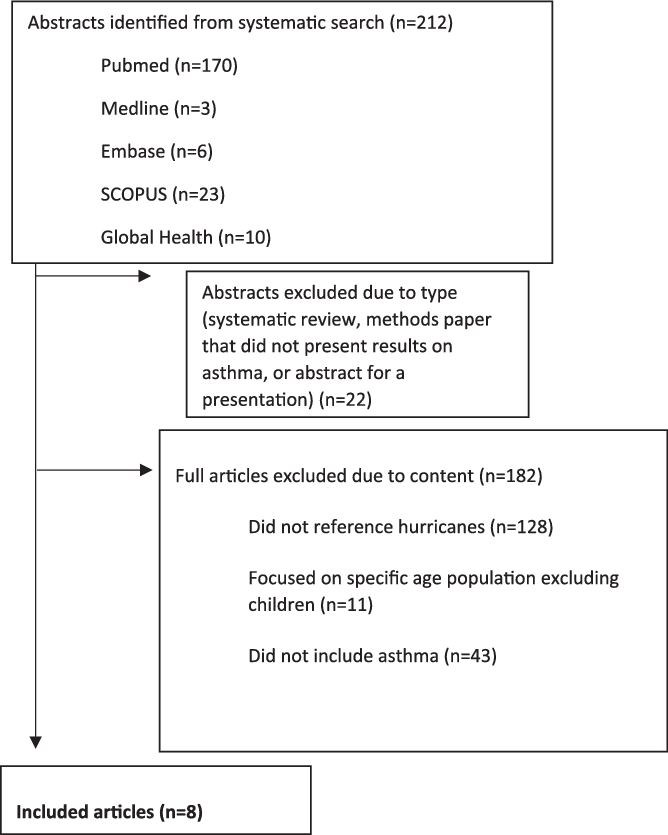
The search terms returned 212 abstracts (Figure 1). Twenty-two of the abstracts were removed because of type (ie, a methods paper that did not report results, a systematic review, or an abstract for a presentation or meeting). After review of the full-length articles, 182 were excluded, for 3 reasons: did not relate to a hurricane, did not include children, or did not report results related to asthma.
Summary of articles identified from the literature search.

A total of 8 articles met the criteria. Because of heterogeneity in these articles, a meta-analysis was not performed. All 8 articles were related to Hurricane Katrina. Almost half (3/8) of the articles focused solely on children; the remainder included both children and adults. Most articles (6/8) involved people living in Louisiana after Hurricane Katrina. Two articles described people who lived in Louisiana before Hurricane Katrina but were displaced to other states (Texas, Mississippi) after the disaster. Only 1 article included comparison to other groups (ie, nondisplaced populations and nondisaster affected populations). Reference Quast20
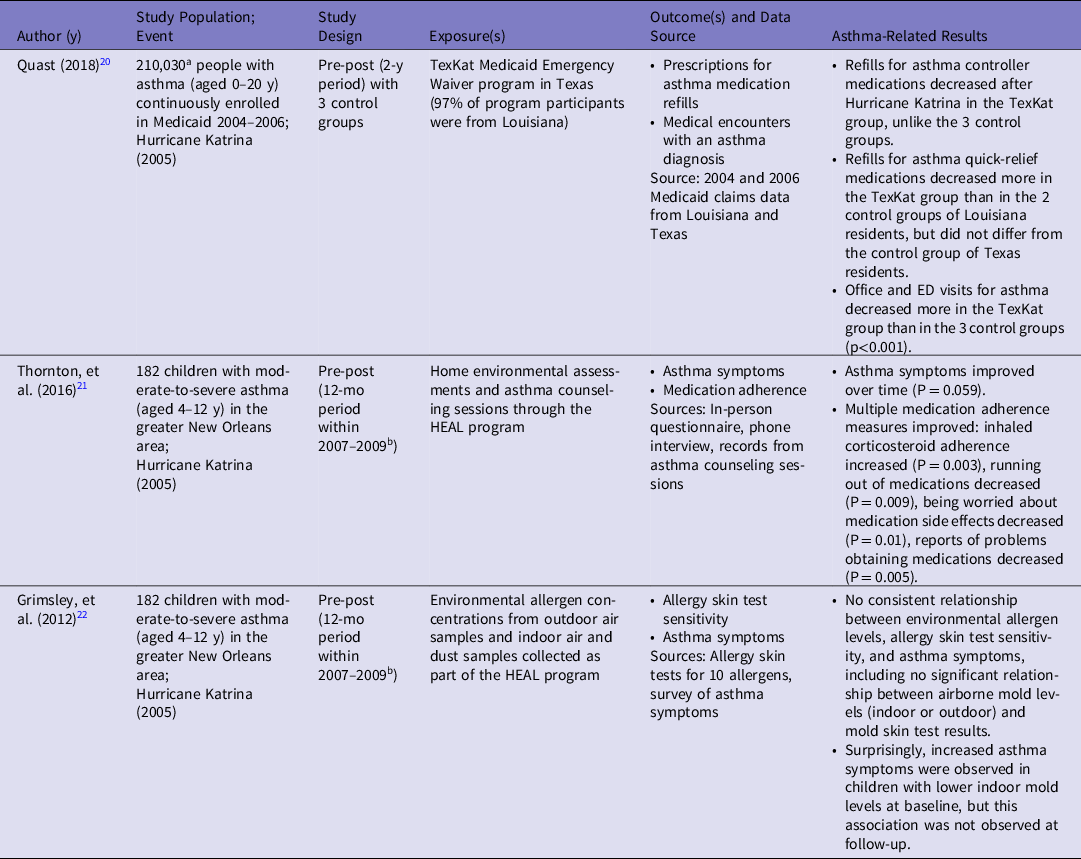
Three articles focused on asthma and involved children; 1 also included young adults (aged 18-20 y) with asthma (Table 1). The largest and most recently published article in this group examined Medicaid claims data to assess the effect of a Medicaid Emergency Waiver program (“TexKat”) in Texas, which mostly served former Louisiana residents displaced by Hurricane Katrina. Reference Quast20 People with asthma (aged 0-20 y) in the TexKat program appeared to have greater decreases in health-care use (office and emergency department visits) and asthma medication refills (controller and rescue medications) than in 3 comparison groups of nondisplaced populations.
Summary of included articles that focused solely on asthma and involved children

Abbreviations: ED, emergency department; HEAL, Head-off Environmental Asthma in Louisiana.
a Of the 210,030 study participants, 1,151 were enrolled in the TexKat program and 208,879 were in the control groups (Louisiana residents who lived in a disaster-declared area prior to Hurricane Katrina but did not relocate to Texas [n = 62,317]; Louisiana residents who did not live in a disaster-declared area [n = 45,982]; and Texas residents enrolled in Medicaid not through TexKat [n = 100,580]).
b Baseline evaluations began March 2007 through July 2008, between 19 and 35 mo after Hurricane Katrina. Reference Grimsley, Chulada and Kennedy38
The 2 other articles that focused exclusively on asthma were related to the Head-off Environmental Asthma in Louisiana (HEAL) study. This program provided home environmental assessments and asthma counseling sessions for 182 children (aged 4-12 y) with moderate to severe asthma in the greater New Orleans area after Hurricane Katrina. Reference Thornton, Kennedy and Hayes-Watson21,Reference Grimsley, Wildfire and Lichtveld22 Both articles were pre-post analyses among the same population. The first of these articles, by Grimsley and colleagues, examined relationships between environmental allergen levels, allergy skin test sensitivity, and asthma symptoms but did not observe any consistent relationships. Reference Grimsley, Wildfire and Lichtveld22 The authors found that lower indoor levels of airborne mold were significantly associated with asthma symptoms in their baseline data, but observed no significant associations between mold levels and asthma symptoms at 6-mo and 12-mo follow-up. These results led the study authors to question the usefulness of 1 set of exposure measurements from 18 mo after Hurricane Katrina (ie, their baseline measurements taken in 2007). Reference Grimsley, Wildfire and Lichtveld22 The more recent article by Thornton and colleagues found that medication adherence among program participants significantly improved over the 12-mo study period. Reference Thornton, Kennedy and Hayes-Watson21
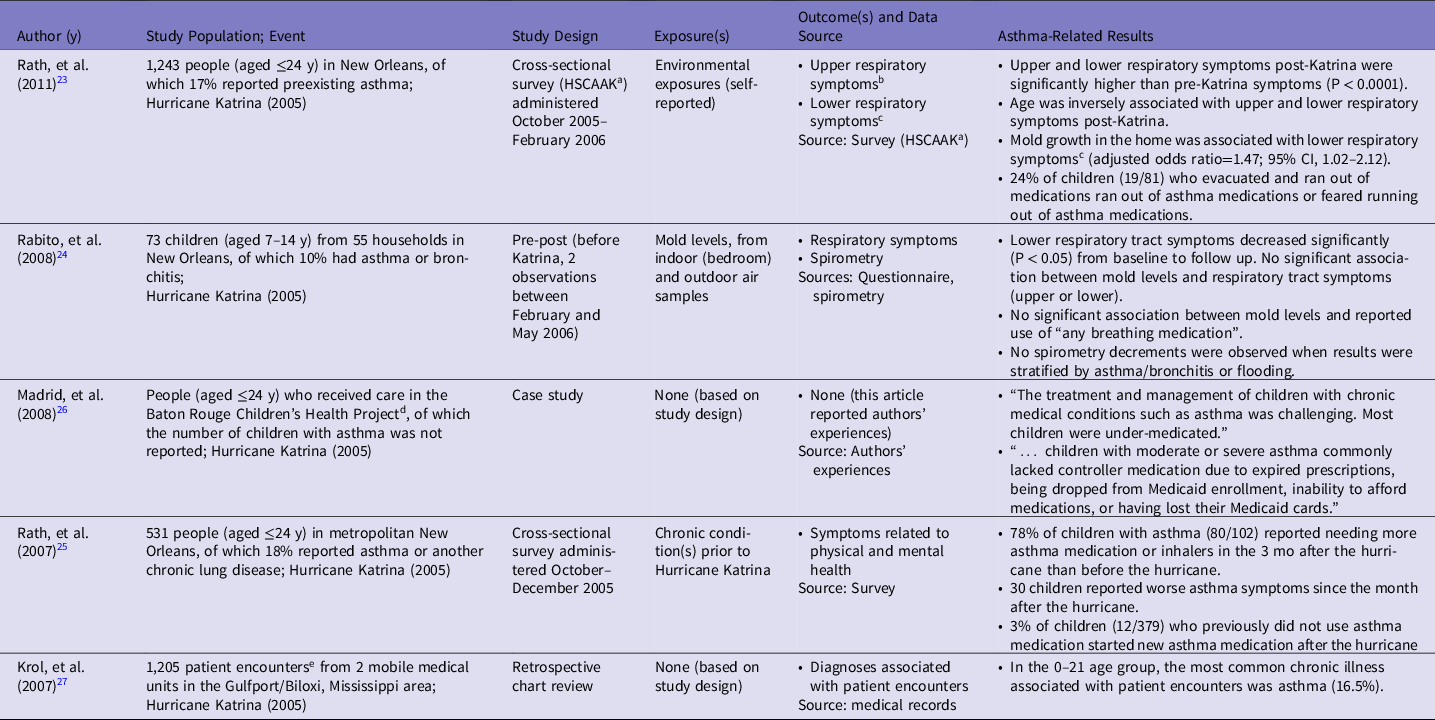
Most of the articles (5/8) in this review included but were not limited to participants with asthma (Table 2). Three reported the percentage of people with asthma in the study populations (10-18% Reference Rath, Young and Harris23-Reference Rath, Donato and Duggan25 ); 2 did not report these data. Reference Madrid, Sinclair and Bankston26,Reference Krol, Redlener and Shapiro27 Only 1 article, by Rabito and colleagues, focused exclusively on children (aged 7-14 y), of which 10% had asthma or bronchitis. Reference Rabito, Iqbal and Kiernan24 Three articles included participants aged ≤24 y. In the 2011 Rath et al. article, 72% of participants were 10 y old or younger. Reference Rath, Young and Harris23 In the 2007 Rath et al. article, 80% of participants were younger than 13 y old. Reference Rath, Donato and Duggan25 In the 2008 Madrid et al. article, ages were not reported. Reference Madrid, Sinclair and Bankston26 In the remaining article (Krol et al.), 29% of patient encounters were for individuals aged 0-21 y, but the percentage of encounters for individuals aged 0-17 y old was not reported. Reference Krol, Redlener and Shapiro27
Summary of included articles that involved children with asthma or other health conditions

Abbreviations: CI, confidence interval; FEMA, Federal Emergency Management Agency; HSCAAK, Health Survey for Children and Adolescents After Katrina.
a The Health Survey for Children and Adolescents After Katrina (HSCAAK) was administered to individuals aged ≤24 y in New Orleans health clinics between October 2005 and February 2006.
b Upper respiratory symptoms included runny nose, stuffy nose, sore throat, flu-like illness, ear infection, new-onset cough, new-onset headache, red eye, and eye drainage.
c Lower respiratory symptoms included shortness of breath, pneumonia, bronchitis, asthma attack, cough >2 wk, and difficulty breathing.
d The Baton Rouge Children’s Health Project included a mobile medical unit to deliver primary care to people in a FEMA transitional housing site that housed approximately 1,600 Katrina evacuees (including about 600 children) near Baton Rouge, Louisiana.
e A total of 296 of these 1,205 patient encounters were for patients aged 0–21 y. For this age group, 31 patient encounters were associated with a diagnosis of asthma.
The only article in Table 2 focused exclusively on children was a repeated measures follow-up study that assessed respiratory symptoms and spirometry over a 2-mo period in 2006, the year after Hurricane Katrina. Reference Rabito, Iqbal and Kiernan24 The authors reported that lower respiratory tract symptoms decreased significantly over the 2-mo study period among 73 children aged 7-14 y (of which 10% had asthma or bronchitis). They found no significant associations between air sampling measurements of mold levels (indoor and outdoor) and respiratory symptoms or medication use. They also observed no differences in spirometry results between the 2 time periods.
Of the remaining 4 articles in Table 2, 2 were cross-sectional surveys, Reference Rath, Young and Harris23,Reference Rath, Donato and Duggan25 1 was a case study, Reference Madrid, Sinclair and Bankston26 and 1 was a retrospective chart review. Reference Krol, Redlener and Shapiro27 One cross-sectional survey, the Health Survey for Children and Adolescents After Katrina (HSCAAK), found that lower respiratory symptoms (including shortness of breath, asthma attack, and/or difficulty breathing) increased after Hurricane Katrina. Reference Rath, Young and Harris23 Also, mold growth in the home was associated with lower respiratory tract symptoms (adjusted odds ratio = 1.47; 95% CI 1.02-2.12) and of the 81 children who evacuated and ran out of medications, 24% ran out of asthma medications or feared they would run out of asthma medications. The other cross-sectional survey in this group (Rath et al., 200725) compared people aged ≤24 y with and without chronic condition(s) before Hurricane Katrina. In this survey, 18% of participants reported asthma or another chronic lung disease. Among these individuals, 78% reported needing more asthma medication during the first 3 mo after Hurricane Katrina than before the hurricane. Reference Rath, Donato and Duggan25
Two articles of individuals with and without asthma reported observations from mobile medical units, which served people displaced by Hurricane Katrina and living in Federal Emergency Management Agency transitional housing. One of these articles was a retrospective chart review of patient encounters at 2 mobile medical units in Mississippi. This study found that asthma was the most common chronic illness associated with patient encounters in individuals aged 0-21 y old. Reference Krol, Redlener and Shapiro27 The other article was a case study which described multiple challenges faced by people aged ≤24 y with asthma who received care from a mobile medical unit in Louisiana. Reference Madrid, Sinclair and Bankston26 These challenges included expired controller medication prescriptions, inability to afford medications, lost Medicaid insurance cards, and loss of health insurance because of being dropped from Medicaid enrollment. Reference Madrid, Sinclair and Bankston26 Assessment of prehurricane asthma morbidity was not available for either of these articles.
Discussion
This systematic literature review identified 8 articles involving children with asthma after hurricanes, all conducted after Hurricane Katrina gathering data related to the research question “What are the effects of hurricanes on children with asthma?” The articles addressed a wide range of research questions, such as the effect of a Medicaid Emergency Waiver program for people displaced by a hurricane and the result of posthurricane environmental exposures on asthma symptoms. Many articles reported discontinuity in health insurance, asthma-related health-care use, or asthma medication use following a hurricane. Also, a few articles examined the relationship between posthurricane mold exposure and asthma symptoms, reporting varying results.
This review adds to the literature by synthesizing existing research involving children with asthma after hurricanes. Strengths of this project include its systematic search and review process, as well as having 3 individuals review articles and abstract data. Also, broad criteria were used to include articles of many types, capturing many perspectives on posthurricane research. This study highlights opportunities for disaster preparedness planning to reduce asthma burden among children by identifying frequently reported issues among children with asthma posthurricane: discontinuity in health insurance, asthma-related health-care use, or asthma medication use.
Characterizing the scope of existing literature on this topic makes research gaps more evident. For example, all included articles were related to Hurricane Katrina; we did not find any articles pertaining to more recent major hurricanes, such as Hurricanes Harvey, Irma, or Maria in 2017. Also, this review did not find publications describing mental health among children with asthma, despite related research on adults with asthma, mental health after hurricanes, and known associations between mental health and asthma morbidity among children. Reference Arcaya, Lowe and Rhodes17,Reference Katon, Richardson and Lozano28-Reference Weems, Taylor and Cannon33 The majority of included articles (n = 5) relied on self-reported measures for exposure, outcome, or both, and only 1 article included comparison groups. Reference Quast20 Future research on this topic would benefit from different study designs and objective measures. Finally, work to determine the population attributable fraction of posthurricane asthma burden related to factors, such as discontinuity in health care or indoor mold exposure could facilitate efficient allocation of resources after a hurricane. Based on our high-level perspective we have identified that cohort studies that objectively measure exposures and asthma symptoms or outcomes pre- and posthurricane would be valuable.
Because a wealth of evidence documents a relationship between indoor mold exposure and asthma symptoms, it was surprising that results varied from included articles examining the relationship between posthurricane mold exposure and asthma symptoms. 34,Reference Mendell, Mirer and Cheung35 The largest included article to address this relationship, a survey of 1243 people, found current mold growth was significantly associated with current lower respiratory symptoms. Reference Rath, Young and Harris23 In contrast, included articles that did not report consistent relationships between mold exposure and asthma measures (ie, asthma symptoms, “breathing medication use”) had much smaller sample sizes (N = 182 and = 73). Reference Grimsley, Wildfire and Lichtveld22,Reference Rabito, Iqbal and Kiernan24 Differences in sample size among these 3 articles might have accounted for variation in their results.
Although no formal quality assessment was conducted because of the heterogeneity of the study types included, the authors carefully reviewed the limitations of postdisaster research. One identified limitation is that the majority of articles on this topic following Hurricane Katrina were cross-sectional. Hurricanes can be difficult to predict, and they are predicted usually only a few days before they occur, at a time where safety needs to be prioritized over research. This short warning time makes other study designs less feasible in this context. One limitation of this systematic literature review is that it included articles only in the United States, so its findings cannot be generalized to other nations, particularly those with different types of health-care systems. Also, these results cannot necessarily be generalized to adults or to children of socioeconomic backgrounds not addressed in the included articles. Additionally, only peer-reviewed articles were included, so it is possible that some research in this area was missed. This systematic literature review abstracted environmental exposure data only if they were analyzed in relationship to asthma-related health outcomes, so it is not intended to fully describe environmental exposures among children with asthma after hurricanes.
Currently, the CDC recommends that, if a tropical storm or hurricane is coming to an area, people with asthma should make sure to have at least a 3-d supply of asthma medication and copies of medical documents such as asthma action plans, health insurance cards, and immunization records. 36 Also, the CDC recommends that children and people with asthma or with weakened immune systems do not spend time in areas with mold or participate in clean-up. 37 Specific messaging targeted to those with asthma regarding continuing medication use, coping with disasters, and staying away from mold in homes could be useful in reducing exacerbations in asthma following hurricanes.
Conclusions
This systematic literature review identified and summarized research conducted on the effects of hurricanes on children with asthma. Eight articles were included, all conducted after Hurricane Katrina. Many articles reported discontinuity in health insurance, asthma-related health-care use, or asthma medication use following a hurricane. Also, a few examined the relationship between posthurricane mold exposure and asthma symptoms and reported varying results, indicating that further research on mold growth in the homes of children with asthma may be useful. These findings can be used to inform hurricane preparedness planning, public health hurricane response, and future investigations.
Acknowledgements
The findings and conclusions in this report are those of the authors and do not necessarily represent the views of the Centers for Disease Control and Prevention.
Funding
None.
Supplementary material
To view supplementary material for this article, please visit https://doi.org/10.1017/dmp.2020.424.