Neglect is the most frequently identified form of child maltreatment. It has been associated with malnutrition, accidents, injuries, untreated health conditions, and developmental delays (Erickson & Egeland, Reference Erickson, Egeland, Myers, Berliner, Briere, Hendrix, Jenny and Reid2002; Gaudin, Reference Gaudin and Dubowitz1999). Mothers with a history of child neglect typically show low sensitivity to the child's demands and provide insufficient or inadequate care to fulfill the child's cognitive, emotional, educational, and physical protection needs (Dubowitz et al., Reference Dubowitz, Pitts, Litrownik, Coxd, Runyan and Black2005). These demands are usually conveyed by negative and positive emotional cues (e.g., facial expressions and vocal cues) in the preverbal child. Therefore, the caregiver should be able to “read” and react adequately to these cues in order to meet the child's demands. Behavioral studies have shown that this is probably not the case for neglectful mothers. They appear to be less skillful in dealing with emotional communication, because they tend to show lower levels of emotional expression, less emotional perspective taking, and less understanding of their children's emotional displays; and they provide little exchange of emotional information compared to control mothers (Bousha & Twentyman, Reference Bousha and Twentyman1984; Crittenden, Lang, Claussen, & Partridge, Reference Crittenden, Lang, Claussen, Partridge, Crittenden and Claussen2000; Gaudin, Reference Gaudin and Dubowitz1999; Shipman, Edwards, Brown, Swisher, & Jennings, Reference Shipman, Edwards, Brown, Swisher and Jennings2005). In turn, neglected children tend to have difficulty discriminating and identifying emotional expressions (i.e., anger, sadness) and fewer adaptive emotional regulation skills (Pollak, Cicchetti, Hornung, & Reed, Reference Pollak, Cicchetti, Hornung and Reed2000; Shipman et al., Reference Shipman, Edwards, Brown, Swisher and Jennings2005; Wismer Fries, & Pollak, Reference Wismer Fries and Pollak2004).
Research into the neurobiology of parent–infant relationships is increasingly paying attention to the study of the biological basis of parental recognition and discrimination of the infant's signals (Swain, Lorberbaum, Kose, & Strathearn, Reference Swain, Lorberbaum, Kose and Strathearn2007). An interesting topic of research is whether mothers who neglect their children may have difficulties in the processing of emotional infant signals such as facial expressions (cries and laughs). Variations in maternal sensitivity may be reflected in measurable differences in the mothers' brain activity in response to these infant expressions and registered by means of electroencephalographic techniques. In particular, event-related potentials (ERPs) could be biomarkers of this sensitivity, as they allow access to the time course of emotional processing and provide information about the processing stages of infant cues in which neglectful mothers may show impairment. Similarly, several ERP studies have reported the distinctive patterns of neural processing evoked by the facial expressions of adult female models in maltreated and nonmaltreated young children (Cicchetti & Curtis, Reference Cicchetti and Curtis2005; Parker, Nelson, & The Bucharest Early Intervention Core Group, Reference Parker and Nelson2005). Their findings suggested that angry and happy targets activated affective representations differently in maltreated versus nonmaltreated children.
It is surprising that no ERP studies have examined the neurological correlates of maternal sensitivity in neglectful mothers compared to control (nonneglectful) mothers by registering their respective brain potentials in response to facial images of crying and laughing infants. However, two lines of ERP evidence of adult processing of emotional expressions could be used to support our expectations. The first line shows a facilitation of emotional adult faces at several points of information processing (Cuthbert, Schupp, Bradley, Birbaumer, & Lang, Reference Cuthbert, Schupp, Bradley, Birbaumer and Lang2000; Eimer, Holmes, & MgLone, Reference Eimer, Holmes and Mglone2003; Krolak-Salmon, Fischer, Vighetto, & Mauguiére, Reference Krolak-Salmon, Fischer, Vighetto and Mauguiére2001). It is proposed that the ability to discriminate between emotional and neutral expressions is highly adaptive, because emotions are markers of mental states and signals of intentions (Schupp, Junghöfer, Weike, & Hamm, Reference Schupp, Junghöfer, Weike and Hamm2004). According to a broad facilitation of emotional stimuli, enhanced ERP responses would be expected for both crying and laughing infant faces when compared to neutral faces.
A second line of evidence demonstrates the preferential processing of emotionally negative stimuli compared with positive and neutral ones, as indicated by increased amplitudes at different stages of face processing (Carretié, Mercado, Tapia, & Hinojosa, Reference Carretié, Mercado, Tapia and Hinojosa2001; Huang & Luo, Reference Huang and Luo2006; Schupp, Öhman, et al., Reference Schupp, Öhman, Junghöfer, Weike, Stockburger and Hamm2004). This phenomenon, known as the negativity bias, is highly adaptive, because it provides critical information about potential dangers in the environment and ensures defensive responses typical of the aversive system (withdrawal, aggression, or freezing with fear responses) to proximate negative cues (Bradley, Codispoti, Cuthbert, & Lang, Reference Bradley, Codispoti, Cuthbert and Lang2001; Cacciopo & Berntson, Reference Cacciopo and Berntson1999). However, two pieces of information call this line of thinking into question when applied to infant stimuli. First, infant crying fits better with the appetitive system, activated in contexts involving sustenance, procreation, and nurturance, than with the aversive system, primarily activated in contexts involving threat and danger. The reason is that infant crying is a negative valence stimulus that is part of the cues (gaze, head turning, vocalizations, sucking) for promoting social engagement and attachment with the caregivers (Porges, Reference Porges2003). Therefore, infant crying may elicit approach or immobility responses from the caregivers, typical of empathy and social receptivity (Facchinetti, Imbiriba, Azevedo, Vargas, & Volchan, Reference Facchinetti, Imbiriba, Azevedo, Vargas and Volchan2006), rather than withdrawal or aggressive responses. Thus, it is questionable which dipole (aversive or appetitive) infant crying gravitates toward. Second, interpreting heightened ERP responses to negative valence stimuli as a negativity bias requires that arousal has been put on a level with positive valence stimuli. This is particularly difficult in the case of infant faces, because crying is likely to elicit greater arousal than smiling, at least in mothers. According to a selective facilitation of negative stimuli, enhanced ERP responses would be expected for crying faces when compared to laughing and neutral faces but should not be considered as evidence of a negativity bias.
Evidence supporting either a broad or selective facilitation of emotional stimuli would be useful to shape the particular mechanisms that characterize the processing of infant stimuli at different time points. A mother's ability to be alert or attuned to an infant's needs could be based in part on these mechanisms. What would be expected for the neglectful mothers? Would they exhibit a motherlike pattern of brain activity? If not, would personality characteristics help to explain the differences between the brain patterns of neglectful and control mothers? In the following section, we review studies based on the recording of ERP components in the adult brain in response to emotional faces as well as studies revealing personality dimensions that may explain variations in the mothers' ERP patterns.
Emotional Faces and ERP
Evidence from many studies (for a review, see Vuilleumier & Pourtois, Reference Vuilleumier and Pourtois2007) supports the notion that emotional face perception involves consecutive stages of processing (e.g., perceptual, attentive, and evaluative) spread over different periods of time. Emotion effects occur in the EEG at both early and late time intervals after stimulus onset, even though the functional meaning and the neural sources of these effects remain quite uncertain.
Face-specific potential for negative occipitotemporal component peaking at around 170 ms on the scalp (N170)
It is frequently assumed that specialized neural systems in the human inferotemporal cortex are activated by faces, compared to other visual objects, at around 150–200 ms after stimulus onset, which is indexed by the N170 component that is measured over the scalp with occipitotemporal electrodes (Bentin, Allison, Puce, Perez, & McCarthy, Reference Bentin, Allison, Puce, Perez and McCarthy1996). These visual responses are thought to reflect early perceptual encoding and categorization of face stimuli prior to face recognition (Bobes, Martin, Olivares, & Valdes-Sosa, Reference Bobes, Martin, Olivares and Valdes-Sosa2000; Carmel & Bentin, Reference Carmel and Bentin2002; Eimer, Reference Eimer2000). Several studies have reported modulation of the N170 from positive and negative faces compared to neutral faces (Ashley, Vuilleumier, & Swick, Reference Ashley, Vuilleumier and Swick2004; Miyoshi, Katayama, & Morotomi, Reference Miyoshi, Katayama and Morotomi2004; Pizzagalli et al., Reference Pizzagalli, Lehman, Hendrick, Regard, Pascual-Marqui and Davidson2002). However, fearful faces have also been reported to elicit larger N170 than neutral or happy faces (Batty & Taylor, Reference Batty and Taylor2003; Leppänen, Moulson, Vogel-Farley, & Nelson, Reference Leppänen, Moulson, Vogel-Farley and Nelson2007). Both types of modulation are typically interpreted as reflecting differential processing of emotionally meaningful and neutral stimuli in cortical visual regions.
Positive electrical potential peaking at about 200 ms (P200)
The P200 is an attention-related component that is thought to index the brain's response to emotional stimulation, although it is not specific to faces (Dennis & Chen, Reference Dennis and Chen2007). The P200, originated in the visual association cortex over centroparietal scalp regions, reflects input processing-related attention toward affective pictures that are assumed to be of intrinsic relevance (Carretié et al., Reference Carretié, Mercado, Tapia and Hinojosa2001). This component can be modulated by the valence of stimuli. Different studies have reported increased P200 amplitude to unpleasant stimuli compared to pleasant stimuli at different sites (Carretié et al., Reference Carretié, Mercado, Tapia and Hinojosa2001; Delphanque, Lavoie, Silvert, & Sequeira, Reference Delphanque, Lavoie, Silvert and Sequeira2004; Eimer et al., Reference Eimer, Holmes and Mglone2003; Huang & Luo, Reference Huang and Luo2006). Negative stimuli seem to occupy more attentional resources than positive events, perhaps receiving preferential treatment during early stages of processing (Huang & Luo, Reference Huang and Luo2006).
Late positive potential (LPP)
The majority of ERP studies reported that the affective expression of faces is also processed at relatively later stages in the perceptual system, during a time window starting at 350–400 ms and lasting for several hundred milliseconds (Vuilleumier & Pourtois, Reference Vuilleumier and Pourtois2007). This late potential is not specific to faces. On a functional basis, the LPP amplitudes are hypothesized to index further allocation of attentional resources (Cuthbert et al., Reference Cuthbert, Schupp, Bradley, Birbaumer and Lang2000), initial semantic categorization (Codispoti, Ferrari, & Bradley, Reference Codispoti, Ferrari and Bradley2007), and initial memory storage events that allow the representation of stimuli in working memory (Azizian & Polish, Reference Azizian and Polich2007). The LPP also probably indicates a sustained and more elaborated stimulus analysis phase, typical of evaluative processes, after the stimulus identification is complete (Ritter & Ruchkin, Reference Ritter and Ruchkin1992). Differential effects of emotional versus neutral faces have been found for mid and late latencies or amplitudes that are presumably generated in associative or supramodal brain areas, such as the P300 component or the LPP recorded over centroparietal scalp regions (Krolak-Salmon et al., Reference Krolak-Salmon, Fischer, Vighetto and Mauguiére2001; Marinkovic & Halgren, Reference Marinkovic and Halgren1998; Schupp, Junghöfer, et al., Reference Schupp, Junghöfer, Weike and Hamm2004). Marinkovic and Halgren (Reference Marinkovic and Halgren1998) also found a modulation of late positive complex by emotional expressions at the frontal sites when attention to the emotional valence was required. An enhanced positivity for negative compared to neutral faces was elicited in some studies, with explicit attention given to comparing ERP responses to fearful versus neutral faces (Eimer & Holmes, Reference Eimer and Holmes2002; Holmes, Vuilleumier, & Eimer, Reference Holmes, Vuilleumier and Eimer2003). Even when no explicit attention was required, facial threats also elicited augmented LPP compared to friendly expressions, and both did so more than neutral faces (Schupp, Öhman, et al., Reference Schupp, Öhman, Junghöfer, Weike, Stockburger and Hamm2004). These combined findings support the hypothesis of facilitated encoding of emotional adult faces, especially of negative emotions, at early perceptual and attentive stages and at later sustained, evaluative stages of face processing. This phenomenon of facilitated encoding may be used to compare the maternal processing of infant faces in neglectful and control mothers.
Personality Measures and ERPs
Two personality variables, empathy and anhedonia, appear to be good candidates for identifying individual differences between neglectful and control mothers. Empathy is defined as appropriated perception, experience, and response to another's emotion (Davis, Reference Davis1983). It has two components: cognitive empathy, which is related to the “theory of mind” or the ability to understand and predict another person's mental perspective (Baron-Cohen, Wheelwright, Hill, Raste, & Plumb, Reference Baron-Cohen, Wheelwright, Hill, Raste and Plumb2001), and affective empathy, which is the ability to experience an appropriate emotional response mirroring the affective state of others (Hoffman, Reference Hoffman, Izard and Kagan1984). Empathy is an important component of adaptive interpersonal relationships and is necessary for effective parenting, as it provides powerful motivation to meet the needs of others (Kerem, Fishman, & Josselson, Reference Kerem, Fishman and Josselson2001). Thus, it is likely that deficits in the cognitive and/or affective components of empathy would be at the core of the lack of perspective-taking abilities shown by neglectful mothers when they have to respond to infant demands, mostly conveyed by emotional expressions (Crittenden et al., Reference Crittenden, Lang, Claussen, Partridge, Crittenden and Claussen2000; Shahar, Reference Shahar2001).
Anhedonia is the loss of the capacity to subjectively experience pleasure. A distinction has been made between physical anhedonia, which is the loss of capacity to subjectively experience pleasure from sensorial (e.g., visual, auditory, olfactory) input, and social anhedonia, characterized by disinterest in relationships and a lack of reward from social contact. It has been found that decreased hedonic tone is a predictor of poor social outcomes in adulthood (Freedman, Rock, Roberts, Cornblatt, & Erlenmeyer-Kimiling, Reference Freedman, Rock, Roberts, Cornblatt and Erlenmeyer-Kimiling1998), suggesting that anhedonia might lie at the heart of the attitudes of social withdrawal and the problems with interpersonal relationships exhibited by neglectful mothers (Christensen et al., Reference Christensen, Brayden, Dietrich, McLaughlin, Sherrod and Altemeier1994; Friedrich, Tyler, & Clark, Reference Friedrich, Tyler and Clark1985; Schumacher, Slep, & Heyman, Reference Schumacher, Slep and Heyman2001).
Contrary to the lack of empirical findings relating empathy to ERP measures, effects of hedonic tone on brain potential measures of cognitive processing have been reported in both psychopathological and normal populations. Reduced amplitudes of LPPs in attention tasks have been associated with several psychiatric conditions such as schizophrenia (Mathalon, Ford, Rosenbloom, & Pfefferbaum, Reference Mathalon, Ford, Rosenbloom and Pfefferbaum2000) and depression (Röschke & Wagner, Reference Röschke and Wagner2003). Several studies indicate that anhedonia is an important mediating variable between those psychiatric diseases and reduced early (P50) and late (P300) ERP amplitudes (Arnfred & Chen, Reference Arnfred and Chen2004; Bruder et al., Reference Bruder, Tenke, Towey, Leite, Fong and Stewart1998). This evidence is relevant to our study, because Christensen et al. (Reference Christensen, Brayden, Dietrich, McLaughlin, Sherrod and Altemeier1994) and Friedrich et al. (Reference Friedrich, Tyler and Clark1985) noted that neglectful mothers responded in ways similar to maladjusted and personality-disordered groups. Moreover, higher scores in anhedonia in healthy individuals performing an attention task to low-probability stimuli (a letter) were also associated with attenuated amplitudes of early (N170) and late (>P300) components (Franken, Van Strien, & Nijs, Reference Franken, Van Strien and Nijs2006), indicating that this result is not only specific to unhealthy populations. Finally, high anhedonics compared with controls exposed to passive viewing of positive emotional (male or female nude) and neutral stimuli showed a clearly reduced P300 only to low-probability emotional stimuli (Miller, Simons, & Lang, Reference Miller, Simons and Lang1984).
Research Goals and Predictions
In this study, the electrophysiological correlates of the processing of infant faces in neglectful and control mothers were explored using the three specific ERP components targeting early and late face processing. The first goal was to investigate whether the maternal processing of infant faces was modulated by their emotional significance, thus expanding previous findings. Specifically, we wanted to know whether the maternal early encoding of face stimuli, indexed by the N170 and P200 components, as well as the further elaboration of stimuli at later stages, indexed by the LPP, were modulated either by both infant crying faces and laughing faces versus neutral faces, or only by cry stimuli. The second goal was to investigate whether the ERP emotional modulation differed in neglectful and control mothers, and thus, whether it reveals neurological differences in maternal sensitivity to these infant signals. The relevant psychological measures of empathy and anhedonia, which have never been considered at the same time in a comparative study, were chosen to examine personality differences between the two groups. Specifically, we wanted to investigate whether variations in maternal self-ratings of empathy and anhedonia would be related to maternal brain activity, and thus, whether this may help in the interpretation of any differential patterns of brain potentials eventually observed between the two groups.
We recorded the ERPs in neglectful and control mothers, under the same viewing conditions, associated with the viewing of pictures of different infant faces showing emotional (crying and laughing) and neutral expressions. The mothers were given instructions to categorize the facial expressions to ensure their attention to the stimuli. Based on the literature reviewed above, we predicted that the crying and laughing faces would modulate the three ERP components (a) by increasing amplitudes of the N170 and P200 components compared to the neutral faces and (b) by increasing amplitudes of the LPP component relative to neutral expressions. It is also reasonable to expect a further advantage of the cry stimuli over the laugh stimuli, similar to that of fearful and threatening stimuli, based on the highly adaptive value of cry stimuli for infant survival. We predicted that the emotional modulation obtained in the early and late ERP potentials would be less evident in the group of neglectful mothers, based on their typically low sensitivity to infant demands and displays of emotion. Concerning personality measures, higher self-ratings of anhedonia and lower self-ratings of empathy were expected for the neglectful group compared to the nonneglectful or control group. We also predicted that the ERPs of high-anhedonic subjects would be attenuated compared with those of low-anhedonic subjects. We also tentatively predict, given the lack of studies, a similar pattern of results for low-empathic subjects, based on the emotional significance of infant stimuli and the importance of empathy for effective parenting. Finally, it was thought that the use of multidimensional measures of empathy and anhedonia in our study would provide further details concerning the particular components that significantly contribute to variations in ERP patterns.
Method
Participants
A total of 30 White mothers, most of whom were poorly educated and unemployed, participated in the data collection. Data from 28 of these mothers were retained for analyses (2 were discarded because of technical problems); the final sample consisted of 14 neglectful mothers and 14 control mothers living in Tenerife, Canary Islands, Spain. To maximize comparability, both groups were recruited through the same municipal social services centers (one rural and one urban) from families both with and without risk indicators of maltreatment. They were participating in a parenting program called “Family and Personal Support” (Apoyo Personal y Familiar), a program aimed at improving parenting and personal skills in order to increase the autonomous functioning of poorly educated parents receiving public assistance (Rodrigo, Correa, Máiquez, Martin, & Rodriguez, Reference Rodrigo, Correa, Máiquez, Martín and Rodríguez2006). Parents at risk for maltreatment were specifically invited to participate in the parenting program, whereas parents not at risk attended the program on a more voluntary basis (e.g., to improve their parenting skills). Group sessions were just starting at the time of testing; thus, no interference was expected from the potential effects of the program (e.g., increased levels of empathy). Neglectful mothers were drawn from a pool of 36 at-risk mothers (27 neglectful mothers), and control mothers were drawn from a pool of 25 mothers.
The primary identified problem of the mothers in the neglectful group was substantiated neglect of a child under 5 years old. In fact, neglect was the only concern leading to referral recorded in the Child Protective Services (CPS) in the previous 12 months. Maltreatment information was encoded using the operational criteria for child neglect contained in the nosological system for child maltreatment (Maltreatment Classification System; see also Dubowitz et al., Reference Dubowitz, Pitts, Litrownik, Coxd, Runyan and Black2005). All mothers in this group exhibited the three main subtypes of neglect and scored positively on all indicators: physical neglect (inadequate food, hygiene, clothing, and medical care), lack of supervision (child is left alone or in the care of an unreliable caregiver) and educational neglect (lack of cognitive and socioemotional stimulation and lack of attention to child's education). Subtype assignment was based on family-level maltreatment reports of the social services, in addition to CPS reports on individual children, in order to ensure a more complete account of the neglectful environment. The overall agreement between the Maltreatment Classification System coding of the subtypes and the other sources (municipal social services and CPS reports) was 95% for all reports. In addition, all of the neglectful mothers had a history of maltreatment, although none of them had severe mental health problems (e.g., depression), were drug abusers and/or had a low IQ (according to the information available to the social services, which usually receive the reports from the mental health services when this is the case). None of the neglected infants had been placed in foster care at any point in their history, nor had they been born prematurely or suffered perinatal medical complications. All mothers in the control group had at least one child under 5 years old and a confirmed absence of CPS records or Preventive Services records for the family, a situation further corroborated in interviews with the mothers performed by the social workers. Based on the information collected in these interviews, none of the mothers scored positively on any of the indicators for the three subtypes of neglect and none had a history of maltreatment, drug abuse, mental health problems, or low IQs. Children from the control mothers had no history of medical problems.
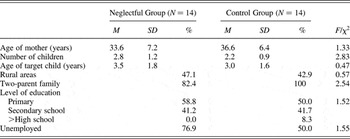
An analysis of key demographic variables revealed that the mothers from the neglectful and the control groups did not significantly differ on any variable (Table 1). The mean ages of the mothers in both groups were in the mid-30s (range = 23–46 and 27–47 in the neglectful and control group, respectively), and they had less than three children as a mean (range = 1–6 and 1–4, respectively). The mean age of the target child was approximately 3 years old (range = 1–5 and 2–5, respectively). Approximately half of the mothers lived in rural environments, more than two-thirds lived in two-parent families, and the majority were poorly educated and unemployed.
Demographic characteristics of mothers in neglectful and control groups

Note: All comparisons p > .05.
Measures
Infant stimuli
Three types of infant stimuli were used: 24 explicit cry, 24 explicit laugh, and 24 neutral faces. For each expression, 50 pictures were downloaded from the Internet and subjected to a rater agreement system with the assistance of 10 postgraduate students. Pictures were matched for size and luminance to minimize any bias caused by their appearance. Only color pictures of White children up to 3 years old were selected. Of the pictures selected, approximately half showed male infants and all showed the infant face in the foreground and facing forward. The neutral faces depicted infants with no detectable emotional expression, whereas the emotional faces depicted infants with an overt emotional expression. The pictures obtaining 95% agreement in the above criteria were selected. The three expressions had very distinctive features (adapted from Oster, Hegely & Nagel, Reference Oster, Hegely and Nagel1992): (a) cry: eyes narrowed or closed, brows drawn together and lowered to create a midbrow furrow, and mouth opened with corners lowered; (b) laugh: eyes open, brows separated and raised, and mouth opened with corners raised; and (c) neutral: eyes wide open, brows raised slightly, and the mouth relaxed with lips closed or half-opened.
The final set of 72 stimuli was presented twice in random order across participants, and there were no more than two repetitions of the same expression. Faces were displayed in the center of the screen for 2000 ms. The intertrial interval varied between 2000 and 3000 ms. Ten pictures served as practice trials. To ensure that they would pay attention to the pictures, mothers were instructed to view each picture and to categorize it either as a crying, laughing, or neutral face by pressing a three-way response button.
Personality measures
Empathy
The Interpersonal Reactivity Index (IRI; Davis, Reference Davis1980) is a 28-item self-report questionnaire in which participants respond to each item using a 5-point Likert-type scale ranging from 0 (does not describe me well) to 4 (does describe me well). It contains four scales of seven items each: two cognitive scales and two affective scales. The two cognitive scales are the Perspective-Taking Scale and the Fantasy Scale. The Perspective-Taking Scale assesses the tendency to spontaneously adopt the psychological point of view of others (e.g., “I try to understand my friends better by imagining how things look from their perspective”). The Fantasy Scale measures the respondents' tendency to identify with fictional characters, such as characters in books, movies, or plays (e.g., “When I watch a good movie, I can very easily put myself in the place of a leading character”). The two affective scales are the Empathic Concern Scale and the Personal Distress Scale. The Empathic Concern Scale taps the respondents' feelings of warmth, compassion, and concern for others (e.g., “I often have tender, concerned feelings for people less fortunate than me”). The Personal Distress Scale assesses self-oriented feelings of anxiety and discomfort resulting from tense interpersonal settings (e.g., “Being in a tense emotional situation scares me”). Individual scores were calculated for each subscale. Full-scale scores were not calculated, as each scale has been shown to measure a discrete component of empathy (Davis, Reference Davis1983). The available Spanish version of the scale was used (Pérez-Albéniz, De Paúl, Etxeberria, Montes, & Torres, Reference Pérez-Albéniz, De Paúl, Etxeberría, Montes and Torres2003). The four-factor structure of the IRI was confirmed (only one item was moved from the Personal Distress Scale to the Empathic Concern Scale) and the scales were determined to have adequate internal consistency, with α coefficients ranging from 0.67 to 0.80.
Anhedonia
Anhedonia was assessed using the Revised Physical Anhedonia Scale (Chapman & Chapman, Reference Chapman and Chapman1978) and Revised Social Anhedonia Scale (Eckblad, Chapman, Chapman, & Mishlove, Reference Eckblad, Chapman, Chapman and Mishlove1982). These true–false self-report measures provide indices of the pleasure derived from physical and social–interpersonal sources, respectively. The Revised Physical Anhedonia Scale (61 items) assesses a self-reported deficit in the ability to experience pleasure from typically pleasurable physical stimuli such as food, sex, and settings (e.g., “Beautiful scenery has been a great delight to me,” keyed false). The Revised Social Anhedonia Scale (40 items) assesses deficits in the ability to experience pleasure from nonphysical stimuli such as other people, talking and exchanging expressions of feelings (e.g., “Having close friends is not as important as many people say,” keyed true). Both scales have been shown to be reliable, with α coefficients ranging from 0.79 to 0.82 for the Revised Physical Anhedonia Scale (Chapman, Chapman, Kwapil, Eckblad, & Zinser, Reference Chapman, Chapman, Kwapil, Eckblad and Zinser1994) and from 0.79 to 0.84 for the Revised Social Anhedonia Scale (Mishlove & Chapman Reference Mishlove and Chapman1985). The Spanish versions of the scales were obtained for this study using a backtranslation method. The Spanish versions of the physical and social anhedonia scales demonstrated adequate reliability after being administered to a sample of 42 female college students in Tenerife (α = 0.87 and 0.77, respectively) and to a sample of 43 neglectful mothers drawn from four other municipal social services centers in Tenerife (α = 0.84 and 0.88, respectively).
Procedure
Written consent was obtained from all the participants according to the protocol approved by the Ethics Committee of the University of La Laguna. All participants were paid for transportation and participation, and a research assistant was available to take care of their children upon their arrival at the lab. A second research assistant received the participants one at a time in an office and submitted them to one of two order conditions: some were asked to complete the two questionnaires first, for which they remained in the office, and then do the EEG task; others were asked to do the EEG task first. The EEG task was conducted in a sound attenuated and dimly lit room located in the lab area by a third assistant who was blind to the participants' group status.
Data collection, reduction, and analysis
Behavioral measures
We registered the reaction time and accuracy in the classification task of infant faces according to their emotional content. A 2 × 3 factorial mixed analysis of variance (ANOVA), with Group (neglectful and control mothers) as the between-subject factor, and Infant Expression (crying, laughing and neutral) as the within-subject factor, was carried out on the reaction times and accuracy.
EEG measures
For the EEG recording, subjects were seated in a comfortable reclining chair at an eye distance of approximately 27.6 in. from a 17-in. computer monitor. The visual stimuli were presented with a vertical visual angle of 2.21 degrees and a horizontal visual angle of 1.69 degrees. Subjects were instructed to focus their gaze on the center of the monitor, avoiding any body movement, and paying attention to all stimuli presented. The EEG was recorded on a MEDICID 5 system (Neuronic SA, Havana) from 19 channels according to the 10–20 system using disk electrodes contained in a cap (Electro-Cap Systems, Eaton, OH). The EEG was measured with respect to electrodes placed on the mastoids, but an average-reference transformation was used off-line for the analysis of the N170 component. Using the mastoids as reference would have cancelled the N170, because of its proximity to the occipitotemporal electrodes where this component is measured (Picton, Lins, & Sherg, Reference Picton, Lins, Sherg, Boller and Grafman1995). The average reference permits a more accurate estimation of the possible amplitude effect in this component, even with a low-density electrode array like the one used in our study. The impedance of all electrodes was kept below 10 kΩ. Additional electrodes were used to record horizontal and vertical eye movements (electrooculogram). The signals were amplified by a factor of 1000 and filtered between 0.05 and 30 Hz. The EEG was continuously recorded (200-Hz sampling rate).
The ERP recording was time locked to the stimulus onset. Epochs beginning 100 ms prior to stimulus onset and continuing for 1000 ms were created. The following 1000 ms before the stimulus offset allowed for the preparation of the behavioral response. Each EEG segment was visually inspected and the ones contaminated by electrooculogram artifacts were manually eliminated off-line. One mother from each group was discarded because of a very noisy EEG. Following artifact rejection, individual participant averages were computed for each stimulus type (crying, laughing, and neutral). For control mothers, the mean numbers of trials accepted for the analyses were 34 (SD = 8.8) for the crying condition, 33 (SD = 10.4) for the laughing condition, and 36 (SD = 10.5) for the neutral condition. For neglectful mothers, the mean numbers of trials were 33 (SD = 11.8) for the crying condition, 35 (SD = 11.2) for the laughing condition, and 33 (SD = 9.6) for the neutral condition. There were no statistically significant differences between the groups regarding the number of trials included in the averages within each condition. According to the literature presented above, three areas of interest were selected for the analyses.
N170
As in previous studies, a typical negative shift related to the structural encoding of faces was obtained at bilateral temporal sites (T5 and T6) within the time window from 170 to 250 ms. Because the occipital electrode sites showed poorer evidence of emotion differentiation, data from these leads were not included in the analyses (e.g., Eimer et al., Reference Eimer, Holmes and Mglone2003). Voltage values were referenced to the average reference before the analysis. The mean amplitude in the window selected was used as a dependent variable, because visual inspection did not reveal any differences between latencies of the N170 waveforms by group and by condition. The mean amplitude scores in the N170 window were analyzed by means of a 2 × 3 × 2 factorial mixed ANOVA, with group (control and neglectful mothers) as the between-subject factor and infant expression (crying, laughing, and neutral faces) and laterality corresponding to the bilateral temporal areas (T5, T6) as within-subject factors.
P200
An attention-related component showing augmented amplitudes over bilateral frontocentroparietal sensors was observed in a time window from 200 to 250 ms. Mean amplitude in the window selected was used as a dependent variable, because visual inspection did not reveal any differences between latencies of the LPP waveforms by group and by condition. Two 2 × 3 × 2 factorial mixed ANOVAs were conducted on the mean amplitude scores of the selected time window. The first one included group (control and neglectful mothers) as the between-subject factor and infant expression (crying, laughing, and neutral faces) and region (frontal, central, and parietal) as within-subject factors. The frontal region includes F3, Fz, and F4 electrodes; the central region includes C3, Cz, and C4 electrodes; and the temporal region includes P3, Pz, and P4 electrodes. In each region, electrodes were averaged to yield mean regional amplitudes. A second ANOVA similar to the first was carried out involving a laterality factor (left, right) instead of the region factor.
LPP
A third potential, which is related to a later processing of emotional stimuli, showed augmented amplitudes over bilateral frontocentroparietal sensors. This component developed around 500 ms and lasted for several hundred milliseconds. As expected, this late complex is similar to that obtained in response to adult faces. Visual inspection did not reveal any differences between latencies of the LPP waveforms by group and by condition. The mean amplitude scores in the time window between 530 and 700 ms (LPP) were analyzed by conducting two repeated measures ANOVAs with the same design as P200.
The Greenhouse–Geisser procedure was used for all ANOVAs, where appropriate, to mitigate violations of sphericity assumptions in the repeated measures designs. The corresponding epsilon values are reported (Keselman & Rogan, Reference Keselman and Rogan1980). When the ANOVA yielded significant effects, planned comparisons were carried out by using Fisher's least significant difference procedure (F tests; Howell, Reference Howell1987). The Sidak correction was used for multiple comparisons.
Personality measures
Personality differences (four subscales of IRI, physical and social anhedonia) between neglectful and control mothers were explored by means of Student t tests. We then performed a discriminant analysis to further investigate which personality variables better discriminate between neglectful and control mothers and to determine which variables are the best predictors of the group classification. The corresponding Wilks Λ, χ2, and p values are reported for this analysis. Only those personality variables that significantly contribute to the discriminant function were selected as potential predictors of the ERP measures. Linear regression analyses were performed using the selected personality measures to predict the overall N170, P200, and LPP amplitudes. Finally, only significant personality measures resulting from the regression analyses were included as covariates in the repeated measures analyses of covariance to compensate for the possibility that the two groups might start out with different mean levels of the selected personality measures.
Results
Behavioral data
Infant faces were accurately classified according to their emotional content by the two groups of mothers. Participants correctly detected an average of 80% of the targets and no significant differences were found by group and emotional content. However, mean reaction times differed by infant expression, F (2, 52) = 11.19, p < .001, ɛ = 0.57. Longer reaction times were obtained for detecting neutral faces compared with laughing faces, F (1, 27) = 11.17, p < .01, and crying faces, F (1, 27) = 12.97, p < .001, but no significant difference was found between crying and laughing faces. Specifically, for crying faces, M = 2177 and SD = 618.6; for laughing faces, M = 2154.42 and SD = 659.4; and for neutral faces, M = 2304.24 and SD = 686.4.
Electrophysiological data
Face-specific N170 component
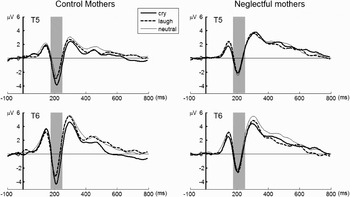
As expected, both groups exhibited the early N170 component with the infant faces as stimuli, in the typical time range and the amplitudes usually obtained in response to adult expressions. N170 amplitudes elicited at T5 and T6 across conditions indicate that the structural characteristics of faces were correctly encoded by all the participants. The N170 component was modulated by the infant emotional expressions in control mothers as shown in Figure 1, depicting the grand average ERPs obtained for control and neglectful mothers at temporal sites. The lines show the ERPs evoked by the three infant expressions: crying, laughing, and neutral. Overall, crying expressions elicited significantly larger negativity than laughing and neutral expressions, F (2, 52) = 3.24, p < .05. However, this emotional modulation differed for neglectful and control mothers, as expected. There was a significant Group × Infant Expression interaction, F (2, 52) = 3.58, p < .05, ɛ = 0.93. Planned comparisons demonstrated that in control mothers, the amplitude of the N170 component was significantly higher for crying faces than for laughing faces, F (1, 13) = 9.16, p < .01, and neutral faces, F (1, 13) = 10.5, p < .01, whereas laughing faces did not significantly differ from neutral faces. By contrast, the three experimental conditions did not significantly differ in neglectful mothers.
Grand-averaged event-related potential waveforms of control and neglectful mothers while viewing crying, laughing, and neutral infant expressions. Left and right sensors were selected for representing the face-specific negative 170 ms (N170) component over the temporal sites (T5 and T6). As highlighted by the gray-shaded area, differences between crying and laughing/neutral faces in a time window from 170 to 250 ms were more pronounced in control mothers than in neglectful mothers.

P200 component
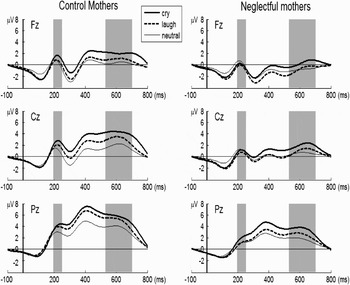
The positive P200 obtained in response to infant faces at centroparietal sensors was similar to that obtained in response to adult faces. As expected, this component was modulated by the infant emotional expressions. Figure 2 displays the grand average ERPs obtained for control and neglectful mothers to infant stimuli across the midline sites. A significant main effect was detected for Infant Expression, F (2, 52) = 4.34, p < .01. Crying expressions prompted the greatest positivity, significantly higher than neutral expressions in both groups, F (1, 27) = 7.86, p < .05, whereas there was no significant difference between crying versus laughing faces and laughing versus neutral faces.
Grand-averaged event-related potential waveforms of control and neglectful mothers while viewing crying, laughing, and neutral infant expressions. Midline electrodes Fz, Cz, and Pz were selected for representing the positive 200 ms (P200) and the late positive potential (LPP) components. As highlighted by the gray-shaded area, the P200 was more pronounced in a time window from 200 to 250 ms in Cz and Pz for infant crying than for neutral faces in both groups. LPP was more pronounced in a time window from 530 to 700 ms in Fz, Cz, and Pz for infant crying than for neutral faces in both groups. Attenuation in the LPP was observed in the neglectful group.

The overall waveform significantly changed by regions, F (2, 52) = 6.76, p < .01, ɛ = 0.59. Increased P200 was observed in central versus frontal sensors, F (1, 27) = 6.82, p < .05; and in parietal versus frontal sensors, F (1, 27) = 7.52, p < .05. However, the general pattern of infant expressions did not change across sensors, as no significant Region × Infant Expression interaction was found. Neither a significant main effect of laterality, nor the significant interactions of laterality by group or by infant expression were found.
LPP
The ERPs associated with all infant faces showed an enhanced positivity at frontocentroparietal sensors, even before 400 ms (see Figure 2). LPP was modulated by the infant emotional expressions for both groups, as indicated by a significant main effect for infant expression, F (2, 52) = 9.92, p < .001. Crying expressions prompted the greatest positivity, significantly higher than neutral expressions in both groups, F (1, 27) = 17.43, p < .001, whereas there was no significant difference between crying versus laughing faces and laughing versus neutral faces. However, the waveform for the neglectful mothers appeared attenuated in amplitude across the three infant expressions with respect to that of the control mothers, as indicated by a significant main effect of group, F (1, 26) = 8.1, p < .01.
The waveform for both groups of mothers significantly changed between the frontal, central and parietal regions, as indicated by a significant main effect of region, F (2, 52) = 60.27, p < .001, ɛ = 0.59. The largest positivity was observed at the parietal region, followed by the central region, with the lowest positivity observed at the frontal region. All region comparisons were significant: central/frontal, F (1, 27) = 42.60, p < .001; parietal/frontal, F (1, 27) = 66.29, p < .001; and parietal/central, F (1, 27) = 65.61, p < .001. The previously described pattern of results by infant expression was consistently found across the different regions, as no significant Region × Infant Expression interaction was obtained. Neither a significant main effect of laterality, nor the significant interactions of laterality by group or by infant expression were found.
Personality data
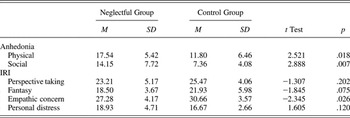
Concerning personality measures, higher self-ratings of anhedonia and lower self-ratings of empathy were expected for the neglectful group compared to the control group. Table 2 shows the means and standard deviations of the personality variables (subscales of IRI and social and physical anhedonia) by group as well as the statistical comparisons. As per our expectations, the neglectful mothers scored significantly higher on physical and social anhedonia and lower on empathic concern compared to the control mothers.
Means, standard deviations, and statistical comparisons of the personality variables according to groups
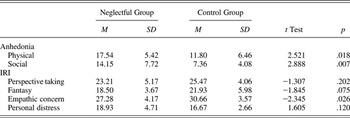
Note: The personality variables were the subscales of anhedonia and the interpersonal reactivity index (IRI).
A discriminant function analysis was carried out to determine the extent to which the personality measures reliably distinguished between the groups. A significant discriminant function was obtained: Wilks Λ = 0.58, χ2 (2) = 13.22, p < .001. The variables that significantly contributed to the classification were social anhedonia (structural coefficient = 0.78), and empathic concern (structural coefficient = −0.75). The function helped to correctly classify 84.6% of the neglectful group and 85.7% of the control group (85.2% of the total sample).
Relations between personality and electrophysiological data
Given that the social anhedonia and empathic concern variables were the only predictors of the mothers' classification, we included them in the regression analyses performed on the overall N170, P200, and LPP amplitudes. We had predicted that the ERPs of high-anhedonic mothers would be attenuated compared to those of low-anhedonic mothers. A similar pattern of results was tentatively predicted for low-empathic mothers. The results for the equations predicting ERP amplitudes were statistically significant for the time window corresponding to LPP, F (2, 24) = 5.87, p < .01; R 2 = .35 (adjusted R 2 = .29). Social anhedonia (β = −0.59, t = −3.4, p < .01) significantly predicted LPP amplitudes, but empathy did not (β = −0.03, t = −0.15, p > .05). The higher the social anhedonia, the lower the LPP amplitude.
Social anhedonia was entered as a covariate in the analyses of covariance. As expected, a substantial proportion of the variability among LPP amplitude between groups was associated with individual differences in anhedonia. When social anhedonia was entered as a covariate, the significant group differences on LPP amplitudes reported above disappeared, F (1, 24) = 1.31, p > .05, and the covariate was significant, F (2, 52) = 9.92, p < .001, ɛ = 0.98. Therefore, the level of social anhedonia helped to explain the overall attenuation observed in the brain potentials of the neglectful group compared to the control group. The Anhedonia × Infant Expression interaction was not obtained, and the covariate itself did not affect the results by infant expression that remained significant, F (2, 52) = 9.92, p < .001, ɛ = 0.98. Therefore, anhedonia effects did not explain the emotional modulation of faces detected in LPP.
Discussion
The present study examines the electrophysiological correlates of maternal processing of crying and laughing infant faces by comparing the brain potentials in neglectful and control mothers who scored differentially in social anhedonia and empathy. This study represents the first investigation of the brain correlates of emotional processing of infant expressions associated with inadequate parenting.
Consistent with our expectations, the three components (N170, P200, and LPP) observed in the maternal responses to infant expressions showed morphology, time windows, amplitudes, and regions of augmented activations that are comparable to the respective ERP patterns obtained in other studies with adult faces (e,g., for N170: Batty & Taylor, Reference Batty and Taylor2003; Leppänen et al., Reference Leppänen, Moulson, Vogel-Farley and Nelson2007; for P200: Carretié et al., Reference Carretié, Mercado, Tapia and Hinojosa2001; Delplanque et al., 2004; Eimer et al., Reference Eimer, Holmes and Mglone2003, Huang & Luo, Reference Huang and Luo2006; for LPP: Eimer & Holmes, Reference Eimer and Holmes2002; Holmes et al., Reference Holmes, Vuilleumier and Eimer2003; Schupp, Öhman, et al., Reference Schupp, Öhman, Junghöfer, Weike, Stockburger and Hamm2004). Because the three potentials tap the respective perceptual, attentive, and sustained/evaluative processes, we were able to explore different stages in the emotional processing of infant faces.
The emotional modulation to the crying faces was found at the three components (N170, P200, and LPP), suggesting that the infant cry has its particular brain features at different stages of emotional processing. These are genuine neural patterns that cannot be confounded with the behavioral pattern obtained in the concurrent categorization task, because no sign of bias toward the cry stimuli was observed at this behavioral level. All mothers were able to accurately recognize both emotional expressions and reacted more rapidly to emotional than to neutral stimuli. Next, we discuss in detail this modulation effect for each brain potential and whether they show group differences.
In control mothers, the ERP evidence of early emotional differentiation was manifested as increased mean amplitude of the N170 in reaction to the infant crying faces compared to the laughing and neutral faces, indicating a strong pattern of emotional modulation. However, some trivial interpretations of this effect should be ruled out. First, the selective N170 enhancement only for crying and not for laughing faces cannot be attributable to any bias in the experimental instructions, which asked for a three-choice classification with no emphasis on any particular emotional category. Second, the impact of the mothers' particular emotional experience with their infants was minimized by the fact that mothers responded to crying faces from infants other than their own. Therefore, the preferential processing of crying faces is probably based on its highly adaptive value for infant survival, sharing status, in this sense, with fearful and threatening stimuli in adults and infants (e.g., Batty & Taylor, Reference Batty and Taylor2003; Leppänen et al., Reference Leppänen, Moulson, Vogel-Farley and Nelson2007; Schupp, Öhman, et al., Reference Schupp, Öhman, Junghöfer, Weike, Stockburger and Hamm2004) and angry faces in maltreated children (Pollak et al., Reference Pollak, Cicchetti, Hornung and Reed2000). This effect should not be interpreted as a genuine valence effect (e.g., negativity bias), as arousal effects might also be involved. Nevertheless, what is clear is that in control mothers, the infant crying faces elicit a more differentiated ERP response than the infant laughing faces, which is compatible with the survival hypothesis.
In contrast to control mothers, the N170 component in neglectful mothers showed no sign of early modulation to emotional stimuli. As predicted, neglectful mothers fail to show differentiated processing of the infant cry at early stages of perceptual encoding. A similar lack of differentiation between crying and laughing was found in the physiological response of abusive mothers (Frody & Lamb, Reference Frody and Lamb1980). In that study, the abusers responded to the smile with no change or decline in the physiological arousal as was the case in controls. They appeared to find any infant elicitation (smiling or crying) aversive. A further study involving neglectful mothers reported less ability to habituate to a stressful auditory stimulus (a noxious tone) and a lower level of autonomic reactivity (skin conductance) to the infant cries than physically abusive mothers, although they rated infant cries as more irritating and demanding than the abusers and controls (Friedrich et al., Reference Friedrich, Tyler and Clark1985). The lack of early differentiation among infant signals may stem from a reduced reward value of social stimuli, such as infant faces, that may lead to a poor social engagement with the child. Face-recognition impairment in the differential ERPs (N170) to normal and altered faces has been found in individuals with autism and in relatives (Dawson et al., Reference Dawson, Webb, Wijsman, Schellenberg, Estes and Munson2005). In that study, it was hypothesized that the lack of emotional tagging of socially relevant stimuli indicates a dysfunction of the dopamine reward system. If a similar dopamine deficit occurs in neglectful mothers, then the infant cry would probably not trigger the appetitive system, which facilitates the urgent and prominent maternal responses to the child's needs.
Recent functional neuroimaging studies indicate that the precognitive processing of emotionally significant stimuli is linked to subcortical structures like the amygdala, which is part of the reward circuitry (Vuillimier & Pourtois, Reference Vuilleumier and Pourtois2007). Parents showed more activation toward infant crying than toward laughing in the right amygdala, whereas the nonparents' response was greater for infant laughing than for crying (Seifritz et al., Reference Seifritz, Esposito, Neuhoff, Luthi, Mustovic and Dammann2003). In light of these results, one possibility is that a differential activation of the amygdala by an infant cry might be crucial for enabling healthy parents to respond as early as possible to their child's displays of emotions. Our findings, showing differentiated ERPs in control mothers only are compatible with this possibility. Further neuroimaging research contrasting the neglectful and control groups is needed to test this hypothesis.
In terms of the P200, our expectation was that the amplitude of this attention-related brain activity would support the involvement of attention to cry stimuli. Results showed increased P200 amplitudes, mostly over centroparietal sensors, to a greater extent for cry stimuli than for neutral stimuli in both groups of mothers. There was no distinction between cry and laugh stimuli, indicating that the pattern of emotional differentiation obtained in the P200 is weaker than the one obtained in the N170 component. The P200 reflects input processing-related attention toward stimuli of intrinsic relevance (Carretié et al., Reference Carretié, Mercado, Tapia and Hinojosa2001). Therefore, higher amplitudes for crying in this potential indicate that emotional processes regulate the allocation of attention by highlighting the most relevant stimuli. The processing of infant crying as a cue of a possible danger occupies more attentional resources than the processing of neutral faces, receiving some kind of preferential treatment during the early stages of processing (Huang & Luo, Reference Huang and Luo2006).
Augmented amplitudes in LPP over frontocentroparietal sensors in response to crying versus neutral faces were also obtained in both mothers (no significant differences were obtained for laughing faces). The LPP is believed to reflect the operation of controlled processes, beyond more basic automatic ones (Schupp, Junghöfer, et al., Reference Schupp, Junghöfer, Weike and Hamm2004). It is also thought to index initial semantic categorization (Codispoti et al., Reference Codispoti, Ferrari and Bradley2007) and initial memory storage events, which allow for the representation of stimuli in working memory (Azizian & Polish, Reference Azizian and Polich2007). Thus, these findings suggest that, because of its motivational significance, infant crying is selected by the brain for sustained processing, which probably results in a more elaborated or evaluative stimulus analysis (Cuthbert et al., Reference Cuthbert, Schupp, Bradley, Birbaumer and Lang2000; Lang, Bradley, & Cuthbert, Reference Lang, Bradley, Cuthbert, Lang, Simons and Balaban1997). However, there was an overall attenuation of the LPP to infant stimuli in the neglectful mothers. Therefore, it is likely that the representations activated by the emotional infant stimuli were less actively categorized, updated, and integrated into memory in the neglectful mothers compared to the control mothers. This may indicate that the integration of relevant information with extant knowledge structures (schemas or internal working models) would be less efficiently performed in that group. Research into the cognitive capacities of neglectful mothers showed that they are less skillful in forming their own cognitive schemas about child development and education (Rodriguez, Rodrigo, Janssens, & Triana, in press) as well as in accessing others' views (Crittenden et al., Reference Crittenden, Lang, Claussen, Partridge, Crittenden and Claussen2000).
Anhedonia and empathy have emerged as two candidates for exploring the personality correlates of insensitive responding in neglectful mothers. Neglectful mothers scored higher on physical and social anhedonia and lower on emphatic concern than control mothers. Thus, the neglectful mothers' lack of perspective-taking abilities is restricted to the emotional aspects of child understanding (Crittenden et al., Reference Crittenden, Lang, Claussen, Partridge, Crittenden and Claussen2000; Shipman et al., Reference Shipman, Edwards, Brown, Swisher and Jennings2005). Moreover, social anhedonia and empathic concern were the two most important variables in the discriminant procedures. In a naturalistic study with healthy undergraduates, higher levels of social anhedonia were associated with increased times spent alone and lower positive affect (Brown, Silvia, Myin-Germeys, & Kwapil, Reference Brown, Silvia, Myin-Germeys and & Kwapil2007), indicating a diminished approach drive. In a recent naturalistic study in schizophrenic patients, higher social anhedonia was linked to reduced anticipatory pleasure but not to consummatory pleasure (Gard, Kring, Gard, Horan, & Green, Reference Gard, Kring, Gard, Horan and Green2007), indicating a difficulty to foresee positive rewarding in social situations. Thus, it is likely that the lack of reward from social contact, low expectations of pleasurable social events, and low affective empathy may combine to produce disinterest and disengagement in mother–infant interactions in neglectful mothers. These results are of particular importance, because both groups in our study were very similar sociodemographically, were drawn from the same socially deprived population and had experience with a child under 5 years of age; however, the interpretation and generalizability of these findings are limited because of the small sample size.
In our study, social anhedonia was the only personality variable that was related to ERP patterns. Specifically, higher scores in anhedonia were associated with attenuated amplitudes of the late ERP component, replicating and extending previous findings obtained in healthy (Franken et al., Reference Franken, Van Strien and Nijs2006; Miller et al., Reference Miller, Simons and Lang1984) and unhealthy populations (e.g., Mathalon et al., Reference Mathalon, Ford, Rosenbloom and Pfefferbaum2000; Röschke & Wagner, Reference Röschke and Wagner2003) with nonemotional stimuli. None of our mothers had comorbid mental health problems, adding converging evidence that ERP attenuation is not only specific to patient groups. Social anhedonia was related to the attenuation observed in the LPP in the neglectful group, because group differences disappeared when significant anhedonia effects were partialled out. The anhedonic effect was obtained for the overall amplitude to infant stimuli and not for the modulation to infant crying, probably indicating a general feature of the late information processing of infant signals in neglectful mothers. Given that attenuation may reflect a less elaborated processing of infant stimuli in accordance with the social anhedonic tone, it is likely that negligent mothers would be less able to give sensible interpretations to the infant displays of emotions in terms of the expression of needs to be fulfilled during social routines (e.g., “my baby is crying because she is hungry” or “he is smiling at me because he does not want to be alone”). Therefore, the higher the disinterest and disengagement in social interactions a mother may show, the less she would be able to attend the infant signals by engaging in social routines with her infant. Observational studies have shown that neglectful mothers are less skillful than physically abusive mothers at handling goal-specific tasks with their children in structured social situations (Gaudin, Polansky, Kilpatrick & Shilton, Reference Gaudin, Polansky, Kilpatrick and Shilton1996).
What could be the consequences of our results on mother–child interactions in neglectful dyads? Because of the poor early differentiation of the cry signal and to the later attenuated ERP activation to infant signals, neglectful mothers may show less emotional expression and little exchange of emotional information, as has been shown in observational studies (Gaudin et al., Reference Gaudin, Polansky, Kilpatrick and Shilton1996). This poor pattern of emotional expression may be imitated by neglected children, because infants tend to match caregivers' expressions with their own (Termine & Izard, Reference Termine and Izard1988). Therefore, our results suggest that the poor differentiation of emotional infant signals in the mothers' brain would underlie neglected children's greater difficulties in accurately discriminating adult emotional expressions compared to physically abused or nonmaltreated children (Pollak et al., Reference Pollak, Cicchetti, Hornung and Reed2000). In other words, a cycle of emotional hypoactivation might be at work in these neglectful dyads as a consequence of the poor maternal processing of infant signals. When the range of emotional expressions is so restricted and the risk of a “turning off” or apathy is elevated, the infant can no longer rely on his caregiver's face for social referencing and for information important to survival (Egeland & Erickson, Reference Egeland, Erickson, Brassard, Germain and Hart1987).
Some practical guidelines to breaking down this negative cycle and reducing its impact on child development can be derived from the present study. Sensitive parental response not only requires a proper cognitive set, as suggested by other researchers (Donovan, Leavitt, & Walsh, Reference Donovan, Leavitt and Walsh1997), but also a well-attuned precognitive perceptual set. Exposure of parents to a variety of infant displays of emotions focusing on their acoustical properties as well as the association of infant signals to social behavior and daily social routines are important elements to be combined with the training of more representational matters related to the way parents conceive their relationships with the child (Bakermans-Kranenburg, van IJzendorn, & Juffer, Reference Bakermans-Kranenburg, van IJzendoorn and Juffer2003). Methods to test program effectiveness with neglectful groups may also benefit from using ERP potentials as biomarkers of parental change, in addition to self-report and observational measures.
Conclusion
In conclusion, this study reveals some neurological and personality factors associated with neglectful mothers' insensitive responding to infant displays. These factors might be one part of the caregiver's ability to be attuned to the infant's needs, which is crucial for healthy development. What is not yet clear in this study is the extent to which these brain correlates of emotional face processing are specific to infant stimuli, or if they can also be observed with respect to other emotional, less socially relevant stimuli. In other words, is the insensitivity of neglectful mothers selective to infant crying, or is it also observed in response to other types of emotional stimulation? Future research using noninfant pleasant and unpleasant stimuli with similar group design may help to answer this important question. In addition, more research is needed to know whether the brain signatures obtained in our study were only typical of mothers showing severe forms of negligence and with a history of maltreatment. The role of empathy in the processing of infant signals also merits further attention. Although much remains to be done, we hope that this study may significantly contribute to the development of a new approach to neurological research applied to the domain of parenting and, in particular, to the study of problematic parenting.